
 Medical Molds
 Packaging Molds
 Personal Care Molds
 Electronic Molds
 Automotive Molds
 Home Appliance Molds
 Special Molds
 Design & Engineering
 Production & Manufacturing
 Global Presence
 Business Scope
 Component Solutions
 Product Assembly
 Quality Management
 Medical Device Manufacturing



125A 280A 350A PA66+GF25 High-Voltage Connector
FEATURES
- muted=false"> muted=false">
Core technical characteristics:
Thermal management: PA66+GF25 maintains structural integrity under continuous operating temperatures of 120–150°C, with short-term excursions beyond 180°C.
Dielectric strength: The glass-fiber reinforcement improves dielectric breakdown resistance while the polymer matrix provides the necessary insulation.
Dimensional stability: The 25% glass loading reduces shrinkage variation and warpage compared to lower reinforcement ratios, critical for connector housings that must maintain sealing integrity and terminal alignment.
Metal-plastic interface: The connector is typically an insert-molded assembly, where metal busbars or terminals are encapsulated by the PA66+GF25 housing. The quality of this interface determines sealing performance and long-term reliability.
-
Mold Description
Product Materials:
PA66+GF25
Mold Material:
S136ESR
Number of Cavities:
2+2
Glue Feeding Method:
Hot runner
Cooling Method:
Water cooling
Molding Cycle
42.5s
- The mold manufacturing process and product material selection
The Manufacturing Challenge: Why These Connectors Are Difficult
High-voltage connectors are not conventional injection-molded parts. They pose a specific set of manufacturing challenges that separate capable suppliers from commodity molders.
Challenge 1: Uneven wall thickness. The connector geometry is dictated by electrical requirements, not molding best practices. Thick sections for structural rigidity coexist with thin walls for space efficiency, creating differential cooling rates that drive warpage and sink marks.
Challenge 2: Metal inserts. The housing encapsulates copper busbars or terminals. The metal-plastic interface is the most failure-prone zone. Poor bonding, stress concentration, or differential thermal expansion can create leak paths that compromise the high-voltage insulation system.
Challenge 3: Glass fiber orientation. PA66+GF25 behaves differently from unfilled polymers. Glass fibers orient during flow, creating anisotropic mechanical properties and unpredictable warpage patterns. Weld lines become structural weak points rather than merely cosmetic defects.
Challenge 4: Dimensional tolerance stack-up. Connector assemblies require precise fit between mating halves. A housing that warps beyond specification creates insertion force problems, sealing failures, or terminal misalignment.
-
Ansix Tech's Hard Power Foundation: Equipment and Capability
3.1 Mold Machining Precision
Ansix Tech's mold fabrication capabilities directly determine the quality ceiling of the final connector. The company operates multiple five-axis high-speed machining centers achieving contour accuracy of ±0.002 mm on complex freeform surfaces. For connector molds with intricate core-back mechanisms, sliders, and lifters, this precision eliminates the need for manual polishing passes that introduce inconsistency across cavities.
Slow-wire EDM systems achieve positioning accuracy of ±0.003 mm and can machine features as small as 0.03 mm in diameter. This capability is essential for the fine gate details and venting features that control glass-fiber flow and weld line location.
3.2 Injection Molding Fleet
Ansix Tech operates 260 injection molding machines with clamping forces from 30 to 2,800 tons, sourced from Fanuc, Engel, and Arburg. All-electric machines on presses ≤650 tons provide shot-to-shot repeatability of ±0.1%, a critical parameter for connectors where packing pressure variation directly affects terminal retention force and seal integrity.
The scale matters for customer risk mitigation. A supplier with 260 machines can absorb demand fluctuations, accommodate parallel mold trials, and avoid the production bottlenecks that plague smaller operations.
3.3 Quality Metrology
Coordinate Measuring Machines provide dimensional accuracy of ±0.001 mm, enabling full-dimensional verification of every production mold before release. Key Characteristic CPK values are computed and reported. The stated commitment is explicit: CPK ≥ 1.33 is guaranteed before production release, no exceptions.
This is not marketing language. CPK ≥ 1.33 corresponds to a process capability where fewer than 0.006% of parts fall outside specification limits under stable production conditions. For connector housings where dimensional deviations translate directly into assembly failures or field returns, this statistical proof is the difference between a supplier relationship and a partnership.
4. From Design to Production: Ansix Tech's Service Framework
4.1 DFM Analysis: Predicting Problems Before Steel Is Cut
The DFM (Design for Manufacturability) report is the first substantive deliverable Ansix Tech provides. The engineering team—averaging over 12 years of experience—analyzes part geometry for uniform wall thickness, adequate draft angles, and potential stress concentrations.
The critical insight: design changes identified before steel is cut cost nothing. The same changes after mold completion typically add 15–30% to project cost. Ansix Tech's DFM process exists to shift problem discovery to the cheapest possible stage.
4.2 Moldflow Simulation: Digital Validation Before Physical Trials
Moldflow analysis for PA66+GF25 connectors requires full 3D mesh simulation, not the double-layer approach that works for unfilled polymers. The glass fibers, metal inserts, and uneven wall thickness make simplified mesh types unreliable.
Ansix Tech's simulation protocol addresses the specific failure modes of connector molding:
Weld line prediction: Identifying where flow fronts converge and ensuring these locations fall in non-critical structural zones.
Air trap detection: Anticipating where air will be trapped during filling so venting can be designed into the mold rather than patched after T0.
Warpage analysis: Predicting dimensional deviation across the full cooling cycle, not just at room temperature.
Metal insert interaction: Simulating the heat transfer between the metal busbar and the polymer melt to predict bonding quality and cycle time impact.
The stated outcome: physical mold trials reduced from industry-typical 5–8 iterations to 2–3 iterations. Each eliminated trial cycle saves 1–2 weeks of schedule and the associated machining, assembly, and trial costs.
4.3 Conformal Cooling: The Cycle Time Lever
Cooling accounts for 60–85% of total injection molding cycle time. Ansix Tech implements conformal cooling channels—3D-printed water lines that follow the cavity contour rather than following straight drilled paths—to achieve uniform heat removal.
The documented results: cycle time reduction of 20–30%, improved dimensional stability on thin-wall sections, and reduced residual stress in molded parts. For a connector program running 500,000 units per year, a 25% cycle time reduction on a 30-second cycle represents approximately 1,041 additional production hours annually—capacity that would otherwise require additional machine capital.
4.4 NPI Process: Structured Validation from T0 to Production
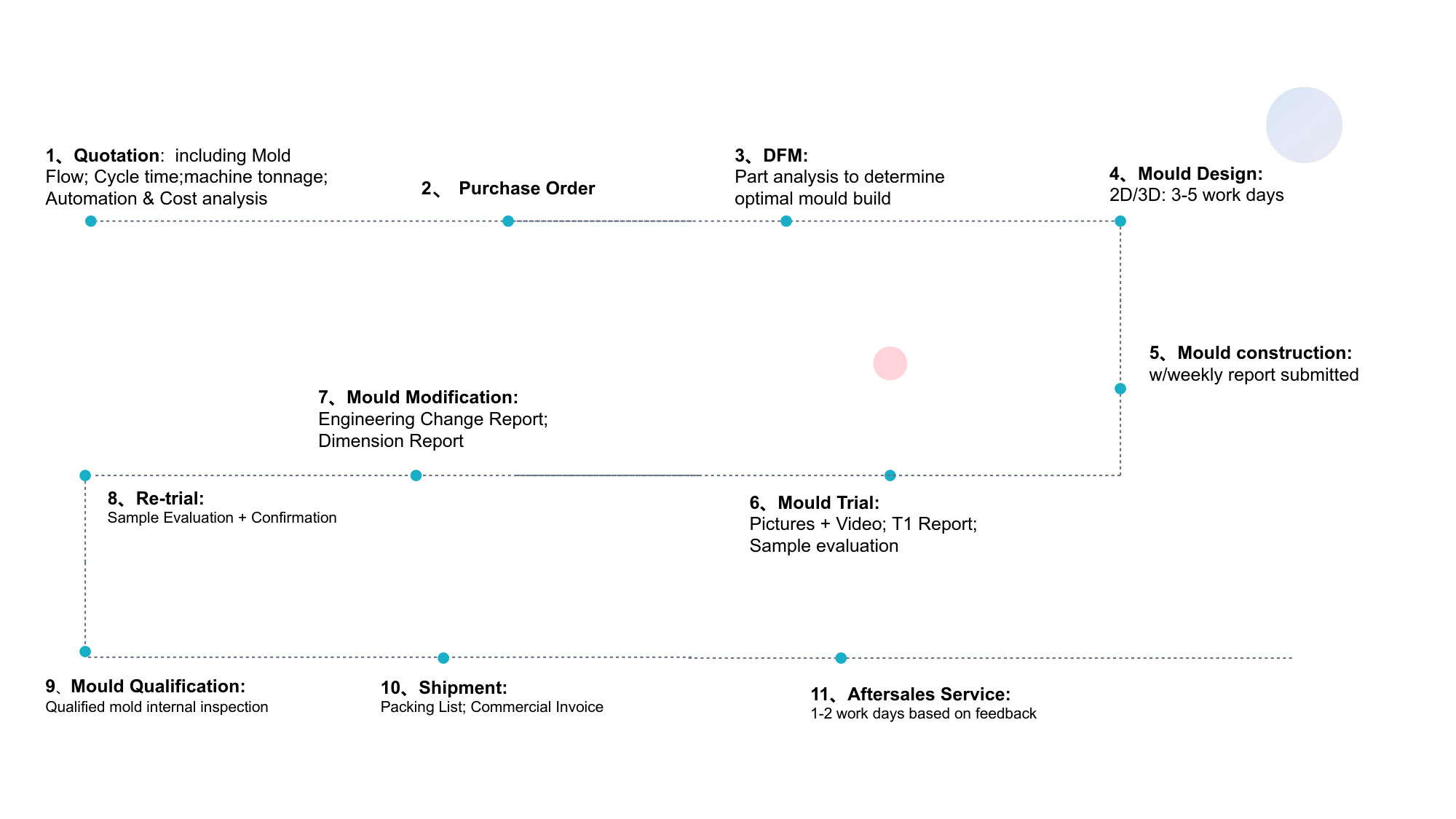
Ansix Tech follows a staged trial protocol that moves from basic functionality verification to full production certification:
Stage Objective Deliverable
T0 Mold function, basic fill 10–20 samples, visual inspection
T1 Gate balance, venting optimization 100 parts + dimensional report
T2 Process window finalization 200 parts + CPK analysis + gate freeze study
T3 Production qualification IQ/OQ/PQ validation report + retained samples
This structured approach means that by the time production begins, the process window is not theoretical—it has been proven across hundreds of cycles under actual manufacturing conditions.
4.5 Process Control: MES-Integrated Manufacturing
Every injection molding machine at Ansix Tech is networked to a Manufacturing Execution System that locks critical process parameters: melt temperature, packing pressure, injection velocity, and cycle time. Only authorized process engineers can modify settings, and every change is logged with operator ID, timestamp, and verification evidence.
The customer-facing benefit: if an audit asks for the exact melt temperature at 3:47 PM on a specific date for a specific part number, the data is retrievable. For automotive and energy customers facing traceability requirements, this is not optional.
5. Material Strategy: Why PA66+GF25 and How Ansix Optimizes It
PA66+GF25 is the specified material for this connector family, but "PA66+GF25" is a formulation family, not a single grade. Glass content, coupling agents, heat stabilizers, and flame retardants vary across suppliers and formulations, producing measurably different processing behavior and final part properties.
Ansix Tech's material strategy operates on three levels:
Level 1: Grade selection. The engineering team evaluates specific PA66+GF25 grades against the connector's requirements: tensile strength, flexural modulus, HDT (heat deflection temperature), dielectric strength, and processing window. The goal is not the highest-performing grade available but the grade that delivers required performance at optimal total cost.
Level 2: Multi-source qualification. For high-volume programs, qualifying materials from multiple suppliers provides supply chain flexibility without requalification costs. This reduces the risk of single-source material disruptions and enables price optimization.
Level 3: Process adaptation. Glass-filled nylons exhibit different shear-thinning behavior than unfilled polymers. The filling profile must account for fiber orientation effects on flow resistance. Packing pressure must be tuned to compensate for the higher shrinkage anisotropy. Ansix Tech's process engineers develop the specific window for each material lot and connector geometry.
6. Cost Control: Where the Savings Actually Come From
Cost reduction in high-voltage connector manufacturing is not about finding cheaper labor or using lower-grade materials. It is about engineering efficiency into every stage of the production lifecycle.
Cycle time reduction is the largest single lever. At 60–85% of cycle time attributable to cooling, conformal cooling that reduces cooling time by 30% translates directly to throughput. A 30-second cycle reduced to 22 seconds produces 36% more parts per machine-hour without capital expenditure.
Material consumption reduction. Hot runner systems eliminate cold runner waste, reducing material consumption by 15–25% compared to cold runner configurations. For PA66+GF25 at premium pricing, this is a significant per-part cost reduction. Wall thickness optimization through DFM eliminates excess material where structural requirements do not demand it.
Scrap rate reduction. Closed-loop process control with real-time parameter monitoring targets scrap rates below 1.5%. In glass-filled nylon connector molding, where warpage and short shots are common failure modes, the difference between 2% and 5% scrap is a 3% direct material cost swing—before considering the labor and machine time embedded in scrapped parts.
Consolidated supply chain. By integrating mold manufacturing, injection molding, assembly, and logistics under one organization, Ansix Tech eliminates the coordination overhead, inter-supplier quality variability, and inventory carrying costs of fragmented supply chains. The stated total cost reduction from consolidation: 15–25% compared to multi-vendor models.
7. Delivery and Logistics: Speed as a Risk Mitigation Tool
Lead time variability is a hidden cost. A supplier who delivers "in 6–8 weeks" forces the customer to carry safety stock, buffer schedules, and manage uncertainty. Ansix Tech's delivery framework reduces this friction through defined lead times and expedited options:
DFM report: 3–5 business days standard, 2–3 days expedited
Simple mold: 10 days standard, 7 days expedited
Medium-complexity mold: 25–45 days standard, 20 days expedited
Mold repair: 24 hours standard, 8 hours emergency
For connector programs where a mold repair shutdown halts production, the 24-hour standard repair turnaround—enabled by in-house electrode manufacturing and EDM capability—is a direct production continuity insurance policy.
Packaging design receives specific attention for high-voltage connectors. Anti-static packaging prevents electrostatic discharge damage. Individual cavity separation prevents surface abrasion on critical sealing surfaces. Moisture barrier bags with desiccant maintain dryness for hygroscopic PA66 during shipping and storage.
8. After-Sales Quality Assurance: What Happens After the Parts Ship
Quality assurance does not end at the loading dock. Ansix Tech's after-sales framework includes:
Retained sample management. Production batches are accompanied by retained samples stored under matched conditions, enabling traceability and comparison if field issues arise.
Real-time production visibility. Customers receive access to production status, quality metrics, and shipment tracking through a customer portal.
Mold maintenance and lifecycle support. Production molds are maintained on a scheduled basis, with wear-part replacement before degradation affects part quality. The objective is to maintain the validated process window for the life of the program, not just through initial production.
Continuous improvement feedback. Field performance data and production data feed back into process refinement. A connector that passes initial qualification but exhibits a slow drift in terminal retention force over 100,000 cycles provides data for process adjustment before the drift reaches specification limits.
9. The Competitive Position: Why Ansix Tech Wins Programs
The high-voltage connector manufacturing market has capable competitors. What separates Ansix Tech is not a single capability but the integration of capabilities across the value chain.
A customer evaluating suppliers faces a fundamental trade-off: a mold shop that makes excellent molds but cannot scale production; a molder with capacity but limited engineering depth; a low-cost supplier whose process capability is unproven at volume.
Ansix Tech compresses this trade-off by integrating mold design, DFM, Moldflow simulation, mold manufacturing, injection molding, quality validation, and logistics under one organization. The customer has one point of accountability for the entire production chain.
The measurable outcomes of this integration:
15–25% total cost reduction compared to fragmented supply chain models
70% reduction in physical prototype cycles through simulation-led design validation
20–30% cycle time reduction through conformal cooling and process optimization
CPK ≥ 1.33 guaranteed before production release
24-hour standard mold repair turnaround
For a customer launching a 125A / 280A / 350A connector program, these numbers translate into a specific business case: faster time to market, lower total cost of ownership, and reduced risk of production disruptions or field failures.
The 125A / 280A / 350A PA66+GF25 high-voltage connector is a demanding product to manufacture. It requires material science knowledge, mold engineering precision, process control discipline, and production scale. Ansix Tech's position in the industry rests on the integration of these capabilities into a single accountable manufacturing partnership.
Ansix Tech Co Ltd
If you have any plans related to 125A 280A 350A PA66+GF25 High-Voltage Connector , you can contact us at any time. We will turn your ideas into reality, let you realize your dreams, and obtain large orders from the market. Our contact information is info@ansixtech.com. Or contact our CTO, mail: stephen@ansixtech.com
#www.ansixtech.com #ansixtech.com #125A 280A 350A PA66+GF25 High-Voltage Connector #125A 280A 350A PA66+GF25 High-Voltage Connector #125A 280A 350A PA66+GF25 High-Voltage Connector Mold injection mold companies #Ansix #Ansix moulds #Ansix china #Ansix tech china #Ansix tech company #Ansix facotry #125A 280A 350A PA66+GF25 High-Voltage Connector injection molding #125A 280A 350A PA66+GF25 High-Voltage Connector injection tools #125A 280A 350A PA66+GF25 High-Voltage Connector injection moulds #125A 280A 350A PA66+GF25 High-Voltage Connector plastic mould #125A 280A 350A PA66+GF25 High-Voltage Connector plastic tools #Ansix Tech #Ansix molds #Ansix injection molding #Ansix mold factory #125A 280A 350A PA66+GF25 High-Voltage Connector injection molding Customized #Ansix mold factory #125A 280A 350A PA66+GF25 High-Voltage Connector china #125A 280A 350A PA66+GF25 High-Voltage Connector molds #injection factory for 125A 280A 350A PA66+GF25 High-Voltage Connector #125A 280A 350A PA66+GF25 High-Voltage Connector injection molding #125A 280A 350A PA66+GF25 High-Voltage Connector injection molding factory #injection molding company #125A 280A 350A PA66+GF25 High-Voltage Connector injection mold companies #125A 280A 350A PA66+GF25 High-Voltage Connector Tooling #125A 280A 350A PA66+GF25 High-Voltage Connector mold limited #Ansix mold china #Ansix companies for 125A 280A 350A PA66+GF25 High-Voltage Connector #Ansix company China #125A 280A 350A PA66+GF25 High-Voltage Connector facotry #Ansix Tech #Ansix Tech mould #125A 280A 350A PA66+GF25 High-Voltage Connector injection moulding #125A 280A 350A PA66+GF25 High-Voltage Connector injection moulding company #Ansix 125A 280A 350A PA66+GF25 High-Voltage Connector parts injection mold companies #125A 280A 350A PA66+GF25 High-Voltage Connector injection molding companies china #125A 280A 350A PA66+GF25 High-Voltage Connector china factory #Ansix moulding companies #Ansix molding company #125A 280A 350A PA66+GF25 High-Voltage Connector injection moulding facotry #Ansix Tech mold #125A 280A 350A PA66+GF25 High-Voltage Connector mould #125A 280A 350A PA66+GF25 High-Voltage Connector plastic injection molding #ansix plastic mold #125A 280A 350A PA66+GF25 High-Voltage Connector Mold manufacturing #125A 280A 350A PA66+GF25 High-Voltage Connector parts manufacturing #125A 280A 350A PA66+GF25 High-Voltage Connector plastic parts factory #125A 280A 350A PA66+GF25 High-Voltage Connector injection parts mold #125A 280A 350A PA66+GF25 High-Voltage Connector PRECISION MANUFACTURING #125A 280A 350A PA66+GF25 High-Voltage Connector TOOL #China 125A 280A 350A PA66+GF25 High-Voltage Connector mold #125A 280A 350A PA66+GF25 High-Voltage Connector injection moulding china #125A 280A 350A PA66+GF25 High-Voltage Connector mould china #china precision mold #125A 280A 350A PA66+GF25 High-Voltage Connector mold in china #125A 280A 350A PA66+GF25 High-Voltage Connector mold china #125A 280A 350A PA66+GF25 High-Voltage Connector Precision molds #High-precision molds #125A 280A 350A PA66+GF25 High-Voltage Connector High-precision tool #Injection molds #125A 280A 350A PA66+GF25 High-Voltage ConnectorFactory #125A 280A 350A PA66+GF25 High-Voltage ConnectorCompany #Super Large Injection Mold Factory #Large Tonnage Injection Molding Factory #125A 280A 350A PA66+GF25 High-Voltage ConnectorCompany #125A 280A 350A PA66+GF25 High-Voltage ConnectorFactory #2800T Injection Molding Factory #3000 Ton Injection Molding #4500 Ton Injection Molding Factory #125A 280A 350A PA66+GF25 High-Voltage Connector Large Mold Injection Molding #Large Plastic Mold Injection Molding Factory #125A 280A 350A PA66+GF25 High-Voltage Connector Large Injection Mold Manufacturer #125A 280A 350A PA66+GF25 High-Voltage Connector Plastic Mold Factory #Injection Mold #Plastic Mold