
 Medical Molds
 Packaging Molds
 Personal Care Molds
 Electronic Molds
 Automotive Molds
 Home Appliance Molds
 Special Molds
 Design & Engineering
 Production & Manufacturing
 Global Presence
 Business Scope
 Component Solutions
 Product Assembly
 Quality Management
 Medical Device Manufacturing



12F-Non-standard Ferrules(6*6.4*1.50mm)
FEATURES
The Foundation of Trust—Hard Capabilities That Deliver Customer Value
1.1 Why the 12F Non-Standard Ferrule (66.41.50mm) Demands a Different Kind of Manufacturer
The 12F Non-Standard Ferrule is not a commodity component. With fiber hole diameters typically specified at 125.2 +1/-0 µm and eccentricity requirements of ≤0.7 µm for low-loss applications, this part operates at the absolute limit of injection molding capability. For customers, the implications are stark: a ferrule that is 0.5 µm out of specification can cause unacceptable insertion loss in a data center connector, leading to field failures, costly recalls, and reputational damage.
This is why customers do not simply buy ferrules—they buy risk mitigation. They need a manufacturing partner who understands that the difference between success and failure is measured in microns, and who has built an entire infrastructure around controlling those microns.
-
Mold Description
Product Materials:
PPS
Mold Material:
S136ESR
Number of Cavities:
1
Glue Feeding Method:
Hot runner
Cooling Method:
Water cooling
Molding Cycle
20.5s
- The mold manufacturing process and product material selection
Equipment Infrastructure: What It Means for the Customer
Ansix’s mold manufacturing capability is built on equipment selected not for prestige, but for the specific challenge of producing 12F ferrule tooling that can run reliably for millions of cycles. The company operates high-speed five-axis machining centers capable of achieving 0.002mm precision on complex curved surfaces. For the customer, this translates directly into a mold with smooth, burr-free parting lines—eliminating a common source of flash that would otherwise require secondary deflashing operations, adding cost and introducing the risk of fiber hole contamination.
The company’s slow-wire EDM capability, capable of cutting 0.03mm micro-slots and narrow features, is essential for the delicate core pins that form the ferrule’s fiber holes. A poorly machined pin produces a poorly molded hole—and a poorly molded hole means a ferrule that cannot meet insertion loss requirements. By maintaining this capability in-house, Ansix eliminates the communication gaps and quality inconsistencies that plague customers who source mold components from multiple vendors.
1.3 The Four-Base Advantage: Supply Chain Resilience as Customer Value
With four production bases across China and Vietnam, Ansix offers customers something that single-location manufacturers cannot: geographic flexibility in the face of uncertainty. For customers exporting to North America or Europe, the Vietnam facility provides tariff optimization and supply chain diversification. For customers requiring access to the deep precision machining supply chain of the Pearl River Delta, the China facilities deliver unmatched component sourcing depth.
But the value extends beyond tariffs. When a customer faces an unexpected demand surge, production can be allocated across facilities. When a localized disruption occurs, redundancy prevents line stoppages. In an industry where a single delayed shipment can idle a customer’s connector assembly line, this geographic flexibility is not a luxury—it is insurance.
-
From Concept to Production—The Ansix Integrated Workflow
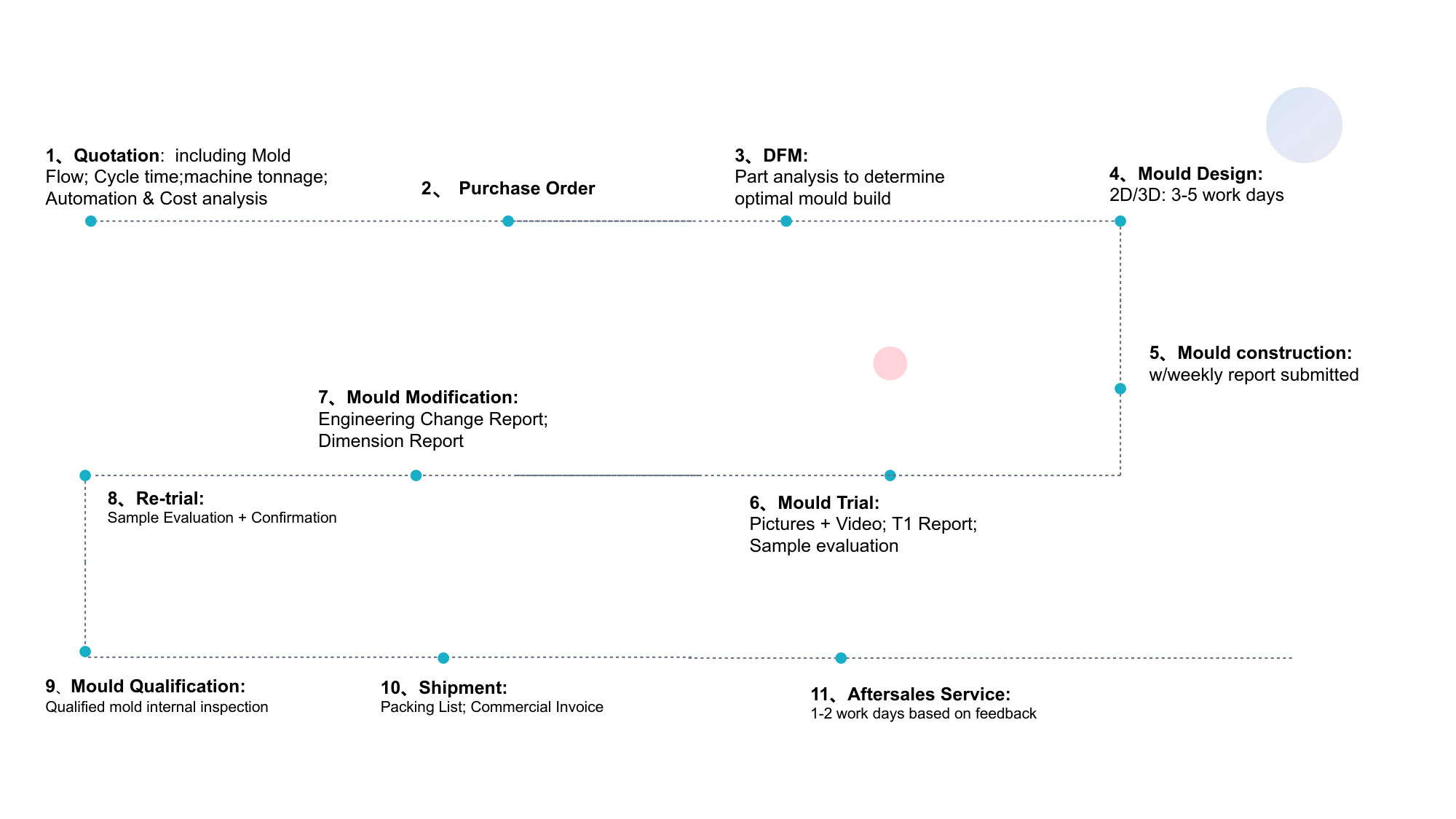
2.1 Product Design and Development: Solving Problems Before They Cost Money
The most expensive mistakes in ferrule manufacturing are made at the design stage. A wall thickness that seems reasonable on a CAD screen may prove impossible to mold with consistent fiber hole concentricity. A gate location that works for a prototype may cause weld lines that degrade optical performance at scale.
Ansix’s design and development service begins with a fundamental principle: the customer’s optical performance requirements dictate the manufacturing strategy. The company’s engineering team works with customers to translate insertion loss and return loss targets into actionable mold design and process specifications. This is not a passive review—it is an active collaboration where Ansix engineers challenge assumptions and propose alternatives that may be more manufacturable without compromising performance.
2.2 DFM: The Discipline That Saves Months and Millions
Design for Manufacturability at Ansix is not a checkbox exercise. For the 12F Non-Standard Ferrule (66.41.50mm), DFM analysis addresses the specific failure modes that make this part difficult:
Fiber hole position sensitivity: The 12 fiber holes must maintain their position relative to the guide pin bores with sub-micron consistency. DFM analysis evaluates how mold design choices—gate location, cooling layout, ejection strategy—affect this critical relationship.
Core pin deflection: The 12 thin pins that form the fiber holes are vulnerable to deflection during injection. Molten polymer flowing around these pins can push them out of position, causing hole misalignment that renders the ferrule unusable. DFM analysis identifies at-risk pins and recommends support structures or process modifications to prevent deflection.
Material-specific behavior: The glass-filled engineering resins used in ferrule production have complex flow characteristics. DFM analysis considers how the specific material grade will behave in the mold, informing gate and runner design.
For the customer, DFM delivers a simple promise: we find the problems before you pay to fix them. A design flaw caught at the DFM stage costs a revision meeting. The same flaw caught after mold manufacturing costs weeks of delay and tens of thousands of dollars in rework.
2.3 Moldflow Analysis: Simulating Before Cutting Steel
Moldflow simulation is where Ansix converts theoretical capability into predictive confidence. By modeling the polymer flow around the core pin array, the company can identify pins at risk of excessive deflection and adjust the support structure or process conditions accordingly. The simulation does not replace physical testing, but it dramatically narrows the design space and reduces the number of mold trials required.
This capability has direct financial implications for customers. Ansix’s average of only two mold trials to reach qualification reflects the effectiveness of this simulation-driven approach. Each avoided mold trial represents savings in time, labor, and machine capacity that would otherwise be passed to the customer.
2.4 Mold Manufacturing: Precision Where It Matters Most
The 12F Non-Standard Ferrule mold is a precision instrument, and its most critical components are the core pins that form the fiber holes. These pins must be manufactured to tolerances measured in fractions of a micron, polished to optical smoothness, and assembled into a mold base that maintains alignment under the pressure and temperature cycling of production.
Ansix’s mold manufacturing process for ferrule tooling includes:
Pin fabrication: Core pins are ground and polished to final geometry, then inspected using coordinate measuring machines (CMM) to verify dimensional accuracy before assembly.
Mold base machining: The mold base is machined with the same attention to tolerance, ensuring that pin alignment is maintained throughout the tool’s life.
Assembly and tryout: The assembled mold undergoes first-shot sampling and process window studies to validate the design under real molding conditions.
Customer verification: Each gate in the NPI process requires customer sign-off, ensuring alignment at every stage and preventing the expensive surprise of discovering a fundamental design issue after the mold is in production.
2.5 NPI Process Planning: A Structured Path to Production
New Product Introduction for the 12F Non-Standard Ferrule follows a phased gate structure designed to catch problems early and build confidence systematically. Each phase has defined deliverables and customer benefits:
Phase Deliverable Customer Benefit
DFM & Simulation DFM report, Moldflow results, risk assessment Identifies issues before tooling commitment
Mold Design 3D design, 2D drawings, BOM Transparent, reviewable design
Pin Fabrication Ground/polished pins, CMM inspection data Verified pin geometry before assembly
Mold Assembly & Tryout First-shot samples, process window study Validates design in real molding conditions
FAI & Qualification Full dimensional report, capability study Confirms production readiness
Pilot Production Production-rate samples, yield data Proves stability before ramp
Production Release Control plan, maintenance schedule Predictable, sustainable output
This structured approach reduces the risk of launching a process that cannot sustain quality at volume. For the customer, the benefit is predictable time-to-market and the confidence that production will not reveal unpleasant surprises.
2.6 Product Validation: Proving Performance, Not Assuming It
Validation at Ansix goes beyond dimensional inspection. For the 12F Non-Standard Ferrule, critical functional characteristics include:
Fiber hole diameter and position: Measured optically or with pin gauges at the end-face, where optical coupling occurs.
Guide pin bore diameter and roundness: Verified per IEC 61300-3-46 methodology.
End-face geometry: Radius of curvature, apex offset, and fiber height are critical for physical contact and optical performance.
Insertion loss and return loss: Sample parts undergo testing using industry-standard methods to validate that the molded ferrule meets optical performance requirements for single-mode or multimode applications.
The customer receives not just parts, but documentation proving those parts will work. This is particularly important for customers who must demonstrate compliance to their own customers or regulatory bodies.
Part III: Manufacturing Excellence—Efficiency, Quality, and Cost
3.1 Production Scaling: From Pilot to Millions
The 12F Non-Standard Ferrule is a high-volume component. Data center and telecommunications applications can consume millions of ferrules annually, and customers need a manufacturing partner who can scale without sacrificing quality.
Ansix supports this scale through multi-cavity mold design. Where part geometry and molding economics permit, molds are designed with 4, 8, or more cavities to multiply output per cycle. For MT ferrules, multi-cavity tooling requires exceptional balance in the feed system and cooling to ensure all cavities produce identical parts—a challenge that Ansix’s mold design and process engineering teams are specifically equipped to address.
Automated part handling—robots and automated conveyance systems—removes parts from the mold and transfers them to downstream operations, reducing labor cost and human variability. For stable, high-volume processes, Ansix can operate molding cells with minimal operator intervention, using automated monitoring and alarm systems.
3.2 Quality Assurance: Engineered In, Not Inspected In
Ansix’s quality philosophy for ferrule production is simple: quality is engineered into the process, not inspected in at the end. The company maintains ISO 9001, IATF 16949, ISO 13485, and ISO 14001 certifications, reflecting its commitment to quality management across automotive, medical, and industrial markets.
For the 12F Non-Standard Ferrule, the quality framework includes:
Incoming material verification: Every resin lot is tested for melt flow rate, moisture content, and thermal properties to ensure batch-to-batch consistency.
Mold monitoring: Cavity pressure sensors and mold temperature controllers provide real-time data on the molding process. Deviation from the validated process window triggers automatic alerts and, in advanced configurations, part segregation.
In-process inspection: Critical dimensions are measured at defined intervals during production. Statistical process control charts track dimensional trends, and out-of-control conditions trigger containment and corrective action.
Final inspection and testing: Dimensional verification, visual inspection for flash and surface defects, and functional testing as required.
Traceability: Every production lot is traceable to the raw material batch, molding machine, mold, and process parameters, enabling rapid root-cause analysis if a quality issue arises.
3.3 Delivery Efficiency: Predictable Throughput, Not Just Speed
For 12F ferrule programs, delivery efficiency is measured not in raw speed but in predictable throughput. A mold that produces 50% yield for three months has delivered less value than a mold that produces 90% yield from week one. Ansix’s emphasis on DFM, Moldflow, and structured NPI is fundamentally a delivery strategy: get the process right, and the parts flow.
The company’s logistics infrastructure supports both scheduled replenishment programs and expedited deliveries for customers facing unexpected demand surges. With 12-hour response times for customer inquiries and a global customer base, Ansix understands the importance of reliable delivery in maintaining production continuity.
3.4 Cost Control: The Total Cost of Ownership Perspective
Ansix approaches cost reduction systematically rather than opportunistically. The company’s cost engineering framework identifies four levers for reducing total cost of ownership:
Material Optimization: Working with resin suppliers to identify grades that meet performance requirements at lower cost, or reformulating compounds to reduce the content of expensive fillers while maintaining dimensional stability. Wall thickness optimization where mechanically permissible can achieve 15-25% material savings compared to conventionally designed parts.
Cycle Time Reduction: Optimized cooling, gate design, and part ejection reduce the time required per molding cycle. For ferrules, where cycle times can be measured in tens of seconds, even small reductions translate into significant annual capacity gains. Ansix’s processes achieve 20-35% cycle time reduction compared to industry averages.
Yield Improvement: Reducing scrap through tighter process control, better mold maintenance, and earlier detection of out-of-spec conditions. For high-precision components, yield improvements often deliver the most substantial cost savings. Even a 1% yield improvement can translate to meaningful savings at volume.
Automation: Deploying robotic part removal, automated inspection, and packaging to reduce labor content and improve consistency.
The customer’s true cost metric is not the unit price of a ferrule but the cost per good ferrule, including insert pin amortization, scrap rate, and downtime. Ansix engineers work with customers to quantify this metric and identify opportunities for improvement.
Part IV: Material Selection and Smart Manufacturing—Core Values Customers Care About
4.1 Material Selection: The Foundation of Optical Performance
The choice of resin for 12F Non-Standard Ferrule production is not merely a procurement decision—it is a performance-critical engineering decision. The material must provide:
Dimensional stability: The ferrule must maintain its critical dimensions through the temperature fluctuations of normal operation and the thermal cycling of the molding process itself.
Low coefficient of thermal expansion: Mismatch between the ferrule material and the optical fiber can cause fiber withdrawal or protrusion at temperature extremes, degrading optical performance.
Adequate mechanical properties: The ferrule must withstand the forces of connector mating and cable handling without deformation or cracking.
Flow characteristics suitable for micro-feature replication: The resin must fill the microscopic fiber hole features completely and uniformly, without premature freezing or incomplete filling.
Ansix works with customers to select and validate materials that meet these requirements. Where necessary, the company collaborates with resin suppliers to develop or modify compounds that optimize the balance of performance and cost.
4.2 Smart Manufacturing: Efficiency Through Intelligence
Ansix’s manufacturing infrastructure incorporates intelligent monitoring and control systems that enhance both efficiency and quality:
Closed-loop process control: Cavity pressure and temperature sensors feed data back to the molding machine, enabling real-time adjustments that maintain the process within the validated window.
Automated inspection: Optical measurement systems inspect critical dimensions at production speed, providing 100% inspection capability for the most critical parameters.
Data-driven maintenance: Mold and machine performance data inform predictive maintenance schedules, reducing unplanned downtime and extending tool life.
Lights-out manufacturing capability: For stable, high-volume processes, molding cells can operate with minimal operator intervention, reducing labor cost and human variability.
4.3 Process Quality Assurance: The Customer’s Risk Reduction
The ultimate value of Ansix’s quality infrastructure is risk reduction for the customer. When a customer sources 12F Non-Standard Ferrules from Ansix, they are not just buying parts—they are buying:
Confidence that the parts will meet specification, lot after lot.
Traceability that enables rapid response if a quality issue arises.
Documentation that supports their own quality and regulatory requirements.
A partner who understands that a defective ferrule is not a minor inconvenience—it is a potential field failure with serious consequences.
Part V: After-Sales Support and the Ansix Advantage
5.1 Technical Support: Partnership Beyond the Sale
Ansix’s commitment to customer success extends well beyond the point of sale. The company provides:
Technical support: Access to engineering resources for troubleshooting, process optimization, and continuous improvement initiatives.
Spare parts and mold maintenance: For customers who purchase tooling from Ansix, the company offers mold maintenance services and replacement parts to ensure long-term production reliability. Most repairs are completed within 24 hours without shipping to external vendors.
Quality issue resolution: In the event of a quality excursion, Ansix mobilizes a cross-functional team to identify root cause, contain the issue, and implement corrective actions. The company’s 12-hour response commitment applies to quality concerns as well as commercial inquiries.
5.2 Continuous Improvement: A Relationship, Not a Transaction
Ansix conducts regular business reviews with customers to identify opportunities for cost reduction, quality enhancement, and delivery improvement. This commitment to continuous improvement reflects the company’s understanding that the best customer relationships are built on mutual success over time, not on one-time transactions.
5.3 The Ansix Advantage: Summary of Customer Value
Customer Concern Ansix Solution Tangible Value
Precision risk Five-axis machining, slow-wire EDM, CMM inspection Sub-micron dimensional control
Time-to-market risk DFM, Moldflow, structured NPI Average 2 mold trials to qualification
Supply chain risk Four production bases, China + Vietnam Geographic flexibility, redundancy
Quality risk ISO-certified QMS, SPC, traceability Engineered-in quality, not inspected-in
Cost pressure Cycle time reduction, yield improvement, automation 20-35% cycle time reduction, material savings
Technical support In-house engineering, 12-hour response Rapid problem resolution
Conclusion
Ansix Tech has achieved industry leadership in 12F Non-Standard Ferrule (66.41.50mm) manufacturing not by claiming superior capabilities, but by converting those capabilities into customer value. The company’s integrated approach—spanning design, mold manufacturing, Moldflow simulation, NPI planning, mass production, quality assurance, and after-sales support—addresses the specific challenges that make this component difficult to manufacture at scale.
For customers, the Ansix advantage is measurable: lower total cost of ownership, faster time-to-market, reduced supply chain risk, and confidence that their ferrule supply will perform as required. In an industry where microns matter and failure is not an option, Ansix has positioned itself as the partner that customers can trust with their most demanding programs.
The company’s 28-year history, four production bases, 260 injection molding machines, and team of over 200 designers represent not just scale, but the accumulated knowledge and process discipline required to manufacture precision components at the limit of what injection molding can achieve. This is the foundation on which Ansix has built its reputation—and the reason customers return, program after program
Ansix Tech Co Ltd
If you have any plans related to 12F-Non-standard Ferrules(6*6.4*1.50mm) , you can contact us at any time. We will turn your ideas into reality, let you realize your dreams, and obtain large orders from the market. Our contact information is info@ansixtech.com. Or contact our CTO, mail: stephen@ansixtech.com
#www.ansixtech.com #ansixtech.com #12F-Non-standard Ferrules(66.41.50mm) #12F-Non-standard Ferrules(66.41.50mm) #12F-Non-standard Ferrules(66.41.50mm) injection mold companies #Ansix #Ansix moulds #Ansix china #Ansix tech china #Ansix tech company #Ansix facotry #Ansix Tooling #Ansix tool #12F-Non-standard Ferrules(66.41.50mm) injection molding #12F-Non-standard Ferrules(66.41.50mm) injection tools #12F-Non-standard Ferrules(66.41.50mm) injection moulds #Ansix moulding company #Ansix molding #ansix tooling #12F-Non-standard Ferrules(66.41.50mm) plastic mould #12F-Non-standard Ferrules(66.41.50mm) plastic tools #Ansix Tech #Ansix molds #Ansix injection molding #Ansix mold factory #12F-Non-standard Ferrules(66.41.50mm) injection molding Customized #Ansix mold factory #12F-Non-standard Ferrules(66.41.50mm) china #12F-Non-standard Ferrules(66.41.50mm) molds #injection factory for 12F-Non-standard Ferrules(66.41.50mm) injection molding #12F-Non-standard Ferrules(66.41.50mm) injection molding factory #injection molding company #12F-Non-standard Ferrules(66.41.50mm) injection mold companies #Mold for 12F-Non-standard Ferrules(66.41.50mm) #12F-Non-standard Ferrules(66.41.50mm) limited #Ansix mold china #Ansix companies for 12F-Non-standard Ferrules(66.41.50mm) #Ansix company China #12F-Non-standard Ferrules(66.41.50mm) facotry #Ansix Tech #Ansix Tech mould #12F-Non-standard Ferrules(66.41.50mm) injection moulding #12F-Non-standard Ferrules(66.41.50mm) injection moulding company #Ansix 12F-Non-standard Ferrules(66.41.50mm) parts injection mold companies #12F-Non-standard Ferrules(66.41.50mm) injection molding companies china #12F-Non-standard Ferrules(66.41.50mm) china factory #Ansix moulding companies #Ansix molding company #12F-Non-standard Ferrules(66.41.50mm) injection moulding facotry #Ansix Tech mold #12F-Non-standard Ferrules(66.41.50mm) mould #12F-Non-standard Ferrules(66.41.50mm) plastic injection molding #ansix plastic mold #12F-Non-standard Ferrules(66.41.50mm) Mold manufacturing #12F-Non-standard Ferrules(66.41.50mm) parts manufacturing #12F-Non-standard Ferrules(66.41.50mm) plastic parts factory #12F-Non-standard Ferrules(66.41.50mm) injection parts mold #12F-Non-standard Ferrules(66.41.50mm) PRECISION MANUFACTURING #12F-Non-standard Ferrules(66.41.50mm) TOOL #China 12F-Non-standard Ferrules(66.41.50mm) mold #12F-Non-standard Ferrules(66.41.50mm) injection moulding china #12F-Non-standard Ferrules(66.41.50mm) mould china #china precision mold #12F-Non-standard Ferrules(66.41.50mm) mold in china #12F-Non-standard Ferrules(66.41.50mm) mold china #12F-Non-standard Ferrules(66.41.50mm) Precision molds #High-precision molds #12F-Non-standard Ferrules(66.41.50mm) High-precision tool #Injection molds #12F-Non-standard Ferrules(66.41.50mm)Factory #12F-Non-standard Ferrules(66.41.50mm)Company #Super Large Injection Mold Factory #Large Tonnage Injection Molding Factory #12F-Non-standard Ferrules(66.41.50mm) Company #12F-Non-standard Ferrules(66.41.50mm) Factory #2800T Injection Molding Factory #3000 Ton Injection Molding #4500 Ton Injection Molding Factory #12F-Non-standard Ferrules(66.41.50mm) Large Mold Injection Molding #Large Plastic Mold Injection Molding Factory #12F-Non-standard Ferrules(66.41.50mm) Large Injection Mold Manufacturer #12F-Non-standard Ferrules(66.41.50mm) Plastic Mold Factory #Injection Mold #Plastic Mold