
 Medical Molds
 Packaging Molds
 Personal Care Molds
 Electronic Molds
 Automotive Molds
 Home Appliance Molds
 Special Molds
 Design & Engineering
 Production & Manufacturing
 Global Presence
 Business Scope
 Component Solutions
 Product Assembly
 Quality Management
 Medical Device Manufacturing



16-cavity hot runner PP bottle cap mold available
FEATURES
The Hard Capability Foundation
1.1 Manufacturing Scale and Infrastructure
Ansix Tech Limited was established in Hong Kong in 1998 and has grown over more than 28 years into a comprehensive injection molding solutions provider. The company operates four production bases across China and Vietnam, with a total building area exceeding 200,000 square meters and a workforce of over 1,200 personnel, including more than 200 designers .
The equipment infrastructure directly relevant to 16-cavity bottle cap mold production includes:
260 injection molding machines with tonnage ranging from 30 tons to 2,800 tons, covering the full spectrum required for cap mold trials and mass production
Tolerance capability of ±0.002mm on critical mold components, enabled by high-precision CNC machining centers and on-machine probing systems
Automated machining ratio of 70%, reducing human error in complex multi-cavity tooling while maintaining consistency across cavity-to-cavity dimensions
More than 30,000 mold sets delivered since establishment, representing accumulated process knowledge across thousands of high-volume packaging applications
-
Mold Description
Product Materials:
PP
Mold Material:
S136ESR
Number of Cavities:
16
Glue Feeding Method:
Hot runner
Cooling Method:
Water cooling
Molding Cycle
4.5s
- The mold manufacturing process and product material selection
Quality System Certifications
The manufacturing ecosystem is governed by internationally recognized quality management systems:
ISO 9001:2015 — foundational quality management across all operations
ISO 13485:2016 — medical device quality management, applicable for pharmaceutical and healthcare bottle cap applications
IATF 16949:2016 — automotive quality standards, relevant for customers who require the same rigor in packaging component production
ISO 14001:2015 — environmental management, increasingly important as brand owners evaluate supplier sustainability credentials
For pharmaceutical and food-contact applications, Ansix Tech maintains full material traceability with certificates including FDA 21 CFR compliance declarations, USP Plastic Classification documentation, ISO 10993 biocompatibility reports, and Certificate of Analysis for each material lot .
-
Customer Value Translation—What the 16-Cavity Hot Runner PP Bottle Cap Mold Actually Delivers
2.1 Defining the Product: What “16-Cavity Hot Runner PP Bottle Cap Mold” Means in Practice
A 16-cavity hot runner mold for polypropylene bottle caps is a high-precision injection tool designed to produce sixteen finished caps in a single molding cycle, with the molten plastic delivered to each cavity through a heated manifold system that maintains the material in a molten state from the injection unit to the gate . This configuration is optimized for high-volume production scenarios where annual requirements typically exceed several million units, and where per-part economics depend on minimizing cycle time, eliminating material waste, and ensuring dimensional consistency across all sixteen cavities .
The “available” designation in the product category indicates that Ansix Tech maintains this as a standardized platform capability—the engineering framework, hot runner configuration, cooling architecture, and manufacturing process parameters are established and proven, enabling rapid customization to specific cap designs without re-engineering the core mold platform from first principles.
2.2 Core Technical Features and Their Customer Value
Hot Runner System with Balanced Manifold Design
The hot runner manifold uses an H-shaped, naturally balanced flow path that ensures molten PP reaches all sixteen cavities at the same pressure and temperature . This eliminates the cavity-to-cavity fill imbalance that plagues improperly designed multi-cavity tools, where some caps are short-shot while others flash.
Customer value: Every cap produced in every cycle meets the same dimensional specification. When these caps arrive at a filling line running at 1,500 caps per minute, there are no jams from oversized caps, no leaks from undersized ones, and no manual sorting required. For a 10-million-unit annual production run, the elimination of 2.5% scrap translates to 250,000 additional usable caps and approximately $8,500 in annual material savings alone .
Precision Temperature Control per Cavity
Each cavity is equipped with independent temperature control on the hot runner nozzle, typically with PID-controlled zones that maintain melt temperature within narrow tolerances . This is particularly critical for PP, which has a relatively narrow processing window and is sensitive to thermal degradation.
Customer value: Independent temperature control prevents the “white defect” and flow marks that occur when PP overheats in some nozzles while running cold in others . For caps destined for pharmaceutical or food applications where visual quality and material integrity are non-negotiable, this control is the difference between a pass and a fail.
Conformal Cooling Channels
Cooling accounts for 50–80% of total cycle time in bottle cap molding . Ansix Tech employs conformal cooling channels machined to follow the contour of the cap geometry rather than straight-line drilled passages. This provides 15–25% faster cooling and more uniform heat extraction .
Customer value: A reduction from 5-second to 4-second cooling time on a 16-cavity mold running continuously represents approximately 3,600 additional cycles per day, or 57,600 additional caps per day. At a conservative contribution margin of $0.01 per cap, this equals $576 per day in incremental profit—$144,000 per year from a single mold modification .
Precision Steel Selection and Heat Treatment
Cavity and core components are manufactured from premium mold steels such as S136 stainless steel (HRC 48–52) or equivalent materials selected based on the specific cap geometry, expected production volume, and resin characteristics . Heat treatment follows material-specific time-temperature curves with documented verification.
Customer value: A mold built with properly specified steel and heat treatment achieves a production life of 1 million to 5 million shots without major refurbishment . For a customer planning a three-year product lifecycle at 5 million units annually, this means the tooling investment is amortized over the full production run without the capital disruption and downtime associated with premature mold replacement.
2.3 Cycle Time and Output Specifications
A properly engineered 16-cavity hot runner PP bottle cap mold achieves cycle times in the range of 12–20 seconds, depending on cap weight and wall thickness . For a typical 28mm water bottle cap weighing approximately 2 grams, a 15-second cycle on a 16-cavity mold yields:
3,840 caps per hour
92,160 caps per day (24-hour operation)
Over 33 million caps per year
The first-pass yield target for these molds is 98% minimum, with CPk of 1.33 or higher on all critical dimensions . This means fewer than 63 defects per million opportunities—a quality level that eliminates sorting labor, filling line stoppages, and consumer complaints.
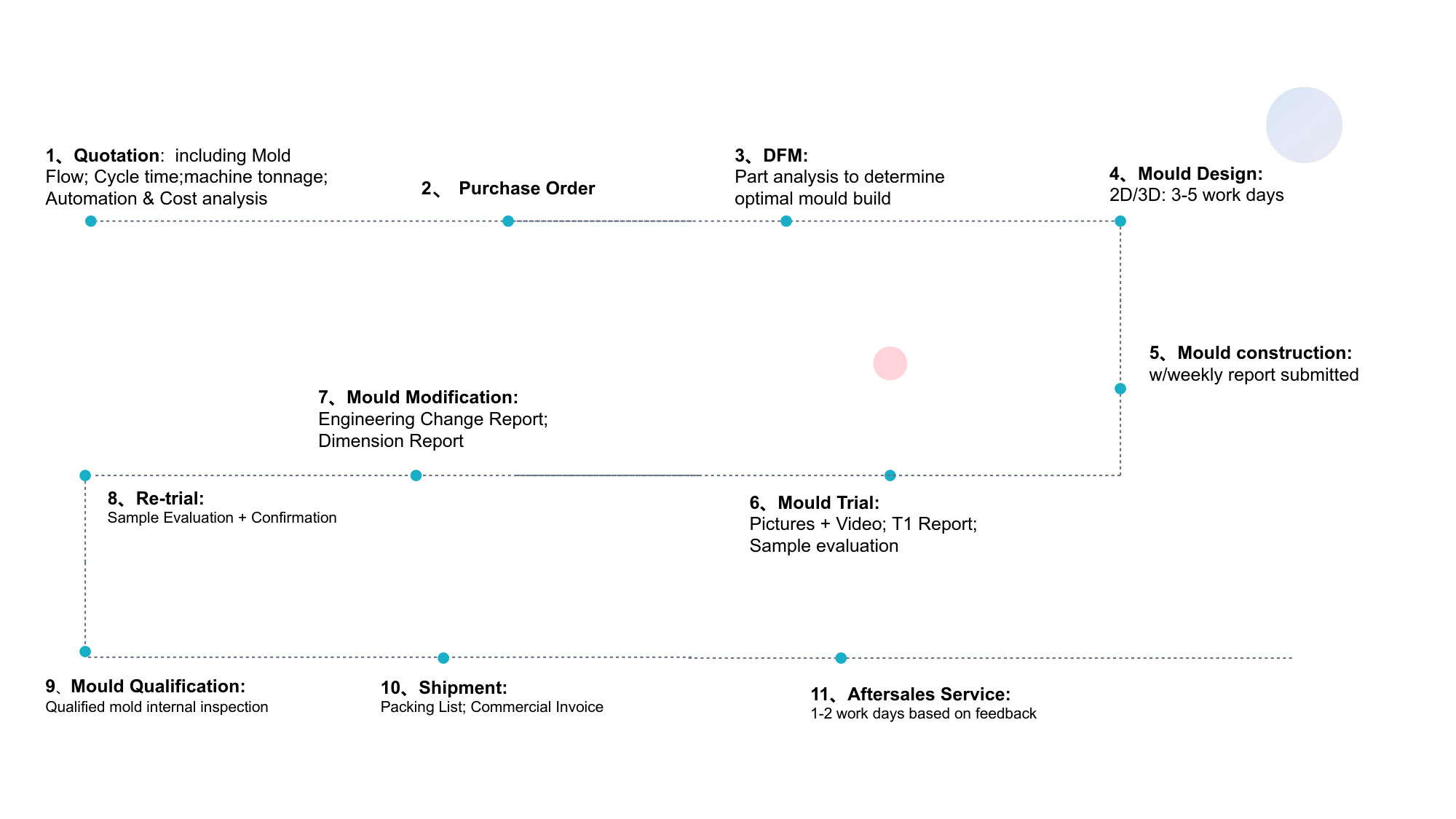
Part Three: The Complete Service Workflow—From Concept to Production and Beyond
3.1 Design and Development: DFM as Risk Mitigation
Design for Manufacturability (DFM) Analysis
Before any steel is cut, Ansix Tech’s engineering team performs a comprehensive DFM review of the customer’s cap design. This is not a formality—it is the single most effective risk-reduction step in the entire project .
The DFM deliverable includes:
Draft angle verification: Minimum 1–3° on vertical walls to ensure reliable ejection without drag marks or scuffing
Wall thickness analysis: Identification of thick sections that will cause sink marks or internal voids, with recommendations for uniform wall thickness that maintains cap strength while reducing material consumption
Gate location optimization: Determination of the optimal gate position to minimize weld line visibility on cosmetic surfaces while ensuring complete fill
Shrinkage compensation: Material-specific shrinkage factors (for PP, typically 1.0–2.5% depending on grade and wall thickness) factored into cavity dimensions before cutting
Ejection strategy: Ejector pin placement agreed with the customer to avoid cosmetic surfaces, with stripper plate or air ejection considered for thin-wall or delicate caps
Customer value: DFM analysis before tooling commitment reduces late-stage modifications by approximately 90%, compressing time-to-market by 4–6 weeks . The cost of a design change after steel is cut is not just the machining expense—it is the lost production time, the delayed product launch, and the competitive disadvantage of arriving late to market.
Moldflow Simulation
Autodesk Moldflow simulation is performed on every new cap geometry before mold design is finalized. The analysis provides :
Fill analysis: Identifies zones of potential short shot or air trap
Pack analysis: Optimizes holding pressure timing to minimize warpage
Cool analysis: Maps thermal gradients across the cavity and predicts cooling time distribution
Warp analysis: Predicts deformation direction and magnitude, enabling pre-compensation in the mold design
Customer value: Moldflow simulation catches filling and cooling problems in the virtual environment, where corrections cost hours rather than weeks. The alternative—discovering a warpage problem at T1 sampling—means the mold must be disassembled, modified, re-tested, and re-sampled, a process that typically adds 3–5 weeks to the project timeline.
3.2 Mold Manufacturing: Precision Execution
The manufacturing workflow for a 16-cavity bottle cap mold follows a structured sequence designed to maintain dimensional accuracy at every stage :
Step 1: Rough CNC Machining
Material removal to within 0.5mm of final surface, with stock allowance verified before heat treatment to ensure adequate material remains for finishing after distortion.
Step 2: Heat Treatment
Hardening to specified hardness (typically HRC 48–52 for cavities and cores), with time-temperature curves documented for traceability.
Step 3: Finish CNC Machining
High-speed 5-axis machining to ±0.002mm accuracy on critical surfaces, with on-machine probing to verify dimensions before the part leaves the machine .
Step 4: EDM for Complex Geometries
Electrical discharge machining for features that cannot be efficiently produced by rotating tools—thread undercuts, sharp internal corners, and micro-textures. Electrode wear compensation ensures dimensional consistency.
Step 5: Polishing
Progressive grits from 400 to 10,000 grit for caps requiring SPI A-1 to A-3 gloss finishes. For caps with textured surfaces, the specified texture is applied by EDM or chemical etching .
Step 6: Assembly and Fitting
Mold base assembly, core and cavity fitting, hot runner installation with leak testing, cooling circuit pressure testing, and ejector system stroke verification .
Customer value: The tolerance achieved on the parting surface is 0.005mm, which translates to flash of ≤0.03mm on produced caps . Caps exit the mold ready for assembly or filling—no manual deflashing, no secondary finishing, no additional labor cost. For a 16-cavity mold producing 92,000 caps per day, eliminating a 2-second manual deflashing step per cap saves over 51 hours of labor per day—a cost reduction that compounds across the production lifecycle.
3.3 Product Validation and NPI Process Planning
T0 Sampling: First Shot
The first injection of plastic into the completed mold establishes the baseline. Part measurement is performed, defects are documented, and initial process parameters are recorded .
T1 Validation: Design Verification
CMM dimensional inspection against the part print, material certification verification, and functional testing as applicable (leak test, hinge cycle test for flip-top caps). All dimensions must be within specified tolerance before proceeding .
T2 Optimization: Process Window Establishment
Design of Experiments (DOE) on key molding parameters—injection speed, holding pressure, cooling time, mold temperature—to establish a robust process window. The target is CPk ≥ 1.00 for critical dimensions at this stage .
T3 Production Validation: Capability Confirmation
A production-scale batch of 500–1,000 parts is run. First-pass yield is calculated, and capability studies are performed. The requirement is CPk ≥ 1.33 for all critical dimensions, equivalent to fewer than 63 defects per million opportunities .
Customer value: By the time mass production begins, the process is proven stable. The customer does not receive a mold and then spend weeks discovering its limitations—they receive a production-ready system with documented process parameters, validated quality, and samples that have passed through the same quality gates as production parts. The ramp-up from T3 to full production is accelerated because the process is already defined .
3.4 Mass Production, Delivery, and After-Sales Support
Mass Production Capability
Ansix Tech’s injection molding facilities can run the 16-cavity mold at production rates from day one. For customers who require complete molded component supply rather than just the mold, Ansix Tech operates as a full-service injection molder with 260 machines capable of handling the required tonnage for 16-cavity cap molds .
Delivery Logistics
Molds are crated for safe transit with proper rust prevention, and shipping documentation includes operation and maintenance manuals, spare parts lists, and process parameter records. For customers requiring on-site commissioning, Ansix Tech provides remote or on-site engineering support .
After-Sales Quality Assurance
The mold structure (excluding consumable components) carries a three-year guarantee . Standard spare parts are provided with every mold, including core pins, ejector pins, and hot runner components, enabling immediate replacement without waiting for manufacturing . Preventive maintenance is recommended every 200,000 shots, with documented inspection and refurbishment actions .
Customer value: A mold breakdown at 2 AM on a Saturday does not wait for Monday morning. The spare parts kit shipped with every mold means the maintenance team can replace a worn ejector pin or a failed heater without placing an order and waiting for delivery. The three-year structural guarantee removes the risk of unexpected capital expenditure within the normal production lifecycle of the tool.
Part Four: Manufacturing Process and Material Selection—The Engineering Decisions That Drive Performance
4.1 Mold Steel Selection Strategy
The 16-cavity bottle cap mold operates under demanding conditions: continuous cycling at 12–20 second intervals, thermal cycling between melt temperature (~230°C for PP) and mold temperature (~30–50°C), and millions of part ejections. Steel selection is therefore a critical engineering decision that directly impacts mold life and maintenance costs.
Cavity and Core Materials
Ansix Tech typically specifies S136 stainless steel (or equivalent ASSAB grade) for cavity and core inserts in bottle cap molds . S136 offers:
Hardness of HRC 48–52 after heat treatment
Excellent corrosion resistance, important for PP that may contain additives or colorants
Good polishability for caps requiring high-gloss surfaces
Wear resistance suitable for 1–5 million shot life
For higher-volume applications or caps with abrasive additives, H13 steel with PVD coating may be specified, offering improved wear resistance at the cost of slightly reduced corrosion resistance .
Hot Runner Manifold Materials
The manifold plate is typically manufactured from H13 tool steel, selected for its thermal stability and resistance to warpage under cyclic heating . The manifold must maintain flatness and dimensional stability across temperature cycles to prevent leakage and ensure consistent melt delivery to all sixteen nozzles.
Ejector System Materials
Ejector pins are precision-ground from hardened tool steel, with surface treatments applied to reduce friction and wear. For caps with tight tolerances on ejection marks, beryllium copper may be used for core pins where enhanced thermal conductivity is beneficial .
Customer value: Proper steel selection is the difference between a mold that produces 1 million shots with routine maintenance and a mold that requires cavity replacement at 300,000 shots. The incremental material cost of premium steel is typically 5–10% of total mold cost, while the production cost of premature mold failure—lost output, emergency repair, expedited replacement—can exceed 50% of the original mold investment .
4.2 Resin Selection for PP Bottle Caps
Polypropylene is the dominant material for bottle caps due to its favorable combination of cost, chemical resistance, and mechanical properties. However, not all PP grades are equal for high-speed injection molding of thin-wall caps.
Key material considerations for 16-cavity mold operation:
Melt Flow Index (MFI): For thin-wall caps (1.0–1.5mm wall thickness), high MFI grades (30–50 g/10min) are preferred to ensure complete fill of all sixteen cavities before the melt freezes. Lower MFI grades may require higher injection pressure and longer fill times, reducing effective cavitation.
Shrinkage characteristics: PP shrinkage varies by grade and processing conditions. The mold cavity dimensions must be compensated based on the specific shrinkage profile of the chosen resin. Ansix Tech documents the shrinkage data for every approved material and incorporates it into the mold design before cutting .
Additive compatibility: Colorants, clarifiers, and anti-static agents can affect flow behavior and shrinkage. Material certification and lot traceability ensure that production runs use resin within the qualified specification .
Customer value: A cap that leaks because the mold was cut with the wrong shrinkage compensation is a warranty claim, a customer complaint, and potentially a regulatory issue for pharmaceutical or food applications. By qualifying the resin and documenting its properties before mold design, Ansix Tech eliminates this risk vector .
4.3 Intelligent Manufacturing and Efficiency Enhancement
In-Mold Sensors and Process Monitoring
For customers requiring the highest level of process control, Ansix Tech can integrate in-mold pressure and temperature sensors that provide real-time feedback on cavity conditions. This enables closed-loop process control that automatically compensates for minor variations in material batch or ambient conditions .
Automated Part Handling
Robotic part removal and packaging systems can be integrated with the molding cell, reducing labor cost per unit by 60–70% compared to manual handling . For a 16-cavity mold running at 15-second cycles, the caps are produced faster than any human operator can handle them without error. Automation is not a luxury—it is a necessity for consistent quality at high output rates.
Centralized Material Handling
Automated material conveying and drying systems reduce downtime for material loading by 4–6 hours per week and ensure consistent moisture levels, which is critical for preventing splay and surface defects .
4.4 Process Quality Assurance Throughout Production
Quality control at Ansix Tech is not a final inspection step—it is embedded at every stage of the manufacturing process :
Incoming Material Inspection: Steel certifications verified against specification. Resin lot certificates reviewed and documented.
In-Process Machining Inspection: On-machine probing after critical CNC operations. CMM inspection of cavity and core dimensions before assembly.
Assembly Verification: Hot runner leak test, cooling circuit pressure test, ejector stroke verification.
Sampling and Validation: CMM dimensional inspection, CPk calculation for critical dimensions, visual inspection under multiple lighting conditions.
Production Monitoring: For mass production runs, ultrasonic wall thickness sensors monitor real-time thickness variation and automatically compensate packing pressure. Vision inspection systems detect and reject defective caps inline .
Customer value: The customer does not need to perform incoming inspection on every cap shipment because the quality system has already verified that the process is capable and stable. The documentation package that accompanies each shipment provides the evidence trail required for regulatory audits, customer quality reviews, and traceability investigations .
Part Five: Cost Control—How Engineering Delivers 15–30% Total Landed Cost Reduction
5.1 Material Cost Reduction
Hot Runner System Eliminates Cold Runner Scrap
The hot runner system maintains the plastic in a molten state from the injection nozzle to the gate, with no cold runner to solidify and be discarded or reground . For a 16-cavity mold producing caps with a typical runner weight of 15–25% of part weight, this elimination translates to:
15–30% material savings compared to cold runner molds
Over 92,000 caps per day, the material savings accumulate rapidly
For a 28mm PP cap weighing 2 grams, a 16-cavity mold with a cold runner system would produce approximately 32 grams of runner scrap per cycle. At 15-second cycles, that is 184 kilograms of scrap per day—or approximately $220 per day in wasted material** at typical PP resin prices. Over a 300-day production year, this exceeds **$66,000 .
DFM Wall Optimization
Thickness analysis and gate optimization in the DFM stage ensure that the cap wall is no thicker than functionally necessary. A 0.1mm reduction in wall thickness on a 28mm cap can reduce part weight by 5–8%, with corresponding material cost reduction across millions of units .
5.2 Cycle Time and Energy Cost Reduction
Conformal Cooling for Faster Cycles
As discussed in Section 2.2, conformal cooling can reduce cooling time by 15–25%, directly translating to shorter cycle times and higher output per machine hour . The energy cost per part decreases as fixed machine energy is spread across more parts per hour.
Servo-Driven Systems
Servo-driven ejector systems reduce mold open/close time by 3–5% and reduce energy consumption compared to hydraulic systems . Over a 24-hour operation, this efficiency compounds into measurable cost savings.
Optimized Hot Runner Design
The balanced hot runner manifold ensures that injection pressure is distributed evenly across all sixteen cavities, minimizing the pressure required to fill the furthest cavity. Lower injection pressure means less energy consumed per cycle and less wear on the injection unit .
5.3 Labor Cost Reduction
Flash Elimination
The 0.005mm parting surface accuracy and optimized mold locking force eliminate flash that would otherwise require manual deflashing . For a mold producing 92,000 caps per day, eliminating a 2-second manual deflashing step per cap saves:
184,000 seconds per day = 51.1 hours per day of labor
At a conservative $15/hour labor rate, this equals **$767 per day** in labor cost avoidance
Annually: $230,000 in labor savings
Automated Part Handling
Robotic removal and packaging reduces the labor content per part by 60–70% compared to manual handling . The operator’s role shifts from physically handling hot parts to monitoring the automated cell—a safer, more productive, and more consistent operation.
5.4 Tooling Maintenance Cost Reduction
Premium Steel and Heat Treatment
The use of S136 or equivalent hardened steel with documented heat treatment extends the production life of the mold to 1–5 million shots before major refurbishment . Compared to a mold with softer steel that requires cavity replacement at 300,000 shots, the maintenance cost per million shots is reduced by 30–50% .
Preventive Maintenance Program
Ansix Tech recommends and supports a preventive maintenance schedule at 200,000-shot intervals, with specific inspection and refurbishment actions documented for each interval . This approach catches wear before it causes catastrophic failure, extending mold life and reducing unplanned downtime.
5.5 Summary of Cost Reduction Impact
Cost Category Typical Reduction Primary Driver
Raw material cost 10–18% Hot runner system, DFM wall optimization
Unit labor cost 50–70% Automated handling, flash elimination
Quality inspection cost 40–60% Inline vision, process capability
Tooling maintenance cost 30–50% over mold life Premium steels, preventive maintenance
Energy cost per part 15–25% Servo drives, optimized cooling
Total landed cost 15–30% Systematic engineering optimization
These savings are not achieved by cutting corners or reducing quality. Every dollar saved comes from engineering efficiency—faster cycles, less wasted resin, reduced handling, and fewer defects. The customer receives the same premium packaging component at a lower total cost, improving their margin or funding additional marketing investment .
Conclusion: Why Ansix Tech
The 16-cavity hot runner PP bottle cap mold is not a commodity product. It is a precision production asset whose performance determines the economics of an entire packaging operation. The difference between a mediocre mold and an excellent one is measured in cycle time, scrap rate, maintenance frequency, and ultimately, cost per thousand caps.
Ansix Tech’s position as a leading provider in this category rests on 28 years of accumulated process knowledge, a vertically integrated manufacturing ecosystem, and a customer-centric engineering philosophy that translates technical capabilities into measurable business value. The company does not sell molds—it delivers production systems that have been designed, validated, and proven before the first commercial shipment.
For brand owners and packaging manufacturers evaluating a 16-cavity hot runner PP bottle cap mold project, the question is not simply “what does the mold cost?” It is “what does this mold deliver over its production life?” Ansix Tech’s answer is a system that produces quality caps from the first shot to the five-millionth, with documented process capability, minimal downtime, and a total cost of ownership that is 15–30% lower than industry averages .
That is not marketing language. It is engineering.
Ansix Tech Co Ltd
If you have any plans related to 16-cavity hot runner PP bottle cap mold available
, you can contact us at any time. We will turn your ideas into reality, let you realize your dreams, and obtain large orders from the market. Our contact information is info@ansixtech.com. Or contact our CTO, mail: stephen@ansixtech.com
#www.ansixtech.com #ansixtech.com #16-cavity hot runner PP bottle cap mold available #16-cavity hot runner PP bottle cap mold available tooling #16-cavity hot runner PP bottle cap mold available injection mold companies #Ansix #Ansix moulds #Ansix china #Ansix tech china #Ansix tech company #Ansix facotry #Ansix Tooling #Ansix tool #16-cavity hot runner PP bottle cap mold available injection molding #16-cavity hot runner PP bottle cap mold available injection tools #16-cavity hot runner PP bottle cap mold available injection moulds #Ansix moulding company #Ansix molding #ansix tooling #16-cavity hot runner PP bottle cap mold available plastic mould #16-cavity hot runner PP bottle cap mold available plastic tools #Ansix Tech #Ansix molds #Ansix injection molding #Ansix mold factory #16-cavity hot runner PP bottle cap mold available injection molding Customized #Ansix mold factory #16-cavity hot runner PP bottle cap mold available china #16-cavity hot runner PP bottle cap mold available molds #injection factory for 16-cavity hot runner PP bottle cap mold available #16-cavity hot runner PP bottle cap mold available injection molding #16-cavity hot runner PP bottle cap mold available injection molding factory #injection molding company #16-cavity hot runner PP bottle cap mold available injection mold companies #Mold for automotive daytime running light guide strip #16-cavity hot runner PP bottle cap mold available mold limited #Ansix mold china #Ansix companies for 16-cavity hot runner PP bottle cap mold available #Ansix company China #16-cavity hot runner PP bottle cap mold available facotry #Ansix Tech #Ansix Tech mould #16-cavity hot runner PP bottle cap mold available injection moulding #16-cavity hot runner PP bottle cap mold available injection moulding company #Ansix 16-cavity hot runner PP bottle cap mold available parts injection mold companies #16-cavity hot runner PP bottle cap mold available injection molding companies china #16-cavity hot runner PP bottle cap mold available china factory #Ansix moulding companies #Ansix molding company #16-cavity hot runner PP bottle cap mold available injection moulding facotry #Ansix Tech mold #16-cavity hot runner PP bottle cap mold available mould #16-cavity hot runner PP bottle cap mold available plastic injection molding #ansix plastic mold #16-cavity hot runner PP bottle cap mold available Mold manufacturing #16-cavity hot runner PP bottle cap mold available parts manufacturing #16-cavity hot runner PP bottle cap mold available plastic parts factory #16-cavity hot runner PP bottle cap mold available injection parts mold #16-cavity hot runner PP bottle cap mold available PRECISION MANUFACTURING #16-cavity hot runner PP bottle cap mold available TOOL #China 16-cavity hot runner PP bottle cap mold available mold #16-cavity hot runner PP bottle cap mold available injection moulding china #16-cavity hot runner PP bottle cap mold available mould china #china precision mold #16-cavity hot runner PP bottle cap mold available mold in china #16-cavity hot runner PP bottle cap mold available mold china #16-cavity hot runner PP bottle cap mold available Precision molds #High-precision molds #16-cavity hot runner PP bottle cap mold available High-precision tool #Injection molds #16-cavity hot runner PP bottle cap mold availableFactory #16-cavity hot runner PP bottle cap mold availableCompany #Super Large Injection Mold Factory #Large Tonnage Injection Molding Factory #16-cavity hot runner PP bottle cap mold available Company #16-cavity hot runner PP bottle cap mold available Factory #2800T Injection Molding Factory #3000 Ton Injection Molding #4500 Ton Injection Molding Factory #16-cavity hot runner PP bottle cap mold available Large Mold Injection Molding #Large Plastic Mold Injection Molding Factory #16-cavity hot runner PP bottle cap mold available Large Injection Mold Manufacturer #16-cavity hot runner PP bottle cap mold available Plastic Mold Factory #Injection Mold #Plastic Mold