
 Medical Molds
 Packaging Molds
 Personal Care Molds
 Electronic Molds
 Automotive Molds
 Home Appliance Molds
 Special Molds
 Design & Engineering
 Production & Manufacturing
 Global Presence
 Business Scope
 Component Solutions
 Product Assembly
 Quality Management
 Medical Device Manufacturing



48F Ferrule
FEATURES
Product Introduction — What Is a 48F Ferrule?
A 48-fiber MT (Mechanically Transferable) ferrule is a precision-molded thermoplastic component that aligns 48 optical fibers in a 4×12 array configuration with 250 μm pitch. The ferrule’s end face contains 48 fiber holes and two guide pin holes (typically 0.7 mm diameter, 4.6 mm pitch), enabling passive alignment of mating connectors through high-precision guide pins . The dimension of the end face follows IEC 61754-5 standards to ensure compatibility with conventional MPO connector housings .
Key Performance Specifications:
Parameter Standard Grade Low Loss Grade
Insertion Loss (IL) ≤0.5 dB ≤0.25–0.35 dB
Fiber Hole Position Error ≤2.5 μm ≤1.5 μm
Guide Hole Diameter 0.699–0.701 mm 0.6990–0.6996 mm
Guide Hole Pitch 4.6 ± 0.0030 mm 4.6 ± 0.0020 mm
Operating Temperature -40°C to +75°C -40°C to +85°C
Applications: Hyperscale data centers, AI/ML cluster interconnects, 5G backhaul and fronthaul, high-performance computing, military/aerospace ruggedized connectors, and next-generation optical backplanes .
The 48F ferrule enables throughput of up to 10.8 Tbps at 25 Gbps per channel in the largest connector shell sizes, making it indispensable for infrastructure that cannot afford fiber-count limitations .
-
Mold Description
Product Materials:
PPS
Mold Material:
S136ESR
Number of Cavities:
1
Glue Feeding Method:
COLDrunner
Cooling Method:
Water cooling
Molding Cycle
20.5s
- The mold manufacturing process and product material selection
Manufacturing Process and Production Technology
2.1 Precision Mold Manufacturing
The 48F ferrule mold is among the most demanding precision tooling applications in thermoplastic injection molding. The core challenge lies in the fiber hole forming pins: 48 individual pins, each approximately 125 μm in diameter, arranged in a 250 μm pitch array, must be supported against injection pressures exceeding 1,000 bar without bending, shifting, or breaking .
Ansix’s mold manufacturing capabilities:
Five-axis high-speed machining centers capable of 0.002 mm machining accuracy for complex parting surfaces, ensuring smooth parting lines free of flash
Slow-wire EDM for micro-features including 0.03 mm slots and narrow ribs, enabling mold inserts with the fine geometry required for ferrule guide pin holes and fiber alignment channels
Jig grinding for ferrule end-face inserts, achieving surface roughness (Ra) of 0.0124 μm and flatness of 0.2 μm across the fiber region of interest—critical for low insertion loss and physical contact performance
Poly Crystalline Diamond (PCD) grinding for final fiber bore and guide pin hole dimensioning, holding hole position to within ±1 μm
The mold design for 48F ferrules employs a pin support structure that sandwiches core pins between precision-machined plates, distributing injection pressure and preventing pin deflection that would cause fiber hole misalignment . Gate positioning and runner design are optimized through simulation to ensure balanced fill without weld lines in the optical region.
Mold Specifications for 48F Ferrule:
Attribute Specification
Mold Material Hardened tool steel, P20 or H13 depending on volume
Core Pin Material Tungsten carbide or high-speed steel
Core Pin Diameter ~125 μm (fiber bore), ~700 μm (guide pin bore)
Mold Base Precision-ground, hardened, with guided ejection
Ejection System Balanced ejector pins with cushion pads to prevent part distortion
Expected Mold Life 500,000–1,000,000 shots with scheduled maintenance
-
Injection Molding and Material Selection
Material selection is arguably the single most consequential decision in 48F ferrule manufacturing. The thermoplastic must simultaneously deliver:
Low shrinkage and anisotropy to maintain fiber hole positions within ±1–2 μm over 48 holes
Low moisture absorption for dimensional stability across -40°C to +85°C
Sufficient flow to fill 125 μm holes at 250 μm pitch without short shots
High strength and creep resistance to withstand fiber insertion and connector mating forces
Ansix’s material expertise encompasses two primary thermoplastic systems:
Liquid Crystal Polymers (LCP): LCPs exhibit exceptional flow in thin-wall micro-features, rapid solidification that minimizes flash around core pins, and low melt viscosity under shear . Their shear-thinning behavior allows precise filling of fiber holes. However, LCPs require careful mold temperature control to achieve optimal crystallinity and dimensional stability.
PPS-Based Compounds: Polyphenylene sulfide formulations offer an optimal balance of dimensional stability, mechanical strength, and cost . Advanced PPS grades incorporate fillers such as tetrapod-shaped whiskers and silica particles to reduce anisotropy and warpage . The 48F ferrule development literature demonstrates that optimized PPS molding can achieve fiber hole position error below 2.5 μm with insertion loss below 0.5 dB .
Molding Process Parameters (Typical for 48F Ferrule):
Parameter Range Rationale
Melt Temperature 320–360°C (PPS) Ensure complete fill before solidification
Mold Temperature 140–160°C Control crystallinity and shrinkage
Injection Speed Moderate to high Fill micro-holes before freeze-off
Packing Pressure Optimized per Moldflow Compensate shrinkage without pin deflection
Cooling Time Extended Ensure dimensional stability before ejection
Ansix employs fully closed-loop molding processes for MT ferrules, where cavity pressure sensors provide real-time feedback to the injection unit, maintaining shot-to-shot consistency even as material batches or ambient conditions vary .
Part 3: From Technical Capability to Customer Value — The Ansix Framework
3.1 The “Hard Power” Foundation: Equipment That Delivers Confidence
Ansix’s manufacturing infrastructure is designed to convert precision specifications into repeatable production outcomes:
Mold Machining Equipment:
Five-axis high-speed machining centers: 0.002 mm accuracy for complex parting surfaces, ensuring smooth parting lines and minimal flash
Slow-wire EDM: 0.03 mm feature capability for micro-slots and narrow ribs, avoiding thin-wall deformation in core inserts
Jig grinding: sub-micron surface finish control for ferrule end-face inserts
Injection Molding Machine Fleet:
260 machines ranging from 30 to 2,800 tons across four production bases in China and Vietnam
All-servo drive systems: repeatability ±0.1%, ensuring every shot in mass production matches the validated process
70% automated machining ratio: directly contributes to both precision and cost efficiency by eliminating human variation in core pin grinding and mold manufacturing
Quality Inspection Equipment:
Coordinate Measuring Machines (CMM): full-dimensional verification of every mold before shipment
Optical vision systems and AOI: 100% inspection of critical ferrule dimensions including fiber hole position, guide hole diameter, and end-face geometry
Interferometry: end-face geometry verification including radius of curvature and fiber height for polished assemblies
Key dimensions maintained at Cpk ≥ 1.33 for production processes
3.2 Mold Manufacturing: Core Competitiveness in Specific Metrics
Customers evaluating 48F ferrule mold suppliers should focus on lifetime, precision, lead time, and repair cost. Here is how Ansix performs against these dimensions:
Dimension Ansix Capability Customer Value
Fiber Hole Position ±1 μm (mold insert capability) Achieve <0.25 dB insertion loss consistently; fewer connector failures in the field
Guide Hole Pitch 4.6 mm ± 0.002 mm (SL grade) Reliable passive alignment; reduced mating force and guide pin wear
End-Face Flatness 0.2 μm across fiber region Full physical contact; no air gaps; stable return loss
Mold Life 500,000–1,000,000 shots with maintenance Lower amortized tooling cost per ferrule; predictable replacement budgeting
Mold Lead Time Streamlined by integrated design-to-tooling workflow Earlier product launch; capture market window
Repair Cost In-house core pin replacement; spare inserts stocked Minimal downtime; controlled maintenance expense
The strategic advantage is vertical integration: design, DFM, mold manufacturing, molding, and validation occur under one organizational roof, eliminating the communication gaps and finger-pointing that plague fragmented supply chains .
3.3 The DFM Advantage: Catching Problems Before They Cost Money
Design for Manufacturability (DFM) analysis is where Ansix generates measurable customer value before a single mold component is machined. For 48F ferrules, DFM addresses:
Wall thickness uniformity: Prevents differential shrinkage that shifts fiber hole positions
Gate location optimization: Avoids weld lines in the optical region; ensures balanced fill across the 4×12 array
Ejection strategy: Prevents pin bending during part removal
Draft analysis: Ensures clean release from deep, narrow features
Material flow length: Confirms that the selected thermoplastic can fill 125 μm holes at 250 μm pitch before freeze-off
Quantified DFM value: Design flaws discovered after mold manufacturing typically cost $15,000–$50,000 in mold rework plus 4–8 weeks of schedule delay. DFM analysis that catches these issues in the design phase costs a fraction of that amount and preserves launch timelines .
3.4 Moldflow Simulation: Reducing Trial-and-Error from 8–10 Shots to 2–3
Moldflow analysis for 48F ferrules is not a luxury—it is essential. The fiber hole forming pins are fragile; trial-and-error adjustments risk pin breakage, which requires complete mold teardown and weeks of repair.
Ansix’s Moldflow simulation for 48F ferrules models:
Fill patterns: Confirms that all 48 fiber holes fill simultaneously, without hesitation or race-tracking
Pressure distribution: Identifies unbalanced pressure that could deflect core pins
Temperature gradients: Prevents differential cooling that causes warpage or hole position drift
Weld line prediction: Ensures no weld lines form in the optical path
Shrinkage and warpage: Predicts final hole positions after cooling, allowing mold cavity dimension compensation
Customer value: Moldflow simulation reduces trial shots from the industry-typical 8–10 to 2–3, saving 3–6 weeks of development time and $10,000–$30,000 in molding machine time and engineering labor .
3.5 NPI Process Planning: From Validated to Repeatable
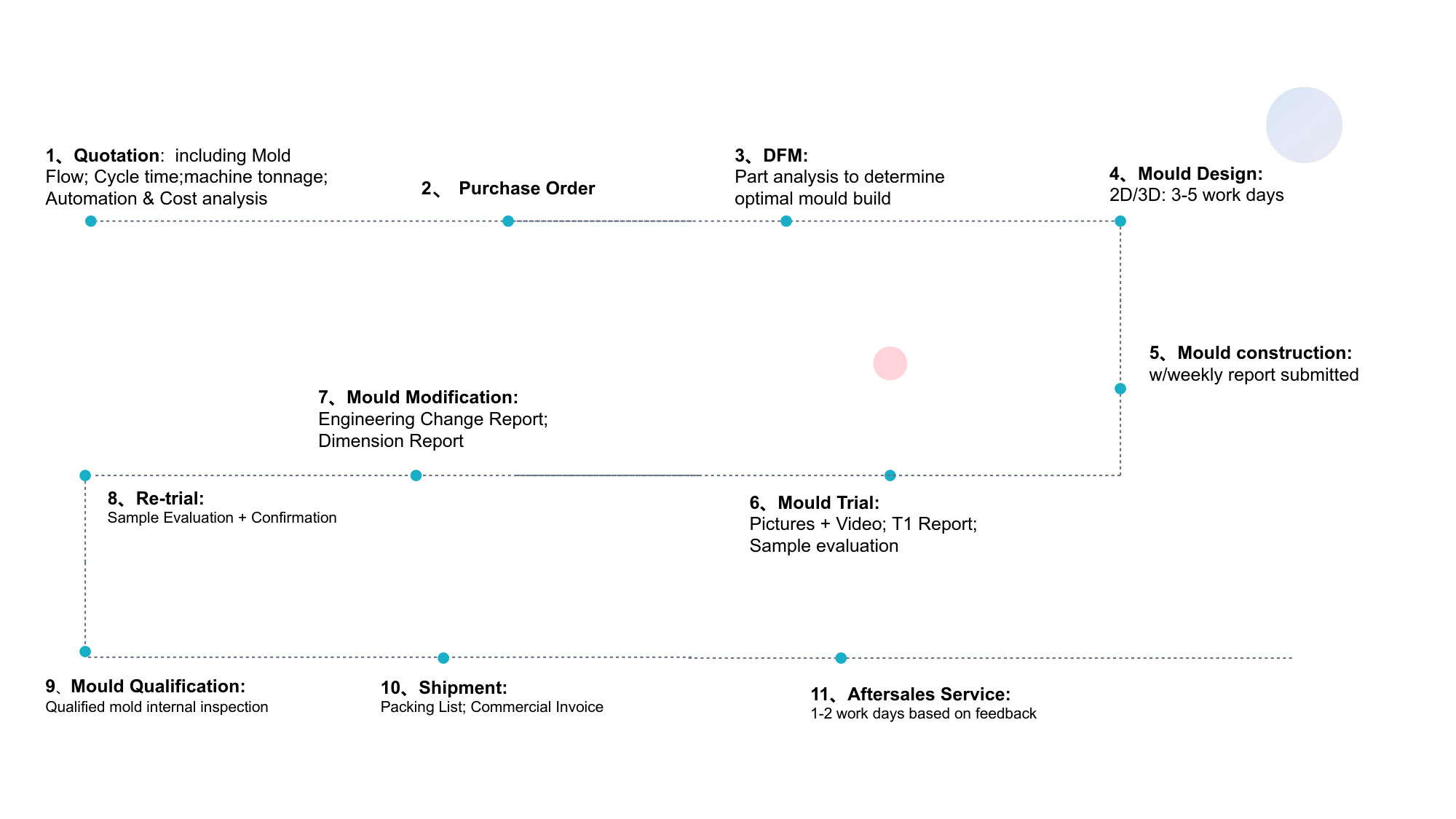
New Product Introduction (NPI) for 48F ferrules follows a structured IQ/OQ/PQ validation framework:
Installation Qualification (IQ): Verifies mold, auxiliary equipment, and press setup conform to design specifications
Operational Qualification (OQ): Establishes and documents the process window—melt temperature, packing pressure, injection speed, cooling time—that produces conforming parts
Performance Qualification (PQ): Confirms that the validated process consistently produces conforming parts across multiple production lots under routine conditions
This framework translates directly to customer confidence: ferrules received in lot 10 will perform identically to those in lot 1.
Pilot production defines the process window and trains operators before full-scale manufacturing begins. First article inspection, dimensional reports, and capability studies (Cpk) prove the process before mass production is authorized .
3.6 Mass Production: Consistency at Volume
Once validated, 48F ferrule production transitions to mass manufacturing with rigorous controls:
SPC monitoring: Critical dimensions—fiber hole position, guide hole diameter, hole pitch—are monitored per lot
AOI inspection: Automated optical inspection provides 100% dimensional checking of critical features
Lot traceability: MES-integrated data capture enables full genealogy from raw material to shipped ferrule
Immediate corrective action: Deviations trigger containment before non-conforming parts reach the customer
Delivery reliability is supported by detailed project planning with milestone transparency and dual-country manufacturing across China and Vietnam, maintaining 95%+ on-time delivery even during regional disruptions .
3.7 Quality Assurance: Beyond Inspection to Process Control
Quality for 48F ferrules cannot be inspected into the product—it must be built into the process. Ansix’s quality framework includes:
Quality Function Method Frequency
Incoming Material Certificate of Analysis + incoming inspection Per lot
Mold Qualification Full dimensional report, Cpk ≥1.33 on critical dimensions Before production release
In-Process Cavity pressure monitoring, SPC on key dimensions Real-time, per shot
Post-Molding AOI on fiber hole position, guide hole diameter, end-face geometry 100% or per sampling plan
Final Inspection CMM verification, end-face interferometry Per lot
Traceability MES lot tracking, material genealogy Continuous
3.8 Delivery and After-Sales Service
Delivery efficiency is a function of integrated operations. Because design, mold manufacturing, and molding occur within the same organization, schedule compression is inherent. Mold manufacturing lead times for 48F ferrules are optimized through:
Parallel processing of mold components
In-house core pin fabrication (no external vendor lead time)
Moldflow-validated designs that eliminate trial-shot iterations
After-sales commitment:
Mold maintenance programs: Scheduled inspection and refurbishment to extend mold life and maintain precision
Process support: Technical assistance for customers running molds in their own facilities
Spare parts management: Critical core pins and cavity inserts stocked for rapid replacement
Continuous improvement: Data-driven optimization of cycle time, yield, and cost over the production life
Part 4: Cost Competitiveness and Risk Reduction — The Business Case
4.1 Cost Control Capability
48F ferrule cost per part is driven by three factors: cycle time, yield, and mold amortization.
Cycle time optimization: Moldflow-guided cooling analysis and conformal cooling channel design (where applicable) reduce cycle time by 15–25% compared to conventionally cooled molds.
Yield improvement: The precision of Ansix molds directly impacts yield in downstream polishing and assembly operations. A ferrule with fiber hole position at ±1 μm enables higher polishing yields and lower insertion loss scrap rates. The cost of a non-conforming ferrule at the molding machine is cents; the cost of a non-conforming ferrule discovered after assembly into a 48F MPO connector is dollars .
Mold amortization: Extended mold life (500,000–1,000,000 shots) and low repair frequency reduce the per-part tooling cost for high-volume programs.
Automation leverage: The 70% automated machining ratio reduces labor cost per mold and improves consistency, with savings passed to customers .
4.2 Risk Reduction
Risk Ansix Mitigation Customer Benefit
Mold rework costs DFM + Moldflow before machining Avoid $15,000–$50,000 in modification costs
Launch delays Integrated design-to-production workflow 3–6 weeks faster time-to-market
Pin bending during molding Validated pin support structure Higher yield, fewer mold repairs
Lot-to-lot variation Closed-loop molding + SPC Reliable optical performance in every lot
Supply chain disruption Dual-country manufacturing 95%+ on-time delivery despite regional events
Audit failure IQ/OQ/PQ validation documentation Pass customer audits on first attempt
Part 5: Strategic Advantages and the Ansix Ecosystem
5.1 Vertically Integrated Manufacturing
Ansix’s competitive moat is its vertically integrated ecosystem. From product design through after-sales service, every stage of the 48F ferrule value chain is controlled internally :
Product Design & Development — Collaborative engineering with customer specifications
DFM Mold Engineering — Manufacturability analysis before commitment
Moldflow Simulation — Virtual validation of fill, pack, cool, and warp
Precision Mold Manufacturing — Five-axis machining, EDM, jig grinding, PCD finishing
Product Validation — First article inspection, dimensional reports, capability studies
NPI Process Planning — IQ/OQ/PQ validation, pilot production
High-Volume Production — 260 injection molding machines, 30–2,800 tons
Quality Assurance — SPC, AOI, CMM, MES traceability
Delivery & Logistics — Dual-country manufacturing, milestone transparency
After-Sales Service — Mold maintenance, process support, spare parts, continuous improvement
This integration eliminates the communication gaps, schedule slippage, and quality inconsistencies that typically arise when design, tooling, and molding are handled by separate vendors.
5.2 Material Expertise as a Differentiator
Ansix’s material science capability for 48F ferrules extends beyond purchasing decisions. The company maintains process knowledge for:
LCP grades optimized for micro-feature filling and low flash
PPS compounds with tailored filler systems for dimensional stability
Application-specific material selection matched to fiber count, environmental requirements, and cost targets
5.3 Smart Manufacturing and Industry 4.0 Readiness
Ansix’s manufacturing execution systems (MES) capture process data at every station, enabling:
Real-time SPC alerts before dimensions drift out of tolerance
Full lot traceability for customer quality investigations
Data-driven process optimization over the production life
Automated inspection integration with production flow
5.4 Global Footprint, Local Support
With four production bases across China and Vietnam and over 200,000 square meters of manufacturing space, Ansix offers geographic diversification for customers concerned about supply chain concentration risk . The company’s 1,200+ employees include over 200 designers and engineers, providing the technical depth to support complex 48F ferrule programs from concept through mass production.
Conclusion: From Technical Capability to Business Outcome
The ultimate measure of a 48F ferrule manufacturing partner is not technical elegance but business impact. Ansix Tech’s value proposition for 48F ferrule customers can be summarized as:
What we solve: The challenge of manufacturing a 48-fiber thermoplastic ferrule with micron-level precision at a cost and quality level suitable for hyperscale deployment.
How we solve it: Through vertically integrated design, precision mold manufacturing, Moldflow-validated processes, closed-loop molding, and rigorous quality systems.
What customers gain:
Lower total cost: Reduced trial shots, higher yield, extended mold life, automation-driven efficiency
Faster time-to-market: Integrated workflow compresses development cycles
Lower risk: DFM and simulation catch problems before they cost money; IQ/OQ/PQ documentation supports audit success
Supply security: Dual-country manufacturing and robust after-sales support
For organizations developing 48F ferrule-based optical interconnect products, Ansix Tech offers not merely a manufacturing service but a partnership that converts the most challenging aspects of precision thermoplastic molding into competitive advantage.
Ansix Tech — Established 1998, Hong Kong. Four production bases, 260 injection molding machines, 200,000+ m² manufacturing space, 1,200+ employees, 200+ designers and engineers. Precision injection molding solutions for fiber optic, medical, automotive, and consumer electronics industries.
Ansix Tech Co Ltd
If you have any plans related to 48F Ferrule , you can contact us at any time. We will turn your ideas into reality, let you realize your dreams, and obtain large orders from the market. Our contact information is info@ansixtech.com. Or contact our CTO, mail: stephen@ansixtech.com
#www.ansixtech.com #ansixtech.com #48F Ferrule #48F Ferrule #48F Ferrule injection mold companies #Ansix #Ansix moulds #Ansix china #Ansix tech china #Ansix tech company #Ansix facotry #Ansix Tooling #Ansix tool #48F Ferrule injection molding #48F Ferrule injection tools #48F Ferrule injection moulds #Ansix moulding company #Ansix molding #ansix tooling #48F Ferrule plastic mould #48F Ferrule plastic tools #Ansix Tech #Ansix molds #Ansix injection molding #Ansix mold factory #48F Ferrule injection molding Customized #Ansix mold factory #48F Ferrule china #48F Ferrule molds #injection factory for 48F Ferrule injection molding #48F Ferrule injection molding factory #injection molding company #48F Ferrule injection mold companies #Mold for 48F Ferrule #48F Ferrule limited #Ansix mold china #Ansix companies for 48F Ferrule #Ansix company China #48F Ferrule facotry #Ansix Tech #Ansix Tech mould #48F Ferrule injection moulding #48F Ferrule injection moulding company #Ansix 48F Ferrule parts injection mold companies #48F Ferrule injection molding companies china #48F Ferrule china factory #Ansix moulding companies #Ansix molding company #48F Ferrule injection moulding facotry #Ansix Tech mold #48F Ferrule mould #48F Ferrule plastic injection molding #ansix plastic mold #48F Ferrule Mold manufacturing #48F Ferrule parts manufacturing #48F Ferrule plastic parts factory #48F Ferrule injection parts mold #48F Ferrule PRECISION MANUFACTURING #48F Ferrule TOOL #China 48F Ferrule mold #48F Ferrule injection moulding china #48F Ferrule mould china #china precision mold #48F Ferrule mold in china #48F Ferrule mold china #48F Ferrule Precision molds #High-precision molds #48F Ferrule High-precision tool #Injection molds #48F FerruleFactory #48F FerruleCompany #Super Large Injection Mold Factory #Large Tonnage Injection Molding Factory #48F Ferrule Company #48F Ferrule Factory #2800T Injection Molding Factory #3000 Ton Injection Molding #4500 Ton Injection Molding Factory #48F Ferrule Large Mold Injection Molding #Large Plastic Mold Injection Molding Factory #48F Ferrule Large Injection Mold Manufacturer #48F Ferrule Plastic Mold Factory #Injection Mold #Plastic Mold