
 Medical Molds
 Packaging Molds
 Personal Care Molds
 Electronic Molds
 Automotive Molds
 Home Appliance Molds
 Special Molds
 Design & Engineering
 Production & Manufacturing
 Global Presence
 Business Scope
 Component Solutions
 Product Assembly
 Quality Management
 Medical Device Manufacturing



96-Cavity 2925 Bottle Cap Mold
FEATURES
The Foundation: Hard Capability That Customers Can Depend On
1.1 Precision Machining Infrastructure
The 2925 bottle cap, with its thin walls, intricate thread geometry, and demanding dimensional tolerances, requires mold components machined to levels of precision that general-purpose equipment cannot achieve. Ansix’s manufacturing floor is built around this reality.
Five-Axis High-Speed Machining Centers form the backbone of Ansix’s precision capability. These machines enable simultaneous multi-axis motion, allowing the cutting tool to approach complex three-dimensional geometries—such as the curved surfaces of cap threads and the intricate contours of the sealing lip—from optimal angles. The result is not merely dimensional accuracy but surface quality that minimizes hand polishing, reducing lead time and eliminating the variability that manual finishing introduces. Modern five-axis platforms, such as those from Mitsui Seiki with spindle speeds up to 30,000 rpm and positioning accuracy of ±0.001 mm, demonstrate the level of precision that has become the benchmark for demanding mold work . Ansix’s investment in this class of equipment means that customers receive mold inserts with parting lines that are smooth and essentially burr-free, directly translating to caps that seal properly and present a clean cosmetic appearance.
Slow-Wire EDM (Wire Electrical Discharge Machining) complements the milling capability by providing a means to cut extremely fine features in hardened tool steel. The 2925 cap mold often incorporates narrow slots for venting, sharp corners in the tamper-evident band geometry, and micro-features that would be difficult or impossible to mill. Slow-wire EDM, which uses a thin wire (typically 0.15–0.30 mm diameter) and spark erosion to remove material, can achieve surface finishes as fine as Ra ≤ 0.25 μm with optional finishing modules . Because the process involves no direct mechanical contact, it eliminates the risk of deformation that can occur when machining thin walls or delicate features. For the 96-cavity 2925 mold, this means that the fine details of each cavity—details that determine whether caps seal, thread correctly, and open smoothly—are reproduced with consistency across all 96 positions .
The combination of five-axis milling and slow-wire EDM gives Ansix the ability to produce mold cores and cavities from hardened tool steels such as H13 (HRC 48–52), which offers a mold life exceeding 500,000 shots in demanding PP cap applications . For customers, this means a mold that will not need replacement after a few million cycles—it is an asset designed for the long haul.
-
Mold Description
Product Materials:
pp
Mold Material:
S136ESR
Number of Cavities:
1*96
Glue Feeding Method:
Hot runner
Cooling Method:
Water cooling
Molding Cycle
9.5s
- The mold manufacturing process and product material selection
Injection Molding Machine Fleet and Servo Technology
A mold’s performance is only as good as the machine it runs in. Ansix maintains a fleet of injection molding machines spanning clamping forces from 30 tons to 4,000 tons, covering the full range of bottle cap production requirements. But the critical differentiator is the adoption of full servo and servo-hydraulic drive technology.
Traditional hydraulic injection molding machines operate with fixed-displacement pumps running continuously, consuming energy even during idle portions of the cycle. Servo-driven systems, by contrast, adjust pump output based on actual demand. Research on servo-hydraulic hybrid injection molding machines with 1,300-ton clamping force has demonstrated energy savings of approximately 40% compared to conventional hydraulic machines, with cycle time remaining essentially equivalent . For high-volume cap production running 24/7, a 40% reduction in energy consumption per machine is not a minor improvement—it is a material reduction in the cost-per-part that directly benefits the customer’s bottom line.
Beyond energy efficiency, servo systems provide superior process repeatability. The precise control of injection velocity and packing pressure that servo drives enable reduces the shot-to-shot variation that causes weight inconsistencies, dimensional drift, and cosmetic defects. For a 96-cavity mold producing millions of caps per week, the ability to hold tight tolerances across all cavities and across extended production runs is essential. Servo technology is not a luxury in this context; it is a prerequisite for consistent quality at scale .
-
From Concept to Production: The Ansix Development Process
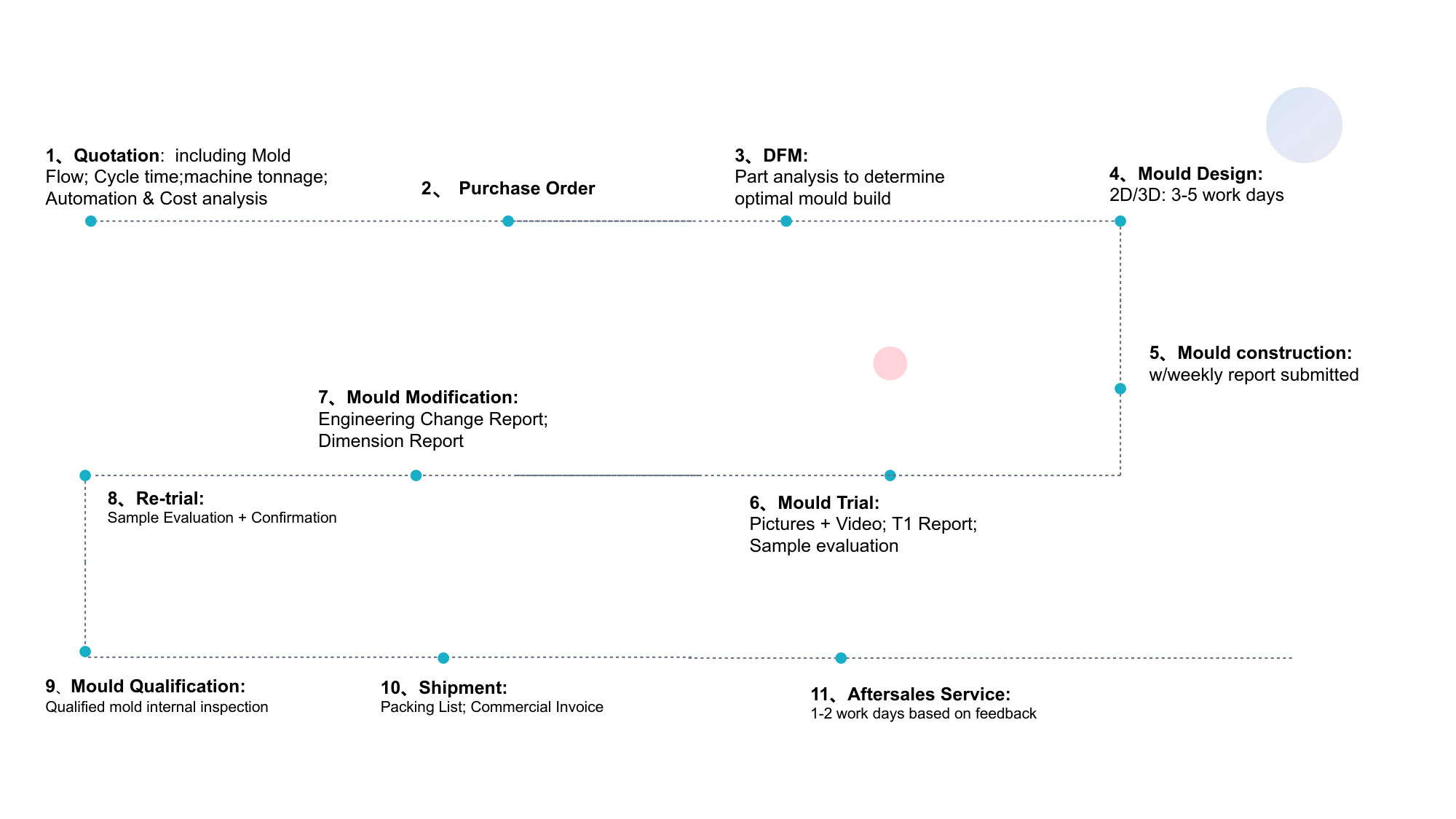
2.1 Design for Manufacturability (DFM): Catching Problems Before They Cost Money
The most expensive mold problem is the one discovered after the steel has been cut. Ansix’s development process begins with a rigorous DFM review that examines the customer’s 3D CAD model and evaluates every feature against the realities of injection molding.
DFM is not a checkbox exercise. It is a structured analysis that identifies potential manufacturing difficulties—inadequate draft angles, wall thickness variations that will cause sink marks or warpage, undercuts that require complex side actions, gate locations that will create cosmetic defects or flow imbalances—and proposes design modifications before tooling begins . For the 2925 cap, DFM considerations might include verifying that the thread geometry provides sufficient draft for clean ejection, that the sealing surface will not be compromised by weld line placement, and that the tamper-evident band features are robust enough to survive demolding without tearing.
The value to the customer is straightforward: DFM catches issues when they are still lines on a screen. A design change at the DFM stage costs nothing but a few hours of engineering time. The same change after the mold is built costs tens of thousands of dollars and weeks of delay.
2.2 Moldflow Simulation: Predicting Performance Before Cutting Steel
While DFM addresses the part design, Moldflow analysis addresses the manufacturing process. Ansix uses industry-standard injection molding simulation software to model how molten polypropylene will flow through the 96-cavity mold, how it will cool, and how it will shrink and warp .
For a 96-cavity 2925 cap mold, the simulation challenges are significant. The melt must fill all 96 cavities simultaneously and uniformly, or some cavities will short-shot while others flash. The cooling system must extract heat evenly across a large mold block, or the caps from different cavities will vary in dimensions. The packing profile must compensate for shrinkage in a way that produces round, dimensionally stable caps without over-packing that causes ejection problems.
Moldflow analysis answers these questions before the first chip is made . The simulation predicts fill patterns, weld line locations, air trap positions, cooling efficiency, and warpage tendencies. Ansix’s engineers use this data to optimize gate locations, runner sizing, cooling channel layout, and process parameters. The customer benefit is twofold: faster time-to-market because physical trial-and-error iterations are reduced, and higher confidence that the mold will produce acceptable parts from the first trial shot.
2.3 NPI Process Planning: A Structured Path to Volume Production
New Product Introduction (NPI) is the disciplined process of taking a validated design and transitioning it into stable, high-volume manufacturing . For the 96-cavity 2925 bottle cap mold, Ansix’s NPI framework ensures that every step—from first article inspection through process capability studies to full production ramp—is planned, executed, and documented.
The NPI process typically progresses through distinct phases: prototype and validation, pre-production trials, and volume ramp . At each phase, Ansix defines specific deliverables and acceptance criteria. The customer knows exactly what to expect and when to expect it. More importantly, the NPI process creates the manufacturing documentation—process parameters, inspection plans, maintenance schedules—that will govern production for the life of the mold. When the mold is handed over, the customer receives not just a tool but a complete production system.
3. Product Validation and Quality Assurance
3.1 Dimensional Verification and Process Capability
A 96-cavity mold produces 96 parts per cycle. Every cavity must produce caps that meet the same dimensional specifications. Ansix’s validation protocol begins with comprehensive dimensional inspection of caps from every cavity, using coordinate measuring machines (CMM) and optical measurement systems to verify critical dimensions: cap diameter, height, thread pitch, sealing surface flatness, and the engagement dimensions of the tamper-evident band.
But dimensional conformance on a sample is not enough. The relevant question is whether the process can hold those dimensions over time. Ansix conducts process capability studies (Cpk analysis) to quantify how consistently each cavity performs. A Cpk of 1.33 or higher is the typical acceptance threshold for critical dimensions; Ansix targets higher capability where the application demands it. This statistical approach to validation moves quality assurance from “the sample passed” to “the process is capable of producing acceptable parts at the required rate.”
3.2 Material Selection: The Right Polyolefin for the Application
The 2925 bottle cap is typically molded from polypropylene (PP) or high-density polyethylene (HDPE), materials chosen for their combination of stiffness, chemical resistance, and sealing performance . However, not all PP grades are equivalent. Melt flow index (MFI) affects flow behavior in the thin walls of a cap and the speed at which the mold can be filled. A grade with an MFI between 10 and 45 g/10 min is typical for cap applications, but the optimal choice depends on the specific wall thickness, flow length, and cycle time targets .
Ansix works with customers to select materials that balance performance requirements with processing considerations. Moisture-sensitive grades require proper drying before processing to avoid splay marks . Grades with higher stiffness may eject more easily but risk stress cracking if over-packed. The material decision is made early in the development process, because it influences mold design, cooling layout, and process parameters.
3.3 In-Process Quality Control
Quality assurance does not end at validation. During mass production, Ansix implements in-process monitoring and inspection protocols that detect drift before it becomes defects. Cavity pressure monitoring, cycle time tracking, and periodic sampling provide real-time visibility into process health. When a parameter drifts outside its control limits, the system alerts operators before bad parts are produced at scale.
4. Manufacturing Excellence: Cost Control Through Efficiency
4.1 Cycle Time Optimization
In high-volume cap molding, cycle time is the single most important determinant of production cost. A 96-cavity mold producing caps on a 12-second cycle yields 28,800 caps per hour. Reducing that cycle to 10 seconds increases output to 34,560 caps per hour—a 20% increase in capacity with the same mold, machine, and labor. Over a year of operation, that difference is measured in millions of caps and hundreds of thousands of dollars.
Ansix pursues cycle time reduction through multiple levers. Moldflow-optimized cooling channel design ensures that heat is removed as quickly as possible without creating temperature gradients that cause warpage . Gate and runner design minimizes pressure drop and fill time. Ejection system design allows the mold to open and the parts to be removed with minimal non-productive time. And servo-driven injection molding machines provide the precise, repeatable control needed to push cycle time to its practical minimum without sacrificing quality .
4.2 Scrap Reduction and Yield Improvement
Every scrapped cap represents wasted material, wasted machine time, and wasted energy. In a 96-cavity operation, even a 1% scrap rate translates to substantial annual losses. Ansix addresses scrap through robust process development and in-process controls.
The sources of scrap in cap molding are well understood: short shots from incomplete fill, flash from excessive packing or worn parting lines, dimensional drift from cooling variation, and cosmetic defects from gate blush or flow marks. Each has a process solution—adequate fill pressure and velocity, precise mold clamping, uniform cooling, optimized gate location and size. Ansix’s engineering team develops the process window that keeps all these variables in control, then documents and transfers that knowledge to production .
4.3 Energy Efficiency as a Competitive Advantage
The 40% energy savings achievable with servo-hydraulic injection molding machines is not merely an environmental benefit—it is a direct reduction in operating cost . For a plant running multiple high-cavitation molds, the cumulative energy savings can fund additional capacity or improve margins. Ansix’s commitment to servo technology means that customers benefit from this efficiency from day one.
5. Delivery, Service, and Long-Term Partnership
5.1 On-Time Delivery Through Project Discipline
Mold projects that run late cost customers money—delayed product launches, idle production capacity, missed market windows. Ansix manages delivery risk through structured project management, clear milestone definitions, and proactive communication.
The NPI framework provides the structure: design reviews with defined deliverables, procurement of long-lead-time components initiated early, machining schedules tracked against the master timeline, and trial shots scheduled with contingency for iteration. Customers receive regular status updates and have visibility into progress at every stage.
5.2 After-Sales Support and Spare Parts
A mold is a long-term investment. Its value depends not only on how it performs on day one but on how it performs after millions of cycles. Ansix supports customers throughout the mold’s life with:
Spare parts availability: Critical mold components—cores, cavities, ejector pins, hot runner tips—are documented with specifications and can be reproduced quickly when replacement is needed.
Technical support: When process issues arise or when a customer wants to optimize an existing mold, Ansix’s engineers provide guidance based on deep familiarity with the mold’s design and performance history.
Maintenance recommendations: Preventive maintenance schedules that address wear points, cooling channel cleaning, and guide pin lubrication extend mold life and prevent unplanned downtime.
5.3 Training and Knowledge Transfer
Ansix believes that a mold performs best when the customer’s team understands it thoroughly. Training on mold operation, process setup, troubleshooting, and maintenance is part of the handover process. This knowledge transfer reduces the risk of process drift and equipment damage, and it empowers the customer to maximize the mold’s productivity.
Conclusion: The Ansix Difference
The 96-Cavity 2925 Bottle Cap Mold is not a commodity. It is a precision production asset whose design and construction determine the economics of a cap manufacturing operation for years. Ansix Tech’s leadership in this market is built on a simple proposition: we apply deep technical expertise—in mold design, simulation, machining, molding process development, and quality assurance—to solve customer problems that translate directly into cost savings, risk reduction, and competitive advantage.
From the five-axis machining centers that cut mold steel to ±0.001 mm accuracy, to the Moldflow simulations that predict and prevent defects before steel is cut, to the servo-driven molding machines that reduce energy consumption by 40%, every capability exists to serve a customer need. The customer does not buy technology for its own sake; they buy confidence that their production will run efficiently, their quality will meet specifications, and their investment will deliver returns for years to come.
That is what Ansix delivers. Not just a mold—a partnership built on performance.
Ansix Tech Co Ltd
If you have any plans related to 96-Cavity 2925 Bottle Cap Mold , you can contact us at any time. We will turn your ideas into reality, let you realize your dreams, and obtain large orders from the market. Our contact information is info@ansixtech.com. Or contact our CTO, mail: stephen@ansixtech.com
#www.ansixtech.com #ansixtech.com #96-Cavity 2925 Bottle Cap Mold #96-Cavity 2925 Bottle Cap Mold Tooling #96-Cavity 2925 Bottle Cap Mold injection mold companies #Ansix #Ansix moulds #Ansix china #Ansix tech china #Ansix tech company #Ansix facotry #Ansix Tooling #Ansix tool #96-Cavity 2925 Bottle Cap Mold injection molding #96-Cavity 2925 Bottle Cap Mold injection tools #96-Cavity 2925 Bottle Cap Mold injection moulds #Ansix moulding company #Ansix molding #ansix tooling #96-Cavity 2925 Bottle Cap Mold plastic mould #96-Cavity 2925 Bottle Cap Mold plastic tools #Ansix Tech #Ansix molds #Ansix injection molding #Ansix mold factory #96-Cavity 2925 Bottle Cap Mold injection molding Customized #Ansix mold factory #96-Cavity 2925 Bottle Cap Mold china #96-Cavity 2925 Bottle Cap Mold molds #injection factory for 96-Cavity 2925 Bottle Cap Mold #96-Cavity 2925 Bottle Cap Mold injection molding #96-Cavity 2925 Bottle Cap Mold injection molding factory #injection molding company #96-Cavity 2925 Bottle Cap Mold injection mold companies #96-Cavity 2925 Bottle Cap Mold Tooling #96-Cavity 2925 Bottle Cap Mold mold limited #Ansix mold china #Ansix companies for 96-Cavity 2925 Bottle Cap Mold #Ansix company China #96-Cavity 2925 Bottle Cap Mold facotry #Ansix Tech #Ansix Tech mould #96-Cavity 2925 Bottle Cap Mold injection moulding #96-Cavity 2925 Bottle Cap Mold injection moulding company #Ansix 96-Cavity 2925 Bottle Cap Mold parts injection mold companies #96-Cavity 2925 Bottle Cap Mold injection molding companies china #96-Cavity 2925 Bottle Cap Mold china factory #Ansix moulding companies #Ansix molding company #96-Cavity 2925 Bottle Cap Mold injection moulding facotry #Ansix Tech mold #96-Cavity 2925 Bottle Cap Mold mould #96-Cavity 2925 Bottle Cap Mold plastic injection molding #ansix plastic mold #96-Cavity 2925 Bottle Cap Mold Mold manufacturing #96-Cavity 2925 Bottle Cap Mold parts manufacturing #96-Cavity 2925 Bottle Cap Mold plastic parts factory #96-Cavity 2925 Bottle Cap Mold injection parts mold #96-Cavity 2925 Bottle Cap Mold PRECISION MANUFACTURING #96-Cavity 2925 Bottle Cap Mold TOOL #China 96-Cavity 2925 Bottle Cap Mold mold #96-Cavity 2925 Bottle Cap Mold injection moulding china #96-Cavity 2925 Bottle Cap Mold mould china #china precision mold #96-Cavity 2925 Bottle Cap Mold mold in china #96-Cavity 2925 Bottle Cap Mold mold china #96-Cavity 2925 Bottle Cap Mold Precision molds #High-precision molds #96-Cavity 2925 Bottle Cap Mold High-precision tool #Injection molds #96-Cavity 2925 Bottle Cap MoldFactory #96-Cavity 2925 Bottle Cap MoldCompany #Super Large Injection Mold Factory #Large Tonnage Injection Molding Factory #96-Cavity 2925 Bottle Cap Mold Company #96-Cavity 2925 Bottle Cap Mold Factory #2800T Injection Molding Factory #3000 Ton Injection Molding #4500 Ton Injection Molding Factory #96-Cavity 2925 Bottle Cap Mold Large Mold Injection Molding #Large Plastic Mold Injection Molding Factory #96-Cavity 2925 Bottle Cap Mold Large Injection Mold Manufacturer #96-Cavity 2925 Bottle Cap Mold Plastic Mold Factory #Injection Mold #Plastic Mold