
 Medical Molds
 Packaging Molds
 Personal Care Molds
 Electronic Molds
 Automotive Molds
 Home Appliance Molds
 Special Molds
 Design & Engineering
 Production & Manufacturing
 Global Presence
 Business Scope
 Component Solutions
 Product Assembly
 Quality Management
 Medical Device Manufacturing



CNT01-29P Cabinet Connector Mold
FEATURES
Foundational Hard Power: Equipment Infrastructure That Earns Customer Trust
1.1 Mold Machining Equipment — Precision That Eliminates Post-Processing
Ansix Tech’s mold fabrication facility is equipped with a comprehensive suite of precision machining assets that directly impact the quality and cost of the CNT01-29P connector mold.
Five-Axis High-Speed Machining Centers: We deploy multiple 5-axis high-speed machining centers capable of achieving ±0.002 mm (2-micron) contour accuracy on complex freeform surfaces. For the CNT01-29P connector mold, where the parting line quality directly affects the sealing performance and the crown spring contact alignment, this means seamless parting lines with no witness marks visible under optical inspection, elimination of manual polishing passes (saving 15–20% of per-mold finishing cost), and reduction of dimensional distortion caused by surface irregularities. Our automated machining ratio stands at 70%, ensuring consistent quality across all mold components.
Slow-Wire EDM (Wire Electrical Discharge Machining): Our wire EDM systems achieve positioning accuracy of ±0.003 mm and can machine features as small as 0.03 mm in diameter. For the CNT01-29P connector mold, which requires micro-features for crown spring retention and precision pin alignment, this capability enables consistent reproduction of micro-structures across all cavities, prevention of thin-wall deformation that would otherwise cause contact misalignment, and no burrs or recast layers that require secondary deburring operations.
CNC Sinker EDM with In-House Electrode Manufacturing: All graphite and copper electrodes are machined on-site, reducing electrode lead time from the typical 10–14 days to 48 hours. This internal capability eliminates dependency on external suppliers and accelerates mold repair turnaround — a critical advantage when production schedules are tight and spare mold components are needed urgently.
-
Mold Description
Product Materials:
PPS+GF40
Mold Material:
S136ESR
Number of Cavities:
1+1
Glue Feeding Method:
Hot runner
Cooling Method:
Water cooling
Molding Cycle
42.5s
- The mold manufacturing process and product material selection
Injection Molding Machine Fleet — Scale Meets Consistency
Ansix Tech operates a fleet of 260 injection molding machines, with clamp forces ranging from 30 tons to 4,000 tons, covering connector components from miniature pin housings to large cabinet-mounted assemblies. The all-electric machines on our ≤650T presses provide ±0.1% shot-to-shot repeatability, a critical requirement for connector components where even micro-variations in packing pressure cause dimensional drift that affects pin insertion force and contact reliability.
Machine Parameter Specification Customer Value
Clamp force range 30T – 4,000T One-stop solution for any connector size
Shot weight (engineering resins) 5g – 8,000g Eliminates need for multiple suppliers
Repeat positioning accuracy ±0.1% of full stroke Every connector dimensionally identical across million-shot runs
Servo drive vs. hydraulic All-electric on ≤650T Energy savings of 30–50%, lower per-part cost
-
Quality Inspection and Metrology — Data That Proves Performance
Coordinate Measuring Machine (CMM): Our CMM provides dimensional measurement accuracy of ±0.001 mm (1 micron). Every production mold undergoes full dimensional inspection before delivery, with all critical dimensions reported and Key Characteristic CPK (Process Capability Index) values computed. For the CNT01-29P connector mold, critical dimensions include cavity-to-cavity pitch accuracy, pin hole diameter tolerance, and crown spring groove depth consistency.
Optical Profile Projector and Vision Measurement Systems: Surface quality is inspected using automated vision systems capable of detecting defects as small as 0.01 mm, including scratches, flow marks, and contamination. For connector housings, visual appearance directly affects perceived quality and brand perception.
Critical to Quality Commitment: Every mold shipped from Ansix includes a full dimensional report. Critical dimension CPK ≥1.33 is guaranteed before production release. No exceptions.
II. Core Competencies in CNT01-29P Connector Mold Manufacturing
2.1 Material Selection — The Foundation of Connector Performance
The performance of the final CNT01-29P connector component is dictated by two key material choices: the plastic resin and the mold steel.
Plastic Resin Selection for Connector Housings:
For the CNT01-29P connector housing, the resin must provide an optimal balance of dielectric strength, dimensional stability, flame retardancy, and mechanical durability. Ansix guides customers toward the most cost-effective quality that meets all specifications.
PBT (Polybutylene Terephthalate) with 30% Glass Fiber Reinforcement: The industry-standard choice for cabinet connector housings. PBT-GF30 offers excellent dielectric properties, high dimensional stability under thermal cycling, and good chemical resistance. The 30% glass fiber reinforcement provides the mechanical strength required for cabinet mounting and repeated mating cycles.
PA66 with Glass Fiber (PA66-GF30): An alternative for applications requiring higher temperature resistance and impact strength. PA66-GF30 provides superior mechanical properties at elevated temperatures, making it suitable for connectors exposed to higher thermal loads.
High-Temperature Engineering Polymers (PPS, LCP): For applications requiring exceptional thermal and chemical resistance, such as high-reliability industrial connectors. The cost is carefully evaluated against performance requirements.
Material Optimization as a Cost Reduction Pillar: Through advanced process control systems that monitor cavity pressure in real-time, Ansix produces high-quality parts consistently from lower-cost, broad-specification, or recycled resins without compromising performance. This can significantly reduce material costs — often the primary variable expense in connector production.
Mold Steel Selection for Connector Molds:
The production mold is an investment, and the steel used determines its lifespan and maintenance requirements.
NAK80 (Pre-Hardened Stainless Steel): Often used for core and cavity inserts in connector molds due to its excellent polishability and good wear resistance. Ideal for achieving the highly polished surfaces required for connector housings with aesthetic requirements.
S136 (Stainless Steel for Molds): Selected for its superior corrosion resistance, vital when processing certain plastics that may release corrosive gases. S136 also offers excellent polishability for transparent or high-gloss connector components.
H13 (Hot Work Steel): Used for components subjected to high thermal stresses, such as cores in deep sections or hot runner manifold components.
2.2 Mold Design and Manufacturing Process
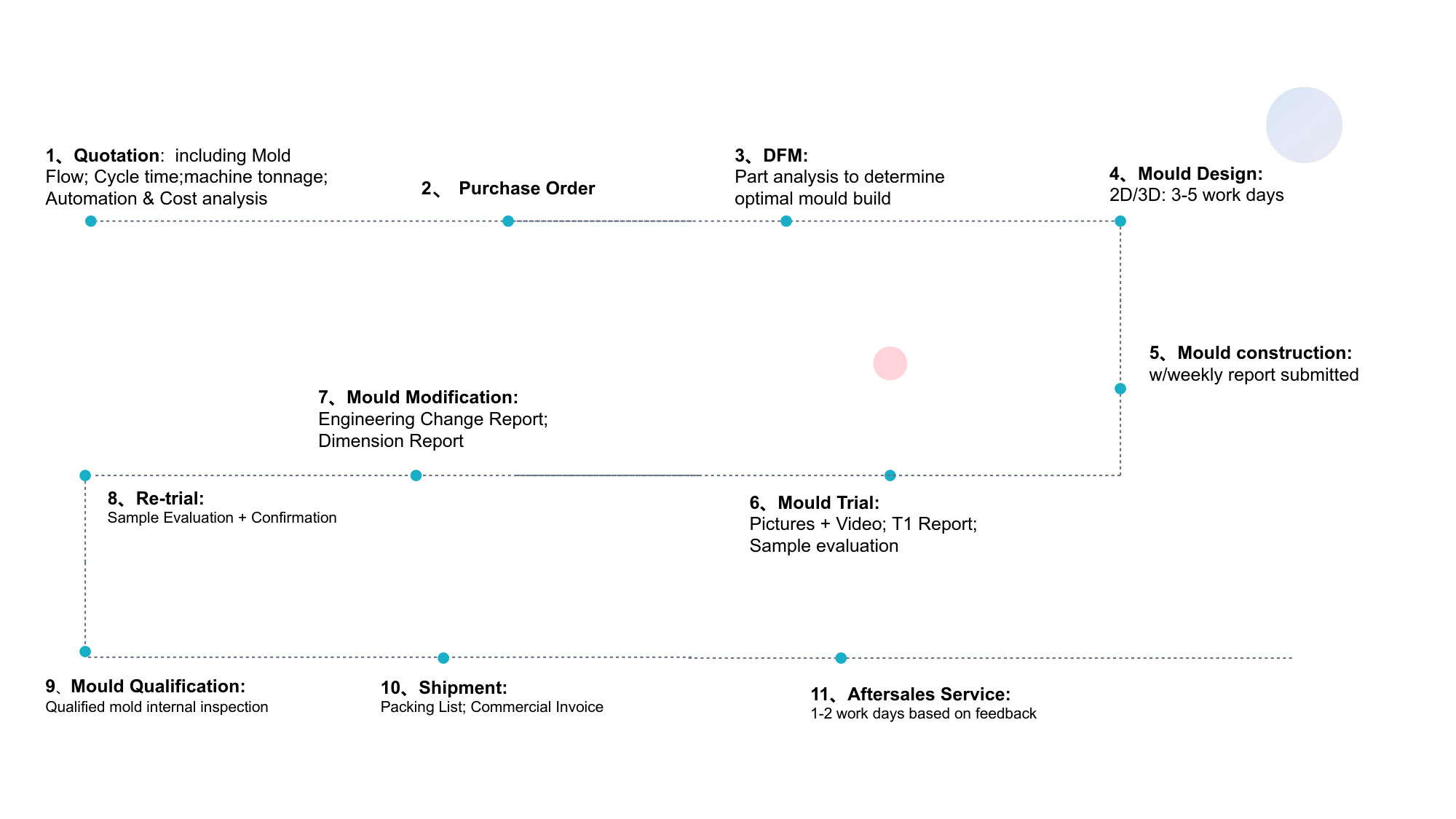
Design Phase: The project begins in the digital domain, not on the factory floor. Ansix’s engineering team, with an average of 12+ years of experience, conducts a thorough collaborative DFM analysis, scrutinizing the connector geometry to identify potential issues such as wall thickness variations, stress concentration, and crown spring groove feasibility, ensuring the part is inherently optimized for production.
Manufacturing Process: Selected steel blocks undergo a precise sequence of machining: CNC milling, EDM for complex details, and high-speed machining for high-precision finishes. Each step is controlled by CMM to ensure micron-level tolerances.
Integrated System Design:
Cooling System: Conformal cooling channels, shaped by 3D printing to follow the contour of the connector housing, are a key efficiency factor. They enable faster and more uniform cooling, reducing cycle time and improving part consistency. This is particularly critical for glass-filled resins, which can exhibit differential shrinkage depending on cooling uniformity.
Feed System and Runners: A hot runner system is typically used to deliver plastic directly into the cavities without cold runners, minimizing material waste. Valve gate sequencing ensures balanced filling of multi-cavity connector molds.
Ejection System: A robust system of ejector pins, sleeves, and potential push plates is designed to gently but firmly remove the complex connector geometry without leaving marks or causing deformation. Given the thin walls and intricate features of connector housings, ejection design is critical to prevent damage to crown spring retention features.
Manufacturing Challenges for Connector Molds: The complexity of connector housings poses specific problems: deep ribs risk insufficient filling, thin walls demand high injection pressure, and undercuts require sophisticated slide mechanisms. Ansix’s expertise is essential in anticipating these difficulties and designing solutions such as optimized venting and strategically placed gates.
III. Moldflow Analysis and Process Optimization
3.1 Simulation-Driven Design Validation
Simulation is not a post-design check; it is integral to the design process. Using advanced software such as Autodesk Moldflow, Ansix conducts comprehensive mold flow analysis (MFA). This virtual prototyping simulates the flow of molten plastic, predicting and eliminating potential defects such as weld lines, air traps, and sink marks.
For the CNT01-29P connector mold, the simulation specifically addresses:
Weld Line Prediction and Mitigation: Connector housings often have multiple features that cause flow fronts to merge. Weld lines are the weakest points in injection-molded parts. Moldflow analysis identifies weld line locations, allowing designers to reposition gates to move weld lines to non-critical areas or strengthen them through optimized packing profiles.
Air Trap Elimination: Trapped air causes short shots, burn marks, and incomplete filling. Simulation identifies air trap locations, enabling proper venting design before the mold is cut.
Gate Location Optimization: Determining optimal gate locations to achieve balanced filling across all cavities, minimize pressure drop, and reduce cycle time.
Dimensional Shrinkage Prediction: Glass-filled resins exhibit anisotropic shrinkage (different shrinkage in flow direction vs. cross-flow direction). Moldflow predicts shrinkage patterns, allowing pre-compensation in the mold dimensions to achieve final part tolerances without trial-and-error.
3.2 Preventing Costly Problems Before They Occur
Ansix provides comprehensive mold flow analysis (DFM reports) before contract signing, offering detailed feasibility assessments including draft angle recommendations, wall thickness optimization, gate location planning, and permissible ejector pin mark locations — preventing customers from discovering structural production issues after mold opening.
Customer Value: This upfront investment in simulation eliminates the cost of mold rework (typically $5,000–$20,000 per iteration) and production trials (50–100 shots per trial × material cost + machine time). More importantly, it prevents production delays that would push back the customer’s product launch schedule.
IV. Product Validation and NPI Process Planning
4.1 Systematic Validation Protocol
Ansix implements a rigorous validation sequence for connector molds, following the IQ/OQ/PQ framework consistent with medical and automotive quality standards:
Installation Qualification (IQ): Verifies that the mold is correctly installed in the injection molding press and that all systems — cooling, hot runner, ejection, safety interlocks — function as intended.
Operational Qualification (OQ): Subjects the mold to its intended operating range, typically varying injection speed, packing pressure, melt temperature, and cooling time to establish the process window. This phase identifies where the process is robust and where it is sensitive to variations. For connector molds, this includes verifying that pin hole diameters and crown spring groove dimensions remain within tolerance across the entire operating window.
Performance Qualification (PQ): Demonstrates that the mold, operating within the established process window, consistently produces parts that meet all specifications, typically over three consecutive production runs of defined duration. Critical to quality parameters such as piece weight (target variation ≤±0.5%) are monitored through statistical process control.
T0 to T3 Trial Samples with Improvement Reports: Ansix provides trial samples with improvement reports after each iteration. Quick interchangeable inserts allow design verification without remaking the entire mold. 100–500 shot pilot production runs validate yield rates and process capability (Cpk) before mass production commitment.
4.2 NPI Process Planning
For connector products, the New Product Introduction (NPI) process includes:
Phase 1 — Design Validation: Review of connector design against injection molding DFM principles, including wall thickness analysis, draft angle verification, and gate location feasibility.
Phase 2 — Tooling and Process Development: Mold design, manufacturing, and initial process setup with Moldflow-validated parameters.
Phase 3 — Product Validation: T0/T1/T2 trial runs with dimensional inspection, functional testing (mating force, contact resistance verification), and environmental testing as required.
Phase 4 — Production Readiness: Process capability validation, operator training, and documentation package delivery including mold drawings, process sheets, inspection reports, and maintenance schedules.
V. Mass Production, Quality Assurance, and Delivery
5.1 Manufacturing Capability and Efficiency
With 260 injection molding machines across four production bases in China and Vietnam, Ansix offers production flexibility and supply chain security that single-location manufacturers cannot match. For connector projects requiring both prototype volumes and mass production quantities, this distributed capacity ensures that production can be ramped up rapidly without disrupting existing customer commitments.
Energy Management Systems: Ansix has implemented energy management systems to reduce energy consumption per part. Medical molding requires precise temperature control, but servo-driven machine designs and insulated hot runner systems can reduce energy consumption by 20–30% compared to conventional equipment.
Multi-Cavity Molding: High-cavitation molds produce more parts per cycle, directly distributing tooling cost and machine overhead across greater production volumes. A 64-cavity mold producing the same number of connector housings as a 32-cavity mold in half the machine hours achieves approximately 50% lower machine-related costs per part. However, this must be weighed against higher initial tooling investment and the complexity of maintaining uniform quality across a larger number of cavities.
5.2 Quality Assurance System
Ansix operates with a complete quality control system and holds ISO9001, IATF16949, ISO13485, and ISO14001 certifications. For connector applications, the quality assurance framework includes:
In-Process Quality Control: Dimensional inspections at defined intervals, visual inspection for cosmetic defects, and functional testing (mating force, contact resistance) at specified frequencies.
Statistical Process Control (SPC): Monitoring of critical parameters such as piece weight, critical dimensions, and process parameters to detect drift before it produces non-conforming parts.
Predictive Maintenance: Every unplanned stoppage — whether for tool cleaning, hot runner repair, or injection unit maintenance — generates additional costs. Ansix’s rigorous validation and continuous monitoring of equipment condition results in fewer interruptions and more consistent uptime, reducing total cost of ownership for customers.
In-House Validation and Testing: By maintaining all testing and validation capabilities internally, Ansix eliminates delays and costs associated with external testing. This vertical integration extends to secondary operations such as assembly, packaging, and quality inspection.
5.3 Delivery and Logistics
Delivery Efficiency: Ansix’s production facilities, strategically located in China and Vietnam, enable the company to serve global medical and industrial markets with reduced lead times. The combination of in-house tooling, molding, and packaging eliminates logistical transfers, accelerating time-to-market from initial design consultation to first shipment of finished components.
Supply Chain Security: With four production bases and complete control of the value chain, Ansix provides unmatched supply chain security and delivery assurance. This redundancy is particularly valuable for customers with global operations who require backup production capacity in case of regional disruptions.
VI. Cost Control and Competitive Advantage
6.1 Systematic Cost Engineering
Ansix’s cost optimization approach addresses every angle of the manufacturing equation:
Material Optimization: Strategic selection and custom compounding eliminate over-engineering and over-spending on material properties. For connector housings, selecting PBT-GF30 instead of a more expensive high-temperature polymer when thermal requirements permit can reduce material cost by 30–40%.
Process Efficiency: Conformal cooling and automation reduce cycle time by 15–30%, directly lowering per-part cost. Faster cycle times also increase production capacity without additional machine investment.
First-Time-Right Success: Heavy upfront investment in simulation and DFM analysis virtually eliminates costly mold rework and production trials, saving significant time and capital. The average mold trial count at Ansix is 2 times, compared to the industry average of 4–5 times.
Production Capacity Enhancement: Stack mold technology and cycle time reduction have enabled Ansix to dramatically increase capacity from a single production line. A documented case increased daily production from 1,300 to 1,670 pieces — a direct 28%+ capacity improvement.
6.2 Total Cost of Ownership Perspective
For cabinet connector applications, the true cost extends beyond the unit price of the molded component. Ansix helps customers evaluate:
Tooling Lifecycle Cost: Proper steel selection and heat treatment extend mold life, reducing the amortized cost per part over the production run.
Scrap Rate Impact: High process capability (Cpk ≥1.33) minimizes scrap and rework, directly improving yield and reducing effective unit cost.
Downtime Cost: Predictive maintenance and robust mold design minimize unplanned production interruptions.
Assembly Efficiency: DFM-optimized designs with snap-fits and self-locating features reduce assembly time and labor cost.
VII. Comprehensive Service Framework: From Concept to After-Sales
7.1 Integrated Service Offerings
Ansix provides end-to-end services spanning the entire product lifecycle:
Product Design & Development: Comprehensive DFM analysis before contract signing, including draft angle recommendations, wall thickness optimization, gate location planning, and permissible ejector pin mark locations.
Moldflow Analysis: Full simulation of filling, packing, and cooling phases to predict and eliminate defects before steel is cut.
DFM Mold Manufacturing: Precision tooling with tolerances as tight as ±0.002mm, using 5-axis machining, slow-wire EDM, and in-house electrode manufacturing.
Product Validation: T0 to T3 trial samples with improvement reports, quick interchangeable inserts for design verification, and 100–500 shot pilot production runs to validate yield rates and Cpk before mass production.
NPI Process Planning: Structured introduction process with defined milestones, deliverables, and validation gates.
Mass Production: 260 injection molding machines across four facilities, with clamp forces from 30T to 4,000T, ensuring capacity for any production volume.
Quality Assurance: ISO9001, IATF16949, and ISO13485 certified quality system with Cpk ≥1.33 guarantee on critical dimensions.
Delivery & After-Sales: Global logistics network with production bases in China and Vietnam, plus ongoing technical support, mold maintenance services, and replacement part availability.
7.2 Turning Technical Capabilities into Customer Value
The key to Ansix’s customer satisfaction and industry leadership lies in systematically translating technical terminology into measurable, tangible client benefits. Rather than presenting raw capabilities abstractly, every technical feature is framed in terms of the specific problem it solves, the cost it saves, and the risk it mitigates.
Example Translation:
Technical Capability Customer Value Delivered
±0.002mm machining accuracy Pin holes and crown spring grooves consistently within tolerance — no assembly rejection due to interference or loose fit
Moldflow simulation before cutting steel Weld lines and air traps eliminated in design phase — no production delays from defect discovery at T1
In-house electrode manufacturing Mold repair turnaround reduced from 10–14 days to 48 hours — minimal production downtime
Cpk ≥1.33 on critical dimensions Scrap rate below 0.1% — direct material and labor cost savings
Conformal cooling channels Cycle time reduced 15–30% — lower per-part machine cost and higher throughput
Four production bases (China + Vietnam) Supply chain redundancy — no single point of failure for global customers
VIII. Conclusion: Why Ansix Leads the Industry
Ansix Tech’s position at the forefront of connector mold manufacturing is built on a foundation of precision equipment, deep engineering expertise, and a customer-centric philosophy. For the CNT01-29P Cabinet Connector Mold project, this means:
Uncompromising Precision: ±0.002mm machining accuracy ensures that every connector housing produced meets the tight tolerances required for reliable mating and long-term contact performance.
Simulation-Driven Engineering: Moldflow analysis and DFM review prevent defects before they occur, eliminating costly rework and accelerating time-to-market.
Material Science Expertise: Optimal selection of PBT-GF30, PA66-GF30, or high-temperature polymers balances performance requirements with cost efficiency.
Vertically Integrated Operations: From design and tooling through molding and packaging, all processes are controlled internally, ensuring quality consistency and schedule reliability.
Measurable Cost Advantages: Systematic cost engineering reduces material, process, and quality costs while improving capacity and yield.
Global Supply Chain Security: Four production bases in China and Vietnam provide redundancy and delivery assurance for customers worldwide.
Ansix Tech does not merely supply molds and molded components. The company functions as a strategic engineering partner, delivering measurable competitive advantage through precision manufacturing, cost engineering, and an unwavering commitment to customer success. This philosophy — “Make Our Customers Successful” — is the driving force behind every connector mold project and the reason why global brands trust Ansix for their most demanding precision molding applications
Ansix Tech Co Ltd
If you have any plans related to CNT01-29P Cabinet Connector Mold , you can contact us at any time. We will turn your ideas into reality, let you realize your dreams, and obtain large orders from the market. Our contact information is info@ansixtech.com. Or contact our CTO, mail: stephen@ansixtech.com
#www.ansixtech.com #ansixtech.com #CNT01-29P Cabinet Connector Mold #CNT01-29P Cabinet Connector Mold tooling #CNT01-29P Cabinet Connector Mold injection mold companies #Ansix #Ansix moulds #Ansix china #Ansix tech china #Ansix tech company #Ansix facotry #Ansix Tooling #Ansix tool #CNT01-29P Cabinet Connector Mold injection molding #CNT01-29P Cabinet Connector Mold injection tools #CNT01-29P Cabinet Connector Mold injection moulds #Ansix moulding company #Ansix molding #ansix tooling #CNT01-29P Cabinet Connector Mold plastic mould #CNT01-29P Cabinet Connector Mold plastic tools #Ansix Tech #Ansix molds #Ansix injection molding #Ansix mold factory #CNT01-29P Cabinet Connector Mold injection molding Customized #Ansix mold factory #CNT01-29P Cabinet Connector Mold china #CNT01-29P Cabinet Connector Mold molds #injection factory for CNT01-29P Cabinet Connector Mold0A 70A Energy Storage Connector Waterproof, Quick-Connect, Stackable Battery Module Plug injection molding #CNT01-29P Cabinet Connector Mold injection molding factory #injection molding company #CNT01-29P Cabinet Connector Mold injection mold companies #Mold for automotive daytime running light guide strip #CNT01-29P Cabinet Connector Mold mold limited #Ansix mold china #Ansix companies for CNT01-29P Cabinet Connector Mold #Ansix company China #CNT01-29P Cabinet Connector Mold facotry #Ansix Tech #Ansix Tech mould #CNT01-29P Cabinet Connector Mold injection moulding #CNT01-29P Cabinet Connector Mold injection moulding company #Ansix CNT01-29P Cabinet Connector Mold parts injection mold companies #CNT01-29P Cabinet Connector Mold injection molding companies china #CNT01-29P Cabinet Connector Mold china factory #Ansix moulding companies #Ansix molding company #CNT01-29P Cabinet Connector Mold injection moulding facotry #Ansix Tech mold #CNT01-29P Cabinet Connector Mold mould #CNT01-29P Cabinet Connector Mold plastic injection molding #ansix plastic mold #CNT01-29P Cabinet Connector Mold Mold manufacturing #CNT01-29P Cabinet Connector Mold parts manufacturing #CNT01-29P Cabinet Connector Mold plastic parts factory #CNT01-29P Cabinet Connector Mold injection parts mold #CNT01-29P Cabinet Connector Mold PRECISION MANUFACTURING #CNT01-29P Cabinet Connector Mold TOOL #China CNT01-29P Cabinet Connector Mold mold #CNT01-29P Cabinet Connector Mold injection moulding china #CNT01-29P Cabinet Connector Mold mould china #china precision mold #CNT01-29P Cabinet Connector Mold mold in china #CNT01-29P Cabinet Connector Mold mold china #CNT01-29P Cabinet Connector Mold Precision molds #High-precision molds #CNT01-29P Cabinet Connector Mold High-precision tool #Injection molds #CNT01-29P Cabinet Connector MoldFactory #CNT01-29P Cabinet Connector MoldCompany #Super Large Injection Mold Factory #Large Tonnage Injection Molding Factory #CNT01-29P Cabinet Connector Mold Company #CNT01-29P Cabinet Connector Mold Factory #2800T Injection Molding Factory #3000 Ton Injection Molding #4500 Ton Injection Molding Factory #CNT01-29P Cabinet Connector Mold Large Mold Injection Molding #Large Plastic Mold Injection Molding Factory #CNT01-29P Cabinet Connector Mold Large Injection Mold Manufacturer #CNT01-29P Cabinet Connector Mold Plastic Mold Factory #Injection Mold #Plastic Mold