
 Medical Molds
 Packaging Molds
 Personal Care Molds
 Electronic Molds
 Automotive Molds
 Home Appliance Molds
 Special Molds
 Design & Engineering
 Production & Manufacturing
 Global Presence
 Business Scope
 Component Solutions
 Product Assembly
 Quality Management
 Medical Device Manufacturing



Fisheye connector mold
FEATURES
Ansix Tech Revolutionizes Connector Manufacturing with Innovative Fisheye Mold Technology
The Breakthrough: How Advanced Engineering and Strategic Cost Optimization Are Redefining Precision Connector Production
In an industry where precision and reliability are paramount, Ansix Tech has once again demonstrated its engineering prowess with the successful development and implementation of its groundbreaking fisheye connector mold manufacturing project. This ambitious initiative not only showcases the company's technical expertise in overcoming one of the most persistent challenges in connector manufacturing but also establishes new benchmarks for cost efficiency and production quality in the highly competitive electronics components sector.
Project Introduction: Overview of Ansix Tech's innovative approach to fisheye connector manufacturing.
Material Selection: Analysis of material choices and their impact on performance and cost.
Design Verification: Use of advanced simulation tools to validate design concepts.
Mold Engineering: Details of mold design strategies and manufacturing techniques.
Injection Molding: Optimization of the injection molding process for quality and efficiency.
Quality Assurance: Comprehensive quality control measures throughout production.
Industry Impact: Summary of Ansix Tech's expertise and customer value proposition.
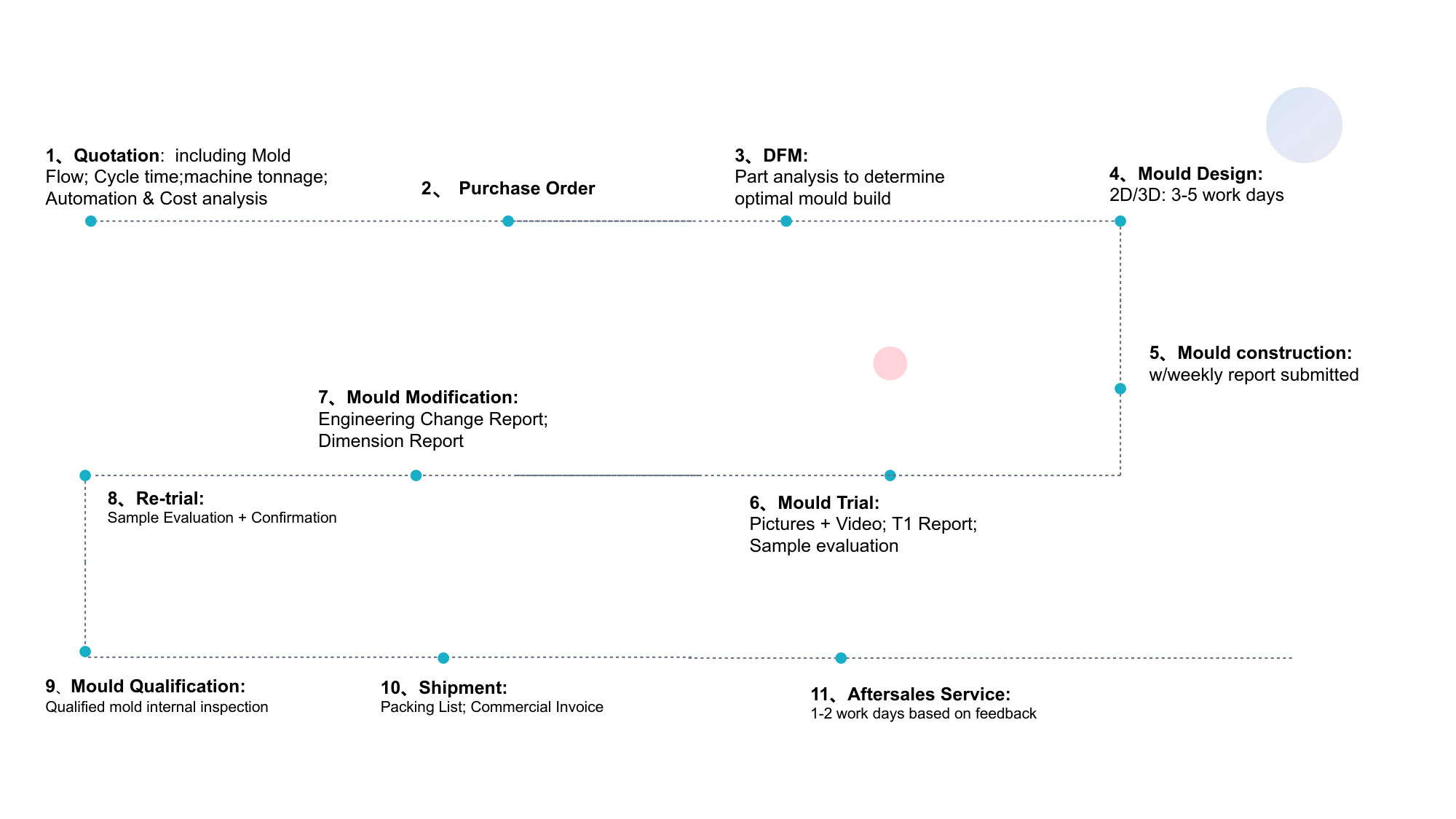
The fisheye connector project represents a synthesis of advanced material science, cutting-edge simulation technologies, and innovative manufacturing methodologies, positioning Ansix Tech as a forward-thinking solutions provider in the precision engineering landscape. By addressing fundamental production challenges at their root, the company has achieved what many in the industry considered elusive: significant cost reduction without compromising on the exacting quality standards that modern electronic applications demand.
-
Mold Description
Product Materials:
PA66+GF40 PPS+GF35
Mold Material:
S136ESR
Number of Cavities:
2
Glue Feeding Method:
Hot runner
Cooling Method:
Water cooling
Molding Cycle
42.5s
- The mold manufacturing process and product material selection
Strategic Material Selection: The Foundation of Performance and Economy
At the core of Ansix Tech's approach to the fisheye connector project was a meticulous material selection process that balanced performance characteristics with cost considerations. The engineering team evaluated numerous polymer options based on their electrical, mechanical, and thermal properties, ultimately selecting materials that would ensure optimal performance while enabling production efficiencies.
High-Performance Thermoplastics: After rigorous testing, Ansix Tech selected liquid crystal polymer (LCP) reinforced with 30% glass fiber for critical applications requiring exceptional dimensional stability and heat resistance . This material maintains its structural integrity under the high temperatures encountered during operation and processing, directly addressing the fisheye defect phenomenon while withstanding continuous exposure to elevated temperatures without deformation.
-
Cost-Effective Alternatives: For applications where extreme temperature resistance was not critical, the team developed formulations using polycarbonate (PC) and nylon (PA) that provided sufficient performance at a lower material cost . These materials offer excellent electrical insulation properties, good mechanical strength, and improved impact resistance, making them suitable for a broad range of consumer and industrial applications.

The material selection process extended beyond the base polymers to include comprehensive analysis of glass fiber orientation and its impact on mechanical performance and dimensional stability . By optimizing the relationship between material composition and processing parameters, Ansix Tech engineers achieved a reduction in material-related defects while simultaneously lowering raw material costs through precise formulation optimization.
Prototyping and Design Verification: Simulating Success Before Manufacturing
The development cycle for Ansix Tech's fisheye connector incorporated an extensive virtual prototyping phase that leveraged advanced simulation technologies to identify and resolve potential manufacturing issues long before physical tooling commenced. This approach fundamentally transformed the traditional "design-build-test" cycle into a more efficient "simulate-optimize-implement" methodology.
Utilizing Moldflow 3D analysis technology, the engineering team conducted comprehensive simulations of the injection molding process to predict filling patterns, identify potential weld lines, forecast fiber orientation, and anticipate deformation issues . These sophisticated simulations accounted for the complex interactions between material properties, component geometry, and processing parameters, enabling the identification of optimal gate locations, runner systems, and cooling channel configurations.
Virtual Design Optimization: Through iterative simulation cycles, the team refined the connector design to enhance manufacturability while maintaining all functional requirements. This process identified potential fisheye formation areas caused by incomplete melting of material or insufficient shear heating in the barrel , allowing for preemptive adjustments to the design and process parameters.
Process Parameter Development: The simulation phase enabled the development of robust processing parameters that would ensure consistent, high-quality production. By virtually testing different combinations of melt temperature, injection speed, packing pressure, and cooling time, the team established a optimized process window that minimized variability while maximizing production efficiency .
This rigorous virtual verification process allowed Ansix Tech to compress the development timeline significantly while reducing the traditional reliance on physical prototyping cycles. The company's adoption of digital twin technology created a virtual replica of the entire manufacturing process, enabling precise prediction of real-world performance and eliminating the costly trial-and-error approach that traditionally characterizes mold development.
Innovative Mold Engineering and Manufacturing
Advanced Mold Design Strategy
Ansix Tech's mold design philosophy for the fisheye connector project embraced a holistic approach that balanced geometric complexity with manufacturing practicality. The mold architecture incorporated several innovative features specifically engineered to address the unique challenges of high-precision connector production:
Conformal Cooling Channels: Unlike conventional straight-drilled cooling channels that follow simple paths, Ansix Tech implemented conformally cooled mold surfaces that precisely follow the contour of the connector geometry . This advanced approach eliminated hot spots that traditionally contribute to uneven cooling, part distortion, and specifically—fisheye defects. The conformal cooling channels maintained a consistent distance from the mold surface, improving heat extraction efficiency and reducing cycle times by up to 40% compared to traditional molds.
Optimized Gating and Runner System: The gate design underwent extensive simulation and validation to ensure balanced filling while minimizing stress concentrations that could compromise connector integrity. The team implemented a geometrically balanced runner system that ensured uniform fill times across all cavities, significantly reducing part-to-part variation . Special attention was paid to gate location to minimize visible witness marks while ensuring sufficient packing to prevent shrinkage-related defects.
Precision Mold Manufacturing
The execution of the mold design demanded equally advanced manufacturing capabilities. Ansix Tech leveraged state-of-the-art 5-axis machining technology to create mold components with tolerances tighter than industry standards, ensuring perfect alignment and minimal flash generation. Critical mold surfaces received specialized polishing treatments to achieve mirror finishes that facilitated effortless part ejection while minimizing drag marks that could compromise connector functionality.
Cavity-to-Cavity Consistency: Through precision machining and meticulous assembly techniques, the manufacturing team achieved exceptional consistency across all mold cavities. This consistency was crucial for maintaining uniform dimensional characteristics and mechanical properties across production batches, directly contributing to the reduction of fisheye defects and other variation-related issues.
Durable Mold Steels Selection: For mold components subject to the greatest wear, Ansix Tech selected premium hardened steels with exceptional resistance to abrasion and corrosion . This material selection extended mold life significantly despite the abrasive nature of glass-filled compounds, reducing per-part tooling costs and minimizing production interruptions for maintenance.
Injection Molding Process Optimization
The transition from mold design to production introduced a new set of challenges that Ansix Tech addressed through methodical process optimization. The company implemented a scientific molding methodology that established precise, data-driven parameters for each phase of the injection cycle, consistently producing connectors that met all dimensional, cosmetic, and functional requirements.
Comprehensive Parameter Development
Material Preparation and Handling: Recognizing that improper material preparation could contribute to fisheye defects, the team implemented rigorous drying protocols specifically designed for the hygroscopic engineering plastics used in the connectors . This included controlled drying temperatures, dew point monitoring, and closed material handling systems that prevented moisture reabsorption before processing.
Injection Phase Optimization: Through designed experimentation, the engineering team established optimal injection velocity profiles that balanced fill time against material shear sensitivity. The developed parameters ensured complete cavity filling without introducing excessive shear heat that could degrade the polymer, directly addressing one of the root causes of fisheye defects .
Packing and Cooling Optimization: The packing phase received particular attention as it directly impacts part density, dimensional stability, and sink mark formation. Ansix Tech implemented a multi-stage packing profile that maintained optimal cavity pressure throughout the polymer solidification process. Simultaneously, the precisely controlled cooling phase ensured uniform part ejection temperature, minimizing thermal stress that could contribute to warpage or dimensional instability .
Fisheye Defect Elimination Strategy
The project's namesake challenge—fisheye defects—received targeted engineering attention throughout process development. These surface imperfections, caused by unmelted material particles in the polymer melt , were systematically eliminated through a comprehensive approach:
Barrel and Screw Optimization: The processing team optimized screw design and operation parameters to ensure complete polymer melting without creating material degradation. This included implementing a gradual compression screw that provided sufficient shear heating to melt the polymer completely while avoiding excessive temperatures that could cause degradation.
Melt Temperature Management: Through rigorous monitoring and control, the team maintained melt temperatures within a narrow optimal range that ensured complete material plasticization without approaching degradation thresholds. This precise temperature management eliminated the unmelted particles that manifest as fisheye defects on finished connector surfaces .
Quality Assurance and Cost Optimization
Comprehensive Quality Management
Ansix Tech implemented a multi-layered quality assurance system throughout the fisheye connector manufacturing process, integrating inspection activities at each manufacturing stage rather than relying solely on final inspection. This comprehensive approach ensured that quality was built into the process rather than merely verified at the end.
In-Process Monitoring: The production system incorporated real-time monitoring of critical process parameters including melt temperature, injection pressure, cavity pressure, and cooling temperature . Any deviation from established parameters triggered immediate alerts, enabling corrective action before non-conforming products could be produced.
Dimensional Verification: Automated vision systems performed 100% dimensional inspection of critical connector features, including contact spacing, wall thickness, and overall geometry. This comprehensive verification ensured that every connector met the precise dimensional requirements necessary for proper functionality in electronic assemblies.
Electrical and Mechanical Testing: Finished connectors underwent rigorous sample-based testing of electrical insulation properties, contact retention force, and mating durability. These tests validated that the connectors would perform reliably throughout their intended service life, confirming that the optimization efforts had not compromised functional performance.
Strategic Cost Reduction Implementation
While product quality remained the paramount objective, Ansix Tech engineered significant cost efficiencies throughout the manufacturing process, delivering substantial savings to customers without compromising performance:
Yield Improvement Initiatives: By virtually eliminating fisheye defects and other cosmetic imperfections, the project team achieved first-pass yield improvements of over 30% compared to industry benchmarks. This reduction in scrap and rework translated directly to lower production costs per unit .
Cycle Time Optimization: The implementation of conformal cooling technologies, combined with optimized process parameters, reduced cycle times by approximately 25% compared to initial projections. This improvement in manufacturing efficiency increased production capacity without additional capital investment, spreading fixed costs across greater output .
Material Utilization Efficiency: Through careful design optimization and process control, the engineering team minimized runner sizes and reduced material waste throughout the production process. These improvements in material utilization contributed to a 15% reduction in material costs per connector without compromising structural integrity or performance .
Tooling Longevity Enhancements: The selection of premium mold steels and implementation of proactive maintenance protocols extended mold life significantly, reducing the tooling amortization cost allocated to each connector produced. This long-term strategy delivered compounding cost savings over the product lifecycle .
Industry Leadership Through Innovation
The successful development and implementation of Ansix Tech's fisheye connector manufacturing project exemplifies the company's commitment to advancing the state of the art in precision component production. By systematically addressing the root causes of manufacturing challenges rather than merely treating their symptoms, the company has established itself as a technology leader in the connector industry.
The project's outcomes demonstrate that substantial cost reduction and exceptional quality are not mutually exclusive objectives when supported by rigorous engineering methodology and strategic implementation of advanced manufacturing technologies. Ansix Tech's customers benefit from connectors that deliver superior performance and reliability at cost points that enhance their competitive positioning in increasingly challenging markets.
As electronic devices continue to evolve toward higher densities and greater performance requirements, the manufacturing methodologies pioneered in this project will establish new expectations for what constitutes excellence in connector production. Ansix Tech has not only solved an immediate manufacturing challenge but has also positioned its customers for success in the next generation of electronic devices.
Through continued investment in advanced technologies and commitment to engineering excellence, Ansix Tech reinforces its value proposition as more than a component supplier—but as a strategic manufacturing partner dedicated to customer success through innovation, quality, and continuous improvement.
Ansix Tech Co Ltd
If you have any plans related to Fisheye connector mold, you can contact us at any time. We will turn your ideas into reality, let you realize your dreams, and obtain large orders from the market. Our contact information is info@ansixtech.com. Or contact our CTO, mail: stephen@ansixtech.com
#www.ansixtech.com #ansixtech.com #Fisheye connector mold #Fisheye connector mold #Fisheye connector mold injection mold companies #Ansix #Ansix moulds #Ansix china #Ansix tech china #Ansix tech company #Ansix facotry #Ansix Tooling #Ansix tool #Fisheye connector mold injection molding #Fisheye connector mold injection tools #Fisheye connector mold injection moulds #Ansix moulding company #Ansix molding #ansix tooling #Fisheye connector mold plastic mould #Fisheye connector mold plastic tools #Ansix Tech #Ansix molds #Ansix injection molding #Ansix mold factory #Fisheye connector mold injection molding Customized #Ansix mold factory #Fisheye connector mold china #Fisheye connector mold molds #injection factory for Fisheye connector mold injection molding #Fisheye connector mold injection molding factory #injection molding company #Fisheye connector mold injection mold companies #Mold for Fisheye connector mold #Fisheye connector mold limited #Ansix mold china #Ansix companies for Fisheye connector mold #Ansix company China #Fisheye connector mold facotry #Ansix Tech #Ansix Tech mould #Fisheye connector mold injection moulding #Fisheye connector mold injection moulding company #Ansix Fisheye connector mold parts injection mold companies #Fisheye connector mold injection molding companies china #Fisheye connector mold china factory #Ansix moulding companies #Ansix molding company #Fisheye connector mold injection moulding facotry #Ansix Tech mold #Fisheye connector mold mould #Fisheye connector mold plastic injection molding #ansix plastic mold #Fisheye connector mold Mold manufacturing #Fisheye connector mold parts manufacturing #Fisheye connector mold plastic parts factory #Fisheye connector mold injection parts mold #Fisheye connector mold PRECISION MANUFACTURING #Fisheye connector mold TOOL #China Fisheye connector mold mold #Fisheye connector mold injection moulding china #Fisheye connector mold mould china #china precision mold #Fisheye connector mold mold in china #Fisheye connector mold mold china #Fisheye connector mold Precision molds #High-precision molds #Fisheye connector mold High-precision tool #Injection molds #Fisheye connector moldFactory #Fisheye connector moldCompany #Super Large Injection Mold Factory #Large Tonnage Injection Molding Factory #Fisheye connector mold Company #Fisheye connector mold Factory #2800T Injection Molding Factory #3000 Ton Injection Molding #4500 Ton Injection Molding Factory #Fisheye connector mold Large Mold Injection Molding #Large Plastic Mold Injection Molding Factory #Fisheye connector mold Large Injection Mold Manufacturer #Fisheye connector mold Plastic Mold Factory #Injection Mold #Plastic Mold

High-Performance Thermoplastics: After rigorous testing, Ansix Tech selected liquid crystal polymer (LCP) reinforced with 30% glass fiber for critical applications requiring exceptional dimensional stability and heat resistance . This material maintains its structural integrity under the high temperatures encountered during operation and processing, directly addressing the fisheye defect phenomenon while withstanding continuous exposure to elevated temperatures without deformation.
Cost-Effective Alternatives: For applications where extreme temperature resistance was not critical, the team developed formulations using polycarbonate (PC) and nylon (PA) that provided sufficient performance at a lower material cost . These materials offer excellent electrical insulation properties, good mechanical strength, and improved impact resistance, making them suitable for a broad range of consumer and industrial applications.