
 Medical Molds
 Packaging Molds
 Personal Care Molds
 Electronic Molds
 Automotive Molds
 Home Appliance Molds
 Special Molds
 Design & Engineering
 Production & Manufacturing
 Global Presence
 Business Scope
 Component Solutions
 Product Assembly
 Quality Management
 Medical Device Manufacturing



Foldable Dispensing ToolMold for BV Wire Spools
FEATURES
Foundation of Trust — The “Hard Power” Infrastructure
1.1 Mold Machining Equipment: Precision That Eliminates Post-Processing
The foundation of any injection mold’s success lies in the precision of its machining. For Foldable Dispensing Tool molds — where folding hinge tolerances, spool support rod alignment, and structural locking mechanisms demand micron-level accuracy — Ansix deploys a comprehensive suite of precision machining assets .
Five-Axis High-Speed Machining Centers achieve contour accuracy of ±0.002 mm (2 microns) on complex freeform surfaces. For folding tool components, this translates directly to seamless parting lines, elimination of manual polishing passes, and consistent reproduction of intricate hinge geometries across all cavities .
Slow-Wire EDM Systems deliver positioning accuracy of ±0.003 mm and can machine features as small as 0.03 mm in diameter. This capability is critical for the fine details of folding mechanisms — narrow slots, thin-walled hinge sections, and precision pin-retention features .
CNC Sinker EDM with In-House Electrode Manufacturing reduces electrode lead time from the industry-typical 10–14 days to 48 hours. This internal capability eliminates dependency on external suppliers and dramatically accelerates mold repair and modification turnaround .
-
Mold Description
Product Materials:
pa pa
Mold Material:
S136ESR
Number of Cavities:
1+1
Glue Feeding Method:
Hot runner
Cooling Method:
Water cooling
Molding Cycle
42.5s
- The mold manufacturing process and product material selection
Injection Molding Machine Fleet: Scale Meets Consistency
Ansix operates 260 injection molding machines across four production bases in China and Vietnam, with tonnage ranging from 30 tons to 2,800 tons . This fleet includes leading global brands: Japan’s Fanuc, Sumitomo, Toshiba, Nissei, and Engel; Germany’s Arburg (specializing in liquid silicone and two-component molding); and domestic leaders like Haitian and Taichung Precision .
For Foldable Dispensing Tool production, this breadth of tonnage ensures that everything from small hinge pins to large structural frame components can be molded in-house. All-electric machines on presses ≤650 tons provide ±0.1% shot-to-shot repeatability, critical for folding tool components where dimensional consistency directly impacts assembly fit and field performance .
The facility spans over 200,000 square meters of building area, employs more than 1,200 people (including over 200 designers), and has produced over 30,000 mold sets since inception . The automated machining ratio stands at 70% , with average mold trials limited to just 2 rounds — a testament to first-time-right engineering .
1.3 Quality Inspection and Metrology: Data That Proves Performance
No mold or molded component leaves Ansix without statistically validated proof of conformance. The quality lab features Coordinate Measuring Machines (CMM) with ±0.001 mm (1 micron) accuracy. Every production mold undergoes full dimensional inspection before delivery, with all critical dimensions reported and Key Characteristic CPK values computed .
Ansix maintains a documented commitment: “Every mold shipped from Ansix includes a full dimensional report. Critical dimension CPK ≥1.33 is guaranteed before production release. No exceptions” .
1.4 Certifications and Compliance
Ansix’s quality management system holds ISO9001, ISO14001, IATF16949, and ISO13485 certifications . For Foldable Dispensing Tool applications — particularly those serving electrical and telecommunications infrastructure markets — this compliance framework provides documented traceability, process control, and continuous improvement protocols that global OEMs require.
-
Project Initiation — Converting Technical Expertise into Customer Value
2.1 The Ansix Project Initiation Philosophy
At Ansix Tech, the project initiation phase is treated as the most critical value-creation window. Rather than a transactional handoff where the customer provides CAD files and the factory simply cuts steel, Ansix employs a multi-disciplinary review process that involves design engineers, mold flow analysts, and production managers working collaboratively before any material is removed .
For Foldable Dispensing Tool Molds, this closed-loop feedback system ensures that every tolerance, feature, and material selection is mapped to its ultimate function: field durability, user safety, and cost-efficient manufacturability.
2.2 Design for Manufacturability (DFM): Pre-Empting Problems Before Steel Is Cut
The DFM process for Foldable Dispensing Tools addresses several critical design challenges:
Folding Mechanism Integrity: The hinge points of a foldable tool experience repeated stress cycles. DFM analysis evaluates wall thickness transitions, rib placement, and material flow around hinge features to prevent warpage, sink marks, and stress concentrations that could lead to premature failure.
Structural Load Paths: The tool must support the weight of wire spools — potentially up to 2,500 feet of cable — without deflection or deformation. DFM analysis identifies optimal ribbing patterns, gusset placements, and wall thickness distributions to maximize structural rigidity while minimizing material usage and cycle time.
Assembly Simplification: Ansix designers employ DFM principles early to reduce part counts, integrate snap-fits where appropriate, and eliminate secondary operations. By simplifying assemblies, Ansix can lower assembly time and reduce total landed cost for the customer .
Gate Location and Runner Optimization: For multi-cavity Foldable Dispensing Tool molds, gate placement directly impacts filling balance, shrinkage uniformity, and weld-line quality. Ansix performs iterative simulations to identify optimal gate locations before committing to steel .
2.3 Moldflow Analysis: Virtual Validation Before Physical Commitment
Moldflow analysis (MFA) at Ansix goes beyond standard fill-time prediction. The team calibrates simulations specifically for the engineering-grade materials used in structural tools — typically glass-filled nylons, polypropylenes, or ABS grades selected for impact resistance and UV stability .
For Foldable Dispensing Tools, MFA delivers:
Weld Line Analysis: In folding tool frames, weld lines located in high-stress areas (hinge roots, locking tabs, spool support mounts) represent potential failure points. Iterative simulation identifies and relocates weld lines to low-stress regions or optimizes process parameters to strengthen them.
Cooling Uniformity Prediction: Cooling accounts for 70–80% of cycle time. Ansix selects high-thermal-conductivity materials (copper alloys with 160–250 W/m·K) for critical mold sections to accelerate heat dissipation and reduce cycle time .
Shrinkage and Warpage Compensation: Folding tools with long structural members are particularly susceptible to differential shrinkage. MFA predicts shrinkage patterns so that mold dimensions can be pre-compensated, eliminating trial-and-error iterations.
2.4 Quality Gating: Defining Success Before Manufacturing Begins
Before the project enters the mold manufacturing phase, Ansix defines Critical-to-Quality (CTQ) parameters . For Foldable Dispensing Tool Molds, these typically include:
Hinge pin bore concentricity: Tolerance measured in microns to ensure smooth folding without binding.
Spool support rod alignment: Critical for preventing cable tangling or uneven dispensing.
Locking mechanism engagement force: Specified within a functional range to ensure secure deployment and easy folding.
Surface finish on cable contact surfaces: To prevent abrasion damage to wire insulation during dispensing.
By defining these parameters upfront, validation becomes a structured phase of the manufacturing lifecycle rather than an after-the-fact corrective exercise.
Part Three: Product Introduction — Foldable Dispensing Tool Mold for BV Wire Spools
3.1 Product Overview
The Foldable Dispensing Tool is a portable, collapsible apparatus engineered to hold and dispense wire and cable products from BV-style spools during field installation. The device is designed for transportability — capable of being completely disassembled for storage in a gang box or vehicle trunk — while providing stable, controlled cable dispensing during use .
Typical construction includes:
H-Frame Section: The primary structural base, fabricated from square tubing or molded structural components, equipped with caster wheels for mobility and support bridges for the C-frame section .
C-Frame Section: The spool-supporting member that interfaces with the H-frame via hand-knob locking mechanisms, allowing for quick assembly and disassembly .
Spool Support Rods: Zinc-coated or stainless steel rods that pass through the center of wire spools to allow free rotation during dispensing .
Folding Mechanism: Hinge assemblies or sliding joints that allow the tool to collapse into a compact footprint for transport.
3.2 Material Selection for Foldable Dispensing Tools
Material selection is a high-stakes balance between conductivity (not required for structural components), thermal stability, mechanical strength, and cost. Ansix approaches material selection as a core engineering competency, not a procurement decision .
For structural components of Foldable Dispensing Tools, candidate materials typically include:
Material Key Properties Application
Glass-Filled Nylon (PA6-GF30) High stiffness, excellent fatigue resistance, good chemical resistance Hinge components, locking mechanisms, structural brackets
Polypropylene (PP) Copolymer High impact resistance at low temperatures, good chemical resistance Frame components, spool supports, protective covers
ABS Good balance of strength, toughness, and cosmetic appearance Visible housing components, control knobs
PC/ABS Blend Superior impact strength, dimensional stability, heat resistance High-stress structural members
Glass-Filled PBT Excellent dimensional stability, low moisture absorption Precision hinge pins, close-tolerance features
The intended use of the part is the paramount consideration: Will it be used in high-impact field conditions? Will it be exposed to sunlight, damp conditions, or temperature extremes? For outdoor wire installation tools, UV resistance and hydrolytic stability are non-negotiable .
3.3 Manufacturing Process Flow: From CAD to Completion
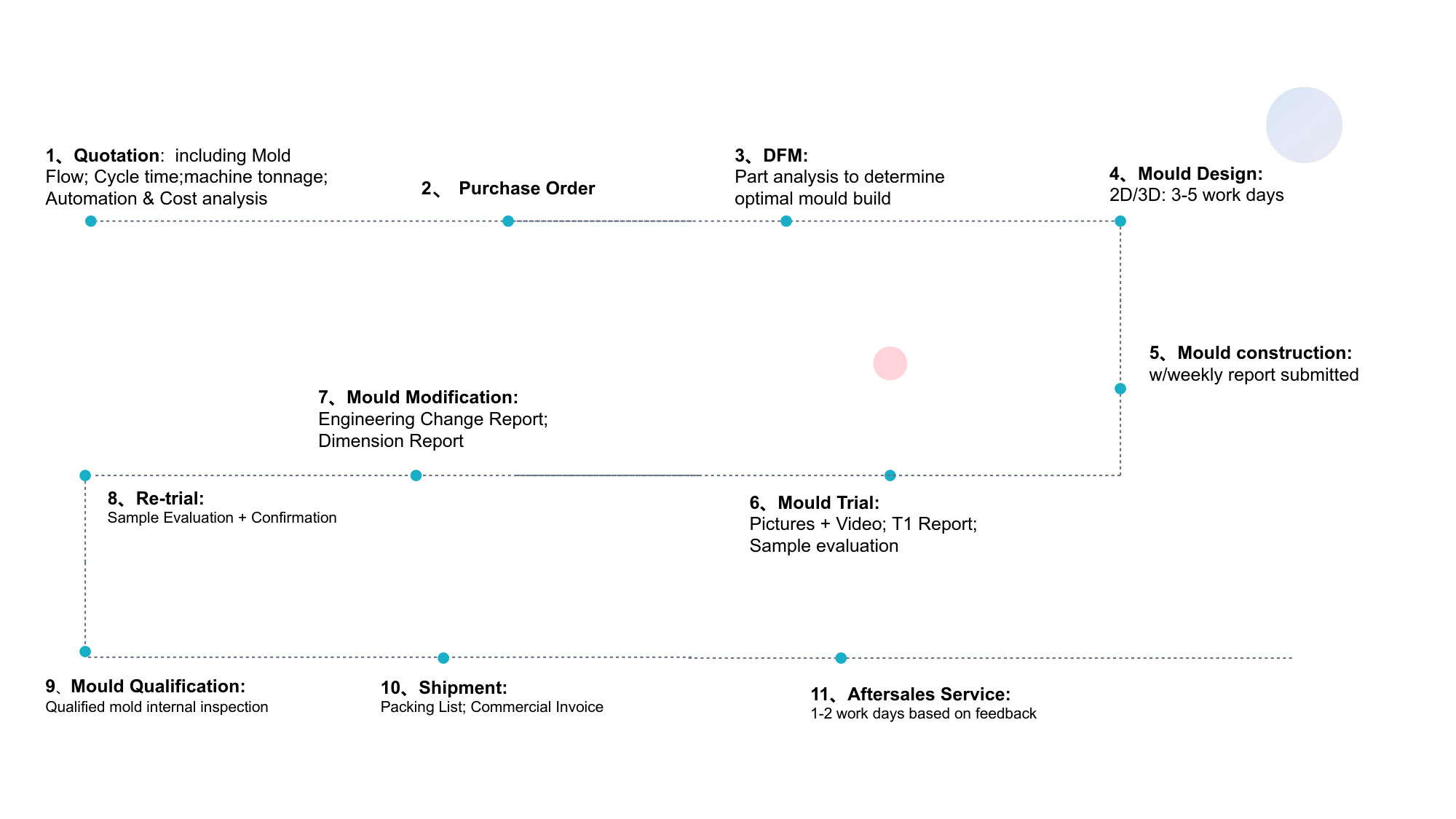
The manufacturing process for Foldable Dispensing Tool Molds follows a structured, quality-gated workflow :
CAD/CAM Design and Simulation — 3D modeling and Moldflow validation using industry-leading software.
Material Procurement and Certification — All mold steels sourced with full material certificates and heat treatment documentation.
CNC Rough Machining — Material removal to approximate dimensions.
Heat Treatment — Controlled process with documented temperature curves.
Precision Finishing — 5-axis CNC machining to final dimensions.
EDM and Wire Cutting — Fine features, narrow slots, and complex geometries.
Surface Finishing — Polishing to specified surface roughness.
Assembly and Fitment — Core/cavity assembly, cooling channel pressure testing.
CMM Inspection — Full dimensional verification against CAD model.
Mold Trial (T0) — 2,000-cycle trial with data logging and defect inspection.
Customer Sampling (T1–T3) — Customer-approved samples with corrective action reports.
Pre-production Validation — 100–500 shot batch, CPK ≥ 1.33 confirmation.
Final Inspection and Shipping — Full documentation package delivered with mold.
3.4 Delivery Efficiency and Quality Assurance
Ansix’s standard delivery timeline for mold manufacturing is 45–60 days from order confirmation, with expedited options available for time-critical projects . This schedule is underpinned by:
In-house electrode manufacturing reducing lead times by 60–80%.
70% automated machining ratio minimizing manual intervention and variability.
Average 2 mold trials versus industry-typical 4–6, achieved through rigorous upfront simulation.
Quality assurance protocols for Foldable Dispensing Tool production include:
Incoming Material Control: Resin moisture verification, color and additive verification, batch-level certificates of analysis.
In-Process Quality Control: Shot weight monitoring per cycle, cavity-to-cavity weight balance, visual inspection under standardized lighting.
Statistical Process Control (SPC): X-R control charts for critical dimensions, CPK tracking with target ≥1.33.
Final Product Verification: Dimensional inspection using CMM, functional testing of folding mechanisms, load testing of spool supports.
3.5 Cost Control and Competitive Advantage
Ansix’s cost control strategy for Foldable Dispensing Tool Molds operates on multiple levels:
Design-Level Cost Engineering: DFM optimization reduces part counts, eliminates unnecessary features, and simplifies assembly. By simplifying assemblies — reducing screws in favor of snap-fits, consolidating components — Ansix can lower assembly time and total cost .
Material Cost Optimization: For structural components, Ansix evaluates the trade-off between material cost and processing cost. Glass-filled engineering resins cost more per kilogram but may enable thinner walls, faster cycles, and fewer reject parts. The total cost of ownership calculation, not the raw material price, drives material selection.
Cycle Time Reduction: Optimized cooling design — using high-thermal-conductivity materials and conformal cooling channels where beneficial — can reduce cycle times by 20–30% below industry baseline . On a 60-second cycle, each second shaved increases annual capacity by approximately 80,000 parts (single-cavity, 8,000 operating hours).
Multi-Cavity Efficiency: High-cavitation molds produce more parts per cycle, directly distributing tooling and machine overhead costs across greater production volumes. A 64-cavity mold producing the same quantity as a 32-cavity mold in half the machine hours achieves approximately 50% lower machine-related cost per part .
Energy Efficiency: Ansix’s transition to all-electric injection molding machines has reduced energy consumption per cycle by 30% while improving Overall Equipment Effectiveness (OEE) by over 85% .
Consolidated Supply Chain: By maintaining mold making, injection molding, secondary operations, and packaging under one roof, Ansix eliminates inter-supplier freight costs and reduces total logistics spend by 30–50% .
Part Four: Core Value for Customers — Mold Manufacturing and Injection Molding Excellence
4.1 Material Selection: The Foundation of Product Performance
For Foldable Dispensing Tool Mold production, Ansix applies a rigorous material selection framework :
Intended Use Analysis: What loads will the tool experience? What temperature range? Will it be exposed to sunlight, moisture, or chemicals? For wire dispensing tools used in outdoor electrical installation, UV-stabilized materials with hydrolytic resistance are essential.
Regulatory Compliance: Does the part require flame retardancy (UL94 V-0)? Does it contact food or medical products (FDA, USP Class VI)? For electrical infrastructure tools, compliance with relevant IEC standards may be required.
Cosmetic Requirements: Does the part require a specific color for brand identity or safety visibility? Does it need a textured surface for grip?
Expected Product Lifetime: Is this a 5-year or 25-year product? Engineering resins offer superior longevity but at higher material cost. The total lifecycle cost analysis guides the selection.
Secondary Operations Compatibility: Will the part be machined, assembled, or overmolded? Material selection must account for downstream processing.
4.2 Intelligent Manufacturing: Efficiency Through Technology
Ansix’s smart manufacturing infrastructure directly benefits Foldable Dispensing Tool production through:
Real-Time Process Monitoring: Pressure sensors and vision systems detect deviations instantly, reducing defect rates from 3% to 0.5% .
Automated Packaging Integration: For high-volume production, automated packaging lines can be integrated directly with molding, eliminating manual handling and reducing contamination risk .
SMED (Single-Minute Exchange of Die): Quick-changeover techniques reduce mold change time by 60% , enhancing equipment utilization to >85% .
Predictive Maintenance: Continuous monitoring of mold and machine condition reduces unplanned downtime, ensuring consistent delivery schedules.
4.3 Process Quality Assurance: Built-In, Not Bolted-On
Quality at Ansix is not a final inspection step — it is an integrated manufacturing philosophy. For Foldable Dispensing Tool Molds, quality assurance operates at every stage:
Mold Qualification Protocol: Following ISO 13485-aligned validation protocols, every mold undergoes Installation Qualification (IQ), Operational Qualification (OQ), and Performance Qualification (PQ). The OQ phase establishes the process window by varying injection speed, packing pressure, melt temperature, and cooling time to identify robust operating parameters .
Statistical Process Control: Critical dimensions are monitored using control charts, with CPK ≥1.33 required before production release. When CPK approaches the lower control limit, continuous improvement loops activate .
Full Traceability: Every production batch receives a unique lot number tracing back to raw material batch numbers, molding machine, mold cavity, operator, shift, and all process parameters recorded during the run .
Part Five: Manufacturing Solutions for Foldable Dispensing Tool Molds — A 2000+ Word Industry Analysis
5.1 Market Context: Why Foldable Dispensing Tools Matter
The global expansion of electrical and telecommunications infrastructure — driven by 5G deployment, rural electrification, and data center construction — has created unprecedented demand for efficient cable installation tools. Traditional cable dispensing methods involve stationary spool racks or improvised field solutions that are heavy, cumbersome, and inefficient. Foldable Dispensing Tools address this pain point by providing a portable, quick-deploy, quick-collapse solution that can be transported in a standard service vehicle and set up by a single technician .
For mold manufacturers, this product category presents unique challenges:
Structural Load Requirements: The tool must support spools weighing up to 100+ kg without deflection or instability.
Repeated Use Durability: Hinge mechanisms must survive thousands of fold/unfold cycles without degradation.
Field Environment Exposure: UV radiation, temperature extremes, moisture, and rough handling demand robust material selection.
Cost Sensitivity: As a field tool, not a consumer product, cost pressures are intense while quality expectations remain high.
5.2 Ansix’s Approach: Engineering the Total Solution
Ansix Tech approaches Foldable Dispensing Tool mold projects as integrated engineering challenges, not isolated manufacturing transactions. The company’s competitive advantage lies in converting deep technical expertise into tangible customer value across five dimensions.
Dimension One: Design for Manufacturability (DFM) as Risk Mitigation
The DFM process at Ansix functions as an insurance policy against expensive downstream problems. For a Foldable Dispensing Tool mold, DFM analysis might reveal:
Thick wall sections in the frame that would cause sink marks and extended cycle times. Solution: Core out thick sections and replace with ribbed structures that maintain stiffness.
Uneven cooling around hinge features that would cause warpage and binding. Solution: Redesign cooling channel layout to provide uniform heat extraction.
Weld lines located at the highest stress point of the folding joint. Solution: Relocate the gate to shift weld line position or add an overflow well to strengthen the weld.
Each DFM-identified issue that is corrected in the design phase eliminates a potential mold modification, a production delay, or a field failure. The cost of DFM analysis is measured in hours; the cost of fixing a design flaw after mold steel is cut is measured in weeks and tens of thousands of dollars.
Dimension Two: Moldflow Analysis as Virtual Prototyping
Moldflow analysis for Foldable Dispensing Tools goes beyond simple fill simulation. Ansix’s CAE team performs:
Fill and Pack Analysis: Confirming complete filling without short shots, predicting packing pressure distribution, and identifying potential void formation.
Cooling Analysis: Predicting temperature distribution across the mold surface, identifying hot spots that would cause differential shrinkage, and optimizing cooling circuit design.
Warpage Analysis: Predicting final part deformation based on anisotropic shrinkage, fiber orientation (for glass-filled materials), and cooling imbalance.
For a structural component like a folding tool frame, warp analysis is particularly critical. Even minor warpage in a long structural member can cause misalignment at assembly, binding at hinges, or instability when the tool is loaded with a wire spool. By pre-compensating mold dimensions based on warpage predictions, Ansix delivers molds that produce in-spec parts from the first shot.
Dimension Three: Material Science as Performance Engineering
Material selection for Foldable Dispensing Tools is not a catalog exercise. Ansix engineers evaluate materials against the specific mechanical, thermal, and environmental demands of the application.
For a typical foldable dispensing tool, the material selection matrix might include:
Hinge and Locking Components: Glass-filled nylon (PA6-GF30 or PA66-GF30) offers high stiffness, excellent fatigue resistance, and good dimensional stability. The glass fiber reinforcement provides the creep resistance needed for components under constant load.
Structural Frame Members: Long-glass-fiber reinforced polypropylene (LGF-PP) can provide exceptional impact resistance at low temperatures — critical for tools that might be left in a vehicle overnight in cold climates — while maintaining cost efficiency.
Cable Contact Surfaces: Unfilled or minimally filled materials with low coefficient of friction prevent abrasion damage to wire insulation. Surface texture can be added via mold texturing to manage cable tracking.
Outdoor-Exposed Components: UV-stabilized grades with carbon black or hindered amine light stabilizers (HALS) prevent degradation from prolonged sun exposure.
The material selection process also considers processing characteristics. Highly glass-filled materials are more abrasive to mold surfaces and require hardened tool steel (HRC 48–52 or higher) for the cavity and core inserts. The interplay between material selection and mold steel specification is another area where Ansix’s integrated approach delivers value.
Dimension Four: Intelligent Manufacturing as Cost Reduction
Ansix’s investment in smart manufacturing infrastructure directly benefits Foldable Dispensing Tool customers through:
Energy Cost Reduction: The transition from hydraulic to all-electric injection molding machines reduces energy consumption per cycle by 30% . For a high-volume tool production program, this translates to measurable cost savings that can be passed to the customer.
Labor Efficiency: Automated part removal, automated packaging, and automated quality inspection reduce direct labor content. The 70% automated machining ratio in mold manufacturing means less variability and faster throughput .
Cycle Time Optimization: By optimizing cooling time (which represents 70–80% of cycle time), injection speed profiles, and packing parameters, Ansix achieves cycle times 20–30% below industry baseline . Each second of cycle time reduction has a direct multiplier effect on annual capacity and per-part cost.
Dimension Five: Quality as Total Cost of Ownership Reduction
Quality failures are expensive. A rejected part is not just the cost of the material and machine time — it is the cost of the labor, the energy, the quality inspection, the rework or disposal, and the administrative overhead of managing the nonconformance. For a field tool where a failed part means a technician cannot complete an installation, the cost of failure extends far beyond the factory floor.
Ansix’s quality system is designed to prevent defects rather than detect them. Statistical process control, in-process monitoring, and CPK-driven process release ensure that the process is capable before production begins. The result for the customer is a lower total cost of ownership: fewer reject parts, fewer field failures, less warranty exposure, and greater confidence in the product.
5.3 The Ansix Value Proposition: From Technical Capability to Customer Success
The core of Ansix’s competitive advantage lies in translating technical capability into customer value. This translation happens across four dimensions:
What Problems Can Ansix Solve?
For Foldable Dispensing Tool manufacturers, Ansix solves:
Design Feasibility Problems: “Can this folding mechanism actually be molded in one piece?” DFM analysis answers this before steel is cut.
Structural Integrity Problems: “Will this tool survive field use without cracking?” Moldflow and material selection engineering provide the answer.
Production Efficiency Problems: “How do we achieve the required volume at a cost that supports our market price?” Cycle optimization and multi-cavity design deliver.
Quality Consistency Problems: “How do we ensure every part from every cavity meets specification?” Statistical process control and CPK-driven release guarantee.
How Much Cost Can Be Saved?
Material Cost: DFM-driven wall thickness optimization can reduce material usage by 10–20% without sacrificing performance.
Cycle Time: Optimized cooling and process parameters reduce cycle time by 20–30%.
Labor Cost: Automated handling and reduced part counts lower assembly labor by 30–50%.
Quality Cost: Defect rate reduction from 3% to 0.5% eliminates most scrap, rework, and sorting costs.
Logistics Cost: Consolidated manufacturing reduces supply chain freight and inventory carrying costs by 30–50%.
How Much Risk Can Be Reduced?
Design Risk: DFM and Moldflow analysis catch 90%+ of design issues before mold steel is cut.
Manufacturing Risk: 70% automated machining and average 2 mold trials minimize schedule risk.
Quality Risk: CPK ≥1.33 guarantee and full traceability minimize field failure risk.
Supply Chain Risk: Four production bases in China and Vietnam provide geographic diversification and capacity redundancy.
Financial Risk: Transparent cost engineering and lifetime repair support protect against unexpected expenses.
What Capabilities Enable These Outcomes?
200+ designers with deep expertise in structural component DFM .
260 injection molding machines from 30T to 2,800T for complete size range coverage .
±0.002 mm machining accuracy for tooling that produces in-spec parts from the first shot .
IATF16949 and ISO13485 certifications for automotive and medical-grade quality systems .
In-house material science and CAE capability for evidence-based engineering decisions.
5.4 After-Sales Service: Protecting Production Uptime
Ansix’s commitment to customer success extends well beyond mold delivery. The after-sales support program for Foldable Dispensing Tool Molds includes:
Spare Parts Package: Every mold ships with a pre-packaged spare parts kit covering all standard wear components: ejector pins, core pins, wear plates, slide gibs, and return pins. All spare parts are machined to original specifications. This eliminates the need for emergency air freight and rush-order minimum quantities .
Scheduled Preventive Maintenance: Recommended at 200,000-shot intervals, preventive maintenance includes complete mold teardown, ultrasonic cleaning, wear measurement, replacement of worn components, re-polishing of cavity surfaces, lubrication, cooling channel flushing, and full dimensional inspection .
Lifetime Cost-Recovery Repairs: For molds damaged beyond scheduled maintenance, Ansix performs repairs at direct workshop cost plus a modest overhead allowance — not at standard mold-building labor rates. Catastrophic damage does not mean catastrophic expense .
12-Hour Response Commitment: Any inquiry regarding Ansix products receives a response within 12 hours .
Part Six: Conclusion — Why Ansix Leads
Ansix Tech’s position as an industry leader in Foldable Dispensing Tool Mold manufacturing is not the result of any single capability. It is the product of a vertically integrated ecosystem where design, engineering, tooling, production, quality, and service operate as a unified system.
The competitive advantages are cumulative:
Precision that eliminates post-processing reduces cost and lead time.
Scale that spans 30T to 2,800T covers the full range of component sizes.
Engineering that predicts performance reduces trial-and-error and field failures.
Materials expertise that optimizes total cost balances performance against processing economics.
Smart manufacturing that reduces waste improves efficiency and consistency.
Quality systems that prevent defects lower total cost of ownership.
After-sales support that protects uptime builds long-term customer trust.
For clients evaluating partners for Foldable Dispensing Tool Mold projects, the decision framework is straightforward: What is the total cost of ownership over the product lifecycle? What is the risk profile of the manufacturing partner? What is the partner’s track record on similar structural component challenges?
Ansix Tech answers these questions with 28+ years of experience, 30,000+ molds built, 260 molding machines, 200+ engineers, and a customer mission statement that distills the company’s purpose into four words: “Make Our Customers Successful” .
About Ansix Tech
Ansix Tech Limited was established in Hong Kong in 1998. The company specializes in the design and manufacturing of precision injection molds and molded components, serving automotive, medical, consumer electronics, industrial, and commercial markets globally. Production facilities in China and Vietnam span over 200,000 square meters. Certifications include ISO9001, ISO14001, IATF16949, and ISO13485.
Contact: info@ansixtech.com
Ansix Tech Co Ltd
If you have any plans related to Foldable Dispensing ToolMold for BV Wire Spools , you can contact us at any time. We will turn your ideas into reality, let you realize your dreams, and obtain large orders from the market. Our contact information is info@ansixtech.com. Or contact our CTO, mail: stephen@ansixtech.com
#www.ansixtech.com #ansixtech.com #Foldable Dispensing ToolMold for BV Wire Spools #Mold for automotive daytime running light guide strip #Foldable Dispensing ToolMold for BV Wire Spools injection mold companies #Ansix #Ansix moulds #Ansix china #Ansix tech china #Ansix tech company #Ansix facotry #Ansix Tooling #Ansix tool #Foldable Dispensing ToolMold for BV Wire Spools injection molding #Foldable Dispensing ToolMold for BV Wire Spools injection tools #Foldable Dispensing ToolMold for BV Wire Spools injection moulds #Ansix moulding company #Ansix molding #ansix tooling #Foldable Dispensing ToolMold for BV Wire Spools plastic mould #Foldable Dispensing ToolMold for BV Wire Spools plastic tools #Ansix Tech #Ansix molds #Ansix injection molding #Ansix mold factory #Foldable Dispensing ToolMold for BV Wire Spools injection molding Customized #Ansix mold factory #Foldable Dispensing ToolMold for BV Wire Spools china #Foldable Dispensing ToolMold for BV Wire Spools molds #injection factory for Foldable Dispensing ToolMold for BV Wire Spools #Foldable Dispensing ToolMold for BV Wire Spools injection molding #Foldable Dispensing ToolMold for BV Wire Spools injection molding factory #injection molding company #Foldable Dispensing ToolMold for BV Wire Spools injection mold companies #Mold for automotive daytime running light guide strip #Foldable Dispensing ToolMold for BV Wire Spools mold limited #Ansix mold china #Ansix companies for Foldable Dispensing ToolMold for BV Wire Spools #Ansix company China #Foldable Dispensing ToolMold for BV Wire Spools facotry #Ansix Tech #Ansix Tech mould #Foldable Dispensing ToolMold for BV Wire Spools injection moulding #Foldable Dispensing ToolMold for BV Wire Spools injection moulding company #Ansix Foldable Dispensing ToolMold for BV Wire Spools parts injection mold companies #Foldable Dispensing ToolMold for BV Wire Spools injection molding companies china #Foldable Dispensing ToolMold for BV Wire Spools china factory #Ansix moulding companies #Ansix molding company #Foldable Dispensing ToolMold for BV Wire Spools injection moulding facotry #Ansix Tech mold #Foldable Dispensing ToolMold for BV Wire Spools mould #Foldable Dispensing ToolMold for BV Wire Spools plastic injection molding #ansix plastic mold #Foldable Dispensing ToolMold for BV Wire Spools Mold manufacturing #Foldable Dispensing ToolMold for BV Wire Spools parts manufacturing #Foldable Dispensing ToolMold for BV Wire Spools plastic parts factory #Foldable Dispensing ToolMold for BV Wire Spools injection parts mold #Foldable Dispensing ToolMold for BV Wire Spools PRECISION MANUFACTURING #Foldable Dispensing ToolMold for BV Wire Spools TOOL #China Foldable Dispensing ToolMold for BV Wire Spools mold #Foldable Dispensing ToolMold for BV Wire Spools injection moulding china #Foldable Dispensing ToolMold for BV Wire Spools mould china #china precision mold #Foldable Dispensing ToolMold for BV Wire Spools mold in china #Foldable Dispensing ToolMold for BV Wire Spools mold china #Foldable Dispensing ToolMold for BV Wire Spools Precision molds #High-precision molds #Foldable Dispensing ToolMold for BV Wire Spools High-precision tool #Injection molds #Foldable Dispensing ToolMold for BV Wire SpoolsFactory #Foldable Dispensing ToolMold for BV Wire SpoolsCompany #Super Large Injection Mold Factory #Large Tonnage Injection Molding Factory #Foldable Dispensing ToolMold for BV Wire Spools Company #Foldable Dispensing ToolMold for BV Wire Spools Factory #2800T Injection Molding Factory #3000 Ton Injection Molding #4500 Ton Injection Molding Factory #Foldable Dispensing ToolMold for BV Wire Spools Large Mold Injection Molding #Large Plastic Mold Injection Molding Factory #Foldable Dispensing ToolMold for BV Wire Spools Large Injection Mold Manufacturer #Foldable Dispensing ToolMold for BV Wire Spools Plastic Mold Factory #Injection Mold #Plastic Mold