
 Medical Molds
 Packaging Molds
 Personal Care Molds
 Electronic Molds
 Automotive Molds
 Home Appliance Molds
 Special Molds
 Design & Engineering
 Production & Manufacturing
 Global Presence
 Business Scope
 Component Solutions
 Product Assembly
 Quality Management
 Medical Device Manufacturing



Johnson & Johnson MedTech Stapler Cartridge Mold Manufacturing
FEATURES
For a mold manufacturer, this means the cartridge mold is a capability statement. Cavity-to-cavity dimensional consistency, staple-pocket positional accuracy, venting at sub-millimeter features, core-shift control at thin walls, and cooling uniformity that prevents warpage in a part that must interface with a metal anvil—these are not “nice-to-haves.” They are the difference between a reload that fires reliably and one that becomes a field correction. Ansix Tech’s positioning in this segment is therefore not built on a single machine or a single price point. It is built on a systemic answer to a systemic problem: how to take a stapler cartridge program from a J&J MedTech-style functional requirement set to a validated, high-cavitation, cleanroom-compatible production mold—repeatedly, traceably, and at a total cost that survives the scrutiny of a global OEM.
2. The Structural Foundation: What Ansix Brings to the Table
Ansix Tech Limited was established in Hong Kong in 1998 and has developed over more than 28 years into a vertically integrated injection molding and tooling provider. The metrics that matter for a stapler cartridge program are not marketing figures; they are the raw materials of program assurance:
Tooling throughput and precision. Over 30,000 mold sets delivered since inception, with mold accuracy at 0.002 mm and an average of only two mold trials before reaching acceptable part quality. In stapler cartridge tooling, where a multi-cavity layout may place staple pockets within microns of each other, a two-trial average is not a boast—it is evidence that simulation and DFM are doing the work before steel is cut.
Machine range and redundancy. 260 injection molding machines spanning 30 to 2,800 tons across four production bases in China and Vietnam, with approximately 200,000 m² of building area and over 1,200 employees, including more than 200 designers. For cartridge programs that may run in engineering-grade resins requiring high tonnage and precise shot control, this fleet provides both the tonnage headroom and the geographic redundancy that OEM supply-chain risk assessments demand.
Certifications that map to the medical device quality system. ISO 9001, ISO 14001, IATF 16949, and—critically—ISO 13485, with ISO Class 8 cleanroom capability and GMP alignment for medical molding and assembly. A stapler cartridge mold program is not merely a tooling purchase; it is an entry point into a supplier quality system that must withstand OEM audits, FDA 510(k) or CE MDR technical file scrutiny, and ongoing change-control discipline.
Engineering depth. More than 200 designers and an engineering team with an average of over 12 years of experience, operating in a simulation-driven culture where Moldflow and Moldex3D are embedded in the standard development process rather than deployed as a troubleshooting afterthought.
These structural assets matter because stapler cartridge mold manufacturing is a low-volume, high-complexity tooling business wrapped inside a high-volume, high-consistency production business. A supplier that can do one but not the other will fail at the handoff from T1 to PPAP—or, worse, at the handoff from PPAP to a million-unit launch.
-
Mold Description
Product Materials:
PA12 PEEK
Mold Material:
S136ESR
Number of Cavities:
2
Glue Feeding Method:
Hot runner
Cooling Method:
Water cooling
Molding Cycle
42.5s
- The mold manufacturing process and product material selection
The Co-Engineering Philosophy: Why Ansix Starts Before the Purchase Order
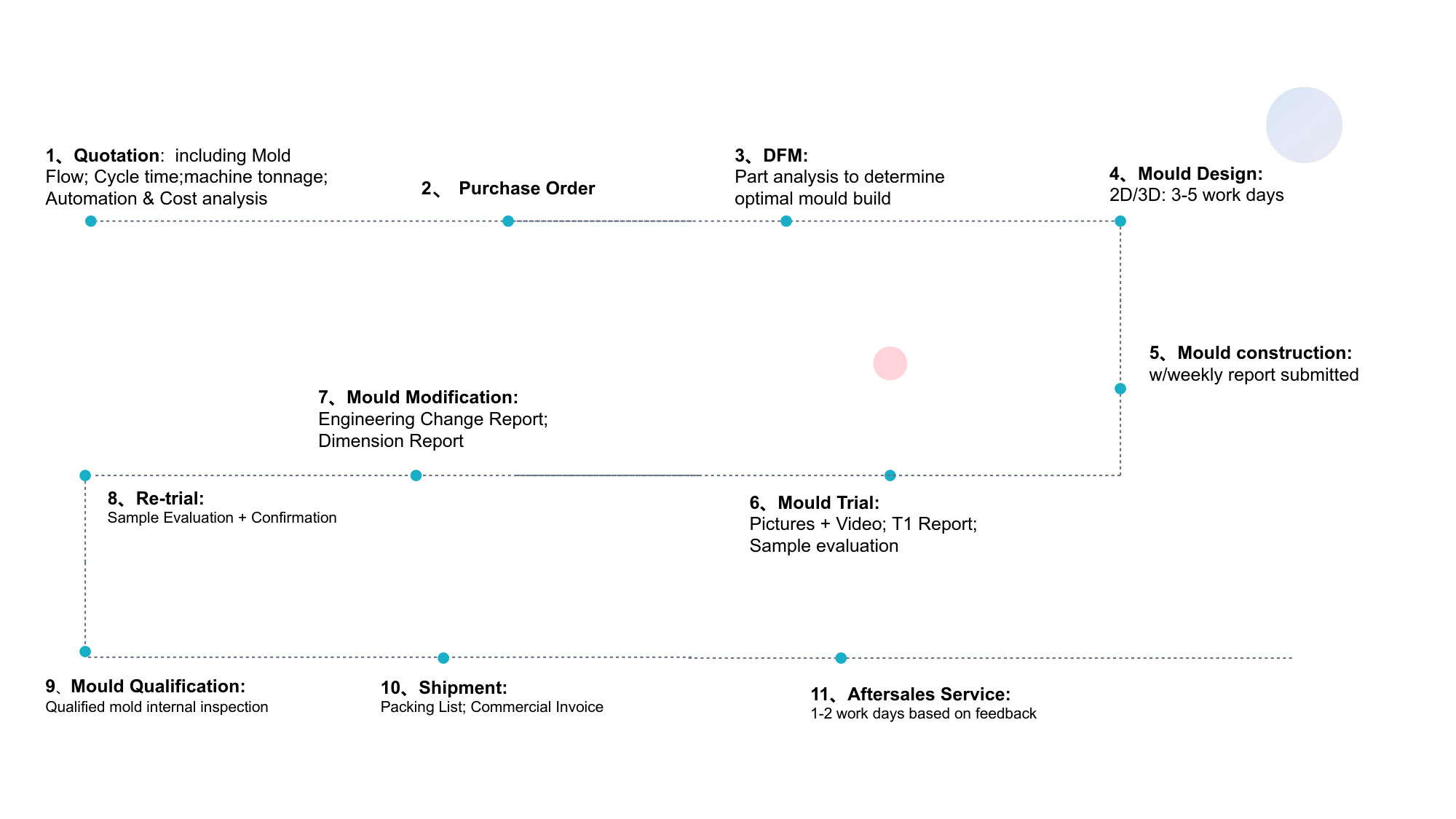
Ansix’s approach to customer satisfaction begins with a deliberate inversion of the conventional supplier relationship. Instead of waiting for a frozen 3D model and a purchase order for steel, Ansix positions itself as a co-engineering partner from the conceptual phase. The company’s stated philosophy invites customers to participate early, “ensuring that the final product is technically robust and economically optimized from the outset”. This is not altruism. It is grounded in a hard economic fact: approximately 70% of a product’s manufacturing cost is defined during the initial design phase. Once a stapler cartridge geometry is frozen with a wall thickness that cannot fill, a staple-pocket draft that cannot eject, or a gate location that creates a weld line in a high-stress hinge, the cost of correction is no longer a design cost—it is a tooling rework cost, a schedule slip, and a validation restart.
For a J&J MedTech-style stapler cartridge program, co-engineering manifests in concrete engineering outputs:
A moldability report that documents proposed geometry changes, gate-location options, expected cycle time, and mold-life estimates before tooling investment is authorized. The customer’s product definition and manufacturing reality are reconciled on paper, not on a trial mold.
-
A closed-loop DFM document that captures every identified risk and its resolution: wall-thickness transitions and differential shrinkage, draft requirements for clean ejection of delicate staple-pocket features, gate placement to avoid weld lines in functional or sealing areas, cooling layout for deep-draw geometry, and venting positioned at simulation-predicted air traps.
A shared simulation package in which Moldflow/Moldex3D results for fill time, pressure requirements, weld-line locations, air traps, cooling differential, and warpage prediction are transparently reviewed with the customer as part of the DFM deliverable. The customer is not asked to trust a black box; they are asked to review a digital twin.
This early-engineering posture is the first mechanism through which Ansix achieves customer satisfaction. It converts the customer from a specifier waiting for a quote into a co-designer with visibility into cost and risk. For a stapler cartridge program, that visibility is the difference between a tooling program that meets its launch window and one that discovers a staple-pocket warpage issue at T2.
4. The DFM–Moldflow–Tooling Continuum: How Cartridge Molds Are Actually Made to Specification
The stapler cartridge mold is where Ansix’s co-engineering philosophy becomes physical. The manufacturing logic follows a disciplined continuum, and each stage is designed to eliminate a specific class of failure that cartridge tooling is prone to.
4.1 DFM as the Digital Foundation
For a stapler cartridge body, DFM is not a generic wall-thickness check. It is a feature-by-feature manufacturability audit of the functional geometry: staple pockets, pusher channels, knife slots, articulation interfaces, and sterilization-venting features. Ansix engineers examine wall-thickness uniformity to prevent sink marks and differential shrinkage in regions where pocket depth transitions into the cartridge floor; verify draft angles on deep, narrow staple-pocket walls to allow clean ejection without scuffing or cracking; and identify opportunities to consolidate multi-piece metal assemblies into a single moldable plastic geometry where the design intent permits. Integrated snap-fits and press-fits are evaluated for their ejection and assembly implications, with the explicit goal of reducing post-molding assembly time—Ansix reports reductions of up to 40% in assembly time through this DFM-driven consolidation.
The output of DFM is not a report that sits in a folder. It is the closed-loop input to the mold design and the PFMEA. Every DFM finding is dispositioned as accepted, modified, or controlled, and that disposition record becomes the traceable basis for the control plan that will govern production.
4.2 Moldflow and Moldex3D: The Digital Twin as the First Line of Defense
Stapler cartridge molds are expensive to iterate. A multi-cavity layout with complex cooling, fine core features for staple pockets, and tight shut-off requirements can take weeks to cut and weeks more to correct if the first trial reveals a filling imbalance or a warpage pattern. Ansix’s response is to run the molding process digitally before cutting steel. CAE simulation predicts filling patterns, pressure requirements, cooling times, weld-line locations, air traps, and shrinkage/warpage behavior.
For cartridge applications, three simulation outputs are particularly consequential:
Fill balance and pressure margin. An unbalanced fill in a multi-cavity cartridge tool means cavity-to-cavity variation in staple-pocket dimensions—a direct threat to staple retention force. Simulation identifies flow-front imbalances and allows gate and runner optimization before the tool is cut.
Warpage prediction at sealing and interface features. A cartridge body that warps at the anvil-interface surface or at the staple-pocket array will not fire consistently. Moldflow’s shrinkage and warpage analysis allows the tool design to compensate for predicted distortion rather than discovering it at T1.
Cooling differential and cycle-time optimization. Non-uniform mold temperature in a cartridge tool produces differential crystallization (in semi-crystalline resins) and differential shrinkage (in amorphous resins), both of which manifest as dimensional drift. Simulation-driven cooling layout—including conformal cooling where the geometry justifies it—addresses this before the first shot.
The credibility of this simulation-first approach is reflected in Ansix’s average of two mold trials to reach acceptable parts. In a segment where three to five trials are not uncommon for complex medical tooling, a two-trial average is an operational signature of simulation fidelity.
4.3 Mold Materials and Cavity Strategy
A stapler cartridge mold must survive abrasive engineering resins, repeated cleaning, and the dimensional stability demands of a medical production program. Ansix’s mold construction practice uses P20 for mold bases and wear-resistant insert grades—S136 (high-chromium martensitic stainless steel), 2344, 8407, SKD11/61, DC53, M340, and NAK80—for cavity and core inserts, selected according to resin abrasiveness, corrosion risk, and polishability requirements. For medical applications involving corrosive sterilization environments or polished staple-pocket forming surfaces, S136ESR is a common selection because its corrosion resistance and polishability preserve both tool life and part surface quality.
The cavity strategy for a cartridge mold is program-specific. A high-volume disposable reload may justify a multi-cavity hot-runner tool with balanced feed and conformal cooling. A lower-volume specialty cartridge or a bridge tool may use a single- or low-cavity layout with a cold runner and a focus on first-shot accuracy. The decision is made through the DFM and simulation package, not by a default template.
5. Material Selection as a Satisfaction Lever: Matching Polymer to Cartridge Function
Stapler cartridge components are not molded in a single “medical plastic.” The material choice is dictated by the specific function within the cartridge assembly, the sterilization method, and the mechanical duty cycle. Patent and technical literature on surgical stapler cartridges identifies PEEK, polypropylene (including Prolene-type grades), polyester, and PET as candidate materials for staple retention matrices and cartridge bodies, with PEEK favored for high-temperature and high-strength retention features. Reinforced thermoplastic compounds—long-fiber PP, glass-reinforced PPSU and PEEK, and non-reinforced PC—are also identified as suitable for stapler applications requiring dimensional stability and sterilization compatibility.
Ansix’s material-selection practice for cartridge programs reflects this functional mapping:
PEEK is specified where the cartridge feature must maintain mechanical integrity through aggressive sterilization, resist chemical attack, and survive millions of cycles of articulation or pusher travel. PEEK’s continuous service range of −100°C to 250°C and fatigue performance are relevant to reusable or high-cycle cartridge interfaces. PEEK injection molding, however, is not a standard process: melt temperatures in the 370–400°C range and mold temperatures of 160–200°C are recommended to achieve the crystallinity (typically 30–40%) that delivers mechanical strength and dimensional stability. A cartridge tool running PEEK must be thermally designed for those conditions—hot-runner capability, mold-temperature control, and steel selection that tolerates the thermal load.
Medical-grade PP is selected for high-volume disposable cartridge bodies and retention features where chemical resistance, fatigue resistance, steam-sterilization capability, and cost efficiency are the dominant requirements. PP’s lower processing temperature and broader process window make it a workhorse for cartridge geometries that do not require PEEK-level thermal performance.
LCP (liquid crystal polymer) appears in Ansix’s medical stapler cartridge mold portfolio, particularly for thin-wall, high-flow, high-dimensional-stability features where its anisotropic shrinkage must be managed through simulation and gate design.
PC and PC/ABS are specified for cartridge housings or instrument-interface components requiring impact strength, stiffness, and transparency, with medical-grade PC offering autoclave and gamma compatibility.
The customer-satisfaction mechanism here is not “we have many materials.” It is Ansix’s ability to recommend the material that satisfies the cartridge’s functional requirement at the lowest total cost, and to then build a mold and a process that actually runs that material to capability. A supplier who can mold PP but cannot control PEEK crystallinity is not a full-service cartridge partner. A supplier who can quote PEEK but does not simulate its shrinkage behavior is a risk. Ansix’s material breadth is meaningful only because it is coupled to simulation, tooling, and process validation for each resin class.
6. NPI as a Gated Discipline: Preventing the “Mold That Sort of Works”
The most common failure mode in medical tooling programs is not a catastrophic tool crash. It is the mold that sort of works—the tool that produces parts that pass a dimensional check but reveal a capability gap only after thousands of shots, or the process that runs well on the trial machine but drifts on the production floor. Ansix’s NPI process is structured as a stage-gate system explicitly designed to prevent this outcome. The gates include: design freeze and DFM closure; mold design review and approval; mold manufacturing and T1 (first trial); T1 dimensional and functional evaluation with mold corrections; T2/T3 samples and process-window development; PFMEA and Control Plan finalization; pilot production with capability studies (Cpk ≥ 1.33 on critical features); and production release.
For a stapler cartridge program, the critical gates are:
T1 evaluation against functional geometry, not just nominal dimensions. A cartridge that measures within tolerance on a CMM but exhibits a staple-pocket draft that varies by cavity will not necessarily fail dimensional inspection—but it may fail staple retention testing. The T1 evaluation must include functional proxies for staple seating, pusher travel, and anvil interface fit.
Process-window development at T2/T3. The objective is not to find “a set of parameters that makes good parts.” It is to define a robust process window—a range of melt temperature, pack pressure, hold time, and cooling time within which the process reliably produces conforming parts despite material lot variation and machine drift. In-mold pressure and temperature sensors, with closed-loop control, are used to compensate for batch-to-batch resin variation and to ensure the process reliably produces good parts, not merely can produce them.
Pilot capability studies before production release. Cpk ≥ 1.33 on critical cartridge features—staple-pocket position, pocket depth, anvil-interface flatness, and any sealing or retention geometry—is the release criterion. This is consistent with medical molding practice, where Cpk ≥ 1.33 is a widely used capability target for validated processes. A cartridge program that cannot demonstrate capability at pilot production is not ready for a J&J MedTech-style launch cadence.
7. Quality Validation: IQ/OQ/PQ and the Evidence Trail
Medical device process validation is not an inspection activity appended to production. It is a structured demonstration that the process, as installed and operated, consistently produces output meeting predetermined specifications. The accepted framework is IQ/OQ/PQ: Installation Qualification confirms equipment is installed correctly and meets specifications; Operational Qualification defines and challenges operating limits; Performance Qualification demonstrates the process produces conforming product under routine conditions.
Ansix’s validation practice for medical programs includes IQ/OQ/PQ-compatible protocols, ISIR (Initial Sample Inspection Report), Cpk and SPC reporting, and in-house try-out capability. For a stapler cartridge mold, the validation package is the bridge between the tooling program and the customer’s regulatory submission. It must include not only dimensional data but also material certificates with lot traceability, process-parameter records linked to specific production lots, and—where the cartridge is terminally sterilized—post-sterilization dimensional stability data.
The Cpk ≥ 1.33 threshold is particularly relevant to stapler cartridges. A cartridge with dozens of staple pockets has dozens of positional and depth dimensions that collectively determine staple retention and formation. If each dimension is merely “in tolerance” at ±3σ, the cumulative probability of a non-conforming cartridge can become unacceptably high. Capability, not conformance, is the correct metric. Ansix’s pilot-production capability studies are structured to demonstrate that the cartridge tool and process hold the tight band required for functional reliability.
8. From Tooling to Mass Production: The Handoff That Defines Customer Satisfaction
A cartridge mold that is brilliant at T2 but drifts at 500,000 shots is not a satisfactory mold. Ansix’s mass-production phase operates under the control plan finalized during NPI, with monitored parameters including melt temperature, mold temperature, injection velocity, pack pressure, and cooling time. For PEEK cartridge features, the melt-temperature window may be in the 370–400°C range with mold temperatures of 160–200°C; for PP, the window is substantially lower. The control plan is material-specific and feature-specific, not generic.
Delivery efficiency is managed through production planning across the four global bases, with protective packaging designed to shield critical sealing surfaces and functional interfaces from contamination or damage during transit. For stapler cartridges, packaging is not a commodity—a scratched anvil-interface surface or a deformed staple pocket can render a reload unusable. The packaging specification is part of the quality system, not a logistics afterthought.
Ansix’s stated operating principle—“marketing as the guide, quality for survival, technology for development, service as the foundation”—is not a slogan that appears only on a website. It is the logic that connects the co-engineering phase to the after-sales phase. After-sales support includes technical consultation on installation and sterilization cycling, replacement-part availability, and root-cause investigation if field issues arise. For a J&J MedTech-style cartridge program, this means the supplier remains accountable for the lifecycle performance of the tool and the parts, not merely for the shipment.
9. How the Industry-Leadership Position Is Actually Built
Ansix’s position in the stapler cartridge mold segment is not the product of a single capability. It is the compounding effect of four structural advantages that are difficult to replicate in a fragmented supplier landscape:
Vertically integrated tooling. Mold design, manufacturing, repair, and production remain under one roof. When a cartridge tool requires a correction during NPI, the feedback loop is measured in hours or days, not weeks of inter-company shipping and liability negotiation. The two-trial average is a direct beneficiary of this integration: simulation and tool correction happen in the same engineering conversation.
Simulation-driven culture. Moldflow and Moldex3D are standard tools, not premium add-ons. The engineering team’s average of over 12 years of experience allows simulation results to be interpreted with judgment, not just software defaults. For a cartridge program, this judgment is what distinguishes a useful warpage prediction from a simulation that is technically correct but functionally irrelevant.
Scale with redundancy. 260 machines across four bases, spanning 30 to 2,800 tons, provide both the tonnage range for high-cavitation cartridge tools and the geographic flexibility to serve OEM programs that require supply-chain redundancy. Scale also enables competitive material procurement and logistics pricing, which flows through to the total cost of ownership.
Cross-industry experience applied to medical. Ansix’s customer base spans automotive (IATF 16949), medical (ISO 13485), consumer electronics, and personal care. Automotive tooling discipline—PPAP, Cpk, poke-yoke, and high-volume consistency—is transferable to medical cartridge programs. The medical quality system provides the regulatory framework; the automotive discipline provides the production-maturity mindset.
These four advantages explain why Ansix can credibly claim to be a co-engineering partner rather than a build-to-print tool shop. The difference matters most precisely in the stapler cartridge segment, where the tooling is complex, the quality bar is unforgiving, and the cost of a failed launch is measured not only in money but in surgeon trust and patient outcomes.
Part II — Johnson & Johnson MedTech Stapler Cartridge Mold Manufacturing: Product Introduction, Applications, Process, Materials, and Customer-Centric Value
1. Product Introduction: What a Stapler Cartridge Mold Actually Produces
The “product” of a stapler cartridge mold is a polymer component system that performs a mechanically active role in surgery. In a surgical stapler, the cartridge holds the staples, guides the pushers that drive the staples through tissue, and interfaces with the anvil that forms the staple legs into a closed configuration. In modern reload architectures—such as the ETHICON™ 3D Reloads associated with the ETHICON™ 4000 Stapler—the cartridge is part of a system designed to optimize compression not only beneath each staple but across staples and multiple staple lines, including both stapled and unstapled regions of tissue. The reload also incorporates enhanced gripping surfaces intended to stabilize tissue and minimize slippage during firing.
From a mold-manufacturing perspective, the cartridge body is a multi-feature precision component: a staple-pocket array with positional and depth tolerances that govern staple retention and formation; pusher channels with controlled draft and surface finish for smooth travel; a knife slot or cutting path with straightness and edge-clearance requirements; articulation or coupling features that interface with the instrument; and—depending on the design—venting or sterilization-access features. When the cartridge is supplied sterile and preloaded, as with certain curved cutter stapler reloads, the molded component must also be compatible with the chosen sterilization modality and the packaging environment.
The mold that produces this component must therefore be specified not by “number of cavities” alone, but by a capability statement: cavity-to-cavity staple-pocket positional repeatability, core-shift control at thin walls, cooling uniformity across a geometry with variable wall sections, venting at sub-millimeter features, and tool-steel selection compatible with the resin’s abrasiveness and corrosion profile. These are the engineering dimensions along which a cartridge mold supplier is ultimately judged.
2. Application Domains: Where the Cartridge Mold’s Output Is Used
Surgical stapler cartridges are used across a spectrum of procedures and tissue types. The ETHICON™ 4000 Stapler and 3D Reloads are certified for open and laparoscopic surgery across specialties including bariatric, colorectal, and thoracic procedures in the European Union, with planned future use on the OTTAVA™ Robotic Surgical System. The clinical challenge that drives cartridge design is the variability of tissue: thick, fragile, and inconsistent tissue can compromise staple-line integrity, and surgeons frequently reinforce staple lines through oversewing or buttressing—one study cited in J&J’s announcement found that bariatric surgeons reinforced the staple line in 77% of laparoscopic sleeve gastrectomy cases.
This clinical reality translates into mold-design requirements. A cartridge intended for bariatric or thoracic reloads may need taller staple pockets, different pusher geometries, and tighter staple-retention features than a cartridge for thinner tissue. The mold must accommodate these feature variations without sacrificing cavity-to-cavity consistency. A reload platform may share a common cartridge-body architecture across multiple staple-line lengths or tissue indications; the mold program must therefore support family tooling or modular insert strategies that allow feature variation without rebuilding the entire tool.
The application domain also determines the sterilization pathway. Ethylene oxide, gamma irradiation, and autoclave cycling impose different thermal and chemical stresses on the cartridge polymer. A PP cartridge intended for gamma sterilization may have different dimensional-stability requirements than a PEEK or PPSU feature intended for repeated autoclave exposure. The mold design and material selection must be co-optimized with the sterilization method from the beginning—not after the tool is cut.
3. Production Process: From Polymer Pellets to Validated Cartridge
The production process for a stapler cartridge mold program follows a logical sequence, but the content of each stage is cartridge-specific.
Material drying and handling. Engineering resins used in cartridge applications—PEEK, PP, PPSU, LCP, PC—have specific moisture sensitivity profiles. PEEK and PPSU require rigorous drying to prevent hydrolytic degradation; PP is less moisture-sensitive but still requires controlled handling to avoid contamination. Ansix’s material-management practice includes incoming verification and moisture analysis for critical resins, with lot traceability maintained from pellet to finished part.
Injection molding. The process window is resin-specific. PEEK requires melt temperatures in the 370–400°C range and mold temperatures of 160–200°C to achieve the crystallinity that delivers mechanical performance. PP runs at substantially lower temperatures with a broader window. LCP requires high injection speeds and careful thermal management to manage its anisotropic shrinkage. The mold’s hot-runner or cold-runner configuration, gate design, and cooling layout are all selected to match the resin’s rheology and crystallization behavior.
In-mold sensing and closed-loop control. For medical cartridge programs, Ansix’s machines are equipped with in-mold pressure and temperature sensors for closed-loop control, compensating for material batch variations and ensuring that the process reliably produces good parts rather than merely can produce them under favorable conditions. This is a critical distinction for cartridge production, where a subtle drift in pack pressure can change staple-pocket depth by enough to affect staple retention.
Secondary operations and assembly. Depending on cartridge design, secondary operations may include deflashing, ultrasonic welding, laser marking, or cleanroom assembly of components. Ansix’s ISO Class 8 cleanroom capability supports medical-device assembly and packaging requirements. The DFM phase explicitly evaluates opportunities to integrate features that eliminate secondary assembly—snap-fits, press-fits, and living hinges—with the goal of reducing post-molding assembly time and eliminating adhesive or mechanical-fastener operations.
Sterilization compatibility and packaging. The cartridge must be compatible with the chosen sterilization method and packaged to protect functional surfaces. Ansix’s validation packages for medical programs include material certificates and, where applicable, post-sterilization dimensional stability data. Packaging is designed to shield sealing surfaces and functional interfaces from contamination or damage during transit.
4. Delivery Efficiency: How Schedule Risk Is Managed
Delivery efficiency in a stapler cartridge mold program is not a function of shipping speed. It is a function of schedule certainty—the probability that the tool will be validated and production-ready on the promised date. Ansix addresses schedule certainty through several mechanisms:
Simulation-driven first-trial accuracy. An average of two mold trials means the tool reaches acceptable parts faster, compressing the T1-to-T2 loop that consumes the largest share of a tooling schedule.
Vertical integration of tool correction. When a T1 correction is required, the tool remains in Ansix’s own manufacturing environment. There is no inter-company shipment, no liability negotiation, and no queue behind other customers’ tools. Response times are measured in hours to days, not weeks.
Production planning across four bases. With manufacturing capacity in China and Vietnam, Ansix can allocate cartridge production to the base with available capacity, avoiding single-point-of-failure scheduling.
NPI stage-gate discipline. The stage-gate process prevents the common schedule failure mode in which a “sort-of-working” mold proceeds to production and the schedule slips are discovered only after thousands of parts are molded.
5. Mold Manufacturing and Injection Molding Material Selection: The Coupled Decision
The choice of mold steel and the choice of polymer are not independent decisions. They are coupled through abrasiveness, corrosion, thermal load, and polishability requirements.
For a PEEK cartridge feature, the mold must withstand melt temperatures approaching 400°C and mold temperatures of 160–200°C. S136ESR stainless steel is a common selection for cavity and core inserts because its corrosion resistance and polishability preserve staple-pocket surface quality and tool life under these thermal conditions. For glass- or carbon-reinforced PEEK grades, wear-resistant grades such as 2344 or DC53 may be specified for high-abrasion regions. For PP cartridge bodies, P20 or S136 inserts are common, with the selection driven by production volume and surface-finish requirements. For LCP cartridge components, the high flow and thin-wall filling characteristics require careful venting and thermal design; S136 or NAK80 inserts are used where polishability and dimensional stability are critical.
The mold-base material is typically P20, with cavity and core inserts in the appropriate wear-resistant grade. The cavity count and runner configuration are determined through the DFM and simulation package, not by a default rule. A high-volume reload platform may justify a multi-cavity hot-runner tool; a lower-volume specialty cartridge may use a single-cavity cold-runner bridge tool followed by a multi-cavity production tool once demand is validated.
6. Intelligent Manufacturing and Efficiency Improvement
Ansix’s tooling operations report a 70% automated machining ratio and a 0.002 mm mold accuracy standard. For cartridge molds, automation in machining translates directly into cavity-to-cavity consistency: wire EDM, CNC milling, and electrode machining performed under automated schedules with in-process metrology reduce the human variability that produces cavity-to-cavity staple-pocket differences.
On the molding side, efficiency improvements come from three sources:
Conformal cooling. Ansix reports that high-efficiency cooling systems—including conformal cooling channels that follow the mold geometry—can reduce molding cycle time by up to 22% compared to conventional cooling designs. In a cartridge tool with deep core features, conformal cooling also improves mold-temperature uniformity, which reduces warpage and dimensional drift.
Material-yield management. Layered material-feed systems and regrind-management practices reduce scrap by up to 18%. For engineering resins such as PEEK, scrap reduction has a direct and significant cost impact.
Automation of part extraction and handling. Robot take-out, conveyor integration, and in-mold labeling eliminate manual handling and reduce the risk of surface damage to critical cartridge features.
These measures collectively contribute to a 15–30% reduction in part cost while maintaining tight tolerances—typically in the ±0.02 mm range for precision features.
7. Process Quality Assurance: The Evidence That the Cartridge Will Perform
Process quality assurance for a stapler cartridge is built on three layers of evidence.
Layer 1: Material and lot traceability. Every resin lot is verified against its certificate of analysis, with moisture analysis for moisture-sensitive resins. The traceability chain links pellet lot to molded lot to inspection results.
Layer 2: In-process monitoring and SPC. Critical process parameters—melt temperature, mold temperature, injection velocity, pack pressure, cooling time—are monitored under the control plan. In-mold sensors provide closed-loop feedback. SPC monitors critical dimensions, and capability is maintained at Cpk ≥ 1.33 for validated features.
Layer 3: Final validation and documentation. The validation package includes FAI reports with CMM data for critical dimensions, material certificates, process-parameter records, and—where applicable—post-sterilization stability data. For medical programs, the validation is structured to support IQ/OQ/PQ requirements and to withstand OEM quality audits and regulatory scrutiny.
8. The Most Competitive Cost-Control Capability
Cost control in stapler cartridge mold manufacturing is not a matter of squeezing labor rates or negotiating steel prices. It is a matter of engineering the total cost of ownership out of the program before and during tooling.
Design-stage cost elimination. Because approximately 70% of manufacturing cost is defined at the design stage, Ansix’s co-engineering and DFM phases are the most powerful cost-control levers. A gate location optimized in simulation avoids a tool rework; a wall-thickness adjustment avoids a cycle-time penalty; a snap-fit consolidation avoids an assembly station.
Cycle-time and yield optimization. Conformal cooling (up to 22% cycle reduction) and material-yield management (up to 18% scrap reduction) directly reduce per-part cost. In a high-volume cartridge program, these percentages translate into substantial annual savings.
Tool-life warranty and depreciation. Ansix offers a mold-life warranty of 1 million shots for glass-fiber-reinforced engineering resins, which allows customers to depreciate tooling cost over a longer production run and reduces the risk of premature tool replacement.
Scale economics in procurement and logistics. The four-base, 260-machine footprint provides procurement leverage on resin and logistics, contributing to competitive pricing without sacrificing quality.
9. After-Sales Service Quality: The Lifecycle Guarantee
After-sales support for a stapler cartridge mold program extends well beyond a warranty period. It includes technical consultation on installation and sterilization cycling, replacement-part availability for mold components, and root-cause investigation if field or production issues arise. For medical programs, this after-sales capability is part of the supplier quality agreement: the customer needs assurance that a tool issue will be diagnosed and corrected by engineers who understand the cartridge’s functional requirements, not by a third-party repair shop reading a drawing for the first time.
Ansix’s vertically integrated tooling model makes this assurance credible. Because mold design, manufacturing, and repair remain in-house, the engineers who respond to an after-sales issue have access to the original tool design rationale, the simulation history, and the process-development records. This institutional memory is a quality asset that cannot be replicated by a supplier who outsources tool repair.
Part III — The Value Ansix’s Mold Making and Injection Molding Design-and-Manufacturing Capability Delivers to Customers
1. The Value Proposition in One Sentence
Ansix’s design-and-manufacturing capability delivers value by converting a customer’s functional requirement for a stapler cartridge—or any precision medical component—into a validated, capable, and cost-optimized production system faster and with less risk than the customer could achieve through a fragmented supplier chain. The value is not the mold. The value is the certainty that the mold, the process, the material, and the validation will converge on a production-ready state within the program’s schedule and cost constraints.
This proposition can be decomposed into the specific problems Ansix solves and the mechanisms through which it solves them.
2. What Problems Ansix Solves
2.1 The “Design–Tooling Disconnect” Problem
Many medical device OEMs develop a cartridge design in one organization, source tooling in another, and source molding in a third. The design may be functionally elegant but moldability-challenged; the tool may be built to the drawing but not to the molding process; the molder may inherit a tool that is difficult to run consistently. The result is a sequence of finger-pointing, schedule slips, and cost overruns.
Ansix solves this problem through vertical integration and co-engineering. Design, DFM, simulation, tooling, molding, validation, and assembly are under one roof and under one engineering conversation. The DFM findings flow directly into the mold design; the simulation results flow directly into the process window; the T1 data flow directly into the correction loop. There is no organizational boundary at which information is lost or liability is transferred.
2.2 The “Simulation Without Judgment” Problem
Access to Moldflow or Moldex3D is not a differentiator; many suppliers have licenses. The differentiator is the engineering judgment to set up the simulation correctly, interpret the results in the context of the cartridge’s functional requirements, and translate them into tool-design decisions. Ansix’s engineering team averages over 12 years of experience, and simulation is embedded in a culture that treats it as a decision tool rather than a report generator. For a cartridge program, this means the simulation predicts warpage at the anvil-interface surface—the feature that actually matters functionally—not just at the easiest-to-measure datum.
2.3 The “Tool That Sort of Works” Problem
The stage-gate NPI process is explicitly designed to prevent the “sort-of-works” tool from reaching production. T1 is evaluated against functional geometry; T2/T3 develop a robust process window; pilot production demonstrates Cpk ≥ 1.33 before release. The customer receives a tool that has been qualified as a system, not merely a tool that has produced some acceptable parts.
2.4 The “Cost Discovered Too Late” Problem
Because 70% of manufacturing cost is locked in at design, Ansix’s co-engineering and DFM phases are the primary cost-control mechanism. The customer is not presented with a fait accompli tooling cost after the design is frozen; they are presented with cost-reduction options—gate location, cooling strategy, feature consolidation, material selection—while those options are still actionable. The subsequent manufacturing-phase savings (conformal cooling, scrap reduction, automation) compound the design-stage savings.
2.5 The “Capacity and Lead-Time Uncertainty” Problem
Ansix’s 260-machine fleet, spanning 30 to 2,800 tons across four bases, provides both capacity headroom and geographic redundancy. For a cartridge program that may require pilot-scale volumes followed by a steep production ramp, this footprint allows capacity to be allocated without single-point-of-failure risk. The simulation-driven first-trial accuracy and in-house tool correction compress the tooling schedule, while the four-base production network provides delivery flexibility.
3. How Ansix Delivers Quality Validation
Quality validation for a stapler cartridge mold program is delivered as a layered evidence package that supports both the customer’s internal quality system and their regulatory submissions.
Design-input validation. The DFM and Moldflow package is reviewed with the customer before tooling investment. This is not a customer “sign-off on a drawing”; it is a technical review of the proposed manufacturing solution, including risks and mitigations. The customer’s quality team can trace each DFM finding to a disposition and each disposition to a mold-design or control-plan action.
Tool and process validation. T1 evaluation includes dimensional inspection against the drawing and functional evaluation against the cartridge’s intended function. T2/T3 process-window development defines the robust operating range. Pilot production demonstrates capability on critical features, with Cpk ≥ 1.33 as the release criterion.
IQ/OQ/PQ support. Ansix’s validation practice includes IQ/OQ/PQ-compatible protocols, ISIR reports, Cpk and SPC data, and in-house try-out records. For medical programs, the validation package is structured to meet the expectations of a notified body or a customer/supplier quality engineer.
Material and traceability validation. Material certificates, lot traceability from pellet to part, moisture-analysis records for moisture-sensitive resins, and post-sterilization stability data where applicable are included in the validation package.
The value of this validation approach is not the paperwork. It is the reduction of late-stage surprises. A cartridge program that enters production with a validated process window and demonstrated capability is far less likely to experience a field issue or a regulatory observation than a program that entered production on the basis of a successful T1.
4. How Ansix Reduces Customer Costs
Cost reduction is delivered through four mechanisms, each with a different time horizon.
Design-stage cost avoidance (immediate to short term). Co-engineering and DFM eliminate costly redesigns, tool reworks, and late-stage changes. The customer avoids the cost of discovering a moldability issue at T2—and the schedule cost of a tool correction—because the issue was identified in simulation.
Manufacturing-phase cost reduction (short to medium term). Conformal cooling reduces cycle time by up to 22%; material-yield management reduces scrap by up to 18%; automation reduces manual handling and labor cost. These measures collectively support a 15–30% reduction in part cost while maintaining tight tolerances.
Tool-life cost amortization (medium to long term). A mold-life warranty of 1 million shots for reinforced engineering resins allows the customer to amortize tooling cost over a longer production run and reduces the risk of unplanned tool replacement.
Total-cost-of-ownership reduction (program lifecycle). The combination of validated quality, schedule certainty, and after-sales support reduces the unplanned costs that dominate the total cost of ownership: expedited shipping, line-down situations, field corrections, and regulatory remediation. These costs are often invisible in a piece-price comparison, but they are the costs that determine whether a program is profitable.
5. How Ansix Improves Capacity and Guarantees Delivery
Capacity and delivery assurance are structural outcomes of Ansix’s operating model.
Machine capacity and range. 260 injection molding machines from 30 to 2,800 tons provide the tonnage range for high-cavitation cartridge tools and the capacity headroom for production ramps.
Geographic redundancy. Four production bases across China and Vietnam allow production allocation across sites, reducing the risk of a single-site disruption.
Schedule compression through simulation. The two-trial average and in-house tool correction compress the tooling schedule and reduce the probability of a T2 delay.
Stage-gate discipline. The NPI gates prevent the schedule slippage that occurs when a “sort-of-working” tool proceeds to production and problems are discovered late.
Production planning and packaging. Delivery efficiency is managed through production planning across the four bases, with protective packaging designed to preserve critical surfaces during transit.
The result is not a guarantee that no schedule risk exists—no supplier can honestly offer that—but a systematic reduction of the sources of schedule risk that are within a manufacturer’s control.
6. The 29-Year Positioning: What Experience Actually Means for a Stapler Cartridge Program
Ansix’s 29 years of manufacturing experience—rooted in a company established in 1998 and developed over more than 28 years into a one-stop injection molding provider—is not merely a longevity claim. In the stapler cartridge segment, experience manifests as pattern recognition: the ability to recognize, at the DFM stage, which cartridge geometry features are likely to cause ejection problems; which resin and mold-temperature combinations are likely to produce crystallinity gradients; which cooling layouts are likely to produce warpage at the anvil interface; and which NPI gate is most likely to be compressed under schedule pressure.
This pattern recognition is embedded in the engineering team’s average experience of over 12 years and in the company’s accumulated tooling record of over 30,000 mold sets. For a customer, the value is not the number of years. The value is the reduction in the probability that the program will encounter a problem the supplier has never seen before—and the assurance that if a novel problem does arise, the supplier has the simulation tools, the in-house tooling capability, and the engineering depth to solve it without transferring the risk back to the customer.
7. Conclusion: The Integrated Value Proposition
Ansix’s value to a Johnson & Johnson MedTech-style stapler cartridge mold manufacturing program can be summarized in a single integrated proposition:
Ansix provides a vertically integrated, simulation-driven, ISO 13485-governed path from cartridge design intent to validated high-volume production, with the engineering discipline to prevent late-stage failures, the manufacturing scale to absorb ramp-up demand, the cost-control mechanisms to deliver competitive piece pricing, and the after-sales infrastructure to remain accountable for tool and process performance across the product lifecycle.
The individual capabilities—DFM, Moldflow, S136 tooling, PEEK and PP material expertise, IQ/OQ/PQ validation, Cpk ≥ 1.33, conformal cooling, four-base production—are not independent selling points. They are the components of a system that is designed to do one thing: make the customer’s cartridge program succeed. That is the standard against which Ansix’s claim to customer satisfaction and industry leadership should be measured.
Document scope note: This monograph is structured in three parts to address the distinct informational needs of program stakeholders: Part I focuses on the organizational and process mechanisms behind customer satisfaction and industry positioning; Part II focuses on the product, application, process, material, cost, and service attributes of the cartridge mold manufacturing offering; Part III focuses on the value, problem-solving, validation, cost-reduction, and capacity-assurance dimensions of Ansix’s design-and-manufacturing capability. Technical data and capability claims are drawn from Ansix’s published technical materials and from public medical-device and medical-molding industry sources as cited. Program-specific specifications—cavity counts, cycle times, material grades, and validation protocols—should be confirmed through a project-specific DFM and commercial review.
Ansix Tech Co Ltd
If you have any plans related to Johnson & Johnson MedTech Stapler Cartridge Mold Manufacturing , you can contact us at any time. We will turn your ideas into reality, let you realize your dreams, and obtain large orders from the market. Our contact information is info@ansixtech.com. Or contact our CTO, mail: stephen@ansixtech.com
#www.ansixtech.com #ansixtech.com #Johnson & Johnson MedTech Stapler Cartridge Mold Manufacturing #Johnson & Johnson MedTech Stapler Cartridge Mold Manufacturing Tooling #Johnson & Johnson MedTech Stapler Cartridge Mold Manufacturing injection mold companies #Ansix #Ansix moulds #Ansix china #Ansix tech china #Ansix tech company #Ansix facotry #Ansix Tooling #Ansix tool #Johnson & Johnson MedTech Stapler Cartridge Mold Manufacturing injection molding #Johnson & Johnson MedTech Stapler Cartridge Mold Manufacturing injection tools #Johnson & Johnson MedTech Stapler Cartridge Mold Manufacturing injection moulds #Ansix moulding company #Ansix molding #ansix tooling #Johnson & Johnson MedTech Stapler Cartridge Mold Manufacturing plastic mould #Johnson & Johnson MedTech Stapler Cartridge Mold Manufacturing plastic tools #Ansix Tech #Ansix molds #Ansix injection molding #Ansix mold factory #Johnson & Johnson MedTech Stapler Cartridge Mold Manufacturing injection molding Customized #Ansix mold factory #Johnson & Johnson MedTech Stapler Cartridge Mold Manufacturing china #Johnson & Johnson MedTech Stapler Cartridge Mold Manufacturing molds #injection factory for Johnson & Johnson MedTech Stapler Cartridge Mold Manufacturing #Johnson & Johnson MedTech Stapler Cartridge Mold Manufacturing injection molding #Johnson & Johnson MedTech Stapler Cartridge Mold Manufacturing injection molding factory #injection molding company #Johnson & Johnson MedTech Stapler Cartridge Mold Manufacturing injection mold companies #Johnson & Johnson MedTech Stapler Cartridge Mold Manufacturing Tooling #Johnson & Johnson MedTech Stapler Cartridge Mold Manufacturing mold limited #Ansix mold china #Ansix companies for Johnson & Johnson MedTech Stapler Cartridge Mold Manufacturing #Ansix company China #Johnson & Johnson MedTech Stapler Cartridge Mold Manufacturing facotry #Ansix Tech #Ansix Tech mould #Johnson & Johnson MedTech Stapler Cartridge Mold Manufacturing injection moulding #Johnson & Johnson MedTech Stapler Cartridge Mold Manufacturing injection moulding company #Ansix Johnson & Johnson MedTech Stapler Cartridge Mold Manufacturing parts injection mold companies #Johnson & Johnson MedTech Stapler Cartridge Mold Manufacturing injection molding companies china #Johnson & Johnson MedTech Stapler Cartridge Mold Manufacturing china factory #Ansix moulding companies #Ansix molding company #Johnson & Johnson MedTech Stapler Cartridge Mold Manufacturing injection moulding facotry #Ansix Tech mold #Johnson & Johnson MedTech Stapler Cartridge Mold Manufacturing mould #Johnson & Johnson MedTech Stapler Cartridge Mold Manufacturing plastic injection molding #ansix plastic mold #Johnson & Johnson MedTech Stapler Cartridge Mold Manufacturing Mold manufacturing #Johnson & Johnson MedTech Stapler Cartridge Mold Manufacturing parts manufacturing #Johnson & Johnson MedTech Stapler Cartridge Mold Manufacturing plastic parts factory #Johnson & Johnson MedTech Stapler Cartridge Mold Manufacturing injection parts mold #Johnson & Johnson MedTech Stapler Cartridge Mold Manufacturing PRECISION MANUFACTURING #Johnson & Johnson MedTech Stapler Cartridge Mold Manufacturing TOOL #China Johnson & Johnson MedTech Stapler Cartridge Mold Manufacturing mold #Johnson & Johnson MedTech Stapler Cartridge Mold Manufacturing injection moulding china #Johnson & Johnson MedTech Stapler Cartridge Mold Manufacturing mould china #china precision mold #Johnson & Johnson MedTech Stapler Cartridge Mold Manufacturing mold in china #Johnson & Johnson MedTech Stapler Cartridge Mold Manufacturing mold china #Johnson & Johnson MedTech Stapler Cartridge Mold Manufacturing Precision molds #High-precision molds #Johnson & Johnson MedTech Stapler Cartridge Mold Manufacturing High-precision tool #Injection molds #Mold for thin-walled endoscopic protective sleeve components (wall thickness 0.08 mm)Factory #Mold for thin-walled endoscopic protective sleeve components (wall thickness 0.08 mm)Company #Super Large Injection Mold Factory #Large Tonnage Injection Molding Factory #Johnson & Johnson MedTech Stapler Cartridge Mold Manufacturing Company #Johnson & Johnson MedTech Stapler Cartridge Mold Manufacturing Factory #2800T Injection Molding Factory #3000 Ton Injection Molding #4500 Ton Injection Molding Factory #Johnson & Johnson MedTech Stapler Cartridge Mold Manufacturing Large Mold Injection Molding #Large Plastic Mold Injection Molding Factory #Johnson & Johnson MedTech Stapler Cartridge Mold Manufacturing Large Injection Mold Manufacturer #Johnson & Johnson MedTech Stapler Cartridge Mold Manufacturing Plastic Mold Factory #Injection Mold #Plastic Mold