
 Medical Molds
 Packaging Molds
 Personal Care Molds
 Electronic Molds
 Automotive Molds
 Home Appliance Molds
 Special Molds
 Design & Engineering
 Production & Manufacturing
 Global Presence
 Business Scope
 Component Solutions
 Product Assembly
 Quality Management
 Medical Device Manufacturing



Laundry detergent bottle cap – 1x8 cavities Tooling
FEATURES
Why the 1×8 Cavity Configuration Matters for Laundry Detergent Caps
1.1 The Application Demands
Laundry detergent caps are typically 42/410 or 38/3-start closures, weighing between 18g and 80g depending on the format (single-dose measuring cap versus large-format bulk cap). They must:
Seal reliably against alkaline detergent formulations without chemical degradation.
Withstand repeated open/close cycles across the product’s life.
Provide graduated dosing accuracy for consumer use.
Survive shipping, stacking, and retail handling without cracking or leaking.
These are not cosmetic closures. A cap that fails in transit creates a detergent-soaked carton, a customer complaint, and a potential retailer chargeback. The cost of a single leaking cap far exceeds the per-unit price of the cap itself.
-
Mold Description
Product Materials:
PP PET
Mold Material:
S136ESR
Number of Cavities:
8
Glue Feeding Method:
Hot runner
Cooling Method:
Water cooling
Molding Cycle
9.5s
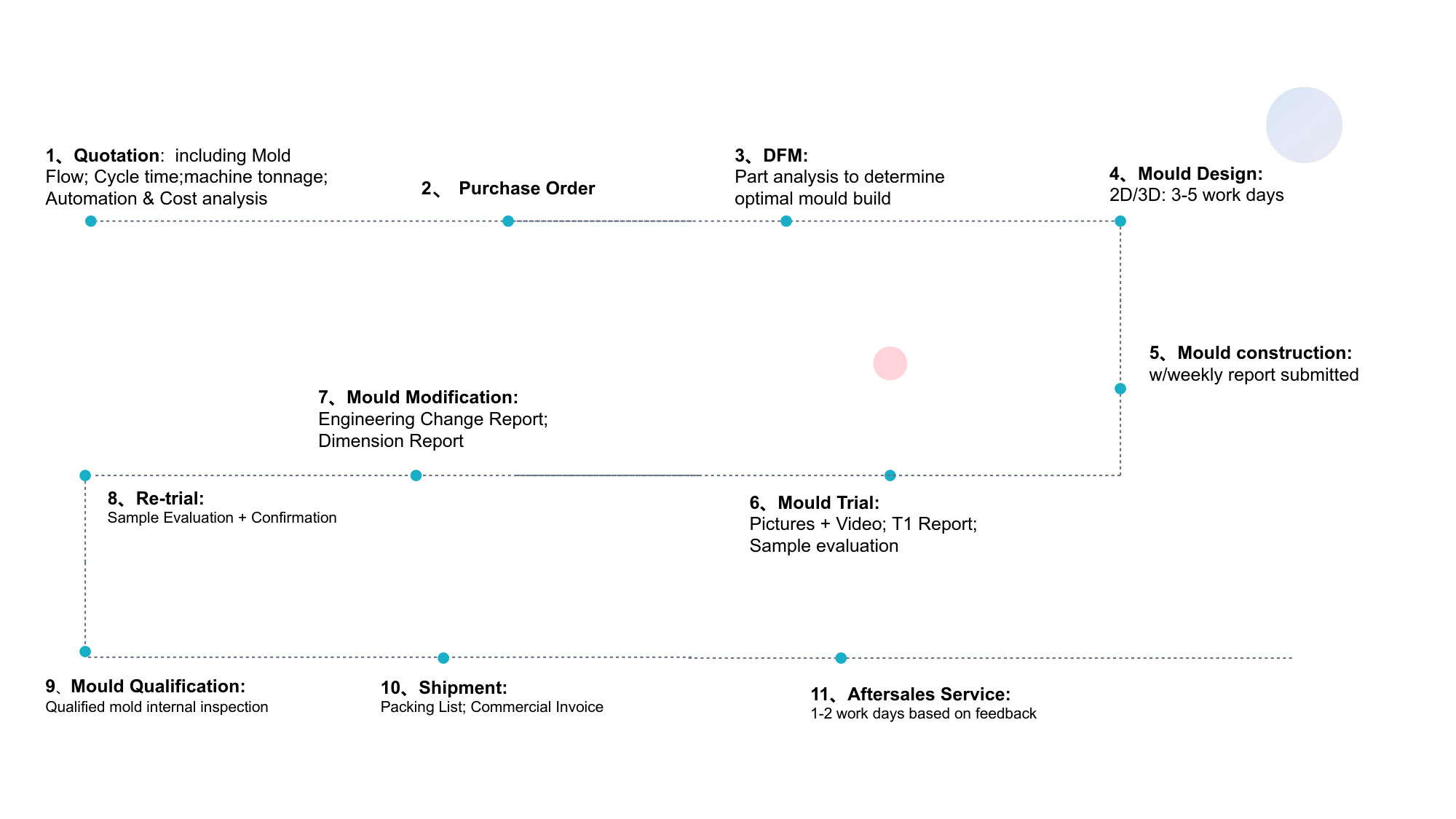
- The mold manufacturing process and product material selection
The 1×8 Cavity Rationale
The 1×8 configuration is not the highest-cavity-count option available. Tools exist for 16, 24, and even 48 cavities for standard closures. However, for laundry detergent caps specifically, 8 cavities frequently represents the optimal balance among three competing forces:
Quality consistency. More cavities mean more chances for dimensional variation across the mold. A 48-cavity tool demands extraordinary mold-making precision to ensure cavity #1 and cavity #48 produce interchangeable parts. An 8-cavity tool is more forgiving—the risk of one cavity producing out-of-tolerance caps is reduced, and the tool is easier to maintain over its life.
Tooling cost versus production volume. For a high-volume detergent brand running millions of caps annually, the tooling amortization is real, but so is the cost of poor quality. An 8-cavity tool costs significantly less than a 24-cavity tool while still delivering meaningful production volume. For caps weighing 25–50g with a cycle time of 16–20 seconds, an 8-cavity tool running 24/7 can produce 1.2–1.8 million caps per month—sufficient for many regional and mid-tier detergent brands.
Mold maintenance and uptime. Fewer cavities mean simpler cooling circuits, fewer hot-runner drops, and faster maintenance. When a tool goes down for service, the production interruption is shorter and the repair cost is lower. For a detergent manufacturer running lean inventory, tool reliability directly affects supply chain stability.
Ansix’s role is to help each customer determine whether 8 cavities is genuinely the right choice for their specific volume, cap design, and quality tolerance—or whether a different configuration better serves their economics. That conversation happens during DFM, before steel is cut.
-
How Ansix Translates Technical Capability into Customer Value
2.1 DFM: Catching Costly Problems Before They Are Molded in Steel
The most expensive mold modification is the one required after the tool is built. Ansix’s DFM process is designed to front-load engineering scrutiny, identifying issues when the cost of correction is measured in hours of CAD time rather than weeks of mold rework.
For a laundry detergent cap project, the DFM review examines several cap-specific risks:
Sealing geometry and draft angles. The cap’s sealing lip and thread geometry are functional features. Inadequate draft on the sealing surface causes drag marks during ejection, which become leak paths. Ansix engineers recommend specific draft angles per feature type—typically 0.5° to 3° depending on texture depth and sealing requirements—and verify that ejection forces will not deform critical sealing surfaces.
Wall thickness distribution. Detergent caps often combine a rigid outer shell with a thinner measuring-cup interior. Uneven wall thickness creates differential shrinkage, leading to warpage and dimensional instability. DFM identifies where thickness transitions can be softened with radiused corners and rib placement to maintain rigidity without sink marks.
Gate location and weld lines. The gate is where molten plastic enters the cavity. Its location determines where weld lines form—the weak points where two flow fronts meet. For detergent caps, weld lines on or near the sealing surface are unacceptable. Ansix DFM identifies gate locations that keep weld lines in non-critical, often hidden areas, and recommends gate sizes that fill the cavity without excessive shear heating.
The measurable value here is straightforward: Ansix’s DFM team typically identifies 5–15 improvement opportunities per project, most of which save measurable cost without adding timeline. A documented case study for a 28mm high-volume cap showed annual savings of approximately $35,500 from DFM-driven optimizations alone—material waste reduction, cycle-time improvement, elimination of deflashing labor, scrap-rate reduction, and energy savings.
2.2 Moldflow Analysis: Simulating the Future Before It Happens
Moldflow analysis is not a formality. It is the virtual proving ground where the mold design either succeeds or fails before a single cavity is machined.
For a laundry detergent cap, the Moldflow simulation addresses specific questions:
Will the cap fill completely before the melt freezes? Detergent caps have thin measuring-cup walls and thicker thread regions. If the thin sections freeze off before the thick sections are packed, the result is short shots or underpacked threads that leak.
Where will air traps occur? Air trapped in the cavity becomes a burn mark or a void. Moldflow predicts these locations, allowing Ansix to add venting precisely where it is needed rather than guessing.
What is the optimal cooling strategy? Cooling accounts for 50–70% of total cycle time in injection molding. For an 8-cavity detergent cap tool, conformal cooling channels that follow the cap’s cylindrical contour can reduce cooling time while improving dimensional consistency. Moldflow validates the cooling layout before the steel is machined.
Will the cap warp? The cap must fit the bottle neck with a consistent seal. Warpage from uneven cooling or packing differentials can turn a perfectly designed sealing lip into a leaker. Moldflow predicts warpage, and Ansix engineers adjust gate locations, packing profiles, and cooling layouts to minimize it.
The customer value here is not the simulation itself. It is the avoided cost of a mold that “almost” works—a tool that requires expensive rework after the first trial, or worse, produces caps that pass initial inspection but develop leak issues in the field.
2.3 Material Selection: Performance at the Lowest Total Cost
Laundry detergent caps are typically molded from polypropylene (PP) for its chemical resistance to alkaline detergents, good fatigue resistance for living hinges (if a flip-top design is used), and low cost. However, the optimal material choice for a specific cap design is not always obvious.
Consider a measuring-cup cap with a snap-fit engagement. The snap-fit feature undergoes repeated flexing during normal use. For this application, Ansix engineers might evaluate POM (acetal), which offers superior stiffness, fatigue resistance, and low friction compared to PP. POM costs more per kilogram, but its higher mechanical properties may allow a thinner, lighter design that uses less material overall—reducing total part cost even with a more expensive resin.
Ansix’s material selection process is explicitly cost-focused: identify the cheapest material that meets all functional requirements, not the most expensive or the most prestigious. This means evaluating:
Chemical compatibility with the specific detergent formulation (some formulations include solvents, enzymes, or bleaching agents that stress certain polymers).
Dimensional stability over the cap’s shelf life and use temperature range.
Processing window (some materials are more forgiving of process variation than others, affecting yield and cycle time).
Availability and supply-chain reliability, especially for high-volume production runs.
The customer outcome is straightforward: the right material at the right cost, validated through simulation and trial, with no surprises at production scale.
2.4 Tooling: Precision That Prevents Leaks
A laundry detergent cap mold is a sealing device. Its steel surfaces must reproduce the cap’s sealing geometry with enough precision that every cavity produces a cap that seals.
Steel selection. Ansix uses pre-hardened P20 or 1.2083 stainless steel for cap molds, depending on production volume and material aggressiveness. For very high volumes (10 million+ caps), hardened H13 may be used for wear-prone areas. The choice balances tool life against tool cost.
Machining precision. The sealing surface of a detergent cap is a complex, often polished contour. Any tool mark transferred from the mold steel to the plastic cap becomes a potential leak path. Ansix uses five-axis high-speed machining with accuracies to ±0.002mm, followed by EDM for deep ribs and hand polishing to a mirror finish on sealing surfaces.
Cooling design. For an 8-cavity cap mold, Ansix typically employs independent cooling circuits per cavity or a carefully balanced manifold. Independent circuits allow individual flow control, ensuring that every cavity cools at the same rate. This matters because uneven cooling produces caps with varying dimensions—some that seal, some that leak, some that are too tight to thread smoothly.
Ejection. Cap ejection must be gentle enough not to deform the cap’s sealing lip, yet forceful enough to release the part from a deep core. Ansix designs ejection systems using polished ejector pins and sleeves, with force distributed to rigid sections of the cap rather than thin sealing zones.
The customer’s payoff is measurable: a tool that produces consistent, leak-free caps from the first shot, with cycle times optimized for the lowest cost per part and maintenance intervals that maximize uptime.
Section 3: Production, Quality, and Delivery
3.1 Scientific Molding: From “Trial and Error” to Data-Driven Process Control
Once the tool is proven, production begins. But “proven” does not mean “set and forget.” Ansix applies Scientific Molding principles to establish a process window that is robust against normal variation—material lot changes, ambient temperature shifts, machine wear.
The key process variables for a detergent cap are:
Fill velocity and pressure: Optimized to fill thin measuring-cup walls without overpacking the thicker thread region.
Packing and holding: Calibrated to compensate for PP shrinkage (typically 1.2–2.0%) and ensure dimensional stability of the sealing diameter.
Cooling time: Determined by mold temperature and cooling circuit efficiency, set to the minimum that still produces stable, warp-free parts.
Melt and mold temperature: Controlled within narrow windows to maintain consistent viscosity and surface finish.
A documented case study for a leak-proof measuring cup lid (a more complex component than a standard detergent cap) showed that switching from trial-and-error to Scientific Molding reduced cycle time by 18% and achieved a first-pass yield of 99.2%. For a cap running at millions of units annually, a few percentage points of yield improvement translate directly into material savings and machine-time efficiency.
3.2 In-Mold and Inline Quality Assurance
Detergent caps leave the mold at high speed. Quality must be built into the process, not inspected in afterward. Ansix’s automation strategy for high-volume cap production includes:
Robotic take-out systems that remove all 8 caps from the mold in a single synchronized motion, preventing drops and damage.
Automated degating that removes the sprue and runner in-mold or immediately after ejection, eliminating a manual deflashing operation that adds labor cost and cycle time.
Vision inspection systems that perform 100% inline inspection for critical attributes: thread integrity, flash presence, sealing surface condition, and color consistency. Defective caps are rejected before they enter the supply chain, not after they have been packed, shipped, and discovered by the customer.
For customers who require documentation, Ansix provides dimensional reports, defect logs, and process capability studies (Cpk) on critical dimensions. The cap’s sealing diameter, thread pitch, and wall thickness are measured and documented, not just assumed.
3.3 Delivery Efficiency
Ansix operates four production bases across China and Vietnam, with 260 injection molding machines ranging from 30 to 2,800 tons. For a laundry detergent cap project, the 1×8 cavity tool would typically run on a machine in the 150–250 ton range, depending on cap size and mold base dimensions.
The geographically distributed manufacturing network provides several customer benefits:
Supply chain resilience. If one facility experiences disruption, production can be shifted to another site with the same tooling and process specifications.
Regional delivery optimization. Customers in different markets can be served from the nearest production base, reducing logistics cost and lead time.
Scalability. A successful cap project that grows from 1 million to 10 million units annually can be scaled across multiple machines and sites without redesigning the tool.
Ansix’s average mold trial count is 2 times—meaning most tools are production-ready after two trials, not the industry-typical three or more. This reduces the time from tool completion to full production, accelerating the customer’s time-to-market.
Section 4: The Integrated Service Stack — What “End-to-End” Actually Means
Many suppliers claim to offer “end-to-end” service. The meaningful question is: what does that mean for a laundry detergent cap project specifically?
Design and development: Ansix engineers work from the customer’s bottle neck finish (e.g., 42/410, 38/3-start) and cap functional requirements to develop a CAD model that is manufacturable at scale. DFM feedback is provided before the customer commits to tooling.
Moldflow and validation: Simulation validates fill, cooling, and warp. T0–T3 trial samples are produced with improvement reports after each iteration. Quick-change inserts can be used to test design variations without rebuilding the mold.
NPI process planning: For a new cap program, Ansix develops the production process in parallel with tooling: machine selection, cycle time targets, operator instructions, quality control plan, and packaging specifications.
Mass production: Once qualified, the tool runs at optimized cycle time with inline quality monitoring and automated material handling.
Quality assurance: ISO 9001, ISO 14001, IATF 16949, and ISO 13485 certifications provide the framework. For detergent caps specifically, the critical quality metric is leak-free sealing, verified through dimensional control and functional testing.
Delivery and aftersales: Molded caps are packed, labeled, and shipped per the customer’s logistics requirements. Ansix provides tool maintenance support and process troubleshooting for the life of the tool.
The integration matters because it eliminates handoffs. When the DFM engineer, the mold designer, the process engineer, and the quality engineer all work within the same organization, information does not get lost between them. A concern raised in DFM is addressed in the mold design. A mold design decision is validated in Moldflow. A Moldflow insight is implemented in the process setup. The customer does not have to manage these conversations.
Section 5: The Competitive Cost Position — How Ansix Delivers Value, Not Just Price
A laundry detergent cap is a price-sensitive component. Detergent brands operate on thin margins, and packaging cost is a visible line item. Ansix’s cost strategy is not to be the cheapest quote. It is to be the lowest total cost provider—the supplier whose caps cost less to use, not just to buy.
Material optimization. The right material at the right price, validated for the application. No over-specification, no under-performance.
Cycle-time optimization. Moldflow-validated cooling and Scientific Molding-optimized process parameters. A 14% cycle-time reduction on a 4.2-second cycle is not dramatic in isolation; across millions of parts, it is significant machine-hour savings.
Labor elimination. Automated degating, robotic take-out, and inline vision inspection reduce the labor content per part. For a high-volume cap, the labor saved from eliminating deflashing alone can be $8,000 per year on a 10-million-unit program.
Scrap reduction. DFM-driven design improvements and process control reduce scrap rate from typical 2–3% to sub-1%. On a 10-million-unit run, a 1.7% scrap reduction is 170,000 additional good parts—or 170,000 parts that do not need to be molded, packed, shipped, and disposed of.
Tool reliability. A tool that runs longer between maintenance intervals produces more caps at lower amortized cost. Precision mold-making and appropriate steel selection extend tool life and reduce unplanned downtime.
Conclusion
Ansix Tech’s position in the laundry detergent bottle cap 1×8 cavity tooling market is not built on a single technical advantage. It is built on the systematic conversion of engineering capability into customer economics.
DFM catches problems before they become costs. Moldflow validates the mold design before it becomes steel. Material science matches resin to function at the lowest viable cost. Precision tooling produces caps that seal from the first shot. Scientific Molding and automated quality control maintain that performance at production scale. Integrated service eliminates the gaps where problems hide.
For a detergent brand evaluating a cap tooling supplier, the questions are practical: Will the caps leak? Will the tool run reliably? Will the cost per thousand caps stay within budget? Ansix’s answer is documented—in DFM savings, cycle-time data, yield figures, and tool trial records. That is what “customer value” means in this business: numbers, not adjectives.
Ansix Tech Co Ltd
If you have any plans related to Laundry detergent bottle cap – 1x8 cavities tooling, you can contact us at any time. We will turn your ideas into reality, let you realize your dreams, and obtain large orders from the market. Our contact information is info@ansixtech.com. Or contact our CTO, mail: stephen@ansixtech.com
#www.ansixtech.com #ansixtech.com #Laundry detergent bottle cap – 1x8 cavities Tooling #Laundry detergent bottle cap – 1x8 cavities Tooling Tooling #Laundry detergent bottle cap – 1x8 cavities Tooling injection mold companies #Ansix #Ansix moulds #Ansix china #Ansix tech china #Ansix tech company #Ansix facotry #Ansix Tooling #Ansix tool #Laundry detergent bottle cap – 1x8 cavities Tooling injection molding #Laundry detergent bottle cap – 1x8 cavities Tooling injection tools #Laundry detergent bottle cap – 1x8 cavities Tooling injection moulds #Ansix moulding company #Ansix molding #ansix tooling #Laundry detergent bottle cap – 1x8 cavities Tooling plastic mould #Laundry detergent bottle cap – 1x8 cavities Tooling plastic tools #Ansix Tech #Ansix molds #Ansix injection molding #Ansix mold factory #Laundry detergent bottle cap – 1x8 cavities Tooling injection molding Customized #Ansix mold factory #Laundry detergent bottle cap – 1x8 cavities Tooling china #Laundry detergent bottle cap – 1x8 cavities Tooling molds #injection factory for Laundry detergent bottle cap – 1x8 cavities Tooling #Laundry detergent bottle cap – 1x8 cavities Tooling injection molding #Laundry detergent bottle cap – 1x8 cavities Tooling injection molding factory #injection molding company #Laundry detergent bottle cap – 1x8 cavities Tooling injection mold companies #Laundry detergent bottle cap – 1x8 cavities Tooling Tooling #Laundry detergent bottle cap – 1x8 cavities Tooling mold limited #Ansix mold china #Ansix companies for Laundry detergent bottle cap – 1x8 cavities Tooling #Ansix company China #Laundry detergent bottle cap – 1x8 cavities Tooling facotry #Ansix Tech #Ansix Tech mould #Laundry detergent bottle cap – 1x8 cavities Tooling injection moulding #Laundry detergent bottle cap – 1x8 cavities Tooling injection moulding company #Ansix Laundry detergent bottle cap – 1x8 cavities Tooling parts injection mold companies #Laundry detergent bottle cap – 1x8 cavities Tooling injection molding companies china #Laundry detergent bottle cap – 1x8 cavities Tooling china factory #Ansix moulding companies #Ansix molding company #Laundry detergent bottle cap – 1x8 cavities Tooling injection moulding facotry #Ansix Tech mold #Laundry detergent bottle cap – 1x8 cavities Tooling mould #Laundry detergent bottle cap – 1x8 cavities Tooling plastic injection molding #ansix plastic mold #Laundry detergent bottle cap – 1x8 cavities Tooling Mold manufacturing #Laundry detergent bottle cap – 1x8 cavities Tooling parts manufacturing #Laundry detergent bottle cap – 1x8 cavities Tooling plastic parts factory #Laundry detergent bottle cap – 1x8 cavities Tooling injection parts mold #Laundry detergent bottle cap – 1x8 cavities Tooling PRECISION MANUFACTURING #Laundry detergent bottle cap – 1x8 cavities Tooling TOOL #China Laundry detergent bottle cap – 1x8 cavities Tooling mold #Laundry detergent bottle cap – 1x8 cavities Tooling injection moulding china #Laundry detergent bottle cap – 1x8 cavities Tooling mould china #china precision mold #Laundry detergent bottle cap – 1x8 cavities Tooling mold in china #Laundry detergent bottle cap – 1x8 cavities Tooling mold china #Laundry detergent bottle cap – 1x8 cavities Tooling Precision molds #High-precision molds #Laundry detergent bottle cap – 1x8 cavities Tooling High-precision tool #Injection molds #Laundry detergent bottle cap – 1x8 cavities ToolingFactory #Laundry detergent bottle cap – 1x8 cavities ToolingCompany #Super Large Injection Mold Factory #Large Tonnage Injection Molding Factory #Laundry detergent bottle cap – 1x8 cavities Tooling Company #Laundry detergent bottle cap – 1x8 cavities Tooling Factory #2800T Injection Molding Factory #3000 Ton Injection Molding #4500 Ton Injection Molding Factory #Laundry detergent bottle cap – 1x8 cavities Tooling Large Mold Injection Molding #Large Plastic Mold Injection Molding Factory #Laundry detergent bottle cap – 1x8 cavities Tooling Large Injection Mold Manufacturer #Laundry detergent bottle cap – 1x8 cavities Tooling Plastic Mold Factory #Injection Mold #Plastic Mold