
 Medical Molds
 Packaging Molds
 Personal Care Molds
 Electronic Molds
 Automotive Molds
 Home Appliance Molds
 Special Molds
 Design & Engineering
 Production & Manufacturing
 Global Presence
 Business Scope
 Component Solutions
 Product Assembly
 Quality Management
 Medical Device Manufacturing



Manufacturer of Injection-Molded Micro-Components for Medical Applications
FEATURES
The Co-Engineering Philosophy: Why Customers Recognize Ansix
Ansix’s customer recognition does not rest on price alone. It rests on a structural decision to position itself as a co-engineering partner rather than a transactional parts supplier. Approximately 70% of a molded product’s manufacturing cost is defined during the initial design phase. Ansix’s engineering team intervenes at this stage, systematically identifying cost drivers and manufacturability risks before the first mold steel is cut. The company’s chief technical officer, Dr. Lena Chen, articulates the principle directly: “Quality is not something that can be added to a product through inspection; it must be engineered in from the design stage. We are not merely a parts supplier, but an integrated engineering partner that builds uncompromising reliability while systematically reducing cost”.
This philosophy translates into measurable customer outcomes. In Design for Manufacturability (DFM) engagements, Ansix has helped clients consolidate multi-part metal assemblies into single moldable plastic geometries, reducing post-molding assembly time by as much as 40%. Moldflow-driven process optimization has increased resin utilization by 15–20%, directly reducing material waste and per-part cost. Optimized mold designs have reduced required clamp tonnage by 20–30%, lowering both capital investment and energy consumption over the production life of the tool. These are the concrete mechanisms through which customers come to recognize Ansix as a partner that improves their economics, not merely a vendor that fulfills a purchase order.
-
Mold Description
Product Materials:
PA PEEK
Soft rubber: Tpu
Mold Material:
S136ESR
Number of Cavities:
2+2
Glue Feeding Method:
Hot runner
Cooling Method:
Water cooling
Molding Cycle
42.5s
- The mold manufacturing process and product material selection
What “Industry-Leading” Means in Practice
Leadership in medical micro-injection molding is not a matter of a single capability. It is the simultaneous possession of four attributes that are rarely found in one organization: micro-scale tooling precision, validated process control, regulatory-grade documentation, and scalable production infrastructure.
On tooling precision, Ansix’s five-axis high-speed machining centers achieve contour accuracy of ±0.002 mm (2 microns) on critical mold features, while slow-wire EDM systems machine micro-features down to 0.03 mm in diameter and hold positioning accuracy of ±0.003 mm. For medical components, this precision is not an abstraction: it determines whether a microfluidic channel maintains its intended cross-section, whether a needle hub achieves a leak-free seal under pressure, and whether a valve seat meters drug delivery within microliter tolerances.
On validation, Ansix applies the IQ/OQ/PQ framework as a standard operating protocol for medical programs. Installation Qualification verifies that tooling, auxiliary equipment, and press configuration meet design specifications; Operational Qualification establishes and documents the parameter windows for melt temperature, packing pressure, injection velocity, and cooling time; Performance Qualification confirms that the validated process produces conforming parts consistently across multiple production lots under routine manufacturing conditions. This is the language that medical device OEMs and regulatory bodies require, and Ansix speaks it fluently.
On infrastructure for scale, the combination of 260 presses, four sites, and in-house tooling eliminates the hand-off friction that fragments timelines in multi-supplier arrangements. When a program moves from prototype to pilot to high-volume production, the same engineering team, the same quality system, and the same documentation architecture travel with it. The result is continuity that customers experience as reliability.
-
The insulin pump valve assembly project illustrates these attributes in combination. The requirement was a micro-scale fluidic valve with tolerances of ±0.01 mm for accurate microliter drug dosing, biocompatibility and resistance to repeated autoclave and gamma sterilization, chemical resistance to insulin formulations, functional reliability across more than 10,000 actuation cycles with zero failures, and a regulatory pathway aligned with FDA 21 CFR Part 820 and ISO 13485 from the outset. Ansix approached the program through material evaluation (including PEEK and medical-grade PC), digital prototyping via DFM and Moldflow analysis, and a tooling and validation sequence that treated each requirement as a design constraint rather than a post-hoc inspection criterion. The project exemplifies how the company’s capabilities converge on a single high-consequence application.
4. The Full-Service Chain: From Design to After-Sales Delivery
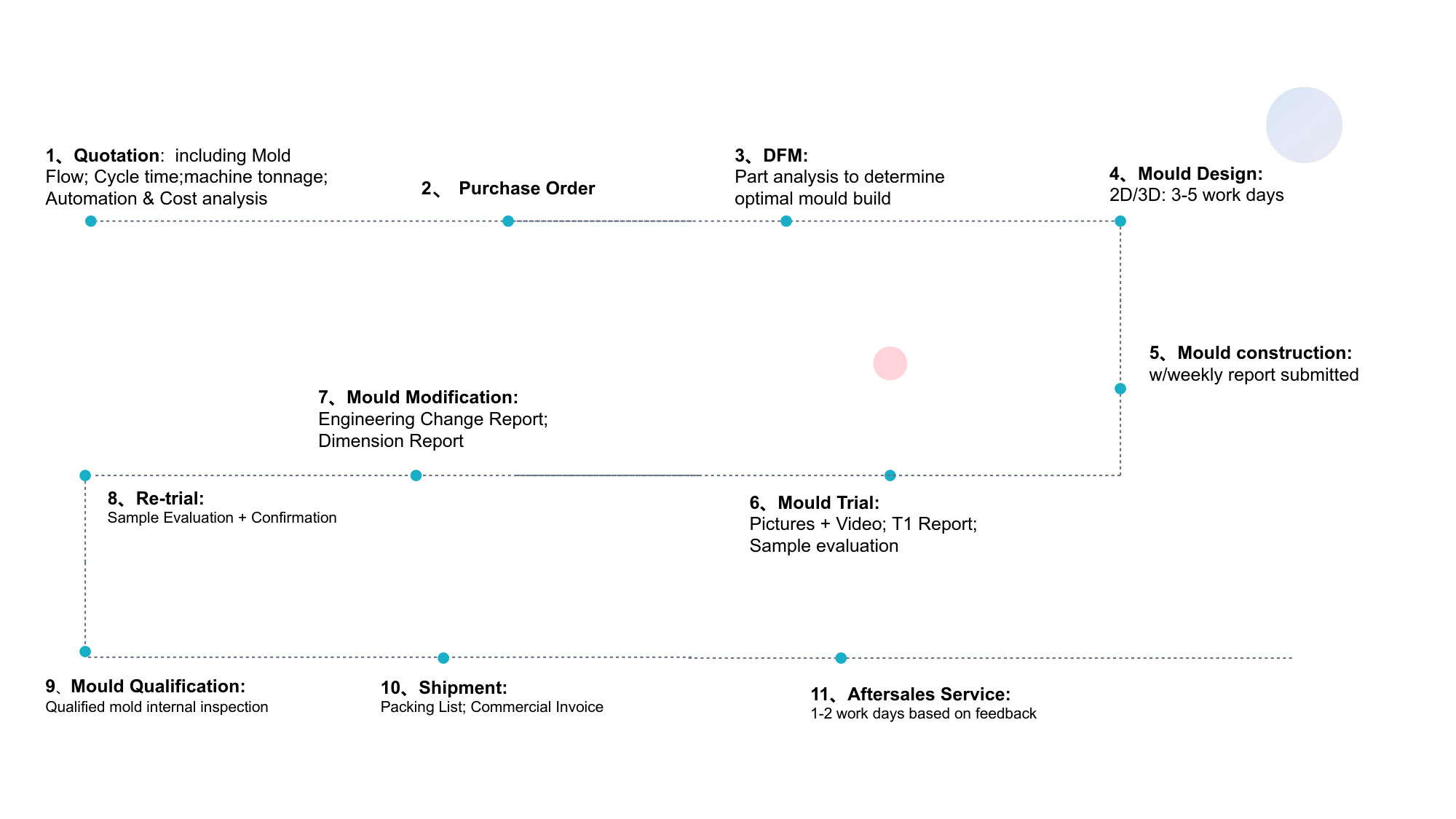
Ansix’s service architecture is deliberately end-to-end, encompassing product design and development, DFM, mold manufacturing, Moldflow simulation, product validation, New Product Introduction (NPI) process planning, high-volume production, quality assurance, delivery, and after-sales support. The significance of this integration lies in what it eliminates: the communication gaps, specification drift, and accountability gaps that arise when design, tooling, molding, and validation are distributed across separate suppliers. A single unified platform means that a DFM recommendation is not a suggestion handed off to a third party—it is an engineering decision executed within the same system that will build the tool and run the press.
The after-sales dimension is often underweighted in manufacturing profiles, but for medical components it is integral to customer recognition. Ansix’s documented DFM process is explicitly designed to prevent the downstream delays and cost overruns that occur when moldability issues are discovered after mold completion—a scenario that generates far greater total cost than any invoice-price difference between suppliers. The company’s in-house EDM, CNC, wire EDM, and polishing capabilities compress mold lead times and enable rapid design iterations without dependence on external suppliers, which in turn supports responsive engineering changes and repair turnaround during the production life of a program. The “lifetime service commitment” language that appears in Ansix’s medical project documentation reflects an orientation toward the full program lifecycle, not merely the shipment date.
Part Two — Product Introduction, Applications, Production Process, Delivery Efficiency, Tooling and Material Selection, Intelligent Manufacturing, and Process Quality Assurance
1. Product Introduction: What “Injection-Molded Micro-Components for Medical Applications” Actually Means
Medical micro-injection molding occupies the intersection of precision engineering, polymer science, and regulatory rigor. The global medical micro-injection molding plastics market was valued at approximately USD 2.68 billion in 2025 and is projected to reach USD 2.93 billion in 2026, growing at a compound annual growth rate of 9.55% toward USD 5.08 billion by 2032. The technical frontier is defined by parts with masses as low as 0.1 mg and feature dimensions in the tens-of-micrometers range, enabling microfluidic diagnostics, drug delivery mechanisms, minimally invasive instruments, and implantable device components that were not manufacturable at commercial scale a decade ago.
Ansix’s medical micro-component portfolio spans several product families. PA12 micro-precision components serve catheter parts, needle hubs, protective caps, microfluidic device housings, and diagnostic equipment parts, leveraging PA12’s density of approximately 1.02 g/cm³, low moisture absorption (~1.6% at equilibrium), dimensional stability under humidity and liquid contact, hydrolysis resistance, inherent biocompatibility, and compatibility with autoclave, gamma, and ethylene oxide sterilization. PEEK components address implantable and high-temperature applications where continuous service temperatures from −100 °C to 250 °C, chemical resistance to aggressive sterilization agents, and fatigue performance across millions of articulation cycles are required. Medical-grade polycarbonate and PC/ABS blends serve transparent housings, surgical instrument components, and needle-base applications requiring impact strength, rigidity, and autoclave or gamma compatibility. PPSU is specified where repeated steam sterilization and retention of transparency after autoclaving are critical. PP, TPU, TPE, and liquid silicone rubber (LSR) round out the material portfolio for high-volume disposable diagnostics, flexible tubing, and two-component overmolded assemblies.
The common thread across these product families is not a single material or a single part geometry, but a manufacturing discipline: holding micron-level tolerances on features that are often invisible to the unaided eye, while producing documentation that satisfies regulatory audit.
2. Application Domains
The application map for Ansix’s medical micro-components follows the broader trajectory of device miniaturization. Minimally invasive surgical instruments require micro-molded jaws, seals, and articulation components that function reliably across repeated sterilization and use cycles. Drug delivery systems—including wearable insulin pumps, autoinjectors, and prefilled pen platforms—demand fluidic valves, needle hubs, and sealing geometries that meter microliter volumes with zero-failure reliability across thousands of actuation cycles. Diagnostic equipment relies on microfluidic housings, cuvette components, and precision optical mounts where dimensional conformance directly determines assay performance. Implantable and indwelling devices use PEEK and other high-performance polymers for components that must maintain mechanical integrity and biocompatibility over extended periods in physiological environments. Needle-based systems—puncture needles, anesthesia needles, biopsy needles, and safety-engineered needle assemblies—depend on micro-molded needle bases and overmolded polymer-to-metal interfaces that maintain seal integrity under injection pressures.
What unites these applications is consequence asymmetry. A cosmetic defect in a consumer electronics housing is a customer-satisfaction issue. A 10-micron dimensional drift in a drug delivery valve is a patient-safety issue. Ansix’s process architecture is calibrated to the latter standard.
3. Production Process: From Digital Twin to Validated Part
The Ansix production process for medical micro-components follows a structured sequence that front-loads risk reduction into the digital domain.
Phase 1: Requirements capture and regulatory mapping. The project begins not with a mold design but with a structured analysis of the intended use environment, sterilization method (autoclave, gamma, EtO, or chemical), and the specific regulatory pathway the final device must follow—FDA 510(k), EU MDR, or NMPA. This ensures that material selection, documentation, and validation scope are aligned with the eventual submission requirements from day one.
Phase 2: DFM and Moldflow simulation. Ansix engineers analyze wall-thickness uniformity to prevent sink marks and differential shrinkage, verify draft angles for clean ejection without damaging delicate features, and identify opportunities to consolidate multi-part assemblies into single moldable geometries. Autodesk Moldflow and Moldex3D are used to construct a digital twin of the injection molding process before steel is cut. The simulation predicts filling patterns, pressure requirements, cooling times, weld-line locations, air traps, and warpage potential. For precision medical components—thin-walled tubes, anesthesia needle geometries, microfluidic channels—balanced filling is not a refinement but a precondition for functional conformance. The virtual prototyping stage routinely saves weeks of mold rework and tens of thousands of dollars in tooling modification costs.
Phase 3: Precision mold manufacturing. Roughing is performed on interconnected five-axis machining centers, leaving controlled finishing allowances. EDM achieves surface finishes of Ra 0.8 μm with dimensional consistency of ±0.002 mm on complex geometries and micro-holes. High-grade mold steels—P20, 718, NAK80, H13, and corrosion-resistant S136 stainless steel for cleanroom compatibility—undergo vacuum hardening and cryogenic treatment to reach final hardness of HRC 52–54, significantly improving wear resistance and tool life. For high-cavitation, high-volume medical programs, S136 stainless steel is specified to withstand cleanroom conditions and extended production cycles. Conformal cooling channels, sometimes produced via additive manufacturing, are deployed where uniform heat removal is critical to controlling both cycle time and crystallinity in semicrystalline polymers such as PEEK.
Phase 4: Sampling, validation, and NPI. Mold trials are systematic and instrumented, verifying fill balance, cooling performance, and ejection behavior before production release. IQ/OQ/PQ protocols are executed and documented. The NPI process plan defines the transition from pilot to volume production, including capacity allocation, inspection planning, and supply-chain readiness.
Phase 5: High-volume production with in-process quality control. Production runs on all-electric and hybrid servo-driven machines with ±0.1% shot-to-shot repeatability. Automated optical inspection (AOI), coordinate measuring machines (CMM), and vision systems perform real-time quality checks, with data uploaded to Manufacturing Execution Systems (MES) for Statistical Process Control (SPC) analysis. The quality target is not detection of defects but prevention of drift: CPK ≥ 1.33 on critical dimensions is a production release condition, not an aspiration.
4. Delivery Efficiency: Why Integration Compresses Time
Delivery efficiency in medical injection molding is rarely limited by press speed. It is limited by the number of organizational boundaries a project must cross. Ansix’s integrated ecosystem—design, engineering, tooling, production, and logistics on a unified platform—eliminates the communication gaps and specification hand-offs that accumulate calendar time in fragmented supply chains.
The in-house tooling capability is particularly consequential. Because CNC, EDM, wire EDM, electrode manufacturing, and polishing are performed internally, electrode lead time drops from a typical 10–14 days to 48 hours, and mold repair turnaround is not gated by external supplier queues. Detailed project planning with clearly defined milestones provides schedule transparency and enables reliable delivery even for high-volume programs with compressed timelines. The four-site footprint across China and Vietnam provides geographic redundancy and capacity absorption during demand peaks, reducing the risk of single-site disruption.
5. Mold Manufacturing and Injection Molding Material Selection
Material selection is the first and most durable cost lever in medical micro-molding. Ansix’s engineers evaluate materials against the full triad of performance, regulatory compliance, and total cost of ownership—not simply against a datasheet’s headline properties. In some cases, a higher-cost resin with superior flow characteristics enables thinner wall sections, which in turn reduces cycle time—the single largest driver of per-part cost—and offsets the raw-material premium. In other cases, a thermo-stabilized glass-fiber-reinforced polyamide meets all functional requirements at a fraction of the cost of PEEK, and the engineering discipline lies in recognizing that equivalence rather than defaulting to the most expensive option.
The medical material portfolio is matched to sterilization and application requirements: PA12 for dimensional stability and toughness in catheter and needle-hub applications; PEEK for implantable and high-temperature service; PC and PC/ISO for transparent, impact-resistant, gamma-compatible housings; PPSU for repeated autoclave cycles with transparency retention; PP for high-volume disposable diagnostics with steam sterilization compatibility; and TPU/TPE/LSR for flexible and sealing elements. Mold steel selection follows a parallel logic: S136 for corrosion resistance in cleanroom and high-humidity environments, 718 and NAK80 for polished surfaces and wear resistance in high-cavitation tools, and conformal cooling or copper-alloy inserts in thermally critical zones to reduce cycle time without sacrificing dimensional control.
6. Intelligent Manufacturing and Efficiency Enhancement
Ansix operates at a 70% automated machining ratio, a figure that reflects deliberate investment in reducing human variability in the toolroom and on the production floor. Automated optical inspection and vision systems detect defects as small as 0.01 mm, including scratches, bubbles, flow marks, and black-spec contamination. CMM provides dimensional measurement accuracy of ±0.001 mm (1 micron), and every production mold undergoes full dimensional inspection before delivery, with Key Characteristic CPK values computed and reported.
The efficiency gains are not confined to inspection. Moldflow-driven process optimization increases resin utilization by 15–20%. Optimized mold designs reduce required clamp tonnage by 20–30%, allowing smaller machines to produce the same part, with corresponding reductions in energy consumption and capital intensity. All-electric machines on presses of 650 tons and below deliver energy savings of 30–50% compared with hydraulic alternatives. These are the mechanisms through which “intelligent manufacturing” becomes a customer-facing cost advantage rather than an internal buzzword.
7. Process Quality Assurance: Prevention over Detection
The quality architecture at Ansix is built on a single principle: a conforming part is the output of a validated process, not the surviving unit of an inspection batch. This principle is operationalized through the IQ/OQ/PQ framework, SPC with CPK ≥ 1.33 on critical dimensions, full material and process traceability from raw resin to final inspection, and a cleanroom environment (ISO 14644-1 Class ISO 7 or 8) with HEPA filtration, positive differential pressure, and validated environmental monitoring for particles and microbial load.
For medical programs, the documentation package is as important as the physical part. Ansix provides full dimensional reports for every critical feature, with CPK values computed and certified before production release. “We don’t ship and hope—we measure, document, and certify,” is how the company describes its metrology discipline. This documentation readiness is what enables medical OEMs to move through their own regulatory submissions and supplier qualification processes without re-creating process evidence from scratch.
Part Three — The Value Ansix Delivers through Mold and Injection Molding Design, Development, and Manufacturing: Problem-Solving, Quality Validation, Cost Reduction, Capacity, and Delivery Assurance
1. What Value Ansix Provides and What Problems It Solves
The medical device OEM selecting a micro-injection molding partner faces a recurring set of structural problems. Design concepts that appear manufacturable on CAD fail in tooling because wall-thickness transitions create sink, draft is insufficient for clean ejection, or gate locations produce weld lines in structurally critical zones. Material selections optimized for performance ignore sterilization compatibility or processability at micro-scale. Tooling built by one supplier and validated by another produces documentation gaps that surface during regulatory audit. Production distributed across multiple vendors produces lot-to-lot variation that erodes yield and triggers costly incoming inspection. Scale-up from pilot to volume reveals that the chosen partner lacks the press capacity, automation, or cleanroom footprint to absorb the program.
Ansix’s value proposition is the systematic elimination of these problems through integration and front-loaded engineering. The co-engineering model addresses manufacturability before tooling commitment. DFM analysis identifies and resolves wall-thickness, draft-angle, undercut, and assembly-consolidation issues while changes are still inexpensive. Moldflow simulation converts trial-and-error into predictive engineering, identifying filling imbalances, air traps, weld-line locations, and warpage risk in the digital domain. Material selection is conducted against the full application envelope—sterilization method, chemical exposure, fatigue cycles, and regulatory pathway—rather than against a single mechanical property. Tooling, validation, and production occur within one quality system, so the documentation that supports regulatory submission is generated once, coherently, and without reconstruction.
2. How Ansix Executes Quality Validation for Medical Customers
Quality validation for medical micro-components is not a final inspection step. It is a longitudinal process that begins with requirements definition and continues through production monitoring.
At the requirements stage, Ansix maps the intended use environment, sterilization method, and regulatory pathway (FDA 510(k), EU MDR, or NMPA) into the engineering specification. This prevents the common and expensive failure mode in which a device passes functional testing but fails regulatory review because the process evidence does not align with the submission’s scope.
At the process development stage, IQ/OQ/PQ is executed as a structured protocol. IQ verifies that tooling, auxiliary equipment, and press configuration conform to design specifications. OQ establishes and documents the parameter windows—melt temperature, packing pressure, injection velocity, cooling time—that produce conforming parts. PQ confirms that the validated process yields conforming parts consistently across multiple production lots under routine conditions. CMM inspection at ±0.001 mm accuracy, AOI at 0.01 mm defect detection capability, and CPK ≥ 1.33 on critical dimensions provide the objective evidence base.
At the production stage, SPC monitoring with MES data capture enables detection of process drift before it produces nonconforming parts. Full traceability from raw material lot to final inspection supports root-cause analysis and regulatory audit. The cleanroom environment—ISO 7 or 8 with validated particle and microbial monitoring—addresses the contamination-control dimension that distinguishes medical molding from industrial molding.
3. How Ansix Reduces Customer Costs
Cost reduction in medical micro-molding is not a matter of negotiating resin prices. It is the cumulative effect of decisions made across design, tooling, process, and material selection.
The largest single lever is design-phase intervention. Because approximately 70% of manufacturing cost is locked in during design, Ansix’s DFM and co-engineering engagement targets cost before it becomes embedded in tooling and process. Specific mechanisms include consolidating multi-part metal assemblies into single moldable geometries, which has reduced post-molding assembly time by up to 40% for Ansix clients; optimizing wall thickness to shorten cycle time, the dominant per-part cost driver; and designing balanced filling and cooling to reduce scrap and rework.
Moldflow analysis contributes directly to material cost reduction: resin utilization improvements of 15–20% reduce waste and per-part material consumption. Optimized mold designs that reduce required clamp tonnage by 20–30% lower energy consumption and allow production on smaller, less capital-intensive machines. All-electric presses deliver 30–50% energy savings versus hydraulic machines, compounding the per-part cost advantage over multi-year programs. Strategic material selection—specifying a lower-cost engineering polymer that meets all functional requirements rather than defaulting to a premium resin—further reduces direct material cost without performance compromise.
The tooling investment itself is subject to cost optimization. In-house electrode manufacturing reduces lead time from 10–14 days to 48 hours, and in-house EDM, wire EDM, and polishing eliminate external supplier margins and queue delays. For high-volume programs, tooling cost is amortized across production volumes that often exceed 500,000 parts, reducing the tooling contribution to unit cost to a small fraction of total cost.
4. How Ansix Increases Capacity and Guarantees Delivery
Capacity assurance begins with installed infrastructure. The 260-press fleet, spanning 30 to 2,800 tons across four sites, provides both the low-tonnage precision required for micro-components and the high-tonnage capability for larger device housings, allowing a single partner to scale with a program from prototype quantities to millions of units annually. The geographic distribution across China and Vietnam provides redundancy and flexibility in capacity allocation, reducing exposure to single-site disruption.
Delivery assurance is a function of integration as much as capacity. The unified platform—design, engineering, tooling, production, and logistics—eliminates the communication gaps that accumulate calendar time in fragmented supply chains. In-house tooling capability means that mold repairs and engineering changes are not gated by external supplier schedules. Detailed project planning with defined milestones provides schedule transparency, and the 70% automated machining ratio reduces the labor-variability and rework delays that erode delivery reliability in less automated operations.
For medical OEMs, delivery reliability has a regulatory dimension. A late delivery of a validated component can delay a device launch, trigger inventory shortages, or force expedited shipping costs that erase program margins. Ansix’s delivery model addresses this by treating schedule adherence as a quality attribute: the same documentation discipline, process monitoring, and milestone planning that ensure dimensional conformance are applied to timeline conformance.
Conclusion
Ansix Tech’s position in injection-molded micro-components for medical applications is the cumulative result of a deliberate architectural choice: to build an integrated engineering and manufacturing platform in which design, tooling, validation, and production are not separate commercial transactions but stages of a single controlled process. The 28-year operating history, the 260-press fleet, the ISO 13485 and ISO 8 infrastructure, the ±0.002 mm tooling precision, and the CPK ≥ 1.33 quality discipline are the visible evidence of that choice. The deeper evidence is in the customer outcomes: reduced assembly time, improved resin utilization, lower required tonnage, compressed tooling lead times, and documentation that supports rather than obstructs regulatory submission.
For medical device OEMs, the practical significance is straightforward. A partner that can hold micron tolerances, validate a process to IQ/OQ/PQ standards, document every critical dimension with CPK evidence, scale from prototype to millions of units, and deliver on a schedule is a strategic asset. Ansix Tech has built its business around being that asset—not through a single capability, but through the disciplined integration of many.
Ansix Tech Co Ltd
If you have any plans related to Manufacturer of Injection-Molded Micro-Components for Medical Applications , you can contact us at any time. We will turn your ideas into reality, let you realize your dreams, and obtain large orders from the market. Our contact information is info@ansixtech.com. Or contact our CTO, mail: stephen@ansixtech.com
#www.ansixtech.com #ansixtech.com #Manufacturer of Injection-Molded Micro-Components for Medical Applications #Manufacturer of Injection-Molded Micro-Components for Medical Applications Tooling #Manufacturer of Injection-Molded Micro-Components for Medical Applications injection mold companies #Ansix #Ansix moulds #Ansix china #Ansix tech china #Ansix tech company #Ansix facotry #Ansix Tooling #Ansix tool #Manufacturer of Injection-Molded Micro-Components for Medical Applications injection molding #Manufacturer of Injection-Molded Micro-Components for Medical Applications injection tools #Manufacturer of Injection-Molded Micro-Components for Medical Applications injection moulds #Ansix moulding company #Ansix molding #ansix tooling #Manufacturer of Injection-Molded Micro-Components for Medical Applications plastic mould #Manufacturer of Injection-Molded Micro-Components for Medical Applications plastic tools #Ansix Tech #Ansix molds #Ansix injection molding #Ansix mold factory #Manufacturer of Injection-Molded Micro-Components for Medical Applications injection molding Customized #Ansix mold factory #Manufacturer of Injection-Molded Micro-Components for Medical Applications china #Manufacturer of Injection-Molded Micro-Components for Medical Applications molds #injection factory for Manufacturer of Injection-Molded Micro-Components for Medical Applications #Manufacturer of Injection-Molded Micro-Components for Medical Applications injection molding #Manufacturer of Injection-Molded Micro-Components for Medical Applications injection molding factory #injection molding company #Manufacturer of Injection-Molded Micro-Components for Medical Applications injection mold companies #Manufacturer of Injection-Molded Micro-Components for Medical Applications Tooling #Manufacturer of Injection-Molded Micro-Components for Medical Applications mold limited #Ansix mold china #Ansix companies for Manufacturer of Injection-Molded Micro-Components for Medical Applications #Ansix company China #Manufacturer of Injection-Molded Micro-Components for Medical Applications facotry #Ansix Tech #Ansix Tech mould #Manufacturer of Injection-Molded Micro-Components for Medical Applications injection moulding #Manufacturer of Injection-Molded Micro-Components for Medical Applications injection moulding company #Ansix Manufacturer of Injection-Molded Micro-Components for Medical Applications parts injection mold companies #Manufacturer of Injection-Molded Micro-Components for Medical Applications injection molding companies china #Manufacturer of Injection-Molded Micro-Components for Medical Applications china factory #Ansix moulding companies #Ansix molding company #Manufacturer of Injection-Molded Micro-Components for Medical Applications injection moulding facotry #Ansix Tech mold #Manufacturer of Injection-Molded Micro-Components for Medical Applications mould #Manufacturer of Injection-Molded Micro-Components for Medical Applications plastic injection molding #ansix plastic mold #Manufacturer of Injection-Molded Micro-Components for Medical Applications Mold manufacturing #Manufacturer of Injection-Molded Micro-Components for Medical Applications parts manufacturing #Manufacturer of Injection-Molded Micro-Components for Medical Applications plastic parts factory #Manufacturer of Injection-Molded Micro-Components for Medical Applications injection parts mold #Manufacturer of Injection-Molded Micro-Components for Medical Applications PRECISION MANUFACTURING #Manufacturer of Injection-Molded Micro-Components for Medical Applications TOOL #China Manufacturer of Injection-Molded Micro-Components for Medical Applications mold #Manufacturer of Injection-Molded Micro-Components for Medical Applications injection moulding china #Manufacturer of Injection-Molded Micro-Components for Medical Applications mould china #china precision mold #Manufacturer of Injection-Molded Micro-Components for Medical Applications mold in china #Manufacturer of Injection-Molded Micro-Components for Medical Applications mold china #Manufacturer of Injection-Molded Micro-Components for Medical Applications Precision molds #High-precision molds #Manufacturer of Injection-Molded Micro-Components for Medical Applications High-precision tool #Injection molds #Mold for thin-walled endoscopic protective sleeve components (wall thickness 0.08 mm)Factory #Mold for thin-walled endoscopic protective sleeve components (wall thickness 0.08 mm)Company #Super Large Injection Mold Factory #Large Tonnage Injection Molding Factory #Manufacturer of Injection-Molded Micro-Components for Medical Applications Company #Manufacturer of Injection-Molded Micro-Components for Medical Applications Factory #2800T Injection Molding Factory #3000 Ton Injection Molding #4500 Ton Injection Molding Factory #Manufacturer of Injection-Molded Micro-Components for Medical Applications Large Mold Injection Molding #Large Plastic Mold Injection Molding Factory #Manufacturer of Injection-Molded Micro-Components for Medical Applications Large Injection Mold Manufacturer #Manufacturer of Injection-Molded Micro-Components for Medical Applications Plastic Mold Factory #Injection Mold #Plastic Mold