
 Medical Molds
 Packaging Molds
 Personal Care Molds
 Electronic Molds
 Automotive Molds
 Home Appliance Molds
 Special Molds
 Design & Engineering
 Production & Manufacturing
 Global Presence
 Business Scope
 Component Solutions
 Product Assembly
 Quality Management
 Medical Device Manufacturing



Manufacturer of Molds for Miniature Nail Guns
FEATURES
Ansix Tech has built its position in this niche not by treating a miniature nail gun mold as a generic “small part” tool, but by applying the same engineering discipline it uses for medical, automotive, and precision electronic molds: simulation-led design, tool-steel selection matched to the resin and shot volume, statistically validated processes, and a service model that runs from part concept through after-sales support. The result is a mold that enters the customer’s supply chain as a production-ready asset, not a tool that requires an extended debugging phase after delivery.
2. The Ansix platform: scale, precision, and certification
Ansix Tech was established in Hong Kong in 1998 and has operated for more than 28 years as a precision injection molding specialist. The company runs four production bases in China and Vietnam with a total building area of approximately 200,000 square meters. Its injection molding fleet comprises 260 machines ranging from 30 to 2,800 tons, and the workforce exceeds 1,200 people, including more than 200 design engineers. Ansix has delivered over 30,000 mold sets and reports precision capability reaching 0.002 mm. Its quality management system holds ISO 9001, ISO 14001, IATF 16949, and ISO 13485 certifications, and its automated machining ratio stands at 70%.
Those numbers matter for miniature nail gun molds in specific, non-generic ways:
The 30-to-2,800-ton machine range allows Ansix to run small, high-cavitation miniature part molds on appropriately sized presses rather than forcing them onto oversized machines, which would waste cycle time and energy while increasing melt-residence variability.
Over 200 design engineers mean that DFM and Moldflow work is not a bottleneck outsourced to a third party; it is an in-house front-end capability that can iterate with the customer’s product team in days rather than weeks.
0.002 mm precision is the order of magnitude required for nail-gun magazine channels, trigger pivots, and interlock features where fit and function are determined by tool geometry, not by post-mold adjustment.
IATF 16949 and ISO 13485 are the discipline anchors for PPAP-style validation and traceability — the same frameworks that professional power-tool and construction-fastener OEMs expect from their molding partners.
-
Mold Description
Product Materials:
lcp
Mold Material:
S136ESR
Number of Cavities:
2
Glue Feeding Method:
Hot runner
Cooling Method:
Water cooling
Molding Cycle
42.5s
- The mold manufacturing process and product material selection
How Ansix moves a miniature nail gun program from concept to customer-recognized production
3.1 Product design and development: starting from function, not from a drawing
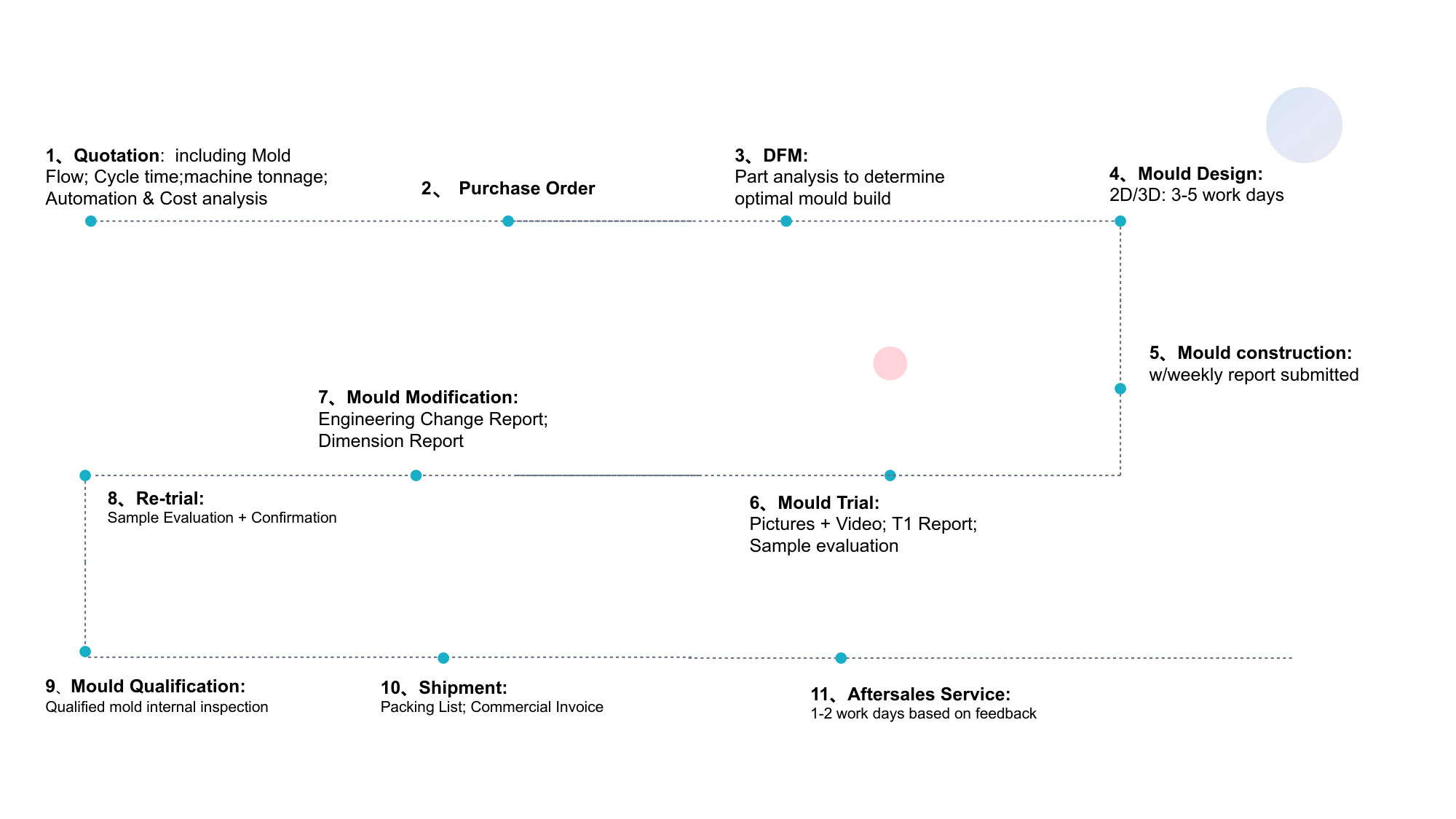
Ansix’s service chain begins before the mold exists. For a miniature nail gun, the relevant plastic parts are functional components in a mechanical system: the housing carries impact loads and locates the driving mechanism; the magazine guides and retains collated nails; the trigger and safety elements transmit motion and must not creep or wear through. Ansix’s product design and development support works at this functional level, combining part geometry review with material selection and process feasibility. The company explicitly positions design as a front-end engineering activity integrated with Moldflow and ESI simulation, rather than a decorative CAD step.
In practice, this means that when a customer brings a miniature nail gun architecture or an existing metal-and-thermoplastic design, Ansix’s engineers ask questions that directly affect mold success: Which features are wear surfaces? Which walls are structural and which are flow paths? Where will the part be assembled against metal components, and what tolerance stack-up must the plastic molding hold? What is the expected shot life, and will the tool see glass-filled resin? These answers determine tool steel, gate strategy, ejection layout, and cooling architecture before a single mold plate is cut.
-
DFM and Moldflow: converting uncertainty into a process window
Design for Manufacturability (DFM) is the bridge between part design and mold design. For miniature nail gun components, DFM addresses wall-thickness uniformity, rib-to-wall thickness ratios, draft on deep features, gate location and type, ejector-pin placement on non-cosmetic surfaces, and the feasibility of automated de-gating. Ansix’s DFM is not a checklist; it is the input to Moldflow simulation.
Ansix uses Moldflow to analyze volumetric shrinkage, predict and optimize gate locations, and identify filling-related defects such as air traps and weld lines before trial molding. The simulation also examines injection pressure, clamp force, filling patterns, and temperature variation, allowing engineers to correct mold and part design issues in software rather than in steel. For a miniature nail gun, the most valuable Moldflow outputs are often:
Weld-line location and quality in glass-filled nylon housings and magazine bodies, where weld lines can become mechanical weak points under impact.
Air-trap prediction in blind pockets, rib intersections, and deep trigger cavities, which prevents short shots and burn marks without repeated trial-and-error.
Core deflection risk in long, slender core features such as nail-channel mandrels, where unbalanced flow can push a core sideways and produce wall-thickness variation.
Clamp-force and pressure requirements so that the selected press tonnage is neither marginal nor wasteful.
The practical outcome is a higher first-trial success rate and a shorter path from T1 to a stable process window — a direct contributor to on-time delivery and cost control.
3.3 Mold design and mold manufacturing: where miniature nail gun molds earn or lose their life
Miniature nail gun molds concentrate several tooling challenges into a small footprint. The parting-line and shut-off areas around magazine channels and trigger openings are narrow and often stepped; cores for nail channels are long and slender; cooling must reach deep into core features without weakening them; and glass-filled resins demand wear-resistant steel and robust gate construction.
Ansix’s mold design for these applications typically follows a resin-and-volume-driven steel logic. For glass-filled nylon (PA6-GF30 or PA66-GF30) and POM, H13 (1.2344) at 48–52 HRC is the standard workhorse for high-volume production because it combines toughness with resistance to abrasive glass-filled grades and performs well in hot-runner and high-temperature molding. H13 tool life is typically in the 1M–3M shot range for these conditions. Where the resin is corrosive (for example PVC in certain tool bodies) or where a mirror-polished, corrosion-resistant cavity is required — for example a visible housing surface or a clear component — S136 (1.2083) stainless steel at 48–52 HRC is selected, with tool life of 1M+ shots and excellent polishability. For less abrasive, moderate-volume applications, pre-hardened NAK80 (37–43 HRC) can offer good polishability and complex-geometry capability without heat-treatment distortion, at tool life in the 500K–1.5M shot range.
The manufacturing process itself is built around the precision requirements of miniature features. Ansix’s automated machining ratio of 70% and its wire-EDM capability — including micro-hole and narrow-slot machining down to 0.03 mm in some precision applications — are directly relevant to nail-gun mold details such as narrow gate inserts, slender core pins, and fine shut-offs. CNC machining, EDM, and precision grinding are sequenced to maintain alignment and register between cavity and core, because in a miniature nail gun mold a misalignment of a few hundredths of a millimeter at the magazine shut-off is a functional defect, not a cosmetic one.
3.4 Material selection for miniature nail gun components: the resin decision drives the mold decision
The two dominant engineering thermoplastics in miniature nail gun plastic components are glass-fiber-reinforced nylon and POM (acetal). They are not interchangeable, and the mold design must follow the resin’s behavior.
Glass-filled nylon (PA6-GF30 / PA66-GF30). Nylon offers high mechanical strength, toughness, fatigue resistance, and wear resistance, and glass-fiber reinforcement raises stiffness and dimensional performance substantially. PA66-GF30 typically provides higher tensile strength and heat deflection temperature than PA6-GF30 — reported ultimate tensile strength around 190 MPa versus approximately 175 MPa, and HDT around 250°C versus 200°C for comparable 30% glass loading — while PA6-GF30 is generally lower in cost and slightly better in impact strength. In a miniature nail gun, glass-filled nylon is the natural choice for structural housings, frame components, and load-bearing brackets where stiffness, impact resistance, and thermal stability under repeated operation matter. The trade-offs the mold must address are abrasive wear on gates and cavities, weld-line sensitivity, and moisture-related dimensional change after molding.
POM (polyoxymethylene / acetal). POM is selected for precision mechanical movement: low coefficient of friction, excellent wear resistance, high stiffness, low moisture absorption, and excellent dimensional stability. It is the preferred material for gears, bearings, rollers, guides, latches, and precision sliding parts. In a miniature nail gun, POM is a strong candidate for trigger mechanisms, magazine followers, nail-pusher components, and safety interlocks where smooth, repeatable movement and dimensional consistency are more important than maximum toughness. Within the DuPont Delrin® family, the 100, 500, and 900 series represent a melt-viscosity ladder: 100 is the most viscous and is used where maximum toughness is needed; 500 is the general-purpose injection molding grade; and 900 is the most fluid, suited to thin walls or complex flow paths. For miniature nail gun parts, a 500-series general-purpose grade is often the starting point for balanced mechanical properties, while a 900-series grade may be appropriate for thin-section magazine or trigger components where fillability is the constraint.
Material-related mold design consequences. Glass-filled nylon requires H13-class steel for production tools, wear-resistant gate inserts, and generous venting to avoid gas burn. POM requires attention to residence time and shear history to avoid degradation, and its low moisture absorption means that molded dimensions are relatively stable — but its semi-crystalline shrinkage behavior still requires Moldflow-informed packing and cooling design. A single miniature nail gun program may therefore use H13 tooling for the glass-filled nylon housing and a POM-optimized tool for the trigger and magazine internals, with different gate and cooling strategies for each.
3.5 NPI process planning: T0 through PPAP and into mass production
New Product Introduction (NPI) for a miniature nail gun mold is a phased qualification sequence, not a single sampling event. Ansix’s NPI workflow follows the industry-standard structure of tool tryout and validation, T1/T2 verification, customer approval, pilot production, and PPAP-style deliverables.
T0 — internal first trial. The mold is assembled and run to confirm basic mechanical function: filling, ejection, core movement, and hot-runner or cold-runner behavior. T0 is where gross tooling issues — a sticking core, an unbalanced runner, a mis-set shut-off — are exposed before customer samples are produced.
T1 — first customer sample and dimensional check. The objective is to validate fill, ejection, and cooling function and to produce a full dimensional report against the drawing. T1 parts may still carry defects; the purpose is to confirm mold function and establish the correction list.
T1-to-T2 steel correction. In practice, most molds require at least one round of steel correction after T1. Ansix plans for this in the project timeline rather than treating it as an unplanned delay.
T2 — process window and capability. T2 proves that the process is stable and repeatable at full cycle speed. The outputs are a process window study, optimized parameters, and capability data — typically Cpk — before production sign-off.
PPAP / production release. The final stage produces the approved documentation set: dimensional reports, material certificates, process capability records, and the customer sign-off that releases the mold to mass production.
For a miniature nail gun program, this sequence is applied part-by-part across the tool family — housing, magazine, trigger, internal mechanisms — so that the customer receives a qualified process for each component rather than a single “mold passed” milestone that conceals part-specific risks.
3.6 Mass production, quality assurance, and delivery
Once released, Ansix runs production under a quality architecture built around incoming, in-process, and outgoing controls, with FAI, CMM verification, and PPAP documentation as the evidence layer. Incoming Quality Control (IQC) verifies resin identity, grade, and certificate of analysis against the specified material; In-Process Quality Control (IPQC) monitors dimensions, visual defects, and process parameters at defined frequency; Outgoing Quality Control (OQC) confirms that the shipment matches the approved sample and documentation package. First Article Inspection measures every feature on the engineering drawing against tolerance using calibrated instruments including CMM and optical comparators, and the PPAP report package ties the molding process to the approved design record.
Delivery performance is supported by the same NPI discipline. Because T1 and T2 are planned as stages rather than surprises, the production release date is anchored to process capability rather than to hope. For customers ramping a miniature nail gun program, this means the mold and the molding process arrive together as a qualified system.
3.7 After-sales service: the mold is an asset, not a transaction
Ansix’s after-sales model includes technical consultation, replacement-part availability, root-cause investigation if field issues arise, and preventive maintenance protocols intended to extend mold life and lower per-part amortized tooling cost. For a miniature nail gun mold, preventive maintenance is especially consequential: wear on glass-filled-nylon gates and core tips, gradual loss of shut-off integrity, and cooling-channel scaling all degrade part quality slowly before they cause a catastrophic failure. A maintenance schedule tied to shot count and resin abrasiveness protects the customer’s production continuity and preserves the dimensional capability established at T2.
4. How this translates into customer recognition and industry leadership
Ansix’s position in miniature nail gun molds is not built on a single capability but on the integration of four disciplines that are often separated in the mold-making industry:
Simulation before steel. Moldflow and DFM are used to eliminate fill, cooling, and warpage risks in software, so that T1 is a confirmation step rather than a discovery step.
Resin-specific tooling. H13 for glass-filled nylon production, S136 for corrosive or polish-critical applications, and POM-appropriate thermal and gate design are selected from the material outward, not from a generic mold template.
Qualification as a process, not a sample. T0–T1–T2–PPAP sequencing produces a documented process window and capability data, which is what professional OEM customers actually require.
Lifecycle ownership. After-sales maintenance, root-cause support, and replacement-part availability turn the mold into a managed production asset.
The customer-recognized result is a miniature nail gun mold that produces functional parts at the specified tolerance, at the expected shot life, and at a total cost that includes tool life and maintenance — not merely a low initial mold price.
Part II — Manufacturer of Molds for Miniature Nail Guns: Product Introduction, Applications, Process, Materials, Intelligent Manufacturing, Quality, Cost, and Service
1. Product introduction: what a “mold for miniature nail guns” actually includes
A miniature nail gun mold set is not a single tool. It is a family of precision injection molds that together produce the plastic content of a compact fastening tool. The typical scope includes:
Housing and frame molds — structural components that locate the driving cylinder or piston, the magazine, and the trigger assembly. These are usually glass-filled nylon (PA6-GF30 or PA66-GF30) and carry impact and vibration loads.
Magazine and nail-channel molds — long, often thin-walled components with guide ribs and retention features. Dimensional consistency here directly determines nail-feed reliability.
Trigger, safety-interlock, and actuator molds — precision mechanical parts where POM is frequently selected for low friction, wear resistance, and dimensional stability.
Internal mechanism molds — pushers, followers, guides, and latches, often POM or glass-filled nylon depending on load and wear duty.
Optional overmolded or multi-material components — grip surfaces or dampening elements where a thermoplastic elastomer is bonded to a rigid substrate.
Each mold in the family has its own gate strategy, cooling layout, ejection plan, and steel selection. Ansix’s role is to engineer the family as an integrated system so that the assembled tool functions as intended, not to optimize each part in isolation at the expense of assembly fit.
2. Application domains: where miniature nail guns are used and why the molded parts matter
Miniature nail guns are used in applications where a full-size framing nailer cannot reach or is not practical: joist hangers, decking, fencing, roof clips and flashing, edge protection, fibre-cement cladding, plasterboard-to-timber fastening, and tight-space trim and panel work. The molded plastic components are not incidental to these applications. In a palm nailer or compact coil nailer, the housing transmits impact and vibration to the user’s hand; the magazine controls nail collation and feed angle; the trigger and safety mechanism must operate reliably in dust, moisture, and temperature variation. A dimensional drift in the magazine channel or a wear-induced change in trigger travel is a field failure, not a cosmetic issue.
This application profile drives the mold requirements: wear-resistant steels for glass-filled resins, robust core support for long magazine features, controlled shrinkage for assembly interfaces with metal components, and process capability that remains stable over high-volume production. Ansix’s mold design and material selection are therefore anchored in the tool’s working environment, not in a generic “power tool” category.
3. Production process: from resin pellet to qualified molded part
The production process for miniature nail gun components follows a defined sequence that begins with material verification and ends with documented outgoing quality.
3.1 Material receiving and drying. Glass-filled nylon is hygroscopic and must be dried to the resin supplier’s specification before molding; moisture at the hopper produces hydrolytic degradation, splay, and reduced mechanical properties. POM requires controlled drying and residence-time management to avoid thermal degradation. IQC verifies the resin grade and certificate against the approved material specification before release to production.
3.2 Molding. The mold is run within the T2-established process window: injection profile, packing pressure and time, melt and mold temperature, cooling time, and clamp force. For glass-filled nylon, gate velocity and shear rate are managed to minimize fiber orientation and weld-line weakness; for POM, cycle consistency is prioritized to maintain dimensional stability.
3.3 In-process inspection. IPQC monitors critical dimensions, visual defects (short shots, burn marks, weld-line opening, flash), and process parameters at defined intervals. CMM and optical comparator measurements are used for feature verification, and SPC data are maintained for capability tracking.
3.4 De-gating, assembly, and secondary operations. Depending on part design, automated or semi-automated de-gating is used; assembly verification may include fit checks against mating components. For miniature nail gun programs, the relevant assembly interfaces are often the magazine-to-housing joint, the trigger pivot, and the safety-interlock engagement.
3.5 Final inspection and packaging. OQC confirms that the lot matches the approved sample, dimensional report, and documentation package. Packaging is specified to protect precision features during transit.
4. Delivery efficiency: how the schedule is built
Delivery efficiency in a miniature nail gun mold program is a function of front-end engineering and staged qualification, not of working faster in the tool room alone.
Ansix’s NPI structure allows the project timeline to be built around realistic milestones: DFM and Moldflow before mold design release; T0 as an internal functional gate; T1 as the first dimensional and customer sample; a planned steel-correction allowance between T1 and T2; and T2 as the process-capability gate before PPAP and production release. This sequence prevents the common failure mode in miniature part molds where a “passed” T1 sample conceals a process that cannot run at production cycle speed or hold Cpk at volume.
For customers requiring accelerated market entry, rapid tooling approaches — aluminum or pre-hardened steel molds for bridge production — can reduce tooling lead time by 40–70% compared with conventional production tooling, with prototype tooling lead times typically in the 7–20 day range depending on part complexity, mold size, and material. Ansix’s production tooling for high-volume miniature nail gun components follows the production-grade path: H13 or S136 tool steel, Moldflow-validated design, and T0–T2 qualification, with typical production tooling lead times in the 8–16 week range for multi-cavity, hardened-steel molds. The key is to match the tooling route to the program stage: rapid tooling for design validation and bridge supply, production tooling for the volume ramp.
5. Mold manufacturing and injection molding material selection
5.1 Tool steel selection
The steel decision for a miniature nail gun mold is governed by resin abrasiveness, corrosiveness, expected shot volume, and surface-finish requirements.
Steel Hardness (HRC) Typical tool life Best fit for miniature nail gun molds Constraints
H13 (1.2344) 48–52 1M–3M shots Glass-filled nylon housings, magazines, structural parts; high-volume production; hot-runner systems Not ideal for mirror polish or highly corrosive resins
S136 (1.2083) 48–52 1M+ shots Corrosive resins, medical-grade or food-contact parts, transparent or mirror-polished visible components Higher cost; over-specified for non-corrosive general parts
NAK80 (1.2796) 37–43 500K–1.5M shots Complex geometries, engineering resins such as PC and nylon, applications where heat-treat distortion is a concern Not for very high volume (>2M shots) or highly abrasive compounds
Data reflect industry-standard steel selector guidance for injection molds. For a glass-filled nylon miniature nail gun housing, H13 at 48–52 HRC is the default production choice. For a POM trigger or internal mechanism at moderate volume, NAK80 can offer good polishability and complex-feature capability with adequate wear resistance. For a corrosive-resin component or a visible, high-polish surface, S136 is selected.
5.2 Injection molding material selection
Glass-filled nylon (PA6-GF30 / PA66-GF30). PA66-GF30 provides higher strength and heat resistance (reported UTS ~190 MPa, HDT ~250°C), while PA6-GF30 is lower in cost and slightly tougher in impact, with UTS around 150–175 MPa and HDT around 200°C depending on grade and conditioning. Both reduce shrinkage to roughly 0.3–0.7% and are used for structural housings, brackets, and power-tool cases. The mold must account for fiber orientation, weld-line strength, and gate wear.
POM (acetal / Delrin®). POM offers low friction, excellent wear resistance, high stiffness, low moisture absorption, and excellent dimensional stability — the property set required for precision moving parts such as trigger mechanisms, magazine followers, and latches. The Delrin® 100/500/900 viscosity series gives the designer a processing ladder: 100 for maximum toughness in high-viscosity molding, 500 for general-purpose injection molding, and 900 for the most fluid filling of thin or complex sections.
Selection logic for a miniature nail gun. Use glass-filled nylon where structural stiffness, impact resistance, and thermal stability dominate: housing, frame, load-bearing brackets. Use POM where smooth, repeatable mechanical movement and dimensional consistency dominate: trigger, safety, magazine follower, precision guides. The mold steel, gate design, cooling layout, and process window are then derived from that resin decision.
6. Intelligent manufacturing and efficiency improvement
Ansix operates with a 70% automated machining ratio, which contributes to repeatability and throughput in mold manufacturing. In injection molding production, the efficiency gains available through digital manufacturing are well documented: MES and ERP integration with real-time machine monitoring can raise production efficiency from approximately 70% to 95% while reducing defect rates from 0.3% to 0.1%. A hybrid IoT-MES data architecture in injection molding has been reported to improve Overall Equipment Effectiveness (OEE) by 7.17% and to increase label completeness and traceability substantially. Automated systems combining injection machines, robot automation, central material feeding, MES data management, and AGV logistics have achieved cycle times under 60 seconds with pass rates above 99% and repeat weight deviation within 0.3% in demanding applications.
For a miniature nail gun program, the practical efficiency levers are: real-time machine-status visibility to reduce unplanned downtime; automated first-article and in-process data capture to shorten T1-to-T2 iteration; mold-status and shot-count monitoring to trigger preventive maintenance before wear affects part dimensions; and centralized material handling to maintain drying and resin consistency. Ansix’s manufacturing platform is structured to apply these levers at the program level rather than as isolated equipment purchases.
7. Process quality assurance: the evidence package a customer should expect
A miniature nail gun customer should require more than a certificate. The quality evidence package for each mold and each production lot should include:
IQC records for resin identity, grade, and certificate of analysis.
FAI report measuring every drawing feature against tolerance using calibrated CMM and optical instruments.
IPQC records showing dimensional and visual inspection frequency, process parameters, and SPC data.
OQC records confirming lot conformity to the approved sample and documentation.
PPAP-style documentation set including process flow, control plan, capability data (Cpk), and material certificates.
Mold maintenance records tied to shot count and resin abrasiveness, supporting the tool-life claim.
Ansix’s ISO 9001, IATF 16949, and ISO 13485 certifications provide the framework for these controls, but the customer-recognized value is in the records themselves: traceability from resin lot to molded lot, and from mold maintenance event to dimensional capability.
8. Cost control: the most competitive total cost, not the lowest mold price
The most competitive cost position in miniature nail gun molds comes from five sources, and none of them is “use cheaper steel.”
First, simulation avoids steel rework. Moldflow and DFM catch fill, cooling, and warpage issues before T1, reducing the number and severity of steel corrections and shortening the T1-to-T2 cycle.
Second, steel is matched to duty. Using H13 for glass-filled nylon production tools and NAK80 or P20-class steel only where the shot volume and resin justify it avoids over-specifying every tool to S136 or 1.2343. The cost index for H13 is materially lower than S136, and P20-class steel is lower still, while still delivering 500K–1M shots in appropriate applications.
Third, tool life is managed as an asset. Preventive maintenance protocols extend mold life and lower per-part amortized tooling cost; after-sales replacement-part availability avoids premature mold replacement.
Fourth, cavitation and cycle time are optimized together. Moldflow-informed cooling and ejection design, combined with a press sized to the mold rather than oversized, reduces cycle time and energy per part.
Fifth, front-end engineering reduces program risk. A mold that reaches T2 with a documented process window and Cpk avoids the hidden cost of production ramp failures, expedited freight, and field returns.
9. After-sales service quality: the differentiator after the mold ships
Ansix’s after-sales support includes technical consultation, replacement-part availability, root-cause investigation for field issues, and preventive maintenance planning. In miniature nail gun molds, the highest-value after-sales activities are:
Shot-count-based maintenance scheduling for glass-filled nylon tools, where gate and core-tip wear is progressive.
Dimensional capability re-verification after maintenance or steel repair, so that the customer’s production process is not released on an unverified tool.
Root-cause investigation that distinguishes mold wear from resin variation, drying faults, or machine drift — preventing repeated failures from being misattributed to the tool.
Replacement-part logistics for wear items such as core pins, gate inserts, and ejector components, reducing unplanned downtime.
The customer-recognized outcome is a mold that remains a production asset across its life, not a tool that performs only during the warranty sample phase.
Part III — The Value of Ansix Mold Design and Injection Molding Development and Manufacturing: Problems Solved, Quality Validation, Cost Reduction, Capacity, and Delivery
1. What value Ansix’s design-and-manufacturing model delivers to a miniature nail gun customer
A miniature nail gun program typically faces four categories of risk: functional risk (the plastic parts do not perform in the assembled tool), timing risk (the mold is late or the process is not stable at launch), quality risk (dimensional drift or cosmetic defects at volume), and total-cost risk (the initial mold price is low but tool life, maintenance, and yield erode the business case). Ansix’s integrated model — design development, DFM, Moldflow, mold manufacturing, NPI, mass production, quality assurance, delivery, and after-sales — addresses these risks at their source rather than after they materialize.
The value proposition can be stated concretely:
A mold designed from the resin and the function outward, so the tool is not a generic cavity but a resin-specific, application-specific asset.
A process qualified before production, with T0–T1–T2–PPAP evidence that the mold can hold capability at production cycle speed.
A quality system that produces records, not just certificates, so the customer can audit the supply chain.
A lifecycle cost model, where tool life, maintenance, and yield are part of the decision rather than an afterthought.
A delivery schedule anchored in engineering milestones, not in optimistic promises.
2. What problems Ansix solves for the customer
Problem 1: The part design is not moldable at the target cost or quality. Ansix’s DFM and Moldflow work identify wall-thickness issues, gate locations that create weld lines in load-bearing areas, cooling imbalances that cause warpage, and ejection layouts that risk cosmetic or functional damage. The customer receives a moldability assessment before tool steel is cut, when design changes are still inexpensive.
Problem 2: The first trial reveals functional defects that require major steel rework. T0 as an internal functional gate, followed by a planned T1-to-T2 correction allowance, converts “debugging” from an uncontrolled delay into a managed phase. Moldflow prediction of air traps, weld lines, and core deflection reduces the number and severity of corrections.
Problem 3: The mold passes sampling but cannot hold capability at volume. T2 explicitly requires a stable process window and capability data at full cycle speed before production release. This prevents the common failure in miniature part molds where a cosmetically acceptable T1 sample masks a process that cannot repeat.
Problem 4: Glass-filled resin wears the tool prematurely. H13 at 48–52 HRC with appropriate gate-insert design and preventive maintenance addresses the abrasion mechanism directly; tool-life expectations of 1M–3M shots are consistent with H13 performance in glass-filled service.
Problem 5: POM parts drift or stick due to inadequate cooling or dimensional instability. POM’s low moisture absorption and excellent dimensional stability are advantageous, but the mold must still provide balanced cooling and appropriate shrinkage allowance. Moldflow-informed cooling design and a T2 process window protect dimensional consistency.
Problem 6: The customer has no visibility into tool progress or quality evidence. PPAP-style documentation, FAI/CMM reports, IPQC records, and preventive-maintenance logs give the customer an auditable trail from design to delivery.
3. How Ansix performs quality validation for the customer
Quality validation is structured as a chain of evidence rather than a final inspection. The chain has five links:
Link 1 — Design validation. DFM and Moldflow outputs are reviewed with the customer before mold design release. The deliverable is a design that is moldable, fillable, coolable, and ejectable within the target process window.
Link 2 — Tool validation at T0 and T1. T0 confirms mechanical function: fill, ejection, core movement, and runner balance. T1 produces the first full dimensional report against the drawing, identifies the correction list, and establishes the first Cpk read.
Link 3 — Process validation at T2. T2 runs the mold at full cycle speed, establishes the process window, and produces capability data. This is the gate that proves the process, not just the part, is ready for production.
Link 4 — PPAP and production release. The PPAP-style package includes dimensional results, material and performance test data, process flow, control plan, and capability records. The customer signs off on the process, not merely on a sample box.
Link 5 — Ongoing production validation. IQC, IPQC, and OQC continue after release, with SPC monitoring of critical dimensions and a maintenance-trigger system tied to shot count. FAI is repeated after any major mold repair or steel change.
For a miniature nail gun program, the critical validation points are the magazine-channel dimensions (nail feed), trigger-pivot and interlock dimensions (function and safety), and housing-to-metal interface dimensions (assembly fit). These are explicitly included in the FAI and capability plan.
4. How Ansix reduces cost for the customer
Mold cost. Steel selection is matched to duty: H13 for glass-filled nylon production, NAK80 or P20-class where volume and resin permit, and S136 only where corrosion or polish requirements justify the premium. The cost index difference between H13 and S136 is significant, and the difference between P20-class and H13 is larger still. Over-specifying every tool is a direct cost penalty with no corresponding benefit.
Engineering cost. In-house DFM and Moldflow with over 200 design engineers eliminates the cost and delay of outsourcing simulation and repeated design iterations. Front-end engineering hours are far cheaper than steel-correction hours and schedule delays.
Cycle-time and yield cost. Moldflow-optimized cooling and a press sized to the mold reduce cycle time and energy per part. A stable T2 process with capability data reduces scrap and rework during ramp.
Tool-life cost. Preventive maintenance and replacement-part availability extend mold life and lower per-part amortized tooling cost. For a glass-filled nylon tool, a maintenance program that replaces wear items before they affect part dimensions is cheaper than running to failure and repairing a damaged cavity.
Program-risk cost. A mold that reaches production release without a ramp crisis avoids expedited freight, line-down penalties, and engineering firefighting — costs that rarely appear in a mold quote but are very real in a program budget.
5. How Ansix improves capacity and guarantees delivery
Capacity. The 260-machine fleet ranging from 30 to 2,800 tons allows production to be allocated to presses appropriate to the mold size and tonnage requirement, avoiding the cycle-time and energy penalty of running small molds on large machines. The four production bases in China and Vietnam provide geographic and capacity redundancy, which is relevant for customers with regional supply requirements or risk-mitigation policies. Automated machining at 70% supports mold-manufacturing throughput and repeatability.
Delivery. Delivery certainty is built through the NPI structure: DFM and Moldflow before design release; T0 as an internal gate; T1 with a planned correction allowance; T2 with capability data; and PPAP before mass-production release. Each milestone has a defined deliverable, so the customer can see whether the program is on track before a delay becomes unavoidable. For programs that need bridge supply before production tooling is ready, rapid tooling can reduce lead time by 40–70% and support low-volume production while the hardened production mold is completed.
After-sales delivery. Replacement-part availability and preventive-maintenance planning protect production continuity after the mold is in service. The objective is not only to deliver the mold on time but to keep the customer’s press running on the qualified process window.
6. The integrated value statement
Ansix’s design-and-manufacturing model for miniature nail gun molds delivers value by moving risk upstream. Functional and moldability risks are addressed in DFM and Moldflow; tooling risks are addressed through resin-matched steel selection and precision machining; process risks are addressed through T0–T2 qualification and PPAP; lifecycle risks are addressed through preventive maintenance and after-sales support. The customer receives a mold and a qualified molding process as a single production asset — one that is dimensionally capable, cost-effective over its tool life, and supported through the production ramp and beyond. That is the operational meaning of customer satisfaction and industry recognition in this niche: not a low-cost tool, but a mold that makes the customer’s miniature nail gun program predictable.
Ansix Tech Co Ltd
If you have any plans related to Manufacturer of Molds for Miniature Nail Guns , you can contact us at any time. We will turn your ideas into reality, let you realize your dreams, and obtain large orders from the market. Our contact information is info@ansixtech.com. Or contact our CTO, mail: stephen@ansixtech.com
#www.ansixtech.com #ansixtech.com #Manufacturer of Molds for Miniature Nail Guns #Manufacturer of Molds for Miniature Nail Guns Tooling #Manufacturer of Molds for Miniature Nail Guns injection mold companies #Ansix #Ansix moulds #Ansix china #Ansix tech china #Ansix tech company #Ansix facotry #Ansix Tooling #Ansix tool #Manufacturer of Molds for Miniature Nail Guns injection molding #Manufacturer of Molds for Miniature Nail Guns injection tools #Manufacturer of Molds for Miniature Nail Guns injection moulds #Ansix moulding company #Ansix molding #ansix tooling #Manufacturer of Molds for Miniature Nail Guns plastic mould #Manufacturer of Molds for Miniature Nail Guns plastic tools #Ansix Tech #Ansix molds #Ansix injection molding #Ansix mold factory #Manufacturer of Molds for Miniature Nail Guns injection molding Customized #Ansix mold factory #Manufacturer of Molds for Miniature Nail Guns china #Manufacturer of Molds for Miniature Nail Guns molds #injection factory for Manufacturer of Molds for Miniature Nail Guns #Manufacturer of Molds for Miniature Nail Guns injection molding #Manufacturer of Molds for Miniature Nail Guns injection molding factory #injection molding company #Manufacturer of Molds for Miniature Nail Guns injection mold companies #Manufacturer of Molds for Miniature Nail Guns Tooling #Manufacturer of Molds for Miniature Nail Guns mold limited #Ansix mold china #Ansix companies for Manufacturer of Molds for Miniature Nail Guns #Ansix company China #Manufacturer of Molds for Miniature Nail Guns facotry #Ansix Tech #Ansix Tech mould #Manufacturer of Molds for Miniature Nail Guns injection moulding #Manufacturer of Molds for Miniature Nail Guns injection moulding company #Ansix Manufacturer of Molds for Miniature Nail Guns parts injection mold companies #Manufacturer of Molds for Miniature Nail Guns injection molding companies china #Manufacturer of Molds for Miniature Nail Guns china factory #Ansix moulding companies #Ansix molding company #Manufacturer of Molds for Miniature Nail Guns injection moulding facotry #Ansix Tech mold #Manufacturer of Molds for Miniature Nail Guns mould #Manufacturer of Molds for Miniature Nail Guns plastic injection molding #ansix plastic mold #Manufacturer of Molds for Miniature Nail Guns Mold manufacturing #Manufacturer of Molds for Miniature Nail Guns parts manufacturing #Manufacturer of Molds for Miniature Nail Guns plastic parts factory #Manufacturer of Molds for Miniature Nail Guns injection parts mold #Manufacturer of Molds for Miniature Nail Guns PRECISION MANUFACTURING #Manufacturer of Molds for Miniature Nail Guns TOOL #China Manufacturer of Molds for Miniature Nail Guns mold #Manufacturer of Molds for Miniature Nail Guns injection moulding china #Manufacturer of Molds for Miniature Nail Guns mould china #china precision mold #Manufacturer of Molds for Miniature Nail Guns mold in china #Manufacturer of Molds for Miniature Nail Guns mold china #Manufacturer of Molds for Miniature Nail Guns Precision molds #High-precision molds #Manufacturer of Molds for Miniature Nail Guns High-precision tool #Injection molds #Mold for thin-walled endoscopic protective sleeve components (wall thickness 0.08 mm)Factory #Mold for thin-walled endoscopic protective sleeve components (wall thickness 0.08 mm)Company #Super Large Injection Mold Factory #Large Tonnage Injection Molding Factory #Manufacturer of Molds for Miniature Nail Guns Company #Manufacturer of Molds for Miniature Nail Guns Factory #2800T Injection Molding Factory #3000 Ton Injection Molding #4500 Ton Injection Molding Factory #Manufacturer of Molds for Miniature Nail Guns Large Mold Injection Molding #Large Plastic Mold Injection Molding Factory #Manufacturer of Molds for Miniature Nail Guns Large Injection Mold Manufacturer #Manufacturer of Molds for Miniature Nail Guns Plastic Mold Factory #Injection Mold #Plastic Mold