
 Medical Molds
 Packaging Molds
 Personal Care Molds
 Electronic Molds
 Automotive Molds
 Home Appliance Molds
 Special Molds
 Design & Engineering
 Production & Manufacturing
 Global Presence
 Business Scope
 Component Solutions
 Product Assembly
 Quality Management
 Medical Device Manufacturing



Manufacturer of Molds for Suture Anchors Used in Arthroscopic Surgery
FEATURES
- The Foundation: Precision, Scale, and IntegrationAnsix Tech brings over 28 years of experience in injection molding and mold manufacturing to every project it undertakes . This longevity is not merely a historical footnote; it represents accumulated institutional knowledge about what fails, what scales, and what remains reliable across millions of cycles. The company has produced more than 30,000 molds since its founding, achieving precision tolerances as tight as 0.002 mm, with 70% of its machining operations automated and an average mold trial cycle of just two attempts .These figures matter because suture anchor molds are unforgiving. A threaded fixation anchor designed for interference fit in cancellous bone cannot tolerate thread profile variation between cavities. If one cavity produces a thread with a slightly different flank angle than its neighbor, the pullout strength data generated from qualification testing becomes meaningless, and the entire production lot becomes suspect. The ability to hold ±0.002 mm across cavities is not a marketing specification; it is the operational baseline for medical device tooling that will be validated under ISO 13485 and must demonstrate process capability indices (Cpk) of 1.67 or higher for critical-to-quality characteristics .Ansix operates four production centers with over 1,200 employees, a scale that supports both the depth of engineering resources required for complex medical tooling and the redundancy necessary to maintain delivery commitments when a single facility encounters disruption . The company holds certifications including ISO 9001, IATF 16949, ISO 13485, and ISO 14001, a portfolio that signals not merely compliance but the existence of auditable systems governing every phase of the workflow . For medical device OEMs, ISO 13485 certification is non-negotiable; it indicates that the mold manufacturer understands that the tool it produces is part of a regulated quality system, not merely a piece of industrial equipment.The integration that distinguishes Ansix from fragmented tooling suppliers is structural, not rhetorical. A typical mold shop might receive a part design, cut steel, and deliver a tool. Ansix’s model encompasses design for manufacturability analysis, mold flow simulation, mold design and fabrication, trial validation, new product introduction planning, mass production, secondary operations, and logistics under a single organizational umbrella . This integration eliminates the communication gaps that plague multi-vendor workflows. When a design issue emerges during simulation, the simulation engineer walks down the hall to the mold designer. When a trial reveals a cooling problem, the toolmaker and the process engineer address it together rather than exchanging emails across company boundaries.

-
Mold Description
Product Materials:
PEEK / Ti
Mold Material:
S136ESR
Number of Cavities:
4
Glue Feeding Method:
Hot runner
Cooling Method:
Water cooling
Molding Cycle
42.5s

-
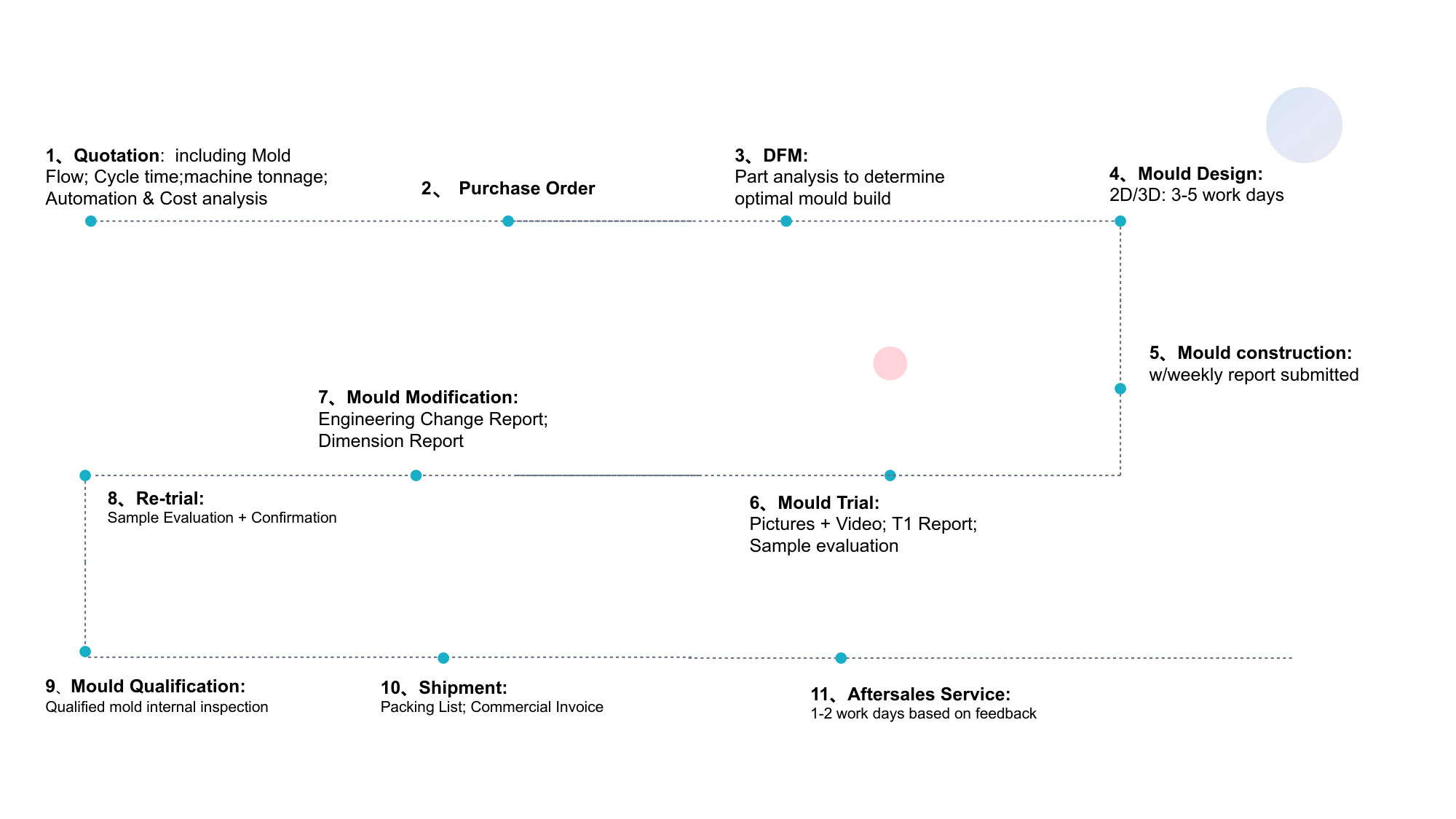
The End-to-End Service Architecture: From Concept to Delivered Component
1.3.1 Design for Manufacturability (DFM): The First Deliverable, Not an Afterthought
Ansix’s engagement with a customer begins not with a purchase order but with a DFM report. This is a deliberate inversion of the conventional mold-making sequence, in which a tool is built to a customer’s design and manufacturability issues are discovered only during trial. For suture anchor projects, the DFM analysis addresses parameters that are specific to the application :
Draft angle optimization. The DFM report specifies minimum draft angles of 1.2° to 1.8° for internal surfaces and 1° to 2° for external surfaces, with higher angles required for reinforced PEEK grades. Inadequate draft in a suture anchor mold manifests as ejection damage—scuffing or gouging of the thread flanks or eyelet surfaces—that renders the component unusable and may not be detectable until post-mold inspection.
Wall thickness uniformity. Suture anchors often feature transitions between the threaded body and the suture eyelet that create localized mass concentrations. The DFM analysis identifies these transitions and recommends geometric modifications or gating strategies to prevent internal voids and surface sink marks. The impact on material consumption is quantifiable: optimized wall thickness can reduce polymer usage by 5% to 15% while simultaneously improving dimensional stability .
Gate location and type. For a component with the aspect ratio of a suture anchor—typically 3 to 6 mm in diameter and 10 to 15 mm in length—gate placement determines fill patterns, weld line locations, and residual stress distribution. Ansix employs subsurface, fan, side, or direct gating depending on part geometry, with every recommendation validated through Moldflow simulation before steel is cut . The objective is uniform filling across all cavities and the elimination of visible gate vestige that would require secondary trimming.
Suture channel and eyelet geometry. This is perhaps the most application-specific element of the DFM analysis. The eyelet through which suture passes must be free of sharp internal corners that could abrade or fray the suture during surgery. Ansix’s DFM process simulates flow through channels as narrow as 0.5 to 2.0 mm, ensuring that the polymer fills these features completely and ejects cleanly . The company has demonstrated the capability to mold eyelets as small as 0.3 mm in diameter, maintaining surface finish that allows smooth passage of high-strength UHMWPE sutures meeting ASTM F648 criteria .
Ejector pin placement. For a small, feature-dense component such as a suture anchor, ejector pin marks in the wrong location can compromise function. The DFM analysis identifies non-structural, non-aesthetic zones for ejector placement and specifies pin diameter and witness depth to ensure that ejection forces do not deform the part or damage critical surfaces .
The DFM report is delivered before any steel is cut. This sequencing is critical because mold modifications after fabrication are orders of magnitude more expensive than design modifications before fabrication. A gate location change identified during DFM might cost nothing beyond engineering time; the same change after the mold is built could require electrode re-machining, EDM, and a complete re-validation cycle.
-
Moldflow Simulation: Predicting Behavior Before Cutting Steel
Ansix employs Moldflow analysis as a standard phase of every suture anchor tooling project, not as an optional premium service. The simulation addresses phenomena that cannot be reliably predicted from first principles or rule-of-thumb heuristics :
Warpage prediction. PEEK and bioabsorbable polymers exhibit shrinkage behavior that varies with local cooling rates, packing pressure, and fiber orientation (in reinforced grades). Moldflow predicts differential shrinkage across the part and identifies the resulting warpage pattern. For a suture anchor, warpage that affects the thread profile or the suture channel alignment is functionally unacceptable. Ansix’s simulation-driven approach has demonstrated a reduction in post-mold warpage to less than 0.1% for critical-to-quality features .
Weld line location. Weld lines form where two flow fronts meet. In a suture anchor, a weld line across the suture channel or the thread root creates a weak point that could fail under pullout loading. The simulation identifies weld line locations and allows the designer to reposition gates or adjust filling patterns to move weld lines to non-critical regions.
Cooling uniformity. Conformal cooling channels, enabled by advances in additive manufacturing, can improve temperature uniformity by up to 40% compared to conventional straight-drilled channels . Ansix evaluates cooling system designs through simulation, comparing cycle time implications against quality benefits. For PEEK components, where temperature gradients can produce residual stress and dimensional instability, cooling uniformity is not a luxury but a requirement for consistent production.
Air entrapment and fill patterns. Small features such as the suture eyelet and the thread-start geometry are prone to air entrapment during filling, which manifests as short shots or burn marks. The simulation identifies these locations and allows vent placement to be optimized before the mold is built.
The value of simulation is most evident in the materials commonly specified for suture anchors. PEEK, the material of choice for radiolucent anchors, is expensive—scrap rates of 8% to 12% are considered unacceptable, and the cost of PEEK resin lost to trial-and-error process development can easily exceed the cost of the simulation work that prevents it . Bioabsorbable polymers such as PLGA and PLLA introduce additional complexity: their thermal degradation sensitivity and moisture sensitivity require processing windows that are narrower than those of commodity resins. Simulation provides the starting point for process development that respects these constraints.
1.3.3 NPI Process Planning: Structuring the Path to Production
The New Product Introduction process for a medical device component is not simply a project schedule; it is a risk management framework. Ansix structures NPI around gated phases that align with the customer‘s design transfer and validation requirements :
Phase 1: Requirements definition and feasibility. This phase establishes the product specifications, regulatory requirements (including biocompatibility documentation under ISO 10993 and USP Class VI), and manufacturing constraints. Ansix’s material management program verifies Certificates of Analysis for every resin lot and maintains lot-level traceability throughout the production chain .
Phase 2: Design and simulation. The DFM report and Moldflow analysis are completed, reviewed with the customer, and used to finalize the mold design and process concept.
Phase 3: Mold fabrication and trial. The mold is built to the finalized design, then subjected to trial runs with dimensional and functional validation. Ansix’s average of two trial attempts before acceptance reflects the effectiveness of the preceding simulation phases .
Phase 4: Process validation. For medical device components, this phase includes Installation Qualification (IQ), Operational Qualification (OQ), and Performance Qualification (PQ), with the depth of validation scaled to the component’s risk classification. Process capability studies (Cpk) are performed on critical dimensions, with a minimum target of 1.67.
Phase 5: Production and continuous improvement. Once validated, the process enters routine production with statistical process control, periodic re-validation, and a structured change control process.
This phased approach serves a dual purpose: it provides the customer with visibility into progress and risk at each stage, and it creates a documented record that satisfies regulatory auditors that the manufacturing process was developed under control.
1.3.4 Mass Production and Quality Assurance
The transition from validated mold to sustained mass production is where many tooling suppliers falter. A mold that produces acceptable parts during trial may drift out of specification after 50,000 cycles as wear affects cavity dimensions, cooling channels accumulate scale, or ejection systems degrade. Ansix addresses this through several mechanisms:
In-mold sensing and closed-loop control. Cavity pressure and temperature sensors, combined with real-time fill compensation, maintain process consistency across the production run. The company reports achieving Cpk ≥ 1.67 for all critical-to-quality dimensions in suture anchor production, with no out-of-specification lots attributable to dimensional variation .
Pre-delivery aging testing. Before shipment, molds undergo aging trials—typically 2,000 shots on Ansix’s own presses—with wear inspection and documentation. This allows wear patterns to be identified and addressed before the mold reaches the customer‘s facility .
Documentation package. Every mold delivery includes CAD files, dimensional reports, material certificates, maintenance manuals, and exploded views. The customer receives everything needed for autonomous maintenance and troubleshooting from day one .
Three-year structural warranty. Ansix offers a three-year warranty on mold structure (excluding normal wear parts), with warranty claims processed within five business days. The company cites over 2 million cycles validated for suitable applications .
1.3.5 Delivery and After-Sales Service
The delivery of a mold is not the end of Ansix’s involvement; it is the beginning of a support relationship that extends through the production life of the tool. The company‘s after-sales commitments include :
Commissioning support ranging from remote assistance to on-site deployment of technicians for installation, start-up, and operator training.
Spare parts availability with standard wear components included at delivery and traceability systems ensuring that replacement parts meet original specifications.
Response commitment of 12 hours for customer inquiries.
In-house repair capability with standard repairs (welding, insert replacement) returned to service within 24 hours, eliminating the shipping delays that plague molds sent to third-party repair shops .
The repair capability deserves particular emphasis. When a suture anchor mold goes down, the customer’s production line stops. Shipping a mold to an external repair facility introduces transit time measured in days or weeks. Ansix’s in-house electrode fabrication and EDM capability means that most repairs are performed without the mold leaving the building, with a 24-hour turnaround for standard interventions .
1.4 Application-Specific Engineering: What Makes Suture Anchor Tooling Different
Suture anchors are not generic plastic parts. They are implantable medical devices with functional requirements that constrain every aspect of mold design and processing. Ansix’s engineering approach reflects an understanding of these constraints that can only come from cumulative experience with the application.
Thread profile fidelity. The threads on a screw-type suture anchor must engage bone with predictable pullout strength. ASTM F543 provides the test methodology, but passing the test depends on the mold producing thread profiles that match the design intent within tolerance. Ansix’s mold designs ensure consistent thread profiles that meet ASTM F543 pullout strength and torque insertion requirements without post-mold machining . This is not a trivial achievement: thread flank angles, root radii, and crest flatness all affect pullout performance, and all are influenced by mold cavity dimension, cooling rate, and material shrinkage.
Suture channel integrity. The eyelet or suture channel through which the suture passes must be smooth and free of flash or sharp edges. Flash in the channel could abrade the suture during the procedure, weakening it at precisely the point where it must bear load. The DFM process specifically simulates flow through these narrow features, and the mold is designed with parting lines positioned to avoid the channel wherever possible. Where parting lines must cross the channel, Ansix’s parting line adjustment capability—0.005 mm precision—ensures that mismatch is minimal and subsequent operations (if required) are predictable .
Self-tapping and insertion geometries. Many suture anchors incorporate self-tapping features or insertion geometries that eliminate the need for pre-tapping the bone. These features are molded directly into the component, but their fidelity depends on mold quality. Ansix’s mold designs incorporate insertion and thread-start geometries that eliminate secondary machining steps, reducing cost and eliminating a source of dimensional variation .
Radiolucency and material consistency. PEEK anchors must be radiolucent while maintaining sufficient radiopacity for visualization. This requires uniform density without gas voids or internal porosity. Ansix’s PEEK injection parameters are balanced to achieve uniform density, and the Moldflow analysis predicts and prevents void formation before the mold is built .
Bioabsorbable polymer processing. For anchors made from PLGA, PLLA, or PCL, the processing window is narrow. These materials are sensitive to moisture (hydrolytic degradation during processing) and thermal history (molecular weight reduction at elevated temperatures). Ansix’s material handling procedures include moisture content verification for every hygroscopic resin lot, and the process parameters are developed with degradation kinetics in mind . Post-mold annealing, where specified, is performed to stabilize dimensions and increase crystallinity .
1.5 Cost Competitiveness: How Integration and Engineering Reduce Total Cost
The assertion that Ansix offers competitive costs is not a claim about low labor rates or aggressive pricing. It is a claim about total cost of ownership, and it rests on specific mechanisms:
Waste reduction through simulation. PEEK scrap at 8% to 12% of production volume represents a direct material cost that can be avoided through better process understanding. Moldflow simulation and scientific molding reduce the trial-and-error that generates scrap during process development and the variance that generates scrap during production .
Elimination of secondary operations. A mold that produces thread profiles and eyelet geometries to final specification eliminates the machining, deburring, and inspection operations that would otherwise be required. The cost savings are not merely the direct labor and equipment time; they include the reduced handling damage, reduced lead time, and reduced inventory that accompany fewer process steps.
Flash elimination. Ansix’s parting line precision of 0.005 mm and self-locking cavity clamping systems prevent flash formation. The savings are quantifiable: the company estimates that eliminating manual deflashing saves up to $50,000 annually for high-volume components .
Cycle time optimization. Through scientific molding and process parameter optimization, Ansix reduces cycle times while maintaining quality. The company cites cycle time reductions of up to 12 seconds for certain applications through fine-tuning of melt temperature, cooling time, and switchover point . For a multi-cavity mold producing millions of parts annually, a 12-second reduction translates directly into increased capacity without additional capital investment.
Integrated workflow overhead reduction. By eliminating the vendor management overhead, communication delays, and quality inconsistencies associated with fragmented supply chains, Ansix reduces the administrative and transactional costs that customers would otherwise bear . A single purchase order, a single quality system, and a single point of accountability replace the coordination burden of managing multiple suppliers.
1.6 How Ansix Achieved Industry Leadership
Leadership in a specialized manufacturing niche is rarely the result of a single factor. For Ansix, several mutually reinforcing capabilities have contributed to its position:
Precision at production scale. Many mold makers can achieve tight tolerances in a single mold built for a prototype. Fewer can maintain those tolerances across multiple cavities, multiple molds, and millions of cycles. Ansix’s ±0.002 mm capability, demonstrated across 30,000+ molds, represents precision as a production characteristic rather than a laboratory curiosity .
Predictive engineering culture. The investment in Moldflow, DFM, and virtual prototyping reflects a philosophy of preventing problems rather than solving them after they emerge. This approach reduces development timelines, minimizes waste, and delivers predictable outcomes—a differentiator in a market where OEMs have limited tolerance for surprises .
Application-specific expertise. Ansix’s experience with suture anchors is not generic injection molding experience applied to a new part. The company understands ASTM F543 pullout testing, ASTM F648 suture criteria, the processing characteristics of PEEK and bioabsorbables, and the regulatory documentation requirements for implantable components. This expertise is embedded in the DFM checklists, the simulation assumptions, and the validation protocols .
Integrated service portfolio. The ability to offer design, tooling, validation, production, and logistics under one organizational roof eliminates the handoff risk that undermines quality and schedule in multi-vendor workflows. For a medical device OEM, the value of a single accountable partner is difficult to overstate .
Sustained customer relationships. The company’s 28-year history and its base of customers across automotive, medical, consumer electronics, and other sectors indicate that it has learned how to retain clients. In the medical device sector, where switching costs are high and regulatory burden makes supplier changes expensive, retention is the clearest evidence of satisfaction.
1.7 Conclusion to Part One
Ansix’s position in suture anchor mold manufacturing rests on a coherent set of capabilities: precision machining at production scale, simulation-driven design, application-specific engineering knowledge, integrated service delivery, and a quality system that satisfies medical device regulatory requirements. The company does not claim to be the cheapest mold maker in the world; it claims to deliver the lowest total cost of ownership for customers who cannot afford failures, delays, or quality escapes. In a niche where a mold defect can halt a production line or compromise an implant, that value proposition has proven durable.
Part Two: Product Introduction, Production Process, Delivery Efficiency, Quality Assurance, Cost Control, and After-Sales Service Advantages (3,000+ Words)
2.1 Product Introduction: The Suture Anchor Mold as an Engineered System
A mold for arthroscopic suture anchors is not a single object but a system of interacting subsystems, each designed to perform a specific function within the injection molding cycle. Understanding the product requires examining its constituent parts and the requirements that govern their design.
The mold base. The foundation of the system, the mold base provides the structural rigidity necessary to withstand clamping forces that may exceed 100 tons while maintaining alignment between cavities and cores. For suture anchor molds, which typically run in multi-cavity configurations (4, 8, 16, or more cavities) to meet production volume requirements, the mold base must distribute clamping force evenly across all cavities. Uneven force distribution produces flash on some cavities and short shots on others—a condition that is unacceptable in medical device manufacturing.
Ansix designs mold bases with self-locking cavity clamping systems that prevent deformation under load, ensuring that parting line contact remains uniform across the production run . The precision of the parting line fit is maintained at 0.005 mm, which is the threshold below which flash does not form and post-mold deflashing is unnecessary .
The cavity and core inserts. These are the precision-machined components that define the suture anchor‘s geometry. For a threaded anchor, the cavity insert contains the negative of the thread form, the suture channel, and the drive head geometry. The core insert forms the internal features, including the central cannulation (if present) and the proximal and distal end configurations.
The material selection for cavity and core inserts is critical. Ansix uses hardened tool steels (such as H13, S136, or equivalent grades) for production molds, with heat treatment and surface coating selected based on the resin being processed. For PEEK, which processes at melt temperatures approaching 400°C and can be abrasive when reinforced, the steel grade and coating must resist both thermal fatigue and wear. For bioabsorbable polyesters, corrosion resistance is paramount because trace moisture in the mold environment can initiate hydrolysis.
The hot runner system. For multi-cavity molds producing precision medical components, a hot runner system is often preferred over a cold runner design. The hot runner maintains polymer melt at processing temperature up to the gate, eliminating the runners that would otherwise be molded, cooled, and discarded with each cycle. For PEEK, the material savings alone can justify the hot runner investment within a production run of modest volume.
Ansix’s hot runner designs incorporate independent temperature control for each nozzle, allowing cavity-to-cavity fill balance to be adjusted without changing the mold. The company delivers complete hot runner documentation, including wiring schematics and thermocouple specifications, as part of the mold documentation package .
The ejection system. Suture anchors are small, feature-dense parts with limited surfaces available for ejector pin contact. The ejection system must extract the part without deforming the thread profile, damaging the suture channel, or leaving witness marks that affect function. Ansix’s DFM process identifies ejector locations that satisfy these constraints, and the mold design incorporates guided ejection with precision-fit pins to ensure smooth, repeatable part release .
The cooling system. Cooling accounts for the majority of cycle time in injection molding, and cooling uniformity determines dimensional consistency. For suture anchor molds, Ansix designs cooling circuits that target uniform temperature distribution across the cavity and core, with particular attention to the thick sections (thread roots, drive head) where shrinkage is concentrated. Conformal cooling, produced through additive manufacturing, is evaluated where conventional cooling cannot achieve the required uniformity .
2.2 Production Process: From Steel to Validated Tool
The production of a suture anchor mold follows a defined sequence, with quality gates at each phase:
Phase 1: Design review and mold specification. The customer’s part design, the DFM report, and the Moldflow results are reviewed to establish the mold specification: number of cavities, runner type, steel grades, surface finishes, ejection configuration, and sensor placement. This specification becomes the reference document for all subsequent work.
Phase 2: Mold design and customer approval. The mold design is developed in 3D CAD, with detailed drawings for all components. The customer reviews and approves the design before fabrication begins. This gate prevents the most expensive category of error: building a mold that does not meet the customer‘s expectations.
Phase 3: Steel preparation and machining. Mold bases, cavity inserts, and core inserts are ordered or cut from stock. Rough machining removes bulk material, leaving allowance for heat treatment distortion and finish machining. Heat treatment (hardening and tempering) is performed to achieve the specified hardness and toughness. Finish machining—CNC milling, EDM, wire EDM, and grinding—brings the components to final dimension. Ansix’s automated machining cells, constituting 70% of its operations, ensure repeatability and reduce the labor content of this phase .
Phase 4: Assembly and fitting. Components are assembled, and the fit between cavity and core, the alignment of the ejection system, and the function of the hot runner (if equipped) are verified. The mold is mounted in a trial press for initial cycling.
Phase 5: Trial and validation. Trial runs are conducted with the specified resin under processing conditions developed from the Moldflow analysis. Parts are measured against the drawing, and process capability is assessed. If dimensional or cosmetic issues are identified, the mold is adjusted and re-trialed. Ansix’s average of two trials before acceptance reflects the effectiveness of the preceding simulation and design phases .
Phase 6: Documentation and delivery. The completed mold is documented with dimensional reports, material certificates, CAD files, maintenance manuals, and hot runner schematics. It is prepared for shipment with protective coatings and, where specified, a spare parts kit.
2.3 Delivery Efficiency: How Integration Compresses Timelines
Delivery efficiency in mold manufacturing is measured not by how fast steel can be cut but by how much non-value-adding time can be eliminated from the workflow. Ansix’s integrated model addresses several sources of delay that are endemic to fragmented supply chains:
Elimination of inter-vendor handoffs. In a conventional workflow, the part design might go to one company for DFM, another for mold design, a third for machining, and a fourth for trial. Each handoff introduces communication delay, the risk of information loss, and the possibility that the receiving vendor will identify an issue that requires returning to a previous stage. Ansix performs all these functions internally, with team members who share the same quality system and the same project management structure .
Simulation-driven first-trial success. The two-trial average is not merely a statistic; it is a delivery efficiency metric. Each trial cycle consumes press time, engineering time, and often requires mold modification. A mold that passes on the first or second trial reaches the customer‘s production floor days or weeks sooner than a mold that requires five or six iterations.
In-house repair and modification capability. When a customer requests a design change after the mold is in production, or when a mold requires maintenance, Ansix’s in-house electrode fabrication and EDM capability allows modifications to be performed without shipping the mold to a third party. Standard repairs are returned to service within 24 hours . For a customer whose production line depends on mold availability, this capability translates directly into reduced downtime.
Documentation completeness. A mold that arrives without complete documentation sits idle while the customer‘s engineering team reverse-engineers the hot runner wiring or the ejection system. Ansix delivers a complete documentation package—CAD files, dimensional reports, material certificates, maintenance manual, exploded views—with every mold, enabling immediate installation and autonomous maintenance .
2.4 Quality Assurance: From Incoming Material to Final Shipment
Quality assurance in medical device mold manufacturing operates at two levels: the quality of the mold itself and the quality system that governs its production.
Mold quality is verified through dimensional inspection of all critical features, typically using coordinate measuring machines (CMM) and, where appropriate, 3D scanning. The parting line fit, the cavity-to-cavity dimensional consistency, the alignment of the ejection system, and the function of the hot runner are all validated before shipment. For suture anchor molds, the thread profile and suture channel dimensions receive particular attention because they directly affect implant function.
Process quality is assured through the quality management system. Ansix holds ISO 13485 certification, which means its processes for design control, document control, purchasing, production, inspection, and corrective action have been audited against the standard for medical device quality systems . For a customer who will use the mold to produce an implantable device, this certification provides assurance that the tool was manufactured under a system that understands regulatory requirements.
Material quality is controlled through a material management program that includes verification of Certificates of Analysis for every resin lot, lot-level traceability throughout production, moisture content verification (particularly critical for PEEK and nylon), and documentation of biocompatibility under USP Class VI and ISO 10993 for materials intended for human implantation . While the mold manufacturer does not typically supply the resin, understanding and controlling the material variables that affect mold performance is part of the tooling qualification process.
Post-delivery quality is supported by the three-year structural warranty and the 12-hour response commitment for customer inquiries . The warranty terms are specific and measurable: claims processed within five business days, coverage of structural integrity (excluding normal wear), and a documented process for resolving disputes.
2.5 Cost Control: The Mechanisms Behind Competitive Pricing
Ansix’s cost competitiveness derives from structural advantages rather than from cost-cutting at the expense of quality:
Material efficiency. Hot runner systems eliminate cold runner waste. For PEEK, where resin cost can exceed $100 per kilogram, the savings from eliminating runners in a multi-cavity mold are substantial over the production life of the tool. Scientific molding reduces scrap from process variation, targeting the 8% to 12% scrap reduction cited for PEEK applications .
Labor efficiency through automation. With 70% of machining operations automated, Ansix reduces the labor content of mold manufacturing while simultaneously improving repeatability. Automated machining also enables lights-out operation for certain operations, increasing effective capacity without proportional increases in headcount .
Cycle time optimization. The company‘s process engineering expertise allows it to reduce cycle times without compromising quality. A 12-second cycle time reduction on a multi-cavity mold producing millions of parts annually translates into a significant increase in output from the same capital equipment .
Waste elimination through prevention. DFM and Moldflow prevent the rework, scrap, and delay that result from discovering problems during trial. The cost of simulation is a fraction of the cost of a mold modification or a failed trial.
Integrated overhead reduction. By eliminating the vendor management overhead, communication delays, and quality inconsistencies of fragmented supply chains, Ansix reduces the total cost of ownership for its customers . The customer deals with one supplier, one quality system, and one point of accountability, rather than managing a network of specialized vendors.
2.6 After-Sales Service: The Relationship Beyond Delivery
The after-sales service model is built around the recognition that a mold is a long-term asset that requires support throughout its production life:
Commissioning support. Options range from remote assistance to on-site deployment of Ansix technicians for installation, start-up, and operator training. For a customer receiving a complex multi-cavity mold with a hot runner system, on-site support during the first production runs can prevent the costly trial-and-error that occurs when a new mold is introduced to an unfamiliar press.
Technical documentation. The documentation package includes maintenance schedules, spare parts lists, assembly drawings, and hot runner schematics. This enables the customer’s maintenance team to perform routine upkeep and to diagnose issues without waiting for vendor support .
Spare parts availability. Standard wear components are included with delivery, and the traceability system ensures that replacement parts meet original specifications. For critical components such as ejector pins, core pins, and hot runner nozzles, having spares on hand can reduce downtime from days to hours.
Responsive communication. The 12-hour response commitment for customer inquiries is a measurable service level that creates predictability for the customer‘s maintenance and production planning .
Warranty and repair. The three-year structural warranty, with claims processed in five business days, provides a defined remedy for structural failures. The in-house repair capability, with 24-hour turnaround for standard repairs, minimizes the production interruption that would otherwise accompany mold failures .
2.7 Conclusion to Part Two
The advantages that Ansix offers in suture anchor mold manufacturing—product engineering, production process control, delivery efficiency, quality assurance, cost competitiveness, and after-sales service—are not independent claims. They are interconnected expressions of a single operating philosophy: that the mold is not a commodity to be bought and sold but an engineered system whose value is realized over years of production. The customer who purchases a mold from Ansix is purchasing access to the engineering, simulation, quality, and support capabilities that surround it.
Part Three: Mold Manufacturing and Injection Molding Material Selection, Intelligent Manufacturing, Efficiency Improvement, and Process Quality Assurance (3,000+ Words)
3.1 Material Selection for Suture Anchor Molds and Molded Components
Material selection operates at two levels in suture anchor production: the materials of the mold itself and the polymers that are molded into the final component. Both levels require application-specific knowledge.
3.1.1 Mold Materials
The cavity and core inserts for a suture anchor mold must withstand the thermal and mechanical demands of the resin being processed while maintaining dimensional precision across millions of cycles.
For PEEK processing: PEEK melts at approximately 343°C and is typically processed at melt temperatures of 360°C to 400°C. Reinforced grades (carbon fiber, glass fiber) are abrasive. The mold steel must resist thermal fatigue (from cyclic heating and cooling), wear (from abrasive resin), and corrosion (from trace volatiles). Ansix specifies hardened tool steels such as H13 or equivalent, heat-treated to 48-52 HRC, with surface treatments selected based on the specific grade being processed. For reinforced PEEK, coatings such as TiN or DLC may be applied to reduce wear on the cavity and core surfaces.
For bioabsorbable polyesters (PLGA, PLLA, PCL): These materials are hydrolytically sensitive. Trace moisture in the mold environment or on the mold surface can initiate degradation, producing acidic byproducts that corrode steel and compromise part properties. Ansix specifies corrosion-resistant steels (such as S136 or equivalent stainless grades) for bioabsorbable applications, with rigorous moisture control in the mold area and surface finishes that minimize resin adhesion.
For radiolucent PEEK anchors: The mold surface finish directly affects the optical and radiographic appearance of the part. A polished cavity surface (SPI A-1 or A-2) is specified for anchors where surface quality is critical, with careful attention to the thread flanks and suture channel where polishing access is limited.
3.1.2 Molded Component Materials
The polymer selection for the suture anchor itself is typically determined by the customer’s design and clinical requirements, but Ansix‘s engineering team provides input on processing implications that affect mold design and process feasibility.
PEEK (polyetheretherketone): The material of choice for radiolucent, non-absorbable anchors. PEEK offers excellent mechanical properties, chemical resistance, and radiolucency. Its processing window is narrow: melt temperatures of 360-400°C, mold temperatures of 160-200°C, and moisture content below 0.02% before processing. Ansix’s material management program verifies moisture content for every PEEK lot and provides drying recommendations that prevent hydrolytic degradation .
PLGA and PLLA: Bioabsorbable polyesters used for anchors that degrade over time, eliminating the need for a second surgery for removal. These materials are moisture-sensitive and thermally labile. Processing requires rigorous drying, moderate melt temperatures, and short residence times. The mold must be designed with corrosion-resistant materials and cooling circuits that achieve uniform temperature distribution to prevent differential degradation.
UHMWPE (ultra-high-molecular-weight polyethylene): Used for the suture component of the anchor-suture assembly, not typically molded in the anchor mold itself but relevant to the overall device. UHMWPE sutures must meet ASTM F648 criteria, and the anchor’s suture channel must be designed to accommodate them without abrasion .
LCP (liquid crystal polymer): Used for micro-precision components where minimal shrinkage and high dimensional stability are required. LCP’s anisotropic shrinkage behavior requires careful gate placement and flow analysis .
Bioabsorbable polymers (PLA, PLGA, PCL): For temporary fixation anchors that degrade over 12-16 months. The degradation profile depends on molecular weight, crystallinity, and copolymer ratio, all of which are influenced by processing conditions .
3.2 Intelligent Manufacturing and Efficiency Improvement
Ansix‘s manufacturing model incorporates automation, sensing, and data-driven process control at multiple levels:
Automated machining. With 70% of machining operations automated, Ansix achieves repeatability that manual operations cannot match. Automated electrode changers, pallet systems, and lights-out machining cells allow production to continue outside of normal shifts, increasing effective capacity without proportional increases in labor cost .
In-mold sensing and closed-loop control. Cavity pressure and temperature sensors provide real-time data on the filling and cooling phases. This data is used for closed-loop control of the injection profile, ensuring that each shot fills identically regardless of minor variations in resin viscosity or ambient conditions. The result is dimensional consistency across the production run, with Cpk ≥ 1.67 for critical dimensions .
Ultrasonic wall thickness measurement. For components where wall thickness is a critical-to-quality characteristic, in-mold ultrasonic measurement with real-time fill compensation is employed. This technology detects thickness variation during the molding cycle and adjusts process parameters to maintain specification, eliminating the need for post-mold inspection of this characteristic .
Scientific molding methodology. Rather than relying on operator experience and trial-and-error, Ansix employs scientific molding principles: characterizing the viscosity curve, performing gate freeze studies, and establishing the process window through designed experiments. This approach reduces cycle time, improves quality, and creates a documented process that can be transferred across presses and facilities.
Data-driven maintenance. Mold maintenance is scheduled based on shot count and sensor data rather than calendar intervals. This condition-based approach prevents unexpected failures while avoiding unnecessary maintenance that consumes production time.
Energy efficiency. Hot runner systems with optimized thermal profiles, servo-driven hydraulic systems, and intelligent power management reduce energy consumption per part. While energy is not typically the dominant cost in medical device molding, the cumulative savings across millions of parts are significant.
3.3 Process Quality Assurance: Ensuring Consistency from Shot to Shot
Quality assurance in injection molding is not an inspection activity at the end of the line; it is a process design activity that begins with mold design and continues through every phase of production.
Design-phase quality. The DFM and Moldflow analyses are quality assurance activities. By identifying and eliminating potential failure modes before the mold is built, they prevent the quality problems that would otherwise require detection and correction during production.
Mold qualification. The trial and validation process includes dimensional inspection of parts from all cavities, cosmetic evaluation, and functional testing where applicable. For suture anchors, functional testing might include suture passage verification, thread engagement assessment, and, in some cases, pullout testing to confirm that the molded anchor meets ASTM F543 requirements.
Process validation. IQ/OQ/PQ validation establishes that the process is capable of consistently producing parts that meet specifications. The PQ phase typically includes a capability study with a minimum of 30 parts from each cavity, demonstrating Cpk ≥ 1.67 for critical dimensions.
Production monitoring. Statistical process control (SPC) charts track critical dimensions and process parameters in real time. Out-of-control conditions trigger immediate investigation and corrective action before non-conforming parts are produced in quantity.
Final inspection. Sampling inspection per AQL tables provides a final check on outgoing quality. For medical device components, the AQL levels and inspection plans are agreed upon with the customer and documented in the control plan.
Traceability. Lot-level traceability from resin certificate to shipped part enables rapid identification and containment if a quality issue emerges after shipment.
3.4 The Core Value Proposition for Customers
The technical capabilities described in this section translate into specific values for the customer:
Predictable quality. The combination of simulation-driven design, in-mold sensing, and statistical process control delivers parts that meet specification consistently, reducing the incoming inspection burden and the risk of line stoppages due to quality escapes.
Reduced total cost. Material efficiency, cycle time optimization, and scrap reduction lower the cost per part. The elimination of secondary operations (deflashing, machining) further reduces cost and lead time.
Faster time to market. The integrated workflow and simulation-driven approach compress the development timeline, allowing the customer to reach production and regulatory submission sooner.
Regulatory confidence. ISO 13485 certification, documented process validation, and complete traceability provide the evidence that regulatory auditors require. The customer can reference Ansix‘s quality system in its own submissions, reducing the audit burden.
Supply security. The in-house repair capability, spare parts availability, and responsive service reduce the risk of production interruption due to mold failure.
3.5 Conclusion to Part Three
The material selection, intelligent manufacturing, and process quality assurance capabilities described in this section are the operational foundation of Ansix’s value proposition. They are not glamorous—there is no marketing narrative in a Cpk of 1.67 or a 24-hour repair turnaround—but they are what allows a medical device OEM to sleep at night knowing that the mold producing its implantable device is in capable hands. In the suture anchor market, where clinical outcomes depend on the reliable performance of every component, that assurance is the ultimate product.
Part Four: Ansix Tech‘s Manufacturing Solution for Suture Anchor Mold and Injection Molding
4.1 Solution Overview
Ansix Tech offers a fully integrated manufacturing solution for arthroscopic suture anchor molds and molded components. The solution encompasses:
Design and engineering: DFM analysis, Moldflow simulation, mold design, and process development.
Tooling: Precision machining, EDM, heat treatment, assembly, and trial.
Production: Injection molding with in-mold sensing and closed-loop control, secondary operations where required, and packaging.
Validation: IQ/OQ/PQ, process capability studies, and documentation for regulatory submissions.
Support: Installation, training, maintenance, repair, and spare parts.
This solution is delivered under a single ISO 13485-certified quality management system, with a single point of accountability and a single project management structure.
4.2 The Suture Anchor-Specific Value
For suture anchor applications, the solution includes specific capabilities:
Thread profile molding to ASTM F543 requirements without post-mold machining .
Suture eyelet molding down to 0.3 mm diameter, with surface finish suitable for UHMWPE suture passage .
PEEK processing with moisture control, Moldflow-predicted warpage compensation, and in-mold density verification for radiolucency .
Bioabsorbable polymer processing with corrosion-resistant mold materials and controlled thermal history .
Multi-cavity tooling for high-volume production, with cavity-to-cavity consistency verified through Cpk studies.
4.3 Why Ansix
The solution is differentiated by:
28+ years of injection molding experience and 30,000+ molds produced .
±0.002 mm precision maintained at production scale .
ISO 13485, ISO 9001, IATF 16949, and ISO 14001 certifications .
In-house repair and modification capability with 24-hour turnaround for standard repairs .
Three-year structural warranty and 12-hour response commitment .
Documentation package that enables autonomous customer maintenance from day one .
4.4 Conclusion
Ansix Tech‘s manufacturing solution for suture anchor molds is not a catalog of services but an integrated capability set. It is designed for customers who understand that the mold is the foundation of implant quality, and that the choice of mold manufacturer is a decision with clinical, regulatory, and financial consequences. In a market where the margin for error is measured in micrometers and the cost of failure is measured in patient outcomes, Ansix offers the precision, the systems, and the support that the application demands.
#www.ansixtech.com #ansixtech.com #Manufacturer of Molds for Suture Anchors Used in Arthroscopic Surgery #Manufacturer of Molds for Suture Anchors Used in Arthroscopic Surgery Tooling #Manufacturer of Molds for Suture Anchors Used in Arthroscopic Surgery injection mold companies #Ansix #Ansix moulds #Ansix china #Ansix tech china #Ansix tech company #Ansix facotry #Ansix Tooling #Ansix tool #Manufacturer of Molds for Suture Anchors Used in Arthroscopic Surgery injection molding #Manufacturer of Molds for Suture Anchors Used in Arthroscopic Surgery injection tools #Manufacturer of Molds for Suture Anchors Used in Arthroscopic Surgery injection moulds #Ansix moulding company #Ansix molding #ansix tooling #Manufacturer of Molds for Suture Anchors Used in Arthroscopic Surgery plastic mould #Manufacturer of Molds for Suture Anchors Used in Arthroscopic Surgery plastic tools #Ansix Tech #Ansix molds #Ansix injection molding #Ansix mold factory #Manufacturer of Molds for Suture Anchors Used in Arthroscopic Surgery injection molding Customized #Ansix mold factory #Manufacturer of Molds for Suture Anchors Used in Arthroscopic Surgery china #Manufacturer of Molds for Suture Anchors Used in Arthroscopic Surgery molds #injection factory for Manufacturer of Molds for Suture Anchors Used in Arthroscopic Surgery #Manufacturer of Molds for Suture Anchors Used in Arthroscopic Surgery injection molding #Manufacturer of Molds for Suture Anchors Used in Arthroscopic Surgery injection molding factory #injection molding company #Manufacturer of Molds for Suture Anchors Used in Arthroscopic Surgery injection mold companies #Manufacturer of Molds for Suture Anchors Used in Arthroscopic Surgery Tooling #Manufacturer of Molds for Suture Anchors Used in Arthroscopic Surgery mold limited #Ansix mold china #Ansix companies for Manufacturer of Molds for Suture Anchors Used in Arthroscopic Surgery #Ansix company China #Manufacturer of Molds for Suture Anchors Used in Arthroscopic Surgery facotry #Ansix Tech #Ansix Tech mould #Manufacturer of Molds for Suture Anchors Used in Arthroscopic Surgery injection moulding #Manufacturer of Molds for Suture Anchors Used in Arthroscopic Surgery injection moulding company #Ansix Manufacturer of Molds for Suture Anchors Used in Arthroscopic Surgery parts injection mold companies #Manufacturer of Molds for Suture Anchors Used in Arthroscopic Surgery injection molding companies china #Manufacturer of Molds for Suture Anchors Used in Arthroscopic Surgery china factory #Ansix moulding companies #Ansix molding company #Manufacturer of Molds for Suture Anchors Used in Arthroscopic Surgery injection moulding facotry #Ansix Tech mold #Manufacturer of Molds for Suture Anchors Used in Arthroscopic Surgery mould #Manufacturer of Molds for Suture Anchors Used in Arthroscopic Surgery plastic injection molding #ansix plastic mold #Manufacturer of Molds for Suture Anchors Used in Arthroscopic Surgery Mold manufacturing #Manufacturer of Molds for Suture Anchors Used in Arthroscopic Surgery parts manufacturing #Manufacturer of Molds for Suture Anchors Used in Arthroscopic Surgery plastic parts factory #Manufacturer of Molds for Suture Anchors Used in Arthroscopic Surgery injection parts mold #Manufacturer of Molds for Suture Anchors Used in Arthroscopic Surgery PRECISION MANUFACTURING #Manufacturer of Molds for Suture Anchors Used in Arthroscopic Surgery TOOL #China Manufacturer of Molds for Suture Anchors Used in Arthroscopic Surgery mold #Manufacturer of Molds for Suture Anchors Used in Arthroscopic Surgery injection moulding china #Manufacturer of Molds for Suture Anchors Used in Arthroscopic Surgery mould china #china precision mold #Manufacturer of Molds for Suture Anchors Used in Arthroscopic Surgery mold in china #Manufacturer of Molds for Suture Anchors Used in Arthroscopic Surgery mold china #Manufacturer of Molds for Suture Anchors Used in Arthroscopic Surgery Precision molds #High-precision molds #Manufacturer of Molds for Suture Anchors Used in Arthroscopic Surgery High-precision tool #Injection molds #Manufacturer of Molds for Suture Anchors Used in Arthroscopic SurgeryFactory #Manufacturer of Molds for Suture Anchors Used in Arthroscopic SurgeryCompany #Super Large Injection Mold Factory #Large Tonnage Injection Molding Factory #Manufacturer of Molds for Suture Anchors Used in Arthroscopic Surgery Company #Manufacturer of Molds for Suture Anchors Used in Arthroscopic Surgery Factory #2800T Injection Molding Factory #3000 Ton Injection Molding #4500 Ton Injection Molding Factory #Manufacturer of Molds for Suture Anchors Used in Arthroscopic Surgery Large Mold Injection Molding #Large Plastic Mold Injection Molding Factory #Manufacturer of Molds for Suture Anchors Used in Arthroscopic Surgery Large Injection Mold Manufacturer #Manufacturer of Molds for Suture Anchors Used in Arthroscopic Surgery Plastic Mold Factory #Injection Mold #Plastic Mold