
 Medical Molds
 Packaging Molds
 Personal Care Molds
 Electronic Molds
 Automotive Molds
 Home Appliance Molds
 Special Molds
 Design & Engineering
 Production & Manufacturing
 Global Presence
 Business Scope
 Component Solutions
 Product Assembly
 Quality Management
 Medical Device Manufacturing



Mass production of 16-fiber low-loss MT ferrules
FEATURES
Product Introduction: What the 16-Fiber Low-Loss MT Ferrule Is and Why It Matters
The MT ferrule is the core positioning component in multi-fiber push-on (MPO) connectors used in high-density optical interconnect environments such as hyperscale data centers, AI clusters, and 5G backbone networks. A 16-fiber MT ferrule simultaneously aligns 16 optical fibers with sub-micron precision, using two guide pin holes for mechanical registration and 16 fiber insertion holes arranged in a precision array.
The "low-loss" designation is critical. In standard-loss configurations, typical insertion loss is around 0.25 dB with a maximum of 0.70 dB. For low-loss 16F MT ferrules, the target is a typical insertion loss of 0.12 dB and a maximum of ≤0.35 dB, with return loss mean ≥50 dB for single-mode and ≥25 dB for multimode. These specifications demand guide pin hole diameters of 0.5500 ± 0.00025 mm for single-mode low-loss applications—tolerances that approach the limits of thermoplastic injection molding capability.
The ferrule body is typically molded from polyphenylene sulfide (PPS), a high-performance engineering thermoplastic selected for its low shrinkage, excellent dimensional stability, high strength, and resistance to thermal aging. The combination of sub-micron guide pin pitch control (±0.002–0.003 mm), fiber hole concentricity, and endface geometry determines whether the ferrule will deliver the low insertion loss and repeatable mating performance that customers require.
-
Mold Description
Product Materials:
PPS
Mold Material:
S136ESR
Number of Cavities:
1
Glue Feeding Method:
COLD runner
Cooling Method:
Water cooling
Molding Cycle
20.5s
- The mold manufacturing process and product material selection
The Manufacturing Challenge: Why 16F Low-Loss MT Ferrules Are Difficult to Mass-Produce
The technical barriers to MT ferrule manufacturing are concentrated in four areas: ultra-precision mold making, endface nano-level processing, material stability, and mass production yield
. For 16-fiber low-loss variants, each of these barriers is amplified.
Mold pin deflection and wear. The fiber holes and guide pin holes are formed by core pins that can be as small as 0.1 mm in diameter. During injection, high-pressure melt flowing at 30–70 MPa can deflect these pins, causing hole eccentricity or pin breakage. Over hundreds of thousands of cycles, pin wear alters hole dimensions, drifting the ferrule out of specification. A 16F ferrule has 18 precision holes (16 fiber + 2 guide pin), multiplying the risk of a single defective feature rendering the entire ferrule non-functional.
Material flow and shrinkage. PPS with glass or mineral fillers exhibits anisotropic shrinkage. In a 16F ferrule with walls as thin as fractions of a millimeter, uneven filling or cooling creates warpage, internal stress, and dimensional instability. The spiral flow length of the resin composition must be sufficient to fill the micro-features while maintaining the mechanical properties needed for guide pin retention and fiber support.
Endface geometry control. After injection molding, the ferrule endface is polished to achieve the required apex offset, fiber height, and radius of curvature. The molded endface geometry must be close enough to final specification that polishing removes minimal material while achieving the flatness and surface finish needed for low-loss physical contact. Poor as-molded geometry causes excessive polishing, which in turn can round the guide pin hole edges, degrade hole diameter, and increase insertion loss.
Yield economics. At mass production volumes, even a 1–2% yield loss on a high-value ferrule has significant cost implications. Customers measuring supplier performance look at cost per good part, not cost per molded part.
-
How Ansix Turns Technical Capability into Customer Value
3.1 One-Stop Vertically Integrated Manufacturing: Eliminating the Fragmented Supply Chain
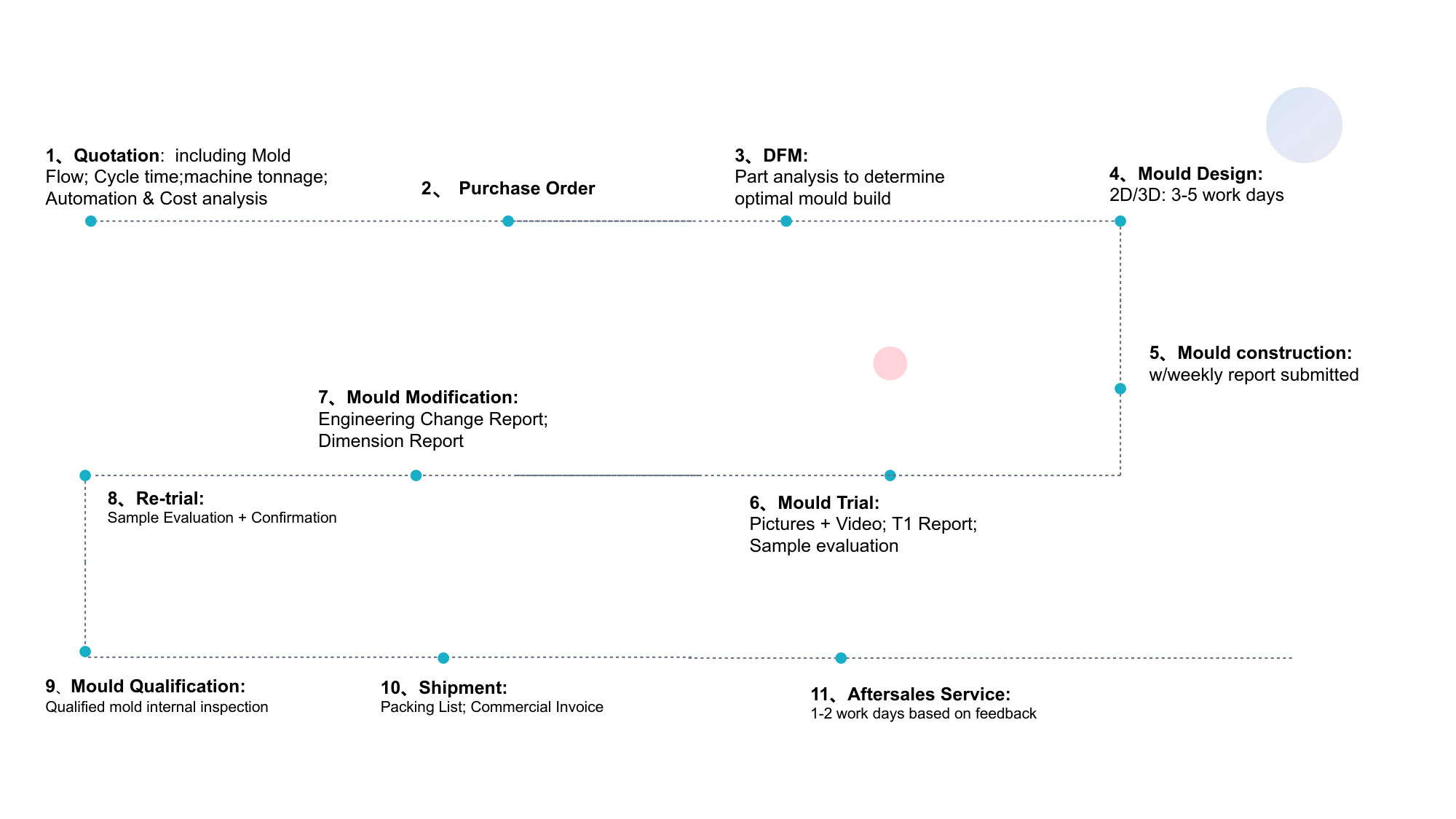
The conventional MT ferrule supply chain is fragmented: a mold shop makes the tool, a molder runs the parts, a metrology lab validates dimensions, and the customer assembles and tests. Each handoff introduces communication delays, tolerance stack-up disputes, and accountability gaps. Ansix's vertically integrated ecosystem controls every stage—product design, DFM analysis, mold manufacturing, Moldflow simulation, product validation, NPI process planning, mass production, quality assurance, delivery, and after-sales—under one roof. This eliminates communication gaps between fragmented suppliers, accelerates project timelines, and ensures consistency from concept to delivery.
For the customer, this integration translates directly into reduced project risk. When a dimensional issue arises during validation, the mold designer, process engineer, and metrology team are in the same facility, diagnosing the root cause together rather than exchanging emails across three companies.
3.2 DFM and Moldflow Analysis: Solving Problems Before the First Shot
Ansix's DFM (Design for Manufacturability) process for 16F low-loss MT ferrules begins with a rigorous review of the customer's optical and mechanical requirements. The team evaluates:
Wall thickness uniformity across the ferrule body to minimize shrinkage variation.
Gate location and fill pattern to balance flow front velocity and avoid weld lines in critical optical alignment zones.
Core pin support strategy for the 0.1 mm-class fiber hole pins, using the mold design principles that constrain pin deflection under injection pressure.
Cooling channel layout to achieve uniform mold temperature and reduce cycle time without sacrificing dimensional stability.
Moldflow simulation then models the actual injection process, predicting fill, pack, cool, and warp behavior. For 16F low-loss ferrules, the simulation focuses on:
Guide pin hole ovality prediction under varying pack pressures.
Fiber hole position drift due to asymmetric shrinkage.
Endface warpage that would require excessive polishing.
By catching these issues in simulation, Ansix avoids the costly cycle of cutting a tool, molding parts, measuring them, and re-cutting the tool—a process that can consume weeks and tens of thousands of dollars.
3.3 Precision Mold Manufacturing: The Foundation of Mass Production Consistency
Ansix's mold manufacturing capability for MT ferrules leverages five-axis high-speed machining and micron-level tolerance control. The core pins that form the fiber holes are made from high-strength tungsten steel, selected for its high elastic modulus and wear resistance. The pins are constrained both axially and angularly to prevent rotation or drift during the molding campaign.
The mold design incorporates a sealing block and internal forming assembly that is integrally machined using oil-cutting (EDM) processes, eliminating assembly gaps and installation errors between the pin support structures. This is particularly important for 16F ferrules, where the cumulative positional error of 16 individual pins determines the overall fiber array accuracy.
3.4 Material Selection and Process Window Development
For 16F low-loss MT ferrules, Ansix works with the customer to select the optimal PPS grade and filler system. The resin composition must balance:
Property Requirement Impact on Ferrule Performance
Spiral flow length ≥60 mm (preferably >100 mm) Complete fill of micro-features without short shots
Shrinkage Low and isotropic Dimensional stability of guide pin pitch
Flexural modulus High Guide pin retention force
Thermal stability Withstands -40°C to +85°C cycling Insertion loss stability over lifetime
The process window—melt temperature, mold temperature, injection pressure, pack profile, and cooling time—is developed through systematic DOE (Design of Experiments), not trial-and-error. This disciplined approach produces a robust process that tolerates normal material lot variation and machine drift without going out of specification.
3.5 NPI Process Planning: From Prototype to Mass Production Without Surprises
The New Product Introduction (NPI) phase is where many promising MT ferrule projects fail. A tool that produces good parts in the sampling lab may not sustain quality and cycle time at production volumes. Ansix's NPI planning addresses this gap by:
Establishing CTQ (Critical-to-Quality) parameters for every production stage.
Developing inspection protocols that match the measurement capability to the tolerance—using vision systems for guide pin pitch, optical interferometry for endface geometry, and insertion loss testing for functional validation.
Qualifying secondary operations such as deflashing, cleaning, and packaging to avoid contamination of the optical surfaces.
Training production and quality personnel on the specific handling requirements of precision optical ferrules.
The goal is a production process that runs at target cycle time with documented capability (Cpk ≥ 1.33 on critical dimensions) from the first production lot.
3.6 Mass Production: Efficiency Without Compromising Precision
Ansix's 260 injection molding machines include a range of tonnage and precision classes. For 16F low-loss MT ferrules, the company uses high-precision, fully closed-loop injection molding machines that maintain shot-to-shot consistency in velocity and pressure. The low-loss, fully closed-loop molding process is specifically designed for MT ferrule production.
Production efficiency for MT ferrules is influenced by cycle time, cavitation, and automation. Ansix's approach to cost control does not rely on sacrificing quality but on:
Optimized cooling to reduce cycle time while maintaining dimensional stability.
Automated part removal and handling to prevent contamination and damage to delicate features.
In-process monitoring of key process parameters, with automatic rejection of out-of-window shots.
Cavitation strategy that matches tooling cost and production volume to the customer's demand profile.
3.7 Quality Assurance: From Dimensional Inspection to Optical Performance Validation
Quality assurance for 16F low-loss MT ferrules cannot rely on visual inspection alone. Ansix's QA framework covers:
Incoming material verification. PPS resin lots are checked for melt flow rate, filler content, and moisture before release to production.
In-process monitoring. Injection pressure, hold pressure, melt temperature, and mold temperature are logged for every shot. Statistical process control (SPC) charts flag drift before parts go out of specification.
Dimensional metrology. Guide pin hole diameter and pitch, fiber hole diameter and position, and ferrule endface geometry are measured using calibrated vision systems and optical profilometers. For low-loss 16F ferrules, guide pin hole tolerance of ±0.00025 mm demands measurement uncertainty well below that level.
Functional testing. Insertion loss and return loss are validated using industry-standard test methods. For low-loss configurations, the target is ≤0.35 dB maximum insertion loss and return loss mean ≥50 dB for single-mode.
Reliability testing. Ferrules are subjected to thermal aging, humidity aging, thermal cycling, and mechanical durability tests per TELCORDIA/GR-1435-CORE requirements.
3.8 Delivery, After-Sales, and Supply Chain Confidence
Ansix's four production bases in China and Vietnam provide geographic diversification and capacity redundancy. For customers concerned about supply chain concentration risk, this dual-region footprint offers a tangible mitigation strategy. The company maintains buffer stock of qualified ferrules for urgent requirements and provides technical support for assembly process optimization after delivery.
After-sales support includes failure analysis, root cause investigation, and corrective action implementation. When a customer encounters an insertion loss issue during connector assembly, Ansix's engineering team can analyze whether the root cause is in the ferrule, the assembly process, or the fiber preparation.
4. Competitive Cost Control and Customer Value Summary
The cost of a 16F low-loss MT ferrule is driven by yield, cycle time, and tooling amortization. Ansix's cost control strategy is built on:
High yield through robust process windows — reducing scrap and rework.
Short cycle times through optimized cooling and automation — increasing machine utilization.
Tooling longevity through proper pin maintenance and replacement protocols — spreading tooling cost over more parts.
Supply chain integration — avoiding margin stacking between separate mold, molding, and metrology suppliers.
The result is a competitive cost per good part that does not come at the expense of optical performance or dimensional consistency.
5. Conclusion
For customers evaluating a manufacturing partner for 16-fiber low-loss MT ferrules, the decision criteria are rarely about basic molding capability. They are about whether the supplier can sustain sub-micron dimensional control across hundreds of thousands of parts, diagnose and resolve yield excursions quickly, and deliver consistently without constant oversight. Ansix's vertically integrated model, precision mold-making expertise, disciplined NPI process, and dual-region production footprint address these criteria directly. The company's ability to translate micron-level technical requirements into reliable, cost-effective mass production is what has positioned it as a leading partner for high-precision fiber optic connector components.
Ansix Tech Co Ltd
If you have any plans related to Mass production of 16-fiber low-loss MT ferrules , you can contact us at any time. We will turn your ideas into reality, let you realize your dreams, and obtain large orders from the market. Our contact information is info@ansixtech.com. Or contact our CTO, mail: stephen@ansixtech.com
#www.ansixtech.com #ansixtech.com #Mass production of 16-fiber low-loss MT ferrules #Mass production of 16-fiber low-loss MT ferrules #Mass production of 16-fiber low-loss MT ferrules injection mold companies #Ansix #Ansix moulds #Ansix china #Ansix tech china #Ansix tech company #Ansix facotry #Ansix Tooling #Ansix tool #Mass production of 16-fiber low-loss MT ferrules injection molding #Mass production of 16-fiber low-loss MT ferrules injection tools #Mass production of 16-fiber low-loss MT ferrules injection moulds #Ansix moulding company #Ansix molding #ansix tooling #Mass production of 16-fiber low-loss MT ferrules plastic mould #Mass production of 16-fiber low-loss MT ferrules plastic tools #Ansix Tech #Ansix molds #Ansix injection molding #Ansix mold factory #Mass production of 16-fiber low-loss MT ferrules injection molding Customized #Ansix mold factory #Mass production of 16-fiber low-loss MT ferrules china #Mass production of 16-fiber low-loss MT ferrules molds #injection factory for Mass production of 16-fiber low-loss MT ferrules injection molding #Mass production of 16-fiber low-loss MT ferrules injection molding factory #injection molding company #Mass production of 16-fiber low-loss MT ferrules injection mold companies #Mold for Mass production of 16-fiber low-loss MT ferrules #Mass production of 16-fiber low-loss MT ferrules limited #Ansix mold china #Ansix companies for Mass production of 16-fiber low-loss MT ferrules #Ansix company China #Mass production of 16-fiber low-loss MT ferrules facotry #Ansix Tech #Ansix Tech mould #Mass production of 16-fiber low-loss MT ferrules injection moulding #Mass production of 16-fiber low-loss MT ferrules injection moulding company #Ansix Mass production of 16-fiber low-loss MT ferrules parts injection mold companies #Mass production of 16-fiber low-loss MT ferrules injection molding companies china #Mass production of 16-fiber low-loss MT ferrules china factory #Ansix moulding companies #Ansix molding company #Mass production of 16-fiber low-loss MT ferrules injection moulding facotry #Ansix Tech mold #Mass production of 16-fiber low-loss MT ferrules mould #Mass production of 16-fiber low-loss MT ferrules plastic injection molding #ansix plastic mold #Mass production of 16-fiber low-loss MT ferrules Mold manufacturing #Mass production of 16-fiber low-loss MT ferrules parts manufacturing #Mass production of 16-fiber low-loss MT ferrules plastic parts factory #Mass production of 16-fiber low-loss MT ferrules injection parts mold #Mass production of 16-fiber low-loss MT ferrules PRECISION MANUFACTURING #Mass production of 16-fiber low-loss MT ferrules TOOL #China Mass production of 16-fiber low-loss MT ferrules mold #Mass production of 16-fiber low-loss MT ferrules injection moulding china #Mass production of 16-fiber low-loss MT ferrules mould china #china precision mold #Mass production of 16-fiber low-loss MT ferrules mold in china #Mass production of 16-fiber low-loss MT ferrules mold china #Mass production of 16-fiber low-loss MT ferrules Precision molds #High-precision molds #Mass production of 16-fiber low-loss MT ferrules High-precision tool #Injection molds #Mass production of 16-fiber low-loss MT ferrulesFactory #Mass production of 16-fiber low-loss MT ferrulesCompany #Super Large Injection Mold Factory #Large Tonnage Injection Molding Factory #Mass production of 16-fiber low-loss MT ferrules Company #Mass production of 16-fiber low-loss MT ferrules Factory #2800T Injection Molding Factory #3000 Ton Injection Molding #4500 Ton Injection Molding Factory #Mass production of 16-fiber low-loss MT ferrules Large Mold Injection Molding #Large Plastic Mold Injection Molding Factory #Mass production of 16-fiber low-loss MT ferrules Large Injection Mold Manufacturer #Mass production of 16-fiber low-loss MT ferrules Plastic Mold Factory #Injection Mold #Plastic Mold