
 Medical Molds
 Packaging Molds
 Personal Care Molds
 Electronic Molds
 Automotive Molds
 Home Appliance Molds
 Special Molds
 Design & Engineering
 Production & Manufacturing
 Global Presence
 Business Scope
 Component Solutions
 Product Assembly
 Quality Management
 Medical Device Manufacturing



Micro-injection molding of staple-forming molds for medical staplers
FEATURES
Application Domains: Where This Product Creates Clinical and Commercial Value
The staple-forming mold family serves three overlapping application domains, each with a distinct failure mode and therefore a distinct quality emphasis.
Gastrointestinal and general anastomosis. Circular and linear staplers used in bowel anastomosis depend on cartridge slot uniformity across the full staple line. A single mispositioned staple pocket changes staple formation height, which in turn changes tissue compression. The molding challenge here is cavity-to-cavity consistency in multi-cavity tools, typically 16-, 24-, or 32-cavity configurations. Ansix’s equipment base is dominated by all-servo electric machines with repeatable precision of ±0.1%, which is the hardware prerequisite for maintaining that consistency across millions of shots.
Thoracic and laparoscopic stapling. Laparoscopic staplers cut and seal tissue through small incisions, and their internal components—housing, triggers, safety locks, and the cartridge interface—require dimensional precision and the ability to withstand repeated sterilization cycles. The trend toward minimally invasive procedures is the structural demand driver: the North America endoscopic surgical stapler market alone is projected to grow from USD 669.0 million in 2024 to USD 1,075.6 million by 2032, and the global medical electric endoscopic stapler market from USD 590 million in 2025 to USD 1,413 million in 2031 at a CAGR of 15.7%. Micro-injection-molded plastic for medical devices is growing at roughly 12.1% annually, with minimally invasive devices cited as a principal driver. Ansix’s product positioning sits directly on this demand curve.
Reusable and reprocessed instrument interfaces. Where stapler components are intended for repeated steam sterilization, material selection shifts toward PPSU and PEEK. PPSU withstands more than 1,000 steam sterilization cycles without significant loss of properties; PEEK endures over 1,000 autoclave cycles with minimal dimensional change. The mold must therefore accommodate a different shrinkage envelope and a different wear profile than an LCP disposable cartridge. Ansix’s role is to translate the sterilization protocol—autoclave, gamma, ethylene oxide, or chemical—into material and tooling decisions before steel is cut.
-
Mold Description
Product Materials:
LCP
Mold Material:
S136ESR
Number of Cavities:
8
Glue Feeding Method:
Hot runner
Cooling Method:
Water cooling
Molding Cycle
12.5s
- The mold manufacturing process and product material selection
Production Process: From Digital Twin to Validated Mass Production
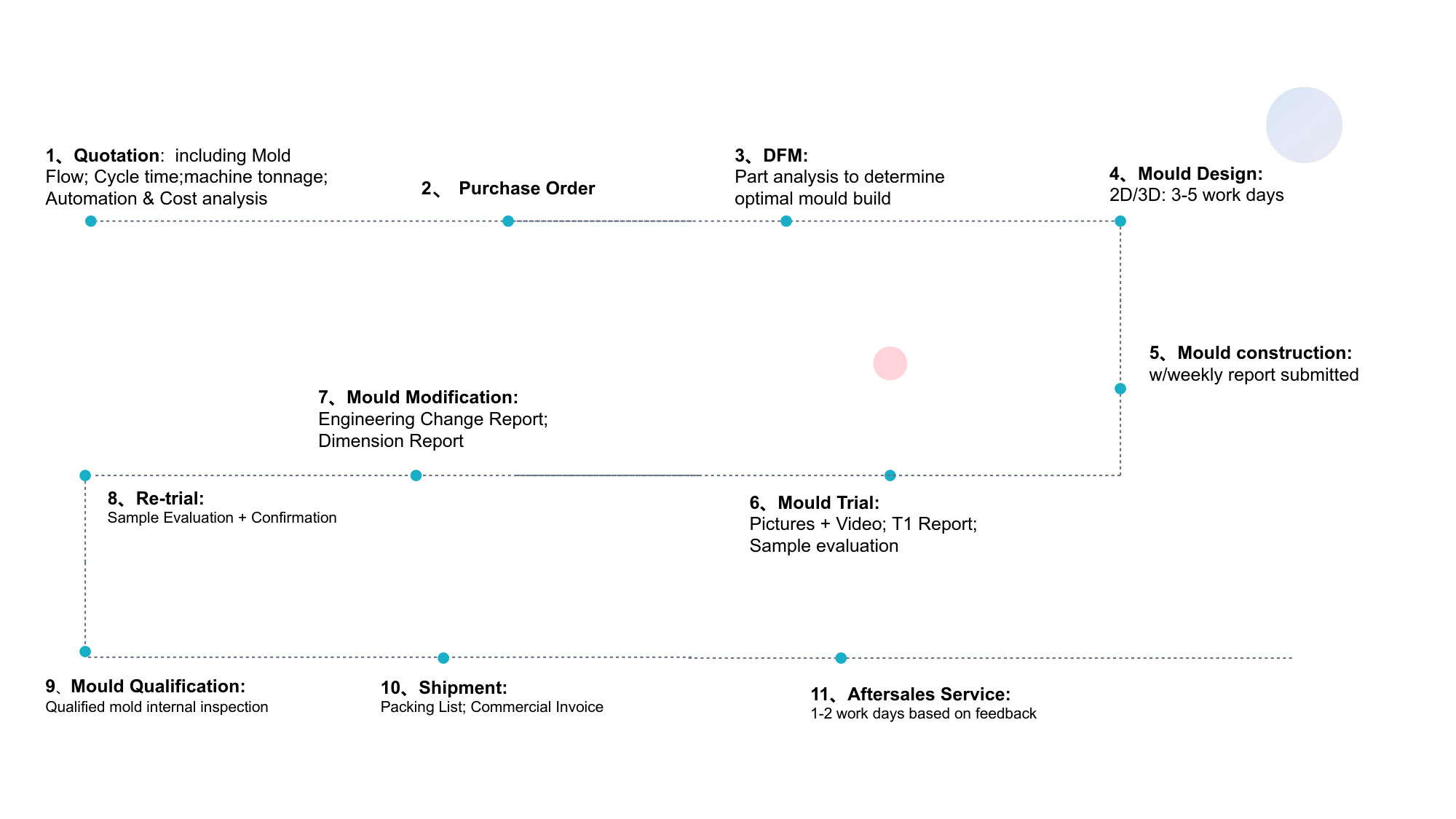
The production process for a staple-forming mold at Ansix follows a gated sequence in which each stage is designed to eliminate a class of risk that would otherwise surface expensively later.
Stage 1 — Design intent capture and DFM. The process begins before a CAD model is finalized. Ansix’s co-engineering philosophy invites customer participation at the conceptual stage because approximately 70% of manufacturing cost is defined during initial design. DFM analysis examines wall-thickness uniformity to prevent sink marks and differential shrinkage, verifies draft angles for clean ejection without damaging delicate features, and identifies opportunities to consolidate multi-piece metal assemblies into a single moldable plastic geometry. In documented cases, integrating press-fit features directly into part designs reduced post-molding assembly time by up to 40%.
Stage 2 — Moldflow simulation as a digital twin. Before steel is cut, engineers use Autodesk Moldflow and Moldex3D to create a digital twin of the mold and the resin flow within it. Simulation predicts fill patterns, pressure requirements, cooling times, weld-line locations, air traps, and sink marks. The commercial effect is not abstract: Ansix has documented simulation-driven optimization reducing sink-mark depth from 80 μm to just 10 μm before the first physical tool existed. For a staple cartridge, that difference is the difference between a functional part and a scrap part.
Stage 3 — Precision mold manufacturing. The mold base is typically P20 steel; cavity and core inserts use wear-resistant grades such as S136, 2344, 8407, SKD11/61, DC53, M340, NAK80, and H13, selected for resistance to the high pressures and temperatures of LCP processing. Five-axis high-speed machining centers machine complex surface geometries to ±0.002 mm, and wire EDM produces micro-features such as 0.03 mm small holes and narrow slots without inducing thin-wall deformation. Each steel batch carries a material certification report and heat-treatment curve.
Stage 4 — Scientific molding and process window development. Trial shots are not a search for “good parts” by trial and error. Ansix uses a structured design-of-experiments (DOE) approach to identify critical factors, build a dimensional prediction model, and lock the process window. Process capability is verified through Cp/Cpk analysis; the standard is Cpk ≥ 1.33 minimum and ≥ 1.67 for critical characteristics. The validated window becomes the production envelope, and any deviation triggers an alarm before defective parts are produced.
Stage 5 — Validation (IQ/OQ/PQ) and NPI. Installation Qualification confirms the tool and equipment are installed and configured to specification; Operational Qualification challenges the process across its upper and lower limits; Performance Qualification demonstrates consistency across production lots. Ansix structures NPI process planning around this framework, so that the transition from tool acceptance to routine production is documented rather than assumed.
Stage 6 — Mass production with SPC. In production, statistical process control monitors key variables—pressure, temperature, time—in real time. Ansix maintains Cpk ≥ 1.33 on all critical-to-quality dimensions, providing statistical evidence that cartridge components perform reliably across millions of cycles. For an LCP stapler cartridge, the molding cycle can run as short as 22.5 seconds; for thin-wall micro components, cycles of 5–15 seconds are attainable depending on cavitation. Short cycles are not merely a productivity metric; they are a consequence of a correctly designed and correctly validated process.
-
Delivery Efficiency: What “Fast” Actually Means in This Product Category
Delivery efficiency in medical micro-molding is not a single lead-time number. It is the sum of design-cycle avoidance, tooling lead time, validation speed, and production ramp reliability. Ansix compresses all four.
Early DFM intervention typically saves customers three to six weeks of rework time and eliminates mold modifications that could increase tooling cost by 30–40%. In tooling, lead time scales with cavitation and validation intent: single-cavity prototype tools in the range of 2–3 weeks, 8–16 cavity tools in the 4–6 week band, and 32–64 cavity high-volume tools in the 7–10 week band are representative of the industry’s achievable envelope. Ansix’s four production bases in China and Vietnam, with 260 injection molding machines spanning 30 to 2,800 tons and approximately 200,000 m² of building area, provide the capacity buffer that separates a quoted lead time from a reliable one. AI-driven optimization in tooling development has been reported to reduce trial runs from five to two, cut tooling cost by roughly 15%, and shorten lead time by about 20%—the kind of margin that matters when a device launch date is fixed.
5. Material Selection: LCP, PEEK, and PPSU as Engineering Trade-Offs
Material selection for a staple-forming mold is a three-way negotiation between clinical function, sterilization protocol, and moldability. Ansix’s position is that the material decision must be made with the mold design in view, not before it.
LCP is the default for thin-walled disposable cartridges. Its fast crystallization and low heat of fusion enable short cycles; it fills thin walls at lower pressures than many polymers; its heat resistance often exceeds 260 °C, making it suitable for repeated sterilization. The trade-off is anisotropy and a narrow processing window. The mold must be gated and cooled to manage directional flow, and the process must be run fast and hot. Ansix’s LCP stapler cartridge tooling uses S136ESR mold steel, cold-runner feeding, water cooling, and a 22.5-second cycle in a single-cavity configuration, with multi-cavity standardization for volume.
PEEK is selected when peak temperature, wear resistance, and dimensional stability under repeated autoclave cycles dominate. It withstands over 1,000 steam sterilization cycles with minimal dimensional change and remains stable in mixed high-heat and high-radiation environments. PEEK is the higher-cost, higher-performance option; it is justified where the stapler component is reusable or where the sterilization burden is extreme.
PPSU occupies the pragmatic middle. It offers virtually unlimited steam sterilization cycles without losing impact strength, low creep, and minimal dimensional change under load, at a lower cost than PEEK where PEEK’s peak temperature capability is not required. For reusable instrument interfaces and sterilization trays, PPSU is frequently the technically correct and commercially rational choice.
The engineering value Ansix provides is not a material catalog. It is the discipline of matching the material’s shrinkage behavior, flow characteristics, and thermal history to a mold design and a validated process window—and then proving the combination through Cpk and IQ/OQ/PQ documentation.
6. Intelligent Manufacturing and Process Efficiency
Ansix’s manufacturing footprint is deliberately configured for micro-precision at scale: 260 injection molding machines, from 30-ton micro-molding platforms to 2,800-ton large-tonnage machines, dominated by all-servo electric drives with ±0.1% repeatable precision. The significance of the all-servo fleet is that shot-to-shot variation is minimized at the machine level, which is the foundation for lot-to-lot consistency in a regulated product. Metrology is integrated into the workflow: CMM and optical measurement systems perform full dimensional reports against CAD data before a mold leaves the facility, and high-volume production is monitored for Cpk on critical dimensions.
The efficiency gain is structural rather than incremental. A tool that requires no post-molding deflashing because parting lines were machined to ±0.002 mm eliminates a labor step, a contamination risk, and an inspection burden simultaneously. A hot-runner system that minimizes runner waste is not merely a materials saving; in LCP, where material cost is high and regrind is unacceptable in medical applications, it is a direct per-part cost reduction. Stack molds and multi-cavity tools double output without doubling floor space or tonnage, which is how capacity is added without proportional overhead.
7. Process Quality Assurance: The Evidence Chain
Quality assurance in this product category is not a final inspection. It is an evidence chain that begins with steel certification and ends with a Cpk report on the last production lot. The chain includes material certification and heat-treatment curves for every steel batch; full dimensional reports against CAD before mold shipment; DOE-derived process windows with documented upper and lower limits; Cp/Cpk verification at ≥1.33 for critical dimensions and ≥1.67 for critical characteristics; IQ/OQ/PQ validation records aligned with ISO 13485 and FDA 21 CFR Part 820; and SPC monitoring in routine production. Ansix operates under ISO 13485, ISO 9001, IATF 16949, and ISO 14001, with ISO Class 8 cleanroom capability for medical precision parts. The regulatory framework is not an afterthought; it is the operating system within which the engineering decisions are made.
8. Cost Control and After-Sales Service as Competitive Advantages
The most consequential cost-control lever in staple-forming mold projects is not steel price or machine-hour rate. It is the avoidance of late-stage redesign. Because roughly 70% of manufacturing cost is committed at the design stage, Ansix’s early DFM and Moldflow intervention is the primary cost-control mechanism. Customers avoid the three-to-six-week rework loop and the 30–40% mold-modification premium that follows a late discovery of manufacturability problems. Simulation reduces trial runs; fewer trial runs reduce tooling cost and lead time. Mold life is guaranteed at a minimum of 500,000 shots for fiber-reinforced LCP cartridge tooling, which converts a consumable tooling cost into a predictable per-shot cost. And in LCP processing, hot-runner and cold-runner optimization directly reduce expensive polymer waste.
After-sales service closes the loop. Ansix’s documented maintenance philosophy recommends mold maintenance every 200,000 cycles with complete records, and provides lifetime repair support at cost with a 24-hour turnaround on critical repairs. Preventive maintenance programs—cleaning, resurfacing, refurbishment, performance verification, and dimensional checks—are designed to extend mold life and reduce unplanned downtime. For a medical device OEM, the after-sales value is not the repair itself; it is the assurance that a validated process remains inside its validated window across the production life of the device. Ansix’s stated customer-satisfaction proposition is built on a continuous service chain that begins before the customer has a CAD model and extends through the product’s production life. That is the commercial meaning of “industry leadership” in this niche: not the largest mold shop, but the partner that can be depended on when the part is difficult, the validation is demanding, and the launch date is non-negotiable.
Part II — The Ansix Integrated Service Chain: Design, DFM, Moldflow, Validation, NPI, Mass Production, Quality, Delivery, and After-Sales (≈4,200 words)
9. Positioning: An Engineering Partner, Not a Build-to-Print Shop
Ansix Tech was established in Hong Kong in 1998 and has operated for more than 28 years—29 years by the company’s own count—as an integrated injection molding solutions provider. The operating scale is specific: over 30,000 mold sets delivered, 260 injection molding machines from 30 to 2,800 tons, more than 1,200 employees including over 200 designers, and four production bases across China and Vietnam with approximately 200,000 m² of building area. But the scale is not the differentiator. The differentiator is the structural choice to operate as a co-engineering partner rather than a conventional build-to-print supplier.
That choice has a direct consequence for the staple-forming mold customer. In a build-to-print relationship, the mold shop’s responsibility begins when the drawing is released and ends when the tool is accepted. In Ansix’s model, responsibility begins at the conceptual stage and extends through validation, mass production, and the production life of the device. The company’s core philosophy—“Make Our Customers Successful”—is expressed operationally in the decision to engage before the design is frozen, when the cost and risk of change are still low.
10. Product Design and Development: Translating Clinical Requirements into Moldable Geometry
The design-development service for a staple-forming mold begins with a requirements decomposition that most mold shops never perform. Ansix engineers analyze the intended use environment, the sterilization method (autoclave, gamma, ethylene oxide, or chemical agents), and the regulatory pathway the final device must follow—FDA 510(k), CE MDR, or NMPA approval. These inputs are not administrative. They determine material eligibility, wall-thickness limits, draft requirements, and the validation evidence package.
From there, the design work is organized around manufacturability. DFM analysis scrutinizes wall-thickness uniformity to prevent sink marks and differential shrinkage, checks draft angles for clean ejection without damaging delicate features, and evaluates whether multi-piece metal assemblies can be consolidated into a single moldable geometry. In medical components that may include living hinges, ultra-thin walls, and complex internal channels, this is the stage where a part that is “technically drawable” becomes a part that can be molded at Cpk ≥ 1.33 in a multi-cavity tool. Ansix’s documented experience includes integrating press-fit features directly into part designs and reducing post-molding assembly time by up to 40%. The design service is therefore not a courtesy CAD review; it is the first cost-reduction and risk-mitigation gate.
11. DFM and Moldflow: The Digital Twin as a Risk-Retirement Instrument
DFM and Moldflow are often described as “simulation services.” In Ansix’s workflow they function as a digital twin that retires technical risk before capital is committed. Engineers use Autodesk Moldflow and Moldex3D to model filling patterns, pressure requirements, cooling times, weld-line locations, air traps, and sink marks. For a thin-walled LCP stapler cartridge, the questions are specific: will the melt reach the end of a 0.25 mm wall before it freezes; where will the weld line fall relative to the staple alignment rail; will differential shrinkage distort the pusher interface beyond ±0.005 mm; will the gate location create a flow orientation that weakens the staple pocket.
The results are measurable before steel is cut. Ansix has documented simulation-driven optimization reducing sink-mark depth from 80 μm to 10 μm. The company’s engineering literature describes the Moldflow phase as creating a “digital twin of the entire injection molding process before cutting steel,” which identifies and eliminates defects that would be catastrophic in a medical device before they manifest in physical tooling. The customer-facing value is not the simulation report. It is the avoidance of a tooling iteration, a validation failure, or a launch delay—each of which costs far more than the simulation itself.
12. Precision Mold Manufacturing: The “Hard Power” Foundation
The mold manufacturing capability that supports staple-forming tools is built around the tolerances the product demands. Five-axis high-speed machining centers machine complex surface geometries to ±0.002 mm, which keeps parting lines smooth and burr-free and eliminates post-molding deflashing operations that add cost and contamination risk. Wire EDM produces micro-features such as 0.03 mm small holes and narrow slots without inducing thin-wall deformation—a critical capability for the intricate internal channels of stapler cartridges.
Mold life is engineered rather than asserted. For fiber-reinforced LCP cartridge tooling, Ansix guarantees a minimum of 500,000 shots. Mold bases are P20; cavity and core inserts use wear-resistant grades including S136, 2344, 8407, SKD11/61, DC53, M340, NAK80, and H13, selected to withstand the 1,500–2,000 bar injection pressures and 320–400 °C melt temperatures characteristic of LCP. Each steel batch is accompanied by a material certification report and detailed heat-treatment curve to validate hardness and microstructure.
The tooling configuration is matched to the production intent. Ansix has extensive experience with hot-runner systems for runner-waste minimization (critical for expensive LCP), stack molds for doubled output without doubled floor space or tonnage, two-shot and multi-material molds for overmolded cartridges with integrated seals, and high-gloss molds with Ra < 0.05 μm where surface finish influences friction or adhesion. For cartridge applications, multi-cavity tools at 16, 24, or 32 cavities are standard, balanced to ensure each cavity fills identically. The gate and runner system is treated as the single greatest determinant of cartridge quality, precisely because LCP’s directional fountain flow makes gate location a functional variable rather than a cosmetic one.
13. Product Validation and IQ/OQ/PQ: Proving the Process, Not Just the Part
Validation in a medical staple-forming mold project is the bridge between “we made good parts” and “the process is proven to make good parts consistently.” Ansix structures validation around the IQ/OQ/PQ framework that ISO 13485 and FDA 21 CFR Part 820 require.
Installation Qualification (IQ) confirms that the tool, machine, auxiliary equipment, and material handling are delivered, installed, and configured according to approved design specifications and regulatory requirements. Operational Qualification (OQ) challenges the process across its upper and lower parameter limits—melt temperature, injection speed, packing pressure, cooling time—to establish that acceptable parts are produced throughout the intended operating range. Performance Qualification (PQ) demonstrates that the process produces conforming parts consistently across production lots, with capability analysis and SPC evidence. The validation package includes the validation plan, approved protocols, executed records, raw data, and capability analysis.
The OQ stage is where the DOE-derived process window becomes a regulatory asset. The process window is the range of each parameter within which the process produces acceptable parts; OQ proves the window is real and robust. Cpk verification—minimum 1.33, and 1.67 for critical characteristics—converts process control into objective evidence aligned with ISO 13485 and FDA requirements. For a staple cartridge, the critical characteristics are the staple slot position, the alignment rail geometry, and the pusher interface; these are the dimensions where Cpk evidence is non-negotiable.
14. NPI Process Planning: Sequencing the Transition from Tool to Production
New Product Introduction for a regulated medical component is an iterative process during which numerous test shots and machine-setting iterations are normal. The risk is not iteration itself; the risk is unmanaged iteration that consumes launch timeline and erodes validation confidence. Ansix’s NPI planning imposes sequence and decision gates on that iteration.
The NPI sequence for a staple-forming mold typically runs: design freeze supported by DFM and Moldflow; tool fabrication and tool tryout; scientific molding DOE to establish the process window; dimensional and functional verification against specification; IQ/OQ execution; PQ and capability demonstration; production readiness review; and transition to routine manufacturing under SPC. Each gate produces a documented deliverable, and the next gate is not opened until the prior deliverable is accepted. This is how a mold project becomes a validated manufacturing process rather than a tool delivery.
The commercial value of structured NPI is time-to-market compression without validation shortcuts. The industry benchmark for NPI acceleration is real—one medical device company reduced NPI from 10 years to 2 years using DFM assistance and a manufacturing network—but for a staple cartridge the more relevant gain is the elimination of late-stage surprises that force a return to tooling or process development after PQ has begun. Ansix’s documented early-DFM intervention saving three to six weeks of rework is a direct NPI timeline contribution.
15. Mass Production, Quality Assurance, and Delivery: Operating Inside the Validated Window
Mass production of staple cartridges is not an exercise in running machines faster. It is an exercise in staying inside the validated process window for millions of cycles while maintaining Cpk on critical dimensions. Ansix’s production environment is built for this: 260 injection molding machines spanning 30 to 2,800 tons, dominated by all-servo electric drives with ±0.1% repeatable precision, which guarantees that the 100th, 10,000th, and 1,000,000th part are identical. This is the hardware condition for lot-to-lot consistency in a regulated product.
Quality assurance in production is layered. In-process SPC monitors key variables—pressure, temperature, time—in real time and alarms on deviation before defective parts are produced. CMM and optical measurement systems perform dimensional verification, and the Cpk on critical-to-quality dimensions is maintained at ≥1.33. The quality management system is certified to ISO 13485, ISO 9001, IATF 16949, and ISO 14001, with ISO Class 8 cleanroom capability for medical precision parts. For medical OEMs, this means the production floor is already operating inside the documentation and traceability framework that their own regulatory submissions require.
Delivery reliability is a function of capacity architecture. Four production bases across China and Vietnam distribute risk and provide regional supply options; 260 machines provide the tonnage range to run micro tools and high-cavity production tools in the same network. The company’s integrated model—design, tooling, molding, and assembly under one organizational structure—removes the handoff delays that occur when tooling and molding are separate suppliers. Ansix’s stated value proposition in medical injection molding is to “systematically reduce product costs, increase production capacity, and guarantee rigorous quality control” for medical OEMs worldwide, and delivery is the visible expression of that proposition.
16. After-Sales Support: Protecting the Validated State
After-sales service for a medical staple-forming mold is not customer service in the conventional sense. It is the protection of a validated manufacturing state. Ansix’s maintenance framework recommends mold maintenance every 200,000 cycles with complete records, and provides lifetime repair support at cost with a 24-hour turnaround on critical repairs. Preventive maintenance programs include mold cleaning, resurfacing, refurbishment, micro-welding and laser welding for precision repairs, complete teardowns and rebuilds, and performance verification with dimensional checks.
The logic is straightforward: a mold that drifts out of its validated dimensional state produces parts that drift out of specification, and a validated process that is not maintained is no longer validated. After-sales support therefore includes ongoing technical support, mold maintenance and optimization, and rapid response to customer feedback. Ansix’s customer-satisfaction proposition is explicitly described as a continuous service chain that begins before the customer has a CAD model and extends through the product’s production life. For a medical device OEM, that continuity is the difference between a supplier and a manufacturing partner of record.
17. How the Service Chain Produces Customer Satisfaction and Industry Leadership
The question of how Ansix achieves customer satisfaction and recognition in this niche has a structural answer. The company’s integrated model addresses the three questions every customer asks: what problem does the capability solve, how much cost does it save, and what risks does it mitigate. For staple-forming molds, the problem is the intersection of micron-level tolerance, thin-wall LCP molding, and regulatory validation. The cost saving is delivered through early DFM (avoiding 30–40% mold-modification premiums), simulation-driven trial reduction, hot-runner material savings, and tooling life guarantees. The risk mitigation is delivered through Cpk evidence, IQ/OQ/PQ documentation, SPC-controlled production, and a maintenance regime that preserves the validated state.
Industry leadership in this segment is not conferred by size alone. It is conferred by the ability to say “yes” to a part that others decline—a 0.25 mm LCP wall, a ±0.005 mm staple alignment rail, a 32-cavity tool that must fill identically in every cavity—and then to prove it with data. Ansix’s 28-plus years, 30,000-plus molds, and four-base footprint are the capacity to deliver. The engineering discipline—DFM, Moldflow, DOE, IQ/OQ/PQ, SPC, Cpk—is the capability to deliver repeatedly. The combination is the competitive position.
Part III — What Ansix’s Mold and Molding Design-Development Capability Delivers: Value, Problem-Solving, Quality Validation, Cost Reduction, Capacity, and Delivery (≈3,200 words)
18. The Value Proposition in One Sentence, Then in Engineering Terms
The value Ansix’s mold and injection molding design-development capability delivers to a medical stapler customer can be stated in one sentence: it converts a clinically critical, technically difficult, heavily regulated component into a manufacturable product with a predictable cost, a validated quality state, and a reliable delivery schedule. In engineering terms, the value is the systematic elimination of the failure modes that make staple-forming molds expensive and slow: late-discovered manufacturability problems, unvalidated process windows, uncontrolled dimensional variation, and unplanned tooling downtime.
Ansix does not simply build molds; the company’s own framing is that it engineers manufacturing success. That distinction matters because the customer is not buying a tool. The customer is buying a supply of staple cartridges or stapler components that will pass validation, perform in surgery, and be available in the volumes and timing the market requires. The mold is the means; manufacturing success is the product.
19. The Problems This Capability Solves
Problem 1 — The design that cannot be molded at the required tolerance. A staple cartridge design may be geometrically valid but manufacturably impossible: wall sections too thin for the specified material, draft insufficient for clean ejection, gate location incompatible with LCP’s directional flow. Ansix’s DFM and Moldflow work resolves these before tooling. The documented case of reducing sink-mark depth from 80 μm to 10 μm through simulation is an example of solving a dimensional problem in the digital domain rather than the steel domain.
Problem 2 — The tool that produces good parts in the laboratory but not in production. A single-cavity tool can be tuned to produce a golden sample. A 16-, 24-, or 32-cavity production tool must fill every cavity identically and hold Cpk across millions of shots. Ansix’s multi-cavity balancing, all-servo machine precision, and SPC-controlled production are the answer to cavity-to-cavity variation, which is one of the most persistent and expensive failure modes in medical multi-cavity molding.
Problem 3 — The validation that fails because the process was never robust. A process window that has not been challenged at its limits will fail OQ. Ansix’s DOE-based window development and Cp/Cpk verification produce a process that has already been tested across its operating range before formal validation begins. The customer receives a validation package built on evidence, not assertion.
Problem 4 — The cost overrun caused by late changes. Mold modifications after design release are expensive and slow. Early DFM intervention saves three to six weeks of rework and eliminates modifications that could increase mold cost by 30–40%. Because approximately 70% of manufacturing cost is committed at the design stage, the earliest possible engineering intervention is also the highest-leverage cost intervention.
Problem 5 — The supply interruption caused by unplanned tooling downtime. A staple-forming mold that fails prematurely or drifts out of tolerance stops a validated production line. Ansix’s 500,000-shot minimum mold life guarantee for LCP cartridge tools, preventive maintenance at 200,000-cycle intervals, and 24-hour critical repair turnaround are designed to convert tooling from a failure risk into a managed asset.
20. How Quality Validation Is Executed for the Customer
Quality validation for a staple-forming mold is executed as a layered evidence system, and the customer’s regulatory submission is the design criterion for the evidence package.
Layer 1 — Material and tooling evidence. Every steel batch carries a certification report and heat-treatment curve. Mold dimensional reports compare all critical features against CAD before shipment. This layer establishes that the physical asset matches the design intent.
Layer 2 — Process window evidence. DOE identifies critical factors and establishes upper and lower acceptable limits for each key parameter. The process window is documented as a map of parameter combinations that produce acceptable parts, and the production process is required to remain inside it.
Layer 3 — Capability evidence. Cp/Cpk analysis on critical dimensions converts process control into objective proof of capability. The standard applied is Cpk ≥ 1.33 minimum and ≥ 1.67 for critical characteristics. For staple cartridges, the critical characteristics—slot position, alignment rail geometry, pusher interface—are the dimensions where capability evidence is mandatory.
Layer 4 — Validation evidence. IQ/OQ/PQ protocols and executed records demonstrate that the equipment is correctly installed (IQ), the process performs across its operating range (OQ), and production is consistent across lots (PQ). The package includes the validation plan, approved protocols, raw data, and control charts.
Layer 5 — Production evidence. SPC monitoring of pressure, temperature, and time in real time, with alarms on deviation, provides ongoing evidence that the validated state is maintained. This is the layer that protects the customer after the validation report is signed.
The customer-facing value of this layered system is that the quality evidence is generated as a by-product of doing the work correctly, not assembled retrospectively to satisfy an auditor. The customer receives a validation package that is aligned with ISO 13485 and FDA 21 CFR Part 820 because the process was designed to produce it.
21. How Ansix Reduces Customer Cost: A Mechanism-by-Mechanism Account
Cost reduction claims in mold-making are often vague. The mechanisms Ansix deploys are specific and traceable.
Design-stage cost avoidance. Early DFM eliminates the rework loop that adds three to six weeks and can add 30–40% to mold cost. Because 70% of manufacturing cost is defined at the design stage, this is the largest single lever.
Simulation-driven trial reduction. Moldflow and DOE reduce physical trial iterations. AI-driven optimization in tooling development has been reported to reduce trial runs from five to two, cut tooling cost by approximately 15%, and shorten lead time by about 20%.
Assembly consolidation. Integrating press-fit and snap-fit features into the molded part can reduce post-molding assembly time by up to 40%. This is a recurring per-part cost saving, not a one-time tooling saving.
Material waste reduction. Hot-runner systems minimize runner waste, which is especially consequential in LCP where material cost is high and regrind is typically unacceptable in medical applications. Cold-runner configurations are used where the part design or material strategy favors them; the choice is engineering-driven rather than default.
Cycle-time productivity. LCP’s fast crystallization enables short cycles: 22.5 seconds for a single-cavity stapler cartridge tool, and 5–15 seconds for thin-wall micro components depending on cavitation. Shorter cycles mean more parts per machine-hour and lower per-part overhead absorption.
Tooling life and maintenance cost. A 500,000-shot minimum life guarantee and documented maintenance at 200,000-cycle intervals convert tooling cost into a predictable per-shot figure and reduce unplanned downtime.
The aggregate effect is a lower total cost of supply, not merely a lower mold price. Ansix’s stated value proposition in medical injection molding is to reduce product costs, increase production capacity, and guarantee quality control—the three variables that determine a medical device’s gross margin and launch reliability.
22. How Capacity Is Increased and Delivery Is Guaranteed
Capacity in micro-molding for medical staplers is not simply a count of machines. It is the ability to match tooling strategy, machine tonnage, and production organization to the volume curve of a device program.
Ansix’s capacity architecture has three dimensions. Machine range: 260 machines from 30 to 2,800 tons cover everything from small-batch prototyping to high-volume runs of millions of cartridges. Tooling scalability: single-cavity prototype tools, 8–16 cavity medium-run tools, and 32–64 cavity high-volume tools allow the customer to invest in tooling in step with demand rather than over- or under-tooling at launch. Geographic distribution: four production bases across China and Vietnam provide regional supply options and risk diversification.
Delivery guarantee is the product of planning discipline rather than expediting. The NPI sequence places validation before volume, so the production ramp begins from a validated process rather than a process still under development. The all-servo machine fleet’s ±0.1% repeatable precision supports lot-to-lot consistency, which reduces the rework and sort operations that erode delivery performance. And the after-sales maintenance regime—preventive maintenance at defined intervals, 24-hour critical repair turnaround—protects uptime after the program is in routine production.
For the customer, the delivery guarantee is ultimately a commercial commitment backed by capacity, tooling strategy, and a quality system that prevents the surprises that cause missed shipments. Ansix’s four-base, 260-machine footprint is the physical basis for that commitment; the validated process and maintenance regime are the operational basis.
Part IV — Conclusion: Twenty-Nine Years of Positioning for This Exact Product Problem (≈900 words)
23. Why the Stapler Mold Is the Test Case for Everything Ansix Claims
A staple-forming mold for a medical stapler is an unusually honest test of a manufacturing partner’s claims. The part is small, the tolerance is measured in microns, the material is unforgiving, the validation is regulated, and the clinical consequence of failure is severe. There is no room for a mold shop that is “good on average.” The product requires a partner that can hold ±0.005 mm on a mating surface, mold LCP into a 0.25 mm wall, prove Cpk ≥ 1.33 on a critical dimension, and keep the validated process inside its window for a million shots.
Ansix Tech’s positioning against that requirement is built on 29 years of manufacturing experience, more than 30,000 molds delivered, 260 injection molding machines across four production bases, and an engineering organization of over 200 designers operating under ISO 13485, ISO 9001, IATF 16949, and ISO 14001. But the more important claim is the integrated model: product design, DFM analysis, Moldflow simulation, precision mold manufacturing, validation, NPI process planning, mass production, quality assurance, and after-sales support delivered as a single chain rather than a series of handoffs.
The company’s own language is that it does not simply build molds—it engineers manufacturing success. For the medical stapler OEM, that is the correct unit of analysis. The customer is not purchasing a tool. The customer is purchasing a validated supply of a critical surgical component, with a cost structure that supports the device’s market position and a delivery schedule that supports the launch. Ansix’s contribution is to make that supply chain predictable: technically, statistically, and commercially. That is how a mold-making company becomes a manufacturing partner of record in one of the most demanding niches in medical device manufacturing—and that is the standard against which Ansix’s staple-forming mold capability should be evaluated.
Ansix Tech Co Ltd
If you have any plans related to Micro-injection molding of staple-forming molds for medical staplers , you can contact us at any time. We will turn your ideas into reality, let you realize your dreams, and obtain large orders from the market. Our contact information is info@ansixtech.com. Or contact our CTO, mail: stephen@ansixtech.com
#www.ansixtech.com #ansixtech.com #Micro-injection molding of staple-forming molds for medical staplers #Micro-injection molding of staple-forming molds for medical staplers Tooling #Micro-injection molding of staple-forming molds for medical staplers injection mold companies #Ansix #Ansix moulds #Ansix china #Ansix tech china #Ansix tech company #Ansix facotry #Ansix Tooling #Ansix tool #Micro-injection molding of staple-forming molds for medical staplers injection molding #Micro-injection molding of staple-forming molds for medical staplers injection tools #Micro-injection molding of staple-forming molds for medical staplers injection moulds #Ansix moulding company #Ansix molding #ansix tooling #Micro-injection molding of staple-forming molds for medical staplers plastic mould #Micro-injection molding of staple-forming molds for medical staplers plastic tools #Ansix Tech #Ansix molds #Ansix injection molding #Ansix mold factory #Micro-injection molding of staple-forming molds for medical staplers injection molding Customized #Ansix mold factory #Micro-injection molding of staple-forming molds for medical staplers china #Micro-injection molding of staple-forming molds for medical staplers molds #injection factory for Micro-injection molding of staple-forming molds for medical staplers #Micro-injection molding of staple-forming molds for medical staplers injection molding #Micro-injection molding of staple-forming molds for medical staplers injection molding factory #injection molding company #Micro-injection molding of staple-forming molds for medical staplers injection mold companies #Micro-injection molding of staple-forming molds for medical staplers Tooling #Micro-injection molding of staple-forming molds for medical staplers mold limited #Ansix mold china #Ansix companies for Micro-injection molding of staple-forming molds for medical staplers #Ansix company China #Micro-injection molding of staple-forming molds for medical staplers facotry #Ansix Tech #Ansix Tech mould #Micro-injection molding of staple-forming molds for medical staplers injection moulding #Micro-injection molding of staple-forming molds for medical staplers injection moulding company #Ansix Micro-injection molding of staple-forming molds for medical staplers parts injection mold companies #Micro-injection molding of staple-forming molds for medical staplers injection molding companies china #Micro-injection molding of staple-forming molds for medical staplers china factory #Ansix moulding companies #Ansix molding company #Micro-injection molding of staple-forming molds for medical staplers injection moulding facotry #Ansix Tech mold #Micro-injection molding of staple-forming molds for medical staplers mould #Micro-injection molding of staple-forming molds for medical staplers plastic injection molding #ansix plastic mold #Micro-injection molding of staple-forming molds for medical staplers Mold manufacturing #Micro-injection molding of staple-forming molds for medical staplers parts manufacturing #Micro-injection molding of staple-forming molds for medical staplers plastic parts factory #Micro-injection molding of staple-forming molds for medical staplers injection parts mold #Micro-injection molding of staple-forming molds for medical staplers PRECISION MANUFACTURING #Micro-injection molding of staple-forming molds for medical staplers TOOL #China Micro-injection molding of staple-forming molds for medical staplers mold #Micro-injection molding of staple-forming molds for medical staplers injection moulding china #Micro-injection molding of staple-forming molds for medical staplers mould china #china precision mold #Micro-injection molding of staple-forming molds for medical staplers mold in china #Micro-injection molding of staple-forming molds for medical staplers mold china #Micro-injection molding of staple-forming molds for medical staplers Precision molds #High-precision molds #Micro-injection molding of staple-forming molds for medical staplers High-precision tool #Injection molds #Mold for thin-walled endoscopic protective sleeve components (wall thickness 0.08 mm)Factory #Mold for thin-walled endoscopic protective sleeve components (wall thickness 0.08 mm)Company #Super Large Injection Mold Factory #Large Tonnage Injection Molding Factory #Micro-injection molding of staple-forming molds for medical staplers Company #Micro-injection molding of staple-forming molds for medical staplers Factory #2800T Injection Molding Factory #3000 Ton Injection Molding #4500 Ton Injection Molding Factory #Micro-injection molding of staple-forming molds for medical staplers Large Mold Injection Molding #Large Plastic Mold Injection Molding Factory #Micro-injection molding of staple-forming molds for medical staplers Large Injection Mold Manufacturer #Micro-injection molding of staple-forming molds for medical staplers Plastic Mold Factory #Injection Mold #Plastic Mold