
 Medical Molds
 Packaging Molds
 Personal Care Molds
 Electronic Molds
 Automotive Molds
 Home Appliance Molds
 Special Molds
 Design & Engineering
 Production & Manufacturing
 Global Presence
 Business Scope
 Component Solutions
 Product Assembly
 Quality Management
 Medical Device Manufacturing



Micro-molding molds for precision miniature TPU dental components
FEATURES
For precision miniature TPU dental components—guide plate temporary denture bases, aligner-related retention features, soft-tissue contact elements, micro fluidic or sealing components in dental delivery systems, and the small flexible geometries that populate modern orthodontic and restorative workflows—the manufacturing problem is fundamentally different from conventional injection molding. The parts weigh well under one gram, feature dimensions in the micrometer range, and must satisfy biocompatibility, cleanability or sterilizability, and dimensional repeatability simultaneously. A mold that produces acceptable visual parts at conventional scale will not automatically produce functional TPU dental components, because TPU’s elastomeric character introduces shrinkage behavior, demolding sensitivity, and mechanical-property dependence on injection parameters that rigid polymers do not exhibit to the same degree. Micro-injection molding of TPU has been shown, for example, to require careful co-optimization of melt temperature, injection speed, and cooling time: in a controlled study, Moldflow simulation predicted complete cavity filling in approximately one second at an injection pressure of about 30.25 MPa and a melt temperature near 204.3 °C, but achieving full part quality required extending cooling from 8.3 s to 9.5–12 s and reduced shrinkage from roughly 11% to approximately 6.38%. These are not parameters a molder can guess. They must be derived from material characterization, simulation, and disciplined experimental validation. Ansix’s organizational structure—over 200 designers, four production bases in China and Vietnam, 260 injection molding machines spanning 30 to 2,800 tons, and a building area of approximately 200,000 m²—provides the resource base, but it is the integration of design, tooling, simulation, and validation under one quality system that makes the difference for dental TPU work.
-
Mold Description
Product Materials:
lcp
Mold Material:
S136ESR
Number of Cavities:
8
Glue Feeding Method:
Hot runner
Cooling Method:
Water cooling
Molding Cycle
42.5s
-
The mold manufacturing process and product material selection
How Ansix Reaches Customer Satisfaction and Recognition in Dental Micro-Molding
Customer satisfaction in dental component manufacturing is not built on relationship management. It is built on four verifiable outcomes: the part functions in the mouth or in the dental workflow; the part is dimensionally and mechanically consistent lot to lot; the regulatory and quality documentation survives audit; and the total cost of ownership—not merely the piece price—declines over the product life cycle. Ansix’s recognition in this space rests on its ability to deliver those four outcomes through a vertically integrated model that eliminates the handoffs, information loss, and finger-pointing that characterize fragmented supply chains.
The first mechanism is early engineering entanglement. Ansix does not wait for a customer to issue a “final” 3D model and then quote a mold. Its DFM review begins while the dental component is still a concept, treating the part as a system of interrelated functional surfaces rather than a collection of plastic features. Because up to 70% of manufacturing cost is defined at the design stage, this early intervention is the single most powerful cost lever available. In a documented dental mold project—the guide plate temporary denture base—Ansix’s engineering team worked through material science, precise simulation, and mold design in an integrated sequence, converting a clinically demanding, patient-specific disposable device into a manufacturable and cost-effective molded component. That project illustrates the pattern: the customer receives not just a mold but a manufacturing rationale that anticipates clinical requirements and production economics simultaneously.
The second mechanism is simulation-before-steel discipline. Moldflow analysis is embedded in Ansix’s workflow, not offered as a premium add-on. Engineers simulate filling patterns, weld-line formation, air entrapment, cooling behavior, and shrinkage before a cavity is cut. For TPU dental components, this matters acutely because the material’s elastic recovery and shrinkage behavior are sensitive to shear history and thermal gradients. A simulation that identifies a weld line in a flexing retention feature or predicts differential shrinkage across a thin sealing land allows the tool design and process window to be corrected in software rather than discovered in a T1 trial. The result is fewer trial iterations, faster qualification, and a mold that arrives at the production floor closer to its capable process window from the first shot.
-
The third mechanism is quality-system depth. Ansix holds ISO 9001, ISO 14001, IATF 16949, and ISO 13485 certifications, and it operates medical molding in ISO Class 8 cleanroom environments where required. For dental components, ISO 13485 is not a badge; it is the operating framework that governs design controls, process validation, traceability, and change management. Ansix supports customer regulatory and quality teams with validation packages that exceed simple dimensional reports, including capability studies with Cpk targets of at least 1.33 on critical features, and it aligns its validation logic with the IQ/OQ/PQ structure that notified bodies and customer quality engineers expect to see. When a dental OEM must demonstrate that a TPU component’s molding process is both installed correctly and operating within proven limits, this documentation architecture is the difference between a smooth regulatory submission and a costly remediation cycle.
The fourth mechanism is cost architecture, not price negotiation. Ansix’s cost position in dental micro-molding derives from design-driven part consolidation, material selection that matches performance to the lowest viable grade, tooling and process optimization that shortens cycle time, and assembly simplification that removes fasteners and secondary operations. Reported outcomes across its medical and precision programs include 5–18% material cost reduction, 20–30% cycle-time reduction, up to 40% assembly-time reduction, and 30–50% reductions in tooling and logistics costs in applicable cases. A documented DFM-guided redesign for an automotive client consolidated multiple parts into a single moldable geometry, eliminated fasteners, and optimized wall thickness, yielding 18% savings per part. The same logic applied to a dental assembly—for example, combining a TPU soft-contact element with a rigid retention feature into a single overmolded or geometrically integrated component—can remove assembly labor, reduce part-count inspection burden, and improve positional accuracy in the finished device.
1.3 The Structural Sources of Ansix’s Position at the Head of the Industry
Industry leadership in micro-molding is rarely the product of a single capability. It is the product of alignment between several capabilities that are difficult to assemble and even harder to keep synchronized. Ansix’s position rests on five such alignments.
The first is scale with precision. A manufacturer can be large or precise; being both is the harder achievement. Ansix operates 260 injection molding machines across four bases, from 30-ton micro presses to 2,800-ton large-tonnage machines, while maintaining mold-making tolerances to ±0.002 mm and a 70% automated machining ratio. For dental TPU components, the relevant scale is not the largest press but the smallest: the micro-tonnage machines, precision ejector systems, and servo-electric ejection platforms that allow consistent demolding of delicate TPU geometries without deformation. Ansix’s tooling practice includes micrometric ejector design and servo-electric ejection or rotary unscrewing mechanisms for complex threaded or undercut features—capabilities that transfer directly to dental components with fine retention details or internal geometries.
The second alignment is materials competence across the medical polymer spectrum. Ansix does not treat material selection as a purchasing decision. Its engineers guide customers through biocompatibility, sterilizability, and mechanical-performance trade-offs, selecting medical-grade TPU grades that match the elastic modulus and stress-relaxation behavior required by the dental application, and providing documentation aligned with ISO 10993 biological evaluation and ISO 13485 supplier certification. The company’s practical experience spans PEEK, PSU, PEI, PC, PP, and TPU, and it routinely evaluates alternative grades that deliver equivalent performance at lower cost or with better processing latitude. In TPU dental work, this means the difference between specifying a resin because it is familiar and specifying a grade whose flow behavior fills a thin section at low pressure, reduces mold wear, and shortens cycle time while still meeting the clinical elasticity requirement.
The third alignment is tooling as a lifecycle asset rather than a one-time purchase. Ansix’s mold-making operation uses five-axis high-speed CNC platforms capable of ±0.002 mm accuracy and surface roughness as low as Ra 0.025 µm, and it selects cavity and core steels—such as Stavax ESR (AISI 420 modified) stainless steel—appropriate to medical and dental production environments where corrosion resistance and polishability matter. The company has built more than 30,000 molds and maintains an average of two mold trials, a metric that reflects both tool-design maturity and the effectiveness of pre-steel simulation. For dental TPU components, where a single mold may produce millions of small parts and where dimensional drift in a soft material can erode fit and function over time, tooling built to this standard is the foundation of long-run consistency.
The fourth alignment is NPI discipline built on stage-gate control. Ansix’s New Product Introduction process follows a structured stage-gate sequence: design freeze and DFM closure; mold design review and approval; mold manufacturing and T1; T1 dimensional and functional evaluation with corrections as required; process capability studies; and transition to validated production. This is not bureaucratic ceremony. In dental micro-molding, each gate is a risk-retirement event: DFM closure retires geometric risk; mold design review retires tooling-concept risk; T1 retires the risk that the simulated process window cannot be realized in steel; capability studies retire the risk that the process is not statistically stable before volume commitments are made. The customer’s quality and operations teams see a documented trail of decisions and evidence, not a series of optimistic assurances.
The fifth alignment is the integration of digital and physical validation. Ansix uses high-precision 3D printing for prototype mold components and design verification before committing to steel, creating a digital-to-physical loop that catches fit and form issues early. This is supplemented by digital twin and simulation-driven validation that extends from design through cleanroom mass production and assembly. For a dental component where the difference between a comfortable and an uncomfortable patient experience may be a few tens of micrometers in a soft-tissue contact surface, the ability to iterate in prototype tooling and verify against the simulation model before cutting production steel is a direct contributor to both speed and clinical acceptability.
1.4 The Full-Service Architecture: What Ansix Actually Delivers for a Dental TPU Program
Ansix’s service model for precision miniature TPU dental components is best understood as a continuous chain rather than a menu of discrete services. The chain begins with product design and development support, where the customer’s clinical or device requirement is translated into a manufacturable geometry, a material specification, and a preliminary process concept. DFM review follows, systematically examining wall-thickness uniformity, draft angles, undercut strategy, gate location, ejection sensitivity, and assembly simplification. Moldflow analysis then tests the filling, packing, cooling, and warpage behavior of the proposed design and process window in a virtual environment, identifying air traps, weld-line locations, and shrinkage patterns before steel is cut.
Mold design and manufacturing follow, with tooling tolerances to ±0.002 mm, appropriate medical-grade steels, and ejection systems engineered for delicate TPU geometries. Product validation then proceeds through T1 sampling, dimensional and functional evaluation, and where required IQ/OQ/PQ protocols with capability studies on critical-to-quality features. NPI process planning converts the validated process into a controlled production system, including the definition of process windows, inspection plans, and control plans. Mass production runs in the appropriate environment—ISO Class 8 cleanroom for medical and dental components where contamination control is specified—with in-process SPC and lot traceability. Quality assurance spans incoming material certification, in-process capability monitoring, final inspection, and the documentation package required for regulatory submission. Delivery and after-sales service close the loop with logistics coordination, technical support, change management, and continuous improvement engagement.
What distinguishes this chain from a typical “design-to-production” claim is the absence of organizational seams. The designers, toolmakers, simulation engineers, validation specialists, and production teams operate under one quality system and one project-accountability structure. That integration is why a dental OEM can move from a concept for a TPU soft-tissue retractor or a micro retention insert to a validated, production-ready component without re-explaining the clinical requirement at every handoff.
1.5 Why Dental TPU Is a Test Case, Not a Commodity
It is worth stating plainly why precision miniature TPU dental components are a demanding lens through which to evaluate a molder. TPU combines elastomeric recovery with thermoplastic processability, which means the molded part’s final geometry is the product of both the tool cavity and the recovery that occurs after ejection. Shrinkage is not a single number; it varies with wall thickness, flow orientation, packing pressure, and cooling history. Weld lines in a flexing feature can become crack-initiation sites under repeated occlusal or insertion forces. Demolding a thin, soft feature without stretching or tearing requires ejector design and surface finish that are more akin to watchmaking than to commodity molding. And because the component contacts oral tissue or participates in a dental procedure, material biocompatibility and cleanability are non-negotiable. A manufacturer that can consistently solve these coupled problems for dental TPU has demonstrated a capability that transfers to a wide range of micro medical devices. Ansix’s 29-year trajectory, its 30,000-plus tooling record, its ISO 13485 framework, and its integrated simulation-to-validation workflow are the accumulated infrastructure that makes this class of work routine rather than exceptional.
Part II: Product Introduction, Applications, Manufacturing Process, Delivery Efficiency, Tooling and Material Selection, Intelligent Manufacturing, and Process Quality Assurance (≈3,200 words)
2.1 What “Precision Miniature TPU Dental Components” Actually Includes
Precision miniature TPU dental components are injection-molded or micro-molded thermoplastic polyurethane parts whose defining dimensions fall in the micrometer-to-low-millimeter range, whose weight is typically below one gram, and whose function depends on controlled elasticity, biocompatibility, and dimensional repeatability. In the dental context, this family includes temporary denture base guide plates and patient-specific provisional components; soft-tissue contact and retraction elements used in restorative and surgical workflows; micro retention features, seals, and flexible interfaces in dental delivery or irrigation systems; aligner-related auxiliary components and soft retention aids; and small flexible couplings or dampers in dental handpiece and instrument assemblies. The common thread is not a single product category but a set of manufacturing requirements: micro-scale feature fidelity, TPU-specific process control, medical-grade material documentation, and validation depth appropriate to a device that interacts with the oral environment.
The application logic is straightforward. Dental devices are becoming smaller, more patient-specific, and more often single-use or short-cycle. A temporary denture base that must seat accurately on a patient-specific model, a soft-tissue retractor that must flex without tearing, or a micro seal that must maintain closure under repeated actuation all push design tolerances into the range where conventional molding variability becomes clinically visible. TPU is selected because it offers the required elasticity, toughness, and biocompatibility, but those same properties make it less forgiving in the mold. The component is therefore a convergence point: clinical function, material behavior, tooling precision, and process control must all be correct simultaneously.
2.2 Applications Across Dental and Adjacent Medical Workflows
The most visible TPU dental application is in orthodontic aligner systems, where TPU is used as the elastic functional layer because its mechanical behavior contributes the controlled, sustained force needed for tooth movement. While clear aligners themselves are often thermoformed, the broader aligner ecosystem—retention aids, auxiliary flexible elements, and patient-specific positioning components—creates demand for micro-molded TPU parts that integrate with the aligner workflow. Ansix’s experience in dental mold projects, including the guide plate temporary denture base, demonstrates direct engagement with patient-specific dental device manufacturing.
Beyond orthodontics, precision TPU micro-components appear in temporary and provisional restorative workflows, where flexible guide elements and soft-tissue management components must be produced in patient-specific or small-batch configurations. In dental delivery and irrigation systems, micro TPU seals, valves, and flexible fluidic interfaces require the same combination of elasticity and dimensional control. Adjacent medical applications—micro fluidic components, soft-tissue contact elements in endoscopic and minimally invasive instruments, and flexible seals in drug delivery devices—share the same manufacturing physics and reinforce the transferability of Ansix’s TPU micro-molding capability. The dental focus is therefore not a narrow niche but a demanding entry point into a broader class of precision elastic medical components.
2.3 The Manufacturing Process, Step by Step
The process begins with a structured DFM review. Ansix’s engineers examine the part geometry for unnecessary complexity, non-uniform wall sections that would produce differential cooling and shrinkage, undercuts that would complicate ejection, and assembly features that could be consolidated or eliminated. For a TPU dental component, this review also addresses the material-specific risks: thin sections that may not fill at permissible shear rates, sharp internal corners that concentrate stress in a flexing part, and surface finishes that could interfere with demolding or cleanability.
Moldflow simulation follows. The filling pattern, injection pressure, melt temperature, cooling time, volumetric shrinkage, air-trap locations, and weld-line positions are predicted and evaluated against the part’s functional requirements. The TPU literature provides a useful illustration of the rigor required: Moldflow can predict complete filling under specific pressure and temperature conditions, but the cooling time must be extended beyond the initial estimate to bring shrinkage within acceptable limits, and the resulting mechanical properties—elastic modulus, yield strength, ultimate tensile strength—depend on the plastification temperature and injection temperature in ways that are material-grade-specific. Ansix’s simulation practice is designed to establish this process window before steel is cut, so that the T1 trial is a confirmation exercise rather than a discovery exercise.
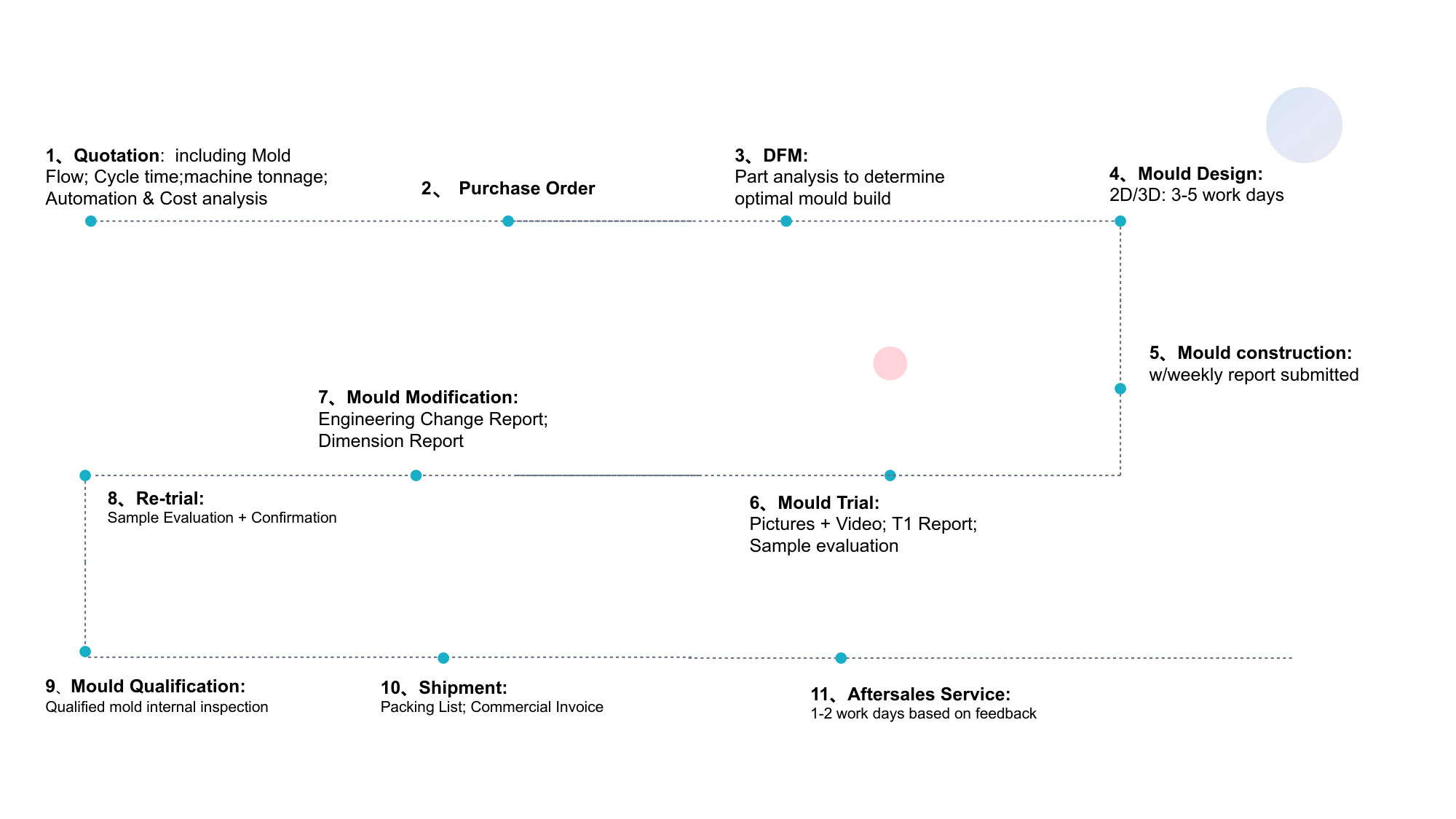
Mold design and manufacturing then proceed. Cavity and core inserts are machined to tolerances as tight as ±0.002 mm on five-axis high-speed CNC platforms, with surface finishes appropriate to the TPU and the demolding requirement. Ejection systems are engineered for delicate parts: micrometric ejector pins, servo-electric ejection, and where necessary rotary unscrewing for threaded or complex internal geometries. Medical-grade stainless steels such as Stavax ESR are selected for corrosion resistance and polishability in dental and medical production environments. The tool is then sampled, typically achieving a stable process within an average of two trials, a metric that reflects the maturity of the design-simulation-manufacturing loop.
Injection molding of the TPU dental component runs on precision machines with closed-loop process control. The process window established during simulation and T1 is locked, and critical parameters—melt temperature, injection speed, packing pressure, cooling time, and ejection velocity—are monitored. For medical and dental production, molding can be conducted in ISO Class 8 cleanroom environments, with material handling and traceability controls consistent with ISO 13485. Post-molding operations are minimized by design; where secondary operations or assembly are required, they are integrated into the controlled process flow and validated accordingly.
2.4 Delivery Efficiency: Why Integration Shortens the Calendar, Not Just the Quote
Delivery efficiency in micro-molding is often misrepresented as press speed. The actual determinant is the number of sequential handoffs and the number of trial iterations required to reach a capable process. Ansix’s integrated model compresses both. Because DFM, Moldflow, tool design, toolmaking, sampling, and validation occur under one organizational roof, the feedback loop between a simulation finding and a tool correction is measured in hours or days rather than in vendor lead times. The company’s reported average of two mold trials is a direct measure of this compression: each avoided trial removes a queue, a setup, a sampling run, and an evaluation cycle from the calendar.
For micro tools, industry lead times vary with cavity count and complexity. Single-cavity prototype or validation tools are commonly delivered in the range of two to three weeks, while higher-cavity production tools extend to four to six weeks and beyond depending on design maturity and validation scope. Ansix’s tooling operation, with 70% automated machining and in-house five-axis capability, is structured to execute the machining portion of that timeline with high predictability, while the simulation and DFM front-end reduces the probability of post-T1 correction loops that erode delivery commitments. The practical outcome for a dental OEM is a program schedule in which the critical path is technical decision-making, not supplier queue time.
2.5 Mold Manufacturing and Injection Molding Material Selection
The tooling material decision and the molded-material decision are treated as coupled variables, not independent purchases. On the tooling side, Ansix selects steels according to the production volume, the abrasiveness and corrosivity of the polymer, the required surface finish, and the maintenance philosophy. For medical and dental TPU components, corrosion-resistant stainless tool steels such as Stavax ESR are frequently appropriate because they resist staining and corrosion in cleanroom and sterilization-adjacent environments, polish to the surface finishes needed for optical or tissue-contact surfaces, and maintain dimensional stability over long production runs. For higher-volume programs, through-hardened or pre-hardened tool steels may be selected where wear resistance and thermal conductivity offer a better lifecycle trade-off.
On the polymer side, Ansix’s engineers guide customers through medical-grade TPU grades on the basis of Shore hardness, elastic modulus, stress-relaxation behavior, sterilizability, and processing latitude. The objective is not to specify the most expensive grade but to identify the lowest-cost grade that reliably meets the clinical and manufacturing requirements. In some cases this means selecting an alternative TPU grade with equivalent performance but better flow characteristics, which reduces fill pressure, mold wear, and energy consumption while improving dimensional consistency. Material suppliers certified to ISO 13485 are used, and documentation supporting ISO 10993 biological evaluation is provided to simplify the customer’s regulatory pathway. For dental components that may contact oral tissue, this material-selection discipline is both a quality control and a regulatory strategy.
2.6 Intelligent Manufacturing and Efficiency Enhancement
Ansix’s intelligent-manufacturing posture is best described as simulation-led and automation-supported rather than automation-for-its-own-sake. The digital thread begins with CAD-based design and DFM, continues through Moldflow simulation and digital prototype validation, and extends into cleanroom production and assembly. A 70% automated machining ratio in toolmaking reduces human variability in the dimensions that most directly affect part quality—cavity geometry, ejector-pin location, and parting-line integrity. Closed-loop injection molding machines with microprocessor regulation maintain repeatable tolerances on small medical components, where the tolerance band may be in the range of 0.01–0.05 mm depending on feature size and material shrinkage.
The efficiency gains are measurable in program economics rather than in machine specifications alone. Cycle-time reductions of 20–30% have been reported through process refinement, and assembly-time reductions of up to 40% through design-for-assembly changes such as snap-fits replacing screws and multi-part assemblies consolidated into single moldable geometries. For a dental component, these gains translate into lower unit cost, shorter production cycles, and reduced inventory exposure—all of which matter in patient-specific and short-run dental device models.
2.7 Process Quality Assurance: From Simulation to SPC
Quality assurance in Ansix’s dental TPU programs is built on the principle that quality is designed and simulated into the process, then verified and monitored, rather than inspected in at the end. The sequence begins with DFM and Moldflow, which remove geometry- and process-induced defect risks before tooling exists. Tool manufacturing tolerances and steel selection then determine the physical capability of the mold. T1 validation confirms dimensional and functional conformance, and process capability studies establish that critical characteristics meet a Cpk target of at least 1.33 before volume production is authorized. During production, statistical process control monitors the parameters and part characteristics that govern fit and function, and lot traceability supports both regulatory requirements and root-cause analysis.
The quality system is certified to ISO 9001, ISO 13485, IATF 16949, and ISO 14001, and medical molding is conducted in ISO Class 8 cleanrooms where specified. For dental components, the practical value of this architecture is that the customer receives not only parts within specification but a documented demonstration that the process is capable, controlled, and traceable—the evidence base required for design-history files, process-validation reports, and regulatory submissions.
Part III: The Value Ansix’s Mold-Making and Injection-Molding Design-Development-Manufacturing Capability Delivers — Problems Solved, Quality Validation, Cost Reduction, Capacity, and Delivery Assurance (≈3,100 words)
3.1 The Value Proposition: Converting Manufacturing Complexity into Predictable Outcomes
The value Ansix provides to a dental device OEM is not “molds and parts.” It is the conversion of a technically uncertain micro-molding program into a predictable, documented, and cost-bounded production system. Three problems dominate precision TPU dental component development, and Ansix’s integrated capability addresses each of them directly.
The first problem is the design-manufacturing gap. A dental component design optimized for clinical function may be difficult or impossible to mold in TPU at the required tolerance: wall sections may be non-uniform, undercuts may prevent clean ejection, or the gate location may create a weld line in a flexing feature. Ansix’s DFM review closes this gap before tooling, and its Moldflow analysis verifies the closure in a virtual environment. Because up to 70% of manufacturing cost is determined at the design stage, resolving these issues in CAD rather than in steel is also the most effective cost-reduction action available.
The second problem is the trial-and-error cost trap. In micro TPU molding, each physical trial consumes tool time, press time, material, and engineering evaluation, and late corrections can cascade into schedule and validation delays. Ansix’s simulation-led approach and its reported average of two mold trials reduce the number of physical iterations and compress the path to a capable process. The customer’s benefit is not merely lower tooling cost but earlier revenue generation and reduced program risk.
The third problem is the validation-documentation burden. Dental devices are regulated products, and a molder that cannot supply IQ/OQ/PQ-compatible validation packages, capability studies, and material traceability creates a regulatory bottleneck for the customer. Ansix’s ISO 13485 framework, cleanroom capability, and validation packages designed for notified-body scrutiny address this burden directly. The customer receives a manufacturing partner that functions as an extension of its own quality and regulatory organization.
3.2 How Quality Validation Is Executed for Dental TPU Components
Validation at Ansix follows a risk-based, stage-gated logic. The first layer is design validation through DFM and simulation: the part geometry and process window are challenged virtually against filling, packing, cooling, and warpage behavior before any steel is cut. The second layer is tool validation at T1: dimensional conformance is measured against the drawing and the simulation prediction, and functional checks are performed on the sampled parts. The third layer is process validation, structured around the IQ/OQ/PQ framework. Installation Qualification confirms that the molding machine, auxiliary equipment, and tooling are installed and configured according to approved specifications. Operational Qualification defines and challenges the operating limits—melt temperature, injection speed, packing pressure, cooling time, ejection velocity—and establishes the nominal process settings. Performance Qualification demonstrates that the process, operating at those nominal settings over a production-representative run, consistently produces parts meeting all specifications, with capability studies on critical characteristics.
For TPU dental components, the critical characteristics typically include feature dimensions that govern fit and retention, wall thickness in flexing regions, and surface finish on tissue-contact or sealing surfaces. The capability target is Cpk ≥ 1.33, maintained across development and validation runs. Where the customer’s regulatory pathway requires it, Ansix provides the documentation package—material certifications, dimensional reports, capability studies, and validation protocols and reports—in a form suitable for inclusion in the design history file and for review by a notified body or customer quality engineer.
3.3 How Ansix Reduces Cost Without Trading Away Quality
Cost reduction at Ansix is structural rather than transactional. It comes from five sources, each of which is a design or process decision rather than a price concession.
The first source is DFM-driven simplification. Consolidating multiple parts into a single moldable geometry, replacing screws with snap-fits, eliminating unnecessary fasteners, and optimizing wall thickness reduce part count, assembly labor, and inspection burden. Documented outcomes include 18% savings per part through DFM-guided redesign and up to 40% assembly-time reduction. In a dental assembly, integrating a flexible TPU sealing or retention element with a rigid support feature can eliminate a secondary assembly step and improve positional accuracy.
The second source is material optimization. Selecting the lowest-cost medical-grade TPU that meets the clinical and processing requirements—rather than defaulting to a premium grade—directly reduces piece price. Ansix’s reported material-cost reductions in the range of 5–18% reflect this discipline. A grade with better flow characteristics can also reduce fill pressure and cycle time, producing a second-order cost benefit.
The third source is tooling and process efficiency. A tool designed for uniform cooling, balanced filling, and clean ejection runs a shorter cycle and produces fewer defects. Reported cycle-time reductions of 20–30% and tooling/logistics cost reductions of 30–50% in applicable programs are the measurable expression of this efficiency. For a dental component produced in high volume, even a modest cycle-time reduction compounds into significant annual capacity and cost benefit.
The fourth source is yield and rework avoidance. Simulation-led process development and in-process SPC reduce the rate of dimensional nonconformance and cosmetic defects, which in micro TPU molding can be both difficult to inspect and expensive to scrap. The cost of poor quality in a dental component is amplified by the value of the material, the cleanroom environment, and the documentation burden; avoiding it is a direct contributor to total cost competitiveness.
The fifth source is supply-chain compression. Because design, tooling, molding, and validation are integrated, the customer does not pay for the coordination overhead, expediting, and duplicate quality systems that fragmented supply chains require. The integrated model eliminates the margin stacking and communication latency that accumulate when a program is split across a design house, a mold shop, a molder, and a validation consultant.
3.4 Capacity and Delivery Assurance
Capacity in micro TPU molding is not simply the number of machines; it is the availability of the right machines, the right tooling capacity, and the engineering bandwidth to qualify new programs without disrupting existing ones. Ansix operates 260 injection molding machines across four production bases in China and Vietnam, spanning 30 to 2,800 tons, in approximately 200,000 m² of manufacturing space. The geographic diversification provides both capacity redundancy and supply-chain resilience, which is increasingly important for medical and dental OEMs with global distribution.
On the delivery side, the key assurance mechanisms are tooling lead-time predictability and process stability. Ansix’s 70% automated machining ratio and in-house five-axis capability reduce the variability that causes tooling delays, and its average of two mold trials reduces the schedule risk associated with post-T1 corrections. The structured NPI stage-gate process provides explicit checkpoints at which schedule status and technical risk are visible to the customer, rather than leaving delivery assurance to a promise at project kickoff. For production programs, closed-loop process control and SPC support consistent output, and the ISO 13485 quality system provides the change-control discipline needed to avoid unplanned deviations that disrupt supply.
The practical delivery value for a dental OEM is a program schedule in which the critical path runs through the customer’s design decisions and clinical validation, not through supplier queue time or repeated tooling iterations. That is the operational meaning of integrated micro-molding capability: it does not make the technical problem disappear, but it ensures that the technical problem is solved in the fastest possible sequence, with the fewest possible physical iterations, and with the documentation depth that the dental device regulatory environment demands.
Summary. Ansix Tech’s relevance to precision miniature TPU dental components is not that it offers micro-molding as one service among many, but that it has assembled—over 29 years, more than 30,000 molds, and a four-base, 260-machine global footprint—the specific combination of simulation-led DFM, micron-level tooling, medical-grade material competence, ISO 13485 validation discipline, cleanroom production, and structural cost engineering that this class of work requires. The company’s industry position is the cumulative result of aligning scale with precision, design with manufacturing, and quality assurance with the regulatory realities of dental and medical devices. For a dental OEM, that alignment translates into fewer surprises, faster qualification, lower total cost, and a manufacturing partner whose documentation and process capability can withstand both clinical scrutiny and regulatory audit.
Ansix Tech Co Ltd
If you have any plans related to Micro-molding molds for precision miniature TPU dental components , you can contact us at any time. We will turn your ideas into reality, let you realize your dreams, and obtain large orders from the market. Our contact information is info@ansixtech.com. Or contact our CTO, mail: stephen@ansixtech.com
#www.ansixtech.com #ansixtech.com #Micro-molding molds for precision miniature TPU dental components #Micro-molding molds for precision miniature TPU dental components Tooling #Micro-molding molds for precision miniature TPU dental components injection mold companies #Ansix #Ansix moulds #Ansix china #Ansix tech china #Ansix tech company #Ansix facotry #Ansix Tooling #Ansix tool #Micro-molding molds for precision miniature TPU dental components injection molding #Micro-molding molds for precision miniature TPU dental components injection tools #Micro-molding molds for precision miniature TPU dental components injection moulds #Ansix moulding company #Ansix molding #ansix tooling #Micro-molding molds for precision miniature TPU dental components plastic mould #Micro-molding molds for precision miniature TPU dental components plastic tools #Ansix Tech #Ansix molds #Ansix injection molding #Ansix mold factory #Micro-molding molds for precision miniature TPU dental components injection molding Customized #Ansix mold factory #Micro-molding molds for precision miniature TPU dental components china #Micro-molding molds for precision miniature TPU dental components molds #injection factory for Micro-molding molds for precision miniature TPU dental components #Micro-molding molds for precision miniature TPU dental components injection molding #Micro-molding molds for precision miniature TPU dental components injection molding factory #injection molding company #Micro-molding molds for precision miniature TPU dental components injection mold companies #Micro-molding molds for precision miniature TPU dental components Tooling #Micro-molding molds for precision miniature TPU dental components mold limited #Ansix mold china #Ansix companies for Micro-molding molds for precision miniature TPU dental components #Ansix company China #Micro-molding molds for precision miniature TPU dental components facotry #Ansix Tech #Ansix Tech mould #Micro-molding molds for precision miniature TPU dental components injection moulding #Micro-molding molds for precision miniature TPU dental components injection moulding company #Ansix Micro-molding molds for precision miniature TPU dental components parts injection mold companies #Micro-molding molds for precision miniature TPU dental components injection molding companies china #Micro-molding molds for precision miniature TPU dental components china factory #Ansix moulding companies #Ansix molding company #Micro-molding molds for precision miniature TPU dental components injection moulding facotry #Ansix Tech mold #Micro-molding molds for precision miniature TPU dental components mould #Micro-molding molds for precision miniature TPU dental components plastic injection molding #ansix plastic mold #Micro-molding molds for precision miniature TPU dental components Mold manufacturing #Micro-molding molds for precision miniature TPU dental components parts manufacturing #Micro-molding molds for precision miniature TPU dental components plastic parts factory #Micro-molding molds for precision miniature TPU dental components injection parts mold #Micro-molding molds for precision miniature TPU dental components PRECISION MANUFACTURING #Micro-molding molds for precision miniature TPU dental components TOOL #China Micro-molding molds for precision miniature TPU dental components mold #Micro-molding molds for precision miniature TPU dental components injection moulding china #Micro-molding molds for precision miniature TPU dental components mould china #china precision mold #Micro-molding molds for precision miniature TPU dental components mold in china #Micro-molding molds for precision miniature TPU dental components mold china #Micro-molding molds for precision miniature TPU dental components Precision molds #High-precision molds #Micro-molding molds for precision miniature TPU dental components High-precision tool #Injection molds #Mold for thin-walled endoscopic protective sleeve components (wall thickness 0.08 mm)Factory #Mold for thin-walled endoscopic protective sleeve components (wall thickness 0.08 mm)Company #Super Large Injection Mold Factory #Large Tonnage Injection Molding Factory #Micro-molding molds for precision miniature TPU dental components Company #Micro-molding molds for precision miniature TPU dental components Factory #2800T Injection Molding Factory #3000 Ton Injection Molding #4500 Ton Injection Molding Factory #Micro-molding molds for precision miniature TPU dental components Large Mold Injection Molding #Large Plastic Mold Injection Molding Factory #Micro-molding molds for precision miniature TPU dental components Large Injection Mold Manufacturer #Micro-molding molds for precision miniature TPU dental components Plastic Mold Factory #Injection Mold #Plastic Mold