
 Medical Molds
 Packaging Molds
 Personal Care Molds
 Electronic Molds
 Automotive Molds
 Home Appliance Molds
 Special Molds
 Design & Engineering
 Production & Manufacturing
 Global Presence
 Business Scope
 Component Solutions
 Product Assembly
 Quality Management
 Medical Device Manufacturing



Mold for New Energy Vehicle EV Plug Connectors
FEATURES
Core Manufacturing Assets
Injection Molding Fleet: 260 injection molding machines with tonnage ranging from 30 tons to 2,800 tons. The primary brands include Japan‘s Fanuc, Sumitomo, Toshiba, Nissei, and Engel, as well as Germany’s Arburg (specializing in liquid silicone and two-component injection molding). Domestic machines include Haitian and Victor Taichung.
Mold Machining Equipment: The company employs micron-level manufacturing equipment including Makino and Frank machining centers, with tolerance control maintained within ±0.002mm.
Professional DFM Team: Average experience exceeding 12 years per engineer.
1.2 Quality Certifications
Ansix Tech holds a comprehensive quality management system certified to ISO9001, IATF16949 (automotive), ISO13485 (medical devices), and ISO14001 (environmental management), with ISO 8 Cleanroom and GMP compliance. For EV connector projects, the IATF16949 certification is particularly critical—it is the mandatory quality standard for automotive supply chain approval, signaling that Ansix‘s processes are audited against the same requirements as Tier 1 automotive suppliers.
-
Mold Description
Product Materials:
PBT +GF35 PA66+GF25
Mold Material:
S136ESR
Number of Cavities:
1+1
Glue Feeding Method:
Hot runner
Cooling Method:
Water cooling
Molding Cycle
42.5s
- The mold manufacturing process and product material selection
Mold for New Energy Vehicle EV Plug Connectors
2.1 Product Definition and Application Scope
EV Plug Connectors are precision-molded plastic components that form the structural housing, sealing interfaces, terminal retention features, and locking mechanisms of high-voltage and signal connectors used in electric vehicles. These components are deployed across battery management systems, motor controllers, charging gun assemblies, and in-vehicle electrical architectures.
2.2 Technical Challenges in Connector Mold Manufacturing
EV plug connectors present unique molding challenges that separate capable mold makers from the rest:
High-Temperature Material Processing: Connectors often use engineering plastics such as PPA, PA66 with flame retardants, PBT, and high-performance polymers like PEEK. These materials require precise melt temperature control to avoid thermal degradation and carbonization.
Tight Dimensional Tolerances: Connector housings must maintain terminal positioning accuracy, wall thickness uniformity for insulation integrity, and mating surface flatness. Typical tolerances for high-voltage connector molds are ±0.003mm or tighter.
Complex Geometry: Connectors frequently feature undercuts, thin walls, sealing grooves, terminal retention clips, and multi-step internal features requiring side-action mechanisms, lifter systems, and precision insert cores.
Cosmetic and Functional Requirements: Exterior surfaces must be free of flow marks, weld lines, and flash, while internal features must prevent high-voltage leakage paths.
-
Material Selection for EV Connector Molds
Ansix Tech selects mold steel based on the connector‘s production volume, material aggressiveness, and surface finish requirements:
Steel Grade Hardness Key Characteristics Typical Application
NAK80 HRC 38-42 Pre-hardened, excellent polishability, good machinability Cavity and core inserts where fine finish is needed
S136 (AISI 420) HRC 48-52 Stainless, corrosion-resistant, mirror polishable Connectors using flame-retardant or corrosive materials
718H HRC 30-34 Pre-hardened, good toughness General connector components, large inserts
STAVAX HRC 52-54 High polishability, wear resistance High-volume programs requiring extended tool life
For connectors molded from flame-retardant PPA or PA66, corrosion-resistant steel is non-negotiable. Ansix Tech also offers PVD coating on cavity surfaces to further resist chemical attack from halogenated flame retardants, extending tool life in high-volume EV programs.
2.4 Manufacturing Process for EV Connector Molds
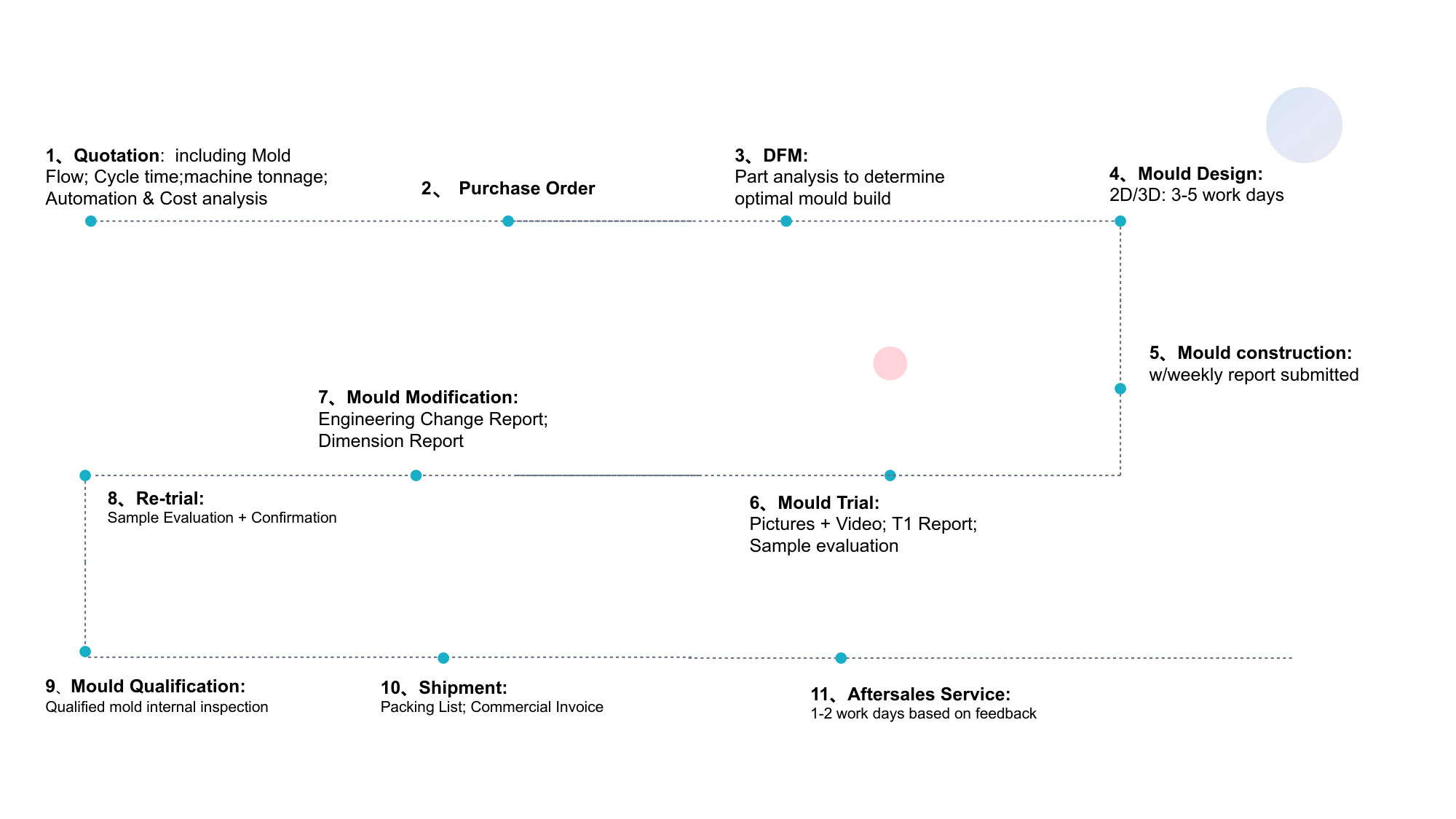
The mold manufacturing workflow for EV connectors follows a disciplined sequence:
Step 1 — DFM Review and Moldflow Simulation: Before steel is cut, Ansix engineers simulate fill patterns, cooling efficiency, and warpage prediction using Moldflow software. One documented high-voltage connector project reduced volumetric shrinkage variation by 45.4% and maximum warpage by 21.3% through gate and cooling optimization identified in simulation.
Step 2 — Mold Design: Cavity and core are typically designed as modular inserts for maintainability. Multi-cavity layouts balance productivity against precision requirements. For complex connectors with undercuts, side-action mechanisms such as angled pin core-pulling systems are incorporated.
Step 3 — Gating System Design: For high-volume connectors, submerged “bullhorn” gates simplify the mold from a three-plate to a two-plate structure, reducing cycle time and allowing clean gate separation.
Step 4 — Cooling System: Conformal cooling channels following the part contour, or a combination of surrounding channels in the cavity and well-type channels in the core, are used to achieve uniform heat extraction.
Step 5 — Ejection System: For delicate connector housings, a combination of round and flat ejector pins distributes force and prevents damage. Ejection sequence is carefully designed to ensure the part clears the mold before robotic removal.
Step 6 — Precision Machining: Five-axis CNC milling, micro-sink EDM, wire EDM, precision surface grinding, vacuum heat treatment, and mirror polishing are applied as required.
2.5 Moldflow Simulation: The Digital Validation Layer
Moldflow analysis is where Ansix Tech’s engineering capability most directly creates customer value by eliminating physical trial-and-error. The simulation covers:
Fill Analysis: Predicts melt flow front, air trap locations, weld line formation, and short-shot risks
Cooling Analysis: Models cooling channel efficiency to ensure uniform part temperature and minimize cycle time
Warpage Prediction: Estimates shrinkage and deformation before the first metal cut
By solving these issues in the digital domain, Ansix avoids trial-and-error iterations that plague traditional mold making—saving weeks of lead time and substantial cost.
2.6 Injection Molding Production
The 260-machine fleet provides flexibility for EV connector production. Critical process parameters monitored during production include melt temperature, mold temperature, injection pressure, holding pressure, and cycle time. Statistical process control (SPC) is applied to critical dimensions, with real-time monitoring feeding back into process adjustment.
For high-cavity connector molds, balanced filling is verified through short-shot studies and pressure-drop analysis across cavities. Insert molding capability supports connectors with metal terminals or functional inserts molded in place.
三、Ansix’s Approach to Customer Satisfaction and Industry Leadership
3.1 Translating Technical Capability into Customer Value
The core of Ansix‘s approach is converting engineering jargon into outcomes the customer actually experiences: problems solved, costs saved, risks reduced.
Problem: Expensive mold revisions and delayed launch
Ansix Capability: Moldflow simulation and DFM review before steel commitment
Customer Value: Weeks of trial-and-error eliminated; first-shot accuracy dramatically improved
Problem: Inconsistent part dimensions causing assembly failures
Ansix Capability: ±0.002mm machining tolerance, modular insert design, SPC monitoring
Customer Value: Connector housings mate reliably; terminal retention force remains within specification across millions of parts
Problem: Tool wear and unplanned downtime in high-volume production
Ansix Capability: Correct steel selection for flame-retardant materials, PVD coating options
Customer Value: Extended tool life; maintenance schedules predictable; production continuity maintained
Problem: High tooling cost for low-to-medium volume programs
Ansix Capability: Optimized cavity layout balancing productivity against tool investment
Customer Value: Competitive piece-part cost without over-investing in capacity that exceeds demand
Problem: Supply chain disruption and delivery uncertainty
Ansix Capability: Four production bases across China and Vietnam
Customer Value: Geographic diversification; 99%+ on-time delivery performance
3.2 How Ansix Reached Industry Leadership
Scale without sacrificing precision. The 260-machine fleet and 200,000+ square meter manufacturing footprint provide capacity that most competitors cannot match. Yet the tolerance control remains at ±0.002mm—demonstrating that scale and precision are not mutually exclusive.
Full-service integration. From design and DFM through mold manufacturing, validation, mass production, and after-sales support, Ansix controls the entire value chain. This eliminates the coordination overhead and finger-pointing that occurs when customers must manage separate mold makers, molders, and finishers.
Automotive-grade quality discipline. IATF16949 certification is not merely a plaque. It represents audited processes for traceability, error-proofing, and continuous improvement that automotive customers require. This credential opens doors to EV programs that exclude non-certified suppliers.
Material expertise. Ansix has developed specific expertise in high-performance polymers including PEEK, PPA, and flame-retardant PA66—materials that many molders avoid due to processing difficulty.
Proven track record with premium automotive brands. Ansix has delivered tooling for Porsche, Mercedes-Benz, and Audi projects. This track record serves as third-party validation of capability for new EV customers.
四、Customer Journey: From Concept to Delivery and Beyond
4.1 Phase 1 — Design and DFM Review
The engagement begins with engineering dialogue. Ansix‘s DFM team reviews the customer’s 2D/3D drawings or physical connector samples, identifying:
Parting line placement and shutoff design
Gate location and type optimization
Cooling channel layout feasibility
Ejection strategy for delicate features
Steel selection based on material and volume
Potential molding risks and mitigation strategies
Customer Value: Design flaws caught before tooling investment; production-ready design confirmed before capital commitment.
4.2 Phase 2 — Moldflow Simulation
Moldflow analysis models the injection process digitally. For a high-voltage connector socket project, simulation identified gate and cooling modifications that reduced volumetric shrinkage variation by 45.4%.
Customer Value: Physical trial iterations reduced; first-shot success rate increased; launch timeline compressed.
4.3 Phase 3 — Mold Design and Manufacturing
Detailed mold design follows approved DFM and simulation results. Modular insert design facilitates maintenance. Steel is selected and heat-treated. Precision machining proceeds through CNC, EDM, and grinding. Assembly and fitting are performed by experienced mold makers.
Customer Value: Tooling built to specification; documented dimensional inspection reports provided.
4.4 Phase 4 — T1 Sampling and Product Validation
First-article inspection includes comprehensive dimensional and optical inspection. For EV connectors, validation extends to:
Dimensional verification against customer specifications using CMM or optical measurement systems
Functional testing as required (mating force, sealing integrity, terminal retention)
Material property verification
Customer Value: Objective data confirming the mold produces parts meeting specifications; documentation for customer‘s own approval process.
4.5 Phase 5 — NPI Process Planning
New Product Introduction (NPI) planning covers:
Production cell layout and workflow
Operator training and work instructions
Quality control plan and inspection frequency
Packaging specification
Logistics coordination
Customer Value: Smooth transition from validation to mass production; no quality degradation at ramp-up.
4.6 Phase 6 — Mass Production
With 260 machines and four production bases, Ansix scales production to customer demand. In-process SPC monitors critical parameters. Automated vision systems verify critical dimensions on statistically significant sampling plans.
Customer Value: Consistent quality at volume; production capacity that grows with the customer’s program.
4.7 Phase 7 — Quality Assurance and Delivery
Outgoing quality control includes dimensional inspection, functional testing where applicable, and packaging verification. Logistics options include sea freight (FCL/LCL), air freight for urgent orders, and door-to-door delivery. For JIT customers, safety stock is maintained to meet delivery windows with 99%+ on-time performance.
Customer Value: Parts arrive on time, to specification, in packaging that prevents damage.
4.8 Phase 8 — After-Sales Support
After-sales services include:
Mold maintenance and repair
Spare parts management
Process troubleshooting
Engineering change support
Mold life-cycle management
Customer Value: Tooling remains productive over its full life; issues resolved without production stoppage.
五、Competitive Cost Control Capability
5.1 Systematic Cost Reduction Through Intelligent Engineering
Ansix attacks cost at every stage of the value chain rather than focusing narrowly on material substitution or labor reduction:
Material Cost Reduction:
Optimized material selection matching properties to requirements, avoiding over-specification
Bulk purchasing power across multiple customers and projects
Regrind utilization where permissible for non-critical features
Process Cost Reduction:
Cycle time optimization through cooling analysis and gate design (15-30% reduction achievable)
Multi-cavity layouts that amortize mold cost across higher output
Automation reducing labor content per part
Tooling Cost Reduction:
Correct steel selection preventing premature tool failure
Modular insert design enabling partial replacement rather than full mold rebuild
Simulation-driven design reducing revision cycles
5.2 Geographic Cost Advantage
Manufacturing in China and Vietnam provides structural cost advantages in labor, overhead, and supply chain proximity. The four-base model allows production allocation based on cost optimization, tariff considerations, and customer location.
5.3 Total Cost of Ownership
The most meaningful cost control is the Total Cost of Ownership (TCO) of the tooling and production program. A mold that costs 10% less initially but requires frequent repair, produces higher scrap rates, or stops production for unplanned maintenance is far more expensive over its life. Ansix‘s precision manufacturing, correct material selection, and proactive maintenance protocols deliver lower TCO even when initial tooling investment is competitive.
六、Quality Assurance Framework
6.1 Incoming Material Control
Each batch of polymer resin undergoes verification testing including melt flow index measurement, moisture content analysis, visual inspection for contamination, and certificate of analysis verification.
6.2 In-Process Quality Control
First Article Inspection: Comprehensive dimensional and visual inspection of first shots from each mold
Statistical Process Control (SPC): Real-time monitoring of melt temperature, mold temperature, injection pressure, and cycle time
Inline Dimensional Inspection: Automated vision systems verify critical dimensions
Visual Inspection: Detection of flow marks, weld lines, sink marks, and other surface defects
6.3 Outgoing Quality Control
Before shipment, finished parts undergo final dimensional verification against customer specifications using CMM or optical measurement systems, functional testing where required, and packaging inspection.
6.4 Certification and Compliance
The quality management system is certified to ISO9001, IATF16949, ISO13485, and ISO14001. For EV connector projects, IATF16949 compliance ensures that quality processes meet automotive industry requirements including traceability, documented inspection, and continuous improvement.
七、Smart Manufacturing and Efficiency Enhancement
7.1 Digital Simulation as a Manufacturing Accelerator
Moldflow simulation is not merely a design tool—it is a manufacturing efficiency technology. By validating the process digitally before physical trials, Ansix reduces the number of trial shots required to achieve acceptable parts. This directly shortens lead time and reduces the cost of sampling.
7.2 Data-Driven Process Optimization
SPC data collected during production feeds back into process refinement. Trends are analyzed to identify parameter drift before it produces out-of-specification parts, enabling preventive adjustment rather than reactive correction.
7.3 Manufacturing Equipment Portfolio
The combination of Japanese, German, and Chinese injection molding machines provides flexibility to match machine characteristics to part requirements. High-precision connectors may run on Fanuc or Engel machines, while larger structural components utilize Haitian or Victor Taichung machines.
7.4 Modular Tooling Design
Modular insert design reduces maintenance downtime. If a high-wear area requires replacement, a new insert can be installed without removing the entire mold from the press, dramatically reducing production interruption.
八、Conclusion: The Ansix Value Proposition for EV Connector Programs
For customers developing New Energy Vehicle EV Plug Connectors, Ansix Tech offers a combination of capabilities that directly addresses the program risks most likely to cause failure:
Technical Risk Mitigation: Moldflow simulation and DFM review catch design and process issues before tooling investment.
Quality Assurance: IATF16949-certified processes and rigorous inspection protocols deliver parts that meet automotive specifications consistently.
Cost Competitiveness: Systematic cost control across material, process, tooling, and geography delivers competitive piece-part pricing without quality compromise.
Delivery Reliability: Four production bases across China and Vietnam, 260 injection molding machines, and 99%+ on-time delivery performance provide supply chain security.
Lifecycle Support: From DFM through mass production and after-sales maintenance, Ansix manages the entire tooling lifecycle, allowing customers to focus on their core business.
The company‘s evolution from a Hong Kong tooling shop in 1998 to a multinational manufacturing organization with 200,000+ square meters of production space reflects a sustained commitment to capability development. For EV connector programs where precision, reliability, and cost efficiency determine success, this depth of capability and experience represents a manufacturing partnership rather than a vendor relationship.
Ansix Tech Co Ltd
If you have any plans related to Mold for New Energy Vehicle EV Plug Connectors , you can contact us at any time. We will turn your ideas into reality, let you realize your dreams, and obtain large orders from the market. Our contact information is info@ansixtech.com. Or contact our CTO, mail: stephen@ansixtech.com
#www.ansixtech.com #ansixtech.com #Mold for New Energy Vehicle EV Plug Connectors #Mold for New Energy Vehicle EV Plug Connectors tooling #Mold for New Energy Vehicle EV Plug Connectors injection mold companies #Ansix #Ansix moulds #Ansix china #Ansix tech china #Ansix tech company #Ansix facotry #Ansix Tooling #Ansix tool #Mold for New Energy Vehicle EV Plug Connectors injection molding #Mold for New Energy Vehicle EV Plug Connectors injection tools #Mold for New Energy Vehicle EV Plug Connectors injection moulds #Ansix moulding company #Ansix molding #ansix tooling #Mold for New Energy Vehicle EV Plug Connectors plastic mould #Mold for New Energy Vehicle EV Plug Connectors plastic tools #Ansix Tech #Ansix molds #Ansix injection molding #Ansix mold factory #Mold for New Energy Vehicle EV Plug Connectors injection molding Customized #Ansix mold factory #Mold for New Energy Vehicle EV Plug Connectors china #Mold for New Energy Vehicle EV Plug Connectors molds #injection factory for Mold for New Energy Vehicle EV Plug Connectors0A 70A Energy Storage Connector Waterproof, Quick-Connect, Stackable Battery Module Plug injection molding #Mold for New Energy Vehicle EV Plug Connectors injection molding factory #injection molding company #Mold for New Energy Vehicle EV Plug Connectors injection mold companies #Mold for automotive daytime running light guide strip #Mold for New Energy Vehicle EV Plug Connectors mold limited #Ansix mold china #Ansix companies for Mold for New Energy Vehicle EV Plug Connectors #Ansix company China #Mold for New Energy Vehicle EV Plug Connectors facotry #Ansix Tech #Ansix Tech mould #Mold for New Energy Vehicle EV Plug Connectors injection moulding #Mold for New Energy Vehicle EV Plug Connectors injection moulding company #Ansix Mold for New Energy Vehicle EV Plug Connectors parts injection mold companies #Mold for New Energy Vehicle EV Plug Connectors injection molding companies china #Mold for New Energy Vehicle EV Plug Connectors china factory #Ansix moulding companies #Ansix molding company #Mold for New Energy Vehicle EV Plug Connectors injection moulding facotry #Ansix Tech mold #Mold for New Energy Vehicle EV Plug Connectors mould #Mold for New Energy Vehicle EV Plug Connectors plastic injection molding #ansix plastic mold #Mold for New Energy Vehicle EV Plug Connectors Mold manufacturing #Mold for New Energy Vehicle EV Plug Connectors parts manufacturing #Mold for New Energy Vehicle EV Plug Connectors plastic parts factory #Mold for New Energy Vehicle EV Plug Connectors injection parts mold #Mold for New Energy Vehicle EV Plug Connectors PRECISION MANUFACTURING #Mold for New Energy Vehicle EV Plug Connectors TOOL #China Mold for New Energy Vehicle EV Plug Connectors mold #Mold for New Energy Vehicle EV Plug Connectors injection moulding china #Mold for New Energy Vehicle EV Plug Connectors mould china #china precision mold #Mold for New Energy Vehicle EV Plug Connectors mold in china #Mold for New Energy Vehicle EV Plug Connectors mold china #Mold for New Energy Vehicle EV Plug Connectors Precision molds #High-precision molds #Mold for New Energy Vehicle EV Plug Connectors High-precision tool #Injection molds #Mold for New Energy Vehicle EV Plug ConnectorsFactory #Mold for New Energy Vehicle EV Plug ConnectorsCompany #Super Large Injection Mold Factory #Large Tonnage Injection Molding Factory #Mold for New Energy Vehicle EV Plug Connectors Company #Mold for New Energy Vehicle EV Plug Connectors Factory #2800T Injection Molding Factory #3000 Ton Injection Molding #4500 Ton Injection Molding Factory #Mold for New Energy Vehicle EV Plug Connectors Large Mold Injection Molding #Large Plastic Mold Injection Molding Factory #Mold for New Energy Vehicle EV Plug Connectors Large Injection Mold Manufacturer #Mold for New Energy Vehicle EV Plug Connectors Plastic Mold Factory #Injection Mold #Plastic Mold