
 Medical Molds
 Packaging Molds
 Personal Care Molds
 Electronic Molds
 Automotive Molds
 Home Appliance Molds
 Special Molds
 Design & Engineering
 Production & Manufacturing
 Global Presence
 Business Scope
 Component Solutions
 Product Assembly
 Quality Management
 Medical Device Manufacturing



Outer tub mold for twin-tub washing machines
FEATURES
How Ansix Tech Achieves Customer Satisfaction and Industry Leadership
1.1 The Foundation of Trust: Hard Capabilities and Infrastructure
Customer trust begins with demonstrable capability. Ansix Tech has built its reputation on a foundation of advanced manufacturing infrastructure that few competitors can match:
Precision Machining Capabilities: The company operates five-axis high-speed machining centers capable of achieving machining accuracy of 0.002mm, a level of precision that is critical for the deep-cavity, complex-geometry molds required for washing machine outer tubs. The automated machining ratio stands at approximately 70%, ensuring consistency and reducing human error across production runs.
Scale and Capacity: With 260 injection molding machines spanning from 30 to 2,800 tons, Ansix Tech possesses the tonnage range necessary to handle the large projected areas and high clamping forces required for twin-tub washing machine outer tub molds. The machine fleet includes equipment from Fanuc, Sumitomo, Toshiba, Nissei, Engel, and Arburg, ensuring that the right machine is matched to each project’s specific requirements.
Certifications and Systems: The company has successfully obtained ISO 9001, ISO 14001, IATF 16949, and ISO 13485 certifications, reflecting adherence to international standards across quality management, environmental responsibility, and industry-specific requirements for automotive and medical device manufacturing. These certifications provide customers with confidence that Ansix Tech operates within rigorous, auditable frameworks.
Geographic Diversification: Production bases in both China and Vietnam offer customers supply chain flexibility and risk mitigation, particularly valuable in an era of geopolitical uncertainty and tariff considerations.
-
Mold Description
Product Materials:
PP
Mold Material:
S136ESR
Number of Cavities:
1
Glue Feeding Method:
Hot runner
Cooling Method:
Water cooling
Molding Cycle
42.5s
- The mold manufacturing process and product material selection
The Differentiator: Translating Technical Expertise into Customer Value
What distinguishes Ansix Tech in the highly competitive mold-making industry is its systematic approach to translating technical capabilities into tangible customer outcomes. Rather than speaking in the language of mold-making—sprue bushings, ejector pins, and cooling channels—Ansix Tech frames its value in terms of what customers actually care about: cost per part, time to market, defect rates, and risk exposure.
Material Utilization as a Cost Lever: In an industry where reducing material waste by 5% is considered a breakthrough, Ansix Tech’s proprietary approach to washing machine outer tub molds has achieved material utilization improvements of 12–18%, directly translating into substantial cost reductions for appliance manufacturers. This is not achieved through compromise but through integrated engineering innovation.
Cycle Time Reduction: Through advanced thermal management and optimized cooling system design, Ansix Tech has demonstrated cycle time reductions of up to 28% on comparable projects, directly improving production throughput and reducing per-unit costs.
Risk Reduction Through Virtual Validation: The company’s commitment to simulation-driven design means that the first physical prototype is highly likely to meet specifications, dramatically reducing the traditional trial-and-error cycles that plague mold development and consume both time and money.
-
The Partnership Model: From Vendor to Strategic Ally
Ansix Tech positions itself not as a transactional mold supplier but as a long-term engineering partner. This is evidenced by its work with major appliance manufacturers such as Haier, where the company was entrusted with developing molds for critical components of next-generation high-efficiency, low-noise washing machines. The relationship extends beyond delivery to encompass ongoing optimization, production support, and continuous improvement initiatives.
Part Two: End-to-End Service Portfolio for Outer Tub Molds
2.1 Product Design and Development
The design of an outer tub mold for a twin-tub washing machine begins not with the mold itself but with a deep understanding of the part’s functional requirements. The outer tub must withstand continuous water exposure, chemical detergents, mechanical stress from rotating laundry, and thermal cycling over millions of wash cycles. The design process therefore integrates mechanical engineering, materials science, and manufacturing feasibility from the outset.
Ansix Tech’s designers employ Design for Manufacturability (DFM) principles early in the development process to preempt production challenges. This includes simplifying assemblies, reducing part counts where possible, and optimizing wall thickness transitions to ensure uniform material flow and cooling.
2.2 Design for Manufacturability (DFM) and Mold Design
The DFM process for a washing machine outer tub mold is particularly challenging due to several inherent characteristics of the part:
Deep Cavity Geometry: The cylindrical shape of the outer tub creates a deep draw that requires careful consideration of core and cavity steel selection, ejection strategy, and cooling channel placement.
Numerous Through-Holes: A typical outer tub may require 286 or more drainage holes, necessitating complex internal core mechanisms to form these features without compromising mold integrity.
Uniform Wall Thickness: Maintaining consistent wall thickness throughout the part is critical for structural integrity, dimensional stability, and cycle time consistency.
High Dimensional Accuracy: Critical mating surfaces typically require tolerances below 0.1mm to ensure proper assembly and leak-free operation.
Structural Reinforcement: The tub must maintain structural stability under high-speed spin cycles, requiring carefully designed reinforcement ribs.
2.3 Moldflow Analysis for Part Forming
Before any steel is cut, Ansix Tech employs advanced simulation software—including Moldex3D and other industry-leading tools—to create a virtual 3D model of the plastic flow into the complex mold cavity. This virtual prototyping phase addresses several critical questions:
Fill Pattern Optimization: The software predicts how molten plastic will flow through the cavity, identifying potential weld lines (weak points where flow fronts meet), air traps, and areas of uneven filling.
Shrinkage and Warpage Forecasting: By accounting for material properties and cooling rates, the simulation predicts how much the part will shrink and whether it will warp as it cools. This allows for preemptive correction in mold design—essentially building the anticipated distortion into the mold in reverse—to yield a final part that is dimensionally perfect.
Pressure and Clamp Force Requirements: The simulation predicts the maximum injection pressure needed to fill the mold, vital for selecting the appropriately sized injection molding machine and verifying that the mold structure can withstand the pressure without deflection.
Cooling Optimization: By adjusting cooling channel layouts, baffle placements, and bubbler configurations in the virtual model, the team can achieve perfectly balanced filling and cooling before committing to physical tooling.
This virtual “test run” ensures that the first physical prototype is highly likely to meet final specifications, dramatically reducing the cost of traditional mold rework and trial-and-error.
2.4 Product Validation
Ansix Tech employs a comprehensive validation protocol that extends across the entire product lifecycle:
Material Incoming Inspection: All raw materials are certified and verified upon receipt to ensure they meet specified requirements.
In-Process Monitoring: Continuous real-time monitoring of injection parameters—including cavity pressure sensing—ensures consistency across millions of production cycles.
Dimensional Verification: Precision measurement using coordinate measuring machines (CMMs) and optical systems verifies that critical dimensions meet tolerance requirements.
Mechanical Property Testing: Tensile strength, elongation, and other mechanical properties are validated to ensure the part can withstand the stresses of its application.
Fit and Function Testing: Prototype assemblies are tested to verify that the molded component interfaces correctly with mating parts.
2.5 New Product Introduction (NPI) Process Planning
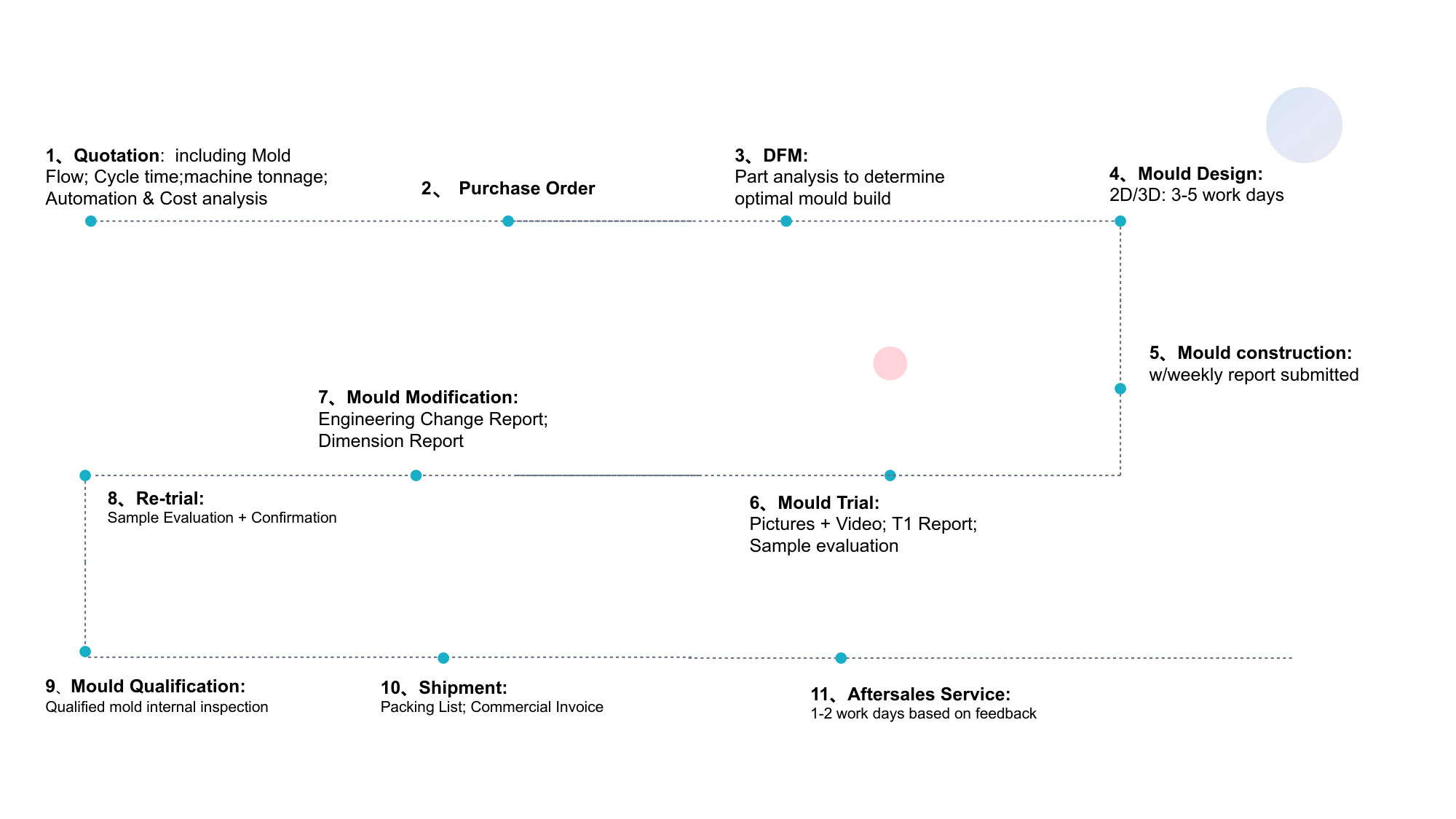
The NPI process for an outer tub mold project follows a structured pathway that balances speed with risk mitigation:
Phase 1 – Concept and Feasibility: Initial design concepts are evaluated for manufacturability, with early DFM feedback integrated into the design.
Phase 2 – Detailed Design and Simulation: The mold design is finalized and validated through Moldflow analysis.
Phase 3 – Tooling Manufacturing: Precision machining of mold components using five-axis CNC, EDM, and other advanced processes.
Phase 4 – Trial and Validation: Mold trials are conducted with systematic parameter optimization, typically achieving acceptable parts within two trials on average.
Phase 5 – Production Ramp-Up: Process parameters are locked, and production begins with statistical process control monitoring.
2.6 Mass Production
Ansix Tech’s mass production capabilities are built on a foundation of intelligent process control:
Closed-Loop Pressure Control: Unlike traditional time-based injection control, Ansix Tech employs cavity pressure sensors that monitor fill and packing in real time, ensuring that every shot fills identically despite minor variations in material viscosity or machine performance. This is particularly important for family molds where multiple cavities must fill consistently.
Automated Process Monitoring: Real-time monitoring systems track critical parameters and alert operators to deviations before they result in defective parts.
Efficient Cooling Design: The cooling system—often the most critical factor in cycle time—is engineered for uniform, rapid heat removal. Channel placement at consistent distances from cavity surfaces, turbulent flow optimization, and strategic use of baffles and bubblers in deep core areas all contribute to cycle time minimization.
2.7 Quality Assurance
Quality assurance at Ansix Tech is not a final inspection step but a philosophy embedded throughout the production process. The company’s quality management systems—ISO 9001, IATF 16949, and ISO 13485—provide the framework, but the execution relies on:
Statistical Process Control (SPC): Critical dimensions are monitored continuously, with control charts identifying trends before they become defects.
Traceability: Every production lot is documented with complete traceability from raw material batch through final packaging, essential for regulatory compliance and root cause analysis.
In-House Laboratory: Comprehensive testing capabilities enable rapid validation without external delays.
2.8 Delivery and After-Sales Service
Ansix Tech’s commitment to customer success extends well beyond mold delivery:
On-Time Delivery: Efficient production planning and supply chain management ensure that molds are delivered according to schedule.
Installation and Commissioning Support: Technical teams assist with mold installation and process setup at the customer’s facility.
Ongoing Technical Support: Troubleshooting, process optimization, and spare parts availability are provided throughout the mold’s production life.
Continuous Improvement: Performance data from production is analyzed to identify opportunities for further optimization.
Part Three: Product Introduction, Production Process, and Competitive Advantages
3.1 Product Introduction: Outer Tub Mold for Twin-Tub Washing Machines
The outer tub of a twin-tub washing machine is a large, deep-cavity component that serves as the primary containment vessel for wash water and laundry. It must withstand the mechanical stresses of agitation, the chemical exposure of detergents, and the thermal cycling of hot and cold wash cycles. The mold that produces this component is among the most technically demanding in appliance manufacturing.
Key Technical Challenges:
Deep draw geometry requiring specialized core and cavity construction
Numerous through-holes necessitating complex side-action mechanisms
Strict dimensional tolerances for mating surfaces
Need for uniform wall thickness to ensure structural integrity and predictable cooling
High surface finish requirements for both aesthetic and functional reasons
Ansix Tech’s Approach: The company’s proprietary methodology addresses these challenges through integrated engineering—design, simulation, and manufacturing processes that work in concert rather than in isolation.
3.2 Production Process
Step 1 – Design and Simulation: The part design is analyzed for manufacturability, and Moldflow simulation optimizes gating, cooling, and ejection strategies.
Step 2 – Mold Manufacturing: Precision machining of mold bases and inserts using five-axis CNC, high-speed milling, and EDM processes.
Step 3 – Mold Assembly and Trial: The mold is assembled, tested, and debugged, with process parameters established and validated.
Step 4 – Production: High-volume molding with closed-loop process control and continuous quality monitoring.
Step 5 – Secondary Operations: As needed, secondary processing such as surface treatment or assembly is performed.
3.3 Delivery Efficiency
Ansix Tech’s delivery efficiency stems from several factors:
Integrated Workflow: The company’s one-stop service model eliminates the delays inherent in coordinating multiple vendors for design, tooling, and production.
Parallel Engineering: Design, simulation, and manufacturing planning proceed in parallel rather than sequentially, compressing the overall timeline.
Simulation-Driven Accuracy: Because virtual validation reduces trial-and-error, mold trials are minimized, accelerating time to production-ready tooling.
3.4 Quality Assurance
Quality assurance at Ansix Tech is built on a foundation of certified systems, advanced metrology, and process discipline:
Certified Quality Management: ISO 9001, IATF 16949, and ISO 13485 provide the framework for consistent quality.
Advanced Inspection Equipment: Coordinate measuring machines, optical inspection systems, and other precision metrology tools verify conformity.
Process Control: Real-time monitoring and closed-loop control ensure that quality is built into the process rather than inspected in at the end.
3.5 Competitive Cost Control
Cost control at Ansix Tech is achieved through engineering innovation rather than cost-cutting compromises:
Material Optimization: Material utilization improvements of 12–18% directly reduce material costs.
Cycle Time Reduction: Up to 28% cycle time reduction through optimized cooling and process parameters.
Virtual Validation: Reduced trial-and-error cuts development costs and accelerates time to market.
Strategic Material Selection: Working with clients to select the optimal resin grade that meets performance requirements without over-specification.
3.6 After-Sales Service Quality
Ansix Tech’s after-sales commitment reflects its mission to “Make Our Customers Successful”:
Technical Support: Ongoing assistance with process optimization and troubleshooting.
Spare Parts Availability: Guaranteed supply of critical mold components to minimize downtime.
Performance Monitoring: Analysis of production data to identify further improvement opportunities.
Responsive Communication: Dedicated support channels with rapid response times.
Part Four: Mold Manufacturing and Injection Molding Material Selection, Smart Manufacturing, and Process Quality
4.1 Material Selection for Outer Tub Mold Manufacturing
The selection of materials for both the plastic part and the mold itself is a cornerstone of Ansix Tech’s strategy to deliver reliability and value.
Plastic Resin Selection:
The choice of plastic resin for the outer tub is dictated by the harsh operating environment. Polypropylene (PP) is common for its chemical resistance, cost-effectiveness, and adequate mechanical properties. For higher-end models requiring enhanced performance, engineering polymers may be specified.
For demanding applications, materials such as glass-fiber reinforced polyamide (PA) offer an optimal balance of tensile strength (exceeding 150 MPa), chemical resistance, and dimensional stability, crucial for a rotating component that must maintain perfect balance.
Ansix Tech works closely with clients to choose a resin that meets performance requirements without unnecessary over-specification, which is a primary driver of part cost.
Mold Steel Selection:
The mold must survive the production of hundreds of thousands of cycles. Ansix Tech employs an expert system for mold material optimization, selecting steel based on the part’s resin, required surface finish, and projected production volume.
For high-gloss surface finishes: Premium polished steel such as high-hardness stainless steel (e.g., SS420) or specialty mirror-finish steel
For large production runs (500,000+ cycles) with abrasive or corrosive materials: Through-hardened tool steels like H13 or S7 offer superior longevity
For optimal balance of cost, machinability, and performance: Pre-hardened steels like P20 (3Cr2Mo) or 718 (3Cr2NiMnMo) are industry standards, supplied ready-for-machining at ~30-36 HRC, eliminating costly and distortion-prone heat treatment after machining
4.2 Smart Manufacturing Integration and Efficiency Enhancement
Ansix Tech’s smart manufacturing initiatives focus on integrating advanced technologies to enhance efficiency, consistency, and quality:
Five-Axis Machining: The company’s five-axis high-speed machining centers enable the production of complex mold geometries with high precision and surface finish, reducing the need for manual polishing and EDM operations.
Automated Machining: Approximately 70% of machining operations are automated, ensuring consistency and reducing labor costs.
Closed-Loop Process Control: Cavity pressure sensors and real-time monitoring systems enable closed-loop control of injection parameters, ensuring shot-to-shot consistency.
Digital Thread: Data flows from design through simulation to manufacturing and quality assurance, enabling traceability and continuous improvement.
Conformal Cooling: For challenging cooling applications, Ansix Tech can employ 3D-printed conformal cooling channels that follow the exact contour of the part, offering a revolutionary leap in cooling efficiency.
4.3 Process Quality Assurance
Process quality assurance at Ansix Tech encompasses every stage of the manufacturing workflow:
Design Phase: DFM analysis and Moldflow simulation validate the design before any physical work begins.
Machining Phase: In-process inspection verifies that mold components meet tolerance requirements at each step.
Assembly Phase: Comprehensive dimensional verification ensures that the assembled mold meets specification.
Trial Phase: Systematic process optimization establishes the parameter window for production.
Production Phase: SPC monitoring and closed-loop control maintain quality throughout the production run.
Part Five: The 2,000-Word Industry Manufacturing Solution Narrative
Ansix Tech’s Comprehensive Approach to Outer Tub Mold Projects for Twin-Tub Washing Machines
Project Initiation: The Strategic Foundation
Every successful outer tub mold project begins with a clear-eyed assessment of what the customer actually needs. For Ansix Tech, this means moving beyond the traditional mold-maker’s conversation about steel grades and machining tolerances to a deeper dialogue about the customer’s business objectives: What is the target cost per part? What production volume must be achieved? What is the acceptable cycle time? What quality level is non-negotiable? What is the time-to-market imperative?
This customer-centric framing transforms the project from a technical exercise into a strategic partnership. It also establishes the metrics by which success will be measured, aligning Ansix Tech’s engineering decisions with the customer’s business outcomes from the very beginning.
Phase One: Design for Manufacturability and Virtual Validation
The first technical phase of the project is where Ansix Tech’s engineering depth delivers its most immediate and measurable value. The design of an outer tub mold for a twin-tub washing machine presents a unique constellation of challenges that demand an integrated solution.
The cylindrical geometry of the outer tub creates a deep cavity that must be filled uniformly and cooled efficiently. The numerous drainage holes—often exceeding 280 in a standard design—require complex side-action mechanisms that must operate reliably for hundreds of thousands of cycles. The structural reinforcement ribs, necessary for withstanding spin-cycle stresses, create thick sections that are prone to shrinkage and warpage if not properly managed. And the critical mating surfaces demand dimensional accuracy measured in fractions of a millimeter.
Ansix Tech’s DFM process addresses these challenges systematically. The engineering team begins by analyzing the part geometry for manufacturability, identifying features that may cause filling problems, cooling challenges, or ejection difficulties. Wall thickness transitions are optimized to promote uniform flow and cooling. Rib designs are refined to balance structural requirements with molding feasibility. Gate locations are evaluated for their impact on flow patterns, weld line formation, and packing effectiveness.
This design work is not done in isolation. It is validated through Moldex3D simulation, which creates a virtual model of the injection molding process and predicts how the molten plastic will behave under the proposed design. The simulation output identifies potential defects—weld lines, air traps, short shots, excessive shrinkage, warpage—and allows the engineering team to adjust the design iteratively until the virtual part meets all specifications.
The value of this virtual validation cannot be overstated. In traditional mold development, the first physical trial is often the first time that design flaws become apparent, and each round of correction consumes both time and money. By front-loading the validation through simulation, Ansix Tech dramatically reduces the number of physical trials required—typically achieving acceptable parts within two trials on average. This acceleration of the development timeline has direct financial value for the customer, enabling earlier market entry and faster return on investment.
Phase Two: Precision Mold Manufacturing
The transition from validated design to physical tooling is where Ansix Tech’s manufacturing capabilities come to the fore. The large size and complex geometry of the outer tub mold demand advanced machining capabilities.
The mold base is typically constructed from pre-hardened P20 steel, selected for its excellent machinability and overall toughness. For the core and cavity inserts—the components that form the actual part surfaces and experience the greatest wear and pressure—Ansix Tech selects H13 hot-work steel, known for its high resistance to thermal fatigue and durability, essential for a mold expected to produce hundreds of thousands of cycles.
The machining of these components requires five-axis CNC capability, particularly for the deep, contoured surfaces of the tub’s interior baffles. Maintaining a high surface finish on these deep surfaces is critical not only for part aesthetics but also for ensuring reliable ejection without sticking or distortion. Ansix Tech’s five-axis machining centers achieve the required precision and surface quality, reducing the need for manual polishing and the associated risk of human error.
The cooling system receives particular attention during the manufacturing phase. For a deep-cavity mold like an outer tub, cooling efficiency is the single most important factor in determining cycle time. Ansix Tech designs cooling systems that employ a combination of spiral channels, baffles, and bubblers to direct coolant into the deepest core areas. Channel placement is optimized to maintain uniform temperature across the mold surface, preventing hot spots that would cause differential shrinkage and warpage.
Phase Three: Injection Molding Process Optimization
With the mold mounted in a high-tonnage injection molding press, the focus shifts to process optimization. The initial parameters derived from the Moldex3D simulation provide a starting point, but the real-world behavior of the mold and material requires fine-tuning.
Ansix Tech employs a closed-loop pressure control system that represents a significant advancement over traditional time-based injection control. Cavity pressure sensors monitor the filling and packing phases in real time, and the control system adjusts the injection profile to ensure that every shot fills identically, regardless of minor variations in material viscosity or machine performance. This is particularly important for family molds, where multiple cavities must fill consistently, and for precision parts where dimensional consistency is critical.
The optimization process systematically explores the parameter space—injection speed, packing pressure, packing time, cooling time, melt temperature, mold temperature—to identify the combination that produces the optimal balance of quality, cycle time, and process robustness. The goal is not merely to produce acceptable parts but to establish a process window that is wide enough to accommodate normal production variations without producing defects.
Phase Four: Quality Assurance and Production Ramp-Up
Quality assurance at Ansix Tech is embedded in every phase of the project, but it becomes particularly intensive during the transition from trial to production. The first production parts are subjected to comprehensive inspection and testing to verify that they meet all dimensional, functional, and aesthetic requirements.
Statistical process control (SPC) is implemented for critical dimensions, with control charts establishing the normal variation of the process and alerting operators to any drift that might indicate a developing problem. The goal is to detect and correct issues before they result in defective parts, rather than relying on final inspection to catch problems after they have occurred.
The production ramp-up is managed carefully to ensure that the process remains stable as volumes increase. Parameters that worked well in trial may require adjustment as the mold heats up and reaches thermal equilibrium. The Ansix Tech team monitors the process closely during this phase, making fine adjustments as needed to maintain quality and cycle time targets.
Phase Five: Delivery, Support, and Continuous Improvement
The delivery of the mold is not the end of the project but the beginning of a long-term partnership. Ansix Tech provides comprehensive support to ensure that the mold performs optimally throughout its production life.
This support includes installation and commissioning assistance at the customer’s facility, training for the customer’s production and maintenance teams, and ongoing technical support for troubleshooting and process optimization. Spare parts are stocked to minimize downtime in the event of component wear or failure.
Beyond reactive support, Ansix Tech engages in proactive continuous improvement. Performance data from production is analyzed to identify opportunities for further optimization—whether through process adjustments, mold modifications, or material changes. The goal is to help the customer achieve ever-better cost, quality, and productivity outcomes over the life of the mold.
The Competitive Advantage: Engineering Depth and Customer Focus
What sets Ansix Tech apart in the competitive landscape of outer tub mold manufacturing? The answer lies in two interrelated strengths: engineering depth and customer focus.
The engineering depth is evident in the company’s investment in simulation technology, precision machining equipment, and process control systems. It is also evident in the expertise of the engineering team—over 200 designers and engineers who bring decades of combined experience to every project.
The customer focus is evident in the company’s willingness to frame its value proposition in terms of customer outcomes rather than technical specifications. When Ansix Tech talks about its capabilities, it talks about material utilization improvements of 12–18%, cycle time reductions of up to 28%, and trial reduction through virtual validation. These are the metrics that matter to customers, and they are the metrics that Ansix Tech delivers against.
Conclusion: A Partnership for Success
For manufacturers of twin-tub washing machines, the outer tub mold is not merely a tool but a critical determinant of product quality, production cost, and time to market. Selecting the right mold partner is therefore a strategic decision with far-reaching implications.
Ansix Tech offers a compelling proposition: deep engineering expertise, advanced manufacturing infrastructure, a proven track record with major appliance manufacturers, and a customer-centric philosophy that translates technical capabilities into tangible business value. For customers seeking a mold partner who can help them achieve their cost, quality, and speed objectives, Ansix Tech represents a partnership for success.
Summary of Key Competitive Advantages
Advantage Category Specific Capability Customer Value
Precision Manufacturing 0.002mm accuracy, 70% automation Consistent quality, reduced variability
Simulation & Validation Moldex3D, DFM, virtual prototyping Reduced trial-and-error, faster time-to-market
Material Optimization 12–18% utilization improvement Direct cost savings
Cycle Time Reduction Up to 28% reduction Increased throughput, lower per-part cost
Process Control Closed-loop pressure control Shot-to-shot consistency, reduced scrap
Certifications ISO 9001, IATF 16949, ISO 13485 Confidence in quality systems
Global Footprint China and Vietnam production bases Supply chain flexibility, risk mitigation
After-Sales Support Technical support, spare parts, continuous improvement Maximized mold life, sustained value
Ansix Tech’s emergence as a leader in outer tub mold manufacturing is not the result of a single advantage but the integration of many capabilities into a coherent, customer-focused solution. By combining engineering depth with strategic customer focus, Ansix Tech has demonstrated that it is not merely a mold maker but a partner in manufacturing success.
Ansix Tech Co Ltd
If you have any plans related to Outer tub mold for twin-tub washing machines , you can contact us at any time. We will turn your ideas into reality, let you realize your dreams, and obtain large orders from the market. Our contact information is info@ansixtech.com. Or contact our CTO, mail: stephen@ansixtech.com
#www.ansixtech.com #ansixtech.com #Outer tub mold for twin-tub washing machines #Outer tub mold for twin-tub washing machines Tooling #Outer tub mold for twin-tub washing machines injection mold companies #Ansix #Ansix moulds #Ansix china #Ansix tech china #Ansix tech company #Ansix facotry #Ansix Tooling #Ansix tool #Outer tub mold for twin-tub washing machines injection molding #Outer tub mold for twin-tub washing machines injection tools #Outer tub mold for twin-tub washing machines injection moulds #Ansix moulding company #Ansix molding #ansix tooling #Outer tub mold for twin-tub washing machines plastic mould #Outer tub mold for twin-tub washing machines plastic tools #Ansix Tech #Ansix molds #Ansix injection molding #Ansix mold factory #Outer tub mold for twin-tub washing machines injection molding Customized #Ansix mold factory #Outer tub mold for twin-tub washing machines china #Outer tub mold for twin-tub washing machines molds #injection factory for Outer tub mold for twin-tub washing machines #Outer tub mold for twin-tub washing machines injection molding #Outer tub mold for twin-tub washing machines injection molding factory #injection molding company #Outer tub mold for twin-tub washing machines injection mold companies #Outer tub mold for twin-tub washing machines Tooling #Outer tub mold for twin-tub washing machines mold limited #Ansix mold china #Ansix companies for Outer tub mold for twin-tub washing machines #Ansix company China #Outer tub mold for twin-tub washing machines facotry #Ansix Tech #Ansix Tech mould #Outer tub mold for twin-tub washing machines injection moulding #Outer tub mold for twin-tub washing machines injection moulding company #Ansix Outer tub mold for twin-tub washing machines parts injection mold companies #Outer tub mold for twin-tub washing machines injection molding companies china #Outer tub mold for twin-tub washing machines china factory #Ansix moulding companies #Ansix molding company #Outer tub mold for twin-tub washing machines injection moulding facotry #Ansix Tech mold #Outer tub mold for twin-tub washing machines mould #Outer tub mold for twin-tub washing machines plastic injection molding #ansix plastic mold #Outer tub mold for twin-tub washing machines Mold manufacturing #Outer tub mold for twin-tub washing machines parts manufacturing #Outer tub mold for twin-tub washing machines plastic parts factory #Outer tub mold for twin-tub washing machines injection parts mold #Outer tub mold for twin-tub washing machines PRECISION MANUFACTURING #Outer tub mold for twin-tub washing machines TOOL #China Outer tub mold for twin-tub washing machines mold #Outer tub mold for twin-tub washing machines injection moulding china #Outer tub mold for twin-tub washing machines mould china #china precision mold #Outer tub mold for twin-tub washing machines mold in china #Outer tub mold for twin-tub washing machines mold china #Outer tub mold for twin-tub washing machines Precision molds #High-precision molds #Outer tub mold for twin-tub washing machines High-precision tool #Injection molds #Outer tub mold for twin-tub washing machinesFactory #Outer tub mold for twin-tub washing machinesCompany #Super Large Injection Mold Factory #Large Tonnage Injection Molding Factory #Outer tub mold for twin-tub washing machines Company #Outer tub mold for twin-tub washing machines Factory #2800T Injection Molding Factory #3000 Ton Injection Molding #4500 Ton Injection Molding Factory #Outer tub mold for twin-tub washing machines Large Mold Injection Molding #Large Plastic Mold Injection Molding Factory #Outer tub mold for twin-tub washing machines Large Injection Mold Manufacturer #Outer tub mold for twin-tub washing machines Plastic Mold Factory #Injection Mold #Plastic Mold