
 Medical Molds
 Packaging Molds
 Personal Care Molds
 Electronic Molds
 Automotive Molds
 Home Appliance Molds
 Special Molds
 Design & Engineering
 Production & Manufacturing
 Global Presence
 Business Scope
 Component Solutions
 Product Assembly
 Quality Management
 Medical Device Manufacturing



PPR Tee Fitting Mold
FEATURES
Hard Infrastructure – The Foundation of Customer Trust
1.1 Mold Processing Equipment
Ansix operates a full suite of advanced mold manufacturing equipment that forms the backbone of its precision engineering capability:
Five-Axis High-Speed Machining Centers: These machines enable the processing of complex curved surfaces with accuracy down to 0.002mm. For PPR Tee Fitting Molds, this ensures that parting lines remain smooth and free from burrs—a critical factor for achieving leak-proof seals in the final plastic fittings.
Slow-Wire EDM (Electrical Discharge Machining): Capable of machining fine micro-holes and narrow slots as small as 0.03mm, this technology prevents thin-wall deformation during the machining process—particularly important for the intricate internal geometries of tee fittings.
Precision Grinding Equipment: Surface treatments such as nitriding or chrome plating are applied to enhance hardness and extend mold longevity.
-
Mold Description
Product Materials:
ppr
Soft rubber: TPR
Mold Material:
S136ESR
Number of Cavities:
2
Glue Feeding Method:
cold runner
Cooling Method:
Water cooling
Molding Cycle
42.5s
- The mold manufacturing process and product material selection
Injection Molding Machine Fleet
Ansix maintains an extensive injection molding machine lineup with clamping forces ranging from 30 tons to 4,000 tons, covering the full spectrum of PPR fitting sizes from small-diameter connectors to large-diameter industrial tees.
All-Servo Electric Drive Systems: Every machine is equipped with all-servo electric drives, ensuring stable repeatability precision of ±0.1% . This means that every single shot—whether it is the 1st or the 100,000th—produces parts with identical dimensions and quality.
-
Inspection and Metrology Equipment
Coordinate Measuring Machines (CMM): Every mold undergoes full dimensional inspection before shipment, with comprehensive dimensional reports provided to customers.
Optical Imaging Inspectors: Surface defects, dimensional deviations, and cosmetic flaws are detected with high precision.
Statistical Process Control: Key dimensions are verified with CPK ≥ 1.33 before molds leave the factory, ensuring that the mold is capable of producing parts within specification tolerances over the long term.
Part Two: Mold Manufacturing – Core Competitiveness Defined by Measurable Metrics
2.1 Mold Lifetime Guarantee
Customers' foremost concern is how long a mold will last before requiring significant maintenance or replacement. Ansix provides clear, data-backed commitments:
Mold Component Material Guaranteed Lifespan
Mold Base P20 1,000,000 shots (standard plastics)
Cavity/Core S136, 2344, 2343, 8407, SKD11/61, DC53, M340, 4Cr13, 9Cr18, NAK80, H13 500,000 shots (glass-fiber reinforced materials)
Material Transparency: Ansix provides full material certificates and heat treatment curves for all mold steels, giving customers complete visibility into the metallurgical quality of their tooling.
2.2 Achievable Tolerances
Component Type Achievable Tolerance
Standard structural components ±0.05mm
Precision gears / medical components ±0.005mm
For PPR Tee Fitting Molds, critical dimensions such as sealing surfaces, socket depths, and thread positions are maintained within ±0.05mm, ensuring that every molded fitting meets ISO 15874 requirements for dimensional accuracy.
2.3 Mold Types and Capabilities
Ansix offers a comprehensive range of mold technologies:
Hot Runner Systems: Reduce material waste by eliminating cold runner scrap. Valve-gate hot runners enable precise packing pressure application at specific locations, directly improving wall thickness uniformity.
Stack Molds: Double production efficiency by molding two layers of parts simultaneously.
Two-Shot / Multi-Material Molds: Enable overmolding of different materials or colors in a single cycle.
High-Gloss Molds: Surface roughness Ra < 0.05μm, ideal for transparent PPR fittings where optical clarity is required.
2.4 Gating System Optimization
Through mold flow analysis (CAE simulation), Ansix predicts weld line locations, air trap positions, and flow imbalances before steel is cut. The gating strategy is optimized to:
Ensure balanced cavity filling
Minimize weld line visibility and strength reduction
Eliminate air traps that cause burn marks or voids
Achieve uniform wall thickness distribution across the entire tee geometry
2.5 Lead Time Standards
Mold Complexity Standard Lead Time Expedited Lead Time
Simple molds 10 working days —
Medium-complexity 25–45 working days 20 working days
Complex / multi-cavity 45–60 working days Negotiable
Critical Note: Even under expedited schedules, Ansix maintains all validation steps—including T0, T1, T2, and T3 trial runs—to ensure quality is never compromised for speed.
Part Three: Injection Molding Process Control – Eliminating Quality Anxiety
Customers' deepest concerns in injection molding are: shrinkage, flash (burrs), dimensional instability, and batch-to-batch color variation. Ansix addresses each systematically.
3.1 Process Standardization
MES-Integrated Parameter Locking: All injection molding machines are networked. Critical parameters—temperature, pressure, injection speed, and cycle time—are locked within the MES (Manufacturing Execution System). Only authorized engineers can adjust settings, and every change is logged with traceability.
First-Article and Last-Article Inspection: Every production batch undergoes first-article inspection (at start of run) and last-article inspection (at end of run) to verify dimensional stability throughout the production run.
3.2 Dimensional Stability Control
Mold Temperature Zoning: Ansix employs mold temperature controllers with zone-specific regulation, ensuring that the temperature difference between core and cavity is maintained within 2°C. This minimizes warpage and differential shrinkage—critical for tee fittings where three ports must maintain accurate angular relationships.
Real-World Performance Data: For comparable bracket-type products, Ansix has demonstrated that critical hole-to-hole spacing fluctuations are ≤ 0.02mm across three consecutive production batches over a one-week period.
Ultrasonic Wall Thickness Sensors: Real-time sensors monitor wall thickness fluctuations during molding and automatically compensate holding pressure, ensuring consistent material distribution.
In-Mold Temperature and Pressure Sensors: Closed-loop control systems adjust parameters in real-time based on cavity pressure and temperature feedback, maintaining process stability shot after shot.
3.3 Surface Quality Grades
Application Achievable Surface Quality
Transparent parts No bubbles, no flow marks
Plating-grade parts No gas marks, no splay
High-gloss parts Surface roughness Ra ≤ 0.2μm
Printing/painting-ready Printing registration accuracy ±0.1mm (with compensation built into mold design)
3.4 Specialty Material Processing Capabilities
Ansix has extensive production experience with a wide range of engineering thermoplastics:
PC/ABS blends
PC (polycarbonate)
PPS + 40% glass fiber
PEEK (high-temperature engineering plastic)
PTFE / PFA (fluoropolymers)
PA6 + GF30 (nylon with 30% glass reinforcement)
PBT
PEI / PPS / LCP (liquid crystal polymer)
Liquid Silicone Rubber (LSR)
Flame Retardancy: UL94 V-0 rated components for electrical and electronics applications.
Weatherability: UV testing validated for 3,000 hours without significant color change or mechanical property degradation.
3.5 PPR-Specific Processing Expertise
PPR (Polypropylene Random Copolymer) presents unique processing challenges that Ansix has mastered over 28 years:
Melt Temperature: 220–240°C
Injection Pressure: 80–120 bar during filling
Cooling Time: 30–60 seconds depending on wall thickness
Screw Speed: 50–80 rpm for uniform melting
Critical Challenges Addressed:
Wall Thickness Variation: PPR tee fittings have complex three-port geometries where molten material must flow and pack uniformly. Ansix uses geometry-specific mold flow analysis to optimize gate placement for elbows, tees, and reducers.
Sink Marks and Voids: Thick-wall PPR fittings (wall thickness ≥ 3mm) are prone to internal voids caused by differential shrinkage. Ansix addresses this through:
Optimized gate sizing to maintain pressure until the gate freezes
Strategic holding pressure profiles
Cooling system design that promotes directional solidification
Weld Line Strength: Improper gate design creates weld lines that become failure points under pressure. Ansix uses CAE analysis to predict and minimize weld line locations.
Flash Control: Ansix maintains parting line fit accuracy of 0.005mm and uses self-locking clamp force compensation to ensure flash is controlled within 0.03mm per batch, eliminating secondary deburring operations.
Part Four: Full-Process Service – Reducing Customer Management Costs
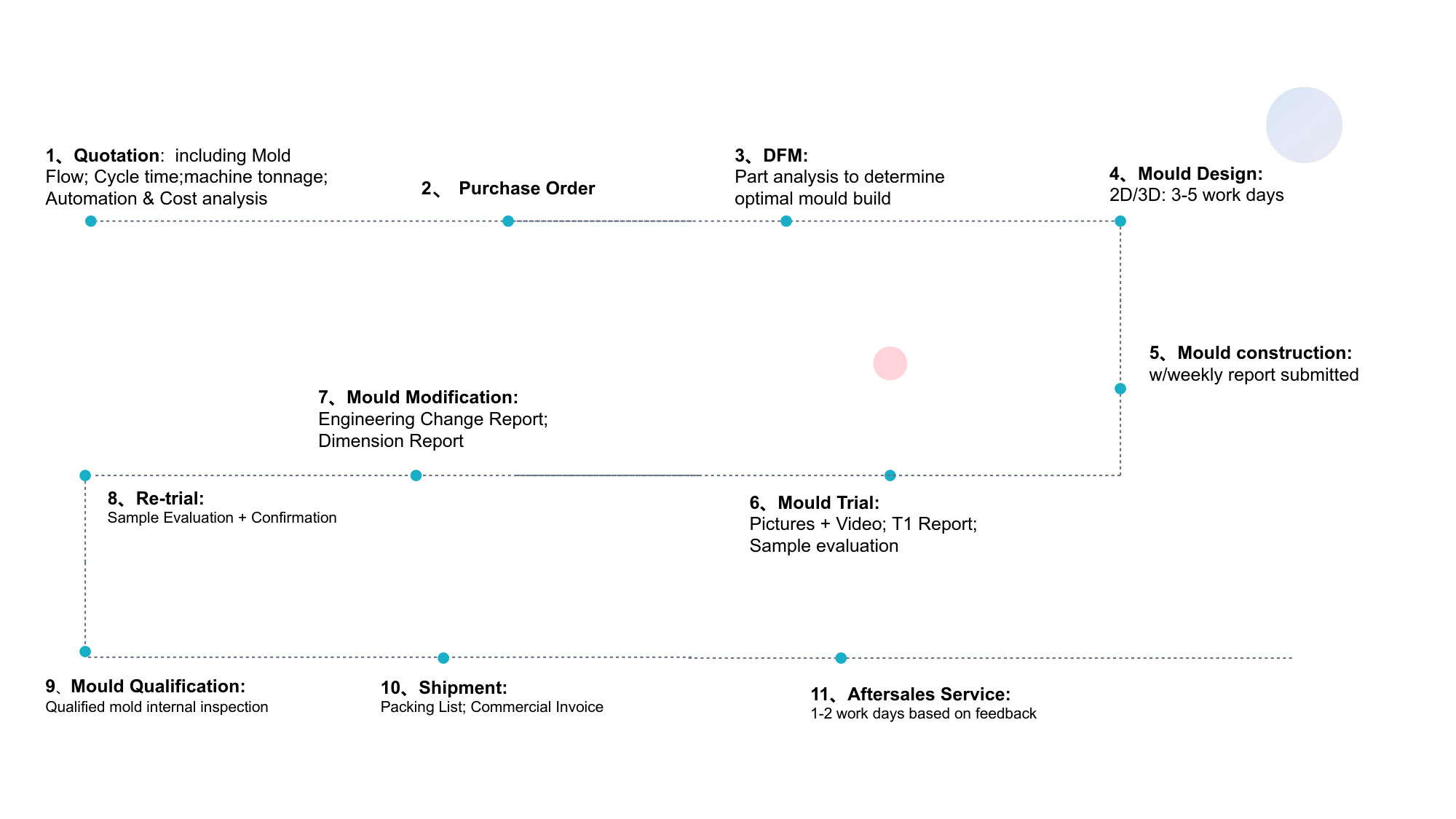
4.1 Early Intervention – DFM (Design for Manufacturability) Reports
Before any contract is signed, Ansix provides a comprehensive Mold Feasibility Analysis Report covering:
Draft angle recommendations for optimal demolding
Wall thickness optimization for balanced filling and reduced shrinkage
Gate location recommendations based on mold flow analysis
Ejector pin mark location and allowable areas
Potential manufacturing risks and mitigation strategies
Customer Value: Problems are identified and solved before steel is cut, preventing expensive design changes after the mold is already in production.
4.2 Trial Molding and Sampling
T0 to T3 Trial Runs: Ansix provides samples from T0 (first trial), T1 (first modification), T2 (second modification), and T3 (final validation). Each trial is accompanied by a detailed improvement report documenting:
Dimensional measurement results
Defect analysis and root cause identification
Corrective actions taken
Recommendations for further optimization
Quick-Change Insert Capability: Ansix designs molds with interchangeable inserts, allowing different design variations to be validated without building an entirely new mold—saving both time and cost.
4.3 Small-Batch Validation
Before committing to full-scale mass production, Ansix offers 100–500 shot pilot runs to:
Verify production yield and defect rates
Calculate process capability indices (CPK)
Confirm dimensional stability across the run
Validate that the mold performs as designed under actual production conditions
Only after CPK confirmation does mass production commence.
4.4 Maintenance and Spare Parts
Spare Parts Kit: Wear components (ejector pins, core pins, inserts) are delivered with the mold, enabling on-site maintenance without waiting for replacement parts to be manufactured.
Scheduled Maintenance: Ansix provides maintenance services every 200,000 shots, extending mold life and preventing unexpected downtime.
Lifetime Repair: Mold repairs are provided at cost for the lifetime of the tool—no hidden markups, no surprise charges.
In-House Repair Capability: Ansix maintains its own electrode machining center and EDM workshop, meaning mold repairs are performed in-house without outsourcing delays. Standard weld repairs and insert replacements are completed within 24 hours.
Part Five: Differentiated Value Proposition – Direct Answers to Common Customer Pain Points
Common Customer Complaint Ansix's Commitment
"Molds need frequent repairs, disrupting production schedules." Ansix performs 2,000-shot accelerated wear testing before delivery and provides a comprehensive wear report. Three-year structural warranty on the mold (excluding normal wear of consumable components).
"Excessive flash means high post-processing costs." Parting line fit machined to 0.005mm precision. Self-locking clamp force compensation ensures flash ≤ 0.03mm per batch—eliminating manual deburring.
"Dimensions vary from batch to batch." Ultrasonic wall thickness sensors with real-time feedback and automatic holding pressure compensation. In-mold temperature and pressure sensors enable closed-loop process control.
"Mold repair takes too long." In-house electrode machining and EDM workshop. Standard repairs completed within 24 hours—no outsourcing delays.
"Weld lines cause fitting failures under pressure." CAE mold flow analysis pre-identifies weld line locations. Gate placement optimized to minimize weld line length and severity.
"Internal voids in thick-wall sections compromise pressure rating." Optimized cooling and packing profiles prevent void formation in wall sections ≥ 3mm.
Customer Value Summary: What Ansix Delivers
What Problems Does Ansix Solve?
Design-to-Manufacturing Gaps: DFM reports identify manufacturability issues before tooling begins.
Production Inefficiency: Multi-cavity molds and hot runner systems maximize output per machine hour.
Quality Inconsistency: MES-locked parameters and closed-loop control ensure every shot meets specifications.
High Post-Processing Costs: Minimal flash (≤0.03mm) eliminates deburring operations.
Unpredictable Mold Life: Material selection and heat treatment guarantee 500,000–1,000,000 shots.
Long Repair Lead Times: In-house repair capability restores production within 24 hours.
How Does Ansix Reduce Costs?
Cost Category Savings Mechanism
Material costs Hot runner systems eliminate cold runner waste
Labor costs Multi-cavity molds increase parts per cycle; automation reduces manual intervention
Post-processing costs Flash ≤0.03mm eliminates manual deburring
Scrap/rework costs CPK ≥1.33 ensures consistent quality, reducing rejects
Maintenance costs Spare parts kit included; lifetime repairs at cost
Inventory costs Fast lead times (10–45 days) enable just-in-time delivery
How Does Ansix Ensure Quality Validation?
DFM phase: Mold feasibility analysis
Design phase: CAE mold flow analysis
Manufacturing phase: In-process inspection with CMM and optical inspection
Trial phase: T0–T3 samples with improvement reports
Validation phase: 100–500 shot pilot runs with CPK calculation
Production phase: First-article/last-article inspection; MES parameter locking
Final phase: Full dimensional report with CPK ≥1.33 before shipment
How Does Ansix Improve Production Capacity and Ensure Delivery?
Equipment scale: 30–4,000 ton injection molding machines cover all product sizes
Process efficiency: All-servo electric drives with ±0.1% repeatability
Mold design: Multi-cavity and stack molds double or triple output
In-house capability: All manufacturing processes under one roof—no outsourcing delays
Inventory strategy: Spare parts delivered with mold; scheduled maintenance prevents unplanned downtime
Lead time commitment: 10–45 days standard; expedited options available
The Ansix Philosophy: "A Mold Is Not a Block of Steel—It's a Money Printer"
"For us, a mold is not just a block of steel—it is a money printer. When we design a mold, we simultaneously plan the injection molding process: flow balance, venting paths, temperature equilibrium. Our goal is that when the mold reaches your production line, it is ready to run—no debugging, minimal flash, maximum lifespan. We invite you to experience a full DFM report walk-through on an existing product. You will see firsthand how we proactively solve weld line, air trap, and shrinkage risks before they ever become problems on your production floor."
Appendix: Key Technical Specifications
PPR Material Properties
Property Value
Melt temperature 220–240°C
Injection pressure 80–120 bar
Cooling time 30–60 seconds
Screw speed 50–80 rpm
Shrinkage Significant; anisotropic—requires compensation in mold design
Service temperature Up to 95°C (hot water applications)
Industry Standards Compliance
ISO 15874: PPR piping systems for hot and cold water
ISO 9001:2015: Quality management systems
ISO 14001:2015: Environmental management systems
DIN / ASTM: Applicable dimensional and performance standards
Mold Steel Material Equivalents
Material Type Application
S136 Stainless mold steel Corrosion-resistant, high-gloss cavities
2344 / H13 Hot-work tool steel Cavities, cores, sliders
8407 Advanced hot-work steel High-wear applications
SKD61 Japanese equivalent to H13 Core pins, inserts
P20 Pre-hardened mold steel Mold bases
NAK80 Pre-hardened steel High-gloss, mirror-finish applications
DC53 Cold-work tool steel Specialized wear applications
This document represents Ansix Tech's comprehensive capability statement for PPR Tee Fitting Mold design, manufacturing, and injection molding services. With 28 years of industry experience, Ansix combines technical excellence with a customer-first philosophy to deliver molds that maximize production efficiency, minimize operational costs, and ensure consistent quality over millions of cycles.
Ansix Tech Co Ltd
If you have any plans related to PPR Tee Fitting Mold , you can contact us at any time. We will turn your ideas into reality, let you realize your dreams, and obtain large orders from the market. Our contact information is info@ansixtech.com. Or contact our CTO, mail: stephen@ansixtech.com
#www.ansixtech.com #ansixtech.com #PPR Tee Fitting Mold #Concrete pump truck elbow #PPR Tee Fitting Mold Mold injection mold companies #Ansix #Ansix moulds #Ansix china #Ansix tech china #Ansix tech company #Ansix facotry #PPR Tee Fitting Mold injection molding #PPR Tee Fitting Mold injection tools #PPR Tee Fitting Mold injection moulds #PPR Tee Fitting Mold plastic mould #PPR Tee Fitting Mold plastic tools #Ansix Tech #Ansix molds #Ansix injection molding #Ansix mold factory #PPR Tee Fitting Mold injection molding Customized #Ansix mold factory #PPR Tee Fitting Mold china #PPR Tee Fitting Mold molds #injection factory for PPR Tee Fitting Mold #PPR Tee Fitting Mold injection molding #PPR Tee Fitting Mold injection molding factory #injection molding company #PPR Tee Fitting Mold injection mold companies #PPR Tee Fitting Mold Tooling #PPR Tee Fitting Mold mold limited #Ansix mold china #Ansix companies for PPR Tee Fitting Mold #Ansix company China #PPR Tee Fitting Mold facotry #Ansix Tech #Ansix Tech mould #PPR Tee Fitting Mold injection moulding #PPR Tee Fitting Mold injection moulding company #Ansix PPR Tee Fitting Mold parts injection mold companies #PPR Tee Fitting Mold injection molding companies china #PPR Tee Fitting Mold china factory #Ansix moulding companies #Ansix molding company #PPR Tee Fitting Mold injection moulding facotry #Ansix Tech mold #PPR Tee Fitting Mold mould #PPR Tee Fitting Mold plastic injection molding #ansix plastic mold #PPR Tee Fitting Mold Mold manufacturing #PPR Tee Fitting Mold parts manufacturing #PPR Tee Fitting Mold plastic parts factory #PPR Tee Fitting Mold injection parts mold #PPR Tee Fitting Mold PRECISION MANUFACTURING #PPR Tee Fitting Mold TOOL #China PPR Tee Fitting Mold mold #Concrete pump truck elbow injection moulding china #PPR Tee Fitting Mold mould china #china precision mold #Concrete pump truck elbow mold in china #PPR Tee Fitting Mold mold china #PPR Tee Fitting Mold Precision molds #High-precision molds #PPR Tee Fitting Mold High-precision tool #Injection molds #PPR Tee Fitting MoldFactory #PPR Tee Fitting MoldCompany #Super Large Injection Mold Factory #Large Tonnage Injection Molding Factory #PPR Tee Fitting MoldCompany #PPR Tee Fitting MoldFactory #2800T Injection Molding Factory #3000 Ton Injection Molding #4500 Ton Injection Molding Factory #PPR Tee Fitting Mold Large Mold Injection Molding #Large Plastic Mold Injection Molding Factory #PPR Tee Fitting Mold Large Injection Mold Manufacturer #PPR Tee Fitting Mold Plastic Mold Factory #Injection Mold #Plastic Mold