
 Medical Molds
 Packaging Molds
 Personal Care Molds
 Electronic Molds
 Automotive Molds
 Home Appliance Molds
 Special Molds
 Design & Engineering
 Production & Manufacturing
 Global Presence
 Business Scope
 Component Solutions
 Product Assembly
 Quality Management
 Medical Device Manufacturing



Pressurized column mold
FEATURES
The Hard Capabilities Foundation—Equipment That Delivers Results, Not Just Specifications
Before customers entrust their critical components to a manufacturing partner, they need confidence in the infrastructure that will produce them. Ansix Tech’s equipment foundation is engineered to deliver measurable outcomes in production, not merely impressive specifications on a capability sheet.
1.1 Mold Machining Equipment: Precision That Translates to Part Quality
Ansix Tech operates 5-axis high-speed machining centers capable of achieving ±0.002mm accuracy on critical mold features. This level of precision is not an abstract metric—it directly determines the quality of the parts that emerge from the mold. When a mold’s parting lines are machined to this tolerance, the resulting plastic components require minimal to no secondary finishing. Burrs, flash, and visible parting line defects are eliminated at the source, reducing labor costs and improving production yield.
The company’s wire EDM equipment enables machining of micro-features down to 0.03mm for narrow slots and thin-wall applications. For pressurized column components where wall thicknesses may range from 0.4mm to 0.8mm, this capability prevents deformation during the machining process, preserving the delicate design geometry that determines the component’s functional performance. In applications where internal flow characteristics or optical clarity are critical, the integrity of thin walls is not negotiable.
For complex three-dimensional geometries—such as the internal cooling channels, gas pathways, and ejection mechanisms required in pressurized column molds—Ansix Tech combines CNC milling with fine-grain graphite electrode EDM to achieve the required surface finish without compromising intricate geometry. This hybrid approach ensures that features which would be impossible to machine with conventional cutting tools are produced with the same precision as more accessible surfaces.
-
Mold Description
Product Materials:
PC
Mold Material:
S136ESR
Number of Cavities:
2+2
Glue Feeding Method:
Hot runner
Cooling Method:
Water cooling
Molding Cycle
42.5s
- The mold manufacturing process and product material selection
Injection Molding Machine Fleet: Scale and Consistency
Ansix Tech operates 260 injection molding machines with clamping forces ranging from 30 tons to 2800 tons. This range covers the full spectrum of pressurized column component sizes, from small precision internal structural components weighing a few grams to large structural assemblies requiring substantial mold mass and injection pressure.
The machine fleet includes equipment from leading global manufacturers: Japan’s Fanuc, Sumitomo, Toshiba, and Nissei; Germany’s Engel and Arburg (specializing in liquid silicone and two-component molding); and China’s Haitian and Victor Taichung. This diverse equipment portfolio allows Ansix Tech to match the optimal machine to each project’s specific requirements—whether the priority is energy efficiency, precision repeatability, or specialized material processing.
Critically, the company emphasizes all-servo motor drive systems with stable repeatability of ±0.1%. In mass production, this consistency means that every shot is identical. For pressurized column components where internal dimensional tolerances directly affect fluid dynamics or structural integrity, shot-to-shot consistency is not a luxury—it is a requirement for acceptable production yield.
-
Metrology and Quality Assurance: Prevention, Not Detection
Ansix Tech’s quality philosophy is built on prevention rather than detection. Every mold undergoes full dimensional inspection on coordinate measuring machines (CMM) with ±0.5μm accuracy, supplemented by optical imaging systems for non-contact verification of complex geometries.
For pressurized column applications requiring optical clarity or fluid contact surfaces, cavity surface finishes achieve Ra < 0.05μm—an optical-grade finish that ensures both part aesthetics and functional performance. The company provides full dimensional reports for every critical feature with CPK ≥ 1.33, meaning that quality yield exceeds 99.99% on critical dimensions.
This documentation is not merely a formality. For medical device manufacturers requiring traceability or automotive suppliers needing PPAP submission, Ansix Tech delivers complete documentation packages that satisfy regulatory requirements without additional administrative burden. Full traceability from raw material to final inspection ensures compliance with global supply chain standards.
Part Two: The Ansix Tech Integrated Workflow—From Concept to Cost-Effective Mass Production
Ansix Tech’s core competitive advantage lies in its holistic approach to injection molding. Unlike fragmented service providers that handle isolated stages of the manufacturing process, Ansix Tech offers a unified platform encompassing design, engineering, tooling, production, and logistics. This integration eliminates communication gaps, accelerates project timelines, and ensures consistency from concept to delivery.
2.1 Product Design and DFM: Building Manufacturability Into the Design
The journey begins not on the shop floor but in the digital domain. Ansix Tech’s engineers collaborate with clients from the earliest concept stages—a practice known as Early Supplier Involvement (ESI) that embeds manufacturability into product design before expensive design changes become necessary.
Designers employ Design for Manufacturability (DFM) principles to preempt production challenges. By simplifying assemblies through strategies such as reducing part counts and replacing screws with snap-fits, Ansix Tech can lower assembly time by up to 40% and material costs by 5–18%. Modular design strategies further enable customization without sacrificing economies of scale, cutting transport and assembly costs by 30–50%.
For pressurized column components—whether chromatography column hardware, flushing device housings, or structural supports—the DFM process addresses specific manufacturability concerns: draft angles that facilitate ejection without surface damage, uniform wall thickness that prevents warpage and sink marks, and parting line placement that minimizes visible knit lines or structural weaknesses.
2.2 Moldflow Analysis and Simulation-Driven Validation: Testing Before Cutting Steel
Before any metal is cut, Ansix Tech performs comprehensive Moldflow analysis to simulate the entire injection molding process digitally. This simulation-driven approach validates the mold design, predicts potential defects, and optimizes process parameters—all before the first chip of steel is removed.
The Moldflow analysis examines several critical factors:
Filling patterns: The simulation predicts how molten plastic will flow through the mold cavity, identifying potential issues such as unbalanced filling, which can cause warpage, or dead zones where air becomes trapped. For pressurized column components with complex internal geometries, ensuring complete and balanced filling is essential for structural integrity.
Cooling efficiency: Cooling accounts for 70–80% of the total cycle time in injection molding. Ansix Tech’s simulation models the cooling system’s performance, verifying that temperature variation across the mold surface remains within acceptable limits. Uneven cooling is a primary cause of warpage and residual stress—defects that are particularly problematic in precision column components where dimensional stability is critical.
Weld line and air trap prediction: Weld lines occur where flow fronts meet during filling. In pressurized column applications, a weld line in a fluid pathway or structural load-bearing region is unacceptable. By virtually adjusting injection point locations, runner diameters, and filling profiles, Ansix Tech eliminates these risks at the design stage rather than discovering them during physical trials.
Ansix Tech’s simulation capabilities extend beyond standard Moldflow analysis. The company integrates ANSYS structural simulation to model how the mold itself deforms under high injection pressure. This dual-software approach enables pre-correction before any metal is machined, delivering what the company describes as “more realistic and reliable” simulation results that de-risk projects upfront.
2.3 Strategic Material Selection: Balancing Performance and Economics
Material selection is a two-level decision that directly impacts both performance and cost. Ansix Tech’s material engineers evaluate candidates against rigorous criteria, often recommending alternatives that meet all performance specifications while offering more favorable cost profiles.
For plastic components, the choice depends on the specific demands of the pressurized column application:
PPSU (Polyphenylsulfone) is recommended for internal components and fluid-contact parts requiring chemical resistance and long-term stability. Its hydrolysis stability allows continuous water contact without degradation, and it withstands repeated exposure to cleaning agents. PPSU offers tensile strength of 15–35 MPa, excellent impact resistance, and continuous service temperature up to 260°C.
Glass-fiber reinforced PP is employed for structural members and less critical components, offering an excellent balance of stiffness, dimensional stability (shrinkage of 0.2–0.8%), and low cost. This hybrid material strategy ensures that expensive high-performance resins are used only where essential, directly contributing to bill-of-materials cost reduction.
PC/ABS blends are selected for applications requiring high impact strength, heat resistance, and aesthetic surface quality—common in visible column components or housings.
For mold steel, Ansix Tech balances hardness, polishability, and cost against production volume and material abrasiveness:
P20 or 718H pre-hardened steels (30–35 HRC) offer excellent polishability and sufficient toughness for medium-volume production. For mirror-finish requirements, P20-type steels provide the necessary surface quality without the premium cost of stainless grades.
H13 tool steel is specified for high-volume production where thermal fatigue resistance and toughness are paramount.
S136 stainless steel is selected for corrosive environments or when processing materials that release corrosive gases, ensuring long-term dimensional stability and surface integrity.
2.4 Precision Mold Manufacturing: From Digital Design to Physical Tooling
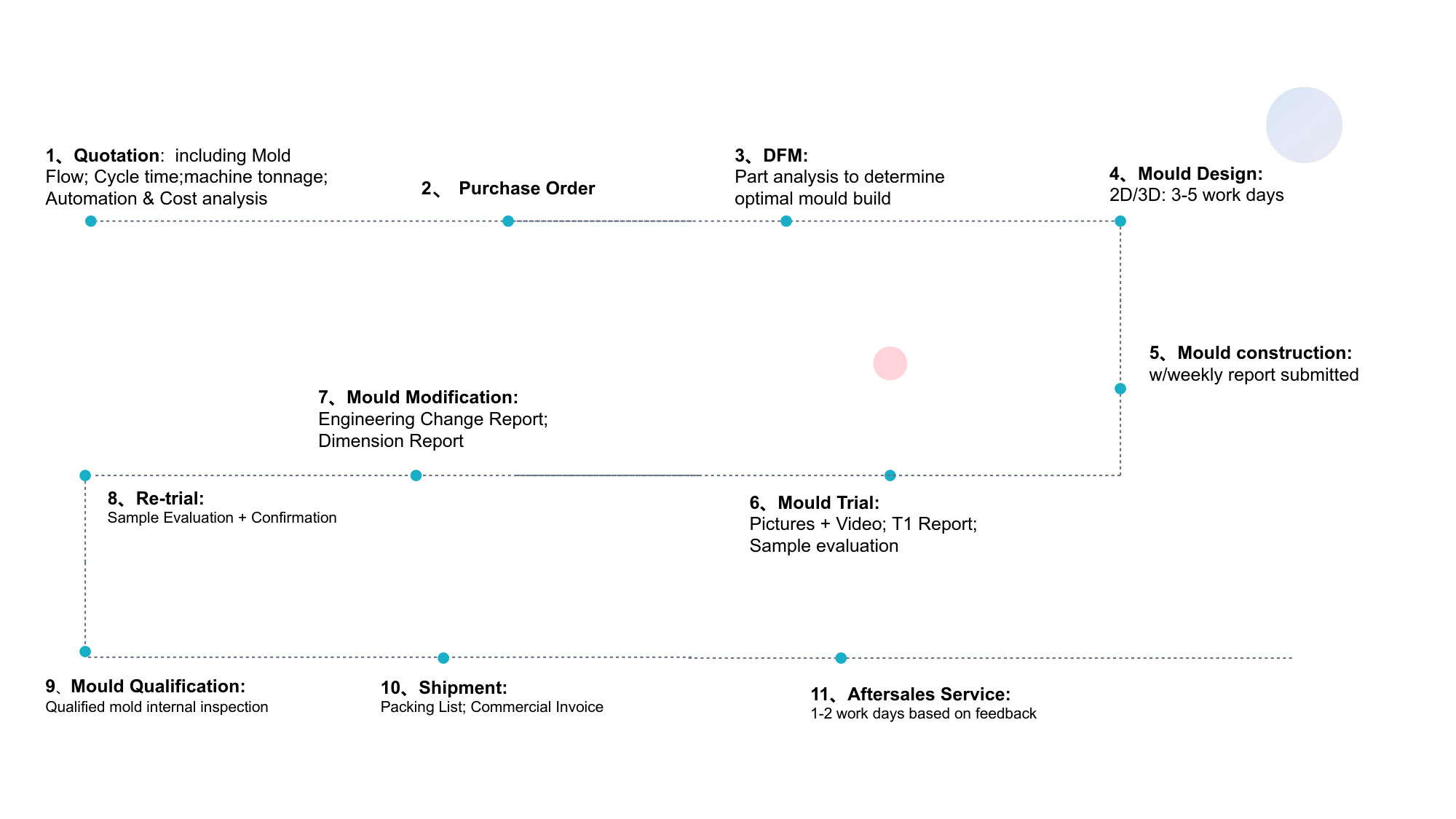
The transformation of a digital design into a physical mold with remarkable precision is where Ansix Tech’s machining expertise becomes tangible. The process follows a disciplined sequence: mold base assembly, shrinkage tolerance calculation, parting surface definition, and extraction of core and cavity components.
Machining and finishing: 5-axis CNC machining centers perform roughing and finishing operations on hardened steel blocks, followed by EDM for intricate details, deep ribs, and sharp corners impossible to achieve with cutting tools alone. Surface polishing then achieves the microscopic smoothness required for optimal part ejection and surface aesthetics.
Cooling system integration: Cooling channels—often drilled using specialized deep-hole drilling equipment—are fitted with baffles and bubblers to precisely direct water flow. For pressurized column molds where cycle time and dimensional consistency are critical, Ansix Tech designs conformal cooling channels that follow the contour of the mold cavity as closely as possible. This approach, validated through thermal simulation, extracts heat uniformly and can reduce cycle time by up to 40% compared to conventional cooling systems.
Ejection system design: For pressurized column components, which are often larger and thinner-walled than conventional solid parts, ejection presents unique challenges. The part is vulnerable to deformation if ejection forces are not perfectly balanced. Ansix Tech employs a combination of hydraulic ejectors, pneumatic air cushions, and telescopic sleeves on core pins. The ejection system is precisely timed; air cushions release vacuum pressure before ejector pins contact the part, ensuring that delicate internal features are not crushed or damaged.
2.5 New Product Introduction and Process Optimization
With the mold mounted on a precision injection molding machine, Ansix Tech’s process engineers conduct Design of Experiments (DoE) during qualification runs to identify optimal settings for injection speed, packing pressure, melt temperature, and cooling time. The objective is to reduce cycle time without compromising part quality.
Real-time process monitoring and Statistical Process Control (SPC) enable detection of deviations before they produce defects. By monitoring cavity pressure, melt temperature, and part weight on every shot, Ansix Tech maintains process consistency that reduces scrap rates to less than 0.5% in demanding applications.
For pressurized column components with thick sections—where volumetric shrinkage is a concern—Ansix Tech employs multi-stage strategies: precise temperature control through dual-zone mold temperature systems, optimized injection parameters using relatively high melt temperatures with moderate injection speeds, extended packing phases to compensate for shrinkage, and controlled cooling profiles that minimize thermal gradients.
2.6 Quality Assurance and Documentation
Ansix Tech operates under a comprehensive quality management system certified to ISO 9001:2015, IATF 16949, ISO 13485, and ISO 14001. These certifications are not merely credentials—they represent audited processes that ensure consistency, traceability, and continuous improvement.
Quality control is proactive rather than reactive. The company employs Process Failure Mode and Effects Analysis (PFMEA) and control plans at each production stage, identifying and mitigating potential process errors before they occur. This “first-time-right” approach prioritizes zero defects through scientific quality planning and advanced manufacturing analysis.
Every mold ships with a comprehensive documentation package that enables any qualified injection molding facility worldwide to mount, set up, and produce good parts within a single shift. The package includes process setup sheets, spare parts lists with part numbers and material grades, and preventive maintenance schedules.
Part Three: The Pressurized Column Mold Advantage—Manufacturing Solutions That Deliver
3.1 Understanding the Pressurized Column Mold Challenge
Pressurized column components present a unique set of manufacturing challenges that demand specialized expertise. Whether the application involves chromatography column hardware for analytical chemistry, pressurized flushing devices for sanitation systems, or light guide columns for automotive lighting, the common thread is the need for precision internal geometries, material purity, and structural integrity under pressure.
In chromatography applications, the column body must be chemically inert, mechanically strong enough to withstand pressures exceeding 600 bar, and manufactured to tolerances that ensure consistent flow and peak separation performance. Any imperfection from the molding process—residual stress, contamination, or dimensional deviation—can cause column failure, compromise analytical data, and result in costly downtime for laboratories and production lines.
For pressurized flushing devices in sanitation systems, the balance between durability, performance, and cost is equally critical. Components must resist chemical and mechanical stress while maintaining reliable fluid behavior and competitive manufacturing costs.
3.2 Ansix Tech’s Pressurized Column Mold Capabilities
Front-Loaded Design and Digital Validation: The manufacturing journey begins in the digital realm. Ansix Tech’s engineers execute a “design inversion” process to create the negative space of the final part, defining the mold cavity with meticulous attention to avoiding dead volumes that cause filling defects. Venting channels are strategically placed at flow path extremities to release trapped air and ensure complete cavity filling.
Advanced Flow Simulation: Using sophisticated software such as Moldex3D Flow, engineers simulate the entire injection process. The analysis predicts melt flow patterns and identifies potential defects including weld lines (which cause structural weaknesses), air traps (causing burns or voids), and irregular filling. For a chromatography column, a weld line in the fluidic circuit is unacceptable—by virtually adjusting injection point locations, runner diameters, and filling profiles, these risks are eliminated at the design stage.
Cooling System Simulation: Conformal cooling channels that follow the mold cavity contour are designed and simulated to ensure uniform, rapid heat extraction. The simulation verifies that mold surface temperature varies by less than a few degrees—essential for minimizing part warpage and residual stress in the final column housing.
Strategic Material Selection: For chromatography column bodies requiring chemical inertness and resistance to sterilization, Ansix Tech evaluates high-performance polymers such as PEEK alongside more economical semi-crystalline polymers with glass fiber reinforcement. The expertise lies in selecting the most cost-effective grade that meets all specifications, scrutinizing material property data including tensile strength, elongation at break, and coefficient of friction.
Precision Mold Steel Selection: For column molds requiring mirror finish to facilitate part ejection and prevent contamination, high-quality polished corrosion-resistant stainless steel such as SS420 or SS440C is typically selected. Its exceptional hardness ensures geometric precision and surface quality through hundreds of thousands of cycles, amortizing the initial cost over large-scale production.
Part Four: Competitive Advantages—Cost Control, Delivery Efficiency, and After-Sales Support
4.1 Cost Control Through Engineering
Ansix Tech’s approach to cost control is not about cutting corners—it is about systematic cost engineering that identifies inefficiencies and eliminates them through design, material, and process optimization.
Material cost reduction is achieved through hybrid material strategies, strategic grade selection, and multi-cavitation design. One documented customer engagement reduced piece-part cost by 23% through Ansix-led VAVE (Value Analysis/Value Engineering) analysis without functional compromise.
Cycle time reduction directly reduces per-part cost. Conformal cooling, optimized gating, and process parameter optimization can reduce cycle times by 15–40% depending on part geometry and material.
Waste reduction through scientific mold design minimizes scrap rates. Venting optimization, balanced filling, and SPC-based process control ensure that production yield remains consistently high.
4.2 Delivery Efficiency
Ansix Tech offers minimum delivery periods of 3–4 weeks for many mold projects, enabled by integrated design-manufacturing workflows, parallel processing, and automated machining capabilities. The company’s automated machining ratio of 70% ensures consistent quality while reducing lead times.
Rapid prototyping techniques—including SLA mold inserts for initial validation—allow customers to test parts in days rather than weeks, reducing tooling delivery times by at least 50% in some applications.
4.3 After-Sales Service and Lifetime Support
Ansix Tech delivers comprehensive after-sales support designed to minimize customer downtime risk:
Spare-parts package with every mold delivery: Each mold ships with a pre-packaged spare-parts kit covering all standard wear components—ejector pins, core pins, small cavitated inserts, wear plates, slide gibs, and return pins. All spare parts are machined to the same material and dimensional specifications as originals, eliminating emergency shipping costs and rush-order minimums.
Scheduled preventive maintenance at 200,000-cycle intervals: Complete teardown and ultrasonic cleaning, wear measurement and documentation on all sliding surfaces, replacement of worn components as needed, re-polishing of cosmetic cavity surfaces, lubrication of moving components, cooling channel flushing, and full dimensional inspection to confirm original tolerances.
Lifetime cost-recovery repairs: For molds damaged beyond scheduled maintenance, Ansix Tech performs repairs at direct workshop cost plus modest overhead, rather than standard mold-building labor rates. Catastrophic mold damage does not mean catastrophic expense.
Conclusion: Engineering Partnership, Not Vendor Relationship
Ansix Tech’s success in the pressurized column mold segment stems from a fundamental understanding: customers are not purchasing molds or molded parts. They are purchasing production reliability, cost predictability, and peace of mind.
By integrating design, simulation, material science, precision manufacturing, and quality assurance into a seamless workflow, Ansix Tech transforms technical challenges into tangible customer value. The company’s “zero-surprise” methodology—simulating, validating, and optimizing every aspect of the manufacturing process before any steel is cut—de-risks projects and accelerates time-to-market.
With over 28 years of experience, four production bases across China and Vietnam, and a commitment to continuous innovation, Ansix Tech stands as a true engineering partner for companies seeking to manufacture pressurized column components that meet the most demanding performance, quality, and cost requirements.
Ansix Tech Co Ltd
If you have any plans related to Pressurized column mold , you can contact us at any time. We will turn your ideas into reality, let you realize your dreams, and obtain large orders from the market. Our contact information is info@ansixtech.com. Or contact our CTO, mail: stephen@ansixtech.com
#www.ansixtech.com #ansixtech.com #Pressurized column mold #Mold for automotive daytime running light guide strip #Pressurized column mold injection mold companies #Ansix #Ansix moulds #Ansix china #Ansix tech china #Ansix tech company #Ansix facotry #Ansix Tooling #Ansix tool #Pressurized column mold injection molding #Pressurized column mold injection tools #Pressurized column mold injection moulds #Ansix moulding company #Ansix molding #ansix tooling #Pressurized column mold plastic mould #Pressurized column mold plastic tools #Ansix Tech #Ansix molds #Ansix injection molding #Ansix mold factory #Pressurized column mold injection molding Customized #Ansix mold factory #Pressurized column mold china #Pressurized column mold molds #injection factory for Pressurized column mold #Pressurized column mold injection molding #Pressurized column mold injection molding factory #injection molding company #Pressurized column mold injection mold companies #Mold for automotive daytime running light guide strip #Pressurized column mold mold limited #Ansix mold china #Ansix companies for Pressurized column mold #Ansix company China #Pressurized column mold facotry #Ansix Tech #Ansix Tech mould #Pressurized column mold injection moulding #Pressurized column mold injection moulding company #Ansix Pressurized column mold parts injection mold companies #Pressurized column mold injection molding companies china #Pressurized column mold china factory #Ansix moulding companies #Ansix molding company #Pressurized column mold injection moulding facotry #Ansix Tech mold #Pressurized column mold mould #Pressurized column mold plastic injection molding #ansix plastic mold #Pressurized column mold Mold manufacturing #Pressurized column mold parts manufacturing #Pressurized column mold plastic parts factory #Pressurized column mold injection parts mold #Pressurized column mold PRECISION MANUFACTURING #Pressurized column mold TOOL #China Pressurized column mold mold #Pressurized column mold injection moulding china #Pressurized column mold mould china #china precision mold #Pressurized column mold mold in china #Pressurized column mold mold china #Pressurized column mold Precision molds #High-precision molds #Pressurized column mold High-precision tool #Injection molds #Pressurized column moldFactory #Pressurized column moldCompany #Super Large Injection Mold Factory #Large Tonnage Injection Molding Factory #Pressurized column mold Company #Pressurized column mold Factory #2800T Injection Molding Factory #3000 Ton Injection Molding #4500 Ton Injection Molding Factory #Pressurized column mold Large Mold Injection Molding #Large Plastic Mold Injection Molding Factory #Pressurized column mold Large Injection Mold Manufacturer #Pressurized column mold Plastic Mold Factory #Injection Mold #Plastic Mold