
 Medical Molds
 Packaging Molds
 Personal Care Molds
 Electronic Molds
 Automotive Molds
 Home Appliance Molds
 Special Molds
 Design & Engineering
 Production & Manufacturing
 Global Presence
 Business Scope
 Component Solutions
 Product Assembly
 Quality Management
 Medical Device Manufacturing



Professional manufacturer of carbon fiber materials and molds for badminton rackets
FEATURES
The Foundation: Why Ansix Is Trusted as a Professional Manufacturer
Ansix’s credibility in the badminton racket mold sector rests on a manufacturing infrastructure that few competitors in this specialized field can match. The company operates four production bases across China and Vietnam, encompassing over 200,000 square meters of manufacturing space and employing more than 1,200 personnel. With 260 injection molding machines ranging from 30 tons to 2,800 tons, Ansix possesses the tonnage flexibility to handle everything from small precision inserts to large structural housings. The machine fleet includes Japanese Fanuc, Sumitomo, Toshiba, Nissei, and Engel presses alongside German Arburg systems for specialized liquid silicone and two-component molding, complemented by Haitian and Victor Taichung machines for high-volume production.
For badminton racket molds specifically, this equipment breadth matters because the mold itself is often a complex assembly of hardened steel inserts, conformal cooling channels, and precision ejection systems. The ability to machine these components in-house—rather than outsourcing to third-party tool rooms—gives Ansix direct control over lead times and quality consistency. The company reports having produced over 30,000 molds since its founding, with mold machining tolerances reaching ±0.002 mm and an average trial cycle count of just two iterations before production approval. These metrics are not merely marketing claims; they reflect a process discipline that has been audited and certified under ISO9001, IATF16949, ISO13485, and ISO14001.
1.3 The Core Differentiator: Technical Innovation in Carbon Fiber and ETFE Racket Molding
What separates Ansix from generic mold makers is its demonstrated capability to process the advanced materials that modern badminton rackets demand. In December 2025, Ansix announced what it describes as the world’s first viable injection molding process for carbon fiber-reinforced ETFE badminton racket frames. This is not an incremental improvement. ETFE (ethylene tetrafluoroethylene) is notoriously difficult to process because its high viscosity, when compounded with carbon fiber reinforcement, resists flow into thin-walled sections. Carbon fibers themselves are abrasive, causing rapid wear on screws, barrels, and mold surfaces. And the fibers tend to break during plasticization, degrading the mechanical properties that make them valuable in the first place.
Ansix’s engineering response to these challenges illustrates its approach to customer problems. The company developed specialized screw designs that provide optimal shear mixing without excessively fracturing fibers. It implemented precise temperature control along the material flow path to maintain viscosity within a narrow processing window. The mold surfaces received advanced treatments to reduce flow resistance while preserving proper venting. Perhaps most critically, Ansix engineers learned to control fiber orientation through strategic gate placement and flow path design, aligning fibers along primary stress paths to create what amounts to an engineered reinforcement structure within the racket frame.
The business impact of this technical achievement is substantial. Traditional thermoset composite racket manufacturing involves prepreg layup and autoclave curing with cycle times exceeding 60 minutes. Ansix’s injection molding process reduces cycle time to 2–3 minutes. For a customer producing tens of thousands of rackets annually, this difference transforms the unit economics of the entire program. Material waste is dramatically reduced because injection molding is a near-net-shape process, and ETFE is fully recyclable, addressing the growing sustainability concerns in sporting goods manufacturing.
-
Mold Description
Product Materials:
CF
Mold Material:
S136ESR
Number of Cavities:
1
Glue Feeding Method:
Hot runner
Cooling Method:
Water cooling
Molding Cycle
42.5s
- The mold manufacturing process and product material selection
The Service Architecture: From Concept to After-Sales
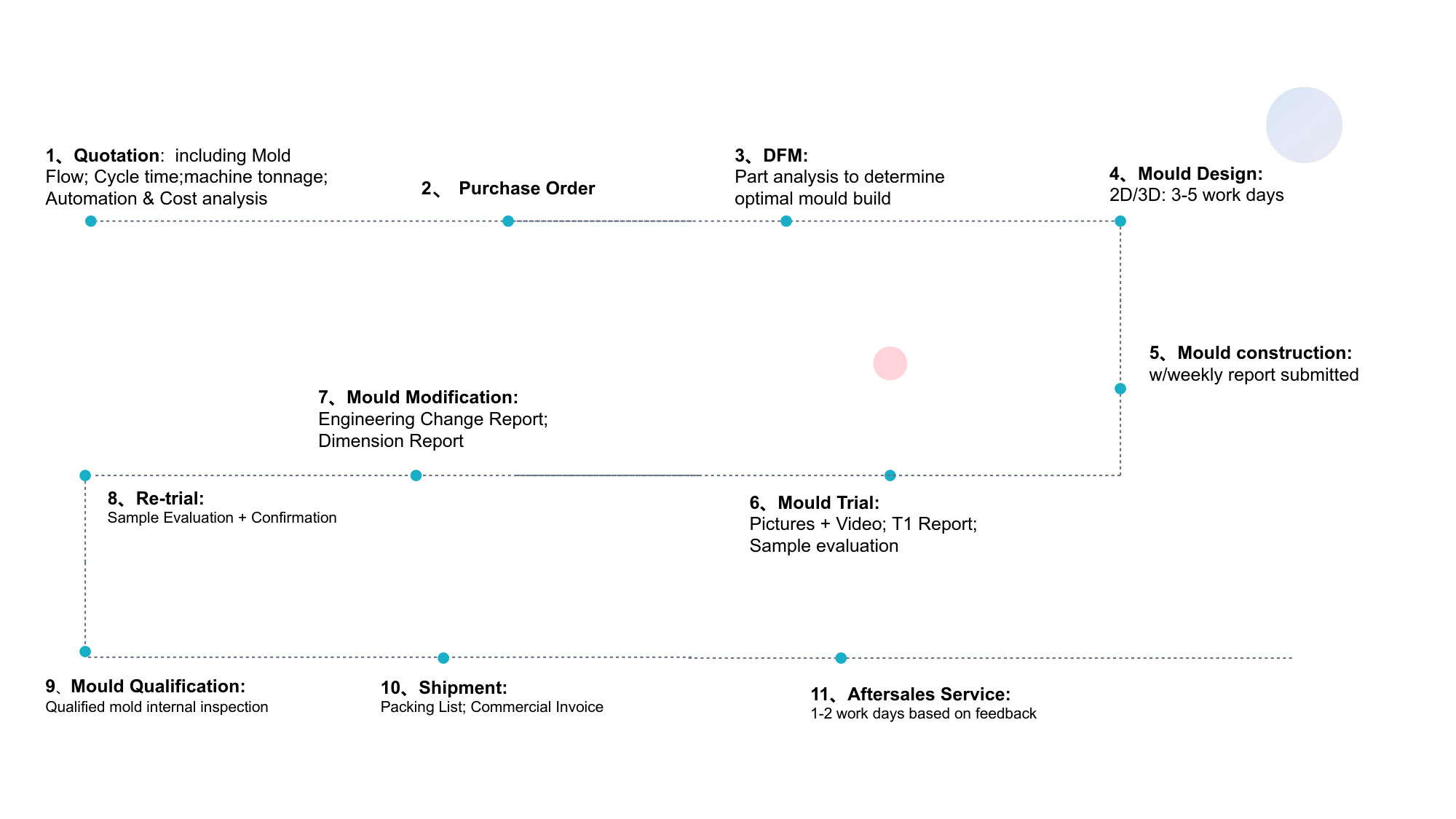
Ansix’s claim to customer satisfaction is not built on mold manufacturing alone. The company offers an integrated service chain that begins before a single piece of steel is cut and extends through the entire product lifecycle.
Design and Development, DFM, and Moldflow Analysis. When a customer approaches Ansix with a badminton racket concept—whether a specific frame geometry, weight distribution target, or stiffness profile—the engineering team begins with a manufacturability review. This is not a cursory check. The DFM process identifies potential issues such as inadequate wall thickness transitions, problematic gate locations that could create weld lines in high-stress regions, and cooling channel layouts that might produce differential shrinkage and frame distortion. Moldflow simulation then models the filling, packing, and cooling phases to predict fiber orientation, potential short shots, and warpage before any tooling is committed.
For carbon fiber-filled materials, this simulation step is particularly valuable because the flow behavior of fiber-reinforced polymers is far more complex than that of unfilled resins. The fiber orientation tensor must be tracked through the flow field, and the resulting anisotropic mechanical properties must be evaluated against the racket’s structural requirements. Ansix’s experience in this domain, accumulated across automotive, medical, and consumer electronics projects, provides a knowledge base that pure sporting goods molders often lack.
Mold Manufacturing and Process Validation. Once the design is validated, mold manufacturing proceeds through a documented workflow: CNC roughing, EDM for fine features, high-speed machining for finish passes, and CMM inspection at each stage. For badminton racket molds, the critical dimensions include the frame cavity geometry, the gate vestige allowance (which affects string clearance), and the ejection system balance to prevent frame distortion during part removal. Ansix’s transparent T0–T3 validation protocol provides customers with full dimensional reports at each stage. At T0, basic functionality is confirmed. T1 involves process parameter optimization based on T0 findings. T2 is an extended cycle run to verify process stability. T3 demonstrates production at target cycle time with CPK ≥ 1.33 across all critical dimensions. This structured approach eliminates the guesswork that plagues many mold development projects.
NPI Process Planning and Pilot Runs. Before full-scale production, Ansix conducts pilot runs of 100–500 shots. During this phase, actual production cycle time, CPK stability, and process capability are documented. The company’s internal analysis suggests that a pilot run costing $2,000–5,000 can identify process issues that, if discovered during full production, might result in $50,000–100,000 in scrap and rework. For badminton rackets, where frame distortion or weight variation can render entire batches unusable, this validation step is particularly valuable.
Mass Production, Quality Assurance, and Delivery. Ansix’s production quality system is built around real-time monitoring and statistical process control. For racket frames, critical quality characteristics include frame weight, balance point, shaft stiffness, and dimensional conformance at the throat and handle interfaces. The company’s ISO 8 cleanroom and GMP compliance, while originally established for medical molding, also support sporting goods customers who require documented cleanliness and process control. Delivery logistics leverage the company’s dual-country manufacturing footprint, allowing customers to balance cost optimization (Vietnam production) against supply chain proximity (China production).
-
After-Sales and Lifecycle Support. Ansix’s approach to after-sales service addresses a common pain point in the mold industry: the supplier who disappears after the mold is delivered. The company provides documented spare parts kits with each mold, including high-wear components such as ejector pins and core inserts. Scheduled maintenance is offered at 200,000-cycle intervals, and for molds returned for repair, the in-house EDM and machining resources enable most repair work—welding, insert replacement, and cavity refurbishment—to be completed within 24 hours. For badminton racket programs with multi-year production lives, this lifecycle commitment reduces the risk of unplanned downtime and ensures that the customer’s capital investment in tooling is protected.
1.5 Cost Competitiveness Without Compromise
The question of how Ansix achieves cost competitiveness while maintaining quality is best answered through its approach to material selection and process optimization. In badminton racket molds, the mold steel selection involves a trade-off between initial cost and longevity. Ansix engineers guide customers through this decision: NAK80 pre-hardened stainless steel offers excellent polishability and good wear resistance for core and cavity inserts, making it suitable for moderate production volumes. S136 stainless steel provides superior corrosion resistance for processing polymers that release corrosive gases. H13 hot-work steel is specified for components subjected to high thermal stress. By matching steel grade to production volume and material aggressiveness, Ansix avoids both over-specification (which inflates mold cost) and under-specification (which leads to premature wear and unplanned maintenance).
On the molding side, Ansix’s process optimization directly attacks the largest variable cost in racket production: material. Carbon fiber-reinforced ETFE compound is expensive, and any scrap or rejected parts represent significant financial loss. By using advanced process control systems that monitor cavity pressure in real time, Ansix can consistently produce high-quality parts using lower-cost resin grades or regrind blends without compromising performance. This is not a theoretical capability; it is a production-proven methodology that the company applies across its portfolio.
1.6 Why Customers Recognize Ansix as an Industry Leader
The badminton racket mold market is small enough that reputation matters enormously. Customers in this space—whether established sporting goods brands or emerging direct-to-consumer racket companies—talk to each other. Ansix’s leadership position derives from several reinforcing factors. First, the company has demonstrated a genuine technological first: the ETFE carbon fiber injection molding process is a capability that, to Ansix’s knowledge, no competitor has commercialized. Second, the company’s integrated service model reduces the coordination burden on customers who would otherwise need to manage separate design, tooling, molding, and validation vendors. Third, the ISO certifications and documented quality systems provide the assurance that larger brands require before committing to a supplier. And fourth, the dual-country manufacturing footprint offers supply chain resilience that single-location molders cannot match.
The company’s self-described operating principle—“marketing as the guide, quality for survival, technology for development, service for growth, and mutual benefit as the goal”—reads like a mission statement, but the underlying metrics support it. Over 30,000 molds produced, 260 injection machines, 1,200 employees, and a customer base spanning automotive, medical, consumer electronics, and sporting goods all point to an organization that has moved beyond the startup phase into a mature, systems-driven manufacturer.
Part Two: Product Introduction, Production Process, Delivery Efficiency, Quality Assurance, and After-Sales Advantages of Ansix’s Badminton Racket Injection Molds
2.1 Product Introduction: What a Badminton Racket Injection Mold Entails
A badminton racket injection mold is a precision tooling assembly designed to produce the frame and shaft of a racket from fiber-reinforced thermoplastic materials. Unlike a simple open-and-shut mold for a flat part, a racket mold must form a complex three-dimensional geometry: the oval or isometric head, the tapered shaft, and the handle interface. The mold must accommodate the flow behavior of carbon fiber-filled polymers, manage the thermal gradients that cause warpage in long, thin-walled parts, and provide reliable ejection without distorting the finished frame.
Ansix’s badminton racket molds are engineered around several key subsystems. The cavity and core inserts are machined from hardened tool steels selected for wear resistance against abrasive carbon fibers. The gating system is designed to introduce melt at a location and angle that promotes proper fiber orientation along the shaft and head, avoiding weld lines in high-stress regions. The cooling system incorporates conformal channels—sometimes produced through additive manufacturing—that follow the racket’s contour to ensure uniform cooling and minimize differential shrinkage. The ejection system employs a balanced arrangement of pins and sleeves that apply force evenly across the frame, preventing the bending and twisting that would render a racket unusable.
For customers requiring the highest performance, Ansix offers molds configured for ETFE-carbon fiber composites, a material system that the company has pioneered in injection molding. These molds incorporate specialized surface treatments and venting designs to handle the high viscosity and abrasive nature of the compound, and the gating is optimized to preserve fiber length and orientation.
2.2 Production Process: From Steel to Validated Mold
The production of a badminton racket mold at Ansix follows a disciplined sequence. The process begins with a detailed mold design review that incorporates DFM findings and Moldflow simulation results. Once the design is approved, steel blocks are selected and prepared. Rough CNC milling removes the bulk of material, followed by heat treatment where required. EDM (electrical discharge machining) creates the fine features—gate details, ejection pin holes, and cooling channel intersections—that cannot be achieved through milling alone. High-speed machining produces the final surface finish, and CMM inspection verifies dimensional conformance at each critical stage.
For badminton racket molds specifically, the cavity geometry requires particular attention to surface finish because any imperfection will transfer to the molded frame. The throat area, where the shaft meets the head, is especially critical because it concentrates stress during play. Ansix’s toolmakers use polishing techniques that achieve mirror finishes in flow-critical areas while maintaining the precise radii and transitions that the structural design requires.
Assembly and fitting follow machining. The mold is assembled with its cooling circuits, ejection system, and any necessary side actions or lifters. A trial run on an appropriately sized injection molding machine then begins the validation sequence. T0 confirms basic functionality. Based on the T0 parts and process data, Ansix engineers adjust gate dimensions, cooling parameters, or ejection timing as needed. T1 produces optimized parts with documented CPK data. T2 is an extended run to verify stability. T3 demonstrates production capability at target cycle time. Only after T3 approval does the mold ship to the customer’s production site or remain at Ansix for contract molding.
2.3 Delivery Efficiency: How Ansix Compresses Timelines
Mold delivery speed in the badminton racket sector is a competitive weapon. Brands that can bring a new racket model to market ahead of a major tournament or retail season gain a disproportionate share of attention and sales. Ansix’s delivery efficiency derives from several structural advantages. The in-house machining capability eliminates the queue times that mold makers who outsource EDM or high-speed machining must endure. The four production sites across China and Vietnam provide capacity redundancy; if one facility is fully loaded, work can be reallocated. And the company’s experience with similar projects means that the design and validation phases proceed without the learning-curve delays that afflict toolmakers encountering a new part type for the first time.
The documented T0–T3 protocol, while seemingly adding steps, actually accelerates the overall timeline because it prevents the back-and-forth revisions that occur when problems are discovered late. A mold that passes T3 and ships is a mold that will run at the customer’s site without extended debugging. Ansix’s average trial cycle count of two iterations reflects this efficiency: most molds require only two trial rounds before production approval, compared to industry norms that can stretch to four or five.
2.4 Quality Assurance: Systems, Documentation, and Process Control
Quality assurance at Ansix operates on two levels. The organizational level is governed by the company’s ISO9001, IATF16949, and ISO13485 certifications, which mandate documented procedures for design review, supplier management, process control, and corrective action. These are not merely certificates on a wall; they represent audited systems that customers can review during supplier qualification.
The project level involves specific quality plans tailored to each badminton racket mold. Critical-to-quality characteristics are identified during design review—typically frame weight, balance point, shaft stiffness, and dimensional conformance at the string holes and handle interface. For each CTQ, the quality plan specifies the measurement method, sampling frequency, and acceptance criteria. During trial runs, CMM reports document dimensional conformance, and process capability studies calculate CPK for each CTQ. Production parts are monitored through statistical process control, with control charts tracking key dimensions over time.
For customers requiring the highest level of assurance, Ansix’s ISO 8 cleanroom and GMP compliance provide a controlled environment for molding and post-processing. While badminton rackets do not require the sterility of medical devices, the cleanroom environment does offer benefits in terms of particulate control and process consistency.
2.5 Cost Control: The Least Visible but Most Valued Advantage
Cost control in badminton racket mold manufacturing is not about cutting corners on steel or labor. It is about making engineering decisions that minimize total cost of ownership over the mold’s life. Ansix’s approach to cost control operates across several dimensions.
Mold life optimization. By selecting the appropriate steel grade for the expected production volume and material abrasiveness, Ansix avoids the false economy of a cheap mold that fails prematurely. For a carbon fiber racket program expected to run hundreds of thousands of cycles, the incremental cost of a higher-grade steel or a superior surface treatment is trivial compared to the cost of unplanned downtime and mold replacement.
Cycle time reduction. The cooling system design directly determines cycle time, and cycle time is the largest driver of molding cost per part. Conformal cooling channels, where implemented, reduce cooling time by maintaining more uniform mold surface temperature. Ansix’s ETFE process achieves 2–3 minute cycles compared to 60+ minutes for thermoset alternatives, a difference that fundamentally changes the economics of racket production.
Material yield. The gating and runner system design affects how much material is wasted in each shot. Hot runner systems, where appropriate, eliminate cold runner waste entirely. For carbon fiber compounds, the ability to use regrind without compromising properties further reduces material cost. Ansix’s cavity pressure monitoring enables consistent part quality even with regrind content, allowing customers to recover and reuse sprues and rejects.
Validation cost avoidance. The pilot run protocol, while adding a small upfront cost, prevents the far larger cost of discovering process problems during full production. This is a direct transfer of risk from the customer to a controlled, documented validation phase.
2.6 After-Sales Service: The Long-Term Partnership
Ansix’s after-sales service model recognizes that a mold is a long-lived asset, and the customer’s success depends on that asset remaining productive for years. The company provides each mold with a documented spare parts kit containing the high-wear components most likely to need replacement: ejector pins, core inserts, and gate details. Scheduled maintenance is recommended at 200,000-cycle intervals, with Ansix providing the service or training the customer’s maintenance team.
When a mold requires repair—whether from normal wear, accidental damage, or a design change—Ansix’s in-house EDM and machining capability enables rapid turnaround. The company commits to completing most repair work within 24 hours of receiving the mold, a response time that is only possible because the repair facility is under the same roof as the original manufacturing operation. For customers running production in multiple locations, Ansix can also provide remote technical support to diagnose issues and guide local maintenance personnel.
The company’s 12-hour response commitment to customer inquiries extends to after-sales support, ensuring that a production issue does not become a production crisis due to communication delays.
Part Three: Material Selection, Smart Manufacturing Integration, Efficiency Enhancement, and Process Quality Assurance for Badminton Racket Mold Manufacturing and Injection Molding
3.1 Mold Steel Selection: Matching Material to Mission
The steel chosen for a badminton racket mold must survive two adversaries: abrasive carbon fibers and thermal cycling. Ansix’s material selection framework addresses both. NAK80, a pre-hardened stainless steel, offers an excellent combination of polishability, wear resistance, and machinability. It is the default choice for core and cavity inserts in moderate-volume programs where the production run is measured in tens of thousands of cycles rather than hundreds of thousands. Its ability to take a high polish is important for racket frames because surface defects in the mold transfer directly to the molded part and can create stress concentrations that lead to premature frame failure.
S136 stainless steel enters the picture when corrosion resistance becomes a priority. Some polymer formulations release corrosive byproducts during processing, and over time these can pit and degrade a standard tool steel. S136’s higher chromium content provides a protective passive layer that resists this attack, extending mold life and maintaining surface quality.
H13 hot-work steel is specified for mold components that experience concentrated thermal loads, such as core pins in thick sections or gate inserts where the melt temperature is highest. H13’s alloy composition is designed to resist softening and heat checking under cyclic thermal stress, making it the appropriate choice for the most demanding locations in the mold.
Beyond steel selection, surface treatment plays a critical role in carbon fiber molds. The abrasive nature of carbon fibers means that any surface in contact with the flowing melt will experience wear. Ansix applies coatings and treatments—the specific type depends on the material being molded and the production volume—that increase surface hardness and reduce friction. Lower friction also improves flow, which is beneficial when molding thin-walled racket sections where the melt must travel long distances before the cavity is full.
3.2 Plastic Material Selection: The Performance-Cost Equation
The plastic material selection for a badminton racket frame involves a multi-dimensional optimization. The material must provide sufficient stiffness and strength at minimal weight, withstand the string tension loads without creeping or cracking, and be processable through injection molding at a commercially viable cycle time.
Carbon fiber-reinforced polyamide (nylon) has been the traditional workhorse for injection-molded racket frames. The carbon fiber content typically ranges from 10% to 40% by weight, with higher loadings increasing stiffness but also increasing viscosity and abrasiveness. The fiber length distribution matters as much as the total content: longer fibers provide better reinforcement but are more prone to breakage during processing. Ansix’s screw and barrel designs are configured to minimize fiber attrition while achieving adequate mixing.
ETFE represents a newer and more demanding material option. Its advantages include excellent toughness, low friction (which is relevant for string movement), and recyclability. The challenges, as discussed earlier, involve high viscosity and the need for precise temperature control. Ansix’s development of a viable ETFE injection molding process for racket frames required modifications to the screw design, the hot runner system, and the mold surface treatment—a systems-level engineering effort rather than a single-point innovation.
For customers with specific performance or cost targets, Ansix engineers can evaluate alternative materials: polycarbonate blends for improved impact resistance, polyphenylene sulfide for higher temperature resistance, or glass fiber-reinforced formulations for cost-sensitive programs. The selection process is documented and data-driven, with mechanical property data, flow simulation results, and cost analysis presented to the customer for informed decision-making.
3.3 Smart Manufacturing: The Infrastructure Behind Consistency
Ansix’s smart manufacturing investments are not merely about automation for its own sake. They address a fundamental problem in precision molding: human variability. When a mold produces hundreds of thousands of parts, the difference between a good run and a problematic one often lies in parameters that drift over time—barrel temperature zones that slowly deviate, cooling water flow rates that decline due to scale buildup, or material moisture content that varies with ambient humidity.
The company’s approach integrates process monitoring, automated material handling, and data analytics. Injection molding machines equipped with cavity pressure sensors provide real-time feedback on the filling and packing phases. This data is used for closed-loop control: if cavity pressure deviates from the target curve, the machine adjusts injection speed or transfer position automatically to maintain consistent part quality. For badminton racket frames, where weight variation of even a few grams can affect balance and playability, this level of control is essential.
Automated material handling systems ensure that the carbon fiber compound is dried to the correct moisture level before processing and conveyed to the machine without manual intervention. Moisture in polyamide or ETFE can cause hydrolysis during melting, degrading mechanical properties and creating surface defects. By eliminating manual handling, Ansix removes a significant source of variability.
Predictive maintenance protocols, based on real-time monitoring of tool condition, address the wear problem that is inherent to carbon fiber molding. Sensors on the mold can detect changes in ejection force or cavity pressure that indicate wear on gate details or ejection pins. Maintenance can then be scheduled proactively, before the wear progresses to the point where it affects part quality or causes mold damage.
3.4 Efficiency Enhancement: Where the Gains Come From
Efficiency in badminton racket molding is measured in seconds of cycle time and percentage of scrap. Ansix attacks both. On cycle time, the primary lever is cooling. The mold’s cooling system design determines how quickly the heat can be removed from the molded frame. Conformal cooling channels, produced through additive manufacturing, follow the contour of the racket head and shaft, placing cooling surfaces at a uniform distance from the part surface. This uniformity is critical for thin-walled racket frames because uneven cooling causes warpage: one section solidifies before another, and the resulting differential shrinkage bends the frame out of alignment.
Ansix’s ETFE process achieving 2–3 minute cycles is a dramatic example of efficiency gain, but even for conventional carbon fiber polyamide rackets, optimized cooling design can shave 15–30% off cycle times compared to conventional drilled cooling channels.
On scrap reduction, the combination of Moldflow simulation, cavity pressure control, and pilot run validation addresses the root causes of rejects. Warpage is predicted and compensated in the mold design through shrinkage allowance adjustment. Short shots are prevented by proper venting and gate sizing, validated during trial runs. Fiber orientation issues that would create weak spots are identified through simulation and corrected by gate relocation before the mold is cut. The cumulative effect is a production process that consistently produces parts within specification, reducing the scrap rate that directly erodes profitability.
3.5 Process Quality Assurance: From First Shot to Last
Quality assurance in badminton racket molding is not a final inspection step; it is embedded in every stage of the process. The T0–T3 validation protocol establishes the baseline. During production, statistical process control monitors critical dimensions and weights. For each production lot, a sample of frames is measured for weight, balance point, and critical dimensions. The data is plotted on control charts, and any trend toward the control limits triggers an investigation before out-of-spec parts are produced.
For customers requiring traceability, Ansix’s documentation system links each production lot to the raw material batch, the machine and mold used, the process parameters recorded during that run, and the inspection results. If a field issue occurs, this data enables rapid root cause analysis and targeted corrective action.
The company’s ISO 8 cleanroom provides an additional layer of process control for customers who require it. While a badminton racket does not need to be sterile, the cleanroom environment controls particulate contamination, which can cause surface defects in molded parts. It also provides a stable temperature and humidity environment, reducing the variability that environmental fluctuations introduce into the molding process.
Part Four: Ansix Tech’s Manufacturing Solution for Badminton Racket Injection Mold Projects
4.1 Project Initiation: Defining the Requirements Before Defining the Mold
Every badminton racket mold project at Ansix begins with a structured requirements definition phase. The customer may arrive with a CAD model of the frame and shaft, a target weight and balance point, and a production volume forecast. Or they may arrive with nothing more than a performance target and a market positioning concept. In either case, the Ansix engineering team’s first task is to translate those inputs into mold specifications.
The requirements definition covers several dimensions. The frame geometry determines the cavity and core complexity, the need for side actions or lifters (if the design includes undercuts or complex string hole configurations), and the gating strategy. The material selection—whether carbon fiber polyamide, ETFE composite, or another formulation—determines the steel grade, surface treatment, and venting requirements. The production volume forecast determines the mold life target and therefore the steel and maintenance strategy. The customer’s quality requirements determine the validation protocol and documentation package.
This phase also includes a candid discussion of what is achievable within the customer’s timeline and budget. Ansix’s experience across thousands of mold projects provides a realistic basis for these discussions. If a customer’s target cycle time is aggressive, the engineering team can evaluate whether conformal cooling is necessary or whether a simpler cooling design can meet the requirement. If the budget is constrained, the team can propose a steel selection or mold configuration that balances upfront cost against lifecycle cost. The goal is to align expectations before commitments are made, preventing the disputes that arise when a mold fails to meet unstated or unrealistic requirements.
4.2 DFM and Moldflow: The Digital Twin Before the Physical Mold
The Design for Manufacturability review is the point at which potential problems are identified and solved in the digital realm, where changes are inexpensive. For a badminton racket, the DFM review examines wall thickness transitions. A sudden change from a thick section to a thin section creates a flow hesitation effect: the melt slows down in the thick section and may freeze before the thin section is filled. The DFM review identifies these transitions and recommends gradual tapering.
Gate location is another critical DFM consideration. The gate must be positioned so that the melt fills the cavity in a balanced manner, with the flow fronts meeting at the end of fill rather than creating weld lines in structurally critical areas. For a racket frame, the throat (where the shaft meets the head) is a high-stress region during play. A weld line in this area would create a weak point that could fail under string tension or impact. Ansix’s DFM review and Moldflow simulation work together to identify gate locations that push weld lines into lower-stress regions or eliminate them entirely through proper flow balancing.
Moldflow analysis extends the DFM review into quantitative prediction. The simulation models the filling phase, tracking the melt front position, temperature, pressure, and shear stress. It predicts where air traps will form (requiring vent placement), where the melt will be hottest (affecting cooling design), and how the carbon fibers will orient as they flow. Fiber orientation is particularly important because it determines the anisotropic mechanical properties of the finished frame. Fibers aligned along the shaft axis provide stiffness in bending, which is desirable. Fibers aligned transversely provide hoop strength, which is also important. The simulation allows the engineer to evaluate how gate placement and flow path design affect the final fiber orientation, and to optimize these parameters before cutting steel.
Warpage prediction is the final major output of the Moldflow analysis. The simulation calculates the differential shrinkage that occurs as the part cools, and predicts the final shape of the frame after it has cooled and been ejected. If the predicted warpage exceeds the tolerance, the engineer can adjust the cooling design, the shrinkage allowance in the mold cavity dimensions, or the packing profile to compensate.
4.3 Mold Design and Manufacturing: Translating Digital into Physical
Once the DFM and Moldflow analyses have optimized the design, the mold manufacturing phase begins. The mold design package includes detailed drawings of every component: cavity and core inserts, slider mechanisms (if needed for string holes or other features), ejection system, cooling circuit layout, and hot runner or cold runner configuration. The design specifies tolerances for each dimension based on its function. Cavity dimensions that directly form the racket frame surface are held to tight tolerances; non-critical dimensions such as mounting features are given more latitude to control cost.
The steel selection is finalized based on the requirements defined earlier. The blocks are ordered and prepared: cutting to size, milling of mounting features, and heat treatment where specified. Rough machining removes the bulk of material, leaving stock for the finishing operations. EDM then creates the features that milling cannot reach: sharp internal corners, deep ribs, and the gate details that control melt flow into the cavity. High-speed machining produces the final surface finish on the cavity and core, achieving the polishability that is critical for both part appearance and release.
Throughout machining, CMM inspection verifies dimensions at each stage. The cavity and core are measured after rough machining to confirm that adequate stock remains. After EDM and high-speed machining, the final dimensions are verified against the design tolerances. Any deviation is corrected before assembly. This in-process inspection is more efficient than inspecting only the finished mold because it catches errors when they are still correctable without scrapping the entire component.
Assembly brings together the cavity, core, ejection system, cooling circuits, and any auxiliary mechanisms. The mold is then mounted in a trial press for the T0 run.
4.4 Validation: T0 Through T3 and Pilot Production
The T0 trial is the first time the mold produces actual parts. The objectives are modest: confirm that the mold fills, that the part ejects without sticking or distortion, and that the basic geometry is correct. The parts from T0 are inspected dimensionally, and the results are documented in a report that is shared with the customer. Inevitably, T0 reveals opportunities for improvement: a slight short shot in a thin section, a weld line in an undesirable location, or ejection marks that need attention.
Based on the T0 findings, Ansix engineers make adjustments. These may include modifying gate dimensions to improve flow balance, adjusting cooling water flow rates to address hot spots, or refining the ejection timing and force to prevent part distortion. The T1 trial validates these adjustments and produces parts that are dimensionally closer to target. CPK data is calculated for critical dimensions, providing a statistical measure of process capability.
The T2 trial is an extended production run, typically several hundred to over a thousand shots, conducted to verify that the process remains stable over time. Parameters are recorded continuously, and samples are taken at intervals for inspection. If the process drifts—cycle time increases, part weight trends upward, or dimensions move toward tolerance limits—the cause is investigated and corrected.
T3 is the production validation run. The mold is run at the target cycle time, with the process parameters that will be used in production. Parts are inspected comprehensively, and the CPK for all critical characteristics must meet or exceed 1.33. Only when T3 is approved does the mold proceed to full production.
Before full production begins, Ansix conducts a pilot run of 100–500 shots. This step is sometimes skipped by other molders, but Ansix considers it essential insurance. The pilot run confirms that the process capability demonstrated at T3 is reproducible under production conditions, with the actual material batch, machine, and operators that will be used. Any issues that emerge are addressed before the customer commits to full-scale production.
4.5 Production Ramp-Up and Ongoing Support
The transition from validation to full production is managed through a ramp-up plan that specifies the production rate, the quality monitoring frequency, and the escalation path if issues arise. During the initial production period, Ansix maintains heightened inspection frequency and process monitoring. Once the process has demonstrated stability over several production lots, the monitoring can be reduced to the standard level.
For customers who choose Ansix as their contract molding partner (rather than operating the mold in their own facility), the company’s production infrastructure provides the capacity and redundancy to meet demand fluctuations. The 260 injection molding machines across four sites can be allocated to badminton racket production as needed, with the Vietnam facility offering a cost-competitive option for high-volume programs.
The ongoing support model includes scheduled mold maintenance, spare parts availability, and technical support for process troubleshooting. Ansix’s commitment to 24-hour turnaround on most mold repairs means that a production interruption due to mold damage is minimized. For customers in the sporting goods industry, where seasonal demand peaks are predictable but unforgiving, this responsiveness is a critical component of supply chain reliability.
4.6 Why the Ansix Model Works for Badminton Racket Programs
The badminton racket injection mold project is an ideal test case for Ansix’s integrated model because it combines technical complexity, demanding materials, and quality requirements that leave little margin for error. The company’s response to these challenges illustrates a broader philosophy: the mold is not a standalone product but the central element of a manufacturing system that includes material selection, process engineering, validation, and lifecycle support.
A customer who engages Ansix for a badminton racket mold gains access to capabilities that would otherwise require coordinating multiple specialized suppliers. The DFM and Moldflow analysis are performed by engineers who understand both the mold and the molding process. The mold is built in a facility that also runs production, so the tooling is designed with production realities in mind. The validation protocol is documented and transparent, giving the customer confidence that the mold will perform as specified. And the after-sales support ensures that the mold remains productive for its entire lifecycle.
The company’s ETFE carbon fiber process is emblematic of this approach. It is not merely a mold-making capability; it is a complete manufacturing solution that encompasses material handling, screw design, mold surface engineering, process control, and validation. A customer who wants to produce ETFE rackets cannot achieve that goal by purchasing a mold alone. They need a partner who understands the entire system. Ansix has positioned itself as that partner.
As the sporting goods industry continues to evolve toward higher performance, lighter weights, and more sustainable materials, the demands on injection molders will only increase. Racket frames will incorporate new fiber types, new resin systems, and new structural architectures. The mold makers who thrive will be those who invest in understanding these materials and processes, not just in machining steel. Ansix’s trajectory—from a Hong Kong tooling shop in 1998 to a multi-country manufacturer with 260 presses and a demonstrated capability to mold materials that others cannot—suggests that the company understands this imperative and is building the capabilities to meet it.
For customers evaluating potential partners for badminton racket injection mold projects, the due diligence checklist should include: demonstrated experience with carbon fiber and high-performance polymers, in-house mold manufacturing with documented quality systems, a transparent validation protocol, and a service model that extends beyond mold delivery. Ansix checks each of these boxes, and in the ETFE process, it offers something that no competitor has yet matched. That combination of proven fundamentals and genuine innovation is what makes the company a credible leader in this specialized field.
Ansix Tech Co Ltd
If you have any plans related to The world's first ETFE material injection molding process for carbon fiber badminton racket injection molds has been launched mold, you can contact us at any time. We will turn your ideas into reality, let you realize your dreams, and obtain large orders from the market. Our contact information is info@ansixtech.com. Or contact our CTO, mail: stephen@ansixtech.com
#www.ansixtech.com #ansixtech.com #Professional manufacturer of injection molds for badminton rackets #Professional manufacturer of injection molds for badminton rackets Tooling #Professional manufacturer of injection molds for badminton rackets injection mold companies #Ansix #Ansix moulds #Ansix china #Ansix tech china #Ansix tech company #Ansix facotry #Ansix Tooling #Ansix tool #Professional manufacturer of injection molds for badminton rackets injection molding #Professional manufacturer of injection molds for badminton rackets injection tools #Professional manufacturer of injection molds for badminton rackets injection moulds #Ansix moulding company #Ansix molding #ansix tooling #Professional manufacturer of injection molds for badminton rackets plastic mould #Professional manufacturer of injection molds for badminton rackets plastic tools #Ansix Tech #Ansix molds #Ansix injection molding #Ansix mold factory #Professional manufacturer of injection molds for badminton rackets injection molding Customized #Ansix mold factory #Professional manufacturer of injection molds for badminton rackets china #Professional manufacturer of injection molds for badminton rackets molds #injection factory for Professional manufacturer of injection molds for badminton rackets #Professional manufacturer of injection molds for badminton rackets injection molding #Professional manufacturer of injection molds for badminton rackets injection molding factory #injection molding company #Professional manufacturer of injection molds for badminton rackets injection mold companies #Professional manufacturer of injection molds for badminton rackets Tooling #Professional manufacturer of injection molds for badminton rackets mold limited #Ansix mold china #Ansix companies for Professional manufacturer of injection molds for badminton rackets #Ansix company China #Professional manufacturer of injection molds for badminton rackets facotry #Ansix Tech #Ansix Tech mould #Professional manufacturer of injection molds for badminton rackets injection moulding #Professional manufacturer of injection molds for badminton rackets injection moulding company #Ansix Professional manufacturer of injection molds for badminton rackets parts injection mold companies #Professional manufacturer of injection molds for badminton rackets injection molding companies china #Professional manufacturer of injection molds for badminton rackets china factory #Ansix moulding companies #Ansix molding company #Professional manufacturer of injection molds for badminton rackets injection moulding facotry #Ansix Tech mold #Professional manufacturer of injection molds for badminton rackets mould #Professional manufacturer of injection molds for badminton rackets plastic injection molding #ansix plastic mold #Professional manufacturer of injection molds for badminton rackets Mold manufacturing #Professional manufacturer of injection molds for badminton rackets parts manufacturing #Professional manufacturer of injection molds for badminton rackets plastic parts factory #Professional manufacturer of injection molds for badminton rackets injection parts mold #Professional manufacturer of injection molds for badminton rackets PRECISION MANUFACTURING #Professional manufacturer of injection molds for badminton rackets TOOL #China Professional manufacturer of injection molds for badminton rackets mold #Professional manufacturer of injection molds for badminton rackets injection moulding china #Professional manufacturer of injection molds for badminton rackets mould china #china precision mold #Professional manufacturer of injection molds for badminton rackets mold in china #Professional manufacturer of injection molds for badminton rackets mold china #Professional manufacturer of injection molds for badminton rackets Precision molds #High-precision molds #Professional manufacturer of injection molds for badminton rackets High-precision tool #Injection molds #Professional manufacturer of injection molds for badminton racketsFactory #Professional manufacturer of injection molds for badminton racketsCompany #Super Large Injection Mold Factory #Large Tonnage Injection Molding Factory #Professional manufacturer of injection molds for badminton rackets Company #Professional manufacturer of injection molds for badminton rackets Factory #2800T Injection Molding Factory #3000 Ton Injection Molding #4500 Ton Injection Molding Factory #Professional manufacturer of injection molds for badminton rackets Large Mold Injection Molding #Large Plastic Mold Injection Molding Factory #Professional manufacturer of injection molds for badminton rackets Large Injection Mold Manufacturer #Professional manufacturer of injection molds for badminton rackets Plastic Mold Factory #Injection Mold #Plastic Mold