
 Medical Molds
 Packaging Molds
 Personal Care Molds
 Electronic Molds
 Automotive Molds
 Home Appliance Molds
 Special Molds
 Design & Engineering
 Production & Manufacturing
 Global Presence
 Business Scope
 Component Solutions
 Product Assembly
 Quality Management
 Medical Device Manufacturing



PSU bottle mold
FEATURES
Hard Infrastructure — Building the Foundation of Trust
1.1 Precision Tooling Equipment
The quality of any injection molded product begins with the precision of its mold. Ansix Tech has made significant investments in state-of-the-art tooling equipment to ensure every mold meets the highest standards of accuracy and durability.
Five-Axis High-Speed Machining Centers: Ansix Tech deploys German HERMLE five-axis machining centers capable of processing complex curved surfaces with 0.002mm precision. For PSU bottle molds, this means parting lines are so smooth they are virtually invisible—no flash, no sharp edges, and no secondary trimming required. The five-axis capability allows for the machining of complex geometries in a single setup, eliminating cumulative positioning errors and ensuring that the mold's split lines align perfectly, which is critical for PSU's high-viscosity melt that tends to flash at poor parting lines.
Slow Wire EDM (Electrical Discharge Machining): Capable of cutting 0.03mm micro-holes and narrow slots. When creating intricate venting channels, precision alignment features, or the fine details required for PSU bottle neck threads, this technology prevents thin-wall deformation that could compromise part consistency. For PSU bottle molds, where wall thickness uniformity directly impacts dimensional stability and transparency, this capability is indispensable.
EDM Spark Erosion Machines: For creating complex cavity geometries that cannot be reached by conventional cutting tools. The textured surfaces required for specific applications are precisely replicated cavity by cavity.
In-House Electrode Machining Center: Critically, Ansix Tech produces its own electrodes in-house. When a mold requires repair or modification, the company does not wait for third-party suppliers—the entire process stays within the facility, reducing turnaround time from weeks to days. This self-sufficiency is particularly valuable for PSU bottle mold projects, where the material's high processing temperature (350-390°C melt temperature) and high viscosity demand rapid response to any tooling adjustments.
-
Mold Description
Product Materials:
PSU
Mold Material:
S136ESR
Number of Cavities:
8
Glue Feeding Method:
Hot runner
Cooling Method:
Water cooling
Molding Cycle
42.5s
- The mold manufacturing process and product material selection
Injection Molding Machine Fleet
Ansix Tech operates 260 injection molding machines across four production bases, with lock-force tonnage ranging from 30 tons to 2,800 tons. This range allows coverage of everything from small precision components to large structural parts.
Key machine partners include Japan's Fanuc, Sumitomo, Toshiba, and Nissei; Engel; and Germany's Arburg—the latter specializing in liquid silicone injection molding with two-component capabilities. China's Haitian and Victor Taichung machinery round out the domestic lineup.
Critical Customer Value: All machines feature fully servo-electric drives achieving repeatable precision of ±0.1%. Whether running 100 parts or 100,000 parts, every shot is statistically identical to the first. For PSU bottle manufacturing, this consistency is the foundation of defect-free production, as PSU's high viscosity and narrow processing window (melt temperature 350-390°C, mold temperature 138-160°C) demand exceptional machine stability.
-
Inspection and Metrology Equipment
Quality is not an afterthought at Ansix Tech—it is engineered into every step of the process.
CMM (Coordinate Measuring Machines) : With touch-probe and scanning capabilities. Every mold shipped undergoes a full dimensional inspection, with a complete dimensional report provided to the customer. Key dimensions are validated to CPK ≥ 1.33 before production begins. This statistical process control ensures that PSU bottle molds will produce parts within specification over millions of cycles.
Optical Imaging Systems: For rapid, non-contact measurement of complex geometries. When verifying the bottle thread dimensions or sealing lip profiles, optical inspection provides reliable, repeatable data in seconds.
2.5D Vision Measurement Systems: For capturing both 2D contours and 3D features in a single inspection cycle.
1.4 Quality Certifications
Ansix Tech maintains ISO 9001, IATF 16949, ISO 13485, ISO 14001, and BSCI certifications, along with an ISO 8 Cleanroom compliant with US FDA 510K medical-grade standards. For PSU bottle manufacturing, ISO 13485—the medical device quality standard—is particularly relevant, as PSU's biocompatibility and sterilizability make it ideal for medical and food-contact applications.
Section II: PSU Material Overview and Mold Manufacturing Core Competencies
2.1 PSU (Polysulfone) Material Properties
Polysulfone (PSU) is a high-temperature, high-strength thermoplastic engineering plastic renowned for its high mechanical strength, excellent electrical insulation, high heat deflection temperature, and good chemical resistance. It exhibits superior thermal aging resistance, creep resistance, and dimensional stability.
Key PSU Grades for Bottle Applications:
Udel® P-1720 (Syensqo): A hydrolytically stable, colorable, biocompatible PSU with good surface finish, toughness, strength, high rigidity, and good dimensional stability. Exhibits good chemical, acid, alcohol, alkali, hydrocarbon, detergent, and high heat resistance. Offers creep resistance, steam resistance, and gamma radiation resistance. Provides excellent sterilizability to autoclave, electron beam, ethylene oxide, heat, steam, and radiation. Complies with FDA 21 CFR 177.1655, ISO 10993, and NSF standards.
Udel P-1700: High resistance to mineral acids, alkali, and salt solutions.
Udel P-3703: A high-flow grade that fills thin walls well.
PSU Material Properties Summary:
Property Value
Glass Transition Temperature (Tg) ~190°C
Melt Temperature 350-390°C
Mold Temperature 138-160°C
Tensile Modulus 2,480 MPa
Tensile Stress at Break 70.3 MPa
Tensile Elongation at Break 50-100%
Equilibrium Moisture Absorption 0.25-0.6%
Continuous Use Temperature Up to 149°C (300°F)
2.2 PSU Injection Molding Processing Challenges
PSU injection molding presents unique challenges that Ansix Tech has mastered over 28 years of experience:
Moisture Sensitivity: PSU is highly hygroscopic (equilibrium water absorption 0.25%, saturation up to 1.2%). Insufficient drying is the primary cause of processing failure. Ansix Tech employs hot air circulation dehumidifying dryers at 120-140°C for 4-6 hours, with material layer thickness ≤50mm to avoid local overheating and degradation. Moisture content after drying is controlled at ≤0.02%.
High Melt Viscosity: PSU melt behaves like a Newtonian fluid with viscosity highly sensitive to temperature. When melt temperature exceeds 330°C, viscosity drops by 50% for every 30°C increase. Despite this sensitivity, viscosity remains high, resulting in poor flow. The melt cools rapidly, and due to rigid molecular chains, internal stress is difficult to eliminate.
Shear Sensitivity: Excessive injection rates can cause melt fracture, limiting filling rate and making mold filling difficult.
2.3 Mold Manufacturing Core Competencies
2.3.1 Mold Steel Selection
Ansix Tech selects mold steels based on specific application requirements:
Steel Grade Application Property
P20 Mold Base General purpose, good machinability
S136 Mold Core/Cavity Stainless, corrosion-resistant, high polishability
2344 / 2343 / 8407 Hot work High toughness, thermal fatigue resistance
SKD11 / SKD61 / DC53 Wear parts High wear resistance
M340 / 4Cr13 / 9Cr18 Medical/ Food Corrosion resistance
NAK80 Pre-hardened Excellent polishability, uniform hardness
H13 Hot work High temperature strength
Customer Value: For glass-fiber reinforced PSU, Ansix Tech guarantees 500,000 mold cycles; for unfilled PSU, 1,000,000 mold cycles. Each mold ships with material certificates and heat treatment curves for full traceability.
2.3.2 Machining Tolerances and Precision
Component Type Achievable Tolerance
General Structural Parts ±0.05mm
Precision Gears / Medical Components ±0.005mm
Mold Dimensional Accuracy 0.002mm
2.3.3 Mold Types Offered
Hot Runner Systems: Reduce material waste and cycle time
Stack Molds: Double production efficiency
Two-Shot / Multi-Material Molds: For complex PSU combinations
High-Gloss Molds: Surface roughness Ra < 0.05μm for transparent PSU bottles
2.3.4 Gate and Runner Design
Ansix Tech uses Autodesk® Moldflow® software to simulate polymer flow, cooling efficiency, shrinkage, and warpage. This allows optimization of feed systems, cooling layouts, and injection configurations before steel is cut. For PSU's high-viscosity melt, gates must be large-diameter to prevent shear-induced degradation—pin-point gates are prohibited.
2.3.5 Cooling System Design
PSU requires precise temperature control. Ansix Tech designs cooling systems with:
Partitioned mold temperature control: Core and cavity temperatures maintained within 2°C differential
Conformal cooling channels: Following part geometry for uniform heat extraction
Mold temperature control units: Maintaining 80-120°C mold temperature for thin-walled parts, 80-100°C for thick-walled parts
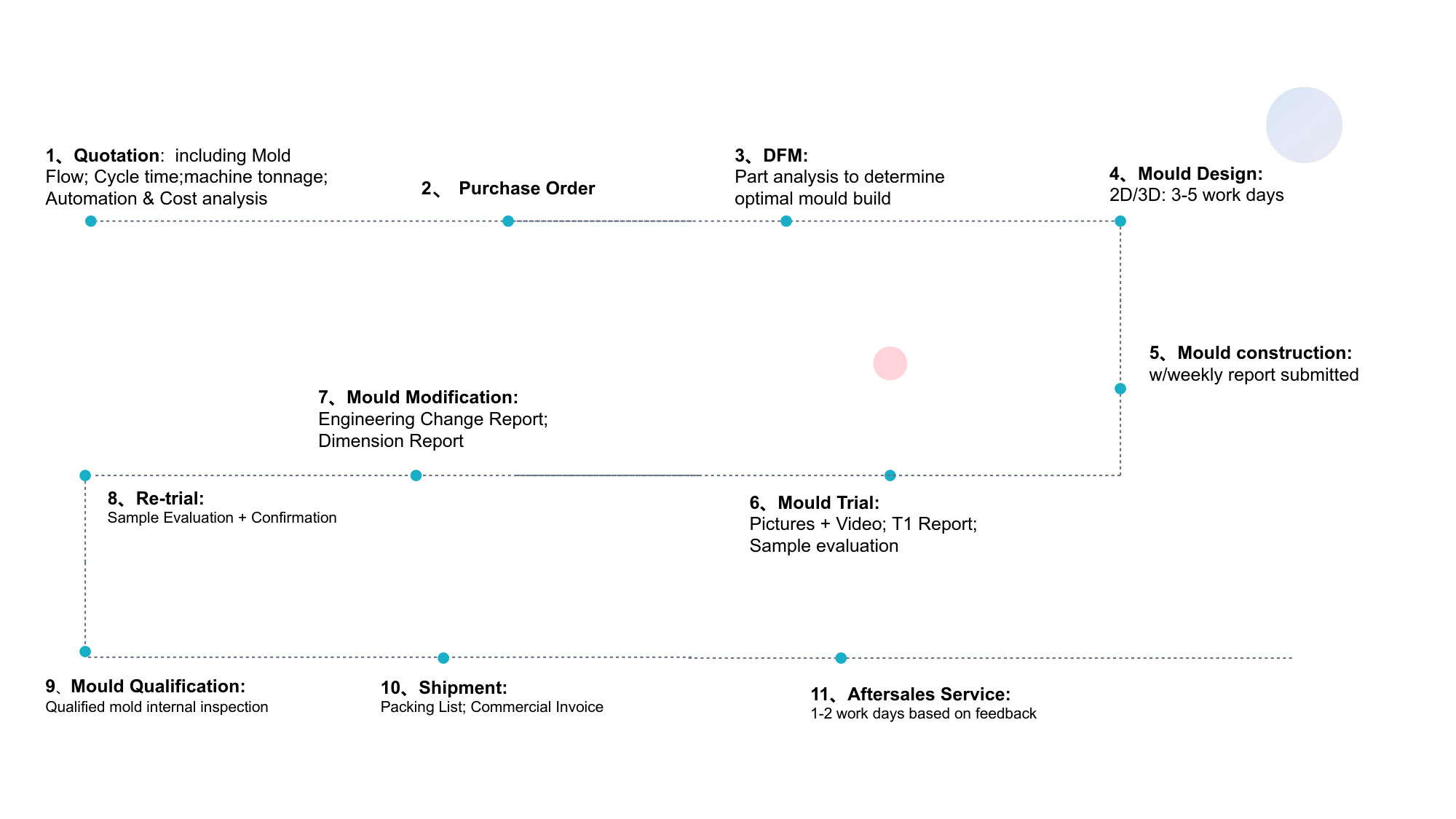
2.4 Mold Manufacturing Process Flow
DFM Analysis: Complete feasibility analysis with Moldflow simulation
CAD Mold Design: 3D modeling with full assembly validation
Steel Selection & Procurement: With material certification
Rough Machining: Five-axis CNC for bulk material removal
Heat Treatment: As per steel specification with documented curves
Precision Machining: Five-axis finishing to 0.002mm accuracy
EDM/Spark Erosion: For complex geometries and fine details
Wire EDM: For micro-holes and narrow slots
Bench Fitting & Assembly: With 0.005mm parting line fit
Polishing: To specified surface finish (Ra < 0.05μm for optical applications)
Quality Inspection: Full CMM dimensional report with CPK ≥ 1.33
Mold Trial (T0-T3) : With detailed improvement reports
2000-Cycle Aging Test: Wear report provided before delivery
Section III: Injection Molding Process Control — Eliminating Quality Anxiety
3.1 Process Standardization
All injection molding machines are networked with成型 parameters (temperature, pressure, speed, time) locked in MES (Manufacturing Execution System). Only authorized engineers can adjust parameters. First-article and last-article inspections are performed for every batch.
3.2 Dimensional Stability Control
Ansix Tech employs multiple strategies to ensure dimensional consistency:
Mold temperature zoning: Core and cavity temperatures maintained within 2°C differential to reduce warpage
Ultrasonic wall thickness sensors: Real-time feedback on wall thickness fluctuations with automatic compensation of holding pressure
In-mold temperature and pressure sensors: Closed-loop control for immediate process adjustment
Statistical validation: For同类支架 products, three batches produced over one week show critical hole spacing fluctuation ≤ 0.02mm
3.3 Surface Finish and Appearance Grades
Requirement Achievable Specification
Transparent Parts No bubbles, no flow marks
Plated Parts No gas marks
High-Gloss Parts Surface roughness Ra ≤ 0.2μm
Printing/Coating Deformation compensation预留; registration accuracy ±0.1mm
3.4 Special Material Capabilities
Ansix Tech has extensive experience with a wide range of engineering thermoplastics:
PC/ABS, PC
PPS + 40% GF
PEEK, PTFE, PFA
PA6 + GF30, PBT
PEI, PPS, LCP
Liquid Silicone Rubber (LSR)
PSU and PPSU (primary focus)
Flame Retardancy: UL94 V-0 rated for electrical housings
Weathering: UV testing 3,000 hours with no color change
Section IV: Full-Process Service — Reducing Customer Management Costs
4.1 Early Intervention (DFM Report)
Before contract signing, Ansix Tech provides a comprehensive mold feasibility analysis report including:
Draft angle recommendations
Wall thickness optimization
Gate location selection
Ejector pin mark location allowances
Shrinkage compensation predictions (PSU: 0.001-0.003 in/in)
This prevents discovering structural issues after mold steel is cut—saving significant time and cost.
4.2 Mold Trials and Sampling
Ansix Tech provides T0 through T3 trial samples, each accompanied by improvement reports. Quick-change inserts allow验证 of different design variations without rebuilding the entire mold.
4.3 Small-Batch Validation
Before full production release, Ansix Tech provides 100-500 shot trial runs with:
Yield rate statistics
CPK validation
Process capability confirmation
Production only proceeds to mass manufacturing once stability is confirmed.
4.4 Maintenance and Spare Parts
Spare parts package: Ejector pins, core inserts, and other wear components shipped with the mold
Preventive maintenance: At every 200,000 cycles
Lifetime repair: At cost, with in-house electrode and EDM capabilities ensuring 24-hour turnaround for standard repairs
Section V: Competitive Differentiation — Direct Solutions to Common Industry Pain Points
5.1 Addressing Customer Complaints
Common Complaint Ansix Tech's Solution
Frequent mold repairs disrupt orders 2,000-cycle aging test before delivery with wear report; 3-year structural warranty (excluding normal wear parts)
Excessive flash increases secondary processing cost 0.005mm parting line fit accuracy; self-locking clamp force compensation; flash controlled within 0.03mm per batch—eliminating manual deburring
Inconsistent dimensions between batches Ultrasonic wall thickness sensors with real-time holding pressure compensation; in-mold temperature and pressure sensors enabling closed-loop control
Long mold repair lead times In-house electrode machining center and EDM workshop; repairs completed without leaving the facility; standard weld repair/insert replacement within 24 hours
5.2 Cost Reduction Capabilities
Ansix Tech reduces customer costs through three primary levers:
Material Optimization:
Proper gate and runner design minimizes material waste
Hot runner systems eliminate runner scrap
Shrinkage prediction (0.001-0.003 in/in) reduces material over-allocation
Process Efficiency:
70% automated machining ratio reduces labor costs
Average of only 2 mold trials reduces development time and material waste
260 machines across four bases provide production flexibility and redundancy
Efficiency Enhancement:
Stack molds double output per machine cycle
Fully servo-electric drives reduce energy consumption
MES-connected machines enable lights-out manufacturing
5.3 Delivery Speed
Mold Complexity Standard Lead Time Expedited Lead Time
Simple Mold 10 days N/A
Medium Complexity 25-45 days 20 days (with validation steps maintained)
Complex / Multi-Cavity 45-60 days 35 days
Section VI: PSU Bottle Mold Project — From Concept to Production
6.1 Project Initiation and Design Phase
When a PSU bottle mold project is initiated, Ansix Tech follows a structured workflow:
Customer Requirements Analysis: Understanding application (medical, food, consumer), volume requirements, quality standards, and regulatory compliance needs (FDA, ISO 10993, USP Class VI)
Material Selection: Based on application requirements:
Standard PSU (Udel P-1700): General purpose, good chemical resistance
High-flow PSU (Udel P-3703): Thin-wall applications
Glass-filled PSU (PSU GF30): Higher rigidity, lower shrinkage (0.001-0.003 in/in)
Medical-grade PSU (Udel P-1720): Biocompatible, sterilizable
DFM Analysis:
Wall thickness optimization (minimum 1.5mm, ideally > 2mm for PSU)
Draft angle recommendations for ejection
Gate location optimization to minimize weld lines
Shrinkage compensation (0.001-0.003 in/in for glass-filled, up to 0.7% for unfilled)
Moldflow Simulation:
Predict filling patterns, weld line locations, and air trap positions
Optimize gate count and placement
Validate cooling efficiency
Predict warpage and shrinkage
6.2 Mold Design and Manufacturing
Mold Design Highlights for PSU Bottle Applications:
Runner System: Circular/trapezoidal large cross-section to minimize flow resistance. Short runner length to reduce pressure drop.
Gate Design: Side gate, fan gate, or large-diameter point gate. Pin-point gates are prohibited due to high shear and blockage risk.
Cooling System: Conformal cooling channels following bottle contour. Mold temperature maintained at 80-120°C (thin-wall: 100-120°C, thick-wall: 80-100°C).
Ejection System: Strategically placed ejector pins with marks in non-critical areas. For transparent PSU bottles, ejector pin marks must be invisible.
Venting: Adequate venting at flow front endpoints and weld line locations to prevent air traps and burns.
Manufacturing Process:
Step Equipment Tolerance
Rough Machining Five-axis CNC ±0.1mm
Heat Treatment Vacuum furnace Documented curve
Finish Machining Five-axis CNC 0.002mm
EDM Spark erosion ±0.005mm
Wire EDM Slow wire cut 0.03mm features
Polishing Manual/CNC Ra < 0.05μm
Inspection CMM CPK ≥ 1.33
6.3 Mold Validation and Sampling
T0 Trial: First mold trial identifying basic issues—filling pattern, ejection, visual defects.
T1-T3 Trials: Iterative improvements with detailed reports. Quick-change inserts allow testing different gate configurations or cooling layouts without rebuilding the mold.
2000-Cycle Aging Test: Simulating production wear to validate durability. Wear report provided.
Small-Batch Validation: 100-500 shot production run with:
Dimensional inspection (first article, in-process, last article)
CPK calculation for critical dimensions
Process capability validation
6.4 Mass Production
Process Control:
MES-locked parameters prevent unauthorized adjustments
Real-time monitoring of temperature, pressure, speed, and time
First-article and last-article inspections per batch
Statistical process control for dimensional stability
Quality Assurance:
ISO 13485 (medical devices), IATF 16949 (automotive), ISO 9001
FDA 510K compliance for medical applications
Full material traceability from resin batch to finished part
Packaging and Logistics:
Custom packaging designed to prevent damage during transit
Global logistics capabilities
Just-in-time delivery options
Section VII: Ansix Tech's Core Value Proposition
7.1 What Ansix Tech Solves for Customers
Customer Concern Ansix Tech's Solution Quantified Value
Design uncertainty DFM and Moldflow analysis before tooling Prevents costly redesigns; reduces time-to-market by 30-40%
Quality inconsistency CPK ≥ 1.33 validation; closed-loop process control Zero-defect production capability; reduced scrap rate
Production delays 260 machines across 4 bases; 24-hour repair capability 95%+ on-time delivery; minimal production interruption
High tooling costs Optimized mold design; longer tool life 500,000-1,000,000 cycle life; lower cost per part
Regulatory compliance ISO 13485, FDA 510K, ISO 10993 Direct market access for medical applications
7.2 Cost Savings Breakdown
Material Cost Savings:
Hot runner systems reduce material waste by 15-30%
Shrinkage prediction (0.001-0.003 in/in) reduces over-allocation
Optimized gating reduces scrap
Process Cost Savings:
70% automated machining reduces labor costs
Average 2 mold trials (vs. industry average 5-7) reduces development cost
Stack molds double output without doubling machine investment
Quality Cost Savings:
CPK ≥ 1.33 eliminates sorting and rework
2000-cycle validation prevents field failures
3-year structural warranty reduces maintenance budget
7.3 Risk Reduction
Risk Mitigation
Material degradation Strict drying protocols (120-140°C, 4-6 hours, ≤0.02% moisture)
Warpage/shrinkage Moldflow simulation; conformal cooling; shrinkage compensation
Mold failure 2000-cycle aging test; wear report; spare parts package
Production interruption 4 production bases; 260 machines; 24-hour repair capability
Regulatory non-compliance ISO certifications; full traceability; material certifications
Conclusion
Ansix Tech's 28-year journey from a Hong Kong-based mold maker to a global leader in injection molding solutions exemplifies how technical excellence translated into customer value creates sustainable competitive advantage. With 30,000+ molds built, 260 injection molding machines, 0.002mm precision capability, and ISO 13485/IATF 16949 certifications, Ansix Tech has mastered the demanding requirements of PSU bottle mold manufacturing.
For PSU bottle mold projects specifically, Ansix Tech's comprehensive capabilities—from material selection (Udel P-1700, P-3703, P-1720, glass-filled grades) through DFM analysis, Moldflow simulation, precision mold manufacturing (0.002mm accuracy), and validated mass production with CPK ≥ 1.33—deliver measurable value. The company's integrated ecosystem eliminates communication gaps, accelerates project timelines from 45 days to as little as 20 days for expedited projects, and ensures consistency from concept to delivery.
The core message is clear: "For us, a mold is not a piece of steel—it's a money-printing machine." Every design decision at Ansix Tech considers flow characteristics, venting paths, temperature balance, and ejection strategies to ensure that when the mold arrives at the customer's production line, it is ready for trouble-free, low-flash, long-life production. This philosophy, backed by quantifiable metrics and verified capabilities, is how Ansix Tech has earned customer trust and achieved industry leadership in PSU bottle mold manufacturing.
Ansix Tech Co Ltd
If you have any plans related to PSU bottle mold , you can contact us at any time. We will turn your ideas into reality, let you realize your dreams, and obtain large orders from the market. Our contact information is info@ansixtech.com. Or contact our CTO, mail: stephen@ansixtech.com
#www.ansixtech.com #ansixtech.com #PSU bottle mold #PSU bottle mold Material #PSU bottle mold Mold injection mold companies #Ansix #Ansix moulds #Ansix china #Ansix tech china #Ansix tech company #Ansix facotry #PSU bottle mold injection molding #PSU bottle mold injection tools #PSU bottle mold injection moulds #PSU bottle mold plastic mould #PSU bottle mold plastic tools #Ansix Tech #Ansix molds #Ansix injection molding #Ansix mold factory #PSU bottle mold injection molding Customized #Ansix mold factory #PSU bottle mold china #PSU bottle mold molds #injection factory for PSU bottle mold #PSU bottle mold injection molding #PSU bottle mold injection molding factory #injection molding company #PSU bottle mold injection mold companies #PSU bottle mold Tooling #PSU bottle mold mold limited #Ansix mold china #Ansix companies for PSU bottle mold #Ansix company China #PSU bottle mold facotry #Ansix Tech #Ansix Tech mould #PSU bottle mold injection moulding #PSU bottle mold injection moulding company #Ansix PSU bottle mold parts injection mold companies #PSU bottle mold injection molding companies china #PSU bottle mold china factory #Ansix moulding companies #Ansix molding company #PSU bottle mold injection moulding facotry #Ansix Tech mold #PSU bottle mold mould #PSU bottle mold plastic injection molding #ansix plastic mold #PSU bottle mold Mold manufacturing #PSU bottle mold parts manufacturing #PSU bottle mold plastic parts factory #PSU bottle mold injection parts mold #PSU bottle mold PRECISION MANUFACTURING #PSU bottle mold TOOL #China PSU bottle mold mold #PSU bottle mold Material injection moulding china #PSU bottle mold mould china #china precision mold #PSU bottle mold Material mold in china #PSU bottle mold mold china #PSU bottle mold Precision molds #High-precision molds #PSU bottle mold High-precision tool #Injection molds #PSU bottle moldFactory #PSU bottle moldCompany #Super Large Injection Mold Factory #Large Tonnage Injection Molding Factory #PSU bottle moldCompany #PSU bottle moldFactory #2800T Injection Molding Factory #3000 Ton Injection Molding #4500 Ton Injection Molding Factory #PSU bottle mold Large Mold Injection Molding #Large Plastic Mold Injection Molding Factory #PSU bottle mold Large Injection Mold Manufacturer #PSU bottle mold Plastic Mold Factory #Injection Mold #Plastic Mold