
 Medical Molds
 Packaging Molds
 Personal Care Molds
 Electronic Molds
 Automotive Molds
 Home Appliance Molds
 Special Molds
 Design & Engineering
 Production & Manufacturing
 Global Presence
 Business Scope
 Component Solutions
 Product Assembly
 Quality Management
 Medical Device Manufacturing



Scooter deck mold
FEATURES
Product Introduction: Understanding Scooter Deck Mold Technology
1.1 The Technical Challenges of Scooter Deck Manufacturing
A scooter deck—the platform on which the rider stands—is far more than a simple plastic component. It is, in essence, a highly compact electromechanical system’s structural envelope. The components constituting the chassis, fenders, and platform must accommodate batteries, control boards, motors, and sensors while also withstanding dynamic loads generated by riders weighing 100 kilograms or more. They must resist impact, absorb vibration, and maintain dimensional stability under extreme temperature conditions—all while minimizing the vehicle’s overall weight .
Traditional injection molding struggles to satisfy these conflicting demands. Solid-section components strong enough to bear structural loads are heavy, costly, and prone to sink marks and internal stresses that compromise long-term reliability. Complex geometries require multiple assembled parts, which not only increase labor and inventory costs but also introduce potential failure points .
Gas-assisted injection molding (GAIM) addresses this challenge by introducing pressurized nitrogen into the mold after partial melt injection, creating hollow channels within thick-walled sections while maintaining solid outer shells. The resulting components possess the strength of solid parts with the weight of hollow ones, achieving material savings of 30% to 35% in typical applications .
For scooter decks specifically, these improvements have profound implications. Lighter components extend battery range. Hollow structures provide internal channels for wiring harnesses. Reduced material usage lowers part costs. Additionally, elimination of sink marks improves aesthetics—critical for consumer products where appearance influences purchasing decisions .
-
Mold Description
Product Materials:
PA66+GF20
Mold Material:
S136ESR
Number of Cavities:
2
Glue Feeding Method:
Hot runner
Cooling Method:
Water cooling
Molding Cycle
42.5s
- The mold manufacturing process and product material selection
1.2 Material Selection for Scooter Deck Applications
The material selection for scooter deck molds and molded components represents a critical engineering decision that balances mechanical performance, thermal stability, chemical resistance, and cost efficiency. Ansix Tech’s material engineers work closely with clients to identify optimal polymer solutions for each application .
PA6+GF30 (30% Glass Fiber Reinforced Nylon 6) represents a primary candidate for scooter deck structural components. This material offers an exceptional stiffness-to-weight ratio, excellent impact resistance at low temperatures, high dimensional stability, and resistance to chemicals and moisture. Its relatively low cost makes it ideal for large structural parts. The 30% glass fiber reinforcement provides the mechanical strength necessary to withstand rider loads while maintaining the weight advantages essential for portable personal mobility devices .
Polycarbonate (PC) and PC/ABS blends are also employed for scooter deck applications requiring enhanced impact resistance and aesthetic qualities. Polycarbonate compositions have been specifically formulated for scooter and motorcycle exterior and interior components, including panels, trim, and structural elements . These materials offer superior surface finish, dimensional stability for tight tolerances around fittings, and inherent flame resistance. For deck covers and visible components, PC-based materials provide the surface quality necessary for consumer acceptance.
Modified PPE/PS blends (such as Noryl®) find application in scooter dashboard and instrument panel components where aesthetics, tactile feel, and durability converge. These materials provide superior surface finish for painting or texturing, good dimensional stability, and inherent flame resistance .
The selection process considers not merely material properties but the entire manufacturing ecosystem. Ansix Tech’s engineers evaluate melt flow characteristics, shrinkage behavior, cooling requirements, and post-molding dimensional stability to ensure that the chosen material performs optimally throughout the production lifecycle.
-
Production Process Overview
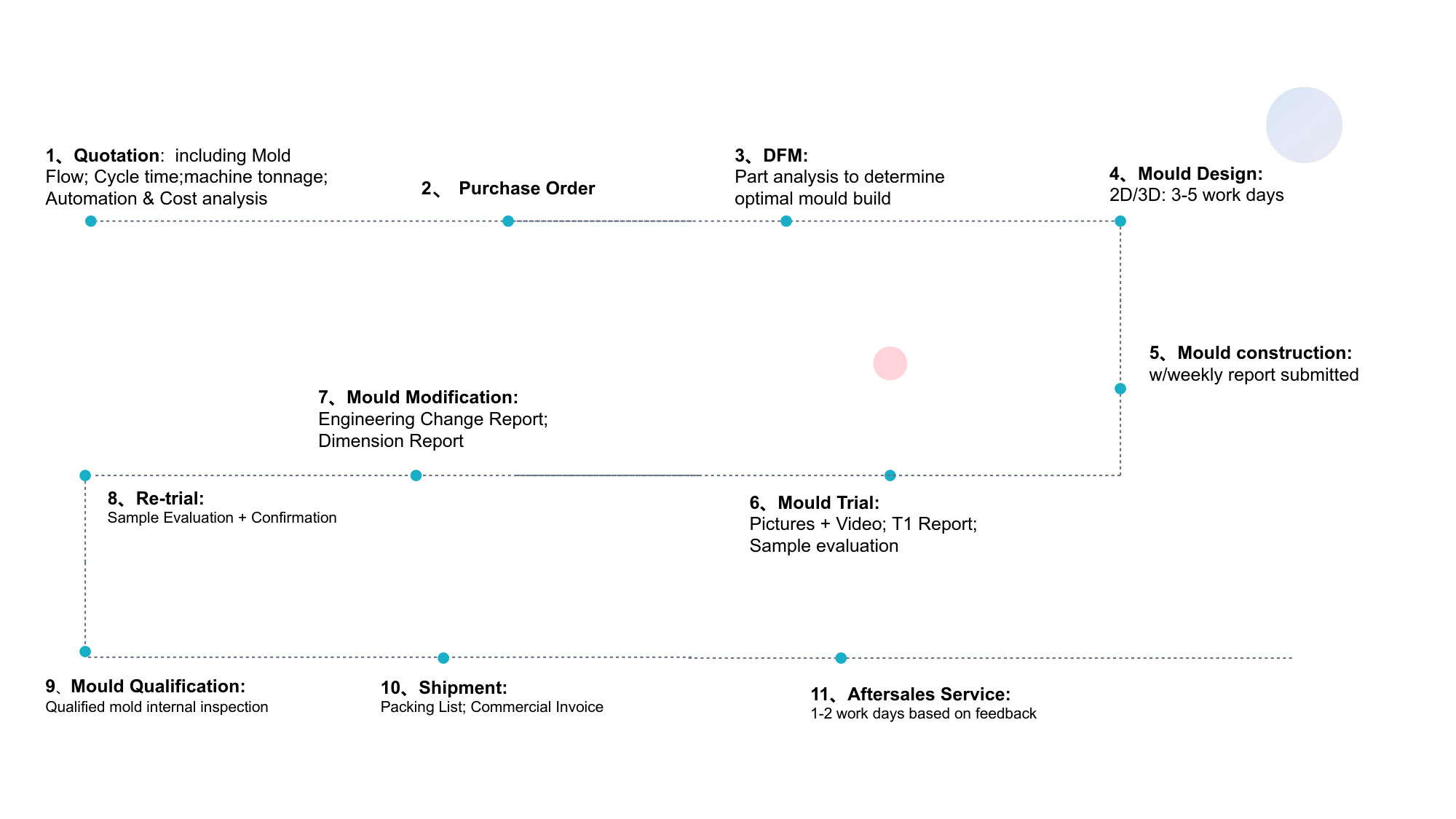
The production of scooter deck molds at Ansix Tech follows a meticulously structured workflow that integrates design, simulation, tooling, and manufacturing. The process begins with Design for Manufacturability (DFM) analysis, during which Ansix’s engineers conduct rigorous design reviews before any steel is ordered. They examine every feature of the proposed scooter component to ensure manufacturability during the gas-assisted welding process. They study wall thickness transitions and their effects on bubble propagation, optimize rib geometries to form gas channels, and evaluate gate locations for their impact on filling patterns and weld strength .
Following DFM approval, mold flow analysis (MFA) creates virtual prototypes that reveal how the melt front advances, how gas permeates, and how cooling progresses across the component geometry. These simulations employ industry-standard platforms to predict and prevent defects before they manifest in physical tooling .
Mold manufacturing then commences using high-precision equipment. Ansix Tech’s tooling solutions leverage cutting-edge technology and intelligent manufacturing, with capabilities including accuracy of 0.002mm and an automated machining ratio of 70%. Since its establishment, the company has built over 30,000 sets of molds with an average of only 2 mold trials .
Injection molding production utilizes a fleet of 260 injection molding machines with tonnage ranging from the smallest 30 tons to 2800 tons. This comprehensive range covers components from small precision inserts to massive structural panels . The company operates four production bases across China and Vietnam, with a total building area of approximately 200,000 square meters and a workforce exceeding 1,200 people, including more than 200 designers .
2. Core Competitive Advantages: How Ansix Tech Delivers Customer Satisfaction and Industry Leadership
2.1 Design and Development: DFM and Mold Flow Analysis
Ansix Tech’s approach to scooter deck mold projects differs fundamentally from the linear, cumbersome handoff workflows prevalent in the injection molding industry. The company employs a vertically integrated model that breaks down traditional boundaries between design, simulation, mold manufacturing, and production .
Design for Manufacturability (DFM) constitutes the core philosophy. Before any steel is ordered, Ansix engineers conduct a rigorous design review examining every feature of the proposed scooter component for manufacturability. They meticulously study wall thickness transitions and their effects on bubble propagation during gas-assisted welding, optimize rib geometries to form gas channels, and evaluate gate locations for their impact on filling patterns and weld strength .
This is not mere theoretical analysis. Ansix utilizes industry-standard simulation platforms to create virtual prototypes through mold flow analysis (MFA), revealing how the melt front advances, how gas penetrates, and how cooling progresses across the component geometry. These simulations enable identification and resolution of potential defects before physical tooling is produced .
The DFM process addresses systematic questions that determine project success: general fillability and process safety, weld lines and air traps, venting positions, avoidance of melt stagnation and race-tracking effects, optimization of gate positions, balanced filling behavior, flow path to wall thickness ratio, and mass accumulation issues . By resolving these factors at the design stage, Ansix eliminates expensive downstream modifications and accelerates time-to-market.
2.2 Precision Mold Manufacturing Capabilities
Ansix Tech’s mold manufacturing capabilities represent the foundation of its competitive advantage in the scooter deck mold sector. The company’s tooling infrastructure includes:
High-precision machining centers capable of achieving tolerances as tight as ±0.002mm, ensuring that parting lines on scooter deck components are smooth and burr-free. This level of precision is essential for components that must fit together seamlessly while maintaining structural integrity .
Slow-wire EDM (Electrical Discharge Machining) equipment enables the creation of fine micro-holes and narrow slots down to 0.03mm, essential for venting and thin-wall features without causing deformation. This capability is critical for scooter deck molds containing complex internal geometries and gas channels .
High-grade tool steels including P-20, H-13, 718H, and S136 are selected based on production volume and material requirements. For high-volume scooter deck production (tens of thousands of units), Ansix specifies materials such as P-20 or H-13 with nitriding or PVD coatings. Recent research suggests that innovative tool coatings can act as thermal insulators during injection, reducing the need for energy-intensive heating and cooling cycles, thereby further reducing operating costs .
For scooter deck molds specifically, 718H pre-hardened steel offers an optimal balance of hardness (33-38 HRC), toughness, and wear resistance. This nickel-containing alloy provides excellent dimensional stability (±0.02mm/m) and can extend mold life beyond 500,000 cycles with minimal maintenance. Its superior machinability can reduce manufacturing lead times by 15-20% compared to fully hardened steels .
S136 stainless steel addresses corrosion challenges in scooter deck applications involving PVC or acidic plastic materials. With 13-14% chromium content and hardness of 48-52 HRC after heat treatment, this material offers superior resistance to pitting and chemical degradation. Its mirror-polishing capability (Ra ≤0.012μm) is essential for visible scooter deck components requiring smooth surface finishes .
2.3 Gas-Assisted Injection Molding Expertise
Ansix Tech’s 28 years of gas-assisted mold engineering experience has established the company as a preferred partner for scooter brands seeking breakthrough technical solutions .
Gas-assisted injection molding solves the fundamental challenge of creating components that are simultaneously strong, lightweight, and aesthetically acceptable. By introducing pressurized nitrogen into the mold after partial melt injection, GAIM creates hollow channels within thick-walled sections while maintaining solid outer shells .
The process requires precise control of multiple parameters. Melt temperature must be optimized to ensure plastic flows easily without degrading (typically 230-250°C for engineering polymers). Mold temperature critically affects surface finish and cooling rate. Shot size—the volume of plastic injected before gas introduction—must be precisely calibrated; too large and there is no space for gas, too small and gas escapes through the melt front, ruining the part. Ansix Tech uses simulation to determine the optimal “short shot” percentage, often around 75% fill before gas injection .
Gas pressure and hold time must also be carefully controlled. Nitrogen pressure (e.g., 10 MPa) must be sufficient to pack the plastic but not so high as to cause blow-through. Hold time must be long enough for plastic to cool and solidify against mold walls while gas maintains internal pressure .
By fine-tuning these parameters, Ansix Tech consistently achieves results that exceed industry benchmarks: more than 25% weight reduction, elimination of sink marks, and reduced cycle times compared to solid injection molding .
2.4 Product Validation and NPI Process Planning
Ansix Tech implements rigorous validation protocols throughout the scooter deck mold development process. The validation sequence typically includes Installation Qualification (IQ), Operational Qualification (OQ), and Performance Qualification (PQ) .
Installation Qualification (IQ) verifies that the mold is correctly installed in the injection molding press and that all systems (cooling, hot runner, ejection, safety interlocks) function as intended .
Operational Qualification (OQ) subjects the mold to its intended operating range, typically varying injection speed, packing pressure, melt temperature, and cooling time to establish process window boundaries. This phase identifies where the process is robust and where it is sensitive to variation .
Performance Qualification (PQ) demonstrates that the mold, operating within the established process window, consistently produces parts meeting all specifications—typically over three consecutive production runs of defined duration .
Statistical process control (SPC) monitors critical quality parameters including part weight, dimensional characteristics, and mechanical properties. First Article Inspection (FAI) using 3D scanners and coordinate measuring machines verifies conformance to customer specifications. A complete PPAP (Production Part Approval Process) package, including process capability studies (Cp/Cpk), is delivered before mass production certification .
Ansix Tech’s NPI (New Product Introduction) process planning emphasizes parallel processing to overlap activities traditionally performed sequentially. Mold base machining begins before cavity inserts are finalized. First article inspection preparations are completed while the mold is still being assembled. Partnerships with material suppliers ensure that production-quality polymers are available when needed, not weeks later. Packaging solutions are developed in parallel with tooling so that finished parts can be protected and shipped immediately after qualification .
The result is development cycles compressed by 30 to 40 percent compared to industry norms .
2.5 Mass Production and Capacity
Ansix Tech’s production infrastructure is designed for scalability and efficiency. The company operates 260 injection molding machines across four production bases in China and Vietnam, with tonnage ranging from 30 to 2800 tons . This comprehensive range enables production of components from small precision inserts to large structural panels .
The company’s capacity planning has been refined over 28 years to manage seasonal peaks. By maintaining strategic raw material inventories (stocking high-demand resins such as ABS, PC/ABS, and PP) and redundant production cells, Ansix guarantees on-time delivery rates exceeding 98% .
For scooter deck production specifically, cycle time optimization is a primary focus. Cooling time often represents the most significant target for reduction. Advanced cooling conformal design directly addresses this bottleneck. Automation through robotic part removal and pad loading further enhances efficiency .
2.6 Quality Assurance and Certifications
Quality at Ansix Tech is not a final inspection step but a philosophy embedded throughout the production process. The company holds ISO9001, ISO14001, IATF16949, and ISO13485 certifications, reflecting adherence to international standards in quality management, environmental responsibility, and automotive and medical device manufacturing .
Quality control extends from raw material receiving through final packaging and shipping. Each batch of polymer received from certified suppliers undergoes verification testing including melt flow index measurement, moisture content analysis, visual inspection for contamination, and certificate of analysis verification .
In-process quality control includes first article inspection of the first shots from each mold, statistical process control with real-time monitoring of critical process parameters (melt temperature, mold temperature, injection pressure, cycle time), automated vision systems for critical dimensions, and visual inspection for flow marks, weld lines, and sink marks .
Outgoing quality control before shipment includes dimensional verification using coordinate measuring machines or optical measurement systems, performance testing, and packaging inspection to prevent damage during transit .
2.7 Delivery and After-Sales Service
Ansix Tech understands that quality extends to packaging and delivery. For scooter deck components, packaging is designed with multiple objectives: surface protection through individual separation using foam interleaving or rigid trays with custom-molded pockets, contamination prevention through sealed packaging, ESD protection for electronics applications, stackability for efficient palletization and container loading, and labeling with part number, quantity, batch/lot number, date of manufacture, and quality certification .
Logistics capabilities include sea freight (FCL and LCL) to ports worldwide, air freight for urgent orders, and door-to-door delivery with integrated logistics management. For customers requiring just-in-time (JIT) delivery, Ansix maintains safety stock and coordinates production schedules to meet delivery windows with 99%+ on-time performance .
3. Material Selection and Intelligent Manufacturing for Competitive Advantage
3.1 Strategic Material Selection
Material selection at Ansix Tech is approached as a strategic engineering decision rather than a procurement transaction. The company’s material engineers work closely with clients to balance cost and performance, avoiding over-specification while ensuring that all functional requirements are met .
For scooter deck structural components, PA6+GF30 represents a primary material choice, offering exceptional stiffness-to-weight ratio, excellent low-temperature impact resistance, high dimensional stability, and resistance to chemicals and moisture. Its low cost makes it ideal for large structural parts .
For components requiring enhanced impact resistance and aesthetic qualities, polycarbonate compositions provide superior surface finish, dimensional stability for tight tolerances, and inherent flame resistance .
The material selection process considers not merely mechanical properties but the entire manufacturing ecosystem. Melt flow characteristics determine processing parameters and cycle times. Shrinkage behavior affects dimensional accuracy and mold design. Cooling requirements influence cycle time and energy consumption. Post-molding dimensional stability determines long-term performance and assembly fit.
Ansix Tech’s material expertise also extends to cost optimization. The company leverages high-volume purchasing power across multiple customers and projects to secure favorable pricing. Where technically permissible, post-industrial regrind is incorporated to reduce virgin material consumption .
3.2 Intelligent Manufacturing and Efficiency Enhancement
Ansix Tech has invested continuously in intelligent manufacturing infrastructure to enhance efficiency and consistency. The company’s approach to capacity improvement is not simply adding more molding machines but increasing the efficiency of existing infrastructure through automation .
Robotic integration for part removal and pad loading has been implemented for large components. Robots handle components immediately after ejection, reducing cycle time and eliminating manual handling risks. For assembly operations, semi-automated lines combine human operators for complex tasks with automated systems for torque application, ultrasonic welding, and labeling. This hybrid automation model allows flexibility (lines can be reconfigured for different scooter models with minimal changeover time) while maintaining the speed required for high-volume production .
Cycle time optimization is a continuous process. Cooling time—often the most significant component of total cycle time—is addressed through advanced cooling channel designs. Conformal cooling solutions place cooling channels closer to the part surface and follow the component’s contours, dramatically reducing cooling time while improving temperature uniformity .
Process optimization using scientific molding principles establishes robust process windows. Parameters including injection speed (in multiple stages to balance flow and shear), packing pressure profile, and cooling time are monitored and controlled digitally. This ensures consistency from the first shot to the millionth .
The company’s automated machining ratio of 70% reflects significant investment in CNC automation and lights-out manufacturing capabilities. This automation reduces labor costs, improves consistency, and enables 24/7 production in certain operations .
3.3 Process Quality Assurance
Quality assurance at Ansix Tech is integrated into every stage of the production process rather than treated as a separate inspection function.
Incoming material quality control verifies every batch of polymer through melt flow index measurement, moisture content analysis (critical for hygroscopic materials like PC and PA), visual inspection for contamination or discoloration, and certificate of analysis verification .
In-process quality control includes first article inspection, statistical process control monitoring of critical parameters, automated vision systems for dimensional verification, and visual inspection for surface defects .
Final quality verification before shipment includes dimensional inspection against customer specifications, performance testing where applicable, and packaging inspection .
The company’s quality management system has been stress-tested across medical, automotive, and consumer sectors. This cross-industry experience provides unique insights into failure modes and preventive measures that benefit every scooter deck project .
3.4 Cost Control Capabilities
Ansix Tech’s approach to cost control differs fundamentally from competitors that focus narrowly on material substitution or labor reduction. The company attacks cost at every stage of the value chain through intelligent engineering that builds quality in from the start .
Material cost reduction is achieved through optimized material selection (matching properties to requirements without over-specification), bulk purchasing power across multiple customers and projects, and appropriate use of regrind where technically permissible .
Process cost reduction targets cycle time reduction through optimized cooling, scientific molding parameter development, and automation of part handling and secondary operations. Cycle time reductions of 15% to 30% have been achieved on comparable projects .
Design cost reduction results from DFM analysis that simplifies assemblies, reduces part counts, and eliminates unnecessary secondary operations. By designing for manufacturability from the outset, Ansix prevents costly design changes after tooling has been cut .
Quality cost reduction is achieved through prevention rather than detection. By building quality into the process, Ansix minimizes scrap, rework, and warranty claims that erode profitability .
4. Conclusion: The Ansix Tech Difference in Scooter Deck Mold Solutions
Ansix Tech’s emergence as an industry leader in scooter deck mold manufacturing is not the result of any single capability but the integration of multiple competencies into a cohesive system. The company’s vertically integrated model eliminates the communication gaps and coordination delays that plague fragmented service providers .
The 28 years of injection molding experience manifest in both obvious and subtle ways. In the obvious category: a facility equipped with molding presses from 30 to 5,500 tons capacity, capable of producing components from small precision inserts to massive structural panels . A team of engineers who have collectively confronted and solved thousands of mold challenges. A quality system that has been stress-tested across medical, automotive, and consumer sectors.
In the subtle category: the ability to predict where a component will fail before a single prototype is made. A database of historical failures that informs proactive design recommendations. Process knowledge that reduces cycle time by seconds per part—seconds that translate into substantial cost savings over millions of cycles .
For scooter deck mold projects specifically, Ansix Tech offers capabilities that directly address the industry’s most pressing challenges. Gas-assisted injection molding expertise enables lightweight, strong components that extend battery range. DFM and mold flow analysis prevent defects before they occur, reducing development cycles by 30-40%. Precision mold manufacturing ensures consistent quality across millions of cycles. Material expertise balances performance and cost. Intelligent manufacturing delivers efficiency and scalability. Rigorous quality assurance and comprehensive validation ensure that every component meets specifications. And a global production footprint with logistics capabilities ensures timely delivery anywhere in the world.
The company’s mission to “Make Our Customers Successful” is not merely a slogan but an operational philosophy. Every capability, every investment, and every process is directed toward solving customer problems, reducing customer costs, and lowering customer risks. In the competitive world of scooter deck manufacturing, this customer-centric approach to engineering excellence is what distinguishes Ansix Tech as an industry leader.
Ansix Tech Co Ltd
If you have any plans related to Scooter deck mold , you can contact us at any time. We will turn your ideas into reality, let you realize your dreams, and obtain large orders from the market. Our contact information is info@ansixtech.com. Or contact our CTO, mail: stephen@ansixtech.com
#www.ansixtech.com #ansixtech.com #Scooter deck mold #Mold for automotive daytime running light guide strip #Scooter deck mold injection mold companies #Ansix #Ansix moulds #Ansix china #Ansix tech china #Ansix tech company #Ansix facotry #Ansix Tooling #Ansix tool #Scooter deck mold injection molding #Scooter deck mold injection tools #Scooter deck mold injection moulds #Ansix moulding company #Ansix molding #ansix tooling #Scooter deck mold plastic mould #Scooter deck mold plastic tools #Ansix Tech #Ansix molds #Ansix injection molding #Ansix mold factory #Scooter deck mold injection molding Customized #Ansix mold factory #Scooter deck mold china #Scooter deck mold molds #injection factory for Scooter deck mold #Scooter deck mold injection molding #Scooter deck mold injection molding factory #injection molding company #Scooter deck mold injection mold companies #Mold for automotive daytime running light guide strip #Scooter deck mold mold limited #Ansix mold china #Ansix companies for Scooter deck mold #Ansix company China #Scooter deck mold facotry #Ansix Tech #Ansix Tech mould #Scooter deck mold injection moulding #Scooter deck mold injection moulding company #Ansix Scooter deck mold parts injection mold companies #Scooter deck mold injection molding companies china #Scooter deck mold china factory #Ansix moulding companies #Ansix molding company #Scooter deck mold injection moulding facotry #Ansix Tech mold #Scooter deck mold mould #Scooter deck mold plastic injection molding #ansix plastic mold #Scooter deck mold Mold manufacturing #Scooter deck mold parts manufacturing #Scooter deck mold plastic parts factory #Scooter deck mold injection parts mold #Scooter deck mold PRECISION MANUFACTURING #Scooter deck mold TOOL #China Scooter deck mold mold #Scooter deck mold injection moulding china #Scooter deck mold mould china #china precision mold #Scooter deck mold mold in china #Scooter deck mold mold china #Scooter deck mold Precision molds #High-precision molds #Scooter deck mold High-precision tool #Injection molds #Scooter deck moldFactory #Scooter deck moldCompany #Super Large Injection Mold Factory #Large Tonnage Injection Molding Factory #Scooter deck mold Company #Scooter deck mold Factory #2800T Injection Molding Factory #3000 Ton Injection Molding #4500 Ton Injection Molding Factory #Scooter deck mold Large Mold Injection Molding #Large Plastic Mold Injection Molding Factory #Scooter deck mold Large Injection Mold Manufacturer #Scooter deck mold Plastic Mold Factory #Injection Mold #Plastic Mold