
 Medical Molds
 Packaging Molds
 Personal Care Molds
 Electronic Molds
 Automotive Molds
 Home Appliance Molds
 Special Molds
 Design & Engineering
 Production & Manufacturing
 Global Presence
 Business Scope
 Component Solutions
 Product Assembly
 Quality Management
 Medical Device Manufacturing



SUV Electric Running Board Motor Bracket and Control Box
FEATURES
The SUV Electric Running Board Product and Ansix’s Manufacturing Role
1.1 Product Overview: SUV Electric Running Board Motor Bracket and Control Box
A powered running board assembly comprises several critical components working in concert to deploy and retract the step surface in response to vehicle door signals . The motor bracket serves as the structural interface between the drive motor assembly and the vehicle chassis, bearing dynamic loads as the running board moves between stowed and deployed positions. The control box (or Electronic Control Unit housing) protects the electronic control module that manages motor operation, position sensing, and safety features including current-spike detection for obstruction response .
These components must withstand continuous mechanical cycling, exposure to road debris, moisture, temperature extremes, and chemical contaminants—all while maintaining precise dimensional relationships that ensure proper gear mesh, sealing integrity, and electrical reliability.
-
Mold Description
Product Materials:
PA66+GF35
Soft rubber: TPR
Mold Material:
S136ESR
Number of Cavities:
1+1
Glue Feeding Method:
COLD runner
Cooling Method:
Water cooling
Molding Cycle
42.5s
- The mold manufacturing process and product material selection
How Ansix Converts Professional Terminology into Customer Value
The manufacturing language of injection molding—shrink rates, draft angles, gate locations, cavity pressure curves—can appear opaque to customers whose expertise lies elsewhere. Ansix’s approach is to translate every technical parameter into its business consequence.
Shrink Rate → Dimensional Reliability. When Ansix engineers discuss material shrinkage compensation, the customer hears: “Your bracket will bolt directly onto the vehicle frame without reaming, shimming, or field modification. Assembly line takt time stays on plan.”
Mold Flow Analysis → Launch Date Certainty. When Moldflow simulation identifies a weld line that would reduce structural integrity, the customer understands: “We identified this risk before cutting steel. Your program avoids a 4-6 week tool modification delay and the associated launch slippage.”
Cavity Pressure Monitoring → Warranty Cost Avoidance. When Ansix implements in-process parametric release, the customer recognizes: “Every shipment is traceable to validated process windows. Defective parts don’t reach your assembly line, and field failures don’t generate warranty claims.”
IATF 16949 Certification → OEM Qualification. For automotive suppliers, IATF 16949 certification is often a prerequisite for participating in OEM tenders . Ansix’s quality management system is built to this standard, meaning customers can confidently present Ansix-produced components within their own PPAP submissions without additional supplier qualification hurdles.
-
Ansix’s End-to-End Service Capabilities
2.1 Product Design and Development
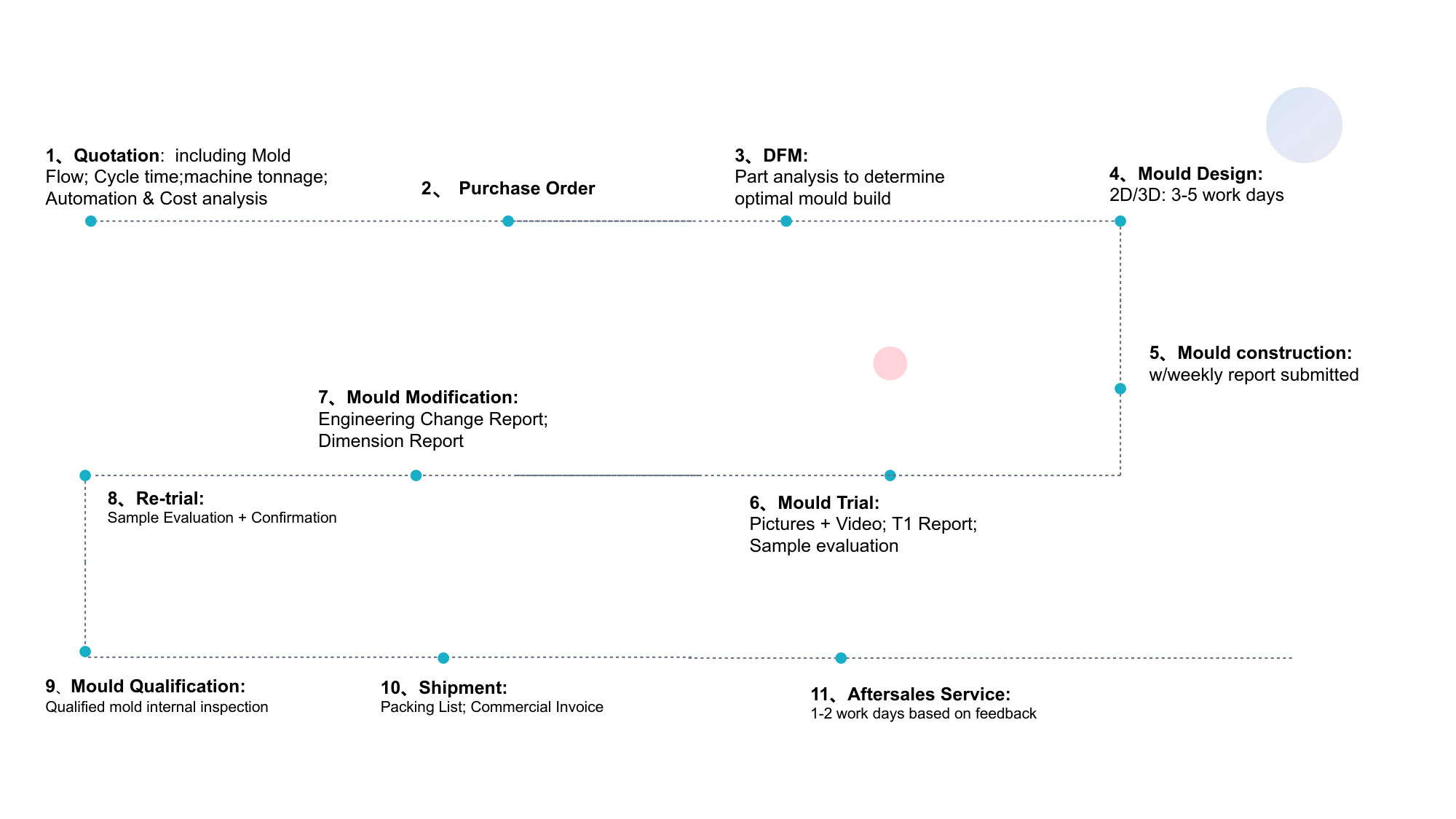
Ansix engages at the earliest concept stage, providing Design for Manufacturing (DFM) feedback that prevents costly design decisions from becoming costly tooling problems. DFM analysis evaluates part geometry, wall thickness uniformity, draft angles, gate placement feasibility, rib and boss design, and tolerance stack-up against molding capability .
The core DFM questions Ansix engineers ask are fundamentally customer-value questions:
Can this design be molded with standard tooling, or does it require complex side actions that add cost and maintenance risk?
Are tolerances specified tighter than functionally necessary, driving up inspection and scrap costs?
Can multiple parts be combined into a single molded component, reducing assembly labor and inventory?
Is the assembly sequence designed for automation, or does it require manual dexterity that varies by operator?
By front-loading these evaluations, Ansix helps customers avoid the “design it first, fix it later” trap that typically adds 15-25% to program development costs.
2.2 DFM Mold Manufacturing
Ansix’s tooling approach treats the mold not as a capital expense to be minimized, but as a production asset whose quality determines long-term unit economics. Key considerations include:
Steel Selection and Heat Treatment. Motor brackets and control box enclosures typically require engineering-grade thermoplastics with abrasive fillers (glass fiber, mineral reinforcement) that accelerate mold wear. Ansix specifies tool steels and surface treatments matched to the expected production volume and material aggressiveness.
Cooling System Design. Uniform cooling is the single most important determinant of cycle time and dimensional consistency. Conformal cooling channels, where geometry permits, reduce cycle time by 15-30% compared to conventional straight-drilled cooling.
Gate and Runner Optimization. For multi-cavity tools, balanced runner systems ensure simultaneous filling, avoiding overpacking in some cavities and short shots in others.
2.3 Moldflow Simulation and Part Validation
Autodesk Moldflow simulation allows Ansix to predict and correct manufacturing issues before the first tool is cut . The simulation workflow addresses:
Fill analysis to confirm complete cavity filling without short shots or excessive injection pressure
Weld line prediction to identify structural weak points and reposition gates where possible
Air trap detection to prevent burn marks and incomplete filling
Cooling analysis to validate cycle time expectations and temperature uniformity
Warpage prediction to anticipate dimensional deviation from nominal CAD geometry
The value proposition is straightforward: Moldflow analysis costs a fraction of a tool modification. Each simulation-driven correction avoids the $5,000-$20,000 cost of cutting, welding, and re-machining a production tool, plus the schedule impact of 2-4 weeks in tool rework.
2.4 New Product Introduction (NPI) Process Planning
Ansix follows a structured NPI framework that moves from concept feasibility through low-volume validation to high-volume production . The phases include:
Phase 0 — Concept Feasibility: Manufacturing review of part design, material selection, and volume requirements to confirm production readiness.
Phase 1 — Industrialization Planning: Project team assembly, tooling and equipment investment planning, supply chain qualification for specialty resins and insert components.
Phase 2 — Pre-Production Validation: Tool tryout, first article inspection, process capability studies (Cpk), and PPAP documentation preparation.
Phase 3 — Low-Volume Production: Pilot runs to validate process stability, operator training, and packaging/logistics readiness.
Phase 4 — High-Volume Ramp: Transition to full production with statistical process control (SPC) monitoring and continuous improvement protocols.
2.5 Mass Production, Quality Assurance, Delivery, and After-Sales
Production Capabilities. Ansix operates injection molding machines sized appropriately for the shot weights and tonnage requirements of motor brackets and control box housings—typically 150-500 ton clamping force for these components. Robotic part removal, automated degating, and vision inspection systems reduce labor content and improve consistency.
Quality Assurance. In-process monitoring includes cavity pressure sensors, melt temperature verification, and automated dimensional checks at defined intervals. The quality management system is structured around IATF 16949 core tools: APQP, FMEA, MSA, SPC, and PPAP . For critical-to-function dimensions, capability studies confirm Cpk ≥ 1.33 before production release.
Delivery Efficiency. Ansix’s production planning aligns with customer build schedules through EDI integration and kanban replenishment where applicable. Geographic proximity to major North American and European automotive assembly and aftermarket distribution centers reduces transit time and tariff exposure.
After-Sales Support. Post-delivery support includes engineering change management, tooling maintenance programs, and root cause analysis for any field quality issues. Ansix maintains tooling documentation and process records to support rapid response to customer inquiries or audits.
Part Three: Materials, Intelligent Manufacturing, and Process Quality
3.1 Material Selection for Motor Brackets and Control Boxes
Motor Bracket Materials. These components require a balance of structural rigidity, impact resistance, and resistance to automotive fluids and temperature cycling. Candidate materials include:
Glass-filled PA66 (Polyamide 66): Excellent strength-to-weight ratio, chemical resistance, and heat resistance. Common loadings are 30-35% glass fiber for structural brackets.
PA6/PPE blends: Improved dimensional stability and lower moisture absorption compared to unfilled PA66.
PBT (Polybutylene Terephthalate): Good dimensional stability, low moisture absorption, and excellent electrical properties for control box applications.
For brackets that must accommodate limited relative movement between vehicle body sections—a known challenge in some SUV chassis designs—material selection may prioritize toughness and fatigue resistance over maximum rigidity .
Control Box Materials. The enclosure protects sensitive electronics, requiring:
Flame-retardant grades meeting UL 94 V-0 or V-2 standards
Low warpage to maintain gasket sealing surfaces and connector alignment
EMI shielding capability where electromagnetic compatibility is a requirement, often addressed through conductive fillers or metallic coatings
UV stability for under-vehicle exposure
Material Shrinkage Considerations. Semi-crystalline materials like PA66 exhibit higher and more anisotropic shrinkage than amorphous materials. Ansix’s mold design compensates for material-specific shrinkage data, not generic values, ensuring mold dimensions produce parts within tolerance .
3.2 Intelligent Manufacturing and Efficiency Enhancement
Machine Monitoring and Data Acquisition. Modern injection molding machines record injection pressure, velocity, cushion position, melt temperature, and cycle time for every shot. Ansix’s centralized process monitoring system compares these parameters against validated tolerance windows, triggering alarms when deviation occurs.
Automation Integration. Robotic part removal, automated quality inspection (vision systems for dimensional and cosmetic checks), and automated packaging reduce human variability and labor cost. For high-volume programs, lights-out or dark-factory operation during off-shifts is feasible with sufficient automation and monitoring.
Parametric Release. Following validation and statistical process control stabilization, Ansix can implement parametric batch release for mature programs. Rather than relying solely on post-production dimensional inspection, the process itself becomes the quality record—every molded part is presumed compliant if all machine parameters remained within validated windows . This approach reduces inspection labor and accelerates lot release.
3.3 Process Quality Assurance
In-Process Monitoring. Cavity pressure sensors, where mold design permits, provide the most direct indication of part quality. A drop in cavity pressure peak indicates a short shot; a rise indicates overpacking. Both are automatically detected and the affected shots segregated.
Statistical Process Control. Key dimensions (mounting hole locations, critical clearances, wall thickness at stress points) are tracked on control charts. Out-of-control signals trigger immediate investigation before non-conforming parts accumulate.
Traceability. Resin lot numbers, machine assignment, operator, date/time, and process parameters are recorded and linked to specific production lots. In the event of a quality issue, containment is rapid and precise.
Continuous Improvement. Defect data from inspection and customer feedback feeds a structured problem-solving process (8D, fishbone, 5-Why) that addresses root causes rather than symptoms.
Part Four: Ansix’s Manufacturing Solution for SUV Electric Running Board Projects
4.1 Project Initiation: From RFQ to Production Release
When an SUV OEM or Tier-1 supplier engages Ansix for motor bracket and control box manufacturing, the project follows a structured initiation sequence:
Requirements Capture. Ansix engineering reviews the customer’s CAD data, material specification, annual volume projections, quality requirements, and delivery schedule. For electric running board programs, this includes understanding the motor assembly interface dimensions, control box PCB mounting configuration, and vehicle-specific mounting point geometry.
DFM Analysis and Feedback. Within 5-10 business days, Ansix delivers a DFM report identifying potential manufacturing risks and recommended design modifications. Typical findings for running board components include:
Draft angle adjustments needed on vertical walls
Wall thickness variations that risk sink marks or warpage
Undercut features that would require side actions or lifters
Gate locations that would create cosmetic defects on visible surfaces
Tolerance recommendations to align with molding capability
Quotation and Program Plan. Ansix provides a detailed quotation breaking down tooling cost, piece price (with volume-based tiers), NRE charges, and tooling lead time. A program timeline identifies key milestones: DFM completion, mold design freeze, steel cutting, first trial, T1 sample submission, PPAP submission, and production release.
4.2 Tooling and Process Development
Mold Design. Following customer DFM approval, Ansix’s tooling engineers complete detailed mold design including cavity layout, runner system, cooling circuit, ejection mechanism, and sensor placement. Customer approval of mold design drawings is obtained before steel procurement.
Mold Manufacturing. Ansix manages mold fabrication either in-house or through qualified partner toolrooms, depending on tool complexity and capacity. Throughout fabrication, dimensional inspection of critical mold components ensures conformance to design specifications.
Trial and Validation. Initial mold trials (T0) use the specified production resin. Parts are evaluated for fill, cosmetic appearance, and dimensional conformance to customer CAD. Adjustments to process parameters and, if necessary, mold modifications are implemented. Subsequent trials (T1, T2) iterate toward a stable process capable of meeting all specifications.
Process Capability. Once the tool and process are stable, Ansix conducts capability studies on critical-to-quality dimensions. Results are documented in PPAP submissions per AIAG requirements.
4.3 Production and Delivery
Production Planning. Ansix schedules production based on customer demand signals (forecasts, purchase orders, or kanban). Minimum order quantities and economic lot sizes are established to balance inventory carrying cost against changeover inefficiency.
Quality Control During Production. In-process inspection frequencies are defined based on the criticality of each dimension and the stability of the process. Automated vision inspection can be integrated for 100% cosmetic checks where warranted.
Packaging and Logistics. Ansix designs packaging to protect components during transit—typically returnable dunnage for OEM programs, expendable packaging for aftermarket distribution. Delivery performance is tracked as a key metric, with on-time delivery targets typically ≥98%.
4.4 Cost Control: The Total Cost Equation
Ansix’s cost philosophy recognizes that piece price is only one component of total landed cost. Other factors include:
Quality cost: Scrap, rework, and inspection labor embedded in piece price. A supplier with 5% scrap rate has 5% of material and machine time wasted—and it shows in the price.
Inventory cost: Longer lead times require larger safety stocks. Ansix’s domestic production and responsive scheduling reduce inventory carrying costs.
Expedite cost: A supplier that misses deliveries forces premium freight and production disruption. Reliability has quantifiable value.
Engineering change cost: Responsive DFM and tool modification capability reduces the cost of design iterations.
For running board motor brackets and control boxes, where annual volumes may range from 10,000 to 500,000+ units depending on vehicle platform success, the cumulative effect of these factors can exceed the piece price differential between suppliers.
4.5 After-Sales Service and Quality Guarantee
Warranty Support. Ansix stands behind its manufactured components with warranty terms aligned to automotive industry norms. In the event of a field failure, Ansix participates in root cause analysis and implements corrective actions.
Engineering Change Management. As vehicle programs evolve—mid-cycle updates, material substitutions, cost reduction initiatives—Ansix manages engineering changes through a controlled process ensuring that revised components are fully validated before production implementation.
Continuous Communication. Regular business reviews with customers cover quality performance (PPM, on-time delivery), capacity planning, cost reduction progress, and upcoming program needs.
Part Five: The Competitive Advantage — Why Ansix Wins Running Board Programs
5.1 Technical Depth in Automotive Injection Molding
Ansix’s engineering team combines mold design expertise with materials knowledge and process optimization experience. For running board components—where the consequences of dimensional deviation include water leaks into control boxes, motor misalignment, or bracket failure under load—this depth translates directly into reliability.
5.2 Integrated Service Model
By offering DFM, mold manufacturing, molding production, and quality assurance under one roof, Ansix eliminates the coordination overhead and finger-pointing that occurs when design, tooling, and production are split across separate suppliers. When a dimensional issue arises, there is one team responsible for solving it.
5.3 Scalable Capacity
From pilot runs of a few hundred units for validation to high-volume production for mainstream SUV platforms, Ansix’s manufacturing footprint can scale with program success. This flexibility is particularly valuable for aftermarket programs where demand may vary significantly by vehicle popularity.
5.4 Quality System Alignment
IATF 16949 certification and adherence to AIAG core tools mean Ansix’s quality documentation integrates directly into customers’ PPAP and APQP processes . The customer’s quality team spends less time auditing and more time adding value elsewhere.
5.5 Cost Competitiveness Through Process Discipline
Low scrap rates, optimized cycle times, and efficient tooling design are not cost-cutting measures—they are cost-avoidance measures that prevent waste from being priced into the component. Ansix’s pricing reflects the true cost of efficient production, not the accumulated cost of inefficiency.
Conclusion
The SUV electric running board market is growing, competitive, and demanding. Success requires a manufacturing partner who understands not just how to mold plastic, but how to deliver reliable, dimensionally consistent, production-ready components that integrate seamlessly into complex electro-mechanical assemblies.
Ansix Tech brings together DFM expertise, mold manufacturing capability, Moldflow simulation, disciplined NPI processes, IATF-aligned quality systems, and competitive production economics. For motor brackets and control box enclosures, these capabilities translate into fewer launch problems, lower total landed cost, and a supply relationship that supports the customer’s success in the marketplace.
The professional terminology matters—shrink rate, cavity pressure, gate location, draft angle. But what matters more is what those terms deliver: parts that fit, programs that launch on time, and running boards that deploy reliably for years in the field. That is the customer value Ansix is built to provide.
Ansix Tech Co Ltd
If you have any plans related to SUV Electric Running Board Motor Bracket and Control Box , you can contact us at any time. We will turn your ideas into reality, let you realize your dreams, and obtain large orders from the market. Our contact information is info@ansixtech.com. Or contact our CTO, mail: stephen@ansixtech.com
#www.ansixtech.com #ansixtech.com #SUV Electric Running Board Motor Bracket and Control Box #SUV Electric Running Board Motor Bracket and Control Box Tooling #SUV Electric Running Board Motor Bracket and Control Box injection mold companies #Ansix #Ansix moulds #Ansix china #Ansix tech china #Ansix tech company #Ansix facotry #Ansix Tooling #Ansix tool #SUV Electric Running Board Motor Bracket and Control Box injection molding #SUV Electric Running Board Motor Bracket and Control Box injection tools #SUV Electric Running Board Motor Bracket and Control Box injection moulds #Ansix moulding company #Ansix molding #ansix tooling #SUV Electric Running Board Motor Bracket and Control Box plastic mould #SUV Electric Running Board Motor Bracket and Control Box plastic tools #Ansix Tech #Ansix molds #Ansix injection molding #Ansix mold factory #SUV Electric Running Board Motor Bracket and Control Box injection molding Customized #Ansix mold factory #SUV Electric Running Board Motor Bracket and Control Box china #SUV Electric Running Board Motor Bracket and Control Box molds #injection factory for SUV Electric Running Board Motor Bracket and Control Box #SUV Electric Running Board Motor Bracket and Control Box injection molding #SUV Electric Running Board Motor Bracket and Control Box injection molding factory #injection molding company #SUV Electric Running Board Motor Bracket and Control Box injection mold companies #SUV Electric Running Board Motor Bracket and Control Box Tooling #SUV Electric Running Board Motor Bracket and Control Box mold limited #Ansix mold china #Ansix companies for SUV Electric Running Board Motor Bracket and Control Box #Ansix company China #SUV Electric Running Board Motor Bracket and Control Box facotry #Ansix Tech #Ansix Tech mould #SUV Electric Running Board Motor Bracket and Control Box injection moulding #SUV Electric Running Board Motor Bracket and Control Box injection moulding company #Ansix SUV Electric Running Board Motor Bracket and Control Box parts injection mold companies #SUV Electric Running Board Motor Bracket and Control Box injection molding companies china #SUV Electric Running Board Motor Bracket and Control Box china factory #Ansix moulding companies #Ansix molding company #SUV Electric Running Board Motor Bracket and Control Box injection moulding facotry #Ansix Tech mold #SUV Electric Running Board Motor Bracket and Control Box mould #SUV Electric Running Board Motor Bracket and Control Box plastic injection molding #ansix plastic mold #SUV Electric Running Board Motor Bracket and Control Box Mold manufacturing #SUV Electric Running Board Motor Bracket and Control Box parts manufacturing #SUV Electric Running Board Motor Bracket and Control Box plastic parts factory #SUV Electric Running Board Motor Bracket and Control Box injection parts mold #SUV Electric Running Board Motor Bracket and Control Box PRECISION MANUFACTURING #SUV Electric Running Board Motor Bracket and Control Box TOOL #China SUV Electric Running Board Motor Bracket and Control Box mold #SUV Electric Running Board Motor Bracket and Control Box injection moulding china #SUV Electric Running Board Motor Bracket and Control Box mould china #china precision mold #SUV Electric Running Board Motor Bracket and Control Box mold in china #SUV Electric Running Board Motor Bracket and Control Box mold china #SUV Electric Running Board Motor Bracket and Control Box Precision molds #High-precision molds #SUV Electric Running Board Motor Bracket and Control Box High-precision tool #Injection molds #SUV Electric Running Board Motor Bracket and Control BoxFactory #SUV Electric Running Board Motor Bracket and Control BoxCompany #Super Large Injection Mold Factory #Large Tonnage Injection Molding Factory #SUV Electric Running Board Motor Bracket and Control Box Company #SUV Electric Running Board Motor Bracket and Control Box Factory #2800T Injection Molding Factory #3000 Ton Injection Molding #4500 Ton Injection Molding Factory #SUV Electric Running Board Motor Bracket and Control Box Large Mold Injection Molding #Large Plastic Mold Injection Molding Factory #SUV Electric Running Board Motor Bracket and Control Box Large Injection Mold Manufacturer #SUV Electric Running Board Motor Bracket and Control Box Plastic Mold Factory #Injection Mold #Plastic Mold