
 Medical Molds
 Packaging Molds
 Personal Care Molds
 Electronic Molds
 Automotive Molds
 Home Appliance Molds
 Special Molds
 Design & Engineering
 Production & Manufacturing
 Global Presence
 Business Scope
 Component Solutions
 Product Assembly
 Quality Management
 Medical Device Manufacturing



Transparent filter housing and cartridge mold
FEATURES
The Foundation of Trust — Manufacturing Infrastructure and Technical Capabilities
Advanced Mold Manufacturing Equipment
The credibility of any mold manufacturer begins with its equipment floor. Ansix Tech's infrastructure reflects an unwavering commitment to precision and efficiency:
Five-Axis High-Speed Machining Centers form the backbone of mold cavity and core production. Unlike conventional three-axis machining, five-axis simultaneous operation enables the production of complex geometries — particularly the contoured cooling channels and intricate gate configurations essential for transparent filter housings — with fewer setups, tighter tolerances, and superior surface finishes. For transparent parts, surface finish directly impacts optical quality; any tool marks or dimensional deviations translate into visible defects.
High-Speed CNC Milling and EDM Cells provide the complementary capabilities required for hardened steel mold components. The integration of electrical discharge machining with CNC milling ensures that even the most challenging features — deep ribs, sharp transitions, and fine sealing surfaces — are produced to specification.
-
Mold Description
Product Materials:
PC PSU PCT
Mold Material:
S136ESR
Number of Cavities:
1
Glue Feeding Method:
Hot runner
Cooling Method:
Water cooling
Molding Cycle
42.5s
- The mold manufacturing process and product material selection
Precision Grinding and Polishing Stations address the unique requirements of transparent molding. Mold surfaces destined for optical clarity applications demand mirror-grade finishes, typically achieved through progressive polishing to sub-micron roughness levels. Ansix Tech's polishing protocols are calibrated to the specific resin systems being processed, accounting for material flow characteristics and release requirements.
Material Science Expertise
Material selection is not a procurement decision — it is a strategic engineering choice with profound implications for part performance, production economics, and regulatory compliance. Ansix Tech's materials engineering team applies systematic evaluation frameworks to every transparent filter housing application.
Mold Steel Selection follows a volume-and-aggression-based decision matrix. For high-volume production runs processing filled or aggressive resins, Ansix Tech specifies premium hardened steels such as H13 or corrosion-resistant S136. These materials deliver exceptional durability when processing filled materials that accelerate wear, ensuring consistent part quality throughout extended production campaigns. For lower-volume applications, economically optimized alternatives such as P20 steel may be recommended, balancing tooling investment against production requirements without compromising quality standards .
Resin Selection for Transparent Housings involves navigating a complex landscape of optical, mechanical, and regulatory requirements. Polycarbonate (PC) offers excellent clarity and impact resistance but faces restrictions in potable water applications due to BPA concerns. Acrylonitrile Styrene Acrylate (ASA) provides an approved alternative but historically required excessive wall thickness — approaching one inch — to pass pressure testing, making production and shipping cost-prohibitive. Co-polyester resins have emerged as a preferred solution, capable of producing clear, thin-wall parts that withstand pressures exceeding 700 psi when processed correctly .
Ansix Tech's material specialists evaluate candidate resins against application-specific criteria: refractive index stability, hydrolytic resistance, pressure containment capability, and compatibility with sterilization or cleaning protocols. Where standard grades prove insufficient, the company extends into custom formulation, potentially incorporating additives for UV resistance, enhanced lubricity, or improved structural properties .
-
The Design-to-Delivery Continuum — Ansix Tech's Integrated Service Model
Design for Manufacturing (DFM) Analysis: Preventing Problems Before Steel is Cut
Industry data consistently demonstrates that proactive DFM analysis can resolve up to 80% of potential production defects before any steel is cut . Ansix Tech's DFM process for transparent filter housings and cartridges is comprehensive and systematic.
The analysis begins with a thorough review of product geometry, wall thickness distribution, and critical-to-function features. For transparent housings, particular attention is paid to:
Flow Path Mapping: The engineering team simulates melt flow trajectories to predict where weld lines (knit lines) will form. In transparent parts, even faint weld lines are immediately visible to end users and are perceived as manufacturing defects, leading to higher return rates and brand damage. The objective is to relocate potential weld line formation to non-visible areas — internal ribs, mounting flanges, or hidden connection points — rather than the primary transparent surface .
Gate Location Optimization: Gate placement is strategically determined based on part size, machine tonnage, and optical requirements. For small compact filter housings, a single offset gate positioned on a non-visible edge allows the flow front to fill the entire clear panel without merging. For larger housings, dual offset gates balance fill pressure, ensuring flow fronts merge only in hidden base or flange regions .
Shrinkage and Warpage Prediction: Transparent amorphous polymers exhibit different shrinkage behavior than semi-crystalline materials, and the consequences of uneven shrinkage — optical distortion, dimensional deviation, assembly interference — are amplified in clear parts. DFM analysis quantifies expected shrinkage patterns and proposes corrective actions: cooling channel adjustments, ejection system modifications, or packing profile optimization .
Moldflow Simulation: Digital Validation Before Physical Commitment
Ansix Tech employs advanced Moldflow simulation software as a core component of its development process. This CAE capability enables virtual validation of mold designs and process parameters, dramatically reducing the need for physical trial-and-error iterations.
The simulation suite addresses multiple critical phenomena :
Fill Analysis predicts melt front advancement, identifying potential short shots, air traps, and weld line locations. For transparent parts, this analysis is calibrated to capture the subtle thermal and shear effects that influence optical quality — factors that are often negligible in opaque molding but become critical when light transmission is required.
Pack and Warpage Analysis models the packing phase and subsequent cooling, predicting volumetric shrinkage distribution and the resulting warpage. The software identifies regions prone to differential shrinkage, enabling designers to implement compensating features — strategic rib placement, variable wall thickness, or localized cooling intensification.
Cooling Analysis evaluates the thermal management system's effectiveness, identifying hot spots that extend cycle time and create localized shrinkage. The analysis supports optimization of cooling channel layout, including the evaluation of conformal cooling configurations for geometrically complex housings.
The integration of Moldflow simulation into the development workflow yields measurable benefits: reduced sample iterations (by approximately 50% according to industry benchmarks), earlier production approval, fewer engineering change orders, and predictable launch timing .
New Product Introduction (NPI) Process: Structured Path to Production
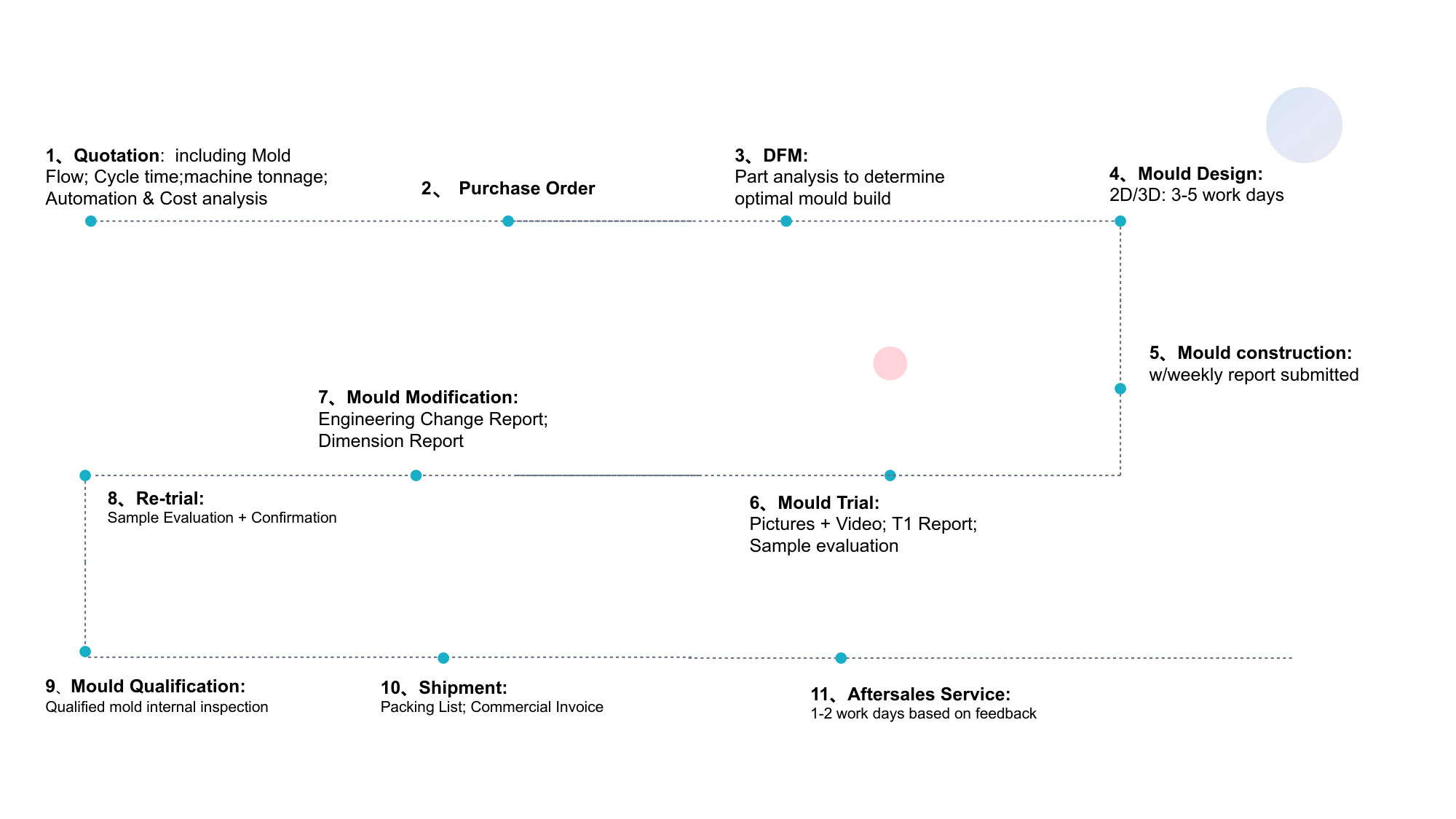
Ansix Tech manages new product introductions through a disciplined, phase-gated methodology that mirrors industry best practices while accommodating the specific requirements of transparent filter housing and cartridge programs .
Phase 1: Concept Validation and Prototyping
The NPI process begins with prototype development using rapid tooling — aluminum molds or 3D-printed inserts — to validate design concepts, fit, and basic functionality. For transparent parts, prototype molds may not replicate final optical quality, but they confirm geometry, assembly interfaces, and basic flow characteristics.
Phase 2: T1 Sample and Iteration
First steel (T1) samples are produced and subjected to rigorous dimensional and functional validation. Coordinate Measuring Machines (CMM) verify critical dimensions against 3D models, while pressure decay testing confirms sealing integrity for filter housings. Based on T1 results, iterative adjustments are made — gate sizing, venting, polishing specifications — typically converging within three adjustment cycles .
Phase 3: T2 Stability Confirmation
Once dimensional and functional requirements are satisfied, T2 trials confirm process stability. Long-run capability studies (30–50 parts from continuous production) establish statistical process control baselines, calculating CpK values for critical-to-quality features .
Phase 4: T3 Pre-Production Approval
The final validation phase occurs at customer-specified target conditions. A Production Part Approval Process (PPAP) submission includes full dimensional FAIR (First Article Inspection Report), material certifications, process capability data, and a production readiness certification. This comprehensive documentation enables the customer to authorize full production with confidence .
Phase 5: Small-Lot Pre-Production Validation
Before authorizing full-volume production, Ansix Tech offers 100–500 part "production trial" runs. These runs generate statistically meaningful lot yield data, confirm CpK on critical features, and produce a full process validation report with risk mitigation log. If CpK is unsatisfactory, adjustments are made before mass production begins — avoiding costly last-minute surprises .
Mass Production and Quality Assurance
Transitioning from validated process to sustained mass production requires rigorous controls and monitoring systems.
Scientific Molding Principles guide process establishment. Rather than relying on operator intuition, Ansix Tech uses data-driven methods to establish robust operating windows. Fill, pack, and cool phases are independently optimized based on rheological data and thermal analysis, producing processes that are repeatable and transferable across machines and production runs .
In-Process Quality Monitoring employs multiple inspection modalities:
Dimensional Inspection: Automated CMM systems verify roundness, concentricity, and critical tolerances in real time, with closed-loop feedback to molding parameters .
Optical Inspection: For transparent components, dedicated visual inspection stations with controlled lighting verify clarity, absence of visible weld lines, and surface finish quality.
Pressure Testing: Every filter housing undergoes pressure decay or hydrostatic testing to verify sealing performance and pressure containment capability .
Statistical Process Control: SPC charts track critical dimensions and process parameters, triggering corrective action when trends indicate drift.
Traceability systems link finished parts to specific production lots, material batches, and process parameters, enabling rapid root-cause analysis if field issues emerge.
Part III: Core Value Propositions — What Ansix Tech Delivers
Product Introduction: Transparent Filter Housing and Cartridge Mold
Transparent filter housings serve both functional and commercial purposes. Functionally, they contain and protect the filtration media, maintain sealing integrity under pressure, and provide structural support for connection interfaces. Commercially, transparency transforms the filter from a hidden component into a visible product feature — consumers can see contaminant accumulation, verify filter presence, and assess replacement necessity.
The manufacturing challenge lies in reconciling these objectives. Transparent materials — polycarbonate, co-polyester, clarified polypropylene, or specialty resins — exhibit processing sensitivities that opaque materials do not. They are unforgiving of weld lines, flow marks, and residual stresses that would be invisible in black or colored parts.
Production Process Overview
The production of transparent filter housings and cartridges follows a carefully controlled sequence:
Material Preparation begins with drying protocols calibrated to the specific resin's moisture sensitivity. Co-polyester resins, for example, demand moisture levels below 0.005% to achieve optical clarity and pressure integrity; material dried at higher moisture levels produces parts that either lose clarity or fail pressure testing . Ansix Tech implements inline moisture monitoring to ensure material conditions remain within specification.
Injection Molding utilizes precision temperature control, profiled injection velocity, and optimized packing pressure to achieve uniform filling and minimal residual stress. For transparent components, the packing phase receives particular attention: inadequate packing allows sink marks and internal voids that become clearly visible in transparent parts, while excessive packing introduces stress that manifests as stress cracking or warpage . Gas-assisted injection molding variants may be employed for thick-wall sections, introducing controlled internal pressure to reduce residual stress and minimize warpage.
Cooling System Design incorporates conformal cooling channels — cooling passages that follow the contour of the mold cavity at a consistent distance from the surface. Unlike conventional straight-drilled cooling lines, conformal channels enable uniform heat extraction across the mold surface, eliminating hot spots that cause uneven cooling, localized warping, and extended cycle times. Documented cases demonstrate cycle time reductions from 52 seconds to 36 seconds per part — a 28% throughput improvement — through conformal cooling implementation .
Ejection System Design for transparent parts requires meticulous attention to avoid stress marks and deformation. Ansix Tech employs multiple ejection techniques — sleeve ejectors, blade ejectors, air poppet valves — strategically positioned in challenging areas with limited space. Simulation tools predict deflection during ejection and prevent issues that would compromise part quality .
Delivery Efficiency
Delivery efficiency in mold manufacturing encompasses multiple dimensions: mold manufacturing lead time, production ramp-up speed, and ongoing production throughput.
Mold Manufacturing benefits from Ansix Tech's integrated infrastructure and streamlined workflows. In-house electrode manufacturing, EDM capacity, and modular mold base designs compress fabrication timelines. For transparent filter housing molds requiring specialized features — conformal cooling circuits, advanced venting, optical-grade polishing — the manufacturing process is sequenced to maintain quality while minimizing delays.
Production Throughput is enhanced by mold design features that reduce cycle time and increase output per shift. Hot runner systems eliminate cold runner waste and reduce material consumption while shortening cycle time . Multi-cavity configurations — appropriate for parts with volumes exceeding 100,000 units annually — amortize machine time and labor across multiple parts per cycle . For transparent parts, multi-cavity molds require precisely balanced filling to ensure optical consistency across cavities; Ansix Tech addresses this through balanced runner design and, where necessary, individual cavity temperature control.
Changeover Efficiency is supported by mold standardization: quick-change couplings for water and hydraulic connections, preset recipe libraries for each press, and SMED (Single Minute Exchange of Die) principles that minimize production interruption during mold changes .
Quality Assurance System
Quality assurance at Ansix Tech operates on multiple levels: design validation, process control, and finished-product verification.
The quality management system is ISO 9001:2015 certified, providing a structured framework for documentation, corrective action, and continuous improvement . For filtration products intended for potable water applications, additional compliance with NSF/ANSI 61 or equivalent standards is addressed through material selection and testing protocols.
Process Capability is quantified through CpK analysis on critical dimensions. Production processes are required to demonstrate CpK ≥ 1.33 for standard applications, with higher targets (≥ 1.67) for critical-to-function features such as sealing surfaces and thread dimensions. These capability levels far exceed industry norms and provide customers with assurance that dimensional consistency will be maintained across production lots .
Dimensional Verification employs Coordinate Measuring Machines (CMM) with automated programming for efficient batch inspection. Roundness, coaxiality, wall thickness, and thread geometry are verified against specifications. For transparent components, wall thickness control is particularly critical — variations in wall thickness produce optical distortion and affect pressure containment capability .
Cost Control Capability
Cost competitiveness in transparent filter housing production derives from multiple strategic levers, not merely labor rate differentials.
Material Cost Optimization begins with appropriate resin selection. Ansix Tech's material specialists evaluate cost-performance tradeoffs across candidate resins, recommending alternatives that maintain or exceed performance requirements while reducing resin cost by 15–30%. For non-visible structural components, substitution of premium grades with standard equivalents may be viable. For applications with ESG objectives, integration of up to 30% post-industrial recycled (PIR) resin streams is possible without compromising mechanical properties or regulatory certifications .
Cycle Time Reduction directly impacts per-part cost. Cooling phase optimization — cooling represents 60–80% of total cycle time in typical injection molding — yields disproportionate benefits. Conformal cooling, high-conductivity mold materials, and optimized cooling circuit design reduce cooling time by 15–25% compared to standard layouts. For a 300-gram cartridge molded in an 8-cavity tool running three shifts, this translates to approximately 120,000 additional parts annually without capital investment .
Defect Prevention eliminates the costs of scrap, rework, and sorting. By addressing potential defects at the design stage through DFM and Moldflow analysis, Ansix Tech reduces defect rates from design inception. Process validation and SPC maintain consistent quality during production, minimizing the labor and material waste associated with quality escapes .
Secondary Operation Elimination reduces post-molding costs. Flash-controlled parting line design confines flash to ≤ 0.03mm, eliminating manual deburring requirements and saving approximately 12 minutes per 1,000 parts in secondary operation labor .
After-Sales Service and Lifetime Support
Ansix Tech's commitment extends beyond mold delivery. The company provides comprehensive after-sales support designed to minimize customer downtime and protect their production investments.
Spare Parts Inclusion: Each mold ships with a standard spare parts kit containing replacement ejector pins, core pins, leader pins, and wear plates — precisely the components likely to require replacement after 250,000 shots. These parts are sourced, certified, and included at no additional charge .
Documented Maintenance Schedules: A plant-floor-ready maintenance logbook documents lubrication points, torque specifications, cleaning intervals, and wear check points for every 200,000 injection cycles. This documentation enables customer maintenance teams to perform preventive maintenance systematically .
Spare Mold Cavity/Insert Storage: For single-cavity molds or expensive inserts, Ansix Tech retains a complete spare assembly in bonded storage, ready for immediate shipment should wear exceed acceptable limits. This eliminates the weeks-long lead time typically associated with replacement cavity procurement .
Lifetime Repair Service: Ansix Tech offers lifetime repair at cost-plus materials. No "obsolete tooling" situations; no expensive re-procurement of entire mold assemblies when only a specific component requires replacement. Most repairs are returned to service within 24 hours, minimizing production interruption .
Accelerated Aging Validation: Before delivery, high-volume molds undergo accelerated aging testing — 2,000 injection shots using the customer's target resin, with full wear report provided. This pre-delivery validation identifies potential wear issues before they impact production and supports a three-year mold structural warranty (excluding normal wear consumables) .
Part IV: Advanced Technologies and Process Innovation
Conformal Cooling: Revolutionizing Cycle Time and Quality
Conformal cooling represents one of the most significant advances in injection mold thermal management. Unlike conventional cooling channels — straight-drilled passages that approximate the mold cavity shape but cannot follow complex contours — conformal cooling channels are produced through additive manufacturing techniques, allowing them to precisely follow the cavity surface at a consistent distance.
The benefits for transparent filter housing production are substantial :
Uniform Heat Extraction: Conformal channels maintain consistent distance from the cavity surface, eliminating the hot spots that occur where conventional cooling lines deviate from the part contour. For transparent parts, uniform cooling is essential to prevent localized shrinkage and optical distortion.
Cycle Time Reduction: Documented implementations demonstrate cycle time reductions from 52 seconds to 36 seconds per part — a 28% improvement in production throughput. For high-volume programs, this efficiency compounds into significant operational savings.
Warpage Reduction: Uniform cooling reduces differential shrinkage and the residual stresses that cause warpage. For large, thin-wall filter housings, warpage control is critical for assembly fit and sealing performance.
Quality Improvement: By eliminating hot spots and promoting uniform cooling, conformal cooling reduces the incidence of sink marks, internal voids, and dimensional variation — all of which are particularly visible in transparent components.
Hot Runner Systems: Efficiency and Material Conservation
Ansix Tech frequently specifies hot runner systems for transparent filter housing molds, particularly in high-volume applications .
Material Savings: Hot runner systems maintain plastic in a molten state within the manifold and nozzle, eliminating the solid sprue and runner waste associated with cold runner systems. For transparent resins — often specialty materials with significant cost per kilogram — this material conservation delivers direct cost reduction.
Cycle Time Reduction: By eliminating the need to cool and eject runners, hot runner systems reduce overall cycle time. The elimination of runner handling also reduces labor requirements and the risk of contamination.
Quality Improvement: Hot runner systems enable more precise control over filling and packing, improving part consistency. Sequential valve gate systems can be programmed to control melt flow advancement, relocating weld lines to non-critical areas — a capability particularly valuable for transparent parts where weld line visibility is a primary concern.
Multi-Cavity Mold Technology
For programs with annual volumes exceeding 100,000 units, multi-cavity molds amortize tooling investment across multiple parts per cycle .
Economic Rationale: While initial tooling investment increases with cavity count, the reduction in per-part cost achieved through amortized machine time and labor creates compelling economics for high-volume programs.
Technical Challenges for Transparent Parts: Multi-cavity molds for transparent components present specific challenges. Each cavity must receive precisely balanced filling; any variation in flow resistance produces different packing characteristics and visible differences in part quality between cavities. Ansix Tech addresses these challenges through balanced runner design, flow simulation for each cavity, and — where necessary — individual cavity temperature control to maintain optical consistency across all cavities.
Scientific Molding and Process Optimization
Ansix Tech applies scientific molding principles — a data-driven approach to process development — rather than relying on operator experience and trial-and-error .
Robust Operating Window Establishment: Process parameters (temperature, pressure, time) are systematically varied to establish a robust operating window — a range of conditions within which the process produces acceptable parts. This approach ensures that normal process variation does not produce defects.
Process Capability Optimization: Once the operating window is established, parameters are optimized to maximize CpK on critical-to-quality features. The objective is not merely to produce acceptable parts, but to produce them with sufficient margin that process drift and normal variation do not compromise quality.
Process Transferability: Scientific molding produces processes that are documented, understood, and transferable. When production scales or transfers to additional machines, the process can be replicated without extensive re-development.
Part V: The Ansix Tech Difference — Translating Expertise into Customer Value
Solving the Weld Line Visibility Problem
For transparent filter housings, visible weld lines are the most common quality complaint. These lines form where separate flow fronts meet during mold filling, and in transparent parts, they are immediately visible — often perceived by end users as cracks or defects.
Ansix Tech's approach to weld line control combines multiple strategies :
Flow Simulation Before Steel Cutting: Moldflow analysis predicts weld line locations before mold manufacturing begins. If predicted weld lines fall on visible surfaces, gate locations are adjusted or part geometry is modified to relocate flow front merging to hidden areas.
Strategic Gate Placement: For small filter housings, a single offset gate allows the flow front to fill the entire clear panel without merging. For larger housings, dual offset gates balance fill pressure, ensuring flow fronts merge in hidden base or flange regions.
Hot Runner and Valve Gate Sequencing: Sequential valve gate systems can control flow front advancement, ensuring that merging occurs in predetermined, non-visible locations.
Process Optimization: Even with optimized gate placement, process parameters — particularly injection velocity and packing profile — influence weld line appearance. Ansix Tech optimizes these parameters during T1 and T2 trials to minimize visible evidence of flow front merging.
Eliminating Warpage in Thin-Wall Transparent Housings
Warpage — dimensional distortion resulting from uneven shrinkage and residual stress — is a persistent challenge in thin-wall transparent housings. Polypropylene, a common material for food-grade filter components, exhibits shrinkage rates of 1–2%, a challenge amplified by large part dimensions and thin walls .
Ansix Tech's warpage control strategy addresses root causes at multiple levels :
Design-Stage Countermeasures: DFM analysis identifies warpage risk factors and proposes design modifications — optimized gate placement to ensure uniform melt flow, conformal cooling channels tailored to the housing geometry, and controlled steel tolerances that account for material shrinkage characteristics.
Process-Stage Controls: Scientific molding establishes fill rates that balance premature cooling against uneven molecular orientation, graduated packing profiles that reduce uneven shrinkage across thick and thin wall sections, and tight temperature control for both melt and mold.
Post-Molding Fixturing: For large thin-wall housings, custom-designed holding fixtures maintain part dimensions while residual stress dissipates after ejection. This simple but effective measure locks in flatness and prevents post-ejection warping.
Reducing Customer Risk Through Validation
The financial risk of a mold that fails to perform as expected — or that requires extensive modification before producing acceptable parts — can be significant. Ansix Tech's validation protocols are designed to reduce this risk to near zero.
Pre-Delivery Accelerated Aging: High-volume molds undergo 2,000-shot accelerated aging tests using the customer's target resin, with full wear report provided. This identifies potential wear or performance issues before the mold is shipped .
Process Capability Documentation: CpK analysis on critical features, with capability indices exceeding 1.67 for key dimensions, provides quantifiable assurance that the process will produce conforming parts consistently .
PPAP Submission: The Production Part Approval Process submission includes full dimensional FAIR, material certifications, process capability data, and production readiness certification — a comprehensive documentation package that supports the customer's own quality and regulatory requirements .
Delivering Cost Competitiveness Without Compromising Quality
In the competitive filtration products market, cost control is essential — but not at the expense of quality. Ansix Tech's cost strategy targets multiple levers simultaneously :
Cycle Time Reduction: Conformal cooling, hot runner systems, and scientific molding combine to reduce cycle time by 15–28% compared to conventional approaches — directly reducing per-part cost.
Material Optimization: Appropriate resin selection, wall thickness optimization, and recycled content integration (where performance requirements permit) reduce material cost by 15–30%.
Defect Reduction: DFM and Moldflow analysis prevent defects at the design stage; SPC maintains process control during production. The combined effect is a dramatic reduction in scrap, rework, and sorting costs.
Secondary Operation Elimination: Flash control and gate design that eliminates post-mold trimming reduce labor costs by approximately 12 minutes per 1,000 parts.
Conclusion: The Ansix Tech Advantage
Ansix Tech's position at the forefront of transparent filter housing and cartridge mold manufacturing is built on a foundation of technical depth, systematic processes, and customer-centric values. The company's capabilities span the entire product lifecycle — from DFM analysis and Moldflow simulation through mold manufacturing, process validation, mass production, and lifetime support.
For customers, this translates into tangible benefits: molds that produce parts with optical clarity and structural integrity from the first shot; production processes with capability indices that exceed industry standards; per-part costs that reflect optimized material usage and cycle time; and support systems that minimize downtime and protect capital investments.
The fundamental difference is philosophical: Ansix Tech does not merely manufacture molds and molded parts. The company solves problems. Transparent filter housings present specific challenges — weld line visibility, warpage control, pressure containment, optical quality — and Ansix Tech has developed the expertise, the processes, and the infrastructure to address each of these challenges systematically. That capability, translated into customer value, is what separates the company from its competitors and positions it as a trusted partner for filtration product manufacturers worldwide.
Ansix Tech Co Ltd
If you have any plans related to Transparent filter housing and cartridge mold , you can contact us at any time. We will turn your ideas into reality, let you realize your dreams, and obtain large orders from the market. Our contact information is info@ansixtech.com. Or contact our CTO, mail: stephen@ansixtech.com
#www.ansixtech.com #ansixtech.com #Transparent filter housing and cartridge mold #Mold for automotive daytime running light guide strip #Transparent filter housing and cartridge mold injection mold companies #Ansix #Ansix moulds #Ansix china #Ansix tech china #Ansix tech company #Ansix facotry #Ansix Tooling #Ansix tool #Transparent filter housing and cartridge mold injection molding #Transparent filter housing and cartridge mold injection tools #Transparent filter housing and cartridge mold injection moulds #Ansix moulding company #Ansix molding #ansix tooling #Transparent filter housing and cartridge mold plastic mould #Transparent filter housing and cartridge mold plastic tools #Ansix Tech #Ansix molds #Ansix injection molding #Ansix mold factory #Transparent filter housing and cartridge mold injection molding Customized #Ansix mold factory #Transparent filter housing and cartridge mold china #Transparent filter housing and cartridge mold molds #injection factory for Transparent filter housing and cartridge mold #Transparent filter housing and cartridge mold injection molding #Transparent filter housing and cartridge mold injection molding factory #injection molding company #Transparent filter housing and cartridge mold injection mold companies #Mold for automotive daytime running light guide strip #Transparent filter housing and cartridge mold mold limited #Ansix mold china #Ansix companies for Transparent filter housing and cartridge mold #Ansix company China #Transparent filter housing and cartridge mold facotry #Ansix Tech #Ansix Tech mould #Transparent filter housing and cartridge mold injection moulding #Transparent filter housing and cartridge mold injection moulding company #Ansix Transparent filter housing and cartridge mold parts injection mold companies #Transparent filter housing and cartridge mold injection molding companies china #Transparent filter housing and cartridge mold china factory #Ansix moulding companies #Ansix molding company #Transparent filter housing and cartridge mold injection moulding facotry #Ansix Tech mold #Transparent filter housing and cartridge mold mould #Transparent filter housing and cartridge mold plastic injection molding #ansix plastic mold #Transparent filter housing and cartridge mold Mold manufacturing #Transparent filter housing and cartridge mold parts manufacturing #Transparent filter housing and cartridge mold plastic parts factory #Transparent filter housing and cartridge mold injection parts mold #Transparent filter housing and cartridge mold PRECISION MANUFACTURING #Transparent filter housing and cartridge mold TOOL #China Transparent filter housing and cartridge mold mold #Transparent filter housing and cartridge mold injection moulding china #Transparent filter housing and cartridge mold mould china #china precision mold #Transparent filter housing and cartridge mold mold in china #Transparent filter housing and cartridge mold mold china #Transparent filter housing and cartridge mold Precision molds #High-precision molds #Transparent filter housing and cartridge mold High-precision tool #Injection molds #Transparent filter housing and cartridge moldFactory #Transparent filter housing and cartridge moldCompany #Super Large Injection Mold Factory #Large Tonnage Injection Molding Factory #Transparent filter housing and cartridge mold Company #Transparent filter housing and cartridge mold Factory #2800T Injection Molding Factory #3000 Ton Injection Molding #4500 Ton Injection Molding Factory #Transparent filter housing and cartridge mold Large Mold Injection Molding #Large Plastic Mold Injection Molding Factory #Transparent filter housing and cartridge mold Large Injection Mold Manufacturer #Transparent filter housing and cartridge mold Plastic Mold Factory #Injection Mold #Plastic Mold