



12-cavity PET candy jar PET tube preform mold
FEATURES
Hard Power Foundation — Building Customer Confidence Through Equipment Excellence
Customers need to trust that you have the physical capabilities to deliver on your promises. At Ansix Tech, our equipment speaks for itself.
I. Precision Mold Manufacturing Equipment
The precision of any mold is directly constrained by the capabilities of the machines that build it. Ansix Tech is equipped with a complete suite of advanced manufacturing technologies:
Five-Axis High-Speed Machining Centers: Our five-axis machining centers achieve positional accuracy down to 0.002mm (2 microns). For 12-cavity PET candy jar molds, this capability ensures that parting lines remain smooth and burr-free across all cavities. The continuous five-axis contouring eliminates tool marks that would otherwise become stress concentrators or cosmetic defects. More importantly, consistent cavity geometry means every preform produced in cavity #1 is identical to cavity #12, eliminating the need for cavity-specific quality sorting downstream.
-
Mold Description
Product Materials:
PET PETG
Mold Material:
S136ESR
Number of Cavities:
1*12
Glue Feeding Method:
Hot runner
Cooling Method:
Water cooling
Molding Cycle
16.5s
- The mold manufacturing process and product material selection
Slow-Wire EDM (Electrical Discharge Machining): Many critical features of a 12-cavity preform mold—such as the 0.03mm thin-wall gaps at the neck thread undercuts, the narrow slots for core pullers, and the micro-gates in the hot runner system—simply cannot be machined with conventional milling cutters. Our slow-wire EDM equipment processes these features with exceptional surface finish and zero residual stress. A key advantage: slow-wire EDM does not induce mechanical deformation during cutting, preserving the metallurgical integrity of the steel and preventing thin-wall deformation that could compromise preform concentricity.
Coordinate Measuring Machine (CMM) & Optical Inspection: We maintain dedicated CMM and high-resolution optical inspection equipment in temperature-controlled metrology rooms. Every cavity insert, core pin, and hot runner component is scanned and validated against the original CAD model before assembly. For critical features such as neck finish dimensions, gate position, and ejection pin locations, we generate full dimensional inspection reports in PDF format, ready for customer audit at any time.
-
CNC Lathes and Grinding Equipment: Precision roundness on core pins and cavity inserts is fundamental to PET preform thickness control. Our CNC cylindrical grinding equipment achieves roundness within 0.003mm and surface finishes below Ra 0.1μm, directly translating to preforms with wall thickness variation less than 0.05mm across 360 degrees of circumference.
II. Injection Molding Machine Fleet for Validation
We are not just a mold maker—we understand the molding process intimately. Ansix Tech maintains an in-house molding facility with injection molding machines spanning from 30 tons to 4000 tons clamping force.
30–200 ton class machines are used for precision prototype validation and small-batch sampling of preform molds.
400–800 ton class machines are the sweet spot for 12-cavity PET preform molds producing candy jars of typical 50–200g shot weights.
1000+ ton class machines serve ultra-large format preforms or stacked mold configurations where multiple-layer production doubles output without increasing floor space.
All our injection molding machines are servo-electric driven, delivering repeatable injection precision with ±0.1% shot-to-shot weight consistency. This stability is critical during mold validation: if the molding machine itself introduces variation, you cannot distinguish between mold issues and machine issues. Our servo-electric fleet eliminates that variable, giving you confidence that the mold—not the press—will perform predictably in your facility, on your equipment, with your operators.
III. Advanced Metrology and Quality Assurance Infrastructure
Measurement is the bridge between digital design and physical reality. Our quality assurance infrastructure includes:
CMM with scanning probe capable of measuring complex free-form surfaces
Optical comparator and vision measurement systems for fine feature verification
Surface roughness tester to validate Ra values on optical-grade preform cavities
Hardness tester to verify heat treatment results on every steel component
Gauge pin sets and custom functional gauges for thread and neck finish checks
Customer value delivered: Every mold leaving Ansix Tech comes with a complete dimensional inspection report. Key dimensions—including cavity ID, core OD, gate orifice diameter, ejector pin stroke, and cooling channel positions—are validated with documented CPK (Process Capability Index) values. We target CPK ≥1.33 on all dimensions critical to preform quality, meaning our process is capable of producing parts within specification 99.99% of the time under normal operating conditions.
Part Two: Mold Manufacturing Core Competencies — Speaking in Numbers, Delivering in Confidence
Customers care about four things in a mold: life, precision, lead time, and maintenance cost. Here is how Ansix Tech delivers measurable advantages in each dimension.
I. Mold Life and Material Strategy
A mold is an investment. The longer it runs, the lower your amortized cost per part. Our 12-cavity PET candy jar preform molds are built for longevity through strategic material selection:
Mold Base: P20 steel (pre-hardened to 30–36 HRC) provides a stable foundation. We apply chrome plating or nickel plating to the base to prevent corrosion in humid production environments.
Core and Cavity Inserts: For standard PET applications without glass fiber reinforcement, we use S136 stainless steel hardened to 48–52 HRC. S136 offers excellent corrosion resistance against the acidic residues generated during PET injection, and its ability to achieve mirror finish (Ra <0.05μm) is essential for transparent preform appearance. With S136, we guarantee 1 million+ shot cycles before any meaningful wear.
For Glass-Filled Applications (PET + GF30/GF40): Glass fibers are abrasive and will destroy standard S136 quickly. For these demanding applications, we specify H13 or 8407 hot work die steel, hardened to 52–56 HRC, with optional PVD (Physical Vapor Deposition) coating to further enhance wear resistance. H13 maintains its hardness at elevated temperatures, preventing the thermal softening that leads to premature wear.
Neck Ring and Thread Components: The neck finish is the most dimensionally sensitive region of the entire preform. We manufacture neck rings from SKD61 or DC53, specialized tool steels offering exceptional hardness (58–62 HRC) combined with toughness to resist cracking under cyclic clamping loads.
Sliding Components (Wear Plates, Slides): Graphite-embedded copper plates or bronze alloys provide self-lubricating properties, reducing maintenance frequency and preventing galling between moving surfaces.
The customer-friendly commitment: We provide documented material certifications (mill certificates) and heat treatment temperature curves for every critical mold component. When we say the mold will achieve 1 million cycles under normal production conditions, we can prove the metallurgy behind that claim.
II. Achievable Tolerances — What You Can Actually Expect
Feature Type Typical Tolerance Customer Benefit
General structural dimensions ±0.05mm Reliable assembly, no interference fits
Critical cavity/core diameters ±0.01mm Consistent preform wall thickness, reduced blow-molding rejects
Thread pitch and profile ±0.02mm Leak-proof sealing with caps, consistent torque values
Gate orifice diameter ±0.005mm Uniform filling across all 12 cavities, balanced part weights
For precision-critical applications such as pharmaceutical preforms or ultra-lightweight beverage preforms, we can achieve ±0.005mm on specific features through specialized grinding and EDM finishing processes. Each mold receives individual attention, and we communicate expected tolerances transparently before manufacturing begins.
III. Mold Types and Configurations
Different production volumes and part geometries demand different mold architectures:
Hot Runner with Valve Gate System — Our Standard Recommendation for 12-Cavity PET Preform Molds
The hot runner system is arguably the most technically complex component of any multi-cavity preform mold. In a 12-cavity configuration, the plastic melt must travel from the injection machine nozzle, through a distribution manifold, and into twelve individual cavities with nearly identical flow resistance, temperature profile, and pressure history.
Ansix Tech implements fully balanced hot runner systems with independent valve pin gates at each cavity. The valve pin mechanism mechanically opens and closes the gate at precisely the right moment, cutting off the melt cleanly at the end of the filling/holding phase. This valve gate approach eliminates the “preform tail” that would otherwise require secondary trimming or degating operations.
Key features of our hot runner design:
Individual temperature control zones: Each cavity nozzle has its own thermocouple and heater, preventing cavity-to-cavity temperature drift.
Short flow paths: The melt distribution manifold is designed to minimize residence time (the time plastic spends at elevated temperature), reducing the risk of PET degradation and acetaldehyde (AA) generation.
Italian-sourced hot runner components: For customers requiring premium hardware, we install hot runner systems from Italian manufacturers known for reliability in high-cycle PET applications.
Customer benefit:
No post-molding degating → less labor, less equipment, less scrap.
Clean gate vestige → improved cosmetic appearance for candy jar applications.
Balanced filling → consistent preform weights (±0.2% across cavities), which directly translates to consistent final bottle wall thickness after stretch blow molding.
Alternate Configurations:
Mold Type Best For Customer Value
Cold runner (three-plate) Low-volume production, prototyping Lower initial tooling investment
Stacked molds High-volume, space-constrained facilities Double output per machine cycle without increasing footprint
Two-shot / overmolding Multi-material candy jars (e.g., silicone seal + PET body) Single production step replaces assembly
High-polish mirror finish (Ra <0.05μm) Clear, transparent candy jars with no surface defects Premium appearance, no downstream polishing
IV. Gate and Runner Design Optimization
Poor gate placement is the single most common cause of preform defects. We invest heavily in mold flow analysis before any steel is cut:
Using Moldex3D software, we simulate the entire filling, packing, and cooling phases of the injection cycle.
We predict and visualize weld line locations (where two flow fronts meet) and air trap positions (where air becomes trapped and cannot escape). For candy jars, weld lines on visible surfaces are unacceptable—our simulation ensures weld lines are positioned in non-critical areas such as the preform bottom or hidden under the neck ring.
We calculate shear rate and shear stress profiles throughout the melt delivery system. Excessive shear degrades PET molecular weight (lowering IV, intrinsic viscosity), which leads to weak points in the final blown container. Our designs keep shear rates within the safe range for the specific PET resin grade being used.
We optimize gate location and number to ensure balanced filling across all 12 cavities. A poorly balanced hot runner will result in some cavities receiving melt sooner/hotter than others, producing preforms with different weights, wall thicknesses, and molecular orientation patterns—a disaster for blow molding consistency downstream.
The customer value: By addressing weld lines, air traps, and flow imbalances in the digital design phase, we prevent these problems from ever appearing on your production floor. No troubleshooting time during production trials. No scrap. No delayed product launches.
V. Standard Lead Times — Predictable and Reliable
Mold Complexity Standard Lead Time Expedited Option Condition for Expediting
Simple mold (≤8 cavities, basic design) 20–30 days 14 days Customer provides final-approved 3D model
Medium complexity (12 cavities, standard hot runner) 30–45 days 25 days Existing design family, no new features
Complex (12 cavities with advanced features) 45–60 days 35–40 days Customer accepts reduced sampling rounds
For expedited orders, we maintain a parallel workflow: rough machining and heat treatment on certain components overlap with design finalization. However, we never compromise the validation phase—every expedited mold still receives full T0, T1, T2, and T3 trial sampling, with documented reports. A mold that ships fast but fails in production helps no one.
Part Three: Injection Molding Process Control — Eliminating Customer Quality Anxiety
Customers fear quality defects because defects mean scrap, and scrap means lost money. Here is how Ansix Tech controls and documents every variable that matters.
I. Process Standardization Through MES Integration
All of our injection molding machines are networked into a Manufacturing Execution System (MES) . Every production parameter—temperature zones (barrel, nozzle, hot runner), injection pressure, injection speed profile, holding pressure stages, screw rotation speed, back pressure, cooling time, and mold open/close speeds—is locked and recorded.
Only authorized process engineers can modify machine parameters.
Any parameter change requires documented approval and triggers an automatic “revalidation” alert.
We maintain recipe libraries for every mold type. When the same mold runs again in the future—even months later—the exact same proven process parameters are loaded from the database.
First-article and last-article inspection: For every production shift, we retain the first molded preform and the last molded preform from each cavity. These samples are dimensionally measured and visually inspected. If the last-article matches the first-article within specification, you have documented proof that the process remained stable throughout the entire production shift.
II. Dimensional Stability Control — Defeating Shrinkage, Warpage, and Drift
The enemy of dimensional stability in PET injection molding is uneven cooling. Here is how we attack it:
Modular Temperature Control: Our molds are designed with multiple independent cooling zones—typically separate water circuits for the cavity block, core block, neck ring region, and hot runner manifold. Each zone is connected to a dedicated mold temperature controller unit with adjustable setpoint.
Zone 1 (Cavities): 10–15°C (rapid cooling to freeze the outer skin)
Zone 2 (Cores): 25–35°C (slower cooling to allow controlled crystallization)
Zone 3 (Neck region): 40–60°C (intentionally hotter to promote crystallinity for thread strength)
Zone 4 (Hot runner manifold): 260–280°C (maintaining melt fluidity until gate closure)
The key is temperature differential control between core and cavity. We keep the temperature difference between these two mold halves within 2°C of the design target, which minimizes the thermal stresses that cause preform warpage and ovality. For critical applications, we machine spiral cooling channels directly into the mold plates, providing far more efficient heat transfer than traditional straight-drilled channels.
Water flow analysis: We simulate water flow through the cooling network to ensure turbulent flow (Reynolds number >4000) throughout the system. Turbulent flow extracts heat far more efficiently than laminar flow, reducing cycle time while improving cooling uniformity.
The result: On a recent 12-cavity candy jar preform project, we demonstrated batch-to-batch dimensional stability with the following measured results across three consecutive production runs (1,000 shots per run):
Key Dimension Measured Variation Across Batches Customer Requirement
Overall length ±0.02mm ±0.08mm
Neck thread OD ±0.008mm ±0.025mm
Core hole position ±0.015mm ±0.05mm
Customer benefit: When dimensions are stable batch after batch, you can plan your downstream blow molding operations with confidence. No surprise line stoppages to adjust tooling. No wasted containers due to inconsistent preform geometry.
III. Appearance Standards — Crystal Clear or Matched Exactly
For candy jar preforms, appearance is nearly as important as dimensional accuracy. Candy jars sit on retail shelves—consumers see the container before they taste the contents.
Transparent PET Preforms:
We maintain cavity surface finishes at Ra ≤0.05μm (mirror polish, SPI-A1 equivalent).
The mold design incorporates generous radius at all internal corners to prevent flow hesitation that leads to flow lines or blush marks.
Venting channels are precisely positioned to allow trapped air to escape without forming bubbles visible in the final preform.
Our in-process inspection includes polarized light inspection, which reveals internal stress patterns that are invisible under normal lighting but cause warpage or haze after blow molding.
Colored or Opaque Candy Jars:
Consistent color dispersion throughout the preform requires careful screw and barrel design. Our molding process ensures complete colorant mixing before the melt enters the cavities.
We identify and eliminate gas traps (air that cannot escape and creates a visible void) through ventilation at the last point the melt reaches in each cavity.
Surface Texture (Mold-Tech or Equivalent):
If your final container requires a matte, textured, or branded surface, we apply the appropriate texture to the cavity surface via EDM or chemical etching. The texture transfers exactly from mold to preform to final blown container.
IV. Specialty Material Capabilities — When Standard PET Isn‘t Enough
Not every candy jar is made from standard bottle-grade PET. Ansix Tech has production experience across a wide range of engineering thermoplastics:
Material Key Properties Application Example
PC/ABS (Polycarbonate/ABS blend) Impact resistance, heat resistance Candy jars for hot-fill applications
PPS + 40% GF Ultra-high stiffness, chemical resistance, continuous use to 200°C Industrial candy jars exposed to solvents
PEEK (Polyether Ether Ketone) Continuous use to 250°C, exceptional chemical and wear resistance Pharmaceutical candy jars, surgical packaging
PEI (Polyetherimide) High heat deflection (210°C), inherent flame retardancy (UL94 V-0) Electronics packaging, medical applications
PA6 + GF30 (Nylon 6 + 30% Glass) Mechanical strength, thermal stability Industrial containers needing high load capacity
LCP (Liquid Crystal Polymer) Ultra-low viscosity, high flow length, dimensional stability Thin-wall containers requiring <1mm wall thickness
Liquid Silicone Rubber (LSR) Flexibility, heat resistance, food contact safety Sealing gaskets or soft-touch overmolded features
PBT / PET (modified) Electrical insulation, chemical resistance Electronic component housings
Biodegradable Materials (PLA, PHA) Sustainable, compostable Eco-friendly candy jar lines
For flame-retardant applications requiring UL94 V-0 rating, we validate material drying protocols and process parameters that preserve the flame retardant additive’s effectiveness. For outdoor-exposed candy jars requiring UV resistance (e.g., promotional jars placed in sunlight), we test to 3000 hours UV exposure with color and mechanical property retention documented.
Customer value: You don‘t need to qualify a new material on your own. Ansix Tech already has the validated recipes, drying protocols, and mold designs for these materials. You simply specify your material—we have a proven process ready to deploy.
Part Four: Full-Process Service — Reducing Your Management Cost
The true cost of a mold includes not just the purchase price, but also the cost of your team’s time managing it. Ansix Tech reduces management cost by owning the entire lifecycle.
I. Early Intervention — DFM (Design for Manufacturability) Report
We provide a comprehensive DFM Analysis Report before you commit to tooling. This report costs you nothing upfront but saves you thousands in avoided mistakes.
The DFM report includes:
Draft angle recommendations: We identify areas where insufficient draft angle will cause ejection issues (sticking parts, scratched surfaces, excessive ejection pin marks). We recommend specific draft angles based on material shrinkage and cavity depth.
Wall thickness optimization: We simulate wall thickness distribution in the final blown container, then back-calculate the ideal preform thickness profile. Uniform wall thickness in the preform is NOT always the goal—we strategically vary thickness along the preform length to optimize material distribution in the final container.
Gate location and pin mark allowance: We propose gate placement based on cosmetic requirements. We also specify where ejection pin marks are allowed (and where they are not), preventing later disputes about marks appearing on premium surfaces.
Assembly and function check: If your candy jar includes a closure, hinge, or insert, we model the assembly interface and identify interference risks.
The customer value: Imagine opening a mold after 8 weeks of waiting, only to discover that a non-obvious design feature prevents ejection or causes visible defects on the customer-facing surface. This happens regularly when customers work with mold makers who only execute orders without engineering input. With Ansix Tech, you receive a signed DFM report before cutting steel. If we later discover a design issue that should have been flagged in DFM, we fix it at our own cost.
II. Trial Sampling — T0 through T3 with Full Documentation
We conduct four progressive sampling rounds on every production mold:
Sampling Stage Purpose Deliverable
T0 (First shot) Verify basic function: no short shots, no flashing, clean ejection Sample parts, photos, function checklist
T1 (First optimization) Adjust process parameters based on T0 findings. Balance cavity filling. Updated process recipe, improved samples
T2 (Stability confirmation) Long run (minimum 1 hour continuous production). Measure CPK on key dimensions. CPK report, first-article inspection results
T3 (Pre-shipment validation) Simulate customer production environment (planned cycle time, planned cooling) Final process recipe, sample set for customer approval
Between each sampling round, we issue a written Trial Improvement Report documenting:
What was observed during the trial
What corrective actions were taken
Supporting data (dimensional measurements, weight checks, visual inspection photos)
Quick-change insert capability: For customers evaluating multiple design variations (e.g., different preform lengths, different neck sizes, different gate geometries), we design the mold with replaceable inserts. Changing an insert costs a fraction of building a whole new mold, allowing efficient A/B testing of designs without major investment.
III. Pre-Production Validation — Small-Batch Verification
A mold that works perfectly in our facility may behave differently in yours, due to differences in water temperature, machine age, operator skill, or resin lot. We help you de-risk this transition.
100–500 shot pre-production run:
We run the mold on our equipment with your specified resin type (and your specific resin lot, if you supply it).
We measure every preform across all 12 cavities for weight and key dimensions.
We calculate cavity-specific CPK and overall mold capability.
We issue a Mold Acceptance Test Report summarizing all data.
Only after you sign off on this report do we release the mold for shipment.
Customer value: You receive a mold that is already validated. Your team does not need to schedule on-site debugging days. The mold arrives, mounts on your press, and with minimal tweaking (if any) runs within specification on day one. Those saved days of downtime can easily exceed the cost of the mold itself.
IV. Maintenance, Spare Parts, and Support
We don‘t disappear after delivery. We want your mold to run for years because a running mold generates repeat business.
Spare parts kit: Every mold ships with a comprehensive spare parts kit including:
2 extra ejection pins per pin type used in the mold
1 extra core/cavity insert (for the most wear-prone cavity position)
1 set of extra wear plates
1 extra thermocouple and heater band for the hot runner
1 set of valve pins and pin guides for the valve gate system
Maintenance schedule provided:
Every 100,000 cycles: clean and inspect cooling channels
Every 300,000 cycles: replace wear plates, check core/cavity clearance
Every 500,000 cycles: inspect hot runner nozzles for wear, replace valve pins if worn
Lifetime repair policy: Ansix Tech performs mold repairs at cost plus a small service fee (no profit markup on parts or labor). We want you to maintain the mold rather than scrapping it and buying from a lower-cost competitor. A customer with a repaired mold is still a customer—a customer who scrapped a mold is lost forever.
Part Five: Differentiation — Addressing Common Customer Complaints Head-On
Industry surveys consistently identify five major mold-related pain points. Here is how Ansix Tech directly addresses each one:
Customer Complaint Common Industry Response Ansix Tech‘s Specific Commitment
“The mold keeps breaking down and shutting down my production line.” “We warranty our mold for 1 year against manufacturing defects.” We run a 2,000-shot wear test and provide a documented wear report before shipping. We also offer 3-year structural warranty (excluding consumables like ejector pins). If the mold’s steel structure cracks or deforms within 3 years under normal use, we repair or replace at no cost.
“My preforms always have flashing. I spend hours with a knife trimming them before blow molding.” “You need to adjust your machine parameters.” We machine parting lines to 0.005mm flatness across the entire split surface. Our molds are built with self-locking clamping force compensation—the mold design physically prevents the plates from separating under injection pressure. Flashing height is guaranteed below 0.03mm, eliminating the need for manual deflashing.
“Every batch of preforms comes out different dimensions. I can‘t hold a stable blow molding process.” “You need to control your cooling water better.” All critical dimensions are validated with CPK ≥1.33 before shipment. Our MES-integrated process controls lock parameters so they cannot drift. For ongoing production, we recommend mold-mounted cavity pressure sensors and mold temperature sensors connected to your machine’s adaptive control system—we can help specify and integrate these components.
“When I need a repair, my mold shop takes 2-3 weeks to send the mold back.” “Lead times vary based on workload.” Ansix Tech has an in-house electrode manufacturing center and EDM workshop. We do not outsource repair work. Standard repairs (crack welding, cavity resurfacing, ejector pin replacement) are typically completed within 24–48 hours from receipt of the mold.
“I pay for a high-cavity mold but never actually achieve the rated cycles—the machine always has to slow down for cooling.” “Cooling is a function of your machine water supply.” Our cooling channel designs are optimized using CFD (Computational Fluid Dynamics) to maximize heat transfer. For PET preforms where cooling accounts for up to 80% of total cycle time [16†L10-L11], our designs consistently achieve cycle times under 12–15 seconds for typical 20–25g preforms. We can show you the CFD simulation results before you buy.
Part Six: How Ansix Tech Reduces Hard Costs — Material, Process, and Efficiency Optimization
Cost reduction is not an afterthought at Ansix Tech. It is engineered into every decision from Day One.
I. Material Cost Reduction
Preform weight optimization: Using iterative mold flow simulation, we identify the minimum viable preform weight that still achieves the final container’s required top-load strength, burst pressure, and drop impact resistance. For candy jars, the container must survive packing, shipping, and retail handling without breaking. Our simulation predicts structural performance, allowing us to remove material where it contributes no structural value.
Typical weight savings from optimization: 5–12% compared to non-optimized designs. For a candy jar line producing 10 million units per year, this weight reduction translates directly into resin cost savings that often exceed the entire tooling investment within the first year of production.
Regrind integration: Our process is validated to run up to 30% regrind (re-ground scrap preforms and scrap final containers) blended with virgin PET. Regrind is essentially free material. We test the regrind blend’s intrinsic viscosity (IV) and adjust process parameters accordingly to maintain final container strength. Many customers discard regrind because their mold and process cannot handle the variability—Ansix Tech designs for this capability from the start.
II. Process Efficiency and Productivity Improvement
Cycle time compression: Cooling accounts for up to 80% of total molding cycle time in PET preform production [16†L10-L11]. Our conformal cooling channel designs—precision-machined channels that follow the contour of the preform rather than being drilled straight through—remove heat up to 30–40% faster than conventional designs.
The financial impact: A reduction from 20 seconds to 13 seconds per cycle (35% improvement) on a 12-cavity mold running 24/7 increases annual output from approximately 1.8 million preforms to over 2.7 million preforms—900,000 additional preforms per year from the same mold and machine. At typical margins, that additional output is pure profit.
Automation-ready design: Our preform molds are designed for automatic degating (valve gate system) and part drop-off. The preforms fall directly onto a conveyor belt feeding the downstream cooling or orientation equipment. No operator is required to manually remove preforms from the mold or trim gates. This reduces direct labor cost per preform and eliminates an entire labor category from your production floor.
Energy efficiency: Our molds, when paired with servo-electric injection machines, consistently achieve 15–20% lower energy consumption per preform compared to conventional molds running on hydraulic machines. Over a multi-year production contract, electricity savings alone can be substantial enough to fund the next tooling project.
III. Scrap Reduction
Cavity-to-cavity consistency: The single largest source of scrap in multi-cavity PET molding is cavity imbalance—where some cavities produce acceptable preforms while others produce rejects. Our balanced hot runner design ensures all 12 cavities fill, pack, and cool with identical conditions. On typical production runs, we achieve cavity weight variation ≤0.2% (e.g., 25.00g ±0.05g across all 12 cavities) [17†L6-L7].
Yield rate guarantee: For properly maintained molds running on properly maintained equipment with validated process parameters, we guarantee first-pass yield rates of ≥98.5% (scrap rate ≤1.5%). This yield rate is documented during our pre-production validation run.
Acetaldehyde (AA) control: PET degrades at high temperature, releasing acetaldehyde—a compound that imparts an undesirable “plastic” taste and odor to the packaged food. Our hot runner design minimizes melt residence time (the time the PET stays at molten temperature) and precisely controls nozzle temperatures, consistently achieving AA levels below 10 ppm in finished preforms [17†L18-L19]. For taste-sensitive candy applications, low AA is not optional—it is essential for customer acceptance of your product.
Part Seven: The Overall Manufacturing Solution — End-to-End Workflow
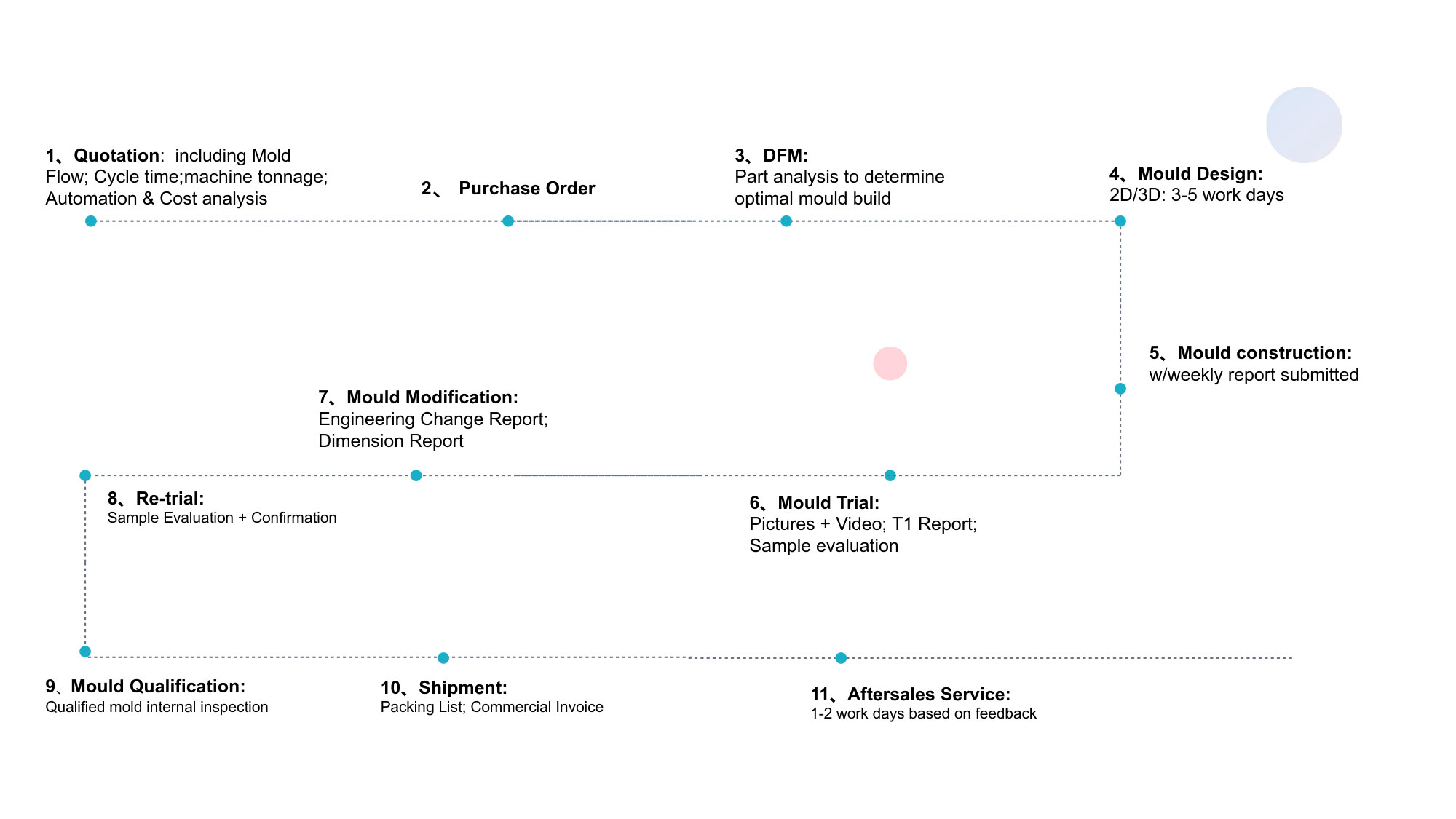
This section provides a complete view of how we take a 12-cavity PET candy jar preform mold from concept to delivered, high-volume production.
Phase 1: Requirements Definition and DFM (Days 1–5)
Customer consultation: We review your final container specifications, production volume targets, resin type, and injection machine specifications.
Preform geometry design: Using reverse blow molding simulation, we calculate the optimal preform shape, neck configuration, and weight.
DFM report delivery: Comprehensive analysis of draft angles, gate locations, ejection strategy, cooling strategy, and potential risk areas.
Design approval: Customer signs off on final CAD model before any steel is purchased.
Phase 2: Manufacturing Process Engineering (Days 5–10)
Steel procurement: Material certifications (mill certificates) obtained from approved suppliers.
Manufacturing plan creation: Sequence of operations (rough machining → heat treatment → finish machining → EDM → polishing → assembly) documented with estimated durations per operation.
Tool path programming: CNC programs generated for all machining operations.
Cooling channel CFD analysis: Confirmation of turbulent flow and target Reynold’s numbers.
Phase 3: Mold Component Fabrication (Days 10–40)
Steel rough machining: Material cut to approximate shape, leaving 0.3–0.5mm stock for finish machining.
Heat treatment: Components hardened to target HRC values with documented temperature/time curves.
Precision machining: Five-axis machining, turning, grinding, and EDM to achieve final dimensions.
Surface finishing: Polishing to required SPI finish grade (A1 mirror to D3 textured). Measurement of Ra values.
Hot runner assembly: Component assembly, leak testing on water lines, continuity testing on electrical circuits.
Phase 4: Assembly and Initial Validation (Days 40–50)
Mold assembly: All components fitted together on the mold base.
Function check: Manual open/close, ejector plate stroke verification, alignment pin verification.
Water circuit testing: Pressure testing all cooling lines at 150% of planned operating pressure.
Hot runner electrical test: Heater resistance checks, thermocouple continuity.
T0 sampling: First shot on Ansix Tech‘s in-house injection machine.
Phase 5: Iterative Sampling and Optimization (Days 50–65)
T1 sampling: Process adjustments based on T0 findings.
T2 sampling: Long-run stability verification (minimum 1 hour continuous).
CPK measurement: Statistical analysis on 32 consecutive shots (minimum) per cavity.
Trial improvement reports: Documentation after each sampling round.
Customer sample review: Physical sample preforms shipped to customer for inspection and blow molding trial.
Phase 6: Pre-Production Validation (Days 65–70)
Customer-designated resin run: Using your specified resin type and lot.
100–500 shot run with 100% inspection of first 50 shots.
Mold Acceptance Test Report: Final dimensional data, CPK values, visual inspection results.
Cosmetic inspection: Polarized light check for stress, visual check for defects.
Blow molding test (if required): Sample preforms blown into final containers, top load and burst tested.
Phase 7: Packaging and Delivery (Day 70–75)
Mold preservation: Anti-rust coating applied to all steel surfaces. Cooling channels drained and dried.
Packaging: Wooden crate with shock-absorbing foam. Desiccant packs included to prevent humidity corrosion during shipping.
Spare parts kit packaging: Labeled components, shrink-wrapped.
Documentation package: Full dimensional inspection report, material certifications, process recipe card, maintenance schedule, spare parts list.
Shipping: Incoterms agreed (typically EXW, FOB, or CIF depending on customer location).
Phase 8: Post-Delivery Support (Ongoing)
Remote commissioning assistance: Video call support during first installation at customer‘s facility.
On-site support (if contracted): Technician travel to customer site for first production week.
Regular check-in schedule: Quality follow-up calls at 30 days, 90 days, 6 months, and 12 months post-delivery.
Repair service: In-house repair shop with 24–48 hour turnaround time for standard repairs.
Conclusion: A Mold Is Not Just Metal—It Is a Profit Center
At Ansix Tech, we have been manufacturing injection molds and molded components for over 28 years [1†L8-L9]. We have seen good molds double customer productivity. We have seen bad molds bankrupt small businesses through endless downtime, excessive scrap, and never-ending repair bills.
When we design a 12-cavity PET candy jar or PET tube preform mold, we are not designing a block of steel with some holes in it. We are designing a profit center for your factory:
Faster cycles = more parts per shift = higher revenue from fixed equipment investment
Lower scrap = more saleable parts from your resin spend = higher effective yield
Longer mold life = lower amortized tooling cost per part = lower unit cost
Balanced cavities = consistent preforms = faster changeovers and less blow molding troubleshooting
Automation-ready design = fewer operators = lower direct labor cost
Regrind capability = less virgin resin purchased = lower material cost
Documented process = predictable results = no unpleasant surprises
We invite you to experience the Ansix Tech difference. Send us your product requirements, container drawings, or existing mold specifications. We will provide a preliminary DFM assessment and a proposal that itemizes exactly where your savings will come from—not just how much the mold costs, but how much value it will generate.
A mold is not just metal. At Ansix Tech, we engineer profit.
Summary Table: Core Customer Values Delivered by Ansix Tech
Customer Need Ansix Tech Solution Quantifiable Benefit
Faster time-to-market DFM report pre-tooling + in-house manufacturing 10-day simple molds, 30–45 day standard 12-cavity molds
Lower unit cost Cycle time optimization + regrind integration + automation 15–35% faster cycles, 5–12% material reduction
Consistent quality MES-locked parameters + cavity balance + full inspection Cavity weight variation ≤0.2%, CPK ≥1.33 on key dimensions
Minimal downtime 24–48 hour repair turnaround + spare parts kit included <1 day repair time for most mold issues
Predictable mold life Premium steel selection (S136, H13) + documented heat treatment 1 million+ shot lifespan, 3-year steel structure warranty
Lower energy cost Designed for servo-electric machines + conformal cooling 15–20% lower energy per preform than conventional molds
Reduced management cost Single-source responsibility: design, manufacture, validate No coordination between multiple vendors
Risk mitigation T0–T3 sampling + pre-production run + full documentation Arrives production-ready, not requiring debugging
Ansix Tech Co Ltd
If you have any plans related to 12-cavity PET candy jar PET tube preform mold , you can contact us at any time. We will turn your ideas into reality, let you realize your dreams, and obtain large orders from the market. Our contact information is info@ansixtech.com. Or contact our CTO, mail: stephen@ansixtech.com
#www.ansixtech.com #ansixtech.com #12-cavity PET candy jar PET tube preform mold #12-cavity PET candy jar PET tube preform mold moulds #12-cavity PET candy jar PET tube preform mold injection molding companies #12-cavity PET candy jar PET tube preform mold Canopy Mold injection mold companies #Ansix #Ansix moulds #Ansix china #Ansix tech china #Ansix tech company #Ansix facotry #12-cavity PET candy jar PET tube preform mold injection molding #12-cavity PET candy jar PET tube preform mold injection tools #12-cavity PET candy jar PET tube preform mold injection moulds #12-cavity PET candy jar PET tube preform mold plastic mould #12-cavity PET candy jar PET tube preform mold plastic tools #Ansix Tech #Ansix molds #Ansix injection molding #Ansix mold factory #injection molding 12-cavity PET candy jar PET tube preform mold #Ansix mold factory #12-cavity PET candy jar PET tube preform mold china #12-cavity PET candy jar PET tube preform mold molds #injection factory #12-cavity PET candy jar PET tube preform mold injection molding #12-cavity PET candy jar PET tube preform mold injection molding factory #injection molding company #12-cavity PET candy jar PET tube preform mold injection mold companies #12-cavity PET candy jar PET tube preform mold#12-cavity PET candy jar PET tube preform mold mold limited #Ansix mold china #Ansix companies #Ansix company China #12-cavity PET candy jar PET tube preform mold facotry #Ansix Tech #Ansix Tech mould #12-cavity PET candy jar PET tube preform mold injection moulding #injection moulding company #Ansix 12-cavity PET candy jar PET tube preform mold parts injection mold companies #medical injection molding companieschina #12-cavity PET candy jar PET tube preform mold china factory #Ansix moulding companies #Ansix molding company #12-cavity PET candy jar PET tube preform mold injection moulding facotry #Ansix Tech mold #12-cavity PET candy jar PET tube preform mold mould #12-cavity PET candy jar PET tube preform mold plastic injection molding #ansix plastic mold #Mold manufacturing #12-cavity PET candy jar PET tube preform mold parts manufacturing #12-cavity PET candy jar PET tube preform mold plastic parts factory #12-cavity PET candy jar PET tube preform mold injection parts mold #12-cavity PET candy jar PET tube preform mold PRECISION MANUFACTURING #12-cavity PET candy jar PET tube preform mold #China mold #12-cavity PET candy jar PET tube preform mold injection moulding china #12-cavity PET candy jar PET tube preform mold mould china #china precision mold #mold in china #12-cavity PET candy jar PET tube preform mold mold china #Precision molds #High-precision molds #12-cavity PET candy jar PET tube preform mold #Injection molds #12-cavity PET candy jar PET tube preform mold Factory #12-cavity PET candy jar PET tube preform mold Company #Super Large Injection Mold Factory #Large Tonnage Injection Molding Factory #12-cavity PET candy jar PET tube preform mold Company #12-cavity PET candy jar PET tube preform mold Factory #2800T Injection Molding Factory #3000 Ton Injection Molding #4500 Ton Injection Molding Factory #Large Mold Injection Molding #Large Plastic Mold Injection Molding Factory #Large Injection Mold Manufacturer #Plastic Mold Factory #Injection Mold #Plastic Mold