



24-cavity PET disinfectant bottle preform mold
FEATURES
Hard Power Infrastructure – The Engineering Backbone Clients Can Trust
A. Mold Manufacturing Equipment: Precision That Eliminates Post-Processing
Every precision mold starts with world-class machining assets. Ansix Tech deploys a fleet of advanced manufacturing equipment that transforms technical specifications into tangible quality advantages:
Capability Technical Specification Customer Value Delivered
5-Axis High-Speed Machining Center 0.002mm contour accuracy Parting lines so smooth that no manual deburring is required; product aesthetics improved; downstream assembly costs eliminated
EDM (Electrical Discharge Machining) ±0.003mm electrode positioning Complex cavity geometries and fine features machined without tool marks; no stress-induced micro-cracks that could propagate under cycling loads
Wire EDM (Slow Wire Cut) 0.03μm surface finish; capable of 0.03mm micro-holes and narrow slots Thin-wall sections machined without distortion; micro-features for valve gates and cooling channels fabricated with precision
CNC Turning Center with Live Tooling Multi-axis simultaneous machining Threaded neck rings and core components produced in single setups; eliminates fixturing errors and reduces tolerance stack-ups
All mold components undergo 100% inspection on coordinate measuring machines (CMM) and optical imaging systems before assembly. Each mold departs with a full dimensional inspection report. Critical dimensions are validated with Cpk ≥ 1.33—a statistical guarantee that your production will remain within specification through millions of cycles.
-
Mold Description
Product Materials:
PET PETG
Mold Material:
S136ESR
Number of Cavities:
1*24
Glue Feeding Method:
Hot runner
Cooling Method:
Water cooling
Molding Cycle
8.5s
- The mold manufacturing process and product material selection
Injection Molding Machine Fleet: Scale That Matches Demand
Ansix Tech operates a total of 260 injection molding machines spanning clamping forces from 30 tons to 2,800 tons. Our fleet includes premium brands: Japan‘s Fanuc, Sumitomo, Toshiba, Nissei; Austria’s Engel; Germany‘s Arburg (primary for liquid silicone injection molding and two-component applications); China’s Haitian; and Taiwan‘s Victor Taichung Machinery.
This diversity delivers three distinct client advantages:
Right-sizing Every Order: Whether your requirement is 10,000 preforms or 10 million, we assign the exact machine tonnage to your cavity count, eliminating energy waste from over-scaled equipment.
Production Redundancy: Multiple compatible machines prevent single-point failures; if one machine requires service, production can be shifted instantly.
-
All-servo Electric Drive: Our servo-electric presses deliver ±0.1% shot-to-shot repeatability. Every cavity fills identically, cycle after cycle, across multi-day production runs.
C. Metrology and Validation: Data Over Assumptions
A mold that measures correctly in its first shot but drifts after 10,000 cycles is a liability, not an asset. Ansix Tech‘s quality control system is built around continuous verification:
In-process inspection: Critical dimensions checked after every machining operation, not just at final assembly.
Full mold dimensional report: Provided before shipment, with each measured dimension annotated against design nominal values.
Cpk validation for production molds: For high-volume applications, we produce a pilot batch on our own machines and provide statistical analysis demonstrating process capability before the mold ever reaches your floor.
Ansix Tech holds comprehensive quality certifications: ISO9001, IATF16949 (automotive-grade quality), ISO13485 (medical device quality), ISO14001 (environmental management), and BSCI (social compliance). For medical and disinfectant packaging applications requiring cleanroom production, we maintain an ISO 8 Cleanroom compliant with GMP and U.S. FDA 510K standards.
Section II: Mold Manufacturing Core Competencies – Performance by the Numbers
Clients care about four dimensions of mold performance: Lifetime, Precision, Delivery Speed, and Serviceability. Below is Ansix Tech‘s quantified commitment on each dimension, with steel selection optimized for disinfectant bottle preform applications.
A. Mold Lifetime: Measured in Millions of Shots, Not Months
The 24-cavity PET disinfectant bottle preform mold represents a substantial upfront investment. Short mold life multiplies that investment many times over. Ansix Tech designs for longevity:
Mold Component Recommended Material Hardness (HRC) Expected Lifetime (Cycles) Material Rationale
Mold Base P20 / 4Cr13 Stainless 30–36 N/A (Reusable chassis) Pre-hardened, thermally stable; 4Cr13 provides corrosion resistance against disinfectant chemicals
Cavity & Core S136 / ASSAB STAVAX (Swedish import) 48–52 2+ million Exceptional mirror polish, superior corrosion resistance (≥13% chromium); ideal for high-transparency PET preform applications
Thread Neck Ring Nitrided steel (German/Japanese import) 58–62 1.5+ million Surface-nitrided for wear resistance against PET‘s abrasive nature; maintains thread precision
Sliders & Ejector Pins H13 / SKD61 48–52 1+ million (replaceable) High toughness with excellent thermal fatigue resistance for repeated sliding contact
Hot Runner Manifold Plate H13 / 2344 48–52 Long-life Thermal stability at elevated temperatures; prevents distortion under continuous heating
Industry research confirms the logic of premium material investment: S136 delivers HRC48–52 hardness with mirror-polish capability reaching Ra ≤ 0.025μm, making it the definitive choice for high-transparency PET preforms requiring optical clarity. H13 and 2344 grades provide high hardness, excellent wear resistance, and superior thermal stability—ideal for molds requiring 1 million+ cycles under sustained high-temperature conditions.
B. Achievable Tolerances: Statistical Certainty, Not Hope
Tolerance specifications without verification are marketing claims. Ansix Tech provides verified, repeatable precision:
Conventional structural features: ±0.05mm
Thread neck ring pitch diameter: ±0.02mm
Gate-to-gate flow balance across 24 cavities: ≤ 1.5% variation
Preform weight variation across all cavities: ≤ ±0.3 grams
Preform wall thickness variation: ≤ ±0.05mm along preform length
Concentricity between core and cavity: ≤ 0.08mm
A 24-cavity mold with ±0.3g weight variation per cavity across a 24-gram preform represents a 1.25% cavity-to-cavity variance. Over a 10-million-shot production run, this consistency alone saves over 3 metric tons of PET resin compared to molds with higher variance.
C. Mold Types and Hot Runner Architecture
For 24-cavity PET preform molds, hot runner systems are non-negotiable—cold runners create excessive material waste and inconsistent melt delivery. Ansix Tech‘s hot runner system incorporates:
Valve-gated design: Each of the 24 cavities features independent valve gate actuation. When combined with individual thermocouples per nozzle (single-point temperature control), this configuration eliminates gate crystallization, prevents stringing, and produces a flat gate vestige requiring no trimming—saving direct labor costs.
Multi-zone temperature control: Individual temperature zones for each cavity ensure heat distribution uniformity across all 24 stations, which is critical when processing PET with narrow processing windows.
Balanced manifold design: Runner lengths are equalized across all 24 cavities, ensuring each cavity receives melt at identical pressure and temperature profiles. This geometric equality, combined with computational flow modeling, eliminates preferential filling of near-gate cavities.
D. Optimized Cooling System Design
Cooling accounts for the majority of total cycle time in PET preform molding—typically 60–70%. Ansix Tech‘s cooling architecture is engineered for turbulent flow and maximum heat transfer:
Conformal cooling channels: Cooling passages follow the contour of the preform geometry, not straight-line drilling
Turbulent flow design: Channel dimensions calculated to achieve Reynolds numbers > 4,000 at minimum flow rates, ensuring maximum heat exchange efficiency between steel and coolant
Multi-zone cooling isolation: Independent cooling circuits for gate area, cavity body, thread splits, and core pin—each zone temperature-controlled to ±1°C
Cavity spacing optimization: 45mm center-to-center spacing minimizes mold footprint while ensuring adequate cooling channel cross-sections between cavities
E. Delivery Standards: Guaranteed Lead Times
Complexity Tier Normal Lead Time Expedited Option What‘s Included
Standard 24-cavity preform mold 45–60 days 35 days (15–25% premium) Full DFM, T1 samples, dimension report
High-cavity (48–72) preform mold 60–75 days 50 days Complete validation protocol
Custom neck finish design Add 10–15 days Expedited machining possible Neck ring qualification report
Expedited condition guarantee: Even under compressed timelines, no validation steps are skipped. T1 samples are still run; dimensional reports are still generated; flow simulation is still performed. Speed is achieved through parallel processing and dedicated machine scheduling, never through quality compromises.
Section III: Injection Molding Process Control – Eliminating Quality Anxiety
Clients who have been burned by inconsistent production are not afraid of molds—they are afraid of shrinkage, flash, dimensional drift, and batch-to-batch color variation. Here is how Ansix Tech‘s process engineering eliminates each of these fears for disinfectant bottle preform production.
A. Process Standardization: Parameters That Cannot Drift
Every Ansix Tech injection molding machine is connected to a Manufacturing Execution System (MES). Process parameters—temperatures, pressures, speeds, injection times, cooling times, hold pressures—are locked into the system and can only be modified by authorized engineers with documented approval. Every batch undergoes first-piece and last-piece dimension comparisons, with statistical process control charts maintained for all critical dimensions.
Melt delivery: All 24 cavities receive melt at identical melt temperature and pressure. For PET, where melt temperature variations as small as 5°C can change crystallinity and clarity, cavity-to-cavity uniformity is non-negotiable.
Shot-to-shot consistency: Servo-electric drives deliver ±0.1% injection volume repeatability. When 24 cavities each require precise shot volumes, aggregate consistency determines overall product quality and material efficiency.
B. Shrinkage, Warpage, and Flash Control: Quantified Outcomes
Defect Root Cause Ansix Tech Solution Client Benefit
Shrinkage voids Inadequate packing/holding pressure Integrated melt cushion monitoring; closed-loop pressure compensation Zero voids in preform cross-section; no internal defects that compromise blow molding
Warpage Uneven cooling across preform length Independent core/cavity cooling circuits; temperature difference ≤2°C across all zones Preforms exit mold straight and concentric; blow molding yield >99%
Flash (excess material at parting lines) Mold deflection under clamping load Self-locking independent cavity clamping; parting line fit to 0.005mm Maximum flash ≤0.03mm; no manual trimming required before blow molding
Gate crystallization Inadequate gate cooling Aggressively cooled gate region thermally isolated from hot runner nozzle Fully amorphous gate area; preforms stretch uniformly during blowing
Research on PET preform injection molding confirms that cooling time is the most significant process parameter, accounting for 28.78% of variability in part quality. Process optimization can reduce warpage by up to 4.75% and reduce weight by over 2% while maintaining mechanical properties. Ansix Tech embeds these insights directly into mold design and process setup.
C. Micro-venting Strategy for Gas Trap Elimination
PET outgassing during injection creates trapped air that manifests as burn marks or localized degradation. Ansix Tech‘s venting strategy:
Venting depth: 0.01–0.05mm at critical locations (gate area, flow front convergence points, and last-to-fill zones)
Venting width: 2–4mm to provide adequate gas escape volume
Secondary vent land: Extends an additional 2mm beyond initial vent to handle transient gas spikes
Each vent location is verified through mold flow analysis (MFA), not guesswork. Clients receive the venting scheme documented in the DFM report before steel is cut.
D. Special Materials Capability
PET for disinfectant bottles must withstand contact with chemical agents (hydrogen peroxide, peroxyacetic acid, alcohol-based sanitizers) without degradation, discoloration, or loss of mechanical properties. Ansix Tech‘s material processing experience spans a wide range of engineering polymers:
PET (standard and recycled content): Process optimization for IV (intrinsic viscosity) retention; minimizes acetaldehyde generation
rPET (up to 100% recycled content): Specialized screw design maintains melt quality despite variable feedstock
High-barrier multilayer preforms: Process control for co-injection configurations
Beyond PET, Ansix Tech‘s technical team maintains process expertise in PC/ABS, PC, PPS+40%GF, PEEK, PTFE/PFA, PA6+GF30, PBT, PEI, LCP, and liquid silicone rubber (LSR).
Section IV: Full-Process Service – Reducing Your Management Overhead
Many manufacturers are excellent at producing molds. Few are excellent at integrating mold production into your production operation. Ansix Tech‘s service model is designed to reduce your management cost—the hidden expense of coordination, inspection, rework, and delayed discovery of issues.
A. Early Engagement: Design for Manufacturability (DFM) Report
Before any steel is cut, Ansix Tech delivers a comprehensive DFM report that includes:
Mold flow analysis (MFA) : Simulates melt progression through all 24 cavities; identifies weld lines, gas trap locations, and potential short-shot zones before tooling begins. For disinfectant bottles where aesthetic appearance is critical (no cosmetic defects), this simulation prevents defects from ever being designed into the mold.
Parting line optimization: Proposed parting line locations documented with justification.
Gate location and sizing: Recommended gate position, diameter, and valve gate stroke based on fill analysis.
Draft angle recommendations: Suggested draft angles for core and cavity based on PET‘s shrinkage characteristics.
Wall thickness analysis: Thickness distribution flagged where fill or cooling issues are predicted.
Ejector pin location and mark tolerance: Client-approved locations for ejector pin witness marks on non-cosmetic areas.
Client value: This upfront analysis changes the project from “hope it works” to “verified it will work.” Clients who receive a DFM report before mold fabrication avoid the industry‘s most expensive problem: discovering a manufacturability issue after the mold is already built.
B. Mold Trials (T0 through T3) with Improvement Documentation
Ansix Tech operates its own injection molding machines, enabling in-house mold trials without third-party scheduling delays:
T1 (First trial) : First samples produced; initial dimensional report generated; any obvious issues documented
T2 (Corrected trial) : Adjustments made based on T1 findings; improved samples and updated report
T3 (Validation trial) : Production-ready samples; full dimensional report; Cpk analysis on critical features
Between each trial, clients receive a formal improvement report documenting what was changed, why, and the measured before/after results. No surprises at final delivery.
C. Pilot Run Before Full Production
For high-volume disinfectant bottle contracts, Ansix Tech offers 100–500-shot pilot runs on client-specified machines (either our machines configured to your line parameters, or your machines if on-site commissioning is arranged). The pilot run includes:
Statistical yield reporting (first-pass yield, defect categories)
Capability analysis (Cpk for all critical dimensions)
Cycle time validation against target
Material consumption verification
Client value: Pilot runs de-risk the transition from mold delivery to high-volume production. You receive a validated process recipe, not just a mold, before authorizing full production.
D. Maintenance, Spares, and Post-Delivery Support
A 24-cavity mold under high-volume production will eventually require maintenance. Ansix Tech eliminates the nightmare of waiting weeks for replacement components:
Standard wear part kit: Each mold ships with spare ejector pins, core inserts, cavity inserts, and valve gate needle sets—the components most likely to require replacement.
Scheduled maintenance intervals: Recommended maintenance at 200,000-cycle, 500,000-cycle, and 1,000,000-cycle intervals, with detailed checklists provided.
Lifetime repair pricing: Repairs beyond warranty are billed at cost-plus-reasonable-labor, never at punitive rates.
Warranty coverage: Three-year structural warranty (excluding normal wear items—ejector pins, core/cavity inserts past rated life, valve gate needles). Defects from manufacturing or materials are repaired at no charge.
For standard component inventories, Ansix Tech maintains stocked wear parts for immediate shipment; unique mold-specific components can be reproduced from retained digital toolpaths in 5–7 working days.
Section V: Cost Control – Lowering Your Total Product Cost, Not Just Mold Price
The most expensive mold is not the highest-priced mold—it is the mold that stops production, produces out-of-spec parts, requires constant adjustment, or fails early. Ansix Tech approaches cost control from a total cost of ownership (TCO) perspective, identifying savings across six dimensions.
A. Material Cost Reduction
Cost Driver Traditional Approach Ansix Tech Approach TCO Savings Potential
PET resin consumption Fixed shot weight per preform; yield losses from off-spec parts Optimized preform weight through flow analysis; weight variation ≤±0.3g across cavities; higher yield in blow molding reduces scrap 2–4% PET resin reduction vs. baseline
Runner scrap (if cold runner used) 15–25% of total shot weight wasted Valve-gated hot runner eliminates runner entirely 15–25% material waste eliminated at source
Secondary trimming labor Manual de-gating required Valve-gated design produces no gate tail; preform exits ready for blowing Zero labor cost for gate trimming
Packaging waste Larger containers required for inconsistent parts Consistent dimensions reduce protective packaging requirements 5–10% packaging cost reduction
For a facility producing 10,000 preforms per hour, 24 hours per day, 300 days per year, a 2% resin reduction saves over 1,400 tons of PET annually (assuming 20g per preform) at significant cost.
B. Cycle Time Optimization and Efficiency Gains
Cycle time directly determines hourly output, machine utilization, and cost per part. Ansix Tech‘s cooling system design—the dominant variable in cycle time—achieves:
Preform Weight Typical Cycle Time (24-cavity) Hourly Output Efficiency Driver
18–35g 7.5–10 seconds Up to 11,500 preforms/hour Optimized conformal cooling; turbulent flow design
67–90g 24 seconds ~3,600 preforms/hour Post-cooling tube integration for sustained throughput
90–120g 28 seconds ~3,085 preforms/hour Heavy-wall cooling strategy with extended heat extraction
A 2-second cycle time reduction on a 24-cavity system producing 10g preforms increases annual output by approximately 1.5 million preforms per line without additional capital investment. Ansix Tech‘s cooling optimization achieves exactly this type of efficiency gain.
C. Processing Efficiency Optimization
Injection molding process parameters directly impact energy consumption, machine wear, and part quality. Through systematic optimization, Ansix Tech‘s process engineering focuses on five controllable parameters that account for nearly 30% of variation in part quality—cooling time, cycle time, melt temperature, injection time, and mold temperature.
For a high-volume PET preform operation, these optimizations translate into:
Reduced energy cost per part (shorter cycle times = less machine time per part)
Reduced resin degradation (optimized melt temperature prevents IV drop)
Reduced acetaldehyde generation (critical for bottled water/disinfectant applications where taste/odor are concerns)
D. Tooling Investment Optimization
Not every cavity configuration is right for every production volume. Ansix Tech assists clients in rightsizing tooling investment:
Production Volume Recommended Cavity Count Mold Investment Level Cost per Preform
<1 million preforms/year 8–16 cavity Lower initial Medium
1–5 million preforms/year 24 cavity (Ansix‘s sweet spot) Optimal Lowest
5–20 million preforms/year 48–72 cavity Higher initial Lowest (spread over volume)
>20 million preforms/year Multiple 48/72-cavity molds or 96–144 cavity systems Premium initial Minimal per-part
For clients without established volume forecasts, Ansix Tech provides modular 24-cavity mold architecture that can be expanded or reduced without replacing entire tooling platforms.
E. Reduced Risk = Reduced Hidden Cost
Hidden costs from quality failures, production delays, and rework often exceed the visible mold price. Ansix Tech‘s risk reduction measures include:
Mold flow analysis (MFA) : Prevents weld line defects before tooling; each DFM report takes 1–3 days to complete but prevents weeks of downstream troubleshooting
In-house validation on our injection molding machines: Prevents the “surprise” of discovering mold issues only when it arrives on your production floor
Material certificates and heat treatment curves: Provided for all mold components; traceability ensures replacement parts match original specifications
Thermal imaging during T1–T3 trials: Validates cooling uniformity across all cavities before production
F. rPET Processing Capability
Recycled PET (rPET) processing requires specialized mold and screw design to manage the variable melt behavior of post-consumer material. Ansix Tech‘s 24-cavity molds are designed for rPET compatibility, incorporating larger gate diameters and enhanced venting to handle the unique flow characteristics of recycled resin. With sustainability regulations increasingly requiring recycled content in packaging, this capability future-proofs your production against regulatory shifts.
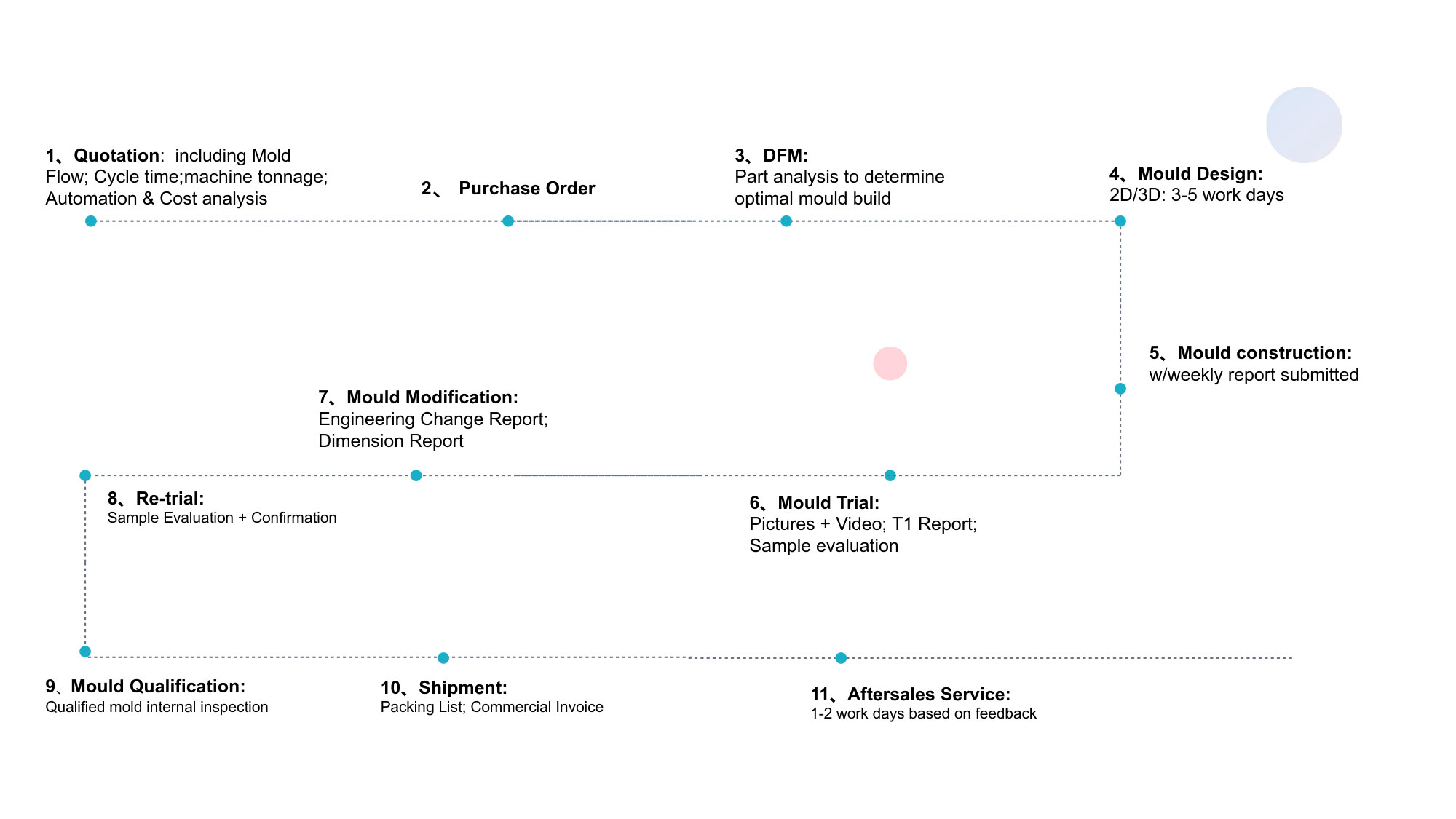
Section VI: 24-Cavity PET Disinfectant Bottle Preform Mold – Manufacturing Process Roadmap
A. Project Initiation: Requirements Definition
Client input needed:
Preform weight (g)
Neck finish type (PCO, ALASKA, ROPP, 30/25, 29/25, 26/22, 38mm, etc.)
Bottle target weight and dimensions (for stretch ratio calculation)
Target cycle time (seconds per shot)
Annual production volume (million preforms/year)
Ansix Tech output after initiation:
Preliminary cavity layout drawing (24-cavity configuration with spacing optimized for cooling)
Mold base size recommendation
Injection machine compatibility check
Preliminary cost estimate and lead time commitment
B. Design Phase: DFM and Mold Flow Analysis
Duration: 5–10 days (depending on complexity)
Activities:
3D preform modeling based on client-supplied bottle specifications
Mold flow analysis (Moldex3D platform) including:
Fill analysis verifying balanced flow across all 24 cavities
Cooling analysis optimizing water channel placement
Warpage prediction validating part geometry after ejection
DFM report delivered with recommendations on:
Gate location and valve gate type (needle valve standard)
Draft angles (0.5°–1.5° depending on preform length)
Cooling circuit configuration (independent zones for gate/cavity/thread/core)
Ejector layout and witness mark locations
Hot runner manifold design with equal-length flow paths to all 24 nozzles
Customer design review and approval before mold base procurement
C. Mold Manufacturing Process Flow
Duration: 30–50 days (depending on cavity count and complexity)
Sequential manufacturing steps:
Step Process Description Quality Verification
1. Mold base machining P20/4Cr13 stainless steel base rough machined, heat treated to HRC30–35 Dimensional check; surface hardness test
2. Cavity & core rough turning S136 round bar machined to near-net shape Preliminary dimension check
3. Heat treatment (cavity/core) Vacuum hardening/quenching to HRC48–52 Hardness certification; material certificate provided
4. Precision CNC milling 5-axis machining to 0.002mm accuracy for complex contours CMM inspection after each operation
5. EDM (where required) Fine detail machining for valve gate seats, venting grooves, narrow slots Surface finish inspection; electrode wear monitoring
6. Wire EDM 0.03mm micro-features; slow wire cut for narrow slots Optical inspection; burr-free verification
7. Thread neck ring machining Imported nitrided steel; precision thread cutting; concentricity ≤0.02mm Thread gauge check; concentricity CMM
8. Cavity & core polishing Mirror polish to optical clarity (Ra ≤ 0.025μm for transparent preforms) Surface roughness profilometer; visual inspection
9. Cooling channel drilling Conformal channels designed for turbulent flow at minimum flow rates Flow simulation verification; pressure drop measurement
10. Hot runner assembly Valve gate nozzle installation; thermal expansion compensation set Leak test at operating temperature
11. Final assembly All components assembled into mold base; cavity alignment verified Concentricity ≤0.08mm; parting line fit ≤0.005mm
12. Mold trial (T1) On Ansix Tech injection machine; first samples produced Sample dimensions measured; cavity-by-cavity weight variation recorded
D. Validation Phase: Pre-Delivery Quality Assurance
No Ansix Tech mold ships without passing through our validation protocol:
Visual inspection: 100% cosmetic inspection under controlled lighting
Dimensional inspection: CMM full dimension report; critical features flagged with Cpk ≥1.33 requirement
Mold flow correlation check: Actual fill behavior compared to MFA predictions; deviations resolved before shipment
Cycle time validation: Confirmed against client‘s specified cycle time target (or our best-in-class standard)
Trail sample retention: Representative samples from T1–T3 retained for client reference and future qualification
Complete documentation package:
Full dimension report (CMM data)
Mold flow analysis report (MFA correlation)
Heat treatment certificates for all hardened components
Material certificates (cavity/core S136 certification)
Maintenance schedule and spare parts list
Mold assembly drawing and exploded view
Hot runner electrical schematic
E. Delivery and Post-Delivery Support
Packaging: Mold crated in moisture-barrier packaging with desiccant; all moving surfaces coated with rust-preventative oil.
Documentation packing list:
1× USB drive containing all CAD files, dimension reports, and MFA data
1× printed maintenance manual
1× spare parts kit (standard wear components)
2× sets of T3 validation samples (packaged separately for client reference)
On-site support options:
Option A: Mold delivered to client‘s facility; commissioning supported remotely (standard)
Option B: Ansix Tech technician on-site for 2–5 days for mold installation, commissioning, operator training (available as billable service)
Option C: Pilot run at Ansix Tech‘s facility with client’s QC team present before shipment (recommended for critical applications)
Section VII: Differentiated Value – Where Ansix Tech Stands Apart
Competitors claim quality. Ansix Tech contractually commits to it. Below is how we address the industry‘s most common client complaints:
Client Complaint Ansix Tech‘s Contractual Response Measurable Commitment
“Mold broke after 6 months—constant repairs.” Pre-delivery aging test: 2,000-shot run on our machine; wear report provided before shipment. Three-year structural warranty (excluding normal wear items). 2+ million cycles proven. Warranty claim processed within 5 business days.
“Flash everywhere—labor cost for manual trimming kills my margin.” Parting line fit to 0.005mm; self-locking independent cavity clamping prevents deflection. Maximum flash ≤0.03mm. Guaranteed: No manual de-flashing required. Test at delivery; refund labor cost difference if claim fails.
“Dimensions drift after every batch change.” All machines MES-integrated; parameters locked; only authorized engineer changes. Plus optional in-mold pressure/temperature sensors for closed-loop control. Cpk ≥1.33 validated at T3. Sensor calibration certificate provided.
“Every repair takes weeks—lost production kills my customers.” On-site electrode manufacturing and EDM; 24-hour repair turnaround for standard repairs (welding/insert replacement). Standard spares shipped within 2 business days. Repair clock starts when client authorizes work; only custom components beyond 48 hours.
“Weight varies cavity-to-cavity—the light ones blow into thin bottles that leak.” Equal-length manifold runners; single-point temperature control per nozzle; flow simulation validated at T1. Weight variation ≤±0.3g across all cavities. Client may reject mold if weight variation exceeds specification.
“I never know if the mold will run on my machine.” Mold designed to client‘s specified injection machine make/model and platen size. We validate machine compatibility before design release. Mold ships with machine-specific setup sheet for your press make/model.
Section VIII: Key Customer Value Proposition – The Final Synthesis
Below is the definitive summary of what Ansix Tech‘s 24-cavity PET disinfectant bottle preform mold delivers:
What Problem Do We Solve?
Problem Our Solution
Inconsistent preform quality from cavity to cavity Valve-gated hot runner with equal-length manifold and individual cavity temperature control
Long cycle times limiting production throughput Optimized cooling channels designed for turbulent flow; independent cooling zones for gate, cavity, thread, core
High reject rates in blow molding due to uneven preform wall thickness Concentricity ≤0.08mm; independent cavity self-locking; wall thickness variation ≤±0.05mm
Corrosion from disinfectant chemicals S136 stainless steel for all wetted surfaces; ≥13% chromium content
High acetaldehyde levels affecting taste/odor in bottled products Gate thermally isolated from hot runner; aggressive gate cooling minimizes thermal degradation
Difficult mold maintenance requiring mold removal from machine Replaceable cavity lock rings and wear parts designed for in-machine servicing
How Do We Reduce Cost?
Cost Category Reduction Mechanism Quantified Benefit
Direct material (PET) Weight variation ≤±0.3g; optimized preform weight through flow analysis 2–4% resin savings vs. industry baseline
Labor (trimming) Valve-gated design eliminates gate tail Zero trimming labor; $0.00/part
Labor (defect sorting) Cpk ≥1.33 on all critical dimensions <0.5% defect rate at steady state
Machine time (energy) Shorter cycle times through optimized cooling 15–30% energy reduction per part vs. baseline
Mold maintenance Premium steel selection (S136/H13); surface treatments 2+ million cycles before major rebuild; annual maintenance <$5,000
Production downtime Standard spares provided; 24-hour repair turnaround for standard repairs Average <48 hours unplanned downtime per mold failure
How Do We Verify Quality?
Verification Stage Method Deliverable to Client
Before design Design for Manufacturability (DFM) analysis DFM report with recommendations
During design Mold flow analysis (Moldex3D) MFA report with predicted filling, cooling, warpage
During machining In-process CMM checks at each operation Intermediate dimension report (available upon request)
At completion Full mold dimensional CMM inspection Complete dimension report; Cpk for critical features
After assembly 2,000-shot pre-delivery aging test on Ansix machine Wear report; cavity-by-cavity weight data
At delivery T3 validation samples Sample sets for client qualification
How Do We Increase Capacity and Guarantee Delivery?
Capacity Factor Ansix Tech Capability Client Benefit
Production facility Four plants (China, Vietnam); 200,000+ sq.m. total Geographically diversified supply; redundancy in production
Machine fleet 260 injection molding machines (30–2,800 tons) Scalability from pilot to mass production without external dependency
Workforce 1,200+ employees including engineers, QC, support Dedicated technical team for mold design separate from production
Lead time guarantee 45–60 days standard; expedited available Predictable delivery planning for your production schedule
On-site support Commissioning available at client facility; remote support standard Minimal ramp-up time; immediate troubleshooting access
Conclusion: Partnering for Productivity
Ansix Tech‘s 24-cavity PET disinfectant bottle preform mold is not a commodity—it is an engineered system designed to maximize your production efficiency, minimize your operating costs, and eliminate the quality anxiety that plagues high-volume preform manufacturing. With 28 years of industry experience, four ISO-certified manufacturing facilities (ISO9001, IATF16949, ISO13485, ISO14001, BSCI), 260 injection molding machines, and over 1,200 specialized employees, Ansix Tech has the infrastructure, the expertise, and the demonstrated track record to deliver preform molds that perform as specified, day after day, million after million.
We invite you to take the next step: Provide Ansix Tech with a product drawing, sample preform, or bottle specification. We will deliver a DFM report and mold flow analysis within 1–3 working days—at no cost or obligation—demonstrating exactly how we will solve your specific manufacturing challenges before we ever cut steel.
Contact Ansix Tech
Website: www.ansixtech.com
Certifications: ISO9001, IATF16949, ISO13485, ISO14001, BSCI, ISO 8 Cleanroom, GMP, FDA 510K
Production bases: Shenzhen, Dongguan, Hunan (China); Vietnam
Total machine capacity: 260 injection molding machines (30–2,800 tons)
Annual output: 1 billion+ RMB turnover
“We do not sell a block of steel. We sell a printing press for profits—designed for flow balance, thermal stability, and million-shot reliability. Your profitability begins in our design review.
Ansix Tech Co Ltd
If you have any plans related to 24-cavity PET disinfectant bottle preform mold , you can contact us at any time. We will turn your ideas into reality, let you realize your dreams, and obtain large orders from the market. Our contact information is info@ansixtech.com. Or contact our CTO, mail: stephen@ansixtech.com
#www.ansixtech.com #ansixtech.com #24-cavity PET disinfectant bottle preform mold #24-cavity PET disinfectant bottle preform mold moulds #24-cavity PET disinfectant bottle preform mold injection molding companies #24-cavity PET disinfectant bottle preform mold Canopy Mold injection mold companies #Ansix #Ansix moulds #Ansix china #Ansix tech china #Ansix tech company #Ansix facotry #24-cavity PET disinfectant bottle preform mold injection molding #24-cavity PET disinfectant bottle preform mold injection tools #24-cavity PET disinfectant bottle preform mold injection moulds #24-cavity PET disinfectant bottle preform mold plastic mould #24-cavity PET disinfectant bottle preform mold plastic tools #Ansix Tech #Ansix molds #Ansix injection molding #Ansix mold factory #injection molding 24-cavity PET disinfectant bottle preform mold #Ansix mold factory #24-cavity PET disinfectant bottle preform mold china #24-cavity PET disinfectant bottle preform mold molds #injection factory #24-cavity PET disinfectant bottle preform mold injection molding #24-cavity PET disinfectant bottle preform mold injection molding factory #injection molding company #24-cavity PET disinfectant bottle preform mold injection mold companies #24-cavity PET disinfectant bottle preform mold#24-cavity PET disinfectant bottle preform mold mold limited #Ansix mold china #Ansix companies #Ansix company China #24-cavity PET disinfectant bottle preform mold facotry #Ansix Tech #Ansix Tech mould #24-cavity PET disinfectant bottle preform mold injection moulding #injection moulding company #Ansix 24-cavity PET disinfectant bottle preform mold parts injection mold companies #medical injection molding companieschina #24-cavity PET disinfectant bottle preform mold china factory #Ansix moulding companies #Ansix molding company #24-cavity PET disinfectant bottle preform mold injection moulding facotry #Ansix Tech mold #24-cavity PET disinfectant bottle preform mold mould #24-cavity PET disinfectant bottle preform mold plastic injection molding #ansix plastic mold #Mold manufacturing #24-cavity PET disinfectant bottle preform mold parts manufacturing #24-cavity PET disinfectant bottle preform mold plastic parts factory #24-cavity PET disinfectant bottle preform mold injection parts mold #24-cavity PET disinfectant bottle preform mold PRECISION MANUFACTURING #24-cavity PET disinfectant bottle preform mold #China mold #24-cavity PET disinfectant bottle preform mold injection moulding china #24-cavity PET disinfectant bottle preform mold mould china #china precision mold #mold in china #24-cavity PET disinfectant bottle preform mold mold china #Precision molds #High-precision molds #24-cavity PET disinfectant bottle preform mold #Injection molds #24-cavity PET disinfectant bottle preform mold Factory #24-cavity PET disinfectant bottle preform mold Company #Super Large Injection Mold Factory #Large Tonnage Injection Molding Factory #24-cavity PET disinfectant bottle preform mold Company #24-cavity PET disinfectant bottle preform mold Factory #2800T Injection Molding Factory #3000 Ton Injection Molding #4500 Ton Injection Molding Factory #Large Mold Injection Molding #Large Plastic Mold Injection Molding Factory #Large Injection Mold Manufacturer #Plastic Mold Factory #Injection Mold #Plastic Mold