



32-cavity oil bottle preform mold
FEATURES
The mold adopts a 4×8 layout design that ensures efficient space utilization while maintaining proper spacing for cooling lines and ejection systems. The core and cavity inserts utilize high-grade stainless steel such as S136 (Swedish ASSAB or equivalent), hardened to HRC 48-52 for superior wear resistance and corrosion protection. Alternative materials include DIN 1.2316 (German stainless) for enhanced corrosion resistance in challenging environments, or H13 for applications requiring maximum hot strength and thermal fatigue resistance. The mold base is machined from #50 steel or chrome-plated P20, providing excellent dimensional stability and structural rigidity.
-
Mold Description
Product Materials:
PET PETG
Mold Material:
S136ESR
Number of Cavities:
1*32
Glue Feeding Method:
Hot runner
Cooling Method:
Water cooling
Molding Cycle
12.5s
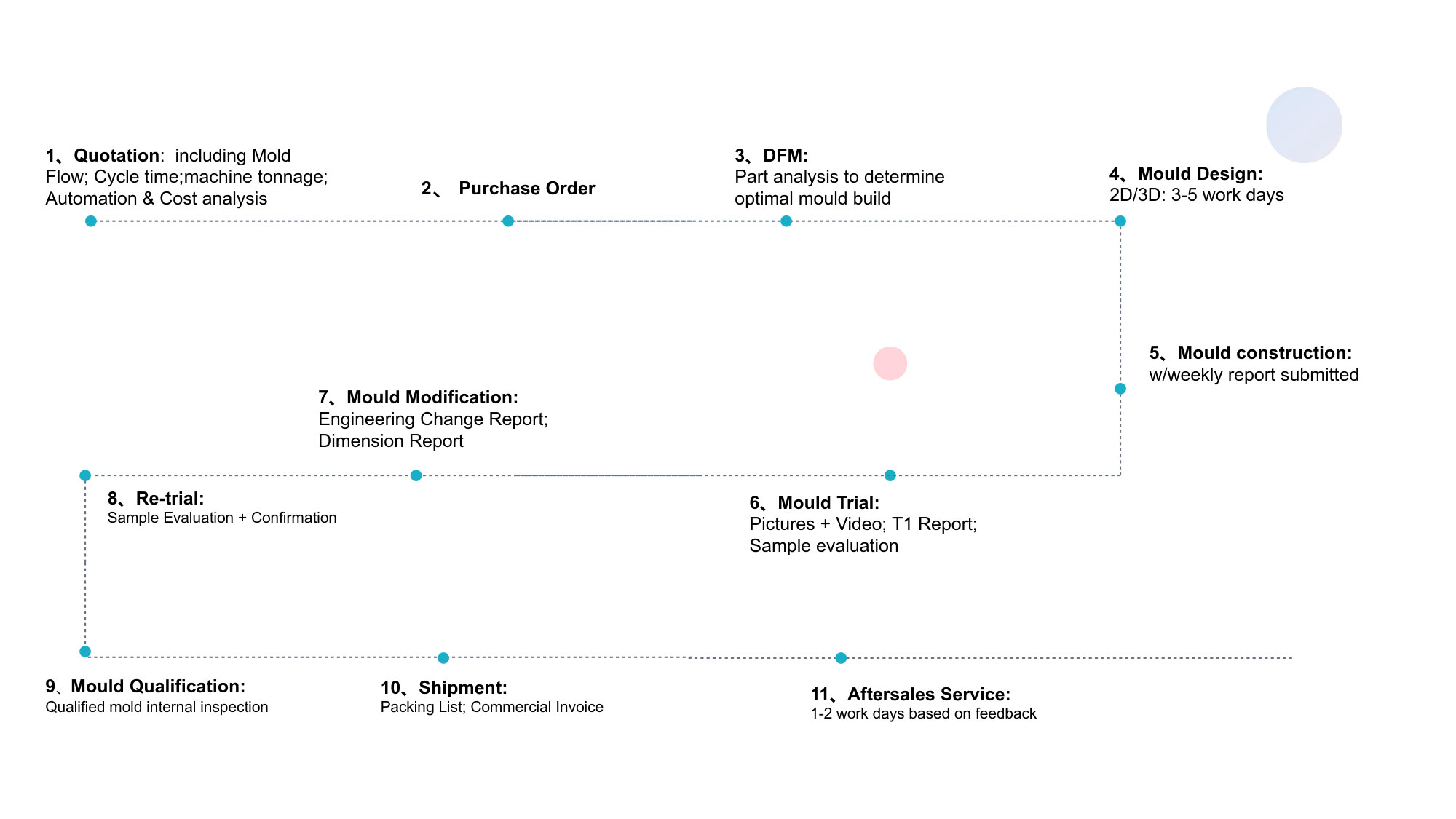
- The mold manufacturing process and product material selection
Hot Runner System: The mold features a valve gate (needle shut-off) hot runner system where each cavity has its own independent heating zone with temperature measured by individual thermocouples. This design ensures precise thermal control across all 32 cavities, eliminating material waste from cold runner systems and enabling consistent melt flow distribution. The system is engineered to accommodate standard PET preform neck finishes including PCO1881, PCO1810, 30/25, and 29/25 specifications.
Manufacturing & Processing Capabilities
Raw Material Selection Strategy: PET resin selection directly impacts preform quality, cycle efficiency, and unit cost. Our material selection framework evaluates intrinsic viscosity (IV), crystallization kinetics, thermal stability, and color consistency. For oil bottle preforms specifically, the material must withstand exposure to oils and fats without degradation or extractable migration. We source premium PET resins with controlled IV ranges (typically 0.74–0.84 dL/g) that balance melt flow for thin-wall cavity filling against the mechanical strength required for stretch-blow molding. Higher IV materials (0.82–0.84) are selected for larger oil bottles requiring superior drop impact resistance and top-load strength, while lower IV materials (0.74–0.78) offer faster cycle times for smaller, lightweight containers. Material certifications including FDA compliance and full traceability documentation are provided with every production batch.
-
Injection Molding Process Development: The 32-cavity tool requires meticulous process development. Key parameters include:
Melt Temperature: 270–290°C, precisely controlled to prevent thermal degradation while ensuring adequate flow through the hot runner system.
Mold Cooling: Circulating chilled water at 8–12°C through conformal cooling channels maintains cavity temperature uniformity within ±2°C across all 32 cavities.
Injection Profile: Multi-stage filling with progressively decreasing speeds ensures balanced filling without hesitation marks or jetting.
Packing Pressure: Optimized through cavity pressure sensor feedback to eliminate sink marks while minimizing residual stress.
Ejection Temperature: Controlled to ensure preforms release cleanly without deformation, typically 50–60°C at ejection.
Advanced process simulation using Moldflow or Moldex3D is performed before any steel is cut. This virtual validation predicts filling patterns, identifies weld line locations, detects air trap positions, and optimizes runner and gate geometry for cavity-to-cavity filling balance across all 32 cavities. Industry studies demonstrate that performing mold flow analysis before steel cutting can eliminate up to 80% of potential defects, preventing costly physical mold rework.
Standard vs. High-Speed Molding: Traditional PET processing achieves cycle times of 14–23 seconds for 32-cavity tools depending on preform weight and cooling efficiency. Through optimized cooling channel design, high-flow resin selection, and advanced machine control, cycle times can be reduced to 10–12 seconds. Research shows that cycle time reductions of up to 36% are achievable through material modification and tooling optimization, with average material throughput increases of 30% and energy consumption reductions of 10–20%. Each second saved per cycle translates directly into increased daily output without additional capital investment.
Smart Manufacturing Integration & Efficiency Enhancement
Equipment Foundation: Our manufacturing facility is equipped with five-axis high-speed machining centers capable of machining complex curved surfaces with precision exceeding 0.002mm. The five-axis positioning accuracy reaches ±0.01mm with repeat positioning accuracy of ±0.005mm, ensuring that mold components achieve ±10μm key feature accuracy directly off the machine, eliminating the need for manual polishing and achieving a “fit only, no rework” assembly condition. This precision is critical for 32-cavity tools where each cavity must produce identical parts — any dimensional deviation is multiplied 32 times across every production cycle.
Our slow wire EDM (Electrical Discharge Machining) equipment enables machining of micro-pores as small as 0.03mm and narrow slots with exceptional precision, critical for producing the needle valve seats, gate orifices, and cooling channel features required in high-cavitation PET preform molds. The combination of high-speed CNC machining and precision EDM provides complete manufacturing capability in-house, meaning mold repairs and modifications stay within our facility — typically completing standard weld repair or insert replacement within 24 hours rather than weeks through external vendors.
For injection molding, we operate a range of all-servo electric injection molding machines spanning 30 tons to 4,000 tons clamping force. The all-servo drive systems deliver stable repeatability at ±0.1%, ensuring that every shot maintains consistent quality across all 32 cavities. Servo-electric machines consume 40–70% less energy than hydraulic equivalents while providing superior precision and faster response times, directly reducing both operating costs and carbon footprint for our customers.
MES Integration & Process Control: All production machines are networked through Manufacturing Execution System (MES) software that provides a real-time monitoring and control platform for the entire production process. MES systems collect data from connected injection molding machines and quality control equipment for centralized process control, enabling real-time SPC (Statistical Process Control) charting to track critical quality parameters against validated ranges. Key molding parameters — temperature, pressure, injection speed, and cycle timing — are locked within the MES system and can only be adjusted by authorized engineers. Each production batch undergoes first-article and last-article inspection comparisons, with complete digital traceability records.
In-Mold Sensor Technology: Advanced molds are equipped with cavity pressure sensors (e.g., Kistler 6182D) and temperature sensors embedded directly in the mold. These sensors provide real-time feedback on each shot’s pressure profile, enabling closed-loop control that automatically compensates for process variation. This technology delivers measurable benefits: scrap reduction through real-time defect detection, the ability to use higher percentages of recycled PCR material without increasing risk, energy savings through optimized fill/pack phases without over-packing or over-cooling, and complete data traceability supporting ESG and regulatory compliance. For 32-cavity molds, sensors can be placed in strategic cavities to monitor for fill imbalance — detecting variations in weight or critical dimensions before they become quality problems. Engineering teams use short-shot arrival sequences and cavity weight mapping to validate balanced fill and ensure CPK ≥ 1.33 across all cavities.
Conformal Cooling: Up to 80% of the injection molding cycle is consumed by cooling. Our use of conformal cooling channels — cooling passages that follow the cavity geometry rather than straight-drilled lines — reduces heat extraction time by 20–30% while improving part quality. Conformal channels eliminate localized hot spots and reduce sink marks by providing uniform cooling across the entire cavity surface. The reduced cycle time increases machine utilization without additional capital investment, while improved cooling uniformity raises first-pass yield rates by minimizing warpage and dimensional variation.
Quality Assurance
Inspection Equipment & Standards: Our quality control system employs coordinate measuring machines (CMM) and optical inspection equipment as fundamental validation tools. Every mold undergoes full dimensional reporting before shipment, with critical dimensions validated to CPK ≥ 1.33 — a rigorous statistical process capability standard where the process variation consumes less than three-quarters of the allowable tolerance band. For 32-cavity molds, this means cavities #1 through #32 all stay within the same control limits, eliminating the common problem of “fast” and “slow” cavities producing different parts in the same shot.
Process Capability Validation: Engineering teams validate multi-cavity balance using short-shot arrival sequences and cavity weight mapping. This empirical approach identifies whether variation stems from geometric runner imbalance, gate freeze timing mismatch, or cooling asymmetry. A minimum CPK of 1.33 is required for production approval, indicating the process produces parts well within specification limits consistently. For customers with the most stringent quality requirements, we can achieve CPK ≥ 1.67 on critical dimensions — representing less than 0.005% defect probability.
Validation Process: From T0 to T3 mold trials, we provide sample parts with accompanying improvement reports after each iteration. Customers receive full trial documentation including inspection reports, process parameter sheets, and corrective action logs. Before full production release, 1,000–5,000 piece pilot runs validate yield rates and CPK stability, confirming the process is robust before high-volume production begins.
Packaging & Logistics: Each mold is shipped with comprehensive documentation including full dimensional inspection reports (CMM), material certificates for all steel components, heat treatment records and hardness test reports, spare wear parts (ejector pins, core inserts, valve needles), and maintenance instruction manuals with recommended spare parts lists. Our global logistics network supports rapid delivery with air freight options for emergency replacements and sea freight for standard orders. Real-time shipment tracking provides full visibility from factory to customer dock.
Cost Control Leadership
Lowering Customer Costs: The fundamental value proposition of the 32-cavity mold is economic — increasing cavitation from 8 or 16 to 32 cavities dramatically raises output per machine cycle, spreading machine time, labor, and energy fixed costs across more parts. Industry data shows that a well-engineered 32-cavity system can increase output per cycle by approximately 50% compared to conventional 16-cavity configurations. For a typical high-volume production line operating 24/7, this throughput increase reduces per-part manufacturing cost by 30% or more.
Cost savings are engineered into every project phase. Approximately 70% of total manufacturing cost is locked at the design stage. Our Design for Manufacturing (DFM) analysis identifies and eliminates cost drivers before any steel is cut: optimizing wall thickness for uniform cooling and material savings, recommending appropriate draft angles (0.5° minimum, 2° typical) to ensure smooth part ejection and prevent damage, eliminating sharp internal corners that require complex machining, and designing parts for self-ejection where possible to avoid costly and complex mold actions.
Material Cost Optimization: Strategic material selection delivers substantial savings without compromising quality. Controlled use of regrind material — reclaimed from sprues and runners — reduces virgin resin consumption while maintaining part integrity under rigorous quality control. For customers able to incorporate post-consumer recycled (PCR) content, cavity pressure detection systems enable higher PCR ratios by compensating for viscosity variation, reducing material costs while meeting sustainability goals.
Long-Term Value: A mold is not a one-time purchase but a long-term production asset. S136 stainless steel molds guarantee a minimum of 1 million shots, with proper maintenance extending well beyond that. For P20 or H13 tooling operating with glass-filled materials, we guarantee 500,000 shots; for standard engineering plastics, 1,000,000 shots minimum. This extended service life spreads the mold’s capital cost across more production cycles, reducing per-part tooling cost by 50% or more compared to lower-grade alternatives that require frequent replacement. Spare wear parts are included with every mold delivery, and we provide mold maintenance service every 200,000 cycles, with lifetime repairs available at cost.
Customer Value Summary
What Ansix Tech Delivers:
Reduced Unit Costs: 32-cavity configuration reduces per-part manufacturing cost by 30% or more compared to 16-cavity alternatives.
Lower Risk: Full DFM analysis plus Moldflow simulation identifies up to 80% of potential defects before production begins, preventing costly mold modifications.
Quality Assurance: CPK ≥ 1.33 certification with complete dimensional traceability and in-mold sensor monitoring for real-time process control.
Production Capacity: Each mold delivers millions of high-quality parts with minimal downtime — maximum output, minimum interruptions.
Operational Efficiency: 24-hour in-house repair capability means modifications happen in days, not weeks.
Total Cost Transparency: No hidden tooling amortization; no unexpected maintenance charges; no surprise shipping fees.
A 32-cavity oil bottle preform mold is more than a piece of tooling — it is a strategic manufacturing asset that lowers per-part cost, scales production capacity, and builds customer confidence through consistent quality. With Ansix Tech’s 28 years of manufacturing experience, advanced equipment infrastructure, and systematic approach to design, quality, and cost control, you receive a solution engineered for long-term value from DFM validation through final delivery and ongoing support.
Ansix Tech Co Ltd
If you have any plans related to 32-cavity oil bottle preform mold , you can contact us at any time. We will turn your ideas into reality, let you realize your dreams, and obtain large orders from the market. Our contact information is info@ansixtech.com. Or contact our CTO, mail: stephen@ansixtech.com
#www.ansixtech.com #ansixtech.com #32-cavity oil bottle preform mold #32-cavity oil bottle preform mold moulds #32-cavity oil bottle preform mold injection molding companies #32-cavity oil bottle preform mold Canopy Mold injection mold companies #Ansix #Ansix moulds #Ansix china #Ansix tech china #Ansix tech company #Ansix facotry #32-cavity oil bottle preform mold injection molding #32-cavity oil bottle preform mold injection tools #32-cavity oil bottle preform mold injection moulds #32-cavity oil bottle preform mold plastic mould #32-cavity oil bottle preform mold plastic tools #Ansix Tech #Ansix molds #Ansix injection molding #Ansix mold factory #injection molding 32-cavity oil bottle preform mold #Ansix mold factory #32-cavity oil bottle preform mold china #32-cavity oil bottle preform mold molds #injection factory #32-cavity oil bottle preform mold injection molding #32-cavity oil bottle preform mold injection molding factory #injection molding company #32-cavity oil bottle preform mold injection mold companies #32-cavity oil bottle preform mold#32-cavity oil bottle preform mold mold limited #Ansix mold china #Ansix companies #Ansix company China #32-cavity oil bottle preform mold facotry #Ansix Tech #Ansix Tech mould #32-cavity oil bottle preform mold injection moulding #injection moulding company #Ansix 32-cavity oil bottle preform mold parts injection mold companies #medical injection molding companieschina #32-cavity oil bottle preform mold china factory #Ansix moulding companies #Ansix molding company #32-cavity oil bottle preform mold injection moulding facotry #Ansix Tech mold #32-cavity oil bottle preform mold mould #32-cavity oil bottle preform mold plastic injection molding #ansix plastic mold #Mold manufacturing #32-cavity oil bottle preform mold parts manufacturing #32-cavity oil bottle preform mold plastic parts factory #32-cavity oil bottle preform mold injection parts mold #32-cavity oil bottle preform mold PRECISION MANUFACTURING #32-cavity oil bottle preform mold #China mold #32-cavity oil bottle preform mold injection moulding china #32-cavity oil bottle preform mold mould china #china precision mold #mold in china #32-cavity oil bottle preform mold mold china #Precision molds #High-precision molds #32-cavity oil bottle preform mold #Injection molds #32-cavity oil bottle preform mold Factory #32-cavity oil bottle preform mold Company #Super Large Injection Mold Factory #Large Tonnage Injection Molding Factory #32-cavity oil bottle preform mold Company #32-cavity oil bottle preform mold Factory #2800T Injection Molding Factory #3000 Ton Injection Molding #4500 Ton Injection Molding Factory #Large Mold Injection Molding #Large Plastic Mold Injection Molding Factory #Large Injection Mold Manufacturer #Plastic Mold Factory #Injection Mold #Plastic Mold