

Ansixtech Company


Buick front door interior trim panel
Pioneering Precision: How Ansix Tech Masters the Injection Molding of Buick's Door Trim
A single plastic car door panel represents a complex orchestration of engineering, material science, and process control, where precision is paramount and a margin of error can cost thousands.
In the competitive world of automotive manufacturing, the interior door panel is far more than a decorative piece. It is a critical functional component, a touchpoint for the consumer, and a significant contributor to the vehicle's safety, acoustics, and overall feel. For Ansix Tech, a leader in advanced injection molding, the project to produce the front door interior trim panel for a new Buick model presented a quintessential challenge. This endeavor required navigating stringent automotive standards, integrating complex geometries, and delivering uncompromising quality—all while relentlessly driving down costs for the client.

Accelerator pedal assembly, electronic accelerator pedal
Precision in Motion: How Ansix Tech Drives Value and Reliability in Automotive Injection Molding
FOR IMMEDIATE RELEASE
[City, Date] – In the intricate ballet of modern automotive engineering, few components embody the critical intersection of driver intent, vehicle response, and safety quite like the accelerator pedal. What was once a simple mechanical lever has evolved into a sophisticated mechatronic interface, a sensor-rich assembly that translates foot pressure into digital commands for the engine control unit. This evolution has placed immense pressure on the manufacturers behind these vital parts, demanding unprecedented levels of precision, durability, and cost-effectiveness. At the forefront of meeting this challenge is Ansix Tech, a leader in high-precision injection molding, whose expertise in manufacturing accelerator pedal assemblies (APAs) and electronic accelerator pedals (EAPs) is setting new standards for the global automotive supply chain.

Rice cooker outer casing mold
Forging Perfection: Inside Ansix Tech’s High-Stakes Mission to Mold the Modern Rice Cooker
How Precision Engineering, Material Science, and Process Innovation Converge to Shape a Kitchen Staple
SHENZHEN, China – In the global appliance industry, few products are as ubiquitous yet demanding as the humble rice cooker. A fixture in billions of households worldwide, its outer casing is far more than a simple shell; it is a complex component that must be aesthetically pleasing, durable, heat-resistant, safe to touch, and cost-effective to produce in the millions. The journey from a designer’s CAD model to a flawless, mass-produced casing is a saga of advanced engineering, relentless problem-solving, and strategic value creation—a saga exemplified by a recent project undertaken by injection molding specialist Ansix Tech.

Self-sealing fuel nozzle holster
Precision Engineered: Ansix Tech Masters the Art of Fuel Nozzle Holster Production
In the high-stakes world of modern manufacturing, where safety, precision, and cost-efficiency are non-negotiable, a single component can define the success of an entire product line. For the automotive and aerospace sectors, the self-sealing fuel nozzle holster is such a component—a critical interface between a vehicle and its energy source. This article delves into the sophisticated journey of bringing this essential part to market, following Ansix Tech's comprehensive project from concept to high-volume delivery. We explore how decades of industry experience, combined with cutting-edge engineering and a relentless focus on optimization, allow manufacturers to deliver exceptional reliability and significant cost savings for their customers.
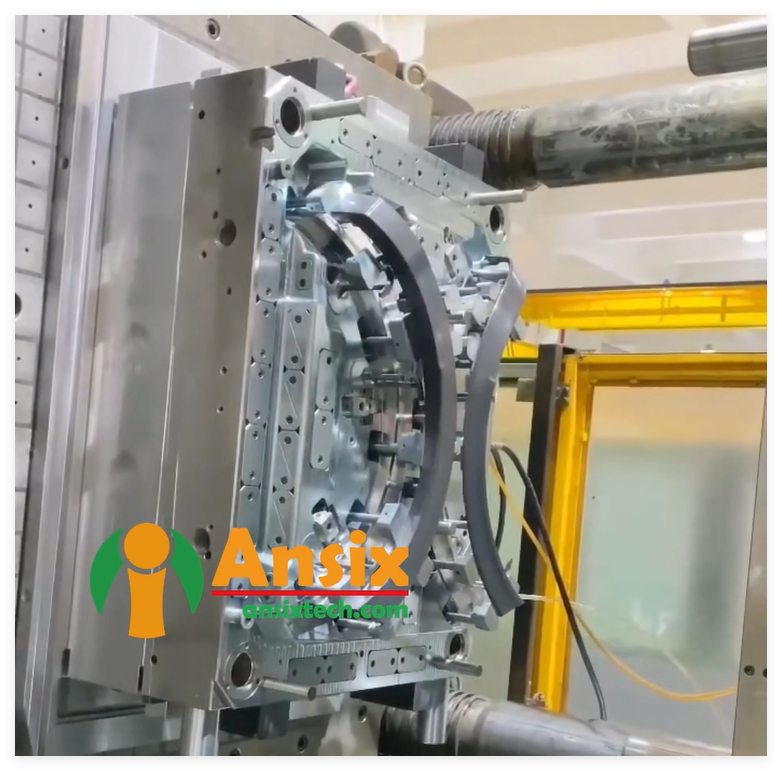
Tesla wheel arch trim panel
Behind the Seamless Curves: The Precision Engineering Powering Tesla's Wheel Arch Trims
How Ansix Tech’s injection molding expertise delivers reliability, efficiency, and significant cost savings for automotive giants.
In the high-stakes arena of automotive manufacturing, where innovation races alongside cost pressures, a single component’s journey from design to production can define competitive advantage. For Tesla—a brand synonymous with technological audacity—every part must embody precision, durability, and efficiency. The wheel arch trim panel, a seemingly unassuming exterior component, is a critical piece of this puzzle. It guards against road debris, contributes to aerodynamics, and must maintain flawless aesthetics under harsh conditions. Supplying such a part for Tesla’s lineup requires more than just manufacturing capability; it demands a fusion of advanced engineering, rigorous process control, and relentless cost optimization.

Two-color injection molding for power tool housings
Innovation Through Color: How Two-Tone Power Tools Are Reshaping Manufacturing
In the dynamic world of power tools, where durability meets design, a quiet revolution in manufacturing is taking place. At the heart of this transformation is two-color injection molding, a sophisticated process that allows manufacturers to combine aesthetics with enhanced functionality in a single, seamless component. Leading this charge is Ansix Tech, a company leveraging deep industry expertise to master the complex production of dual-material power tool housings, driving both innovation and significant cost savings for its global clients.
The market for such advanced manufacturing is booming. As consumers and professionals increasingly demand tools that are not only rugged and reliable but also ergonomic, visually distinctive, and brand-specific, the global two-color injection molding industry is experiencing robust growth. This trend is particularly pronounced in sectors like automotive, electronics, and, critically, power tools, where manufacturers seek to add value and differentiation in a competitive landscape. Ansix Tech’s specialized project for power tool housings exemplifies how cutting-edge technique and strategic engineering converge to meet these modern demands, turning complex challenges into market-ready, high-value products.

US standard charger casing
Ansix Tech Redefines US Charger Casing Production Through Engineering Excellence and Cost Innovation
Shenzhen, China – In the rapidly evolving market for electronic accessories, where profit margins are often measured in fractions of a cent, Ansix Tech has emerged as a pivotal force, systematically deconstructing and re-engineering the injection molding process for US standard charger casings to deliver unprecedented value.
The global standard charger industry, projected to see significant growth through 2028 , is a battlefield of efficiency. Here, Ansix Tech applies a philosophy of precision engineering and material science not merely to manufacture a component, but to solve the fundamental cost equation for its clients. By integrating advanced mold flow simulation, strategic material selection, and optimized thermal management, the company achieves a dual victory: producing casings that meet rigorous US safety standards like UL 498 while significantly reducing the cost base for manufacturers .

Water-cooled cylindrical cabinet air conditioner mold
Revolutionizing Climate Control: How Ansix Tech's Precision Molds Transform Air Conditioner Manufacturing
DONG GUAN, CHINA — In the highly competitive climate control industry, where energy efficiency and aesthetic design intersect with demanding performance requirements, a quiet revolution is taking place in the foundational manufacturing processes. At the forefront of this transformation is Ansix Tech, a mold engineering specialist whose innovative approach to manufacturing water-cooled cylindrical cabinet air conditioner molds is setting new standards for quality, efficiency, and cost-effectiveness in plastic component production.
As commercial and residential spaces increasingly adopt advanced climate control systems, manufacturers face unprecedented pressure to deliver components that balance structural integrity with visual appeal, all while containing costs in an inflationary environment. This pressure converges most critically at the injection molding stage, where plastic components—from structural housings to intricate grilles—are produced in volume. Ansix Tech has responded to these challenges with a comprehensive engineering methodology that addresses every facet of the mold design and manufacturing process, yielding components that meet exacting specifications while significantly reducing production costs.

PC transparent crystal mouse shell
The Art of Clarity: Precision Manufacturing Meets Aesthetic Innovation in PC Transparent Mouse Shells
DONG GUAN, China – In an industry where the functional often overshadows the beautiful, Ansix Tech is redefining the computer peripheral by mastering one of injection molding's most demanding challenges: producing flawless, crystal-clear polycarbonate mouse shells that marry optical purity with structural integrity.
The global market for mouse shells, a segment projected for sustained growth in the coming decade, is fiercely competitive . In this landscape, manufacturers are relentlessly seeking differentiation. While innovations have historically focused on internal sensors or extra buttons, a significant trend is re-emerging: the aesthetic and experiential appeal of the device itself . Consumers, particularly in gaming and high-end office segments, are increasingly drawn to products that showcase technology, leading to a resurgence in demand for transparent or translucent designs that reveal intricate internal components and lighting effects.

96-well deep-well plate silicone cover mold
Ansix Tech Pioneers Cost-Effective Precision: Mastering the 96-Well Deep-Well Plate Silicone Cover Mold
In the high-stakes world of life sciences manufacturing, where reliability is non-negotiable and cost pressures are immense, a single component's failure can derail millions in research. Ansix Tech’s innovative approach to the silicone cover mold project proves that precision and affordability are not mutually exclusive goals.
Introduction: The Critical Seal in Modern Laboratories
In the bustling ecosystem of a modern biomedical laboratory, the humble 96-well deep-well plate is a fundamental workhorse. These plates, essential for high-throughput screening, genomics, and drug discovery, rely on a critical companion: the silicone sealing cover. These are not simple lids but precision-engineered components that must create an absolute seal against contamination, withstand extreme temperatures from -80°C storage to 121°C autoclaving, and endure forces of over 4000 g during centrifugation .