



12-cavity hot runner plastic injection needle valve PET bottle mold
FEATURES
Our Foundational Hard Power – The Equipment Infrastructure That Builds Trust
Precision Mold Processing Equipment
We invest continuously in world-class machining and manufacturing equipment because superior output requires superior input. When you choose Ansix Tech for your 12-cavity PET preform mold, you gain access to an engineering backbone that delivers precision at every stage of production.
Five-Axis High-Speed Machining Centers: Equipped with advanced five-axis simultaneous machining capabilities, our Makino and Mazak machining centers achieve machining accuracies down to 0.002mm on complex surfaces. What does this mean for your product? The parting lines across all 12 cavities are smooth and free of burrs, eliminating secondary finishing operations and extending sealing surface life. Complex thread split geometries are machined in a single setup, ensuring perfect concentricity between core and cavity. This precision translates directly into superior preform wall thickness distribution, with eccentricity controlled below 0.05mm, ensuring consistent material distribution during the subsequent stretch-blow process and dramatically reducing bottle rejects.
-
Mold Description
Product Materials:
PET PETG
Mold Material:
S136ESR
Number of Cavities:
1*12
Glue Feeding Method:
Hot runner
Cooling Method:
Water cooling
Molding Cycle
9.5s
- The mold manufacturing process and product material selection
Slow Wire EDM (Wire Electrical Discharge Machining): Our slow wire EDM capabilities can machine micro-pores and narrow slots down to 0.03mm precision. For the cooling channel designs in your 12-cavity PET preform mold, this means we can machine intricate conformal cooling passages that follow the geometry of each cavity, dramatically improving heat transfer uniformity. We can also machine the delicate needle valve seat geometries with mirror-finish surfaces that ensure positive valve shut-off, preventing gate drool and maintaining clean preform gate quality across millions of cycles. The EDM process minimizes thermal stress on the workpiece, preserving the metallurgical integrity of high-performance mold steels and avoiding micro-cracking that can lead to premature mold failure.
High-Speed Graphite and Copper Electrode Machining: We maintain an in-house electrode production center that supports our EDM operations. This ensures consistent electrode quality and rapid turnaround for repairs or modifications. When you need an engineering change, we can produce electrodes and cut new features in days rather than weeks, dramatically reducing modification lead times and minimizing your production downtime.
-
Injection Molding Machine Fleet
Your mold is only as good as the machine it runs in. We maintain a diverse injection molding machine fleet ranging from 30 tons to 4000 tons of clamping force, covering product sizes from small thin-wall containers to large industrial components.
All our machines are equipped with all-electric servo drives, delivering stable process repeatability of ±0.1% variation from shot to shot. This means that when you run your 12-cavity preform mold on your own machines, you can expect the same precision we achieve during our testing. Each cavity produces preforms with identical weight, dimensional characteristics, and material properties from the first shot of a production run to the last. When you run 12 cavities at a cycle time of 18–25 seconds, even a 0.1% variation in shot-to-shot repeatability translates into significant quality consistency over millions of cycles.
Our machine fleet is optimized specifically for PET preform production. We maintain drying systems capable of reducing PET pellet moisture to below 50 ppm—critical for preventing hydrolysis and maintaining intrinsic viscosity (IV) within ±0.02 dL/g. We run mold temperature control systems that maintain each cavity within narrow temperature bands, preventing the gate blush, yellowing, and brittleness that plague poorly controlled PET processes. During our T1 through T3 trial runs, we use a combination of machine types to validate that your mold will perform reliably on any well-maintained PET injection system, including Husky, Netstal, Engel, and general-purpose PET machines.
Inspection and Quality Assurance Equipment
Precision manufacturing requires precision verification. We maintain a comprehensive inspection laboratory that ensures every 12-cavity mold meets its dimensional specifications before leaving our facility.
Coordinate Measuring Machines (CMM): Our high-accuracy CMM systems measure critical mold dimensions, including cavity diameters, core-cavity concentricity, thread split alignment, and cooling passage locations. Each cavity is inspected individually, and a full dimensional inspection report is generated and provided to you before shipment. For critical dimensions that directly affect preform quality—such as cavity diameter, neck finish dimensions, and gate orifice size—we demonstrate process capability indices (Cpk) of 1.33 or higher. A Cpk of 1.33 indicates that your critical dimensions are produced within specification with a 4-sigma process margin, providing you with confidence that production will remain stable over extended runs.
Optical Measurement and Vision Systems: We use high-resolution optical inspection systems to verify surface finish quality, detect micro-defects, and measure fine features that are difficult to capture with contact probes. This is particularly important for the gate area, where surface finish directly impacts preform clarity and blow molding performance. We also use digital comparators to verify thread profile geometries against master reference standards.
Hardness Testing Equipment: Every mold component is hardness-tested after heat treatment to verify that material specifications have been met. For cavity and core steel, we typically certify hardness between HRC 48–52, ensuring both wear resistance and adequate toughness to resist cracking under cyclic loading.
Leak and Flow Testing: We test every cooling circuit under pressure to verify that there are no internal leaks and that flow rates meet design specifications. This prevents the catastrophic failure that occurs when cooling water enters the hot runner system, and it ensures that each cavity receives adequate cooling flow for consistent temperature control across all 12 positions.
Section Two: Mold Manufacturing Core Competencies – Turning Technical Specifications into Customer Value
Your PET bottle preform mold must deliver consistent performance over millions of cycles. The table below translates our technical specifications into the business value you receive:
Dimension Our Technical Specification What This Means for Your Business
Mold Life Cavity and core: S136 stainless steel, HRC 48–52; mold base: chrome-plated P20 3–5 million shots before major refurbishment, up to 10 years of productive life with proper maintenance. Lower tooling amortization cost per thousand preforms
Preform Eccentricity Off-center adjustment system ensures thickness difference < 0.05mm Consistent wall thickness across all preforms means reliable blow molding with reduced bottle defects; minimal preform rejects
Cavity-to-Cavity Weight Variation Weight difference between cavities ≤ 0.03g (target < 0.02g) All blow molding stations receive identical preforms; consistent bottle expansion; reduced quality sorting requirements
Surface Finish Ra < 0.05μm on cavity surfaces Crystal-clear preforms with excellent transparency; smooth preform surfaces for uniform reheating during blow molding; extended mold release performance
Gate Finish Needle valve gate with polished orifice; no gate tail No post-molding tail cutting required; automated preform handling possible; labor cost reduction of 8–12% compared to cold runner systems
Material Selection Strategy: Matching Steel to Performance Requirements
Material selection is not about choosing the most expensive steel; it is about matching the steel properties to your specific production requirements. Our material selection strategy balances longevity, precision, and cost effectiveness.
Cavity and Core Steel – S136 Stainless Steel: We select S136 stainless steel for cavity and core components in all 12-cavity PET preform molds. S136 offers exceptional corrosion resistance, which is critical when processing PET due to the potential for byproduct formation at high melt temperatures. It delivers superior polishability achieving mirror finishes essential for the crystal clarity that brand owners demand for beverage containers. Hardness of HRC 48–52 after vacuum heat treatment provides excellent wear resistance against abrasive PET melt flow. For medical and food-contact PET applications, S136 meets FDA and food safety requirements.
Neck Thread Components – 2316 or H13 Stainless Steel: We manufacture the neck thread split components from high-performance stainless steels such as 2316 or H13 hardened to HRC 48–52. These steels combine excellent wear resistance with sufficient toughness to resist cracking from the cyclic opening and closing of the thread splits. The dual-taper locking design in these components ensures perfect alignment and concentricity across all 12 cavities.
Mold Base – Chrome-Plated P20 Steel: The mold base is manufactured from P20 steel with a chrome plating process that enhances corrosion resistance and maintains surface integrity. P20 offers excellent machinability and dimensional stability with hardness of 30–36 HRC in pre-hardened condition.
Valve Pins and Components: Valve pins are manufactured from specialized high-hardness materials such as SKD51 (Japanese standard) with hardness of HRC 58–60 to resist wear and maintain seal integrity over millions of cycles. For demanding applications, we use specialized steel grades including 8407, 2344, 2343, DC53, M340, 4Cr13, 9Cr18, NAK80, and other premium materials depending on your specific application requirements.
Advanced Mold Design and Engineering Capabilities
Our design process begins not with CAD modeling but with understanding your production goals. Every engineering decision is evaluated against its impact on your productivity and cost structure.
Mold Flow Analysis and DFM: Before cutting the first piece of steel, we perform comprehensive mold flow analysis to predict and eliminate potential defects. We simulate melt flow from the main inlet through the hot runner manifold to each of the 12 needle valve gates. We verify that all cavities fill simultaneously with balanced pressure distribution. We identify potential air traps, weld lines, and gas entrapment locations before they become quality problems. We optimize gate locations and needle valve timing to ensure clean gate closure without residual stress or gate blush. We simulate cooling performance to predict preform solidification behavior and ejection temperatures. For complex designs, we generate a full Design for Manufacturability (DFM) report that provides you with: recommended draft angles for smooth ejection, wall thickness optimization to minimize cooling time, gate location verification for aesthetic requirements, and permitted ejector pin mark locations to avoid functional surfaces.
Balanced Hot Runner System: The needle valve hot runner system is the heart of your 12-cavity PET preform mold. We design and manufacture hot runner systems that deliver balanced melt distribution to each of the 12 cavities. The manifold is designed using advanced rheology simulation to ensure equal flow lengths and minimal pressure drop across all cavities. Each cavity has its own individual valve pin actuation, providing independent gate control and allowing nozzle-level temperature regulation. The needle valve gate design eliminates the preform gate tail, so your preforms come out of the mold ready for downstream processing—no post-cutting operations required. Hot runner components include PID temperature control systems with single-cavity independent control, maintaining temperature accuracy within extremely tight tolerances.
Advanced Cooling System Design: Cooling time dominates the overall molding cycle—typically 60% to 75% of total cycle time. We design cooling systems that minimize this time while maintaining temperature uniformity. Conformal cooling channels follow the geometry of each cavity, placing cooling water where it is most needed. Beryllium copper inserts, where appropriate, dramatically improve heat transfer from critical zones. We design the cooling circuit with flow-optimized passages that maximize Reynolds number for turbulent flow and efficient heat transfer. Zone-specific cooling circuits allow separate temperature control for neck, body, and gate areas. Titanium alloy heat diffusers can be embedded to further improve cooling uniformity. With this approach, we achieve temperature differences across each cavity of less than 2°C and cavity-to-cavity temperature variation of less than 1°C. This uniform cooling delivers consistent crystallization across all preforms, dramatically reducing warpage and improving blow molding consistency.
Mold Manufacturing Process Flow and Quality Gates
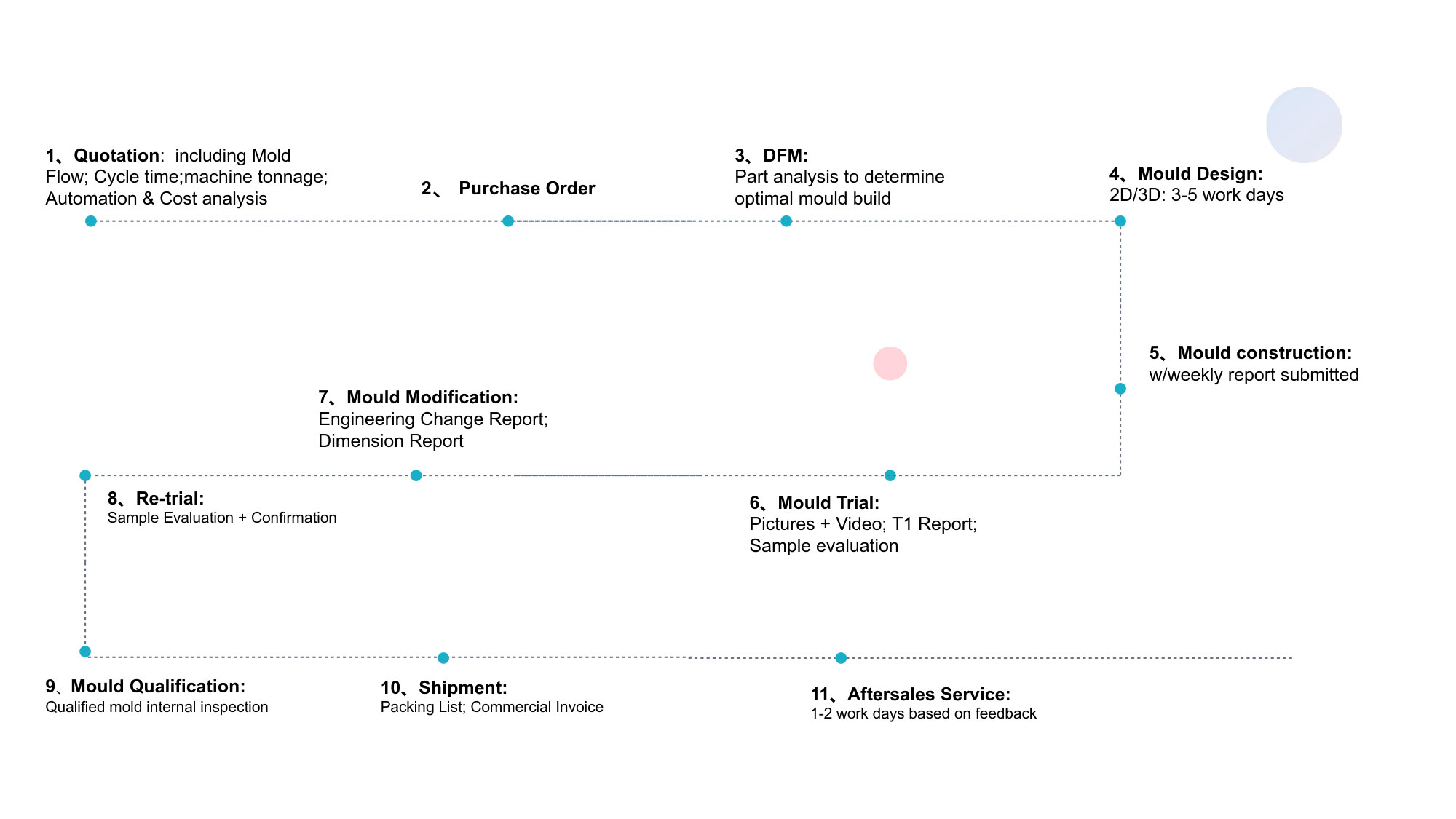
Our 12-cavity PET preform mold manufacturing follows a structured process with quality verification gates at each stage:
Stage 1: Material Verification – Incoming material certificates are verified. Raw steel hardness, composition, and heat treatment records are inspected. An auditable material traceability record is established linking each component to its source certification.
Stage 2: Rough Machining – Using CNC milling centers, we rough-machine the mold base plates, cavity blocks, core blocks, and other major components, leaving stock allowance for final finishing after heat treatment.
Stage 3: Heat Treatment – Cavities, cores, and neck components undergo vacuum heat treatment to achieve target hardness of HRC 48–52. Heat treatment curves and certification records are retained for full material traceability. This step ensures the steel achieves optimal mechanical properties for wear resistance and dimensional stability.
Stage 4: Precision Final Machining – Using five-axis machining centers, we finish-machine cavity and core surfaces to final dimensions with 0.005mm tolerance. EDM operations are performed for micro features that cannot be machined mechanically. Thread split components are machined with matched pairs to ensure perfect alignment.
Stage 5: Polishing and Surface Finishing – Cavity surfaces are progressively polished from rough grits through fine diamond pastes to achieve mirror finishes below Ra 0.05μm. Gate areas and sealing surfaces receive additional attention to ensure smooth melt flow and positive valve shut-off.
Stage 6: Assembly and Fitting – All components are cleaned and assembled in a clean environment. Valve pin travel and timing are adjusted to ensure positive gate closure. Needle valve timing sequence is programmed to create clean gate marks. Thread split operation is verified for smooth opening and closing. Cooling circuits are pressure-tested for leak integrity.
Stage 7: Dimensional Verification – Each cavity is individually inspected on CMM. Neck finish dimensions are verified against cap sealing requirements. Concentricity between cavity and core is verified. A full dimensional report is generated with Cpk calculations for critical dimensions.
Stage 8: T1 and T2 Trial Runs – The assembled mold undergoes test runs on injection molding machines in our facility. We perform T1 shots to verify basic function and fill balance. For T2, we optimize process parameters and collect 100 consecutive preforms for detailed measurement, verifying weight distribution across all 12 cavities, dimensional consistency, and visual quality. If modifications are needed, we return to our manufacturing floor for corrections and produce a T3 trial run.
Stage 9: Final Packaging and Documentation – After successful trialing and customer approval, the mold is cleaned, coated with anti-corrosion oil, and packaged in export-quality wooden cases with moisture-barrier protection. Full documentation including material certificates, heat treatment records, CMM inspection reports, trial run parameters, and maintenance instructions is delivered with the mold.
Section Three: Injection Molding Process Control – Eliminating Quality Anxiety
Your biggest concerns as a PET bottle producer are: part defects that cause blow molding failures, flash that creates additional finishing labor, dimensional inconsistency between production batches, and color or transparency variation that affects brand presentation. Our injection molding process control systems are designed to eliminate these concerns.
Process Standardization and MES Integration
We have integrated all injection molding machines into a Manufacturing Execution System (MES) that logs and controls every critical process parameter:
All key parameters are locked within the MES: melt temperature profiles (barrel zones from feed to nozzle), injection velocity profile (multi-stage control from fill to pack), packing pressure and duration settings, mold temperature (cooling water temperature, flow rate, and zone-specific control), cooling time duration, and needle valve timing and sequencing.
Parameter changes require engineering authorization: Only senior process engineers can adjust these parameters, and all changes are logged with operator ID, timestamp, and reason for change. This prevents unauthorized adjustments that could compromise quality and maintains a complete change history for audit purposes.
First-article and last-article inspection: Every production run begins with a first-article preform inspection that verifies all dimensions, weight, and visual criteria before full production commences. When the run ends, last-article inspection verifies that the process remained stable throughout. This book-end inspection method catches drift before it becomes out-of-specification and provides traceability for every production batch.
Dimensional Stability Control
Mold temperature control: We design each mold with multiple independent cooling zones (neck zone, body zone, gate zone) that connect to the temperature control unit through separate circuits. Each zone can be individually set and monitored to maintain optimal temperature for its specific geometry. We incorporate beryllium copper inserts in hot zones to enhance cooling where it is needed most.
Temperature uniformity: Our mold designs maintain temperature difference between core and cavity within 2°C. Cavity-to-cavity temperature variation is held below 1°C. This uniform cooling environment minimizes warpage, ensures uniform shrinkage, and produces consistent preform dimensions across all 12 cavities.
Measurable capability: Through our process qualification procedures, we regularly demonstrate dimensional Cpk of 1.33 or greater on critical features. For high-volume clients running 24/7 production, we have documented cases where critical hole-to-hole spacing in multi-cavity molds maintained ±0.02mm variation over consecutive production runs. For PET preforms, this translates to preform weight stability of ±0.2–0.5% and IV drift within ±0.02 dL/g over extended production runs.
Quality Control and Testing Protocols
We implement a comprehensive quality control protocol for every 12-cavity PET preform mold and the preforms it produces:
Preform Weight Monitoring: Each cavity’s preform weight is measured and tracked against cavity-specific targets. Weight variation exceeding ±0.2–0.5% triggers immediate investigation of gate wear, melt temperature variation, or hold pressure inconsistency. Cavity-to-cavity weight difference is maintained below 0.03g across all 12 cavities for consistent blow molding performance.
Intrinsic Viscosity (IV) Testing: IV is the single most important material property for blow molding PET preforms. We test preform IV against resin supplier baseline values, maintaining drift within ±0.02 dL/g. Larger IV drift indicates hydrolysis from excessive moisture or thermal degradation from excessive melt temperature. Our drying and temperature control systems are designed to prevent these issues.
Moisture Control: PET pellets are dried to moisture content below 50 ppm before processing, with many operations running 20–40 ppm for optimal results. Moisture above 50 ppm causes hydrolysis during melt processing, reducing IV, creating haze, brittleness, and increasing scrap rates. Our integrated drying systems maintain consistent moisture levels throughout production.
Acetaldehyde (AA) Control: For water-grade PET bottles, AA content in preforms must remain below 10 ppm to prevent taste and odor issues. AA generation is primarily driven by melt temperature and residence time at temperature. Our hot runner systems are designed to minimize melt residence time and maintain uniform temperature control.
Dimensional Inspection: We use plug gauges and profile comparators to verify critical neck finish dimensions, including thread OD, thread ID, support ledge geometry, and tamper band dimensions. The complete preform length is measured to verify shrinkage compensation. Preform wall thickness is measured using ultrasonic or optical methods to verify distribution uniformity.
Appearance Quality Grades
Based on your end-product requirements, we can qualify preforms to meet specific appearance standards:
Transparent parts: Crystal clarity free of bubbles, flow lines, gate blush, or haze. For thick-walled preforms, bubble-free clarity requires melt temperature control within ±3°C and screw decompression timed to prevent air entrapment. Gate blush—the white stress mark around the gate—is prevented through optimized needle valve timing and gate geometry.
Preforms for blow molding: Uniform wall thickness distribution ensures consistent expansion into bottles. Neck finish dimensions must be correct for reliable cap sealing. The gate area must be completely free of residual material that would interfere with the blow pin.
Recycled PET (rPET) processing: Our process parameters are optimized for rPET blends up to 100%, compensating for the viscosity variation and color variation inherent in recycled materials. For sustainable packaging projects, we can demonstrate stable production with up to 100% rPET content.
Experience with Special Engineering Materials
While PET is our primary focus for preform molds, our injection molding expertise extends to a wide range of engineered thermoplastics that require special processing considerations: PC/ABS blends, PC, PPS with 40% glass fiber, PEEK, PTFE/PFA, nylon (PA6 with 30% glass fiber), PBT, PEI, PPS, LCP, and liquid silicone rubber (LSR). For each material, we understand the specific processing requirements: drying protocols for hygroscopic materials, mold temperature optimization for semi-crystalline polymers, hot runner temperature control for heat-sensitive resins, and specialized wear protection for glass-filled or abrasive materials. For electrical and electronic applications, we can certify production to UL94 V-0 flammability standards. For outdoor applications, we can validate production to UV exposure standards (3000-hour UV testing without color shift).
Section Four: Full-Service Lifecycle Management – Reducing Your Administrative Burden
The greatest hidden cost of mold ownership is not the purchase price—it is the administrative burden of managing multiple vendors for design, prototyping, modification, repair, and maintenance. Our full-service approach reduces this burden significantly.
DFM Early Engagement: Solving Problems Before Steel Is Cut
We engage early in your product development cycle, before mold manufacturing begins, to identify and resolve manufacturability concerns:
Mold flow analysis predicts fill behavior, identifies air trap and weld line locations, and verifies cavity-to-cavity balance across all 12 positions.
Draft angle recommendations ensure reliable ejection without part damage. For PET preforms, proper draft on the thread splits and body is essential for smooth ejection.
Wall thickness optimization identifies non-uniform areas that could cause slow cooling, sink marks, or warpage. Even preform wall thickness is critical for subsequent blow molding consistency.
Gate location guidance identifies positions that minimize visible witness marks and avoid functional surfaces. For preforms, the gate is always located at the center of the bottom dome, below the stretch rod contact area.
Ejector pin placement verification ensures that ejector marks are located in non-cosmetic areas where they will not affect performance or appearance.
Shrinkage compensation predicts part shrinkage based on material grade, injection pressure, and cooling conditions, then adjusts mold cavity dimensions to compensate. For rPET materials, we apply an additional 0.18% shrinkage compensation to account for the inherent variability of recycled material.
Trial Sampling and Validation Process
We provide structured trial runs with documentation at each stage:
T1 – First shot validation: Basic functionality verified. All 12 cavities fill completely. No major defects visible. We provide you with sample preforms and initial process parameters.
T2 – Process optimization: We optimize parameters for balance across all 12 cavities. We measure cavity-to-cavity weight variation and make hot runner temperature adjustments to balance fill. We dimensionally inspect sample preforms and compare with part print.
T3 – Final validation: We run the mold continuously for a defined duration to validate stability. We collect a representative sample for full dimensional, weight, and IV testing. We document the final validated process parameters for your production team to replicate on your machines.
Optional T4 – Customer witnessed run: We invite your quality and process engineers to witness the validated run at our facility, providing training on proper mold operation and maintenance before the mold ships.
Small Batch Production for Process Validation
Before you commit to full production, we can produce 100 to 500 preforms using your production material. This trial batch serves multiple purposes:
You can blow mold the preforms into bottles to validate that preform design meets finished bottle requirements.
You can collect dimensional and performance data to validate your own quality specifications.
You can train your setup technicians on the mold with actual material, reducing learning time when the mold arrives.
We track yield rates and CPK from the trial batch, so you have documented evidence of process capability before approving release to production.
Maintenance, Spare Parts, and Technical Support
Your mold is a long-term production asset. We support it throughout its life:
Standard spare parts kit: Each mold includes a kit of commonly replaced wear components—valve pins, ejector pins, valve pin bushings, and replacement core and cavity inserts. These parts allow you to perform routine maintenance without waiting for parts deliveries.
Maintenance schedule: We provide a preventive maintenance schedule with recommended intervals: daily cleaning and inspection, weekly lubrication of moving components, monthly cooling circuit flush and flow verification, quarterly wear component measurement and replacement if worn, and annual full inspection and refurbishment as needed.
Rapid repair service: For unexpected mold damage, our in-house machining, EDM, and welding capabilities allow emergency repairs within 24 hours for most issues. We do not outsource repair work, so your mold never leaves our facility during repair, and we maintain full control over repair quality.
Spare part availability: We maintain a stocked inventory of standard replacement components for all molds we have manufactured. When you need a replacement part, we can ship it within days, not weeks.
Extended warranty: Our standard warranty covers the mold structure and major components against manufacturing defects for one year or one million shots (whichever comes first). Extended warranty coverage, including the hot runner system, can be purchased for high-volume production applications.
Section Five: Differentiated Competitive Advantage – Direct Answers to Common Customer Concerns
Rather than claiming we are “better” in general terms, we provide specific, measurable responses to the most frequent frustrations our clients have experienced with other mold suppliers:
Common Customer Complaint with Other Suppliers Ansix Tech’s Specific Commitment (Verified and Achievable)
“Molds need frequent repair, causing production interruptions and missed orders.” We perform a 2,000-shot aging test before mold delivery, measuring wear on critical components (valve pins, seal rings, ejector components). We provide a detailed wear report with your mold. We offer a three-year mold structure warranty (excluding normal wear items such as valve pin tips, ejector pins, and wear plates).
“Excessive flash requires manual deflashing, adding labor cost and slowing production.” We machine all parting surfaces to 0.005mm precision, ensuring a tight seal between mold halves. We incorporate mechanical lock blocks that maintain clamp force compensation as the mold thermal cycles. Flash across the 12-cavity system is consistently maintained below 0.03mm per cavity. No manual deflashing is required for standard production.
“Dimensions change between production runs, causing quality non-conformance.” We install ultrasonic wall thickness sensors on the injection molding machine that monitor preform wall thickness in real time and automatically compensate packing pressure to maintain targets. For critical dimensions, we can embed mold-mounted temperature and pressure sensors that provide closed-loop feedback to the injection molding machine, automatically adjusting velocity-to-pressure transfer points in response to changing material or environmental conditions.
“Mold repair takes weeks, causing extended downtime.” Our in-house EDM and electrode production center eliminates outsourcing delays for repair work. For most common repairs—such as replacing worn valve pin bushings, refurbishing gate orifices, or repairing damaged cooling lines—we complete the repair in 24 hours from receipt of the mold. We also maintain a complete set of manufacturing records for every mold we have built, allowing us to reproduce any component exactly to original specification without reverse engineering.
Quantified Cost Reduction Analysis
The following table quantifies the cost savings that Ansix Tech’s 12-cavity PET preform mold delivers compared to typical mold alternatives:
Cost Component Conventional Approach Ansix Tech 12-Cavity Solution Annual Savings (based on 5M preforms/year)
Gate Tail Removal 0.8 sec/post per preform × 12 cavities × manual labor Zero – needle valve gate produces tailless preform $12,000–18,000 in direct labor
Flash Removal 0.5 sec/post manual deflashing Zero – flash < 0.03mm, no deflashing required $7,500–10,000 in direct labor
Preform Sorting Visual inspection required for gate blush, stress cracks Eliminated through balanced hot runner and optimized needle valve timing $8,000–12,000 in quality labor
Mold Modification Lead Time 4–6 weeks for design and manufacturing 7–10 days with in-house electrode and EDM capabilities Avoid $15,000–25,000 in expediting fees
Maintenance Interval 150,000–200,000 shots between maintenance 500,000 shots between major maintenance with supplied spare kit $3,000–5,000 in reduced maintenance labor
Premature Replacement Mold replacement at 2 million shots 3–5 million shots with documented material certifications and heat treatment records $30,000–50,000 deferred capital cost
Energy Cost per Preform Standard cooling circuits, longer cycles Optimized cooling reduces cycle time by 10–15% $6,000–10,000 in reduced energy consumption
Scrap Rate 3–5% typical 1–2% achievable with documented CPK and validation $15,000–30,000 in raw material savings
Real-World Performance Metrics
For our standard 12-cavity PET preform mold configuration, clients can expect the following verified performance metrics:
Cycle time: 18 to 25 seconds depending on preform weight and cooling design. For lightweight preforms (18–25g), we regularly achieve cycles of 18–20 seconds.
Mold life: 3 to 5 million shots before major refurbishment. With proper maintenance and operation, molds remain productive for 5 to 10 years.
Cavity-to-cavity weight variation: ≤ 0.03g across all 12 cavities on standard PET.
Preform eccentricity: ≤ 0.05mm verified on CMM.
Delivery time: 45–60 days from design approval to mold completion, including T1 trials.
Recycled material capability: Proven performance with up to 50% rPET content using optimized process parameters. Sustainable packaging formulations supported.
Why a 12-Cavity Mold Delivers the Optimal Balance
Unlike 24-cavity or higher molds that require specialized injection molding machines and limit your flexibility, the 12-cavity configuration works effectively on standard injection molding equipment and fits within machine sizes compatible with 8-cavity molds. The dual-row arrangement (6×2) packs cavities efficiently within the mold base envelope. This means you can upgrade from an 8-cavity to a 12-cavity mold on the same machine, increasing your output by 50% without requiring capital investment in new equipment. The needle valve hot runner system eliminates manual tail cutting operations entirely, and the balanced manifold design ensures consistent filling across all 12 cavities without the complex flow balancing required in higher-cavity configurations. We have successfully delivered 12-cavity needle valve PET preform molds for: 28mm neck beverage preforms (mineral water, carbonated soft drinks), 38mm wide-mouth jar preforms for food packaging, 40mm medical bottle preforms, and 48mm specialty container preforms for industrial applications.
Conclusion: Your Mold Is Not a Block of Steel – It Is Your Production Asset
At Ansix Tech, with over 28 years of dedicated experience in PET preform molds and injection molding, we design every mold with a singular focus: making your production line more profitable.
We design for production stability – ensuring the mold runs from the first shift to the last without unplanned downtime. We design for material efficiency – minimizing scrap through balanced filling and stable process control. We design for labor productivity – eliminating secondary finishing operations through needle valve gate technology and precise flash control. We design for ease of maintenance – providing spare parts kits, detailed documentation, and rapid support for any issue. We deliver on time – with structured project management and in-house manufacturing that eliminates schedule slippage.
Our approach is simple: we translate every specialized technical decision—steel grade selection, cooling circuit design, gate geometry, process parameter optimization—directly into customer value that reduces your production cost, increases your output, and protects your brand quality.
We invite you to experience the Ansix difference. Provide us with your product specifications, target production volume, quality requirements, and delivery schedule. We will respond with a comprehensive proposal that includes: mold design concept, material specification and justification, cooling design and expected cycle time, hot runner system architecture, quality control plan, and delivery timeline with trial schedule.
Better yet, allow us to select one of your existing products for a full DFM review. We will demonstrate, step by step, how we identify and eliminate potential issues—melt flow imbalances, air traps, cooling inconsistencies, shrinkage variation—before you commit a single dollar to manufacturing. You will see precisely how we convert risk into reliability, and how Ansix Tech transforms your mold from a capital expense into a high-return production asset.
Ansix Tech – 28 Years of Excellence in PET Preform Mold Engineering
Ansix Tech Co Ltd
If you have any plans related to 12-cavity hot runner plastic injection needle valve PET bottle mold , you can contact us at any time. We will turn your ideas into reality, let you realize your dreams, and obtain large orders from the market. Our contact information is info@ansixtech.com. Or contact our CTO, mail: stephen@ansixtech.com
#www.ansixtech.com #ansixtech.com #12-cavity hot runner plastic injection needle valve PET bottle mold #12-cavity hot runner plastic injection needle valve PET bottle mold moulds #12-cavity hot runner plastic injection needle valve PET bottle mold injection molding companies #12-cavity hot runner plastic injection needle valve PET bottle mold Canopy Mold injection mold companies #Ansix #Ansix moulds #Ansix china #Ansix tech china #Ansix tech company #Ansix facotry #12-cavity hot runner plastic injection needle valve PET bottle mold injection molding #12-cavity hot runner plastic injection needle valve PET bottle mold injection tools #12-cavity hot runner plastic injection needle valve PET bottle mold injection moulds #12-cavity hot runner plastic injection needle valve PET bottle mold plastic mould #12-cavity hot runner plastic injection needle valve PET bottle mold plastic tools #Ansix Tech #Ansix molds #Ansix injection molding #Ansix mold factory #injection molding 12-cavity hot runner plastic injection needle valve PET bottle mold #Ansix mold factory #12-cavity hot runner plastic injection needle valve PET bottle mold china #12-cavity hot runner plastic injection needle valve PET bottle mold molds #injection factory #12-cavity hot runner plastic injection needle valve PET bottle mold injection molding #12-cavity hot runner plastic injection needle valve PET bottle mold injection molding factory #injection molding company #12-cavity hot runner plastic injection needle valve PET bottle mold injection mold companies #12-cavity hot runner plastic injection needle valve PET bottle mold#12-cavity hot runner plastic injection needle valve PET bottle mold mold limited #Ansix mold china #Ansix companies #Ansix company China #12-cavity hot runner plastic injection needle valve PET bottle mold facotry #Ansix Tech #Ansix Tech mould #12-cavity hot runner plastic injection needle valve PET bottle mold injection moulding #injection moulding company #Ansix 12-cavity hot runner plastic injection needle valve PET bottle mold parts injection mold companies #medical injection molding companieschina #12-cavity hot runner plastic injection needle valve PET bottle mold china factory #Ansix moulding companies #Ansix molding company #12-cavity hot runner plastic injection needle valve PET bottle mold injection moulding facotry #Ansix Tech mold #12-cavity hot runner plastic injection needle valve PET bottle mold mould #12-cavity hot runner plastic injection needle valve PET bottle mold plastic injection molding #ansix plastic mold #Mold manufacturing #12-cavity hot runner plastic injection needle valve PET bottle mold parts manufacturing #12-cavity hot runner plastic injection needle valve PET bottle mold plastic parts factory #12-cavity hot runner plastic injection needle valve PET bottle mold injection parts mold #12-cavity hot runner plastic injection needle valve PET bottle mold PRECISION MANUFACTURING #12-cavity hot runner plastic injection needle valve PET bottle mold #China mold #12-cavity hot runner plastic injection needle valve PET bottle mold injection moulding china #12-cavity hot runner plastic injection needle valve PET bottle mold mould china #china precision mold #mold in china #12-cavity hot runner plastic injection needle valve PET bottle mold mold china #Precision molds #High-precision molds #12-cavity hot runner plastic injection needle valve PET bottle mold #Injection molds #12-cavity hot runner plastic injection needle valve PET bottle mold Factory #12-cavity hot runner plastic injection needle valve PET bottle mold Company #Super Large Injection Mold Factory #Large Tonnage Injection Molding Factory #12-cavity hot runner plastic injection needle valve PET bottle mold Company #12-cavity hot runner plastic injection needle valve PET bottle mold Factory #2800T Injection Molding Factory #3000 Ton Injection Molding #4500 Ton Injection Molding Factory #Large Mold Injection Molding #Large Plastic Mold Injection Molding Factory #Large Injection Mold Manufacturer #Plastic Mold Factory #Injection Mold #Plastic Mold