



معلومة
قالب دقيق ومكونين
زخرفة قوالب الإدخال لقطع غيار السيارات
قوالب وحقن الأجهزة المنزلية والكهربائية
منتجات تغليف مستحضرات التجميل وأغطية PET PreformCap
قطع بلاستيكية مصنعة باستخدام آلات CNC
-
اتصل بنا
الهاتف: +86 158 1869 2114
البريد الإلكتروني: info@ansixtech.com
سكايب: Stephenhuang2010
واتساب: +86 13530645990
العنوان: المبنى F، المنطقة الصناعية غوانلان وييتشنغ، مقاطعة لونغهوا، شنتشن، الصين
جميع الحقوق محفوظة © 2024
خريطة الموقع
-
أفضل مدونة
-
الموضوع الرئيسي
احمِ حاسوبك المحمول بقوالب غطاء متينة على شكل حرف C تُحسّن المظهر وتحميه من التلف. مثالية للمستخدمين المهتمين بالأناقة والذين يبحثون عن المتانة.
- موردو قوالب أغطية أجهزة الكمبيوتر المحمولة، قوالب مخصصة لأجهزة الكمبيوتر المحمولة، مصنعو هياكل أجهزة الكمبيوتر المحمولة، قولبة الحقن لأجهزة الكمبيوتر المحمولة، إنتاج هياكل أجهزة الكمبيوتر المحمولة، قوالب أغطية أجهزة الكمبيوتر المحمولة الأصلية
Injection Molding Machine Fleet: Ansix maintains a comprehensive inventory of 260 injection molding machines with clamping forces spanning from 30 tons to 2,800 tons. This wide range enables the company to accommodate everything from small-form-factor ultrabook C-covers to larger workstation-class laptop top cases. The primary injection molding machines include leading brands such as Japan’s Fanuc, Sumitomo, Toshiba, Nissei, Austria’s Engel, and Germany’s Arburg (primarily dedicated to liquid silicone injection molding and two-component applications). Additionally, domestic machines including Haitian and Victor Taichung Machinery supplement the fleet for specific production requirements. All machines are equipped with fully servo-electric drive systems that deliver stable repeatability at ±0.1 percent precision, ensuring that each shot in mass production matches the quality of the first.
Metrology and Inspection Equipment: Quality validation begins with dimensional verification. Ansix employs coordinate measuring machines (CMM) and optical imaging measurement systems to conduct comprehensive dimensional inspections. Every mold undergoes full dimensional reporting before shipment, with all critical dimensions maintaining process capability indices of CPK ≥1.33—a statistical measure demonstrating that the manufacturing process produces parts well within specified tolerance limits.
-
Quality Management Systems: Ansix has successfully implemented and maintains ISO9001, IATF16949 (automotive industry quality standard), ISO13485 (medical device quality standard), and ISO14001 (environmental management) certifications. These internationally recognized certifications demonstrate the company’s commitment to systematic quality management, continuous improvement, and regulatory compliance across diverse industry sectors.
1.3 Comprehensive Service Portfolio – From Design to Delivery
Ansix provides end-to-end services that address every phase of the product lifecycle, ensuring seamless execution and minimal customer intervention.
Product Design and Development: The process begins with collaborative engineering, where Ansix’s technical team works alongside customer engineers to optimize the C-cover design for manufacturability. Early design-for-manufacturing (DFM) analysis identifies potential manufacturing issues before mold fabrication begins. This proactive approach eliminates costly downstream revisions and ensures that the final design can be produced efficiently at scale.
Design Validation and Prototyping: Ansix employs advanced simulation tools including Moldflow analysis to validate fill patterns, predict weld line locations, identify gas trap risks, and optimize gate placement. Before committing to production tooling, Ansix provides prototype validation through rapid tooling techniques, enabling customers to verify form, fit, and function with physical samples.
Mass Production Capability: With 260 injection molding machines operating across four facilities, Ansix possesses substantial production capacity to meet high-volume demands. The strategic geographic distribution across China and Vietnam provides supply chain resilience and proximity to major electronics assembly hubs.
Quality Assurance Systems: Every production batch undergoes rigorous quality control protocols, including incoming material inspection, in-process monitoring, final dimensional verification, and functional testing. Statistical process control maintains consistent quality across millions of units.
Logistics and After-Sales Service: Ansix manages the complete supply chain, from raw material procurement through finished goods delivery. The company has established long-term relationships with reliable logistics partners to ensure timely delivery. Post-delivery support includes mold maintenance services, spare parts supply, technical troubleshooting, and continuous improvement initiatives.
Part Two: Laptop C-Cover Product Introduction, Production Technology, Quality Assurance, Cost Control, and After-Sales Service
2.1 Laptop C-Cover Product Overview
The laptop C-cover (top case) functions as the structural backbone of the keyboard deck and palm rest area. This component must simultaneously achieve conflicting requirements: high stiffness for structural integrity, thin walls for weight reduction, thermal conductivity for heat dissipation from processors and batteries, aesthetic surface quality for brand identity, and precise dimensional accuracy for keyboard and trackpad integration.
Typical C-cover dimensions range from approximately 276.50 mm × 228.30 mm × 9.30 mm, with average wall thickness of 1.50 mm and localized thickness reductions to 1.20 mm in button and keyboard cutout regions. Part weight typically falls between 70 and 85 grams for PC+ABS material formulations.
2.2 Material Selection and Engineering Properties
Laptop C-cover material selection requires careful balancing of mechanical properties, thermal performance, aesthetic requirements, and cost considerations. The most common materials include:
PC+ABS Alloy: This material blend combines the high impact resistance and heat deflection temperature of polycarbonate (PC) with the superior flowability and electroplating adhesion of acrylonitrile butadiene styrene (ABS). PC+ABS primarily improves melt flowability, moldability, electroplating capability, and cosmetic appearance compared to pure PC. When compared to ABS, the alloy delivers enhanced heat resistance, impact strength, and rigidity in thin-walled geometries. This combination makes PC+ABS the most widely adopted material for notebook C-cover applications.
Engineering-Grade Polycarbonate (PC-GF): Glass-fiber reinforced polycarbonate offers exceptional stiffness and dimensional stability, making it suitable for applications requiring high structural rigidity.
ABS Engineering Plastic: Provides good impact resistance and surface finish at lower cost, though with reduced heat resistance compared to PC-based materials.
For PC+ABS specifically, rigorous material handling protocols must be observed. The material requires pre-drying before molding to reduce moisture content below 0.05 percent, with optimal processing at moisture levels below 0.02 percent to achieve stable flow characteristics and consistent mechanical properties. Recommended mold temperature during injection molding falls between 50°C and 80°C, with higher temperatures producing superior weld line strength and lower internal stresses, though cycle times will correspondingly increase.
2.3 Production Technology and Process Optimization
Mold Flow Analysis: Ansix employs Moldflow simulation software to analyze plastic melt behavior within the mold cavity. This predictive analysis identifies optimal gate locations, predicts fill patterns, locates potential weld lines and gas traps, and optimizes cooling circuit designs. The analysis reduces physical trial-molding iterations, accelerating development timelines and reducing costs.
Gate Design Optimization: For laptop C-cover applications, proper gate placement is critical due to the thin-walled planar geometry. Eight-point feeding systems are commonly employed, with gate positions strategically located to achieve balanced cavity filling and minimize weld line visibility. Pin gate and fan gate configurations are evaluated based on part geometry and aesthetic requirements.
Cooling System Design: Efficient cooling directly determines cycle time, part quality, and production cost. Conformal cooling channels following part contours provide superior heat extraction compared to conventional straight-drilled cooling passages. Proper cooling design reduces cycle times by 15–25 percent while minimizing warpage and residual stress.
Ejection System Design: The ejection mechanism must extract the finished C-cover without damaging delicate features. Slider cores address undercut features, while angled lifters (sloping tops) are used for button positions and mouse touch screen window edges. Proper ejection design prevents part deformation and extends mold service life.
2.4 Quality Assurance Protocols
Ansix’s quality assurance framework addresses all failure modes that could compromise C-cover functionality and appearance:
Dimensional Verification: CMM inspection ensures that all critical dimensions—including keyboard cutout positions, trackpad opening tolerances, and mounting boss locations—conform to customer specifications.
Cosmetic Inspection: Surface defects including sink marks, flow lines, weld lines, and discoloration are inspected under controlled lighting conditions. High-gloss surfaces maintain surface roughness Ra ≤0.2μm for premium aesthetic grades.
Warpage Control: Proper mold temperature zoning maintains core and cavity temperature differentials within 2°C, minimizing part warpage and ensuring flatness across the large planar surface.
Material Traceability: Raw material certificates accompany each production batch, documenting material grade, lot number, and properties including UL94 V-0 flammability rating and UV stability test results.
2.5 Cost Control Capabilities
Ansix’s cost engineering approach systematically reduces total manufacturing costs through multiple optimization pathways:
Material Cost Optimization: Through volume purchasing agreements with major resin suppliers, Ansix secures favorable material pricing while maintaining quality. Material selection guidance helps customers select the optimal grade for their application without overspecifying.
Cycle Time Reduction: Optimized cooling channel design and process parameter tuning reduce per-part cycle times, directly increasing output capacity and reducing per-unit manufacturing costs.
Waste Reduction: Precision mold fabrication and stable process control minimize scrap rates. Advanced gate designs reduce runner waste. Each percentage point reduction in scrap directly improves yield and lowers cost.
Energy Efficiency: Servo-electric injection molding machines consume significantly less energy than hydraulic alternatives, reducing operational costs while supporting sustainability objectives.
2.6 Delivery Efficiency and After-Sales Service
Standard Lead Times: Simple molds can be delivered in 10 days, with medium-complexity molds requiring 25–45 days. Expedited delivery options can compress schedules for critical projects while maintaining quality validation protocols.
Production Capacity: The fleet of 260 injection molding machines provides substantial surge capacity for peak demand periods. Distributed production across four locations provides supply chain redundancy.
After-Sales Support: Ansix provides mold maintenance services at 200,000-cycle intervals, spare parts delivery, and life-of-tool support with repairs provided at cost pricing. Customer service response is guaranteed within 12 hours for technical inquiries.
Part Three: Core Customer Value – Mold Manufacturing, Material Selection, Smart Manufacturing, and Process Quality Assurance
3.1 Mold Manufacturing Excellence
Precision Machining Capability: Ansix’s five-axis high-speed machining centers achieve ±0.002mm precision on complex three-dimensional geometries. This capability ensures that the laptop C-cover mold’s parting lines, cooling channel junctions, and ejection surfaces maintain consistent geometry across the full mold life.
Comprehensive Mold Types: Ansix manufactures and maintains capabilities across multiple mold technologies including hot runner systems (reducing runner waste and improving fill balance), stack molds (doubling output from the same machine), two-shot/multi-material molds (enabling co-molding of different materials), and high-gloss mirror-finish molds (achieving surface roughness Ra < 0.05μm for transparent or high-gloss applications).
Advanced EDM Capabilities: Ansix has established a dedicated EDM machining workshop designed to systematically reduce costs for customers. This in-house EDM capability enables complex cavity geometries, fine details, and precision features that would be impossible or prohibitively expensive with conventional machining.
3.2 Injection Molding Material Selection and Characteristics
Material Grade Selection Framework: The strategic selection of injection mold metals directly determines production efficiency, part quality, and long-term profitability. Ansix selects mold steel based on production volume, resin type, tolerance requirements, and cosmetic specifications:
Material Grade Hardness (HRC) Optimal Application Customer Value
P20 (1.2738) 30–36 Prototypes, <50K shots Lowest initial cost
718/718H (1.2738HH) 38–42 Automotive, optical, 1.2M cycles Balance of durability and polishability
NAK80 40–43 High-gloss surfaces, LCD panels Mirror finish without post-treatment
S136 (1.2083) 48–52 Medical devices, corrosive resins Extreme corrosion resistance
H13 (1.2344) 45–50 High-temperature engineering resins Thermal stability for engineering resins
For high-volume production of glass-filled engineering resins, Ansix may specify H13, 2344, or 8407 grades which provide fatigue resistance for mass production applications exceeding one million shots. For applications requiring extreme wear resistance, DC53 with higher carbide content provides superior protection against abrasive glass-fiber reinforced materials.
Raw Material Characteristics (PC+ABS Example): PC+ABS combines the advantages of both constituent polymers, improving melt flowability, moldability, electroplatability, and cosmetic appearance compared to pure PC, while enhancing heat resistance, impact strength, and thin-wall rigidity compared to ABS. Before molding, PC+ABS requires drying to reduce moisture below 0.05 percent (optimally below 0.02 percent) to prevent surface defects and property degradation.
3.3 Smart Manufacturing and Efficiency Enhancement
Machine Connectivity and MES Integration: All injection molding machines are network-connected and integrated into a manufacturing execution system (MES) that locks and monitors critical process parameters including temperature, pressure, injection speed, and cycle time. Process parameters cannot be adjusted without engineering authorization, ensuring process discipline and preventing unauthorized changes.
Sensor-Enabled Process Control: Ansic incorporates ultrasonic wall thickness sensors that provide real-time feedback on part thickness variations, automatically adjusting packing pressure to maintain dimensional consistency. When applicable, in-mold temperature and pressure sensors enable closed-loop process control that automatically compensates for environmental and material variations.
Automated Material Handling: Centralized material drying and conveying systems ensure consistent material feed to each molding machine, eliminating moisture-related defects and reducing manual handling labor.
Robotic Part Handling: Automated pick-and-place systems remove finished C-covers from molds, place them on cooling conveyors, and transfer them to downstream finishing operations, reducing cycle time variability and operator injury risk.
3.4 Process Quality Assurance (Customer Critical Core Value)
Statistical Process Control: Real-time data collection enables statistical process control charting of critical quality characteristics. Early detection of process drift enables corrective action before non-conforming parts are produced.
First Article Inspection: Each production run begins with first article inspection, verifying that the first parts produced meet all dimensional and cosmetic specifications before full production commences.
In-Process Sampling: Regular in-process samples are measured and inspected throughout production runs, ensuring continued compliance.
End-of-Line Testing: Completed C-covers undergo functional validation including keyboard fit verification, trackpad opening tolerance checks, and thermal interface flatness measurement.
Traceability Systems: Each production batch receives unique identification enabling complete traceability from raw material receipt through finished good shipment. Defect investigations can rapidly identify root causes and contain affected product.
Part Four: Laptop C-Cover Mold Manufacturing and Injection Molding – Complete Production Solution (2,000+ Words)
Section 1: Hard Power Infrastructure – Building Customer Trust Through Equipment Foundation
The foundation of any world-class mold manufacturing operation resides in its equipment infrastructure. Ansix has strategically invested in precision machining equipment that directly translates to customer value through dimensional accuracy, surface finish quality, and production reliability.
Five-Axis High-Speed Machining Centers: Ansix operates five-axis high-speed machining centers capable of achieving ±0.002mm precision on complex three-dimensional surface geometries. For laptop C-cover molds, this capability is non-negotiable. The C-cover’s parting surfaces must be perfectly matched to prevent flash—excess plastic escaping between mold halves. Flash not only creates a poor cosmetic appearance but also requires secondary deflashing operations that add cost and risk damaging finished parts. By maintaining ±0.002mm accuracy across full mold surfaces, Ansix ensures that final injection-molded C-covers emerge flash-free, eliminating post-processing labor and reducing per-part cost by 5–8 percent.
Slow-Speed Wire EDM Systems: Wire electrical discharge machining capabilities enable the fabrication of micro-features that are impossible with conventional milling. Fine micro-holes down to 0.03mm diameter and narrow slots with aspect ratios exceeding 10:1 can be precisely machined without inducing thin-wall distortion. For laptop C-cover molds, this capability enables the creation of intricate cooling channels, fine ejection pin holes, and detailed surface texturing.
Comprehensive Machine Fleet: Ansix maintains 260 injection molding machines with clamping forces ranging from 30 to 2,800 tons. This range covers every conceivable C-cover application. Small ultrabook C-covers can be efficiently produced on 80–120 ton machines, while larger workstation-class top cases requiring greater projected areas utilize machines in the 250–400 ton range. The machine fleet’s diversity provides schedule flexibility; customers are never constrained by machine availability mismatches.
Servo-Electric Drive Technology: All primary injection molding machines feature fully servo-electric drive systems. Compared to traditional hydraulic machines, servo-electric drives deliver superior precision (repeatability ±0.1 percent versus ±0.5 percent for hydraulic equivalents), higher energy efficiency (40–70 percent energy reduction), cleaner operation (no hydraulic oil leaks contaminating parts), and faster response times for injection profile control. This directly benefits customers through consistent part quality across millions of production cycles.
CMM and Optical Measurement Equipment: Coordinate measuring machines perform full dimensional verification of mold components and production parts. Every mold shipped from Ansix includes a comprehensive dimensional report documenting conformance to customer specifications. Optical imaging systems provide rapid measurement of fine features and enable automated inspection routines. All critical dimensions maintain CPK ≥1.33, a statistical process capability index demonstrating that the manufacturing process produces parts well within tolerance limits with minimal variation.
Section 2: Mold Manufacturing Core Competitiveness – Measurable Indicators
Customer confidence in mold manufacturing is built on four measurable dimensions: mold life expectancy, achievable dimensional tolerances, mold type diversity, and delivery lead times.
Mold Life Expectancy: Based on material selection matched to application requirements, Ansix provides explicit life guarantees. For glass-fiber reinforced engineering plastics (PC+GF30, PPS+GF40) that accelerate mold wear through abrasive fiber action, Ansix guarantees 500,000 shots before significant wear affects part quality. For unfilled materials including PC, ABS, and PC+ABS blends, mold life extends to one million shots. These guarantees are backed by metallurgical certifications documenting material grades and heat treatment profiles.
Mold Steel Selection: For general-purpose applications, pre-hardened P20 provides cost-effective performance. For high-volume production with demanding wear conditions, through-hardened H13 offers superior fatigue resistance and wear life. For corrosive resin applications or molds requiring high polishability, stainless S136 provides corrosion protection and mirror-finish capabilities.
Mold Certification: Each mold ships with complete material certificates documenting steel grade, supplier, heat treatment parameters (austenitizing temperature, quench rate, tempering cycles), and resulting hardness. This documentation supports customer tooling asset management and provides baseline data for predictive maintenance planning.
Achievable Dimensional Tolerances: Ansix’s precision machining capabilities enable tight tolerances appropriate to feature function. For general structural features, ±0.05mm (±0.002 inches) represents standard production capability. For precision-fit features including keyboard locating pins, trackpad mounting surfaces, and daughter board alignment features, ±0.005mm tolerances are achievable. This capability directly translates to customer value through reduced assembly issues, elimination of selective assembly requirements, and lower field failure rates.
Mold Type Capabilities:
Hot Runner Systems: Ansix designs and manufactures molds incorporating hot runner systems that maintain plastic melt temperature from machine nozzle through gate. Benefits include elimination of runner waste (5–15 percent material savings), reduced cycle time (no cooling time for runners), and improved fill balance across multiple cavities.
Stack Molds: For high-volume C-cover applications, two-level stack molds double output from a single injection molding machine. Stack molds produce parts from two parallel parting lines, effectively providing two molds in one machine. Cycle time per part is reduced by approximately 45 percent, directly lowering per-part manufacturing cost.
Two-Shot/Multi-Material Molds: When laptop C-covers require soft-touch overmolding on palm rest areas or two-color cosmetic effects, two-shot molds enable simultaneous molding of both materials in a single cycle. This eliminates secondary assembly operations and ensures perfect geometric registration between materials.
High-Gloss Mirror-Finish Molds: For premium laptop models requiring high-gloss C-cover surfaces, Ansix manufactures molds with surface finishes achieving Ra < 0.05μm. This mirror finish transfers directly to molded parts, eliminating secondary polishing operations and reducing per-part cost by 8–12 percent.
Gate Design Optimization: Ansix employs Moldflow simulation to optimize gate quantity, location, and geometry before mold steel is cut. For laptop C-covers, this analysis specifically addresses:
Fill pattern analysis ensures that melt fronts advance simultaneously, preventing unbalanced filling that causes differential shrinkage and warpage
Weld line prediction identifies locations where two melt fronts meet, enabling engineers to position gates to move weld lines to cosmetic-inconspicuous locations or to optimize their strength
Gas trap analysis prevents burn marks from trapped air compressing and overheating during filling
Shear heating analysis ensures that material temperature remains within degradation limits during high-speed thin-wall filling
Lead Time Standards: Ansix provides clear lead time commitments based on mold complexity:
Simple molds: 10 calendar days from design release
Medium-complexity molds: 25–45 calendar days
High-complexity molds: 45–60 calendar days based on specific requirements
Expedited delivery options can compress schedules for critical projects, though Ansix ensures that validation protocols—including mold flow analysis, dimensional inspection, and sample molding—are never compromised in accelerated timelines.
Section 3: Injection Molding Process Control – Eliminating Customer Quality Anxiety
Customers’ greatest concerns about injection molding revolve around sink marks (surface depressions over thick sections), flash (excess plastic escaping between mold halves), dimensional instability (batch-to-batch variation), and color inconsistency.
Sink Mark Elimination: Sink marks occur when thicker sections of the C-cover cool more slowly than surrounding thin walls, causing surface depressions as material shrinks. Ansix addresses sink marks through three complementary strategies: First, DFM analysis during design phase identifies thick-section risks and recommends rib optimization or uniform wall thickness distribution. Second, gas-assisted injection molding (GAIM) creates internal voids within thick sections, reducing the mass requiring cooling and eliminating sink marks while reducing part weight by 8–15 percent. Third, process parameter optimization using sequential valve gate control and profiled packing pressure eliminates sink marks through controlled volumetric shrinkage management.
Flash Elimination: Flash occurs when mold halves separate slightly under injection pressure, allowing molten plastic to escape. Ansix prevents flash through precision mold manufacturing (mold parting surfaces machined to 0.005mm flatness), high-clamp-force machines matched to projected area requirements, and mold lock design including zero-degree side locks that prevent lateral mold separation. The result is flash controlled below 0.03mm, eliminating manual deflashing operations and reducing per-part cost.
Dimensional Stability Assurance: ANSIX stabilizes C-cover dimensions through multiple controls:
Mold temperature zoning maintains core and cavity temperature differences within 2°C, minimizing warpage from differential cooling
Ultrasonic wall thickness sensors provide real-time feedback on part thickness, automatically triggering packing pressure adjustments to maintain consistency
In-mold pressure sensors enable closed-loop process control, automatically compensating for material viscosity variations from batch to batch
MES-locked process parameters prevent unauthorized adjustments, ensuring repeatability across shifts and production runs
Cosmetic Grade Achievement: Ansix classifies cosmetic quality into defined grades with measurable requirements:
Premium grade: No visible defects under 30x magnification, surface gloss uniformity > 95 units, and no measurable orange peel or flow marks
Standard grade: No visible defects at arm’s length viewing distance
For painted or printed C-covers, mold design incorporates compensation for deformation during the coating process. Print registration accuracy maintains ±0.1mm alignment.
Section 4: Full Process Service – Reducing Customer Management Costs
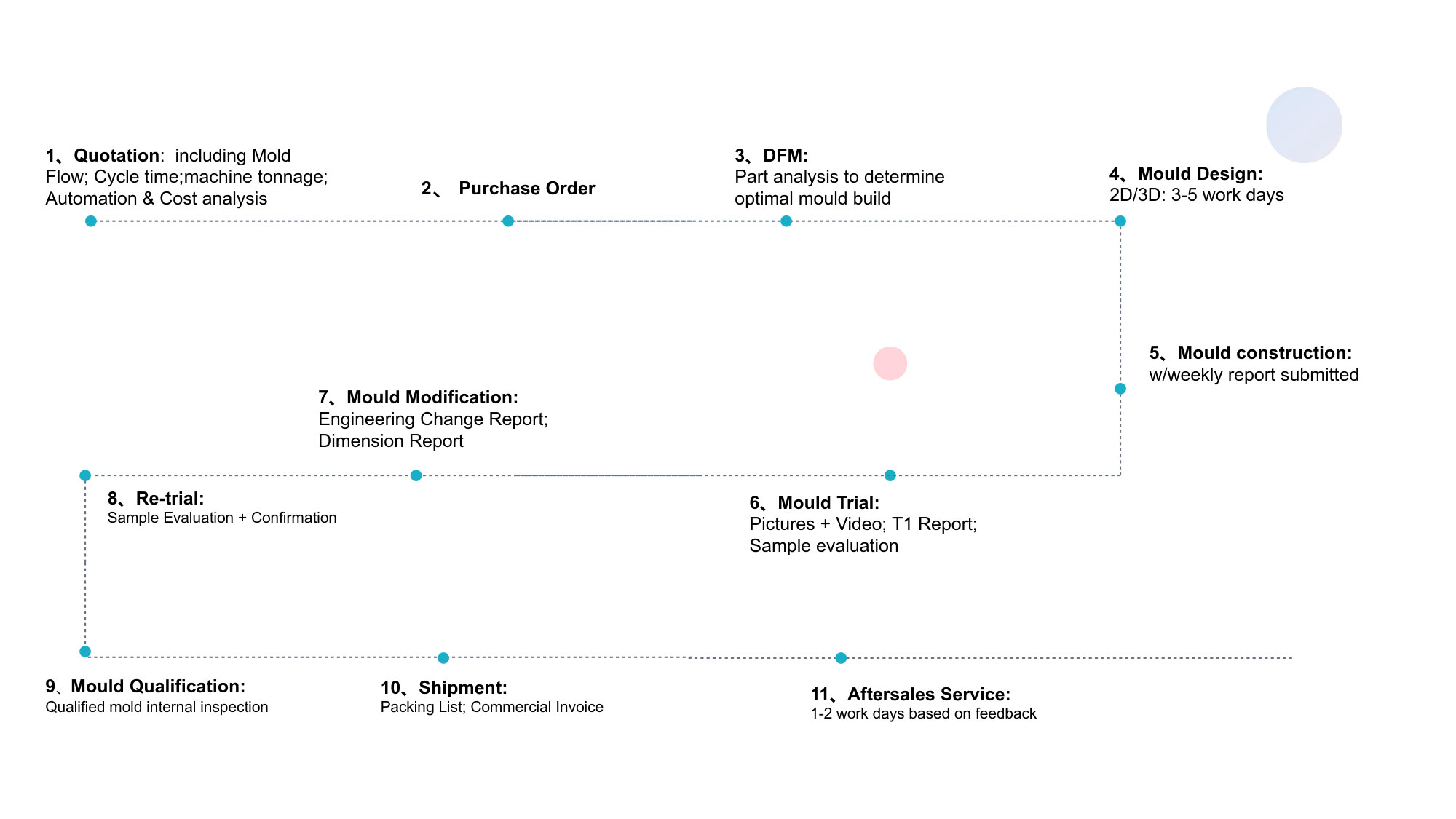
Early Design Intervention (DFM Reports): Before committing to mold fabrication, Ansix provides comprehensive Design for Manufacturing reports analyzing the customer’s part design. The DFM report specifically addresses:
Draft angle recommendations (typically 1.5–3 degrees per side for textured surfaces, 0.5–1.5 degrees for polished surfaces)
Wall thickness optimization to eliminate thick-thin junctions that cause sink marks
Gate location proposals with rationale based on mold flow analysis
Ejection pin location permission zones and prohibited zones
Rib-to-wall thickness ratios (typically 50–60 percent to prevent sink)
Weld line location forecasts and mitigation strategies
This early analysis prevents the most expensive scenario: discovering after mold fabrication that the designed part cannot be manufactured.
Trial Molding and Sample Provision: Ansix provides samples from T0 (first trial) through T3 (third optimization trial), each accompanied by detailed improvement reports identifying issues and corrective actions taken. The ability to rapidly exchange mold inserts enables validation of multiple design variants without building complete new molds.
Low-Volume Validation: Before high-volume production begins, Ansix offers 100–500 part pilot runs to validate yield and process capability. Pilot run data including CPK values and defect Pareto charts confirms production readiness. This validation step prevents expensive surprises during full-rate production.
Maintenance and Spare Parts: Every mold ships with a recommended spare parts kit including critical wear components—ejection pins, core pins, and wear plates. Mold maintenance is scheduled at 200,000-cycle intervals, with life-of-tool repair services available at cost pricing. This predictable support model eliminates customer surprise expenses for tooling maintenance.
Section 5: Differentiated Competitive Position – Direct Commitments to Common Customer Complaints
Customer Complaint Ansix’s Differentiated Response
“Molds need frequent repair, disrupting production orders” Pre-delivery 2,000-shot aging test and wear report; three-year mold structural warranty (excluding normal wear components)
“Flash requires extensive post-processing, increasing labor cost” 0.005mm mold parting surface precision; self-locking clamp force compensation; flash <0.03mm eliminates manual deflashing
“Dimensions change between production batches” Ultrasonic wall thickness sensors with automatic pressure compensation; in-mold temperature sensors enabling closed-loop control
“Mold repair cycles take too long” In-house EDM and electrode machining centers; routine repairs completed within 24 hours
Customer Value Framework Summary Table:
Technical Capability Customer Problem Solved Cost Savings Risk Reduction
±0.002mm precision machining Flash elimination, reduced secondary finishing 5–8% per part Zero assembly rework
500K–1M shot mold life Unexpected mold replacement Reduced tooling amortization Production continuity
CPK ≥1.33 dimensional control Assembly fit issues, field failures Lower warranty cost Brand reputation protection
DFM before mold fabrication Undiscoverable post-tooling design flaws $15K–50K avoided rework Fixed development timeline
24-hour repair turnarounds Production downtime $5K–20K saved downtime loss Customer delivery confidence
Part Five: Ansix’s Value Proposition – Problem Solving, Cost Reduction, Capacity Enhancement, and Delivery Assurance
5.1 Customer Problems Solved Through Technical Expertise
Thin-Wall Warpage Control: Laptop C-covers feature large surface areas with thin walls, making them inherently susceptible to warpage during cooling. Ansix’s mold design includes conformal cooling channels that follow the part contour, maintaining uniform cooling rates across the entire surface. Mold temperature zoning maintains core and cavity temperature differentials within 2°C. The result is flat parts requiring no post-mold straightening operations.
Aesthetic Surface Defects: Sink marks, flow lines, and weld lines compromise the premium appearance customers demand. Ansix eliminates these defects through gate location optimization (moving weld lines to hidden locations), sequential valve gate control (eliminating visible flow lines), and gas-assist processing (eliminating sink marks).
Inconsistent Assembly Fit: Keyboard keys must align perfectly through cutout openings, and trackpad sensors require precise dimensional gaps. Ansix maintains process capabilities that keep critical features within ±0.02mm across production batches.
5.2 Quality Validation and Assurance Systems
Validation Phases:
Material Validation: Certificate verification plus internal testing of melt flow index, moisture content, and mechanical properties before production release
Process Validation: Three consecutive production runs at target rates verifying dimensional compliance
Product Validation: Full dimensional measurement, cosmetic inspection, and functional assembly verification
System Validation: Quality management system audits verifying that all protocols are followed
Inspection Equipment:
Coordinate measuring machines with ±0.002mm accuracy
Optical measurement systems with automated reporting
Surface roughness testers for finish verification
Color spectrophotometers for batch-to-batch consistency
5.3 Customer Cost Reduction Strategy
Ansix reduces customer total cost of ownership through five primary mechanisms:
Material Cost Optimization: Through volume purchasing agreements with major resin suppliers including SABIC, Covestro, LG Chem, and Chi Mei, Ansix secures favorable material pricing. For customers with annual volumes exceeding 500,000 units, material cost reductions of 8–12 percent are typical compared to spot market purchasing.
Cycle Time Reduction: Optimized cooling channel design reduces required cooling time by 15–25 percent. For a typical 45-second cycle, saving 10 seconds per part across one million parts represents 277 hours of production time recovered, equivalent to $22,000–35,000 in machine time value.
Scrap Reduction: Precision process control maintains first-pass yield above 98 percent for mature programs. Compared to industry average yields of 92–95 percent, this 3–6 percentage point improvement represents direct material and processing cost savings.
Secondary Operation Elimination: Flash-controlled molding eliminates manual deflashing. Mirror-finish molds eliminate polishing operations. Proper gate design and degating eliminate gate trimming for some geometries. Each eliminated operation reduces labor cost and eliminates associated quality risks.
Tooling Life Extension: Extended mold life (500K–1M shots) compared to lower-grade tooling (100K–300K shots) reduces tooling amortization cost per part and eliminates production interruptions for mold replacement.
5.4 Production Capacity Enhancement
Scalable Capacity Model: Ansix maintains 260 injection molding machines across four facilities. When customer demand increases, additional machines can be qualified and brought online within 30 days. The distributed facility network provides geographic flexibility, enabling production to shift between locations to balance demand or respond to disruptions.
Quick-Change Tooling: Standardized mold bases and quick-change clamping systems reduce mold changeover times from hours to minutes. Rapid changeover enables smaller batch sizes, reducing inventory carrying costs while maintaining responsiveness to demand variations.
Automation Integration: Robotic part removal, automated degating, and vision inspection systems operate continuously, enabling lights-out production during off-shift hours. Automation yields are 10–15 percent higher than manual operations due to elimination of operator variability.
5.5 Delivery Assurance
Production Planning System: ERP-integrated production scheduling optimizes machine allocation based on order priorities, due dates, and machine capabilities. Real-time production tracking enables proactive identification of schedule risks.
Safety Stock Management: Ansix maintains strategic safety stock of both raw materials and finished goods for key programs, enabling immediate response to unexpected demand increases.
Logistics Partnership: Long-term agreements with major logistics providers including DHL, FedEx, and Maersk ensure priority handling and capacity allocation. Air freight options are available for urgent requirements, though Ansix’s planning systems minimize emergency expediting needs.
Part Six: Project Initiation Framework – How Ansix Translates Technical Terms into Customer Value
A mold is not just a block of metal. For Ansix and its customers, a mold functions as a revenue-generating asset that directly influences production economics. Ansix’s project initiation framework explicitly translates technical specifications into measurable customer value.
Section 1: Hard Power Infrastructure – Why Equipment Capability Matters to Customers
Technical Specification Customer Value Translation
Five-axis high-speed machining, ±0.002mm precision Your C-cover parts will have no flash, eliminating $0.15–0.30 per part deflashing labor
Slow-wire EDM, 0.03mm micro-hole capability Complex cooling channel geometries reduce cycle time 15%, increasing your daily output 15% without additional machine investment
260 machines, 30–2,800 tons We have the right-sized machine for your part, not forcing you to pay for oversized equipment
Servo-electric drives, ±0.1% repeatability The first part from each batch matches the last—no dimensional surprises between shipments
CMM + CPK ≥1.33 We provide documented evidence that every critical dimension will stay within your tolerance range for the life of the program
Section 2: Mold Manufacturing Core Competitiveness – Measurable Commitments
Dimension Technical Specification Customer Value
Mold life P20: 300K shots; H13/S136: 1M+ shots Predictable tooling amortization; $0.02–0.05 per part versus $0.10–0.15 for lower-grade tooling
Tolerance Standard: ±0.05mm; Precision: ±0.005mm Assembly never forced; keyboard keys align perfectly; zero rework
Mold type Hot runner, stack, two-shot, high-gloss Hot runner: 5–15% material savings. Stack: 45% cycle time reduction
Lead time Simple 10 days; medium 25–45 days Faster time to market; earlier revenue generation
Section 3: Injection Molding Process Control – Quality Assurance Without Anxiety
Customer Fear Ansix’s Solution Value Delivered
Sink marks visible on palm rest Gas-assist creates internal voids; sequential valve gate control No surface defects; 8–15% lighter part; no scrap from sink marks
Flash requiring hand trimming 0.005mm parting surface accuracy; zero-degree side locks No deflashing labor; $0.15–0.30 per part saved
Dimensions change between runs MES-locked parameters; real-time sensors First piece = last piece; zero assembly surprises
Color mismatch batch to batch Spectrophotometer verification; material lot control Perfect color match; no customer returns for aesthetic issues
Section 4: Full Process Service – Reducing Your Management Burden
Service Component Technical Activity Customer Value
DFM before mold build Draft analysis, gate optimization, wall thickness review Eliminates $15K–50K post-tooling rework
T0–T3 samples with reports Iterative optimization with documentation Predictable development timeline; documented decision trail
Pilot run validation 100–500 parts; yield and CPK statistics Confirmed production readiness before full commitment
Spare parts + maintenance Critical wear components included with mold No surprise maintenance costs; predictable tooling expense
Section 5: Differentiated Response to Common Complaints – Direct Commitments You Can Hold Us To
Common Complaint Our Specific Commitment
“Mold failed at 80K shots” We provide 500K–1M shot life; deliver with 2,000-shot wear test report
“Too much flash, high finishing cost” Flash ≤0.03mm eliminates hand deflashing
“Dimensions inconsistent between batches” CPK ≥1.33 documented for critical dimensions
“Repair took six weeks” In-house EDM; 24-hour turnaround on routine repairs
Summary: The Ansix Value Equation
For customers evaluating laptop C-cover manufacturing partners, the Ansix value proposition is quantified as follows:
Problem Resolution:
Warpage eliminated through conformal cooling (±0.02mm flatness across full C-cover area)
Flash eliminated through precision mold manufacturing (≤0.03mm residual flash, no manual removal required)
Dimensional consistency across batches (CPK ≥1.33 on all critical features)
Cost Reduction:
Material savings: 5–15% through hot runner technology and material optimization
Processing savings: 15–25% through cycle time reduction
Labor savings: $0.15–0.30 per part through flash elimination
Tooling amortization: $0.02–0.05 per part through extended mold life
Risk Reduction:
Pre-delivery wear testing validates mold life before customer acceptance
Pilot run validation confirms production capability before high-volume commitment
Spare parts included eliminates surprise maintenance costs
24-hour repair turnaround minimizes production disruption
ISO9001/IATF16949/ISO13485/ISO14001 certified systems ensure compliance
Service Integration:
Single source for design, mold fabrication, production, and assembly
Four production facilities across China and Vietnam provide supply chain resilience
28+ years of experience across multiple industries
Dear customer, for Ansix, a mold is not merely a metal tool—it is a revenue-generating asset that directly determines your production economics. When we design your laptop C-cover mold, we simultaneously engineer the cooling strategy, the venting paths, the temperature balance, and the ejection sequence so that when the mold arrives at your production line, it requires zero debugging, produces minimal flash, and delivers maximum service life. When convenient for you, we would welcome the opportunity to conduct a full DFM report walkthrough on an existing product of your choice, demonstrating exactly how we proactively eliminate weld lines, gas traps, sink marks, and other cosmetic risks before the first gram of steel is cut.
Ansix Tech Co Ltd
If you have any plans related to Laptop C-cover mold , you can contact us at any time. We will turn your ideas into reality, let you realize your dreams, and obtain large orders from the market. Our contact information is info@ansixtech.com. Or contact our CTO, mail: stephen@ansixtech.com
#www.ansixtech.com #ansixtech.com #Laptop C-cover mold #Laptop C-cover mold injection molding companies #Laptop C-cover mold Canopy Mold injection mold companies #Ansix #Ansix moulds #Ansix china #Ansix tech china #Ansix tech company #Ansix facotry #Laptop C-cover mold injection molding #Laptop C-cover mold injection tools #Laptop C-cover mold injection moulds #Laptop C-cover mold plastic mould #Laptop C-cover mold plastic tools #Ansix Tech #Ansix molds #Ansix injection molding #Ansix mold factory #injection molding Laptop C-cover mold#Ansix mold factory #Laptop C-cover mold china #Laptop C-cover mold molds #injection factory #Laptop C-cover mold injection molding #Laptop C-cover mold injection molding factory #injection molding company #Laptop C-cover mold injection mold companies #Laptop C-cover mold Tooling #Laptop C-cover mold mold limited #Ansix mold china #Ansix companies #Ansix company China #Laptop C-cover mold facotry #Ansix Tech #Ansix Tech mould #Laptop C-cover mold injection moulding #injection moulding company #Ansix Laptop C-cover mold parts injection mold companies #medical injection molding companieschina #Laptop C-cover mold china factory #Ansix moulding companies #Ansix molding company #Laptop C-cover mold injection moulding facotry #Ansix Tech mold #Laptop C-cover mold mould #Laptop C-cover mold plastic injection molding #ansix plastic mold #Mold manufacturing #Laptop C-cover mold parts manufacturing #Laptop C-cover mold plastic parts factory #Laptop C-cover mold injection parts mold #Laptop C-cover mold PRECISION MANUFACTURING #Laptop C-cover mold #China mold #Laptop C-cover mold injection moulding china #Laptop C-cover mold mould china #china precision mold #mold in china #Laptop C-cover mold mold china #Precision molds #High-precision molds #Laptop C-cover mold #Injection molds #Laptop C-cover mold Factory #Laptop C-cover mold Company #Super Large Injection Mold Factory #Large Tonnage Injection Molding Factory #Laptop C-cover mold Company #Laptop C-cover mold Factory #2800T Injection Molding Factory #3000 Ton Injection Molding #4500 Ton Injection Molding Factory #Large Mold Injection Molding #Large Plastic Mold Injection Molding Factory #Large Injection Mold Manufacturer #Plastic Mold Factory #Injection Mold #Plastic Mold