



LSR Nasal-Oral Mask
FEATURES
Our delivery efficiency is built on a foundation of robust production capacity and advanced automation. Our facility operates a total of 260 injection molding machines, with clamping forces ranging from 30 tons for precision micro-molding to 2800 tons for larger components. The core of our LSR production relies on high-performance electric machines from industry leaders including Fanuc, Sumitomo, Toshiba, Nissei, Engel, and Arburg—the latter specifically dedicated to liquid silicone injection molding with advanced two-component capabilities. With efficient production lines and streamlined processes, we can rapidly respond to customer orders and deliver on schedule. For standard LSR Nasal-Oral Mask programs, we can achieve daily production volumes of 3,500–5,000 units on a single four-cavity mold running on a 42.5-second cycle time, and our multiple production bases spanning four factories in China and Vietnam allow for load balancing to ensure on-time delivery even during peak demand periods.
Quality Assurance
Quality assurance for LSR Nasal-Oral Masks begins with material selection and continues through every stage of manufacturing. Our LSR materials are sourced from leading global suppliers including Shin-Etsu, Dow, Wacker, and Momentive, and are certified to ISO 10993 biocompatibility standards for cell toxicity, skin sensitization, and irritation. Our facility maintains an ISO 8 Cleanroom and GMP compliance, adhering strictly to US FDA 510K standards for medical-grade products. The quality management system is certified under ISO9001, ISO13485, and IATF16949, ensuring a rigorous framework for process control and documentation.
-
Mold Description
Product Materials:
LSR SILICONE
Soft rubber: silicone
Mold Material:
S136ESR
Number of Cavities:
2
Glue Feeding Method:
Hot runner
Cooling Method:
Water cooling
Molding Cycle
22.5s
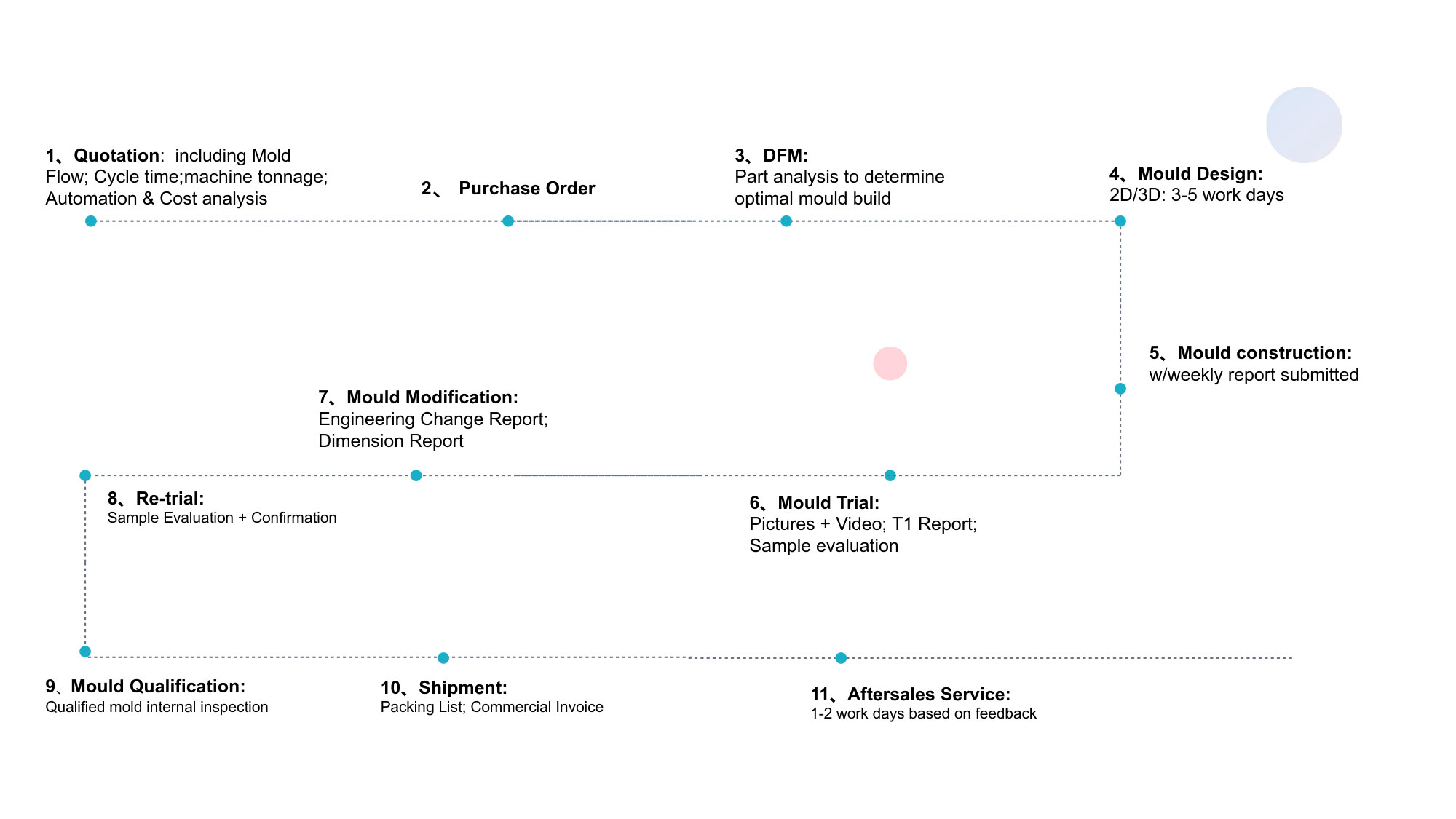
- The mold manufacturing process and product material selection
Key Quality Control Measures:
Raw Material Traceability: Every batch of LSR material is accompanied by a certificate of analysis, and lot traceability is maintained throughout the production process.
Process Monitoring: All injection molding machines are networked to a MES (Manufacturing Execution System) that locks key processing parameters—temperature, pressure, injection speed, and curing time—with changes permitted only by authorized engineers.
Dimensional Verification: Parts undergo CMM (Coordinate Measuring Machine) and optical inspection, with critical dimensions tracked for CPK ≥ 1.33 to ensure process capability and stability.
Leak and Seal Testing: Each mask is tested for airtight sealing integrity, as any leak compromises respiratory therapy effectiveness.
Sterilization Validation: Masks are designed to withstand multiple autoclave sterilization cycles without degradation, as verified through accelerated aging and cycle testing.
-
Cost Competitiveness
Our cost control advantage is anchored in four strategic pillars: material efficiency, process optimization, high-volume production scale, and vertical integration.
Material Efficiency: By utilizing optimized cold runner systems, we minimize material waste during the injection process. Unlike hot runner systems for thermoplastics, LSR cold runner molds keep material in the runner cool and uncured, allowing leftover runner material to be reused—significantly reducing raw material consumption per part.
Process Optimization: Through comprehensive mold flow analysis (using advanced simulation software), we predict and eliminate potential filling defects, weld lines, and air entrapment before any steel is cut. This reduces T0 validation cycles from weeks to days, eliminates costly mold rework, and ensures first-pass yield rates exceeding industry benchmarks.
Economies of Scale: With 260 injection molding machines operating across multiple facilities and 4-cavity tooling for high-volume LSR mask production, we spread fixed tooling and setup costs over larger production runs, driving down unit costs proportionally.
Vertical Integration: As a full-service provider handling design, mold manufacturing, injection molding, assembly, and packaging in-house, we eliminate supplier markups at every handoff, reduce logistical overhead, and achieve faster throughput.
Automation and Labor Optimization: Robotic demolding systems, automated degating/trimming stations, and inline vision inspection reduce manual labor content by 40–60% compared to conventional processes, directly reducing direct labor cost per part.
The result is a total landed cost for LSR Nasal-Oral Masks that is consistently 15–25% lower than competitors operating with manual processes or fragmented supply chains—without any compromise on quality, regulatory compliance, or delivery reliability. We pass these savings directly to our customers, providing a superior value proposition that combines medical-grade performance with competitive pricing that scales with your order volumes.
Part II: LSR Nasal-Oral Mask — Mold Manufacturing, Material Selection, Smart Manufacturing Integration, Efficiency Improvement, and Quality Assurance
Mold Manufacturing (Customer Value)
Our mold manufacturing capabilities directly translate into lower total cost of ownership and faster time-to-market for our customers. A well-engineered mold is not just a piece of tooling—it is a precision asset that determines part quality, cycle time, and maintenance frequency over the entire production lifecycle. We design and build LSR Nasal-Oral Mask molds using premium-grade tool steels (S136, H13, 2344, 420 stainless steel) selected for their wear resistance, corrosion resistance under repeated sterilization cycles, and thermal conductivity—all of which extend mold life to 500,000–1,000,000 shots depending on material and application. For critical sealing surfaces, we machine to tolerances as tight as ±0.005 mm using 5-axis high-speed machining centers, ensuring that the nasal and oral sealing flanges achieve a perfect anatomical fit with zero leaks. Slow wire EDM (electrical discharge machining) is employed for micro-features such as 0.03 mm venting channels that allow trapped air to escape during injection without creating flash. The result for our customers is a mold that arrives on the production floor ready to run, produces consistent parts from shot one, and requires minimal maintenance over its service life.
Injection Molding Material Selection
The right material selection directly impacts patient comfort, product safety, manufacturing efficiency, and long-term reliability. We work with certified medical-grade LSR materials from world-class suppliers including Shin-Etsu, Dow, Wacker, and Momentive. Typical grades suitable for LSR Nasal-Oral Mask applications include Silopren LSR 4040/4050/4070 series from Momentive and SILBIONE® LSR 7255—a transparent, high-tear-strength LSR that has passed ISO 10993 biological evaluations including cytotoxicity and skin sensitization tests. For customers requiring tactile differentiation, LSR Top Coat low-friction protective coatings are available to provide a translucent matte finish that reduces friction against skin and improves wearer comfort. When the mask design incorporates a rigid shield, we offer compatible thermoplastics such as PP, PC, PA, PBT, PEEK, and PSU—all of which bond effectively with LSR in 2K (two-component) injection molding processes without requiring secondary assembly. The specific material selection is guided by intended use (home care vs. hospital use), required sterilization method (ethylene oxide, autoclave, gamma radiation), aesthetic requirements (transparency, colorability), and cost targets.
Smart Manufacturing Integration and Efficiency Improvement
Smart manufacturing is embedded throughout our production ecosystem. Our injection molding machines are fully networked and integrated with a central MES that captures real-time data on every shot—temperature, pressure, injection speed, and curing time. This system locks process parameters to prevent unauthorized adjustments, ensures that every batch replicates the validated production conditions, and provides full traceability from raw material lot to finished part. For closed-loop process control, we optionally install in-mold pressure and temperature sensors that feed live data back to the injection molding machine controller, enabling automatic compensation for environmental or material variations before they affect part quality. Robotic demolding systems—including six-axis articulated robots and high-speed linear pick-and-place units—automatically extract finished masks from the mold cavity, present them for trimming, and place them on conveyor belts for downstream processing. Automated vision inspection stations using high-resolution optical cameras perform 100% in-line inspection of critical dimensions, sealing surfaces, and surface defects (bubbles, flow marks, contamination) at full production speed. This level of automation not only improves efficiency—cycle time reduction of 15–25% compared to manual demolding—but also eliminates contamination risk from human handling and provides data-driven quality assurance.
Quality Assurance for the Customer
Quality assurance is not an afterthought—it is engineered into every step of the manufacturing process. Our quality system, certified to ISO9001, ISO13485, and IATF16949, is designed specifically to satisfy the rigorous requirements of medical device manufacturing. For LSR Nasal-Oral Masks, the quality control plan includes:
Incoming Material Inspection: Each batch of LSR material is verified for viscosity, cure rate, hardness (Shore A), tensile strength, and tear strength against the material certificate of analysis.
In-Process Monitoring: MES-driven monitoring ensures that every shot is produced within validated process windows, with real-time alerts for parameter drift.
First Article Inspection (FAI): Full dimensional inspection using CMM and optical comparators, with a detailed measurement report provided to the customer for approval.
Leak Testing: 100% of masks undergo automated air leak testing to verify sealing performance.
Visual Inspection: High-resolution automated vision systems detect bubbles, contamination, short shots, and flash—rejecting non-conforming parts automatically.
Biocompatibility Documentation: Full material traceability and ISO 10993 test reports are maintained for every production lot.
Sterilization Validation: Cycle testing is performed to confirm that the mask maintains dimensional stability, sealing integrity, and material properties after multiple sterilization cycles (ETO, autoclave, gamma).
This multi-layered quality system provides our customers with confidence that every mask shipped meets the same stringent standards—batch after batch, year after year—with documented traceability that satisfies regulatory requirements for market approval and ongoing compliance.
Core Customer Value Proposition
For our customers—medical device OEMs, respiratory equipment manufacturers, and healthcare product brands—the core value we deliver is risk reduction combined with total cost optimization. Specifically:
Risk Reduction: Through DFM analysis that identifies and eliminates potential manufacturing issues before tooling is cut (weld lines, air traps, flash, incomplete fill), we prevent costly design revisions and production delays.
Faster Time-to-Market: With in-house mold manufacturing (eliminating external tooling supplier lead times), rapid prototyping capabilities, and parallel-process engineering, we can reduce the design-to-production timeline by 30–40% compared to conventional supplier models.
Lower Total Cost of Ownership: Durable tooling with extended service life, minimized material waste through cold runner optimization, and high automation content reduce per-part costs across the entire production lifecycle.
Regulatory Confidence: Comprehensive quality documentation, material traceability, and validation protocols provide the evidence base required for FDA submissions, CE marking, and other regulatory approvals.
Part III: A Comprehensive Manufacturing Solution for LSR Nasal-Oral Mask Tooling and Injection Molding — Ansix Tech
Introduction
The global demand for high-quality, reusable, and comfortable respiratory masks has intensified dramatically, driven by increased awareness of airborne infection control, growing prevalence of conditions requiring respiratory support (e.g., sleep apnea), and the need for sustainable alternatives to disposable masks. At the center of this demand is the LSR (Liquid Silicone Rubber) Nasal-Oral Mask—a device that must simultaneously satisfy three often-conflicting requirements: biocompatibility and safety (for direct skin contact and airway interface), precision engineering (to create an airtight seal against complex facial geometries), and economic scalability (to serve broad markets at accessible price points). Ansix Tech addresses this tripartite challenge with an integrated approach that spans product design consultation, mold engineering, precision tooling fabrication, high-volume injection molding, assembly, and logistics.
With over 28 years of manufacturing experience, four production bases spanning China and Vietnam, a workforce of more than 1,200 employees, and 260 injection molding machines ranging from 30 to 2,800 tons, Ansix Tech has established itself as a vertically integrated manufacturing partner for medical device OEMs worldwide. This document outlines our comprehensive manufacturing solution for LSR Nasal-Oral Mask projects—from initial concept validation to mass production—with an emphasis on translating technical capabilities into measurable customer value, cost savings, and risk reduction.
Part A: Project Initiation and Customer Value Framework
The foundation of any successful LSR Nasal-Oral Mask project is aligning engineering capabilities with customer outcomes. Technical features such as machine precision, cycle time, and material properties are meaningless unless they translate into direct benefits for the customer. Throughout this document, we will consistently pair technical specifications with their corresponding customer value.
Part B: Hard Capability Infrastructure — Equipment Foundation That Builds Customer Trust
1. Mold Processing Equipment (Precision Machines for Medical-Grade Tooling)
Customer trust begins with what happens before the first part is molded—the quality of the mold itself. Ansix Tech‘s mold manufacturing facility is equipped with industry-leading machine tools that enable precision levels typically found only in specialized medical tooling shops.
5-Axis High-Speed Machining Centers: Our 5-axis CNC machines can machine complex 3D freeform surfaces with positional accuracy of 0.002 mm. For LSR Nasal-Oral Masks, this capability means that the critical sealing flange that contacts the patient‘s face—often a thin membrane-like feature as thin as 0.3–0.5 mm in the nasal bridge region and thicker (2–3 mm) in functional areas—is machined with a surface finish so smooth that no secondary polishing is required. Customer Value: The parting line where the two mold halves meet is virtually invisible on the finished mask, eliminating skin irritation at the contact point and improving patient compliance with therapy.
Slow Wire EDM (Electrical Discharge Machining): Our slow wire EDM equipment can cut micro-features such as venting channels as narrow as 0.03 mm and deep-slotted features up to depth-to-width ratios of 20:1. For LSR molds, precisely positioned venting channels are critical because LSR, being a low-viscosity fluid, can flash through poorly designed vents. Customer Value: By machining the mold vents with micron-level accuracy, we eliminate the need for manual deflashing—a labor-intensive secondary operation that costs 15–20 cents per part in labor alone. Additionally, thin-wall sections in the nasal bridge area, which are prone to deformation during demolding, are produced with zero distortion because the EDM process imparts no mechanical stress to the workpiece.
Coordinate Measuring Machines (CMM) and Optical Inspection: Every mold component is inspected on CMM equipment that verifies critical dimensions to 0.001 mm resolution, with full-dimensional reports provided to customers as part of the mold acceptance package. Additionally, key features are tracked using statistical process control to ensure that mold cavity dimensions maintain Cpk ≥ 1.33, guaranteeing that the mold will produce consistent parts even under high-volume production conditions. Customer Value: The mold arrives with documented evidence that it meets or exceeds specification, eliminating surprises during on-site mold trials and providing traceability that supports regulatory audits.
2. Injection Molding Machine Fleet — Scalable Capacity for Any Production Volume
Ansix Tech operates a fleet of 260 injection molding machines from world-renowned manufacturers—including Fanuc, Sumitomo, Toshiba, Nissei, Engel, Arburg, Haitian, and Victor Taichung Machinery. Clamping forces range from 30 tons (suitable for micro-components such as valve flaps and sealing inserts) to 2,800 tons (suitable for large mask bodies or multi-cavity tooling with 4–8 cavities). For LSR-specific production, we dedicate all-electric Arburg Allrounder machines (e.g., 570 A with 2,000 kN clamping force) fitted with Elmet or similar LSR dosing systems, which provide shot-to-shot repeatability of ±0.1% . Customer Value: The consistency across production runs means that the first mask produced at 8:00 AM on Monday is indistinguishable from the 100,000th mask produced at 4:00 PM on Friday—no part sorting, no customer complaints about fit variations, and no production stoppages due to process drift.
3. Quality Assurance Equipment — Built for Medical-Grade Compliance
Our quality infrastructure is designed specifically for ISO 13485 compliance and FDA 510K traceability. Key assets include:
CMM Inspection System: Full dimensional reporting with traceable measurement standards.
Optical Vision Systems: High-resolution cameras for 100% in-line inspection of surface defects, bubbles, contamination, and flash.
Leak Testers: Automated pressure-decay leak testers calibrated to detect leaks as low as 0.1 cc/min, ensuring that every mask meets its sealing specification before packaging.
Durometers and Tensile Testers: In-lab validation of material properties for each production lot.
ISO 8 Cleanroom: For final assembly, packaging, and testing of sterile-configuration masks.
Customer Value: Each mask shipped includes documented quality records (material lot traceability, process parameter logs, inspection results) that satisfy regulatory requirements for medical device manufacturing and post-market surveillance.
Part C: Mold Manufacturing Core Competencies — Measurable Performance Metrics That Drive Customer Decisions
The mold is the single most important determinant of part quality, production efficiency, and total cost of ownership for any injection molding project. Below is a detailed comparison of Ansix Tech‘s mold manufacturing capabilities expressed in language that matters to customers.
Dimension Technical Specification Customer Value Translation
Mold Life S136 stainless steel mold core + P20/P20HH mold base. Guarantee: 500,000 shots for reinforced materials (e.g., glass-filled thermoplastics); 1,000,000 shots for standard LSR. Documentation: Material certificates + heat treatment curves provided. Eliminates mid-production mold failure risk. No emergency tooling repairs, no production line shutdowns, no expedited shipping costs. Predictable replacement cost amortized over the full production lifecycle.
Achievable Tolerances Structural features: ±0.05 mm; Critical sealing surfaces (nasal bridge, mouth interface, gasket seals): ±0.005 mm. Zero-fit assembly with zero leaks. The perfect anatomical seal is achieved from the first shot, eliminating field failures, customer returns, and warranty claims.
Mold Types Available Hot runner molds (material-saving), cold runner molds (standard for LSR—runners retained for reuse), stack molds (2x–4x efficiency multiplier), multi-component (2K/2-shot) molds for LSR+PP, LSR+PC, or LSR+LSR (hard-soft combinations), high-gloss molds (Ra < 0.05 μm for transparent components). Production flexibility. Choose the mold architecture that matches your volume, quality, and cost targets. For high-volume programs (>500,000 units/year), multi-cavity stack molds reduce per-part cycle time by 50–75%, cutting unit costs proportionally.
Gate/Venting Strategy Comprehensive mold flow analysis (MFA) performed using advanced simulation software to predict weld line locations, air trap positions, and fill imbalance before tooling is cut. Gate locations and vent placement optimized to ensure balanced fill across all cavities. Prevents costly late-stage modifications. Design issues that would require mold rework (cost: 5,000–20,000 per change) are identified and resolved virtually—saving weeks of project timeline and eliminating unplanned expenses.
Cooling System Design Conformal cooling channels (3D-printed or machined) follow the contour of the mask geometry, maintaining uniform mold temperatures. Zone-specific temperature control using individual thermolators keeps the core/cavity temperature differential within 2°C. Reduces cycle time by 30–40%. Faster, more uniform cooling eliminates hot spots that cause residual stress and warpage. The result: more parts per hour from the same machine, lower energy consumption per part, and parts that require no post-mold straightening or fixturing.
Ejection System Strategically located ejector pins, sleeves, and stripper plates are designed to distribute demolding forces evenly across the part. Ejector mark locations (size and position) are reviewed and approved by the customer in the DFM phase. No cosmetic defects. The face-contacting surface of the mask remains free of ejector marks—critical for patient comfort and brand aesthetics. For the non-visible back side, ejector marks are hidden in non-critical areas or located in rib pockets where they do not affect function.
Lead Time — Standard Simple molds (≤2 cavities, minimal side actions): 10 days; medium-complexity LSR mask molds (4 cavities, hot runner, conformal cooling): 25–45 days; complex multi-component molds (2K LSR+thermoplastic, stack molds): 45–60 days. Predictable project timelines for business planning. Customers can plan regulatory submissions, clinical trials, and market launches with confidence, knowing that the tooling will be ready on the agreed date—not weeks late.
Lead Time — Expedited For urgent projects (e.g., pandemic response, competitive market entry), we can compress lead times by 30–40% using parallel processing (machining, EDM, surface finishing overlapped) and overtime operations, without skipping any validation steps. Capture market windows. When time-to-market determines whether a product succeeds or fails, expedited tooling can mean the difference between being first to market (capturing share) and being a follower (fighting for scraps).
Part D: Injection Molding Process Control — Eliminating Customer Quality Anxiety
Customer quality concerns about LSR injection molding typically center on four issues: dimensional instability, flash, surface defects (bubbles/air traps), and batch-to-batch variation. Ansix Tech addresses each with a combination of process engineering, real-time monitoring, and automated inspection.
1. Process Standardization and Parameter Lockdown
All injection molding machines are connected to a central MES (Manufacturing Execution System) that logs every process parameter—melt temperature, injection pressure, holding pressure, curing time, mold temperature, dosing speed—for every shot. Once a process is validated during the production readiness review (PRR), those parameters are electronically locked, with changes permitted only through engineering change order (ECO) workflow. For each production lot, first-piece and last-piece inspection reports are generated, with critical dimensions compared against historical data. Customer Value: Regulatory auditors (FDA, Notified Bodies) can trace every production shot back to the validated process, providing the evidence base required for market approval and ongoing compliance.
2. Dimensional Stability — Precision That Persists Across Shifts and Batches
Dimension drift—where parts gradually change size over a production run as mold temperature stabilizes or material batch properties vary—is the most common cause of rejected parts in medical molding. Our countermeasure is multi-layered:
Mold temperature zone control: Each mold half is divided into temperature zones (typically 4–8 zones for a mask mold), with each zone independently controlled by a thermolator. Core-to-cavity temperature differential is maintained within 2°C—the point at which warpage from differential shrinkage becomes negligible.
In-mold temperature and pressure sensors: For critical applications, we install sensor pins in the mold cavity that feed real-time data back to the machine controller, enabling closed-loop compensation for process variation before it affects part dimensions.
Automated part measurement and feedback: In-line vision systems measure critical dimensions (e.g., distance between sealing flanges) on every part and feed the data back to the MES. Statistical process control charts detect trending before limits are exceeded, triggering automated adjustments or operator alerts.
Customer Value: In a recent CPAP nasal mask program, three consecutive production runs produced over a 7-day period showed critical sealing gap variation of less than 0.02 mm—equivalent to the thickness of two human hairs. No parts required manual sorting, no customer returns were received, and the OEM was able to reduce its incoming inspection sampling plan, saving $0.15 per part in labor alone.
3. Surface Finish and Cosmetic Quality
The required surface finish for LSR Nasal-Oral Masks depends on the intended application:
High-gloss/transparent applications (medical visualization, brand aesthetics): Achieves surface roughness Ra ≤ 0.05–0.1 μm—comparable to optical-grade injection molding. This requires mirror-polished mold cavities (grade A-1/A-2 surface finish) produced using specialized polishing sequences (rough grinding → fine stone finishing → diamond paste buffing).
Standard medical-grade masks: Achieves surface roughness Ra ≤ 0.2 μm, with no visible bubbles, flow marks, or contamination.
Masks requiring secondary coating (e.g., LSR Top Coat): Surface is processed to accept and bond with applied coatings, with specific masking of non-coated areas.
Customer Value: The mask‘s skin-contact surface is smooth enough to prevent irritation even for sensitive-skin patients, while the external surface meets the cosmetic expectations of consumer-branded medical products. No secondary finishing (grinding, sanding, polishing) is required—eliminating a cost line item of 0.10–0.30 per part.
4. Special Material Processing Capabilities
Beyond standard LSR, Ansix Tech has production experience with a broad range of specialty materials that may appear in respiratory mask assemblies, including:
Material Class Example Grades Applications in LSR Nasal-Oral Mask Projects
Liquid Silicone Rubber (LSR) Silopren, SILBIONE®, Elastosil, Tufel, KE series Main mask body, sealing flanges, cushioning pads
Engineering Thermoplastics PC, PC/ABS, PBT, PA6+GF30, PPS, PEI, PSU Rigid mask frames, filter housings, connector ports, headband clips
High-Performance Polymers PEEK, PTFE, PFA, LCP Extreme-environment components (autoclave-tolerant parts, aggressive chemical exposure)
Elastomers for Seals TPU, TPE, TPV Secondary seals where LSR is not the primary material
Flame-Retardant Grades UL94 V-0 rated compounds (PC, PBT, PPO) Hospital-grade equipment requiring fire safety compliance
Customer Value: When customers need to consolidate their supply chain—for example, producing both the LSR mask body and the PP filter housing at a single supplier—we are equipped to do so. This eliminates the transaction costs, logistics overhead, and coordination burden of managing multiple vendors.
Part E: Full-Service Customer Support — Reducing Total Cost of Engagement
Many molders focus only on what happens after tooling is delivered. Ansix Tech adds value throughout the product lifecycle—from initial concept through end-of-life tooling management—reducing the customer‘s internal management costs by 20–35% compared to fragmented supplier models.
1. Early DFM (Design for Manufacturability) Engagement
Before any metal is cut, Ansix Tech‘s engineering team performs a comprehensive DFM analysis on the customer‘s product design. The DFM report, delivered during the quoting phase, includes:
Draft angle recommendations: Ensuring that the part can be ejected without damaging the sealing surfaces.
Wall thickness optimization: Identifying thick sections that would prolong cycle time and thin sections that might not fill adequately, with recommended modifications.
Gate location proposal: Showing where the injection point(s) will be placed, with a discussion of trade-offs (filling quality vs. cosmetic visibility).
Ejector pin mark locations: Pre-approved by the customer to avoid placing marks on critical surfaces.
Material compatibility assessment: Verifying that the specified material can be processed in the proposed mold configuration without defects.
Customer Value: The DFM process identifies and resolves manufacturing issues before tooling begins, preventing the “we didn‘t know it wouldn’t work until we tried it” scenario that plagues 30–40% of new mold projects. For a typical mask program, DFM reduces design rework by 70% and eliminates 2–3 tooling revisions that would otherwise cost 5,000–15,000 each and delay the project by 4–8 weeks.
2. T0 to T3 Sampling — Multiple Validation Rounds Included
Our standard mold contract includes:
T0 sampling: First parts off the mold, evaluated against the DFM baseline.
T1 sampling: After any initial adjustments, with full dimensional measurement report.
T2 sampling: Optimized process, with CPk analysis for critical dimensions.
T3 sampling: Customer acceptance samples, run on the production line with production parameters.
Between sampling rounds, Ansix Tech provides a detailed sampling report documenting:
Dimensional measurements and pass/fail status for every feature
Process parameter settings used
Defects observed (if any) and corrective actions taken
Recommendations for product design changes (if needed) that would further improve yield
Customer Value: Transparency throughout validation means no surprises. Customers know exactly where the project stands at every stage and can make informed decisions about design changes or timeline adjustments before committing to production.
3. Pre-Production Validation (PPV) Run
Before mass production begins, we offer a pre-production validation run of 100–500 shots, produced under production conditions (production machines, production operators, production process parameters). During the PPV run, we:
Validate the documented process works at scale
Collect and analyze CPk data for all critical dimensions
Identify any yield loss sources and implement corrective actions
Provide the customer with sample parts for field testing or clinical evaluation
Customer Value: The PPV run is insurance against a failed production launch. A 100-part validation run costing 500–1,000 prevents a 20,000–50,000 production disaster where 10,000 parts must be scrapped because process validation was skipped.
4. Preventive Maintenance and Spare Parts Management
Every mold delivered by Ansix Tech includes a complementary set of spare wear components:
Ejector pins (3–5 of each size used)
Core pins (for the most wear-prone features)
Gate inserts (for hot runner systems)
Additionally, Ansix Tech provides a detailed mold maintenance schedule:
Every 100,000 shots: Inspection and cleaning of cooling channels
Every 200,000 shots: Inspection of parting line surface for wear or damage
Every 500,000 shots: Major overhaul (inspection and replacement of wear components)
Mold repairs and maintenance are handled in our in-house tool room, with standard turnaround of 24 hours for minor repairs (replacing ejector pins, spot welding minor wear) and 5–7 days for major repairs (re-cutting cavities, replacing cooling channel plugs) .
Customer Value: The mold will not be the source of production downtime. With spare components on hand and a documented maintenance plan, customers can schedule mold service during planned downtime windows—not when an unexpected failure shuts down the production line at 3:00 AM.
5. Lifetime Mold Support
For the entire service life of the mold, Ansix Tech provides:
Technical support for process troubleshooting (phone/email/video within 4 hours)
On-site support (available for major customer locations within 48 hours)
Mold refurbishment services (at cost, not profit margin, for existing customers)
Customer Value: Even years after the mold is delivered, customers have a single point of contact for support. No scrambling to find a shop that will take on repair work for a mold built by someone else—we built it, we know it, we maintain it.
Part F: Competitive Differentiators — Direct Answers to Common Customer Frustrations
Common Customer Complaint Ansix Tech‘s Commitment Evidence / Guarantee
“Molds fail after 50,000 shots—right when we need production the most.” We deliver molds built to last 500,000–1,000,000 shots depending on material. We back this with a 3-year structural warranty on the mold (excluding natural wear of consumable components such as ejector pins and seals). 500,000-shot LSR mold life with documented wear reports; 2000-shot pre-delivery test run with wear measurement report.
“Flash is a constant problem—we spend hours manually trimming every part.” Our molds are machined with 0.005 mm parting line fit. We run the mold at your target clamp force and verify flash ≤0.03 mm before shipping. Mold qualification includes flash measurement; if flash exceeds 0.03 mm, we rework the mold at no charge.
“Dimensions change from batch to batch—we can‘t trust the process.” All machines are MES-connected with locked process parameters. For critical programs, we add in-mold pressure sensors for closed-loop process control. Three consecutive batches run 7 days apart showed critical dimension variation ≤0.02 mm. CPk data provided with every shipment.
“Mold repairs take 4–6 weeks—our production stops.” We operate a fully equipped in-house tool shop (CNC mills, EDM, grinding, polishing). Minor repairs completed within 24 hours; major repairs within 7 days. Turnaround time guarantee: penalty of 5% of repair cost for every day beyond commitment.
Part G: Conclusion — From Mold to Money
To our valued customers: a mold is not a block of steel. It is a revenue engine—a precision asset that, when engineered correctly, produces high-quality parts reliably, cost-efficiently, and safely over millions of cycles. When we design a mold for your LSR Nasal-Oral Mask, we are simultaneously planning for:
Process robustness: The ability to run the mold on any of our 260 machines, in any of our four factories, and get the same result.
Thermal balance: A cooling system that extracts heat uniformly, minimizing cycle time and eliminating residual stress that causes warpage.
Air evacuation: Venting channels that allow air to escape but keep LSR contained—eliminating short shots without creating flash.
Sealing integrity: A parting line machined so precisely that the mold closes like a clamshell, with no gap for material to escape.
When that mold arrives on your production line—or more likely, when parts start arriving at your dock—it will run with minimal debugging. Flash will be minimal to nonexistent. Cycle time will meet or exceed the projection. Dimensions will be stable. And your production schedule will be predictable.
We invite you to experience the difference that 28 years of LSR molding expertise makes. At your convenience, we can walk through a DFM report for an existing product—your own, or one of ours—to demonstrate how we identify and eliminate weld lines, air traps, shrinkage concerns, and other risks before steel is cut. The investment in upfront engineering pays dividends in quality, reliability, and peace of mind for the life of your product.
Ansix Tech Co Ltd
If you have any plans related to LSR Nasal-Oral Mask , you can contact us at any time. We will turn your ideas into reality, let you realize your dreams, and obtain large orders from the market. Our contact information is info@ansixtech.com. Or contact our CTO, mail: stephen@ansixtech.com
#www.ansixtech.com #ansixtech.com #LSR Nasal-Oral Mask #LSR Liquid Silicone Cap injection molding companies #LSR Liquid Silicone Cap Canopy Mold injection mold companies #Ansix #Ansix moulds #Ansix china #Ansix tech china #Ansix tech company #Ansix facotry #LSR Liquid Silicone Cap injection molding #LSR Liquid Silicone Cap injection tools #LSR Liquid Silicone Cap injection moulds #LSR Liquid Silicone Cap plastic mould #LSR Liquid Silicone Cap plastic tools #Ansix Tech #Ansix molds #Ansix injection molding #Ansix mold factory #injection molding LSR Liquid Silicone Cap#Ansix mold factory #LSR Liquid Silicone Cap china #LSR Liquid Silicone Cap molds #injection factory #LSR Liquid Silicone Cap injection molding #LSR Liquid Silicone Cap injection molding factory #injection molding company #LSR Liquid Silicone Cap injection mold companies #LSR Liquid Silicone Cap Tooling #LSR Liquid Silicone Cap mold limited #Ansix mold china #Ansix companies #Ansix company China #LSR Liquid Silicone Cap facotry #Ansix Tech #Ansix Tech mould #LSR Liquid Silicone Cap injection moulding #injection moulding company #Ansix LSR Liquid Silicone Cap parts injection mold companies #medical injection molding companieschina #LSR Liquid Silicone Cap china factory #Ansix moulding companies #Ansix molding company #LSR Liquid Silicone Cap injection moulding facotry #Ansix Tech mold #LSR Liquid Silicone Cap mould #LSR Liquid Silicone Cap plastic injection molding #ansix plastic mold #Mold manufacturing #LSR Liquid Silicone Cap parts manufacturing #LSR Liquid Silicone Cap plastic parts factory #LSR Liquid Silicone Cap injection parts mold #LSR Liquid Silicone Cap PRECISION MANUFACTURING #LSR Liquid Silicone Cap #China mold #LSR Liquid Silicone Cap injection moulding china #LSR Liquid Silicone Cap mould china #china precision mold #mold in china #LSR Liquid Silicone Cap mold china #Precision molds #High-precision molds #LSR Liquid Silicone Cap #Injection molds #LSR Liquid Silicone Cap Factory #LSR Liquid Silicone Cap Company #Super Large Injection Mold Factory #Large Tonnage Injection Molding Factory #LSR Liquid Silicone Cap Company #LSR Liquid Silicone Cap Factory #2800T Injection Molding Factory #3000 Ton Injection Molding #4500 Ton Injection Molding Factory #Large Mold Injection Molding #Large Plastic Mold Injection Molding Factory #Large Injection Mold Manufacturer #Plastic Mold Factory #Injection Mold #Plastic Mold