



Automotive connector sealing rings LSR liquid two-color molding
FEATURES
Understanding 2K LSR Technology and Its Customer Value Proposition
1.1 What Is 2K LSR Injection Molding?
Two-component (2K) Liquid Silicone Rubber injection molding is a specialized vulcanization process that creates superior sealing products. The process involves two interdependent but critically important development stages: 2K molding technology and LSR molding technology.
In the 2K molding process, thermoplastic materials and silicone materials are injected into the same mold within a single cycle and cured. The first injection forms a thermoplastic component, and the second injection overmolds LSR or rubber onto the thermoplastic component to form the sealing ring.
-
Mold Description
Product Materials:
PA GF30%+LSR
Soft rubber: silicone
Mold Material:
S136ESR
Number of Cavities:
2+2
Glue Feeding Method:
Hot runner
Cooling Method:
Water cooling
Molding Cycle
42.5s
- The mold manufacturing process and product material selection
LSR is a high-purity vulcanized silicone characterized by low compression set, exceptional stability, and outstanding tolerance to extreme temperatures. These properties, coupled with the avoidance of material quality-related issues, make LSR an ideal material for critical component production.
1.2 Why 2K LSR Is Critical for Automotive Connector Seals
2K LSR molding is particularly vital for any application requiring sealed connectors. Without this technology, creating similar housings would require additional tooling and assembly processes, increasing costs and introducing assembly error possibilities. Traditional approaches also require mechanical locks to retain conventional seals, increasing overall package dimensions—whereas the market demands smaller form factors.
The 2K process expands design options, enabling superior product engineering. LSR materials offer exceptional weather resistance, chemical resistance, and flame retardancy (UL94 V-0 compliant) that far exceed typical sealing materials used in other applications. The 2K LSR process operates across an exceptionally wide temperature range (−90°C to +200°C), making it a primary manufacturing strategy that differentiates superior sealing products from conventional market offerings.
-
By delivering higher levels of sealing performance, 2K LSR molding enables electrification applications in previously challenging or impossible environments, including commercial vehicles, marine applications, automotive systems, and industrial electrical equipment.
1.3 The Customer Value Gap: From Technical Capabilities to Business Outcomes
Many manufacturers struggle to communicate the true value of 2K LSR technology. At Ansix Tech, we translate every technical capability directly into measurable customer benefits:
Technical Feature Customer Value
Single-cycle material bonding Eliminates secondary assembly operations; reduces labor costs by 30-50%
LSR low compression set (<10%) Guarantees seal integrity throughout vehicle lifetime; eliminates warranty claims
−90°C to +200°C operational range Enables reliable performance in all global climate conditions
IP69K sealing capability Protects sensitive electronics even under high-pressure, high-temperature wash-down
No post-cure required for most grades Reduces cycle time and energy consumption by up to 40% compared to conventional rubber
2K LSR molded products achieve an IP69K sealing rating and pass J2030 high-pressure wash testing. These products eliminate assembly steps, reduce tooling and molding costs, and decrease both material consumption and component count—all contributing to significant cost reduction.
Part Two: Hard Capabilities – The Equipment Foundation That Builds Customer Trust
2.1 Mold Machining Equipment
Precision begins with the tools that create the tools. Ansix Tech has invested strategically in industry-leading mold manufacturing equipment to ensure every mold delivers exceptional quality, longevity, and repeatability.
Five-Axis High-Speed Machining Centers
Our five-axis high-speed machining centers represent the gold standard in precision mold manufacturing. These advanced systems process complex 3D contoured workpieces with tolerances as tight as 0.002mm, ensuring exceptionally smooth parting lines and eliminating flash formation. The 30,000-rpm spindles and direct-drive rotary tables deliver rapid, precise full five-axis machining capabilities that reduce or eliminate manual finishing operations.
Value to Customer: Smoother parting lines mean zero post-molding deflashing operations, reducing secondary processing costs by up to 15% per component. Higher precision means better sealing performance and longer mold life.
Slow Wire EDM (Wire-Cut Electrical Discharge Machining)
Our slow wire EDM systems process micro-cavities and narrow slots down to 0.03mm with exceptional precision. This capability is critical for producing the fine-feature geometries often required in connector sealing ring molds while preventing thin-wall deformation.
Value to Customer: Enables the production of complex connector geometries that competitors cannot manufacture. Eliminates thin-wall deformation issues that cause premature seal failure.
Coordinate Measuring Machine (CMM) and Optical Inspection Systems
Every mold manufactured at Ansix Tech undergoes comprehensive dimensional verification before shipment. Our CMM systems generate full dimensional reports comparing every critical feature against design specifications, with key dimensions maintained at Cpk ≥ 1.33.
Value to Customer: Customers receive molds with proven dimensional accuracy, eliminating the uncertainty and rework costs associated with unverified tooling.
2.2 Injection Molding Machine Fleet
Our injection molding fleet spans clamping forces from 30 tons to 400 tons, fully covering the size range required for automotive connector sealing rings. All machines are equipped with all-electric servo drives, delivering consistent repeatability accuracy of ±0.1%—ensuring that every production shot matches the previous one precisely.
Value to Customer: Batch-to-batch consistency eliminates dimensional variation issues. Reduced scrap rates directly translate to lower per-unit costs.
Specialized LSR Injection Units
LSR requires specialized handling due to its low viscosity and high-temperature vulcanization characteristics. Our machines feature precision metering and mixing systems that pump A/B component LSR directly from original 20kg pail or 200kg drum containers through static mixers at a precise 1:1 ratio. Cold runner systems maintain temperatures at 40-80°C to prevent premature curing while heated mold cavities rapidly vulcanize the material.
Value to Customer: Consistent mixing ratio eliminates curing defects. Cold runner systems reduce material waste compared to conventional hot runner designs for LSR.
2.3 Supporting Infrastructure
Beyond primary equipment, we maintain:
Material handling systems for controlled storage and dispensing of A/B LSR components
Temperature-controlled mold storage to preserve precision-ground surfaces
Automated mold cleaning stations for consistent maintenance protocols
In-house electrode manufacturing for EDM operations, enabling rapid mold modifications
Value to Customer: Reduced turnaround time for mold maintenance and repairs. Consistent mold condition ensures predictable production performance.
Part Three: Mold Manufacturing Excellence – The Core Competitive Advantage
3.1 Mold Life and Durability
Mold longevity is arguably the most critical factor in injection molding economics—a short-lived mold directly impacts unit costs and production continuity.
Mold Component Material Options Performance Guarantee
Mold Base P20 / 718H Standard
Core/Cavity Inserts S136 / 2344 / 8407 / SKD11 / DC53 / NAK80 / H13 Glass-filled materials: 500,000 shots minimum
Unfilled plastics: 1,000,000 shots minimum
Wear Surfaces Tungsten carbide / DLC coating Extended life in high-wear areas
Hot Runner Components Advanced alloy steels with thermal coatings 2+ million shots before nozzle replacement
We provide customers with comprehensive material certification reports and heat treatment curves for all mold components.
Value to Customer: Predictable mold life enables accurate long-term cost forecasting. Reduced unscheduled downtime lowers overall production costs and protects delivery schedules.
3.2 Achievable Tolerances
Precision is not optional in automotive connector sealing rings—it is fundamental to sealing performance and electrical integrity.
Feature Type Achievable Tolerance Customer Benefit
General structural features ±0.05mm Consistent assembly fit
Precision sealing surfaces ±0.005mm (selected features) Superior sealing performance; no leak paths
Parting line accuracy 0.005mm fit Flash-free molding eliminates deflashing
Fine slots / micro-holes Down to 0.03mm (via EDM) Enables complex connector geometries
Value to Customer: Tighter tolerances mean better seals, fewer field failures, and reduced scrap during production validation.
3.3 Specialized Mold Types and Capabilities
Hot Runner Systems for LSR
LSR materials require specialized thermal management during injection. Our hot runner systems maintain precise temperature control throughout the feed system, reducing material waste compared to conventional cold runner designs while ensuring consistent fill characteristics across all cavities.
Value to Customer: Reduced material waste lowers raw material costs by 10-20% compared to cold runner systems. Consistent cavity filling eliminates dimensional variation between parts.
Two-Shot (2K) Rotary Molds
Our rotary two-shot mold designs enable the complete production of thermoplastic + LSR components within a single molding cycle. The mold rotates or index-plates between stations, first forming the thermoplastic carrier, then the LSR sealing ring.
Value to Customer: Eliminates secondary assembly operations entirely. Reduces per-part labor costs by up to 70% compared to insert-loading or post-mold assembly approaches.
High-Polish Molds
For applications requiring optical clarity or superior surface finish, our high-polish molds achieve surface roughness values of Ra ≤ 0.05μm.
Value to Customer: Enables see-through or aesthetically-critical applications. Eliminates secondary finishing operations.
3.4 Optimized Runner and Gating Design
Using advanced mold flow analysis software, we simulate LSR filling behavior before cutting any steel. These simulations predict weld line locations, air trap positions, and fill imbalances, enabling us to optimize gate count and placement before production.
Value to Customer: Eliminates costly tooling modifications after mold completion. Accelerates time-to-production by up to 4 weeks compared to trial-and-error approaches.
3.5 Cooling System Design for High-Volume Production
LSR cures rapidly at elevated temperatures, but uneven cooling causes dimensional variation and extended cycle times. Our cooling system design incorporates:
Zoned temperature control for cavity/core surfaces, maintaining temperature differentials within 2°C between mating surfaces
Conformal cooling channels where complex geometries demand optimal thermal distribution
High-flow circuits designed through CFD analysis to ensure uniform cooling across all cavities
Value to Customer: Shorter cycle times (LSR cures in minutes vs. significantly longer for conventional rubber) increase production throughput by up to 30%. Uniform cooling eliminates warpage and shrinkage variation, reducing scrap rates below 1% for stable production.
3.6 Ejection System Engineering
Proper ejection system design is critical for LSR components, which can be difficult to demold cleanly due to material tackiness. Our designs incorporate:
Optimized ejector pin placement based on part geometry analysis
Air-assist ejection for delicate or thin-walled features
Stripper plate systems for parts requiring uniform ejection force distribution
Value to Customer: Clean, damage-free ejection eliminates reject parts. Reduced downtime for stuck-part removal improves OEE.
3.7 Mold Manufacturing Process Flow
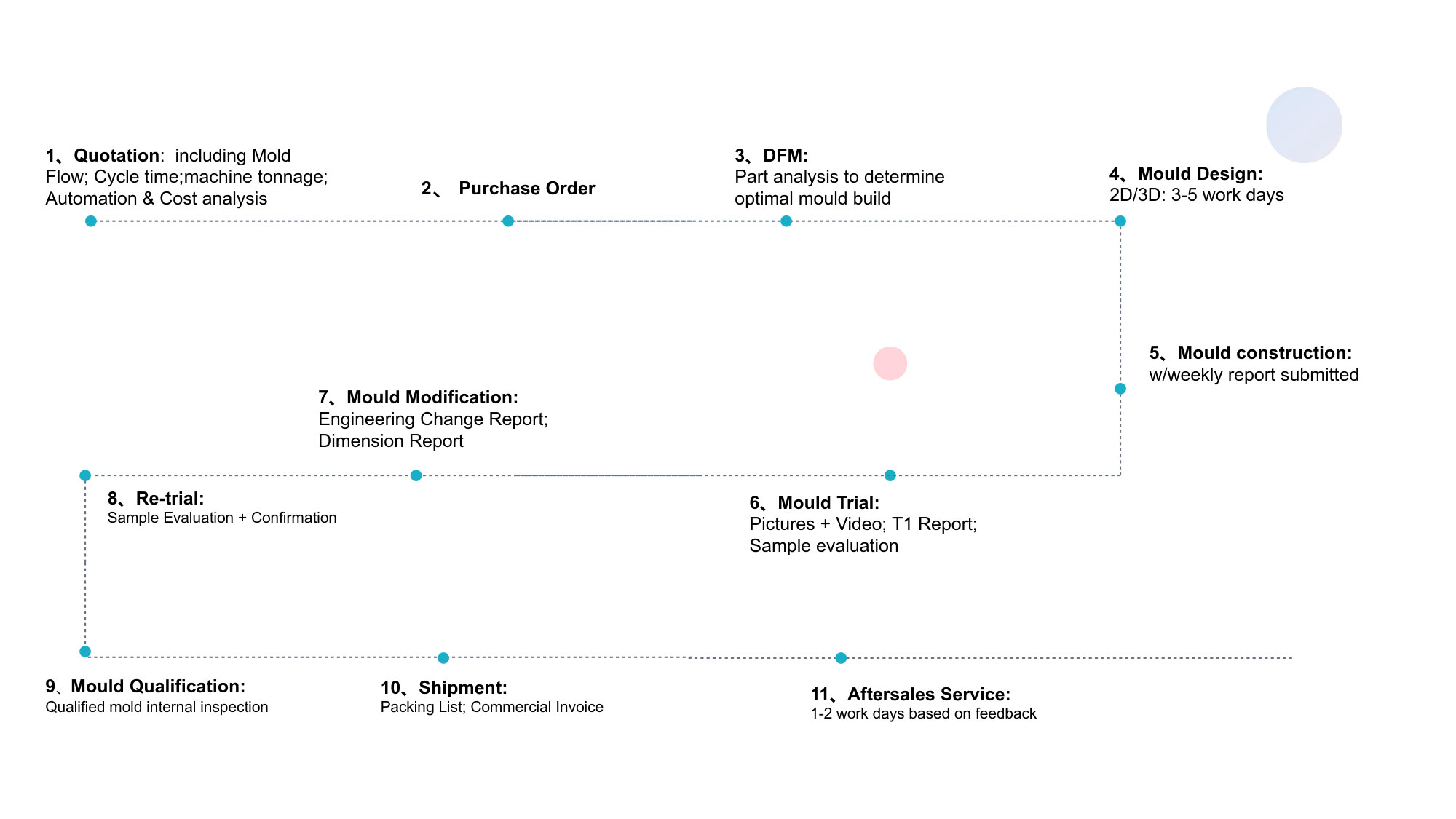
Our mold manufacturing workflow follows a disciplined, documented process:
Design phase: DFM analysis, mold flow simulation, 3D modeling (2-4 weeks)
Material procurement: Certified mold steels with full traceability (1-2 weeks)
Rough machining: 3-axis/5-axis rough cutting (3-7 days)
Heat treatment: Vacuum hardening with controlled cycles (2-5 days)
Finish machining: 5-axis finishing to final tolerances (3-10 days)
EDM operations: Fine-feature and cavity detail work (2-5 days)
Assembly and fitting: Core/cavity fit, slide assembly, ejection system (3-5 days)
Pilot molding: In-machine validation of mold performance (1-2 days)
Inspection and documentation: Full CMM dimensional report (1-2 days)
3.8 Standard Delivery Lead Times
Mold Complexity Standard Lead Time Expedited Lead Time
Simple molds (single cavity, no slides) 10 days 7 days
Medium complexity (multi-cavity, basic slides) 25-35 days 20 days
High complexity (2K rotary, complex slides, tight tolerances) 35-45 days 28 days
For expedited orders, we accelerate by dedicating machining capacity and extending shift coverage while maintaining all validation steps.
Value to Customer: Predictable lead times enable accurate production planning. Expedite options support urgent program launch requirements.
Part Four: Injection Molding Process Excellence – Eliminating Customer Quality Anxiety
4.1 Process Standardization and Control
Customers fear: shrinkage, flash, dimensional instability, and batch-to-batch color variation.
Our solution: All injection molding machines are networked and controlled through our Manufacturing Execution System (MES). Every critical process parameter—temperature, injection pressure, hold pressure, screw speed, and cycle time—is locked within the MES and accessible only by authorized engineers. Every production batch undergoes first-piece and last-piece dimensional comparison to ensure process stability throughout the run.
Value to Customer: Documented process control provides traceability for quality audits. Eliminates unauthorized operator adjustments that cause quality excursions.
4.2 Dimensional Stability Management
LSR shrinkage behavior differs significantly from thermoplastic materials. Our approach to dimensional stability includes:
Zoned mold temperature control maintaining cavity/core temperature differentials within 2°C to minimize warpage
Real-time cavity pressure monitoring with closed-loop control systems
Statistical process control with data collected on every shot
Proven performance data: For bracket-type products produced across three batches within one week, critical hole spacing variation stays within ±0.02mm
Value to Customer: Predictable dimensions eliminate assembly fit issues. Reduced scrap protects profitability.
4.3 Surface Quality Standards
We achieve and maintain specific surface quality levels depending on application requirements:
Application Type Achievable Standard Customer Benefit
Transparent/optical parts Bubble-free, no flow marks Clear visibility for sensor applications
Matte-finish seals Consistent texture, no gloss variation Uniform appearance across high-volume production
Overmolded electronic seals Flash-free, precise edge definition No short circuits from silicone bleed-out
High-gloss surfaces Ra ≤ 0.2μm Meets aesthetic requirements for visible components
For parts requiring printing or coating, we incorporate compensation allowances into mold design to achieve print registration accuracy of ±0.1mm.
Value to Customer: Eliminates secondary finishing operations that add cost and cycle time. Achieves required quality without post-processing.
4.4 Advanced Material Processing Capabilities
Our material processing experience spans the full range of engineering thermoplastics and high-performance materials required for automotive connector applications:
Thermoplastics:
PC / ABS blends
PC (Polycarbonate)
PPS + 40% GF
PEEK (high-temperature, chemical-resistant applications)
PTFE / PFA (fluoropolymer requirements)
PA6 + GF30
PBT (PBT+GF30, PBT+ASA)
PEI (Ultem™)
LCP (Liquid Crystal Polymer)
PP, ABS, PA66, and more
Silicone Materials:
LSR (Liquid Silicone Rubber)
HCR (High Consistency Rubber)
F-LSR (Fluorosilicone for fuel/oil contact)
Material Certifications:
UL94 V-0 flame rating (validated for 1mm thickness)
UV resistance validated to 3,000 hours without discoloration
Low VOC and low volatility for interior automotive applications
RoHS and REACH compliance
Value to Customer: Single-source responsibility for multi-material components reduces supplier management overhead. Proven material experience eliminates trial-and-error during product launch.
Part Five: Comprehensive Service Model – Reducing Customer Management Costs
5.1 Early Engineering Engagement – DFM Reports
Traditional manufacturing often leaves customers to discover manufacturability issues after tooling is already in progress—at significant cost and schedule impact.
Our approach: Before we accept any purchase order for mold manufacturing, we provide a comprehensive Design for Manufacturing (DFM) feasibility analysis report. This document includes:
Draft angle recommendations optimized for LSR demolding
Wall thickness optimization to balance fill, cure, and dimensional stability
Gate location strategy based on mold flow simulation
Ejector pin mark location with clearly identified allowable zones
Weld line and air trap risk assessment with mitigation strategies
Value to Customer: Identifies and resolves manufacturing issues before tooling investment. Eliminates costly mold modifications after steel is cut. Reduces time-to-production by 4-6 weeks compared to conventional approaches.
5.2 Prototype and Sampling – T0 to T3
We provide iterative sampling and validation to ensure mold performance meets customer requirements before production release:
Sample Stage Deliverable Purpose
T0 (First shot) Raw molded samples with defects identified Initial mold validation; identify immediate corrections
T1 (First optimization) Improved samples + dimensional report Verify correction effectiveness
T2 (Fine tuning) Production-ready samples + CPK data Validate dimensional stability
T3 (Production approval) PPAP documentation + run-at-rate Customer sign-off for production release
Between each stage, we provide detailed corrective action reports documenting changes made and performance improvements achieved. Our in-house electrode manufacturing and EDM capabilities enable fast mold modifications without waiting for external machine shops.
Value to Customer: No surprises during mold acceptance. Clear visibility into iterative improvements builds confidence. Fast turnaround between sample stages accelerates project launch.
5.3 Pilot Production Validation
Formal production release requires documented performance validation. Before initiating full-scale production, we offer pilot runs of 100-500 shots, during which we:
Collect and document yield rates
Generate CPK data for all critical dimensions
Verify process stability across full production shift
Identify and resolve any remaining issues before volume production
Value to Customer: Confirms process capability before committing to large-scale production. Eliminates risk of quality surprises during volume ramp-up.
5.4 Maintenance and Spare Parts
Long-term mold performance requires systematic maintenance. Our standard mold delivery package includes:
Complete set of spare wear parts (ejector pins, core inserts, slide wear plates) shipped with the mold
Detailed maintenance schedule and procedures for each mold
Preventive maintenance service at 200,000-shot intervals (completed at our facility or on-site)
Lifetime repair service at material cost plus labor—never priced at premium rates
Value to Customer: No downtime for waiting on spare parts. Predictable maintenance costs protect profitability. Extended mold life through professional maintenance reduces capital expenditure.
Part Six: Differentiated Commitments – Addressing Common Industry Pain Points
6.1 Mapping Customer Complaints to Our Solutions
Common Industry Complaint Our Commitment How We Deliver
"Molds require constant repair, disrupting production schedules." Three-year structural warranty on mold bases and core/cavity assemblies (excluding normal wear components) Every mold undergoes 2,000-shot aging test with wear report provided to customer before shipping
"Excessive flash requires costly secondary deflashing operations." Flash controlled to ≤0.03mm across production batches We machine parting lines to 0.005mm fit accuracy and use self-locking clamp force compensation to maintain consistent clamping
"Dimensions vary unpredictably between production batches." Closed-loop process control with ultrasonic wall thickness monitoring Real-time sensors detect thickness variations and automatically adjust packing pressure. In-mold temperature and pressure sensors enable closed-loop control
"Mold repairs take weeks, delaying production." 24-hour turnaround for standard repair operations In-house electrode manufacturing and EDM workshop means repairs never leave our facility
6.2 The Ansix Difference
We do not view molds as tools—we view them as revenue-generating assets. Every mold we design is engineered with production sustainability, optimized venting paths, thermal balance, and material flow characteristics that ensure zero commissioning time, minimal flash, and maximum service life when installed in your production environment.
We invite customers to experience this difference firsthand. Provide one existing product drawing, and we will deliver a complete DFM report demonstrating how we anticipate and eliminate the risks of weld lines, air traps, and shrinkage concerns before your tooling project begins.
Part Seven: Comprehensive Cost Reduction Strategies
7.1 The Multi-Layered Cost Reduction Framework
Ansix Tech has developed a systematic approach to reducing customer costs across every dimension of manufacturing. Unlike competitors who focus narrowly on piece price, we examine the entire value chain to identify and eliminate cost.
Material Cost Reduction
Through strategic material selection and partnership with leading suppliers including Dow, Wacker, Momentive, and others, we identify optimal material grades for each application. Our expertise in LSR material properties enables us to recommend:
Fast-curing grades that reduce cycle time without compromising quality
Self-adhesive formulations that eliminate primer application
Self-lubricating grades that eliminate secondary lubrication operations
No-post-cure (NPC) grades that eliminate post-mold thermal processing
Example: Selecting Wacker ELASTOSIL® LR 3016/65 eliminates post-cure requirements, directly reducing energy costs and cycle time.
Process Efficiency Optimization
Parameter LSR Advantage vs. Conventional Rubber Customer Saving
Cycle time Cures in minutes vs. significantly longer for HCR 30-50% reduction in per-part machine time
Automation capability LIM enables fully automated production 50-70% labor reduction vs. compression molding
Post-cure requirement Many grades require no post-cure Eliminates oven processing and associated energy/space
Secondary operations Single-cycle overmolding eliminates assembly Eliminates adhesive, mechanical fasteners, assembly labor
Design Optimization Cost Savings
Our DFM engagement identifies cost-saving opportunities before tooling begins:
Part consolidation: Combining multiple components into single 2K molded assembly eliminates procurement, inventory, and assembly costs
Material reduction: Optimized wall thickness reduces raw material consumption by 10-20%
Flash elimination: Precision mold fit eliminates deflashing operations and associated labor
Yield improvement: Robust process design targets first-pass yield ≥98%
Tooling Investment Optimization
We help customers optimize tooling investment through:
Multi-cavity designs that maximize output per machine cycle
Family molds that produce multiple part numbers simultaneously
Modular insert systems enabling quick changeover between similar parts
Progressive qualification starting with single-cavity molds to validate before multi-cavity investment
7.2 Quantifiable Cost Reduction Examples
Cost Category Typical Reduction Source of Saving
Per-part material cost 10-20% Optimized wall thickness, runner design, material selection
Secondary operations 30-70% Precision molding eliminates deflashing, post-cure, assembly
Quality-related costs 40-60% Process controls reduce scrap, field failures, warranty claims
Tooling amortization 20-30% Extended mold life spreads investment over more parts
Labor cost 50-70% Automation, reduced handling, simplified operations
Overall unit cost 20-40% Cumulative effect across all cost categories
7.3 Production Ramp-Up and Capacity Management
We support customers from initial prototype through full production ramp:
Phase 1 – Prototype (10-500 parts):
Single-cavity development molds
Fast turnaround (4-6 weeks from DFM approval)
Process validation and customer sampling
Phase 2 – Pilot Production (500-50,000 parts):
Multi-cavification based on validated process
Production-quality molds
Capability studies and PPAP submission
Phase 3 – High-Volume Production (50,000+ parts):
Full production tooling with spares
Dedicated machine capacity allocation
Continuous improvement through process monitoring
Capacity Commitment: For customer-designated production programs, we commit dedicated machine capacity ensuring delivery against any forecast volume—with 30-day notice of any capacity constraints.
Part Eight: Quality Assurance and Certification Framework
8.1 In-Process Quality Controls
Our production lines incorporate multiple quality verification points:
Material receiving inspection – Certificate of Analysis verification for every LSR lot
Pre-molding verification – Machine setup validation, mold cleanliness check
In-process monitoring – Real-time cavity pressure/temperature data collection
100% visual inspection – Automated optical inspection for critical dimensions
Statistical sampling – AQL-based sampling per ISO 2859-1
First-piece / last-piece comparison – Dimensional verification for every production batch
Functional testing – As required per customer specification (compression set, hardness, tensile strength, dielectric testing)
8.2 Traceability Systems
Complete material and process traceability is maintained:
Lot traceability: Every batch of LSR material recorded with supplier lot number and production dates
Mold traceability: Each mold has unique identification recorded on every shot
Production date coding: Optional date-code marking on molded parts
Batch records: Complete production documentation maintained for audit purposes
8.3 Testing Capabilities
Our in-house quality laboratory is equipped to perform:
Dimensional measurement (CMM, optical comparator, vision measurement systems)
Hardness testing (Shore A)
Tensile strength and elongation testing
Compression set measurement
Dielectric strength and volume resistivity testing
Environmental testing (temperature cycling, humidity, salt spray)
UV/ozone resistance testing
8.4 Quality Certifications
Ansix Tech maintains full compliance with:
IATF 16949 – Automotive quality management system (by customer requirement)
ISO 9001 – Quality management
ISO 14001 – Environmental management (by facility)
Customer-specific quality requirements as defined in each program
Part Nine: Delivery and Logistics Excellence
9.1 Standard Delivery Performance
Service Level Commitment
Routine order lead time 4-6 weeks from production release
Expedited production 2-3 weeks (subject to capacity)
On-time delivery performance ≥98%
Emergency resupply (spare parts) 72 hours for stocked components
9.2 Packaging Solutions
We design packaging in collaboration with customers to optimize:
Part protection: Damage-free delivery through properly designed dunnage
Density optimization: Maximizing parts per shipping container to reduce freight costs
Automation compatibility: Packaging compatible with customer pick-and-place equipment
Cleanliness requirements: Cleanroom-grade packaging for sensitive applications
9.3 Supply Chain Partnerships
We maintain strategic partnerships with global material suppliers including:
Dow – SILASTIC™ LSR series, including self-adhesive SA 9940/9942 series
Wacker – ELASTOSIL® LR series for automotive seals
Momentive – Silopren™ LSR series, including flame-retardant grades
Leading steel suppliers – Certified mold steels with full material traceability
These partnerships ensure consistent material availability, technical support, and access to the latest material innovations.
Part Ten: Industry Experience and Proven Reliability
10.1 Automotive Application Expertise
Over 28 years of experience in automotive sealing components has built deep expertise across:
EV battery systems – Connector seals for high-voltage applications
Powertrain sensors – Environmental protection seals requiring oil/fuel resistance
ADAS components – Radar and LiDAR housing seals demanding dimensional precision
Lighting systems – Headlamp and tail lamp connector seals with UV/weather resistance
Interior electronics – Low-VOC materials for cabin applications
Under-hood components – High-temperature seals for engine compartment connectors
10.2 Engineering Support Capabilities
Our engineering team provides ongoing technical support throughout the product lifecycle:
Design reviews at any stage of product development
Failure analysis for field returns, with corrective action recommendations
Continuous improvement – Monitoring production data to identify further optimization opportunities
Value engineering – Periodic review of established programs to identify cost reduction possibilities
10.3 Partnership Philosophy
We do not view our relationships as transactional supplier arrangements—we are manufacturing partners dedicated to mutual success. This philosophy manifests in:
Transparent communication about capabilities and limitations
Proactive identification of improvement opportunities
Responsive support when challenges arise
Long-term commitment to customer success beyond individual programs
Conclusion: The Ansix Tech Value Proposition
Automotive connector sealing rings manufactured through LSR liquid two-color molding represent a convergence of advanced materials science, precision mold engineering, and process control excellence. At Ansix Tech, we have integrated these disciplines into a comprehensive manufacturing solution that delivers measurable customer value:
Risk Reduction
Pre-production DFM analysis identifies manufacturability issues before tooling investment
Documented process controls eliminate quality variation
Proven material expertise ensures material performance matches specifications
Mold validation testing confirms capability before production release
Cost Reduction
Strategic material selection optimized for application requirements
Process efficiency improvements through automation and fast-curing LSR grades
Elimination of secondary operations via 2K overmolding technology
Extended mold life reducing per-part tooling amortization
Reduced scrap through robust quality systems and process controls
Delivery Certainty
Predictable mold manufacturing lead times
On-time delivery performance tracking
Emergency support for urgent requirements
Spare parts provided at mold delivery
Quality Excellence
Precision manufacturing with documented dimensional control
In-process quality verification at multiple checkpoints
Comprehensive testing capabilities
Full material and process traceability
Single-Source Convenience
Design through production under one roof
Multi-material and multi-process capabilities
Packaging and logistics integration
Sustaining engineering support throughout product lifecycle
We invite you to experience the Ansix Tech difference. Provide your current or planned automotive connector sealing ring design, and our engineering team will deliver a comprehensive DFM analysis demonstrating how we anticipate and eliminate manufacturing risks before your tooling investment begins.
For more information or to schedule a technical review of your application requirements, please contact our automotive business development team.
Ansix Tech – manufacturing excellence for automotive sealing applications. 28 years of experience delivered in every component.
Ansix Tech Co Ltd
If you have any plans related to Automotive connector sealing rings LSR liquid two-color molding , you can contact us at any time. We will turn your ideas into reality, let you realize your dreams, and obtain large orders from the market. Our contact information is info@ansixtech.com. Or contact our CTO, mail: stephen@ansixtech.com
#www.ansixtech.com #ansixtech.com #Automotive connector sealing rings LSR liquid two-color molding #Automotive connector sealing rings LSR liquid two-color molding injection molding companies #Automotive connector sealing rings LSR liquid two-color molding Canopy Mold injection mold companies #Ansix #Ansix moulds #Ansix china #Ansix tech china #Ansix tech company #Ansix facotry #Automotive connector sealing rings LSR liquid two-color molding injection molding #Automotive connector sealing rings LSR liquid two-color molding injection tools #Automotive connector sealing rings LSR liquid two-color molding injection moulds #Automotive connector sealing rings LSR liquid two-color molding plastic mould #Automotive connector sealing rings LSR liquid two-color molding plastic tools #Ansix Tech #Ansix molds #Ansix injection molding #Ansix mold factory #injection molding Automotive connector sealing rings LSR liquid two-color molding#Ansix mold factory #Automotive connector sealing rings LSR liquid two-color molding china #Automotive connector sealing rings LSR liquid two-color molding molds #injection factory #Automotive connector sealing rings LSR liquid two-color molding injection molding #Automotive connector sealing rings LSR liquid two-color molding injection molding factory #injection molding company #Automotive connector sealing rings LSR liquid two-color molding injection mold companies #Automotive connector sealing rings LSR liquid two-color molding Tooling #Automotive connector sealing rings LSR liquid two-color molding mold limited #Ansix mold china #Ansix companies #Ansix company China #Automotive connector sealing rings LSR liquid two-color molding facotry #Ansix Tech #Ansix Tech mould #Automotive connector sealing rings LSR liquid two-color molding injection moulding #injection moulding company #Ansix Automotive connector sealing rings LSR liquid two-color molding parts injection mold companies #medical injection molding companieschina #Automotive connector sealing rings LSR liquid two-color molding china factory #Ansix moulding companies #Ansix molding company #Automotive connector sealing rings LSR liquid two-color molding injection moulding facotry #Ansix Tech mold #Automotive connector sealing rings LSR liquid two-color molding mould #Automotive connector sealing rings LSR liquid two-color molding plastic injection molding #ansix plastic mold #Mold manufacturing #Automotive connector sealing rings LSR liquid two-color molding parts manufacturing #Automotive connector sealing rings LSR liquid two-color molding plastic parts factory #Automotive connector sealing rings LSR liquid two-color molding injection parts mold #Automotive connector sealing rings LSR liquid two-color molding PRECISION MANUFACTURING #Automotive connector sealing rings LSR liquid two-color molding #China mold #Automotive connector sealing rings LSR liquid two-color molding injection moulding china #Automotive connector sealing rings LSR liquid two-color molding mould china #china precision mold #mold in china #Automotive connector sealing rings LSR liquid two-color molding mold china #Precision molds #High-precision molds #Automotive connector sealing rings LSR liquid two-color molding #Injection molds #Automotive connector sealing rings LSR liquid two-color molding Factory #Automotive connector sealing rings LSR liquid two-color molding Company #Super Large Injection Mold Factory #Large Tonnage Injection Molding Factory #Automotive connector sealing rings LSR liquid two-color molding Company #Automotive connector sealing rings LSR liquid two-color molding Factory #2800T Injection Molding Factory #3000 Ton Injection Molding #4500 Ton Injection Molding Factory #Large Mold Injection Molding #Large Plastic Mold Injection Molding Factory #Large Injection Mold Manufacturer #Plastic Mold Factory #Injection Mold #Plastic Mold