



Headlight Transparent Lens Cover
FEATURES
Demonstrating Our Hardware Foundation – Turning Precision Tools Into Quality Assurance
The Customer Concern: Buyers often worry that a manufacturer with inadequate equipment will deliver inconsistent parts, incur high rework costs, or fail to meet tight tolerances.
How Ansix Tech Solves This: We begin by making our equipment capabilities transparent, converting technical specs into confidence for our customers.
Advanced Mold Processing and Machining Equipment
Our facility uses high-precision machinery to guarantee the flawless finish crucial for optical components. For headlight lenses, the surface finish directly impacts light transmission and automotive safety standards.
Five-Axis High-Speed Machining Centers: Ansix Tech utilizes five-axis CNC high-speed machining centers capable of achieving ±0.002mm precision on complex freeform surfaces. For headlight lenses, this ensures that parting lines remain smooth and burr-free, eliminating secondary finishing operations. Traditional three-axis machining would leave micro-step marks that create optical distortion; our five-axis solution ensures mould surfaces transition seamlessly, delivering defect-free transparent parts from the first shot.
-
Mold Description
Product Materials:
pc
Mold Material:
S136ESR
Number of Cavities:
1
Glue Feeding Method:
cold runner
Cooling Method:
Water cooling
Molding Cycle
32.5s
- The mold manufacturing process and product material selection
CNC Wire EDM (Electrical Discharge Machining): For delicate features like venting slots or narrow ribs found in complex headlight bezels and housings, our wire EDM can machine features down to 0.03mm without inducing mechanical stress, preventing thin-wall deformation and dimensional instability.
Injection Molding Machine Capabilities – From Small Components to Large Assemblies
Machine selection directly affects cost control and dimensional consistency.
Broad Tonnage Range (30 tons to 4,000 tons): This wide range allows Ansix Tech to handle everything from signal light lenses (<100g) to large front headlight housings exceeding 2kg, all on equipment sized to match part weight precisely. This prevents the risk of using an oversized machine — which increases energy costs and material waste — or an undersized machine — which leads to inconsistent filling.
All-Servo Electric Drives with ±0.1% Repeatability: Our entire injection molding fleet is equipped with all-servo electric drives, providing the stability absolutely essential for high-volume automotive lighting production. With a ±0.1% shot-to-shot repeatability across all process parameters, each molding cycle is virtually identical to the last. For customers, this ensures that the 1,000,000th lens coming off the production line matches the quality of the very first sample.
-
Measurement and Inspection – Data That Builds Trust
Customers need more than promises; they need verifiable data.
Coordinate Measuring Machines (CMM) with Optical Vision Systems: Before any Ansix Tech mould is shipped to the production floor, we perform a full dimensional inspection, generating a detailed full-dimension report that documents every critical feature. For headlight lenses, we guarantee a Process Capability Index (CPK) of ≥1.33 on all critical-to-quality dimensions. A CPK of 1.33 statistically confirms that at least 99.993% of production will fall within specified tolerances, giving our customers the confidence to proceed with minimal inspection of incoming goods.
Core Competencies in Mold Manufacturing – Delivering on Life, Precision, Speed, and Serviceability
The Customer Concern: Customers fear molds that wear quickly, require constant repair, or are delivered late, causing disruption to their vehicle assembly schedules.
How Ansix Tech Solves This: We design and manufacture molds not as a commodity product but as a capital asset optimized for your specific production environment.
Mold Life and Material Selection – Guaranteed Durability
The choice of mold steel directly determines how many shots a mold will produce before requiring maintenance or replacement.
Premium Mold Steels by Application: For headlight lens covers, which require a high-gloss-polished surface with exceptional corrosion resistance, we select S136 stainless steel, which after fine polishing can achieve a surface roughness of less than Ra0.001μm — ideal for transparent and optical-grade components. S136 also offers excellent corrosion resistance, preventing surface degradation from moisture or acidic molding byproducts. For high-wear areas with glass-fiber reinforcement (typical for PPS or PPA reflectors), we specify H13 (2344) or 8407 tool steels with hardness up to 52-54 HRC. For applications requiring superior toughness, DC53 resists cracking under high clamping forces.
Guaranteed Lifespan, Backed by Rigorous Testing: Ansix Tech guarantees a minimum of 500,000 shots for glass-reinforced materials (40% GF+) and over 1,000,000 shots for unfilled engineering resins like PC, PC/ABS, or PMMA. We deliver a metallurgical certification report and heat treatment curve for every mold, ensuring the material meets specification before the first shot is ever taken.
High-Precision Tolerance Management
For a headlight lens, maintaining perfect geometry is critical for legal compliance in different global markets — including US FMVSS 108, European UN/ECE standards, and Chinese GB requirements.
From Assembly Structure to Optical Surface: Ansix Tech molds achieve ±0.01mm for critical assembly and sealing features, and ±0.005mm for optical surfaces, where even micron-level deviations can alter beam patterns and reduce light output.
International Tolerance Standard Compliance
We manufacture to internationally recognized tolerance standards including GB/T 14486-2013 (Chinese National Standard), ISO 286 (International Geometric Tolerancing), and DIN 16901 (German Standard for Plastic Part Tolerances) , ensuring predictable assembly compatibility for global automotive supply chains.
Gate and Runner Design – Optimizing Flow for Defect-Free Lenses
Hot runner systems are essential for high-volume lens production because they eliminate cold runner waste and reduce material degradation.
Needle Valve Hot Runners: Ansix Tech utilizes needle valve hot runner systems with 0.6-1.0mm gates and ±1°C temperature control per zone. This prevents gate vestige marks and material degradation, delivering clean, stress-free parts right out of the mold. For large headlight lens covers, we incorporate sequential valve gating to control weld line positions — ensuring that any unavoidable flow mark is placed away from optically active zones, leaving the light distribution path defect-free.
Formal Mold Flow Analysis (MFA) Protocol: Prior to any machining, we perform a complete Mold Flow Analysis using leading simulation software. This analysis predicts filling balance, shear stress distribution (we keep maximum shear rate below 100,000 s ⁻¹ to prevent birefringence), weld line placement, and air trap locations. For optical lenses, our MFA report specifies that all weld lines must be positioned at least 1.5mm away from CTQ (critical-to-quality) optical areas.
Rapid Mold Manufacturing and Delivery
Ansix Tech understands that time-to-market is a critical competitive advantage for our customers.
Flexible Delivery Model: Standard delivery for moderate-complexity headlight lens molds is 25 to 45 days. For urgent projects requiring expedited timelines, we can compress this to 20 days by staging machining operations and pre-positioning material blanks — while still running a full T0 (first trial sample) validation before release.
Cooling System Design – The Key to Dimensional Stability
In headlight lenses, the cooling system design determines how uniformly the part solidifies. Uneven cooling produces internal stresses that cause warpage, optical distortion, and inconsistent dimensions.
Conformal Cooling Strategy: Ansix Tech designs cooling channels that follow the three-dimensional contour of the lens surface, minimizing temperature deviation across the cavity to ≤2°C. This uniform cooling produces parts with near-zero residual stress after demolding, preventing post-mold warpage and ensuring that the lens maintains its designed shape throughout its service life.
Section Three: Injection Molding Process Control – Eliminating Customer Quality Anxiety
The Customer Concern: Inconsistent molding leads to scrap parts, rework, and last-minute production holds — exactly what automotive just-in-time supply chains cannot afford.
How Ansix Tech Solves This: We approach injection molding not as an art but as a precise, data-driven science.
Process Standardization and Digital Parameter Locking
We eliminate operator-to-operator and shift-to-shift variation.
MES-Based Parameter Locking: All production machines are connected to our Manufacturing Execution System (MES). Critical parameters — barrel temperatures, injection speeds/pressures, holding pressure profiles, cooling time — are electronically locked and can only be modified by authorised process engineering staff. Each batch undergoes first-article and last-article inspection to confirm parts remain within specification even as the machine operates over extended runs.
Dimensional Stability Control Through Zealous Temperature Management
One of the greatest challenges for transparent plastic part injection moulding is achieving consistent dimensions without sinks, warps, or internal stress.
Independent Zone Temperature Control: Ansix Tech molds incorporate independent mold temperature controllers that maintain cavity and core temperature differentials of ≤2°C. For demanding optical PC grades, we elevate mold surface temperature to 120-140°C to preserve transparency and eliminate freeze-in stress, provided the molding system can maintain consistent high-temperature performance. Using our validated approach, we achieve key hole-to-hole center spacing variation of ≤±0.02mm across three separate production runs produced seven days apart.
Optical Surface Quality Guarantees
For headlight lens covers, the visible quality is as important as the dimensional accuracy. Ansix Tech guarantees bubble‑free and flow‑mark‑free surfaces with clear optical transparency as the standard.
Mirror Finish Mold Surface: By polishing mold cavities to Ra≤0.01µm — and for high‑gloss aesthetic applications, below Ra0.001µm — we produce lenses that meet optical‑grade requirements without post‑molding polishing or corrective coating steps.
Advanced Material Handling Capability
Ansix Tech has deep practical experience with a wide range of engineering resins including PC, PC/ABS, PMMA, PPS+40% GF, PBT+30% GF, PEEK, PA66+GF30 and PEI. For headlight lenses that demand UV stability and long‑term weatherability, we specify UV‑stabilised polycarbonate (PC) grades such as Covestro Makrolon® AL2447, which maintains low‑moisture absorption, exceptional impact strength and broad −40°C to +130°C service temperature. Our transparent PC lenses achieve ≥90% light transmission and pass 2,000‑hour xenon arc lamp aging tests without measurable degradation.
Section Four: Comprehensive Full‑Process Services – Reducing Customer Management Overhead
The Customer Concern: Managing multiple vendors for DFM, prototyping, mould building, sampling, production and maintenance eats up internal resources and introduces coordination risk.
How Ansix Tech Solves This: We provide a true turnkey solution that consolidates the entire supply chain under one roof.
Early DFM Engagement – Preventing Problems Before They Start
By analysing product designs before steel is cut, we eliminate costly late‑stage surprises.
Detailed DFM & MFA Report Package: Before contract signing, Ansix Tech prepares and presents a complete DFM Report that includes mould flow simulation results, optimal gate placement recommendations, part ejection layout, suggested draft angle adjustments, suggested wall thickness optimisations and a full risk matrix identifying potential mould and moulding concerns. This early‑stage review has repeatedly saved customers thousands of dollars by identifying redesigns before any machining begins.
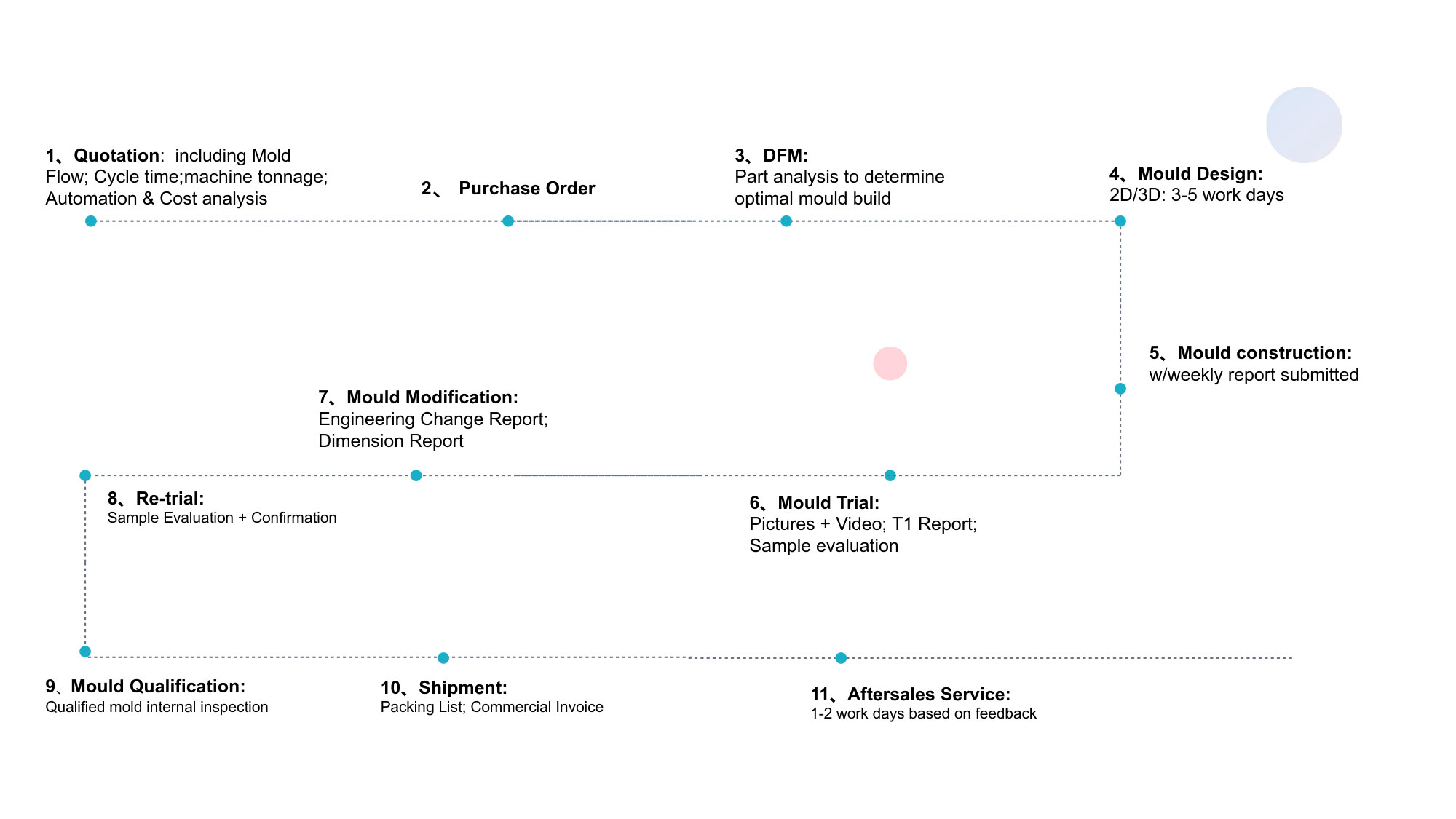
Step‑by‑Step Sampling and Validation – Transparency Through the Process
T0 Through T3 Trials: We provide sample parts for each mould iteration, accompanied by a detailed Inspection Report and dimensional measurement data. For process optimisation, we often use quick‑change inserts that allow different gating or cooling configurations to be tested without building an entirely new mold.
Small‑Batch Pre‑Production Validation – Proving Stability Before Volume Production
Ansix Tech offers a pre‑production trial run of 100 to 500 shots using validated process parameters. During these trials we continuously monitor CPK and dimensional stability over the short run. Only when data confirms that the process can hold tolerances for all cavities does production move to full volume.
Lifetime Maintenance and Spare Parts Strategy
We provide a complete spare parts kit (ejector pins, core inserts, valve pins) delivered with the initial mold. Every 200,000 shots we perform an optional preventative maintenance service, and any required repairs are provided for the remaining life of the mould at cost — not at inflated after‑market pricing.
Section Five: Competitive Differentiation – Moving From Claims to Verifiable Commitments
Comparison Table: Turning Customer Pains into Ansix Solutions
Common Customer Complaint in Traditional Supply Ansix Tech’s Verifiable Commitment
“The mold required repeated expensive repairs, delaying my production schedule.” We run every new mould through a mandatory 2,000‑shot wear test before delivery, complete with a full wear report. We also offer a three‑year structural warranty for the mold base and core set (excluding normal‑wear consumables).
“Flash on every shot meant hours of manual trimming, driving up my labour costs.” Our parting surfaces are machined to a fit clearance of ≤0.005mm, and we incorporate clamp‑force feedback that automatically compensates for day‑to‑day press variations. Resulting flash is ≤0.03mm, thin enough to leave in place — no secondary trimming required.
“Dimensions wandered from batch to batch, forcing us to re‑inspect every incoming shipment.” Each machine is equipped with an in‑mould pressure/temperature sensor array feeding closed‑loop process control. For long‑run jobs, we can optionally integrate a non‑contact inline thickness measurement system that gives real‑time feedback to adjust packing pressure on the fly.
“My mold shop took weeks to return a repaired tool; I lost my production slot.” Ansix Tech maintains an in‑house electrode manufacturing and sinker EDM department, so most repair work never leaves our facility. Standard weld‑repair or insert replacement is completed within 24 hours — often same day.
Section Six: Cost Optimisation – How Ansix Tech Controls Total Project Cost
The Customer Concern: “I need high quality, but I also need to hit my budget.”
How Ansix Tech Solves This: We attack the three main drivers of total cost: material cost, processing cost, and secondary operation cost.
Material Optimisation
By collaborating with major resin suppliers, we fine‑tune material selection to match each headlight lens application exactly. In many cases we recommend a mid‑viscosity UV‑stabilised PC grade that delivers the required weatherability and optical clarity while commanding a lower price than ultra‑premium specialty grades. For customers processing niche resins like PPS+40% GF, we optimise gate and runner design to maximise cavity utilisation and minimise scrap, often raising material yield from industry‑typical 75‑80% to over 95%.
Cycle Time Reduction Through Intelligent Process Design
We provide transparent cycle‑time breakdowns: filling time, pack/hold time, cooling time, and mould open/close. Adjusting cooling channel layout can shave seconds off every cycle, and over one million shots those seconds add up to weeks of saved production time and thousands of kilowatt‑hours of saved energy. The return on investment for a modest up‑front engineering fee can be recovered within just a few months of high‑volume operation.
Minimising Post‑Molding Operations
Our goal is to produce parts that are ready for assembly straight out of the mould. Every operation we eliminate — degating, deflashing, manual inspection — represents direct cost savings for our customers. By designing gate locations on non‑Cosmetic surfaces and keeping flash below 0.03mm, we routinely deliver headlight lenses that go directly from the take‑out robot to the shipping container with no manual handling.
Section Seven: Conclusion – The Ansix Tech Partnership Value
At Ansix Tech, we do not view a mold as just a block of steel. We view it as a revenue‑generating asset — one that will determine your product’s cost structure, production reliability, and customer satisfaction for years to come. By integrating DFM, precision toolmaking, data‑driven production, and lifetime support into a single partnership, we help our customers reduce risk, compress lead times, and achieve the low total cost that makes them competitive.
We invite you to schedule a DFM review session for one of your existing headlight lens components. During that session we will walk you through a complete risk assessment, identifying potential melt‑front convergence, trapped air pockets and sink locations — showing you in concrete terms how we would eliminate those defects before a single gram of resin is ever molded. Let us show you the difference that 28 years of dedicated optical plastics manufacturing experience can make for your next program.
Ansix Tech Co Ltd
If you have any plans related to Headlight Transparent Lens Cover , you can contact us at any time. We will turn your ideas into reality, let you realize your dreams, and obtain large orders from the market. Our contact information is info@ansixtech.com. Or contact our CTO, mail: stephen@ansixtech.com
#www.ansixtech.com #ansixtech.com #Headlight Transparent Lens Cover #Headlight Transparent Lens Cover moulds #Headlight Transparent Lens Cover injection molding companies #Headlight Transparent Lens Cover Canopy Mold injection mold companies #Ansix #Ansix moulds #Ansix china #Ansix tech china #Ansix tech company #Ansix facotry #Headlight Transparent Lens Cover injection molding #Headlight Transparent Lens Cover injection tools #Headlight Transparent Lens Cover injection moulds #Headlight Transparent Lens Cover plastic mould #Headlight Transparent Lens Cover plastic tools #Ansix Tech #Ansix molds #Ansix injection molding #Ansix mold factory #injection molding Headlight Transparent Lens Cover #Ansix mold factory #Headlight Transparent Lens Cover china #Headlight Transparent Lens Cover molds #injection factory #Headlight Transparent Lens Cover injection molding #Headlight Transparent Lens Cover injection molding factory #injection molding company #Headlight Transparent Lens Cover injection mold companies #Headlight Transparent Lens Cover#Headlight Transparent Lens Cover mold limited #Ansix mold china #Ansix companies #Ansix company China #Headlight Transparent Lens Cover facotry #Ansix Tech #Ansix Tech mould #Headlight Transparent Lens Cover injection moulding #injection moulding company #Ansix Headlight Transparent Lens Cover parts injection mold companies #medical injection molding companieschina #Headlight Transparent Lens Cover china factory #Ansix moulding companies #Ansix molding company #Headlight Transparent Lens Cover injection moulding facotry #Ansix Tech mold #Headlight Transparent Lens Cover mould #Headlight Transparent Lens Cover plastic injection molding #ansix plastic mold #Mold manufacturing #Headlight Transparent Lens Cover parts manufacturing #Headlight Transparent Lens Cover plastic parts factory #Headlight Transparent Lens Cover injection parts mold #Headlight Transparent Lens Cover PRECISION MANUFACTURING #Headlight Transparent Lens Cover #China mold #Headlight Transparent Lens Cover injection moulding china #Headlight Transparent Lens Cover mould china #china precision mold #mold in china #Headlight Transparent Lens Cover mold china #Precision molds #High-precision molds #Headlight Transparent Lens Cover #Injection molds #Headlight Transparent Lens Cover Factory #Headlight Transparent Lens Cover Company #Super Large Injection Mold Factory #Large Tonnage Injection Molding Factory #Headlight Transparent Lens Cover Company #Headlight Transparent Lens Cover Factory #2800T Injection Molding Factory #3000 Ton Injection Molding #4500 Ton Injection Molding Factory #Large Mold Injection Molding #Large Plastic Mold Injection Molding Factory #Large Injection Mold Manufacturer #Plastic Mold Factory #Injection Mold #Plastic Mold