



Syringe mold
FEATURES
Revolutionizing Medical Manufacturing: How Ansix Tech’s Advanced Syringe Mold Projects Deliver Unmatched Value Through Precision Engineering and Cost Optimization
A comprehensive industry report on Ansix Tech’s end-to-end syringe mold solutions–from concept validation to high-volume production–and how the company is redefining quality standards while systematically reducing client costs

-
Mold Description
Product Materials:
PP
Mold Material:
S136ESR
Number of Cavities:
96
Glue Feeding Method:
Hot runner
Cooling Method:
Water cooling
Molding Cycle
12.5s
SHENZHEN, GUANGDONG, CHINA – In the high-stakes world of medical device manufacturing, where micron-level tolerances can directly impact patient safety and procedural success, the injection mold serves as the master tool that shapes plastic components with exacting detail. With the global medical injection molding market projected to grow from $27.32 billion in 2025 to $29.42 billion in 2026 at a 7.7% CAGR, driven by rising demand for disposable medical products and increasing use of plastic components in medical equipment, the pressure on manufacturers to deliver precision, reliability, and cost efficiency has never been greater.
-
At the forefront of addressing these challenges stands Ansix Tech, a precision injection molding specialist with over 28 years of manufacturing experience. Established in 1998 in Hong Kong, the company has evolved into a leading provider of one-stop injection molding solutions, operating four production bases in China and Vietnam with a total building area of approximately 200,000 square meters. Their arsenal includes 260 injection molding machines ranging from 30 tons to 2,800 tons, a workforce of over 1,200 employees including more than 200 designers, and an impressive track record of building over 30,000 mold sets with precision capabilities reaching 0.002mm. The company holds ISO9001, ISO14001, IATF16949, and ISO13485 certifications, with an automated machining ratio of 70% and an average of just two mold trials before production readiness.
This report provides a deep dive into Ansix Tech’s comprehensive syringe mold project lifecycle–from project initiation and design development through validation, mass production, and rapid delivery–and examines how the company systematically delivers value to clients, solves critical industry problems, ensures rigorous quality verification, reduces costs through material and process optimization, and scales capacity while guaranteeing on-time delivery.
Part One: Project Initiation and Customer Value Proposition
The Ansix Tech Difference: An Integrated Ecosystem
Ansix Tech’s core competitive advantage lies in its holistic, end-to-end approach to injection molding. Unlike fragmented service providers that outsource critical functions, Ansix Tech offers a unified platform that seamlessly integrates every stage of the product lifecycle: from product design and prototyping to mold manufacturing, high-volume production, secondary processing, and assembly. This integration eliminates communication gaps, accelerates project timelines, and ensures consistency from concept to delivery.
For medical device manufacturers, the value of this integrated model cannot be overstated. “Think of the mold as the DNA of the final product,” explains Dr. Lena Chen, Chief Engineering Officer at Ansix Tech. “Any defect in the mold–misaligned cooling channels, imperfect gating–will be replicated thousands of times in production. For medical syringes, even a slight deviation can affect needle concentricity or seal integrity, making perfection the only acceptable outcome”.
What Ansix Tech’s Syringe Mold Projects Deliver to Clients
When a client initiates a syringe mold project with Ansix Tech, they gain access to a comprehensive value proposition that extends far beyond mold manufacturing:
Low-Risk Product Development: As an ISO13485:2016 certified medical manufacturer with extensive experience in medical product design and development, Ansix Tech provides low-risk product development solutions that protect clients from costly design errors.
Impeccable Product Quality: With a complete quality control system and stringent manufacturing processes, Ansix Tech delivers products that meet the most demanding medical standards.
Lower Project Costs: Through strategic material selection, process refinement, and efficiency enhancements, the company systematically reduces total component costs without compromising quality.
Accelerated Time-to-Market: With 70% automated machining and average mold trial counts of just two, Ansix Tech dramatically compresses development cycles, enabling clients to bring products to market faster.
End-to-End Traceability: From raw material inspection to final product testing, every stage of the manufacturing process is monitored and documented, ensuring complete traceability for regulatory compliance.
Problems Solved: Addressing Critical Industry Pain Points
Medical device manufacturers face numerous challenges in syringe production, many of which Ansix Tech’s syringe mold projects are specifically designed to address:
High Validation Costs: Traditional mold development often requires multiple costly iterations. Ansix Tech’s upfront DFM and Moldflow analyses reduce costly post-machining modifications and shorten validation times.
Inconsistent Quality Across High-Cavity Molds: Unbalanced filling in high-cavitation molds (32, 48, or 64 cavities) causes weight and transparency variations. Through advanced simulation and optimization, Ansix Tech ensures consistent quality across all cavities.
Material Waste and High Unit Costs: Traditional cold runner systems generate 15–20% runner scrap. Ansix Tech employs optimized hot runner systems to eliminate waste and reduce per-part costs.
Long Production Cycles: Extended cooling times drive up per-unit costs. Through conformal cooling channel design and optimized mold temperature control, Ansix Tech minimizes cycle times.
Regulatory Compliance Risks: Medical syringes must meet stringent biocompatibility standards (ISO 10993), sterilization compatibility, and dimensional tolerances (±0.02mm). Ansix Tech’s validated processes ensure full compliance.
Part Two: Design and Development – The Foundation of Manufacturing Excellence
Virtual Engineering: Where the Journey Begins
At Ansix Tech, the syringe mold development journey does not begin on the factory floor. It begins in the advanced world of computer-aided design (CAD). Engineers create detailed three-dimensional models of entire mold assemblies, defining every cavity, core, slide, and ejector pin that will constitute the final syringe component. This digital twin is far more than a static blueprint; it serves as the foundation for rigorous simulation and analysis that preemptively addresses production challenges before any steel is cut.
Design for Manufacturing (DFM) Analysis: The Critical First Step
Before any metal cutting begins, Ansix Tech performs a comprehensive DFM analysis. This collaborative process examines the part design from a moldability perspective, aiming to simplify mold structure, enhance part strength, and ensure reliable demolding. Recommendations may include adding draft angles on vertical walls, optimizing rib thickness to prevent sink marks, or adjusting wall thickness uniformity to ensure consistent filling and cooling. For medical syringe molds–especially high-transparency barrels, high-cavitation structures, and precision-fit components–systematic DFM analysis is not optional; it is essential for project success.
Moldflow Analysis: Predicting and Preventing Defects
Ansix Tech’s engineers utilize advanced simulation software such as Autodesk Moldflow to create a digital twin of the mold and the plastic flow process inside it. This virtual prototyping stage is critical. Engineers simulate the injection molding process of medical-grade plastics–typically polypropylene (PP) or cyclic olefin copolymer (COC)–filling into the predetermined cavity. The analysis predicts potential defects such as air traps, weld lines, or uneven cooling that could cause warpage. For syringe barrels or needle hubs, achieving balanced filling is crucial to prevent stress that could affect the cylindrical integrity of the part.
Key simulation outcomes include:
Melt front time: ensures uniform cavity filling to prevent voids or incomplete fills
Weld line location: identifies where flow fronts meet (creating potential weak points) and allows repositioning of gates or adjustment of wall thickness to relocate weld lines to non-critical areas
Air traps: identifies regions where air may become trapped, causing burn marks, and designs proper venting channels
Cooling analysis: simulates cooling system effectiveness to minimize cycle time and control warpage
For high-cavitation molds, filling balance analysis is particularly critical. Unbalanced filling causes weight and transparency differences across cavities. Through simulation analysis, runner dimensions and gate structures can be optimized before manufacturing begins.
Prototype Validation: The Last Safety Net
After digital models are perfected, Ansix Tech typically produces physical prototype molds using softer materials such as aluminum. This stage tests design assumptions in practice, allowing engineers to validate critical features such as demolding of thin-walled needle hubs or formation of fine threads. “This step is our last safety net,” Dr. Chen explains. “We confirm here that the mold will not only produce parts that look correct but also parts that meet all functional and regulatory requirements”. Using advanced 3D printing technologies such as stereolithography (SLA) or selective laser sintering (SLS), prototypes can be produced in resin or nylon for form and fit validation, client design discussion, and preliminary functional assessment. This “fail fast” approach identifies and resolves potential issues at the lowest possible cost, avoiding expensive modifications to hardened tool steel later.
Part Three: Material Science – The Foundation of Value and Performance
Mold Steel Selection: Balancing Durability, Machinability, and Cost
The mold must withstand hundreds of thousands of cycles under high pressure and high temperature. Ansix Tech selects mold steel based on part complexity, required service life, and the characteristics of the plastic material being molded. For high-volume syringe molds, the company typically uses pre-hardened steel (such as PMS steel) or corrosion-resistant steel (such as PCR steel). These materials achieve an excellent balance between machinability, polishability, and durability, resisting wear as well as corrosive gases that certain plastics may release. This careful selection extends mold service life while maintaining cost efficiency.
For the most demanding medical syringe applications that require high corrosion resistance and biocompatibility, Ansix Tech specifies S136 stainless steel. With hardness reaching HRC45-48 after treatment and compliance with ISO 10993-1 biocompatibility standards, S136 resists corrosion even after 20 cycles of 121℃ high-temperature sterilization. Mold surfaces undergo mirror polishing with Ra values ≤0.05μm, achieved through ultra-precision grinding and wire electrical discharge machining with processing accuracy of ±0.001mm.
Plastic Resin Selection: Matching Material to Application
Medical syringes require materials that are transparent, chemically resistant, biocompatible, and capable of withstanding gamma or ethylene oxide sterilization. The two primary materials are Polypropylene (PP) and Cyclic Olefin Copolymer (COC).
Polypropylene (PP):
PP is the most widely used material for disposable syringes due to its cost-effectiveness, good chemical resistance, lightweight properties, and non-toxicity. It offers a favorable balance of mechanical strength, thermal stability, and transparency. However, PP has lower moisture and oxygen barrier properties compared to COC, limiting its use in pre-filled syringe applications where long-term drug stability is required.
Cyclic Olefin Copolymer (COC) / Cyclic Olefin Polymer (COP):
COC and COP are advanced glass-replacement materials increasingly adopted for premium medical applications such as pre-filled syringes. TOPAS COC, for example, is being used in primary pharmaceutical packaging applications for its combination of transparency, high water barrier, very good purity, and good sterilizability with various methods. Zeon’s medical-grade COP resins provide exceptional impact strength over a wide range of temperatures, including cryogenic storage conditions down to -194℃.
Compared to PP, COC offers approximately 10 times higher barrier properties against both moisture and oxygen. A drug remains stable for up to three years in a COC syringe, retaining its full effectiveness. COC is inert, bio-compatible, and exhibits low protein absorption. Additionally, COC enables flexible design: threads can be created with high precision using injection molding technology–something that cannot be achieved with glass.
Performance Parameters Evaluated by Ansix Tech:
Tensile strength (15-35 MPa): ensures the syringe barrel can withstand pressure without bursting
Heat distortion temperature (70℃ at 0.46 MPa): ensures dimensional stability during sterilization
Shrinkage rate (0.1%–0.3%): a critical value that mold design must precisely compensate for to achieve final part dimensions
Ansix Tech’s engineers work closely with clients to select the optimal material grade, often recommending equivalent alternatives with comparable performance but lower cost or better processability, directly reducing the client’s bill of materials.
Part Four: Mold Design Engineering – Precision Critical Systems
Multi-Cavity Layout and Precision Tolerances
For high-volume syringe production, Ansix Tech designs molds with 8 to 32 cavities (and sometimes up to 64 cavities for maximum throughput). Typical cycle times for syringe components range from 15–25 seconds for syringe barrels, depending on wall thickness and material requirements. The inter-cavity spacing error is controlled within ±0.03mm, and the barrel inner diameter tolerance is maintained at ≤±0.02mm. To prevent flash–the unwanted thin extension of plastic beyond the intended part boundary–the parting surface gap is designed to ≤0.01mm with curved fitting geometry.
Gating System Design: Hot Runner for Efficiency and Quality
Ansix Tech employs hot runner systems as the preferred gating solution for high-volume medical syringe molds. Hot runners eliminate the runner scrap generated by cold runner systems (which typically produces 15–20% waste), with medical-grade hot runner systems achieving 99.5% material utilization, saving over $150,000 annually for high-volume projects. Cycle time reductions of up to 30% boost daily output by 40%, while temperature control within ±1℃ ensures consistency aligned with GMP standards.
For syringe molds, the hot runner system is designed with runner diameters of 4-7mm, optimized for balance via mold flow analysis. This ensures uniform melt flow across all cavities, preventing dimensional variation, flash, or short shots that could compromise product quality.
Cooling System Design: The Heart of Cycle Time Optimization
Cooling typically accounts for 60-70% of the total molding cycle. For syringe barrels with thin walls (as thin as 0.15mm in some applications), efficient and uniform cooling is essential to minimize cycle time while preventing warpage and internal stress concentration.
Ansix Tech adopts conformal cooling channels–cooling channels that follow the contour of the mold cavity rather than being drilled in straight lines. Conformal cooling channels are spaced 20-30mm apart, with water temperature fluctuation controlled to ≤±1℃. The temperature difference between core and cavity is maintained above 5℃ to ensure rapid and uniform cooling. This design accelerates heat dissipation, reduces cycle times, minimizes residual stress, improves dimensional stability, and prevents sink marks and warpage.
Runner and Flow System Balancing
In high-cavitation molds, achieving consistent filling and pressure across all cavities is a primary challenge. Ansix Tech employs naturally balanced hot runner systems with equal-length flow channels, incorporates valve gate technology for sequential filling in complex geometries, and validates flow balance through iterative mold flow simulations. This ensures that each cavity fills at the same rate and experiences the same pressure profile, resulting in uniform part weight, dimensions, and properties.
Ejection System Design
The ejection system must reliably demold delicate syringe components without cosmetic damage. Ansix Tech designs ejection systems with precision ejector pin placement, ensuring balanced ejection force distribution across the molded part. For syringe barrels with thin walls, careful ejection design prevents deformation and maintains critical dimensional tolerances.
Part Five: Mold Manufacturing – Machining Challenges and Process Flow
Manufacturing Challenges in Syringe Mold Production
Producing syringe molds presents unique manufacturing challenges that require advanced machining capabilities and rigorous process control:
Ultra-High Precision Requirements: With barrel inner diameter tolerances of ±0.02mm and cavity spacing errors of ±0.03mm, conventional machining techniques are insufficient. Ansix Tech employs ultra-precision grinding and wire electrical discharge machining (EDM) with processing accuracy of ±0.001mm.
Complex Cooling Channel Geometry: Conformal cooling channels require complex three-dimensional machining paths that cannot be achieved with standard drilling techniques. Advanced five-axis CNC machining or hybrid additive manufacturing technology is required.
Mirror Surface Finish Requirements: Medical syringe components require surface finishes with Ra ≤0.05μm to ensure optical clarity and prevent bacterial adhesion. Achieving such finishes demands specialized polishing techniques and high-quality mold steels.
Corrosion Resistance: Syringe molds must withstand exposure to sterilization processes (gamma radiation, ethylene oxide) and potentially corrosive medical-grade polymers. S136 stainless steel with HRC45-48 hardness provides the required corrosion resistance.
Machining Accuracy and Automation
Ansix Tech’s mold manufacturing achieves precision of ±0.002mm (2 microns)–comparable to the thickness of a strand of spider silk. With an automated machining ratio of 70%, the company has significantly reduced human error and accelerated production timelines. The mold shop is equipped with a comprehensive array of modern CNC hard machining technologies, enabling close tolerance control and temperature-stabilized machining operations.
Mold Manufacturing Process Flow
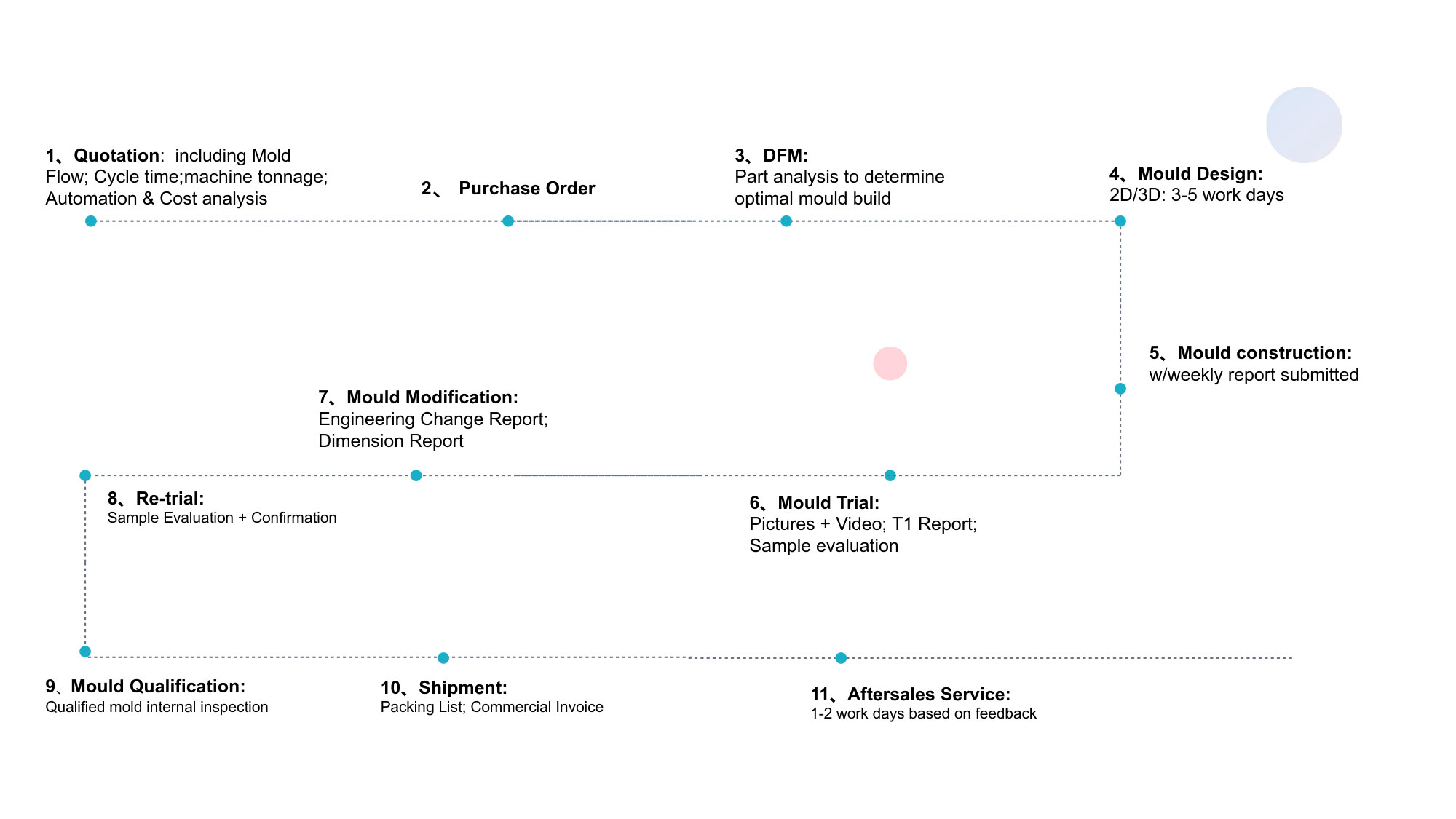
The complete mold manufacturing process at Ansix Tech follows a structured sequence:
CAD Design and DFM Review: Comprehensive design and manufacturability analysis
Mold Flow Analysis: Virtual simulation to predict and prevent defects
Material Selection and Procurement: Strategic selection of mold steel based on application requirements
CNC Rough Machining: Initial cavity and core machining with stock allowance
Heat Treatment: Hardening to achieve specified hardness (e.g., HRC45-48 for S136)
Ultra-Precision CNC Finishing: Final cavity and core machining to tolerances of ±0.001mm
Wire EDM: Precision machining of complex geometric features
Mirror Polishing: Achieving Ra ≤0.05μm surface finish
Cooling Channel Machining: Precision drilling or additive manufacturing of conformal cooling channels
Assembly and Fitting: Precise assembly of all mold components, including cavity plates, core plates, hot runner system, ejector system, and cooling system
Mold Trial and Process Validation: Initial production run to validate quality, cycle time, and process stability
Final Inspection and Documentation: Comprehensive dimensional inspection and quality documentation
Part Six: Syringe Mold Validation – Ensuring Quality and Process Reliability
The Validation Philosophy: Risk Control Trumps Speed
In the medical industry, risk control is far more important than speed. The true significance of providing DFM and Moldflow analysis lies in reducing the number of mold trials, lowering modification costs, shortening delivery cycles, improving first-mold success rates, and enhancing long-term mass production stability. While many mold manufacturers design solely based on experience, conduct no systematic simulations, and repeatedly modify after mold trials, Ansix Tech invests more in upfront engineering analysis to reduce the cost of repeated adjustments later.
The Mold Trial Process: From First Shot to Production Readiness
Ansix Tech’s mold validation process is systematic and data-driven:
Step 1 – First-Shot Validation: The first production run checks basic functionality and safety, verifying that the mold opens and closes correctly, ejector pins function properly, cooling channels are leak-free, and no immediate defects such as flash or short shots appear.
Step 2 – Dimensional Inspection: Produced parts are inspected using coordinate measuring machines (CMM) and automated vision systems to verify that all dimensions fall within specified tolerances.
Step 3 – Process Window Development: Engineers systematically vary injection molding parameters (temperature, pressure, injection speed) to identify the optimal processing window that consistently produces compliant parts.
Step 4 – Cavity Balance Validation: Parts from each cavity are weighed and measured to verify filling balance and dimensional consistency across all cavities.
Step 5 – Stress and Function Testing: Complete syringes assembled from molded components undergo function testing, including seal integrity testing, plunger force testing, and leak testing.
Step 6 – Documentation and Release: All validation data is documented, and the mold is released for mass production only after all acceptance criteria are satisfied.
Quality Control and Assurance Systems
With a complete quality control system and rigorous processes throughout the manufacturing pipeline, Ansix Tech ensures that every product meets the highest quality standards. Key quality assurance elements include:
In-Process Quality Control: Real-time monitoring of injection molding parameters, including temperature, pressure, and injection speed. Any deviation from specified parameters triggers an alert, and non-conforming parts are automatically rejected.
100% Inspection Capability: Automated vision inspection systems integrated into the production line enable 100% inspection of critical dimensions. Components are inspected, measured, and classified immediately after removal, detecting defects as close to the production process as possible.
Statistical Process Control (SPC): Continuous monitoring of process capability indices (Cpk) to detect trends that could indicate process drift before non-conforming parts are produced.
Traceability: Each molded component can be traced back to the specific cavity, production batch, and production date, enabling rapid root cause analysis and containment in the event of quality issues.
Part Seven: Injection Molding Process Optimization – Efficiency and Cost Control
Optimizing the Four Stages of Injection Molding
The injection molding process for syringe components comprises four critical stages: heating and plasticizing, high-pressure injection, holding pressure and cooling, and aseptic demolding. Each stage is precisely controlled to match material properties and product requirements:
Temperature Control: For medical-grade PP, the melting temperature is maintained at 220-270℃, with mold temperature of 50-90℃. Cavity surface temperature difference is compressed to ±0.5℃. For heat-sensitive materials like COC, precise temperature control prevents molecular degradation.
Three-Stage Pressure Control: Injection pressure of 1500-1800bar, holding pressure set at 80% of injection pressure, and switching to holding pressure at 95% of full stroke to prevent shrinkage and voids.
Time Parameters: Injection time of 2-5 seconds, holding time of 15-30 seconds, and cooling time accounting for 60-70% of the total molding cycle.
Reducing Cycle Time to Increase Capacity
For medical device manufacturers, cycle time directly impacts production capacity and per-unit cost. A reduction of just one second in cycle time across a 48-cavity mold can increase daily output by thousands of units and significantly reduce manufacturing cost per unit.
Ansix Tech achieves cycle time optimization through:
Optimized cooling channel layout to accelerate heat dissipation
High-performance hot runner systems that reduce cooling requirements and eliminate runner cooling
Precise temperature control that minimizes the time required to reach demolding temperature
Automated part removal systems that reduce the non-productive portion of the cycle
Waste Reduction and Material Yield Improvement
In medical injection molding, material costs represent a significant portion of total production cost. Medical-grade polymers cost 3-5 times higher than engineering plastics, demanding >99% material utilization to maintain profitability.
Ansix Tech achieves exceptional material yield through:
Hot runner systems that eliminate runner scrap, achieving 99.5% material utilization
Optimized runner geometry that minimizes the volume of plastic retained in the runner system
Precise shot size control that prevents overfilling and reduces flash
Closed-loop recycling systems for any unavoidable scrap
Efficiency Gains Through Automation
With a total of 260 injection molding machines and four production bases in China and Vietnam, Ansix Tech leverages economies of scale that smaller manufacturers cannot match. Their automated machining ratio of 70% ensures consistent quality and faster turnaround times. Cleanroom production (down to ISO Class 8) supports aseptic molding processes, with airborne particle concentration controlled to ≤352,000 particles/m³ for particles ≥0.5μm and temperature-humidity stabilized at 22±2℃, 45±5%RH.
Part Eight: Packaging and Rapid Delivery – The Final Mile
Medical-Grade Packaging Standards
After molding and assembly, syringe components undergo final inspection and packaging in cleanroom environments. Packaging must protect sterility, prevent particle contamination, and maintain dimensional integrity during storage and transportation. Ansix Tech’s packaging solutions are designed for compatibility with automated filling lines, supporting bulk packaging as well as tub configurations that integrate seamlessly into customers’ downstream processes.
Rapid Delivery Infrastructure
Ansix Tech’s four production bases–strategically located in China and Vietnam–provide geographic flexibility and proximity to key markets. With 200,000 square meters of total building area and dual-shift or around-the-clock operations, the company maintains the capacity to scale production rapidly in response to customer demand surges. Since establishment, Ansix Tech has built over 30,000 mold sets, demonstrating a proven track record of delivering complex tooling projects on schedule.
Supply Chain Resilience
The company’s vertically integrated ecosystem eliminates the delays and quality variability that often plague projects with outsourced components. By controlling every aspect of the manufacturing process–from material selection and mold design through machining, assembly, and final inspection–Ansix Tech ensures that project timelines are met with minimal risk of disruption.
Part Nine: Cost Reduction – The Ansix Tech Competitive Advantage
Perhaps the most compelling value proposition that Ansix Tech offers its syringe mold clients is the systematic reduction of total component costs through three primary levers: material optimization, process refinement, and efficiency enhancement.
Hard Cost Reduction Through Material Selection
One of the most direct ways Ansix Tech reduces client costs is through strategic material selection–both for the molded plastic component and for the mold itself.
For the molded plastic component, Ansix Tech’s engineering team analyzes the client’s functional requirements and identifies material grades that meet these requirements at the lowest possible cost. In many cases, the team recommends equivalent alternatives with comparable performance profiles but significantly lower material costs or better processing characteristics. For large-volume syringe production, even a small reduction in per-unit material cost translates into substantial savings over millions of units.
For the mold itself, strategic selection of tool steel based on the specific application–balancing hardness, toughness, wear resistance, and cost–ensures optimal cost-performance. For example, pre-hardened PMS steel may be perfectly adequate for a smaller production run, while S136 stainless steel provides the durability required for multi-million-shot high-volume programs. Matching mold steel to the specific program requirements avoids paying for unnecessary tooling capabilities.
Process-Driven Cost Reduction
Beyond material costs, Ansix Tech optimizes process parameters to drive down per-unit production costs:
Cycle Time Reduction: Through optimized cooling channel design, precise temperature control, and high-performance hot runner systems, Ansix Tech minimizes injection molding cycle time. A 20% reduction in cycle time directly translates into a corresponding increase in production capacity, effectively lowering fixed cost allocation per unit.
Waste Minimization: Hot runner systems eliminate runner scrap, while precise process control reduces flash and reject rates. In large-volume programs, this combination can reduce total material consumption by 15-20% compared to cold runner systems with less precise control.
Energy Efficiency: Ansix Tech’s all-electric injection molding machines consume significantly less energy than hydraulic alternatives, reducing both operational costs and the carbon footprint of syringe production.
Automation: Implementing automated part removal, vision inspection, and packaging reduces manual labor costs while improving consistency and throughput.
Efficiency Optimization–The Result
Through these material and process optimization strategies, Ansix Tech has demonstrated the ability to reduce the manufacturing cost of standard medical syringes by more than 30%. “By leveraging our advanced mold engineering and intelligent process control, we help clients achieve significant cost reductions while maintaining their rigorous quality standards,” says Dr. Chen. “We see ourselves as partners in our clients’ success–their cost reduction is our success”.
Part Ten: Industry Experience and Reliability
28+ Years of Precision Molding Excellence
With over 28 years of experience in the injection molding industry, Ansix Tech has developed deep expertise across a wide range of medical applications. The company has built a diversified customer base across medical devices and personal care products, automotive, commercial communications equipment, mobile and wearable devices, and smart home products. This diversity of experience has fostered a breadth of technical knowledge that benefits each new project.
The company’s technical capabilities underpin its reliability: achieved accuracy of ±0.002mm, automated machining ratio of 70%, and an industry-leading average of only two mold trials per project before production release. With 260 injection molding machines and 1,200+ employees, the company has the scale to support programs of any size, from initial prototyping through full-scale mass production.
ISO 13485:2016 Certification
As an ISO13485:2016 certified manufacturer, Ansix Tech has demonstrated compliance with the international standard for quality management systems specific to medical devices. This certification ensures that the company’s processes meet the stringent requirements of the medical device industry, including documented quality control procedures, risk management, design controls, and regulatory compliance documentation.
Global Leader in End-to-End Solutions
“Ansix Tech stands as a global leader in providing end-to-end injection molding solutions, seamlessly integrating every stage from product design and prototyping to mold manufacturing, high-volume production, secondary processing, and assembly. With advanced technologies such as DFM, mold flow analysis, and intelligent process optimization, we deliver superior value to clients across industries while systematically reducing costs through material selection, process refinement, and efficiency enhancements, all while ensuring uncompromised quality and rapid time-to-market”.
Conclusion: Partnering for Success in the Growing Syringe Market
As the global medical injection molding market continues its strong growth trajectory, the demand for reliable, cost-effective, and high-precision syringe mold solutions will only intensify. Ansix Tech is uniquely positioned to serve this growing market through its combination of deep technical expertise, manufacturing scale, integrated service model, and unwavering commitment to client success.
From the first DFM analysis to the final packaged product ready for shipment, Ansix Tech delivers value at every stage of the syringe mold project lifecycle. By solving the critical problems of high validation costs, inconsistent quality, material waste, and long cycle times, and by systematically reducing costs through material and process optimization, the company has established itself as a trusted partner for medical device manufacturers worldwide.
For medical device manufacturers seeking to launch or scale syringe programs with confidence, Ansix Tech offers a proven pathway from concept to cost-effective, high-volume production–with the quality, reliability, and speed that the medical industry demands.
*About Ansix Tech: Established in 1998, Ansix Tech is a leading provider of integrated injection molding solutions, specializing in the design and manufacturing of injection molds as well as the mechanical design and production of injection-molded components. With over 28 years of experience, 260 injection molding machines, 1,200+ employees, and ISO9001, ISO14001, IATF16949, and ISO13485 certifications, the company serves clients across medical, automotive, consumer electronics, and industrial sectors from four production bases in China and Vietnam.*
*Photo captions: (Photo 1 – Ansix Tech’s automated injection molding machine line producing syringe components in ISO Class 8 cleanroom environment); (Photo 2 – Detailed view of highly polished multi-cavity syringe barrel mold with advanced cooling system design); (Photo 3 – Ansix Tech quality control technicians conducting 100% vision inspection of molded syringe barrels).
Ansix Tech Co Ltd
If you have any plans related to Syringe mold , you can contact us at any time. We will turn your ideas into reality, let you realize your dreams, and obtain large orders from the market. Our contact information is info@ansixtech.com. Or contact our CTO, mail: stephen@ansixtech.com
#www.ansixtech.com #ansixtech.com #Syringe mold #Syringe mold #Syringe mold moulds #Syringe mold molds #Syringe mold injection molding companies #Syringe mold #Syringe mold Canopy Mold injection mold companies #Ansix #Ansix moulds #Ansix china #Ansix tech china #Ansix tech company #Ansix facotry #Syringe mold injection molding #Syringe mold injection tools #Syringe mold injection moulds #Syringe mold plastic mould #Syringe mold plastic tools #Ansix Tech #Ansix molds #Ansix injection molding #Ansix mold factory #injection molding Syringe mold #Ansix mold factory #Syringe mold china #Syringe mold molds #injection factory #Syringe mold injection molding #Syringe mold injection molding factory #injection molding company #Syringe mold injection mold companies #Syringe mold#Syringe mold mold limited #Ansix mold china #Ansix companies #Ansix company China #Syringe mold facotry #Ansix Tech #Ansix Tech mould #Syringe mold injection moulding #injection moulding company #Ansix Syringe mold parts injection mold companies #medical injection molding companieschina #Syringe mold china factory #Ansix moulding companies #Ansix molding company #Syringe mold injection moulding facotry #Ansix Tech mold #Syringe mold mould #Syringe mold plastic injection molding #ansix plastic mold #Mold manufacturing #Syringe mold parts manufacturing #Syringe mold plastic parts factory #Syringe mold injection parts mold #Syringe mold PRECISION MANUFACTURING #Syringe mold #China mold #Syringe mold injection moulding china #Syringe mold mould china #china precision mold #mold in china #Syringe mold mold china #Precision molds #High-precision molds #Syringe mold #Injection molds #Syringe mold Factory #Syringe mold Company #Super Large Injection Mold Factory #Large Tonnage Injection Molding Factory #Syringe mold Company #Syringe mold Factory #2800T Injection Molding Factory #3000 Ton Injection Molding #4500 Ton Injection Molding Factory #Large Mold Injection Molding #Large Plastic Mold Injection Molding Factory #Large Injection Mold Manufacturer #Plastic Mold Factory #Injection Mold #Plastic Mold