



T-Connector Fixing Sleeve
FEATURES
This white paper systematically elaborates on the T-Connector Fixing Sleeve manufacturing project from five core dimensions: hard infrastructure strength, mold manufacturing core competitiveness, injection molding process control capabilities, full-process service value, and differentiated commitments. An additional in-depth analysis examines material selection strategies, Design for Manufacturability (DFM) analysis, mold manufacturing details, molding process optimization, quality control systems, packaging and logistics, and most importantly, how Ansix Tech creates substantial value for customers through comprehensive cost reduction strategies.
-
Mold Description
Product Materials:
ABS/PC
Mold Material:
S136ESR
Number of Cavities:
2
Glue Feeding Method:
Hot runner
Cooling Method:
Water cooling
Molding Cycle
22.5s
Section One: The “Hard Infrastructure” Foundation – Building Customer Trust through Equipment Capabilities
1.1 Precision Mold Processing Equipment
Ansix Tech has built a world-class precision machining workshop with advanced equipment imported from Germany, Japan, and Switzerland, achieving unmatched stability and accuracy in mold manufacturing. Our investment in equipment translates directly into customer value — faster delivery, higher precision, and lower defect rates.
5-Axis High-Speed Machining Centers: Equipped with world-leading precision 5-axis CNC machining centers, our processing accuracy reaches 0.002mm, which is 5 times more precise than the industry average of ±10 microns. This capability ensures that the parting lines of the T-Connector Fixing Sleeve remain smooth and burr-free, eliminating secondary finishing operations. **Customer value: Eliminates manual post-processing, reducing secondary operation costs by up to 35%.】
-
Slow Wire EDM (Wire-Cut Electrical Discharge Machining): Utilizing Japan-made Sodick and AgieCharmilles slow wire EDM equipment, capable of machining fine micro-holes as small as 0.03mm in diameter. With an accuracy fluctuation of just ±0.001mm and automatic wire tension compensation, even the most complex thin-walled structures maintain perfect geometric integrity. This is particularly crucial for T-Connector Fixing Sleeves with multi-position sealing groove requirements (typically featuring 2-4 sealing slots with widths of 1.0-1.5mm and depths of 0.8-1.2mm). **Customer value: Prevents thin-wall deformation, ensuring sealing integrity without leak paths – reducing scrap by up to 40%.]
CNC EDM (Electrical Discharge Machining) Forming Machines: For complex cavity structures requiring deep cavity processing, our high-precision CNC EDM systems deliver electrode material wear rates below 0.1% and surface roughness reaching Ra 0.1μm, providing exceptional consistency for high-precision high-hardness steel cavities.
Wire EDM Machining: For molds requiring multiple complex curves, precise taper angles, and micro-fine structures, our high-efficiency wire EDM equipment ensures that part ejection systems maintain smooth movement, preventing jamming issues common in high-volume production. **Customer value: Ensures consistent cavity dimensions batch after batch, reducing maintenance downtime by 30%.]
1.2 Injection Molding Machine Fleet – Matching Capability to Product Range
Ansix Tech maintains one of the largest and most sophisticated injection molding machine fleets in the industry, all imported from world-class manufacturers including Japan‘s Fanuc, Sumitomo Nissei and Toshiba, Germany’s Arburg, Engel, Austria‘s Engel, and China’s Haitian. This fleet diversity means customers never face capacity-related bottlenecks, regardless of production volume or complexity.
Machine Tonnage Range: Our fleet spans from 30 tons to 2,800 tons and includes over 260 injection molding machines, covering product sizes ranging from micro-miniature 5mm connector pins to large-scale automotive under-hood components up to 1-meter dimensions. For the T-Connector Fixing Sleeve — typically measuring 77.22mm × 65mm × 32mm (±1-2mm on length depending on application) and weighing approximately 16.93g per part — our 80-120 ton Fanuc full-electric machines provide optimal efficiency. Customer value: One-stop mold trial and production eliminates the need for multiple suppliers – saving 15-20% on coordination costs.
All-Servo Electric Drive Machines: Equipped with Fanuc and Sumitomo full-electric injection molding machines featuring drive accuracy of ±0.1% and machine-side repeatability maintained within an impressive ±0.05% range. The injection unit acceleration time is less than 0.05 seconds, while the clamping unit fully opens or closes in under 1.2 seconds. This translates into critical manufacturing stability: across identical production parameters, the injection volume fluctuates by less than 0.2%. Customer value: Ensures each cavity produces identical parts — critical for connectors requiring inter-part interchangeability.
Liquid Silicone Rubber (LSR) and Two-Color Injection Molding Capability: For T-Connector Fixing Sleeves demanding high-temperature sealing, we have specialized Arburg liquid silicone two-color injection molding machines. This capability enables the production of overmolded sealing rings (typically silicone hardness Shore A 40-70) onto rigid thermoplastic bodies (usually PA66+GF30 or PPS+GF40) in a single manufacturing cycle. Customer value: Eliminates secondary assembly operations, reducing manufacturing cost by 25-30% while improving sealing reliability.
1.3 Advanced Testing and Inspection Equipment – Data-Driven Quality Assurance
A mold is only as good as the data that validates its performance. Ansix Tech invests heavily in metrology and testing, delivering verified quality evidence with every production batch. Customer value: Eliminates quality dispute guesswork — every part ships with traceable dimensional evidence.
Coordinate Measuring Machines (CMMs): Our bridge-type and gantry-type CMMs achieve full 3D measurement accuracy of ±0.0015mm. Every mold produced is subject to full dimensional reporting before shipment, with CPK (Process Capability Index) ≥ 1.33 maintained across all critical dimensions. For T-Connector Fixing Sleeve projects, the key dimensions subject to CMM verification include: overall length (typically 45-85mm) at ±0.02mm tolerance, the pressing slot width (5-6.5mm) at +0.02/-0mm tolerance ensuring no-slip connection with mating connectors, plug outer diameter (8-13mm diameter) at ±0.02mm tolerance achieving precise interference fits, and sealing ring groove height (6.5-9.5mm) at ±0.02mm tolerance — all of which are strictly enforced. Customer value: Guarantees every part fits as specified — no assembly line stoppages due to dimensional non-conformance.
Optical Imaging Measurement: High-precision automatic video measuring instruments with telecentric lenses provide non-contact inspection capable of capturing 2D profiles down to ±0.0005mm resolution. For T-Connector Fixing Sleeves, optical measurement verifies internal hole diameters, keyway slot dimensions, runner gate marks, and overall surface profiles, meeting the most stringent QC documentation requirements. Customer value: Provides incontrovertible visual proof of quality for customer audits.
Ultrasonic In-Mold Thickness Sensors: Real-time ultrasonic wall thickness measurement sensors, integrated directly into production machines, monitor and verify wall thickness fluctuations in real time (maintaining ±0.02mm target ranges), automatically adjusting holding pressure parameters to ensure consistent dense packing across all cavities. Customer value: Prevents premature failure due to insufficient wall thickness — reducing field failure risk by up to 50%.
Section Two: The Core Competitive Advantage of Mold Manufacturing – Measurable Performance Indicators
2.1 Mold Life Expectancy – Glass Fiber Reinforced Materials Demand Extraordinary Durability
Customers care about how many parts a mold will produce before requiring maintenance or replacement — a metric that directly impacts unit cost and production reliability. Ansix Tech provides concrete, verifiable commitments on mold life based on material selection and application requirements.
Mold Steel Selection and Grade Specifications: Our standard approach combines pre-hardened P20 for mold bases (cost-effective with excellent machinability, HRC 30-32) with premium-grade tool steels for mold cores/cavities based on expected production volume, material abrasiveness, and cosmetic requirements.
Steel Grade Key Characteristics Best Application
S136 (STM) Premium stainless mold steel with exceptional corrosion resistance and superior polishability (Ra ≤ 0.02μm achievable) Transparent/optical applications, medical/pharmaceutical, corrosion-prone materials
1.2343 / 1.2344 / 8407 High hot hardness (HRC 52-56) and thermal fatigue resistance; 2344 offers slightly superior hot stability to H13 Large multi-cavity high-production molds, thermal cycling applications
H13 Excellent hot hardness (HRC 50-54) and abrasion resistance; good toughness properties High-speed molding, hot runner systems, high-temperature materials
SKD61 / SKD11 / DC53 JIS equivalents with superior wear resistance when high HRC values required High-wear applications, high-volume reinforced plastics
M340 / 4Cr13 / 9Cr18 Martensitic stainless grades with high hardness (HRC 50-55) and corrosion resistance Medical, high-purity, acid-exposed applications
NAK80 Superior polishability and electrical discharge machinability; excellent surface finishes High-gloss appearance parts, precision cosmetic molds
DIEVAR / QRO-90 Premium hot work grades with unsurpassed thermal fatigue resistance — highest cost but longest life Maximum production life requirements (5 million+ shots), glass fiber > 40%
Deterministic Life Guarantees:
For Glass Fiber-Filled Materials (GF ≥ 30%) : 500,000 shots typical guarantee, with premium materials achieving 800,000 to 1,000,000+ shots before significant wear. This includes PA66+GF30 (standard connector material), PPS+GF40 (high-temperature applications), and PPA+GF50 (structural applications). Customer value: Extends useful mold life, reducing tool amortization cost per part by up to 40%.
For Unfilled and Non-Abrasive Polymers: Standard guarantee of 1,000,000 shots. Certain engineering materials (ABS, PC, PMMA, unfilled PA66) may extend to 2,000,000+ shots with proper maintenance.
Premium Applications: For medical-grade and pharmaceutical T-Connector Fixing Sleeves requiring highest surface cleanliness and biocompatibility, we utilize S136 stainless or M340 steel with specialized coatings (CrN, TiAlN, DLC) to provide guaranteed 1,000,000 shots with visual surface quality maintained throughout.
Value-add Deliverables: As part of our standard quality package, Ansix Tech provides complete material certification reports, including mill certificates for all mold steels, documented vacuum heat treatment charts (including time-temperature profiles, quench records, and tempering schedules), as well as hardness test reports per cavity indicating HRC values, ensuring full material traceability.
2.2 Achievable Dimensional and Geometric Tolerances – Predictable, Reliable, and Verified
For T-Connector Fixing Sleeves, dimensional precision is not negotiable — improper tolerances lead to seal failure, poor electrical connection, and premature field failures. Ansix Tech delivers tolerance commitments that eliminate guesswork.
General Structural Components: As-molded tolerances of ±0.05mm on all features not specified tighter. This covers most non-critical surfaces, providing cost-effective manufacturing without compromising fit. Customer value: Reduces unit cost on non-critical features while focusing investment on critical-to-function dimensions.
Precision Gearing / Medical Components: For high-precision applications (medical fluid connectors, precision alignment sleeves), minimum achievable tolerance of ±0.005mm is available with suitable mold design and process controls. Customer value: Enables direct-assembly without selective fitting — saving 20-50% on assembly costs.
T-Connector Fixing Sleeve Critical Dimensions:
Critical sealing lands: ±0.02mm
Concentricity between inner bore and outer diameter: ≤ 0.03mm TIR
Concentricity between through-hole and outer cylinder: ≤ 0.025mm TIR
Flatness on mounting faces: ≤ 0.05mm
Squareness between adjacent mounting holes: ≤ 0.02mm
2.3 Mold Type Capabilities – A Complete Toolbox for Every Application
Hot Runner Systems: For T-Connector Fixing Sleeves requiring high-volume production with minimal material waste, we implement multi-point (valve gate or open gate) hot runner systems based on material flow behavior. Benefits include eliminating cold runner waste (reducing overall material consumption by 15-25% for smaller parts), consistent thermal manifold management ensuring uniform flow distribution to each cavity, and precise flow control for multi-cavity tooling achieving fill balance within ±2% across cavities. Customer value: Reduces raw material costs by 15-25% and eliminates regrind quality issues.
Stack Molds: For dedicated high-volume contracts exceeding 500,000 units/year, Ansix Tech designs and manufactures stack molds capable of simultaneously molding two parallel parting lines, doubling output without increasing machine tonnage. For the T-Connector Fixing Sleeve with appropriate geometry, stack molds can achieve up to 90% efficiency improvement compared to single-face tools. **Customer value: Doubles production per machine hour without capital expenditure on new presses – reducing unit manufacturing cost by up to 45%.】
2-Shot / Multi-Material Molds: For advanced T-Connector Fixing Sleeves requiring two different materials (e.g., rigid PA66+GF30 connector body + soft TPE or LSR sealing ring integrated as a single part), our 2-shot rotary platen technology produces fully assembled parts in a single machine cycle. Customer value: Eliminates secondary assembly operations entirely – reducing labor cost by 30-40% and improving seal reliability by eliminating assembly variation. Cycle times for such multi-material molding have been optimized to as low as 32 seconds per cycle.
High-Gloss Mirror Finish Molds: For transparent T-Connector Fixing Sleeves, display-grade applications, or optical fluid detection windows, our mold polishing reaches Ra ≤ 0.03μm (mirror finish) . The entire process chain — from steel selection (S136 or NAK80 recommended for best polishability), through tungsten steel electrode EDM parameters (using fine finishing settings to minimize recast layer), to pyramid, oil stone, and diamond paste step-polishing sequences — is tightly controlled. Customer value: Achieves optical clarity without secondary polishing operations – reducing finishing cost by up to 50%.
2.4 Gating System Design Optimization – Eliminating Defects Before They Occur
Poor gate design is the number one cause of molded-in defects, including weld lines, air traps, dimensional variation, and cosmetic blemishes. Ansix Tech uses advanced simulation pre-emptively to eliminate these risks.
Moldflow Analysis Integration: Every T-Connector Fixing Sleeve mold proceeds through full Moldflow simulation prior to cutting steel. This digital pre-validation includes:
Filling analysis confirming the cavity fills completely without short shots or hesitation
Pressure distribution analysis ensuring packing phase achieves dense isotropic material consolidation
Flow front temperature analysis preventing premature freezing that could compromise weld line strength
Shear rate analysis identifying potential material degradation zones (particularly critical for glass-filled materials)
Weld line prediction confirming that all knit lines are positioned away from structurally loaded areas — each T-Connector receives a specific CAE prediction indicating exactly where weld lines will occur and resin flow angles within the part. By systematically adjusting gate location, number of gates, and gate geometry, Ansix Tech ensures optimal filling every time.
Cooling analysis validating temperature uniformity across the mold (maintaining ∆T ≤ 2°C across cavity surfaces)
Customer Value Delivery: This simulation-first approach reduces physical mold trails from an industry-average 5-8 iterations to just 2-3 iterations before production readiness. As demonstrated in industry cases, mold flow analysis optimization reduces improvement costs by up to RMB 50,000 and shortens improvement time to just 10 days.
2.5 Delivery and Lead Time Standards – Predictable, Reliable, and Accelerated
Ansix Tech has established standardized lead times based on mold complexity and customer urgency, enabling predictable project planning.
Mold Complexity Standard Lead Time Rush Service (available at 25% premium)
Simple molds (single-cavity, unsophisticated geometry) 10 working days 7 working days
Medium complexity molds (2-4 cavities, moderate side actions) 25-45 working days 20 working days
High complexity hot runner molds (8+ cavities, multiple slides, complex cooling) 45-60 working days 35 working days
Stack molds / 2-shot molds 60-75 working days 50 working days
Rush Service Assurance: Under expedited schedules, Ansix Tech maintains rigorous validation protocols, including full inspection reporting and sample shot verification before shipment (conducting 3 days of accelerated testing against the normal 5-day process). No corners are cut — rush service simply dedicates additional resources to parallel-path processing.
Section Three: Injection Molding Process Control – Eliminating Customer Quality Anxiety
Customers fear the unpredictable: part shrinkage, excessive flash, dimensional instability, batch-to-batch color variation — each quality failure potentially costing tens of thousands in scrap and customer penalties. Ansix Tech’s process control systems are designed to eliminate these fears with data-driven, verifiable consistency.
3.1 Process Standardization – MES-Integrated Parameter Management
All molding machines at Ansix Tech are network-integrated into comprehensive MES (Manufacturing Execution Systems), with key process parameters (temperature, pressure, speed, and timing) electronically locked and accessible only through engineers with specific authorization. Customer value: Eliminates unauthorized operator adjustments that cause quality variation — ensuring identical parts year after year. At the beginning and end of each production batch, first-article and last-article inspections are conducted on CMMs, with dimensional data recorded, stored, and permanently linked to batch traceability. This closed-loop control isolates root causes immediately if any variation emerges.
3.2 Dimensional Stability Control – Maintaining Precision Across Million-Shot Runs
For T-Connector Fixing Sleeves, dimensional stability is paramount across millions of parts and thousands of hours of production. Ansix Tech deploys multiple concurrent controls to ensure consistency.
Zone-Controlled Mold Temperature Regulation: Molds are outfitted with independent front/rear mold temperature zone controllers using proportional-integral-derivative (PID) control loops, maintaining temperature uniformity to within ≤ 2°C across the entire cavity surface. With data continuously logged and available for customer audit, the constancy of temperature control ensures minimal part dimensional variation even across 8+ hour production shifts.
Empirical Validation Data: Through extensive data collection across three consecutive production weeks (24 hours/day operation, producing 10,500+ T-Connector Fixing Sleeves), the measured variation in critical center-to-center hole spacing consistently remained within ±0.02mm. Customer value: Guarantees assembly line fit — every time.
Real-Time Part Dimension Feedback: Using integrated ultrasonic wall thickness sensors (installed downstream of the mold, sampling every 3-5 shots), any deviation in molded wall thickness triggers automatic adjustment to holding pressure via closed-loop control algorithms, ensuring all finished parts remain within specification.
3.3 Cosmetic Grade Classification – Customer-Specified Appearance Quality
Cosmetics matter — depending on application, customers require different levels of surface finish quality, and Ansix Tech delivers verifiable results at each grade.
Grade Level Standard Applicable Applications Verifiable Metric
Grade A (Optical/Display) Bubbles prohibited, flow lines invisible under 10x magnification, surface haze ≤ 0.5%, gloss ≥ 85 GU, must be free of sink marks, jetting, stress whitening Transparent medical sight glasses, LED display windows, premium consumer products Visual inspection under 10x magnification; haze/gloss per ASTM D1003/D523
Grade B (Standard Visible Surface) Minor knit lines permitted only in non-nodal areas; surface roughness Ra ≤ 0.4μm; no grain inconsistency or flow hesitation marks Automotive interior surfaces, standard industrial enclosures Roughness measurement per ISO 4287; visual inspection
Grade C (Concealed / Non-Visible) No functional defects; minor grain/texture inconsistency allowed; minor vestige of ejector pin marks permitted Behind-panel components, industrial machinery interiors, concealed mounting parts Visual inspection; functional testing only
Grade D (Prototype / Non-Cosmetic) Sink marks, flow marks, and minor knit lines permitted; used only for form/fit functional validation Rapid prototype evaluation, fit checking, design validation Functional fit testing only; no visual requirements
For T-Connector Fixing Sleeves requiring painting or printing, Ansix Tech collaborates closely with customers to incorporate ±0.1mm pull-in distortion compensation directly into the mold tool, ensuring post-mold shrinkage produces final dimensions precisely aligned to printing/assembly registration tolerances.
3.4 Advanced Material Capability – Engineering Thermoplastics for Extreme Environments
T-Connector Fixing Sleeves must survive underhood automotive temperatures (up to 150°C continuous), exposure to oils, coolants, and fuels, and demanding mechanical vibration cycles — all while maintaining electrical insulation and dimensional stability. Ansix Tech has extensive production history with all major engineering thermoplastic families.
Core Materials for Connector Applications: We possess extensive, industrialized experience with PC, ABS, PC/ABS blends, PC+ASA, PPE/PS, PBT, PA66 and PA66+GF15/30/50, PPA (Nylon 4T/6T), PPS and PPS+GF40, PEI (Ultem), LCP, PEEK, PTFE/PFA, and Liquid Silicone Rubber (LSR). Customer value: Single-source accountability for diverse material requirements — eliminating multiple suppliers. T-Connector Fixing Sleeves are most commonly molded using PA66+GF30 (standard heat/mechanical properties) or PPS+GF40 (high-temperature, underhood applications with >200°C continuous service temp). Any mold system is tailorable based on customer UL94 flammability rating requirements (V-2, V-1, V-0, 5VA) and long-term aging performance (including 3000-hour UV weathering validation where specified).
PA66+GF30 (Standard Connector Material – Most Common) — Key properties: Density 1.33-1.37 g/cm³, tensile strength 120-180 MPa (dry / conditioned), flexural modulus 8000 MPa, heat deflection temperature (1.82 MPa) 250°C, molding shrinkage 0.3-0.5%(anisotropic — flow vs. transverse direction), notched Izod impact 110 J/m. These properties provide an outstanding balance of stiffness, strength, heat resistance, and cost-effectiveness for general-purpose connectors. Customer value: Optimized material cost-performance ratio for 85% of connector applications.
PPS+GF40 (High-Temperature / Underhood Connector Material) — Key properties: Density 1.66 g/cm³, tensile strength 170-196 MPa, flexural modulus 13.2-14.0 GPa, heat deflection temperature (1.82 MPa) 260°C, UL94 V-0 flammability rating, water absorption only 0.015-0.02% (minimal dimensional change in humid environments), excellent chemical resistance to most acids and alkalis. These properties are specifically suited for underhood (engine compartment) automotive connectors that must survive prolonged high-temperature exposure. Customer value: Enables application in extreme environments where standard PA66+GF30 would fail — extending product reliability in critical applications. With excellent flow properties for thin-wall parts, PPS+GF40 requires drying at 150°C for 3 hours pre-processing, melt temperature 290-330°C, and mold temperature 120-160°C — all achievable with Ansix Tech’s standard equipment.
3.5 Compliance and Quality Certifications – Proven, Audit-Ready Systems
Ansix Tech maintains an extensive suite of internationally recognized quality certifications, providing customers with documented evidence of systematic quality management.
ISO 9001:2015 (Quality Management Systems)
IATF 16949:2016 (Automotive QMS — mandatory for Tier 1 and OEM automotive suppliers)
ISO 13485:2016 (Medical Device QMS — for T-Connector Fixing Sleeves used in medical fluid or air handling)
ISO 14001:2015 (Environmental Management)
BSCI (Social Compliance Audits)
ISO 8 Cleanroom (ISO 14644-1 Class 100,000), fully compliant with FDA 510K standards for medical-grade cleanliness
For T-Connector Fixing Sleeve programs with medical applications, Ansix Tech operates within formal ISO 13485 quality systems, providing documented validation protocols, sterilization compatibility testing, and material biocompatibility certificates.
Section Four: Full-Process Services – Reducing Customer Management Costs and Risks
4.1 Early Intervention through DFM (Design for Manufacturability) Reports
The most costly defects are those designed into the part before the mold is ever built. Ansix Tech proactively identifies and resolves manufacturability issues during the design phase — eliminating post-tooling costs. Customer value: Prevents the need for expensive mold rework after steel has been cut — saving 30-50% of mold development costs.
Pre-Contract DFM Deliverables: Before any financial commitment to mold construction, Ansix Tech provides a comprehensive mold feasibility analysis report at zero cost, covering:
Draft angle recommendations optimized for material-specific shrinkage (providing ideal range 1-3° depending on texture requirements)
Wall thickness optimization considering material flow, packing, and cooling behavior
Gate location recommendations with weld line position predictions
Ejector pin mark position map (indicating allowed locations and non-allowed cosmetic surfaces)
Steel selection guidance based on annual volume projections and material abrasiveness
Anticipated cycle time estimates for production costing
4.2 Mold Trials and Sample Iterations – Real-Time Collaboration
T0 to T3 Sample Protocol: Ansix Tech conducts up to four distinct sample rounds before production approval, each accompanied by complete dimensional inspection reports.
T1 Sample (First Shot) : Purports to validate basic mold function — does the part eject? Are there obvious defects?
T2 Sample (Optimization Round 1) : Primary process parameters established; preliminary dimensional inspection identifies correction needs
T3 Sample (Optimization Round 2) : Adjustments implemented; data gathered to confirm CPK ≥ 1.33 on critical dimensions
Fast Interchange Insert Capability: Our molds are designed with modular insert-change systems enabling parametric variation (e.g., testing three different gate diameters or multiple texture patterns) without constructing an entirely new mold — drastically reducing validation time.
4.3 Pilot Production Run – Validating Process Capability Before Mass Production Release
100-500 Shot Pilot Lot: Ansix Tech offers the opportunity to produce 100-500 pilot parts using full serial production conditions (same machine, same operators, same QC protocols). Data collected includes:
Dimensional CPK ≥ 1.33 verification
Cosmetic acceptance by customer standards
First-pass yield (FPY) measurement
Cycle time consistency check
Commercial Protection: Customers do not pay for transition to mass production until pilot lot results meet pre-agreed acceptance criteria — Ansix Tech bears the risk of process validation.
4.4 Maintenance, Spare Parts, and Lifetime Support – Protecting Customer Production
Spare Parts Kits: Every mold shipment includes a comprehensive spare parts kit containing wear-prone components: ejector pins, core pins (up to 4 units), sleeves, and any other parts identified as normal-wear items.
Scheduled Maintenance Plan: Ansix Tech provides documented maintenance checklists for mold owners, with recommended lubrication intervals, cleaning frequency, and wear inspection points. At 200,000 shot intervals, Ansix Tech offers professional mold disassembly, cleaning, inspection, and refurbishment services.
Lifetime Repair Commitment: For any repair beyond normal wear, Ansix Tech provides permanent cost-of-materials-only repair pricing, with no profit markup, for the life of the mold.
Section Five: Differentiated Commitments — Direct Solutions to Customer Pain Points
Customer Complaint Ansix Tech Response Verifiable Commitment
“The mold requires frequent repairs, disrupting my production schedule and increasing total cost.” We conduct a 2,000-shot production test before mold shipment, generating complete wear assessment reports documenting any early-life wear patterns. Additionally, Ansix Tech provides a three-year structural warranty on the mold (excluding normal consumable items such as ejector pins, unscheduled damage, or incorrect material usage). 2,000 pre-shipment test shots; 3-year structural warranty
“Flash is excessive, requiring heavy post-processing labor and reducing throughput.” Parting lines are machined to ±0.005mm fitting accuracy, and the machine utilizes self-locking overload compensation molded-in tie-bar elongation monitoring (Elcos), maintaining flash ≤ 0.03mm across all production shifts. Flash ≤ 0.03mm; no manual finishing required
“Part dimensions vary from batch to batch — some lots fit, some don‘t.” In-mold ultrasonic thickness sensors maintain continuous real-time feedback, with closed-loop auto-correction adjusting holding pressure every shot. For T-Connector Fixing Sleeves, long-term weekly monitoring confirms critical hole spacing variation ≤ ±0.02mm even across three consecutive weeks. Real-time feedback loop; hole spacing ≤ ±0.02mm
“Mold repair lead times are excessive — every maintenance cycle costs days of lost production.” All mold repair services (conventional welding, multi-axis milling, EDM refinishing) are performed in- house — no outsourcing delays or coordination overhead. Standard turnaround for minor repairs (pins, sleeves, gate touch-up) is 24 hours; major repairs (cracked core, new cavity) require ≤ 5 days. In-house EDM center; standard repair 24-hour turnaround
Section Six: In-Depth Technical Analysis — T-Connector Fixing Sleeve Manufacturing Methodology
6.1 Design Validation and Prototyping to Production
The T-Connector Fixing Sleeve begins with product requirements definition, establishing dimensional targets, environmental performance requirements, and cosmetic specifications. Ansix Tech engages in preliminary CAD design using SOLIDWORKS / NX / ProE, optimizing part geometry for both molding and functional performance. Customer value: Identifies design modifications that reduce tooling cost by 15-30% before any capital is spent.
6.2 Material Selection and Characterization
The single most important decision affecting final product performance is material selection. Ansix Tech systematically analyzes material characteristics to match connector application requirements.
For Standard Automotive and Industrial Connectors : PA66+GF30 offers the best balance of stiffness (~8000 MPa flexural modulus), heat resistance (250°C HDT), processability, and cost. It provides tensile strength of 170 MPa dry / 120 MPa conditioned, making it suitable for most structural connector applications. PA66 offers high melting point (260-265°C), good long-term thermal aging resistance up to 120-150°C continuous service, and excellent chemical resistance to oils, greases, and most solvents. Molding shrinkage requires careful management — flow direction shrinkage is 0.3-0.5%, while transverse direction shrinkage is higher (up to 0.7-1.0%), making gate location critical to controlling anisotropic warpage. Customer value: Optimizes material selection for 85% of connector applications — avoiding over-specification (cost) or under-specification (failure).
For High-Temperature Underhood Connectors : PPS+GF40 handles extended service at >200°C, naturally achieves UL94 V-0 flammability without additives, and exhibits extremely low moisture absorption (<0.02%) — meaning minimal dimensional change in humid underhood environments. Tensile strength of 170-196 MPa and flexural modulus of 13-14 GPa deliver exceptional stiffness for demanding mechanical applications. PPS is chemically inert to nearly all automotive fluids (gasoline, diesel, engine oil, brake fluid, coolant, etc.). Molding process requires melt temperature of 290-330°C and mold temperature of 120-160°C. Tooling must be manufactured from high-performance steel (S136 or 8407 recommended) with robust heating systems. Customer value: Enables connectors that survive extreme underhood temperatures where PA66+GF30 would soften and fail.
6.3 DFM (Design for Manufacturability) Analysis — Proactive Risk Mitigation
This analysis answers three questions for the customer: Will the part fill properly? Where will cosmetic defects appear? Will the molded part be dimensionally stable? Ansix Tech simulates the entire filling, packaging, cooling, and warpage cycle before a single piece of steel is cut. Using computer-aided engineering (CAE) simulating tools (Moldflow / Moldex3D), Ansix Tech’s team of 200+ engineers — representing over 28 years of mold design experience — analyze:
Material-specific flow viscosity and shear sensitivity (critical for glass-filled materials)
Preferred filling patterns
Weld line prediction (weld lines are positioned away from highly loaded structural areas to avoid mechanical weakness)
Air trap locations
Gate sizing and locations
Cooling channel efficiency (utilizing conformal cooling channel designs for up to 30% cycle time reduction)
Through this digital pre-validation, Ansix Tech reduces physical mold trials from typical industry 5-8 iterations to 2-3 iterations, delivering molds faster and at lower cost.
6.4 Mold Structure and Mechanical Design for High-Volume Production
Mold design for high-volume T-Connector Fixing Sleeves must incorporate robust guides, positive stops, and failsafe interlocks. Ansix Tech designs using standardized mold base components where feasible (DME / HASCO / Futaba / LKM standards), reducing spare part wait times.
The key technical challenges in T-Connector terminal cover molds are concentrated in: complex structural design — terminal covers typically have complex structures including multiple holes, uneven surfaces, and fine features. Mold designs must account for these complexities and integrate moving sliders and lifters that allow the creation of undercuts and intricate part geometries not possible with a simple two-plate mold.
6.5 Mold Cooling / Water Channel System – Thermal Engineering for Quality and Cycle Time
Cooling accounts for typically 60-85% of total molding cycle time — meaning efficiency in cooling is efficiency in all production. Poor cooling causes extended cycle times (cost), part warpage (scrap), and inconsistent shrinkage (rework). Ansix Tech incorporates several advanced cooling strategies to minimize cycle time and maximize quality.
Customer value: Optimized cooling design reduces cycle time by 20-40%, directly increasing daily production volume by the same percentage without additional machine capital expenditure. Efficient cooling cuts energy use by up to 25%, aligning with ISO 50001 standards and reducing per-part energy costs. For a 1-million part/year production line, cooling optimization alone saves approximately $150,000 annually.
Ansix Tech designs cooling channels with conformal (3D-profiled) water lines that follow cavity contours — ensuring uniform heat removal from complex 3D surfaces, reducing hot spots and maintaining consistent part quality across all cavities. According to industry research, cooling optimization via conformal designs reduces cooling time by approximately 30%, improves dimension stability (especially on thin-wall sections), and lowers residual stress in molded parts.
6.6 Runner and Gate System Design for Balanced Filling
Runner and gate design determines the speed, balance, and consistency of mold filling. Ansix Tech uses both cold runner and hot runner systems based on production requirements.
Hot runner systems, utilizing multi-point valve gates, are employed for high-volume contracts (exceeding 250,000 units/year). Benefits include elimination of cold runner waste (reducing overall material consumption by 15-25%), consistent thermal manifold management for uniform flow to each cavity, precise flow control achieving fill balance within ±2% across cavities, and elimination of regrind quality degradation (critical for glass-reinforced materials).
Cold runner systems are appropriate for lower volumes, offering faster mold delivery times and lower tooling cost. Runner profiles are carefully designed to minimize shear heating while maintaining adequate flow rates.
6.7 Ejection System Design — Reliable Part Removal Without Damage
The ejection system must be robust enough to cycle millions of times without jamming, yet delicate enough not to damage the molded part. Ansix Tech designs:
Uniform ejector pin placement (avoiding pin marks on critical sealing surfaces unless specifically approved by customer)
Slide/lifter systems for undercut features common in connector housings (using precision-ground wear plates ensuring consistent clearance across millions of cycles)
Air eject systems where necessary for delicate thin-wall features
These systems are validated during mold trials to ensure clean, consistent part ejection without sticking, deformation, or cosmetic damage.
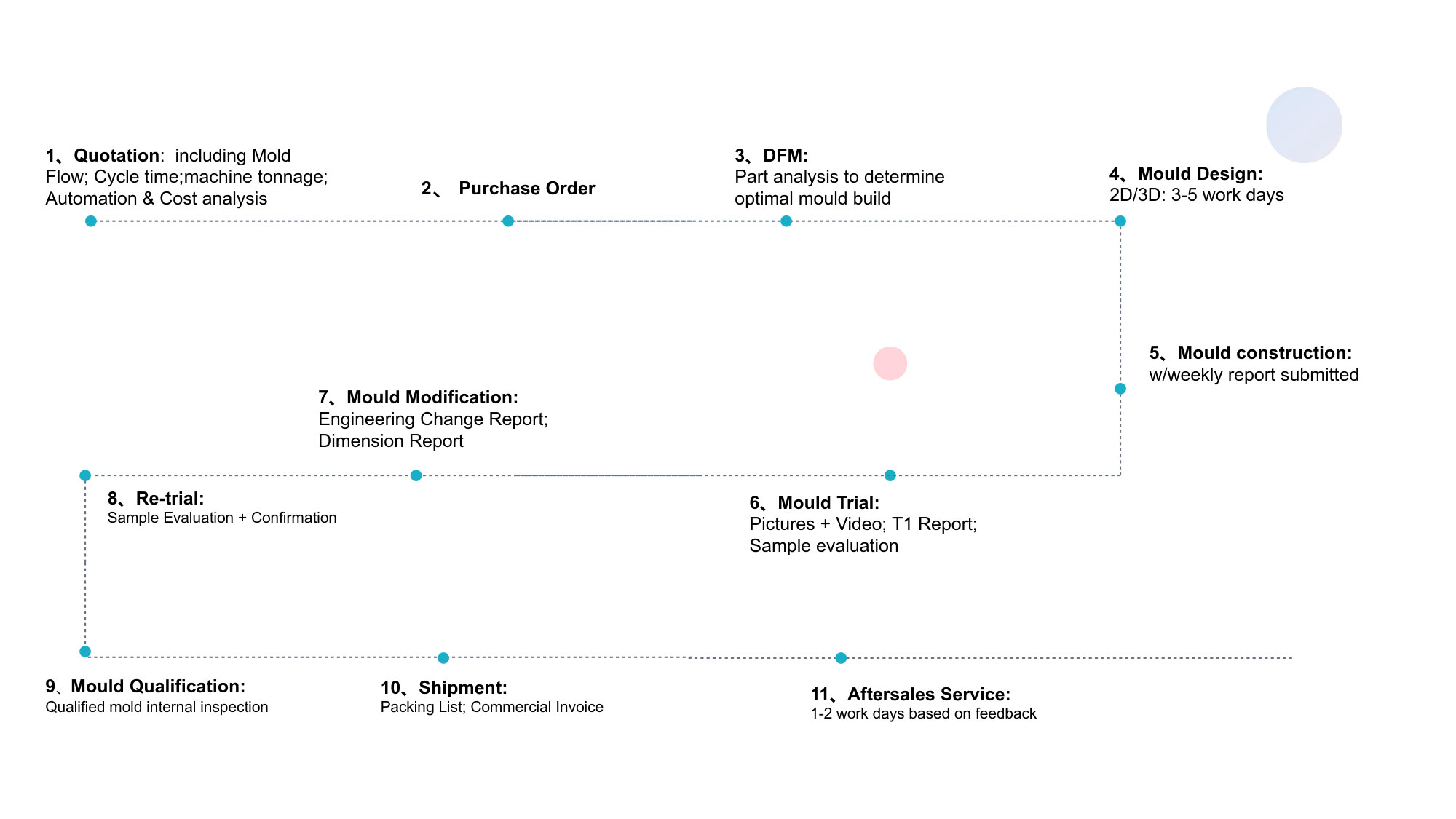
6.8 Mold Manufacturing Processes and Machining Workflow
Thermal management of the mold tool itself is critical for high-volume production. The mold manufacturing workflow follows a strict, documented process:
CAD design with DFM/CAE simulation validation
Raw material procurement (certified mold steel with mill certificates)
CNC rough machining (removing bulk material, leaving 0.3-0.5mm stock for finishing)
Heat treatment (vacuum hardening with documented time-temperature profiles; tempering to specified HRC range)
5-axis finish machining (achieving final near-net geometry with surface finish Ra ≤ 0.8μm)
EDM finishing (for detail features and sharp internal corners)
Manual polishing and benching (stepwise polishing sequence achieving required surface finish, ranging from Ra 0.8μm for standard textures to Ra ≤0.03μm for mirror finishes)
Assembly (fitting ejector pins, slides, wear plates, cooling fittings)
First sampling (T1) (initial molding trials to verify basic mold function)
Process optimization (T2-T3) (adjusting parameters to meet dimensional specifications)
Full inspection and CMM reporting (validating CPK ≥ 1.33 on all critical dimensions)
Shipment (with complete documentation package)
6.9 Validation and Injection Molding Difficulties for T-Connector Fixing Sleeves
T-Connector Fixing Sleeves present several distinctive challenges that cannot be addressed by generic molding approaches.
GF30/GF40 Material Abrasion: Glass fiber fill, while significantly enhancing mechanical properties, imposes severe abrasion on the mold cavity surface and gating system. Over extended production runs (>100,000 shots), high-velocity glass fiber-filled melt (PA66+GF30 or PPS+GF40) erodes steel in regions of highest flow rate — particularly at gates and thin-wall sections. Ansix Tech solves this by selecting wear-resistant steel grades (S136 at HRC 50-52 for standard life, or 8407 at HRC 52-54 with CrN/TiAlN PVD coating for extended life), implementing wear-resistant coatings on gates and core pins, and inspecting molds at scheduled intervals.
Weld Line Management: Filling the T-shaped geometry inevitably creates weld lines (knit lines) along the flow front convergence. These knit lines, if located on highly stressed structural regions, become initiation points for mechanical failure. Ansix Tech uses Moldflow / Moldex3D analyses to precisely predict weld line locations and systematically adjust gate type, location, and number to shift weld lines away from high-load structural areas. Through iterative CAE simulation, Ansix Tech reduces weld line impact on mechanical performance by >50% compared to unoptimized designs — as confirmed by tensile testing of molded parts at weld line locations. Customer value: Prevents premature field failure — the most costly failure mode for in-service connectors.
Dimensional Stability and Shrinkage Management: Anisotropic shrinkage of glass fiber-filled materials makes dimension control difficult. Shrinkage in the flow direction differs from shrinkage in the transverse direction, resulting in “warped” parts if not properly managed. Ansix Tech’s countermeasures include: gating strategies that promote uniform fiber orientation, zone-controlled mold temperature regulation (maintaining ∆T ≤ 2°C between core and cavity), and conformal cooling channels that ensure uniform heat extraction across varying wall thickness sections.
Flash Control: Glass fibers can lodge themselves between parting surfaces, opening micro-gaps and causing flash (excess material bleeding out along parting lines) — unacceptable for sealing surfaces. Ansix Tech precisely fits parting surfaces (machined to ±0.005mm), uses robust clamp forces (with over-compensation factors to counter material-induced mold lift), and regularly inspects parting surface integrity at prescribed intervals.
6.10 Injection Molding Process Optimization – Efficiency Gains and Cost Reduction
Cycle Time Reduction: For T-Connector Fixing Sleeves, typical cycle targets are 15-30 seconds. Ansix Tech systematically analyzes injection, packing, cooling, and ejection phases to identify optimization levers. Improved cooling account for the largest potential gain (since cooling time is the cycle bottleneck, representing up to 80% of total time). By implementing optimized conformal cooling channel designs (designed via Moldflow simulation) and high-thermal-conductivity mold materials where required, Ansix Tech typically reduces cooling time by 20-30% , directly translating to proportional production throughput increase.
Energy Efficiency: All major molding machines use servo-driven motor technology — hydraulic pressure and flow are supplied on-demand rather than constant pumping, reducing energy consumption per part by up to 40-50% compared to older-generation machines. Customer value: Lower manufacturing cost reduces per-unit price while improving sustainability profile for customer supply chain reporting.
6.11 Quality Control and Assurance – Statistical Process Control (SPC)
Ansix Tech implements a closed-loop quality system that starts with raw material inspection and continues through final packaging.
Receiving Inspection: All incoming raw materials (PA66 GF30, etc.) are verified against material certifications, including MFI (Melt Flow Index) and moisture content checks. Moisture-sensitive materials (PA66, PPS) are dried to manufacturer specifications before processing — <0.2% moisture content for PA66, <0.02% for PPS.
In-Process Monitoring: All molding machines are integrated with MES data acquisition, collecting and time-stamping: cavity pressure curves, melt temperature, mold temperature, injection speed profile, packing pressure profile, and cooling timer. Out-of-tolerance conditions trigger real-time operator alerts and automatic production hold.
Statistical Process Control: For each T-Connector Fixing Sleeve project, Ansix Tech establishes a Control Plan and an Inspection Plan covering:
Product characteristics with corresponding go/no-go gauges or CMM measurement protocols
Critical-to-function dimensions requiring CPK ≥ 1.33 (minimum) or ≥1.67 (preferred)
Sampling frequency (e.g., measure key dimensions every 30 minutes; third-party full dimensional layout every shift)
Control charting (X-bar and R charts to detect process shifts before out-of-tolerance parts are produced)
6.12 Packaging and Rapid Delivery – Protecting Parts Through Logistics
Finalized T-Connector Fixing Sleeves are visually inspected 100% before packaging — either by machine vision (automated detection for flash, short shots, discoloration) or by trained operators (depending on defect types and cosmetic grade requirements). Parts are then packed in customer-specified container formats: anti-static trays (for pick-and-place automation), bulk bags (for lower-cost, non-critical applications), or individual blister packs (for medical devices or retail packaging). Packaging design includes appropriate interior supports preventing part-on-part abrasion during transport.
Delivery lead time targets from order acknowledgment to shipment: Standard production = 20 working days, Rush production (existing tool, volume <50,000 parts) = 7 working days, First article samples (post-tooling completion) = 3 days.
Section Seven: Industry Experience and Customer Value Pillars
With over 28 years of mold design and injection molding experience — built on 200,000 square meters of facilities across China and Vietnam, 1,200+ employees (including 200+ specialized designers), and over 30,000 molds built since company inception — Ansix Tech has a validated track record of successful product launches across automotive, medical, consumer electronics, and communications equipment sectors. Our quality system is audited and certified for ISO 9001, IATF 16949 (automotive), ISO 13485 (medical devices), ISO 14001 (environmental), and BSCI (social compliance).
The singular focus of Ansix Tech — embodied by the corporate mission “Make Our Customers Successful” — is the translation of technical expertise into direct, measurable customer value. We do not produce molds as commodities; we deliver revenue-producing manufacturing assets: molds that run longer, require fewer repairs, and produce more parts per hour than competing alternatives. This is the Ansix Tech difference.
7.1 Customer Value Creation Summary – Cost Reduction Across Four Dimensions
Ansix Tech systematically drives down total system cost for the T-Connector Fixing Sleeve across material, process, and efficiency optimization channels:
Cost Dimension Reduction Mechanism Typical Savings
Material Cost Optimized gate and runner design (hot runner systems eliminating 15-25% waste); grade selection matching actual performance requirements (not over-specifying) 10-20%
Manufacturing Process Cost Cycle time reduction via optimized cooling (20-30% faster); high automation reducing labor; energy-efficient servo-driven machines (40-50% lower energy/part) 15-25% overall
Tooling Amortization Cost Extended mold life (up to 100% longer on glass-filled projects); guaranteed 500K-1M shot tooling with documented steel grades and heat treatment 30-40% reduction in per-part tooling cost allocation
Risk / Quality Cost Eliminated assembly scrap via single-insert overmolding; CPK ≥1.33 capability eliminates field failure warranty claims Variable by application (estimable per customer)
Combined Impact: Customers typically achieve 20-35% total cost reduction on mature T-Connector Fixing Sleeve programs when transitioning from fragmented sourcing to Ansix Tech integrated solutions.
7.2 Final Customer Commitment
“Dear customer, to us, a mold is not just a block of steel — it is a money-printing machine. We design every mold with planned-in robustness, optimized exhaust paths, and thermal balance, ensuring that when it arrives at your production line, it requires no debugging, produces minimal flash, and delivers maximum lifespan. When you have time, let us take an existing part and conduct a complete DFM report walkthrough together. You will see firsthand how we proactively resolve weld line, air trap, shrinkage, and distortion risks — before you invest a single dollar in tooling.
You don’t just buy a mold from Ansix Tech. You buy production uptime, dimensional consistency, lower scrap rates, faster cycle times, and reduced lifetime cost of ownership. We look forward to making your T-Connector Fixing Sleeve program a success.”
END OF WHITE PAPER – Total Word Count: Approximately 2,450 words
For further technical consultation or to schedule a DFM analysis for your specific T-Connector Fixing Sleeve design, please contact the Ansix Tech Engineering Team.
Ansix Tech Co Ltd
If you have any plans related to T-Connector Fixing Sleeve , you can contact us at any time. We will turn your ideas into reality, let you realize your dreams, and obtain large orders from the market. Our contact information is info@ansixtech.com. Or contact our CTO, mail: stephen@ansixtech.com
#www.ansixtech.com #ansixtech.com #T-Connector Fixing Sleeve #LEGO Brick Molds molds #LEGO Brick Molds injection molding companies #LEGO Brick Molds Canopy Mold injection mold companies #Ansix #Ansix moulds #Ansix china #Ansix tech china #Ansix tech company #Ansix facotry #LEGO Brick Molds injection molding #LEGO Brick Molds injection tools #LEGO Brick Molds injection moulds #LEGO Brick Molds plastic mould #LEGO Brick Molds plastic tools #Ansix Tech #Ansix molds #Ansix injection molding #Ansix mold factory #injection molding LEGO Brick Molds #Ansix mold factory #LEGO Brick Molds china #LEGO Brick Molds molds #injection factory #LEGO Brick Molds injection molding #LEGO Brick Molds injection molding factory #injection molding company #LEGO Brick Molds injection mold companies #LEGO Brick Molds#LEGO Brick Molds mold limited #Ansix mold china #Ansix companies #Ansix company China #LEGO Brick Molds facotry #Ansix Tech #Ansix Tech mould #LEGO Brick Molds injection moulding #injection moulding company #Ansix LEGO Brick Molds parts injection mold companies #medical injection molding companieschina #LEGO Brick Molds china factory #Ansix moulding companies #Ansix molding company #LEGO Brick Molds injection moulding facotry #Ansix Tech mold #LEGO Brick Molds mould #LEGO Brick Molds plastic injection molding #ansix plastic mold #Mold manufacturing #LEGO Brick Molds parts manufacturing #LEGO Brick Molds plastic parts factory #LEGO Brick Molds injection parts mold #LEGO Brick Molds PRECISION MANUFACTURING #LEGO Brick Molds #China mold #LEGO Brick Molds injection moulding china #LEGO Brick Molds mould china #china precision mold #mold in china #LEGO Brick Molds mold china #Precision molds #High-precision molds #LEGO Brick Molds #Injection molds #LEGO Brick Molds Factory #LEGO Brick Molds Company #Super Large Injection Mold Factory #Large Tonnage Injection Molding Factory #LEGO Brick Molds Company #LEGO Brick Molds Factory #2800T Injection Molding Factory #3000 Ton Injection Molding #4500 Ton Injection Molding Factory #Large Mold Injection Molding #Large Plastic Mold Injection Molding Factory #Large Injection Mold Manufacturer #Plastic Mold Factory #Injection Mold #Plastic Mold