



honey bottle caps
FEATURES
Customer Satisfaction Framework: A Holistic Service Model
Product Design & Development — Early Intervention That Prevents Costly Reworks
Ansix’s customer satisfaction begins before a single CAD drawing is finalized. The company engages clients through a Design for Manufacturability (DFM) Report provided at the pre-contract stage. This report contains comprehensive analysis covering draft angle recommendations, wall thickness optimization, gate location strategy, and ejector pin mark allowance ranges — preventing the discovery of non-manufacturable structures after mold fabrication has already begun.
Customer Value Delivered: Early DFM intervention typically saves clients 3–6 weeks of rework time and eliminates tooling modifications that could otherwise add 30–40% to the mold cost.
-
Mold Description
Product Materials:
PP
Mold Material:
S136ESR
Number of Cavities:
16
Glue Feeding Method:
Hot runner
Cooling Method:
Water cooling
Molding Cycle
12.5s
- The mold manufacturing process and product material selection
Product Validation — Iterative Verification That Eliminates Surprises
Product validation at Ansix follows a structured T0 through T3 sampling protocol. Each validation round includes:
T0 Sample (First Trial) : First-shot parts with initial defect analysis
T1 Sample (Optimization) : Corrected mold with documented improvement changes
T2 Sample (Refinement) : Fine-tuned parameters and verification
T3 Sample (Production Validation) : Production-ready validation with statistical process control (SPC) data
For honey bottle cap projects, this iterative validation process ensures that sealing performance, hinge durability (for flip-top configurations), thread compatibility with standard honey bottle necks (typically 38mm to 120mm diameter), and food-grade compliance are verified before mass production begins.
-
Mass Production — Process Stability Delivered Through Technology Integration
During mass production, Ansix’s MES (Manufacturing Execution System) locks injection molding parameters — including temperature, pressure, injection speed, and cycle timing — such that only authorized engineers can adjust settings. This eliminates operator variability, one of the most common sources of quality inconsistency in plastic injection molding. Every batch undergoes first-article and last-article inspection comparison, with dimensional fluctuations held within ±0.02mm for standard features and as tight as ±0.005mm for critical sealing surfaces.
4. Quality Assurance — Data-Driven Confidence at Scale
Honey bottle caps demand uncompromised food safety and dimensional consistency. Ansix maintains multiple certifications applicable to food-grade packaging: ISO9001 for quality management systems, IATF16949 for automotive-grade process control (adapted for high-volume consumer packaging), ISO13485 for medical-grade quality discipline, ISO14001 for environmental compliance, and BSCI for social accountability.
For honey bottle cap projects specifically, Ansix implements the following quality protocols:
Quality Dimension Protocol Customer Value
Material Certification FDA food-grade material certification (PP or PE) with full traceability from batch lot to production run Zero contamination risk; complete recall-ready documentation
Dimensional Inspection CMM measurement with ±0.5-micron volumetric accuracy; optical imaging with 0.1-micron resolution Guaranteed fit with standard honey bottle necks; elimination of assembly line jams
Sealing Performance Leak testing under vacuum and pressure conditions at production intervals Honey preservation integrity; no leakage complaints from end consumers
Hinge Durability (Flip Caps) Living hinge cycle testing (minimum 5,000 open-close cycles without cracking) Extended product lifespan for reusable honey containers
Appearance Inspection Matte/frosted finish verification; gate mark, flow mark, and sink mark rejection criteria Premium brand presentation on retail shelves
Process Capability CPk ≥ 1.33 for all critical-to-quality dimensions 99.99% of parts remain within specification without adjustment
5. Delivery — Just-in-Time Supply Chain Management
With four production bases strategically located across China and Vietnam, Ansix delivers just-in-time inventory solutions that align with customer production schedules. Standard delivery lead times from order confirmation to first shipment range from 25–45 days for new molds, with expedited options available for urgent projects (subject to validation step preservation). For repeat orders of existing molds, shipment can be arranged within 5–10 business days.
6. After-Sales Service — Lifetime Support Architecture
Ansix’s after-sales commitment includes:
Spare parts inventory : Critical wear components (ejector pins, core inserts) shipped with every new mold
Preventive maintenance schedule : Mold maintenance recommended every 200,000 cycles with full documentation
Lifetime repair support : Repairs performed at cost with standard 24-hour turnaround for critical repairs
Production monitoring : Quarterly remote production data analysis to identify optimization opportunities
How Ansix Achieved Industry Leadership
Ansix’s ascent to industry leadership in honey bottle cap manufacturing rests on five strategic pillars:
Pillar One — Manufacturing Scale with Precision: 260 injection molding machines provide capacity to serve global demand without sacrificing individual process control.
Pillar Two — Vertical Integration: In-house mold manufacturing eliminates supply chain dependencies and shortens response times for modifications. Ansix maintains its own electrode machining center and EDM workshop, enabling mold repairs within 24 hours without external vendor delays.
Pillar Three — Technical Workforce Investment: Over 200 design engineers with average industry experience exceeding 10 years contribute to technical innovation and problem-solving capabilities.
Pillar Four — Geographic Diversification: Four production bases across China and Vietnam provide supply chain redundancy and tariff mitigation for clients selling into multiple global markets.
Pillar Five — Certification-Driven Discipline: Multiple international certifications (ISO9001, IATF16949, ISO13485, ISO14001, BSCI) provide auditable proof of process rigor, reducing customer audit burden and accelerating vendor qualification.
Part Two: Honey Bottle Cap Product Introduction, Manufacturing Process, Delivery Efficiency, Quality Assurance, Cost Control, and After-Sales Service
Product Introduction: Honey Bottle Caps
Honey bottle caps are precision-engineered closure components manufactured through injection molding using food-grade plastics, primarily polypropylene (PP) and high-density polyethylene (HDPE) . These materials are selected for their specific properties that align with honey packaging requirements:
Material Density (g/cm³) Temperature Range (°C) Key Properties Suitability for Honey Caps
PP (Polypropylene) 0.89–0.91 -20 to 120 Excellent chemical resistance, living hinge capability, FDA food-contact certified, lightweight, rigid Ideal for flip-top caps requiring hinge durability; resists honey’s acidic and sugary composition
HDPE (High-Density Polyethylene) 0.94–0.96 -100 to 80 Good barrier properties, stress crack resistance, flexible, cost-effective Suitable for squeeze bottles and screw caps requiring seal integrity
LDPE (Low-Density Polyethylene) 0.91–0.93 -50 to 80 Highly flexible, squeezable, good sealing at low torque Best for flip-top caps on squeeze honey bottles
Customer Value of Material Selection:
FDA Food-Grade Certification — Each material batch is certified for direct food contact, eliminating contamination liability
Sealing Performance — PP and HDPE provide excellent moisture barrier properties, preventing honey crystallization due to moisture ingress
Chemical Resistance — Materials resist honey’s natural acids and sugars, preventing cap degradation over time
Living Hinge Compatibility (PP specific) — PP’s molecular structure allows up to 5,000+ open-close cycles without hinge failure
Manufacturing Process: From Raw Material to Finished Cap
Step 1: Raw Material Preparation
Food-grade polypropylene or polyethylene resin pellets are dried to remove moisture (typically 0.02% or less) and mixed with color masterbatch matched to customer Pantone specifications. For transparent or translucent honey caps, clarified PP grades are used. Anti-UV additives may be incorporated for products with extended shelf-life requirements.
Step 2: Injection Molding
The injection molding process for honey bottle caps is designed for high-volume output with consistent quality:
Mold clamp closed — Multi-cavity molds (ranging from 16 to 48 cavities or more for high-volume production) are securely clamped with precisely controlled clamp force
Melt injection — Plastic resin is heated to 180–260°C (depending on material grade), becoming a viscous melt. Hot runner systems maintain the melt at precise temperature, eliminating cold runner waste and reducing material consumption by 15–30%
Melt fills mold cavities — The melt is injected under high pressure (typically 50–200 MPa) into each cavity through the gate system. Mold flow analysis ensures all cavities fill simultaneously with balanced flow, preventing short shots or overpacking
Cooling — The melt solidifies as it contacts the temperature-controlled mold surface (typically 20–50°C). Conformal cooling channels, designed using thermal analysis, ensure uniform cooling across all cavities, minimizing cycle time
Mold opens and part ejection — The mold opens along the parting line; ejector pins push finished caps out of the mold cavities. For automatic unscrewing applications, unscrewing mechanisms rotate cores to release threaded caps without thread damage
Cycle repeats — The complete cycle typically runs 10–30 seconds for honey caps, depending on part volume and cooling requirements
Step 3: Post-Molding Operations (As Required)
Deflashing — Remove any micro-flash (thin plastic extension beyond mold parting line), controlled to within 0.03mm to minimize post-processing
Assembly — For flip-top caps, hinge folding may be automated; for two-component caps (e.g., rigid outer layer with soft-touch inner seal), assembly occurs via automated lines
Inspection — 100% visual inspection or automated camera inspection for visible defects; leak testing at production intervals
Step 4: Packaging
Finished caps are packaged in food-grade polyethylene bags, boxed in corrugated containers, and palletized for shipment. Packaging is documented with batch number, material certification, quantity, and inspection status for full traceability.
Delivery Efficiency
Ansix’s four production bases across China and Vietnam provide geographic advantage for serving global customers:
China bases (Shenzhen, Dongguan, Hunan) — Serve Asian, European, and North American markets with established logistics corridors
Vietnam base — Serves Southeast Asian markets with competitive delivery costs
Standard Lead Times:
Project Type Lead Time (from order confirmation to first shipment) Notes
New mold fabrication (48 cavities) 25–35 days Includes mold design, machining, assembly, and T0 sampling
Existing mold duplication 20–25 days Using proven design and machining parameters
Production repeat order (existing mold) 5–10 business days Subject to raw material availability
Expedited mold (medium complexity) 20 days Validation steps are not omitted — requires dedicated resources
Quality Assurance System
Ansix operates a closed-loop quality management system with four integrated components:
Component 1 — Incoming Quality Control (IQC): All raw materials are verified against purchase specifications before release to production. Material certifications are maintained for seven years minimum.
Component 2 — In-Process Quality Control (IPQC): Production parameters are monitored in real-time through MES. First-article inspection is performed at start of each batch; periodic sampling (typically every 1–2 hours) verifies conformance to requirements.
Component 3 — Final Quality Control (FQC): Completed caps undergo inspection for dimensions, appearance, sealing performance, and function. Automated vision inspection systems for high-volume lines detect defects including short shots, flash, black specks, sink marks, and surface blemishes.
Component 4 — Quality Management System: ISO9001 certification ensures documented procedures, trained personnel, and continuous improvement processes are embedded in daily operations. IATF16949 practices (adapted for packaging) provide statistical process control rigor.
Cost Control Leadership
Ansix achieves competitive cost positioning through systematic optimization across five drivers:
Driver 1 — Material Cost Optimization:
Economies of scale — Consolidated material purchasing across four factories reduces per-unit material cost by 8–15%
Material substitution guidance — Engineering team recommends optimal material grade for each application, avoiding over-specification
In-house compound capability — Color masterbatch production reduces third-party material markup
Driver 2 — Process Efficiency:
Multi-cavity molds — 48-cavity molds produce 48 caps per injection cycle, reducing per-part cycle cost by 90%+ compared to single-cavity molds
Hot runner systems — Eliminate cold runner waste, reducing material consumption by 15–30%
Optimized cooling — Conformal cooling channels reduce cycle times by 15–25% compared to conventional cooling design
Driver 3 — Automation Integration:
Take-out robots remove parts from mold and place them on conveyors automatically
Automated assembly lines combine multiple production stages into streamlined workflows
Automated inspection reduces manual inspection labor by 60–80%
Driver 4 — Quality-Driven Yield Management:
CPk ≥ 1.33 for critical dimensions ensures 99.99% first-pass yield
Early DFM intervention prevents tooling modifications that could add 30–40% to mold cost
Statistical process control prevents run-to-run variability that could generate scrap
Driver 5 — Total Cost of Ownership Focus:
Longer mold life — 1 million+ cycles for standard materials, 500,000+ cycles for glass-filled materials — means fewer mold replacement costs over product lifespan
Lower maintenance frequency — Precision-machined components reduce wear-related downtime
After-Sales Service
Ansix’s after-sales commitment includes documented service levels:
Service Component Commitment
Spare parts Critical wear components (ejector pins, core inserts, heaters, thermocouples) shipped with every new mold
Maintenance schedule Preventive maintenance documentation provided every 200,000 cycles
Repair turnaround Standard repairs — 5–7 business days; critical repairs — 24 hours
Technical support Remote troubleshooting available within 4 hours; on-site support within 48 hours for qualifying customers
Lifetime repair Repairs performed at cost for the life of the mold
Training Operator and maintenance technician training available at Ansix facility or customer site
Part Three: Core Customer Value in Mold Manufacturing, Injection Molding Material Selection, Smart Manufacturing Integration, Efficiency Enhancement, and Process Quality Assurance
Mold Manufacturing — The Foundation of Production Excellence
Mold Processing Equipment That Delivers Customer Confidence:
Equipment Capability Specification Technical Translation Customer Value
Five-Axis High-Speed Machining Centers (Mikron, Makino, Frank) ±0.002mm contour accuracy on complex freeform surfaces Eliminates multiple clamping operations; machines complex parting lines in single setup No flash means zero manual deflashing — saves 5–15 seconds of labor per cap
Slow Wire EDM (Wire-Cut Electrical Discharge Machining) 0.03mm micro-holes, narrow slots, internal splines Machining for thin-wall sealing lips and thread geometry without deformation Threads fit perfectly — caps seal without leaks; no costly post-machining corrections
Coordinate Measuring Machines (CMM) ±0.5-micron volumetric accuracy Full-dimension inspection reports for every mold before shipment You receive what you approved — no dimensional surprises at your production line
Optical Imaging Systems 0.1-micron resolution Surface finish verification; detection of micro-cracks or tool marks Premium surface quality — brand presentation on retail shelves is flawless
Mold Steel Material Selection — Science Backed by Heat Treatment:
Ansix maintains strategic inventory of premium tool steels specific to application requirements, with documented heat treatment protocols:
Steel Grade Hardness (HRC) Key Properties Customer Value
S136 / S136H (Stavax) Pre-hard 30–35 / Quench 48–54 Superior corrosion resistance; ultra-high mirror polish (Ra < 0.05μm); excellent wear resistance Transparent/translucent caps — crystal-clear appearance; no rust contamination in humid environments
2344 / 8407 / H13 48–52 (quench & temper) High hot hardness at 550–600°C; excellent toughness; superior thermal fatigue resistance High-cycle production — mold maintains dimensional stability over millions of cycles with glass-filled materials
NAK80 37–43 (pre-hard) Super mirror polish; excellent EDM machinability Cosmetic-grade finishes — ultra-smooth surfaces require no secondary polishing
SKD11 / DC53 58–62 High wear resistance; high compression strength Abrasive material tolerance — wear inserts in gates and shear edges resist erosion from glass-filled plastics
M340 / 4Cr13 / 9Cr18 48–53 Stainless martensitic; excellent corrosion resistance FDA-grade applications — suitable for acidic honey and humid production environments
P20 28–32 (pre-hard) Good machinability; cost-effective Mold bases and support plates — cost-optimized where surface finish is non-critical
Heat Treatment Verification: Each mold steel batch is accompanied by documented time-temperature heat treatment curves. For S136, precise quench at 1000–1050°C, oil-cooled to 50–100°C, then tempered at 200+°C to achieve 48–54HRC while preventing cracking.
Mold Type Capabilities:
Mold Type Description Application for Honey Caps Customer Benefit
Hot Runner Mold Melt remains molten in manifold; gates directly feed cavities High-volume honey cap production (24–48 cavities) 15–30% material savings; shorter cycle times; no runner regrind contamination
Cold Runner Mold Runner solidifies with part; material reground or discarded Smaller production runs or development projects Lower initial tooling cost; simpler design
Stack Mold (Two-Sided) Two parting lines; double the cavities in same machine Very high-volume applications (e.g., 2 × 32 cavities) Double output from same injection machine; 100% efficiency gain
Unscrewing Mold Mechanical or hydraulic unscrewing cores for threaded parts Standard screw-type honey caps with uniform threads Threaded caps produced without post-machining; consistent thread profile
Injection Molding Machine Fleet and Precision Capability
Ansix operates 260 injection molding machines across four production facilities, ranging from 30 tons to 2,800 tons clamp force, with dedicated high-speed machines capable of injection rates exceeding 600mm/s for thin-wall applications.
Capability Range Specification Customer Value
Clamp force range 30–4,000 tons One machine size up from theoretical minimum provides process stability without capital over-investment
Servo-electric drive Repeatable precision ±0.1% across millions of cycles Every cap matches the first — eliminates lot-to-lot variation; reduces inspection costs
Injection rate (high-speed machines) 600+ mm/s Rapid cavity filling for thin-wall caps prevents premature melt solidification and flow marks
Primary machine brands Fanuc, Sumitomo, Toshiba, Nissei, Engel, Arburg, Haitian Proven reliability with global parts and service network
Smart Manufacturing Integration and Efficiency Enhancement
MES (Manufacturing Execution System) — All Machines Connected:
All 260 injection molding machines are connected through a centralized MES that captures and stores every production parameter for every cycle:
Parameter Category Monitored Variables
Temperature Barrel zones (4–6 zones), nozzle, hot runner manifold, mold surface
Pressure Injection pressure, holding pressure, back pressure
Speed Injection speed, screw rotation speed, clamp open/close speed
Timing Fill time, holding time, cooling time, cycle total
Position Screw position, ejector position, mold position
Customer Value of MES:
Parameters are locked — only authorized engineers can modify settings, eliminating operator error
Batch-to-batch consistency — production parameters recalled and reapplied for repeat orders
Real-time alerts — out-of-tolerance conditions trigger immediate notifications
Traceability — full production parameter records maintained for each batch
Process Stability Assurance:
Mold temperature control — Mold temperature controllers maintain cavity surface temperature within ±2°C across all cavities, minimizing differential shrinkage and warpage
Conformal cooling — Cooling channels follow cavity contour, reducing cooling time by 15–25% compared to conventional straight-line cooling
Thermal imaging — Periodic thermal imaging verifies uniform mold surface temperature distribution
Process Quality Assurance — Key Customer Concerns Addressed
Customer Concern: Sink marks, flash, flow marks, short shots, dimensional inconsistency, color variation — Addressed through systematic controls
Customer Concern Root Cause Ansix Solution Customer Value
Sink marks (surface depressions) Insufficient holding pressure or cooling MES-monitored holding pressure profile; conformal cooling channels Premium appearance — no cosmetic rejects
Flash (thin plastic extension beyond parting line) Insufficient clamp force or worn parting surfaces 0.005mm mold parting line machining tolerance; self-locking clamp force compensation; flash controlled within 0.03mm Zero manual deflashing required — 5–15 seconds saved per part
Flow marks (wavy surface patterns) Melt temperature variation; improper gate design Mold flow analysis before mold fabrication; hot runner with balanced manifold design Consistent surface finish — brand presentation protected
Short shots (incomplete cavity fill) Insufficient injection pressure or poor venting Mold flow analysis identifies venting locations; precision-machined vent channels 100% cavity fill — zero incomplete parts reaching assembly
Dimensional inconsistency across cavities Imbalanced flow in multi-cavity mold; uneven cooling Naturally balanced runner system; conformal cooling; CPk monitoring for each cavity Inner stopper 1 fits same as inner stopper 48 — no assembly line jams
Batch-to-batch color variation Improper color masterbatch mixing Automated color dosing with closed-loop verification; standardized base resin lots Color consistency across millions of caps — brand color identity maintained
Sealing performance failure Thread geometry deviation or sealing lip defects CMM verification of thread dimensions; 100% leak testing at intervals Zero leakage complaints — honey preservation maintained
Hinge failure (flip-top caps) Material degradation or improper molding parameters PP-specific molding parameters; documented hinge cycle testing (5,000+ cycles) Extended product life — hinge performs for expected usage duration
Part Four: Comprehensive Manufacturing Solution for Honey Bottle Caps — 2000+ Word Industry Analysis
Project Initiation: Transforming Technical Capabilities into Customer Value
At Ansix Tech, every honey bottle cap project begins with a single, unshakeable conviction: a mold is not a block of steel — it is a profit engine. This philosophy drives everything from initial customer consultation through final delivery and after-sales support.
When a customer approaches Ansix for a honey bottle cap project — whether a standard screw cap for glass honey jars, a flip-top cap for squeeze honey bottles, a child-resistant cap for medical-grade honey products, or a custom-designed closure for a premium honey brand — the engagement follows a structured, five-phase framework that systematically translates technical expertise into measurable business outcomes.
Phase One: Project Scoping and Feasibility Analysis — Risk Identification Before Commitment
What We Do:
Before any design work begins, Ansix’s engineering team conducts a comprehensive project assessment covering:
Volume projections — Annual production quantities inform mold cavitation decisions (16, 24, 32, 48 cavities) and mold material selection
Material selection guidance — Based on application requirements (food-grade certification, hinge durability, barrier properties, cost targets)
Regulatory requirements — FDA food contact certification, EU food contact regulations, customer-specific standards
Production environment — Customer’s injection machine specifications, available clamp force, automation integration
Quality requirements — Dimensional tolerance bands, visual acceptance criteria, sealing performance specifications
Timeline constraints — Target launch date, sample requirements, production ramp schedule
How This Solves Customer Problems:
Customer Problem Ansix Solution
Choosing wrong material for application Engineering team provides material comparison data with cost/performance trade-offs
Designing mold incompatible with customer’s available injection machine We capture machine specifications before mold design begins
Unrealistic timeline expectations We provide honest timeline assessment with critical path identification
Unclear quality acceptance criteria We help define measurable specifications with documented acceptance methods
What Customer Value This Delivers:
Risk reduction — Avoids mold rework costs that typically add 30–40% to project cost
Time savings — Eliminates downstream surprises that could delay launch by months
Cost certainty — Clear project scope prevents cost overruns
Phase Two: Design and Engineering — DFM Analysis and Mold Design
2.1 DFM (Design for Manufacturability) Analysis
The DFM report is Ansix’s single most valuable deliverable before mold fabrication begins. This document analyzes the customer‘s cap design and identifies potential manufacturing issues before they become costly problems.
DFM Report Contents:
Analysis Component What We Examine Professional Terminology
Wall thickness analysis Uniform vs. variable wall sections; thick-to-thin transitions “Wall thickness uniformity impacts cooling rate and differential shrinkage. Thick sections ( > 4mm ) may require sink mark mitigation through gas assist or rib design modification.”
Draft angle verification Ejection clearance for all vertical surfaces “Minimum 1° draft per side for cavity side; 1.5–2° for core side to prevent vacuum lock during ejection. Zero-draft vertical walls risk surface scuffing.”
Gate location and type Optimal injection point for balanced filling “Submarine gate at base of cap side wall recommended. Gate vestige will be below tamper-evident band — not visible when cap assembled on bottle.”
Weld line prediction Where converging melt fronts meet “Mold flow analysis predicts weld line at 90° to flow direction at 12 o‘clock and 6 o’clock positions. Weld line strength at 85% of base material — acceptable for static load but not for impact zone.”
Gas trap identification Air entrapment locations during fill “Venting at last-fill region (cap dome apex) essential. 0.02–0.05mm × 5mm vents recommended — allows air escape without plastic bleed.”
Ejector pin placement Optimal locations for part removal without visible marks “Ejector pins on internal surface of cap where marks are not visible. 8 pins recommended for 28mm cap diameter to distribute ejection force and prevent part deformation.”
Shrinkage compensation Mold cavity oversized to account for material shrinkage “PP shrinkage factor: 1.2–2.0%. Mold cavity dimension = final part dimension ÷ (1 – shrinkage %).”
How This Solves Customer Problems:
Customer Problem Ansix Solution
Designer creates part that can‘t be manufactured DFM identifies non-manufacturable features before mold fabrication begins
Sink marks visible on brand face of cap Gate relocation and wall thickness optimization prevents sink marks in visible locations
Flash requiring manual deflashing Draft angle and parting line design optimizes mating surface contact
Warped caps after molding Cooling channel placement and cycle time recommendations from thermal analysis
2.2 Mold Design — Engineering for High-Volume Production
Runner System Design:
System Type Description Application for Honey Caps Customer Benefit
Hot runner — insulated manifold Melt remains molten; balanced naturally through H-shaped manifold 32–48 cavity high-volume production 15–30% material saved; no runner regrind contamination risk
Hot runner — externally heated Individual cavity temperature control Applications with tight dimensional requirements across all cavities Each cavity independently controlled for dimensional uniformity
Cold runner Runner solidifies with cap Development runs or lower-volume production Lower initial tooling cost
Cooling System Design — The Unsung Hero of Cycle Time:
Cooling typically accounts for 50–80% of total injection molding cycle time. For honey bottle cap molds operating at 30,000+ cycles per day, every second reduction in cooling time translates directly to increased daily output.
Cooling Design Feature Technical Description Customer Benefit
Conformal cooling channels Cooling channels machined to follow cavity contour rather than straight-line drilling 15–25% faster cooling; uniform cooling reduces warpage
Bubbler cooling (core pins) Turbulent flow through core pins provides aggressive cooling Critical for thick sections where heat concentrates
Heat pipes Passive heat transfer devices for hard-to-reach areas Eliminates hot spots without adding cooling channels
Mold temperature controller External water circulator maintains set mold temperature within ±2°C Cycle-to-cycle consistency regardless of ambient conditions
Ejection System Design:
Component Technical Description Customer Benefit
Ejector pins Precision-ground pins push part off core side 8 pins for 28mm cap; evenly distributed force prevents part deformation
Stripper plate Plate pushes part at perimeter Better for thin-wall or cosmetic parts where pin marks unacceptable
Air ejection Compressed air blast separates part For parts with delicate features where mechanical ejection could damage
Unscrewing mechanism (threaded caps) Rotating core unscrews from molded threads before ejection Threaded caps produced in-mold without post-machining; thread profile consistent
Phase Three: Mold Manufacturing — From CAD to Steel
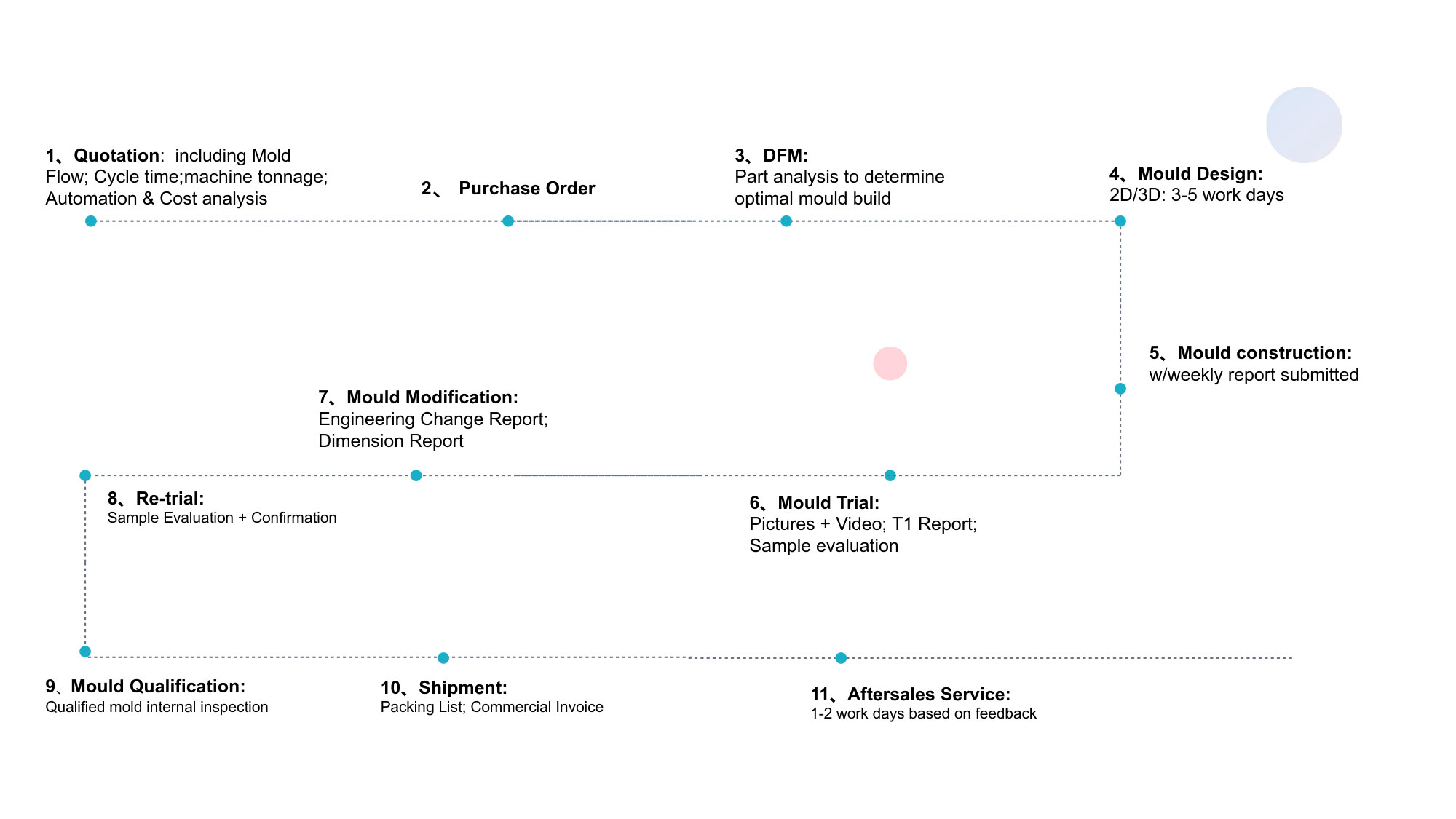
Mold Fabrication Process Flow:
text
CAD Design → DFM Validation → CAM Programming → Steel Procurement → CNC Machining (Rough) → Heat Treatment → CNC Machining (Finish) → EDM (if required) → Wire EDM (if required) → Polishing → Texturing (if required) → Assembly → Fitting → Test Shot (T0) → Inspection → Shipping
Key Process Details for Honey Bottle Cap Molds:
Process Step Parameters Quality Check
Rough CNC machining Material removal to within 0.5mm of final surface Verify correct stock allowance before heat treatment
Heat treatment As per material-specific time-temperature curve Documented curve; hardness verification
Finish CNC machining ±0.002mm accuracy for critical surfaces On-machine probe verification
EDM (for complex geometries) Electrode wear compensation; multiple electrodes for rough/finish Electrode runout; surface finish Ra measurement
Wire EDM (for thin slots) 0.10mm wire diameter; 0.03mm minimum slot width Burr inspection; dimensional measurement
Polishing Progressive grits from 400 to 10,000; diamond compound final Ra measurement on polished surfaces
Texturing Chemical etching or EDM texturing Texture depth and pattern verification
Manufacturing Difficulties Specific to Honey Bottle Caps:
Difficulty Technical Challenge Ansix Solution Customer Benefit
Thread precision Threads must match bottle neck exactly; deviation causes leaks or cross-threading CNC thread milling with on-machine verification; wire EDM for undercuts Reliable sealing; no customer complaints
Living hinge durability (flip caps) PP hinge must withstand thousands of cycles without cracking Controlled hinge thickness (typically 0.2–0.3mm); consistent PP material; mold temperature control during hinge formation Flip cap lasts for expected product lifespan
Multi-cavity fill balance 48 cavities must all fill simultaneously with same pressure and temperature Mold flow analysis validates runner balance; naturally balanced hot runner manifold Every cap identical across all cavities
Parting line flash control Flash requires manual deflashing if > 0.03mm 0.005mm parting surface machining accuracy; mold locking force optimized Caps exit mold ready for assembly — no additional labor
Phase Four: Validation and Trial Production — Proving Capability Before Mass Production
T0 through T3 Protocol:
Stage Description Activities Exit Criteria
T0 — First Shot First injection of plastic into completed mold • Part measurement • Defect documentation • Process parameter baseline Mold fills completely; no visible damage to mold
T1 — Design Validation Validate part geometry against print • CMM dimensional inspection • Material certification verification • Hinge cycle test (500 cycles) • Leak test All dimensions within specified tolerance; no functional failures
T2 — Process Optimization Optimize molding parameters for stability • DOE (Design of Experiments) on key parameters • Cooling optimization • Cycle time reduction Process window established; CPk ≥ 1.00 for critical dimensions
T3 — Production Validation Run production-scale batch • 500–1,000 part run • First-pass yield calculation • Capability study (CPk ≥ 1.33 required) • Customer sample shipment CPk ≥ 1.33 for all critical dimensions; yield ≥ 98%
What Customer Value This Delivers:
No launch surprises — By the time mass production begins, the process is proven stable
Dimensional confidence — Cpk ≥ 1.33 means 99.99% of production parts will be within specification
Accelerated ramp-up — Process parameters ready for production before molds ship
Phase Five: Production and Ongoing Support — Delivering Value at Scale
Production Capabilities Summary Table:
Parameter Standard Capability Expedited Capability
Cavity count per mold 16–48 for honey caps 64+ for very high volume
Cycle time 12–20 seconds (depending on part weight) Can be reduced with mold modifications
Daily output (48-cavity mold, 15 sec cycle) 276,480 caps per day —
First-pass yield target 98% minimum —
CPk target ≥ 1.33 for critical dimensions —
Customer Problem Resolution Matrix:
What Customer Wants Ansix’s Capability That Delivers It
“I need my caps to seal perfectly without leaks.” CMM-verified thread dimensions; documented leak test results at production intervals
“I can‘t afford line stoppages from caps that don’t fit.” Multi-cavity molds with ±0.002mm cavity-to-cavity consistency — every cap fits every bottle
“I need to scale production quickly for seasonal demand.” 260 machines across four factories provide surge capacity without requalification
“I‘m tired of mold repairs that take weeks.” In-house mold repair shop; emergency repair commitment within 24 hours
“I need cost reduction without quality compromise.” Multi-cavity molds, hot runner systems, conformal cooling, automation — each adds 10–30% cost efficiency
Cost Reduction Analysis: How Ansix Lowers Total Cost of Ownership
Ansix systematically reduces customer costs across four levers:
Lever 1 — Material Cost: 15–30% Reduction
Hot runner system eliminates cold runner waste (15–30% material savings)
Optimal wall thickness design minimizes material consumption
Consolidated purchasing across four factories reduces per-unit material cost
Lever 2 — Direct Labor Cost: 5–15 Seconds per Part Saved
Precision-machined molds produce flash-free caps requiring no manual deflashing
Take-out robots automate part removal and conveyor placement
Automated assembly lines combine operations into single workflow
Lever 3 — Rework and Scrap Reduction: 2–5% Higher Yield
CPk ≥ 1.33 reduces out-of-spec parts to 0.01% or less
Statistical process control prevents batch-to-batch variation
Early DFM prevents downstream rework
Lever 4 — Mold Life Extension: Lower Capital Replacement Cost
Material Type Mold Life (Number of cycles) Customer Value
Unfilled PP/PE 1,000,000+ cycles Mold lasts 5+ years at typical production volumes
Glass-filled (>20% GF) 500,000+ cycles 50% longer than industry average for abrasive materials
Abrasive materials (PPS+40%GF, PEEK) 300,000+ cycles (with wear inserts) Wear inserts replaceable without new mold
Conclusion: The Ansix Value Proposition for Honey Bottle Caps
For customers seeking a partner in honey bottle cap manufacturing, Ansix Tech offers:
Technical capability proven by 30,000+ molds delivered since 1998
Production scale with 260 machines across four manufacturing bases
Quality certification including ISO9001, IATF16949, ISO13485, and ISO14001
End-to-end service from DFM analysis through mass production to after-sales support
Cost structure optimized through material efficiency, process engineering, and automation
Risk mitigation through documented validation protocols and statistical process control
When you choose Ansix for your honey bottle cap project, you are not buying a mold — you are investing in a revenue-generating asset engineered to maximize your return on investment.
For specific project discussions, DFM report requests, or sample requirements, contact Ansix Tech directly through any of their four global production bases.
Ansix Tech Co Ltd
If you have any plans related to honey bottle caps , you can contact us at any time. We will turn your ideas into reality, let you realize your dreams, and obtain large orders from the market. Our contact information is info@ansixtech.com. Or contact our CTO, mail: stephen@ansixtech.com
#www.ansixtech.com #ansixtech.com #honey bottle caps #honey bottle caps injection molding companies #honey bottle caps Canopy Mold injection mold companies #Ansix #Ansix moulds #Ansix china #Ansix tech china #Ansix tech company #Ansix facotry #honey bottle caps injection molding #honey bottle caps injection tools #honey bottle caps injection moulds #honey bottle caps plastic mould #honey bottle caps plastic tools #Ansix Tech #Ansix molds #Ansix injection molding #Ansix mold factory #injection molding honey bottle caps#Ansix mold factory #honey bottle caps china #honey bottle caps molds #injection factory #honey bottle caps injection molding #honey bottle caps injection molding factory #injection molding company #honey bottle caps injection mold companies #honey bottle caps Tooling #honey bottle caps mold limited #Ansix mold china #Ansix companies #Ansix company China #honey bottle caps facotry #Ansix Tech #Ansix Tech mould #honey bottle caps injection moulding #injection moulding company #Ansix honey bottle caps parts injection mold companies #medical injection molding companieschina #honey bottle caps china factory #Ansix moulding companies #Ansix molding company #honey bottle caps injection moulding facotry #Ansix Tech mold #honey bottle caps mould #honey bottle caps plastic injection molding #ansix plastic mold #Mold manufacturing #honey bottle caps parts manufacturing #honey bottle caps plastic parts factory #honey bottle caps injection parts mold #honey bottle caps PRECISION MANUFACTURING #honey bottle caps #China mold #honey bottle caps injection moulding china #honey bottle caps mould china #china precision mold #mold in china #honey bottle caps mold china #Precision molds #High-precision molds #honey bottle caps #Injection molds #honey bottle caps Factory #honey bottle caps Company #Super Large Injection Mold Factory #Large Tonnage Injection Molding Factory #honey bottle caps Company #honey bottle caps Factory #2800T Injection Molding Factory #3000 Ton Injection Molding #4500 Ton Injection Molding Factory #Large Mold Injection Molding #Large Plastic Mold Injection Molding Factory #Large Injection Mold Manufacturer #Plastic Mold Factory #Injection Mold #Plastic Mold