



Manufacturing and Injection Molding of Medical Thin-Walled Stapler Cartridge Molds
FEATURES
Ansix Tech, with over 28 years of experience in precision injection molding, has built its approach around a simple operating principle: translate every technical capability into measurable customer value. Established in Hong Kong in 1998, the company has grown into a leading provider of integrated injection molding solutions, serving industries including medical devices, automotive, and consumer electronics. For medical thin‑walled staple cartridges—components that demand micron‑level precision, zero defects, and full regulatory compliance—Ansix Tech has developed systematic capabilities that transform complexity into customer confidence.
-
Mold Description
Product Materials:
LCP
Mold Material:
S136ESR
Number of Cavities:
1
Glue Feeding Method:
Hot runner
Cooling Method:
Water cooling
Molding Cycle
22.5s

This article discusses how Ansix Tech’s mold manufacturing and injection molding expertise directly addresses the five critical questions medical device OEMs ask: What value can you provide? What problems can you solve? How do you validate quality? How do you reduce costs? How do you ensure capacity and delivery?
Section One: The Foundation of Capability—Hardware That Builds Confidence
Before discussing process sophistication, customers need to trust the physical assets that make precision possible. Ansix Tech has invested in equipment specifically selected for medical molding applications, and the value of this investment flows directly to customers.
-
Five‑Axis High‑Speed Machining Centers
Ansix Tech operates multiple five‑axis high‑speed machining centers capable of achieving 0.002 mm machining accuracy. For a thin‑walled staple cartridge, this means complex curved surfaces and critical parting lines are machined with extreme fidelity. The customer value is unmistakable: seamless parting lines translate to no flash, no secondary deburring, and no post‑molding manual trimming. One of the most common hidden costs in medical molding is manual flash removal. By delivering a mold that produces flash‑free parts from the first shot, Ansix Tech eliminates these labor expenses entirely.
Wire EDM for Ultra‑Fine Features
Medical staple cartridges require micro‑holes, narrow slots, and fine features that traditional machining cannot produce with consistency. Ansix Tech’s slow‑speed wire EDM (Electrical Discharge Machining) capability can produce features as fine as 0.03 mm. This directly addresses the thin‑wall deformation risk that plagues conventional machining of delicate features. The customer value is certainty: every micro‑hole is dimensionally exact from cavity to cavity, and the mold maintains this precision over millions of cycles.
Injection Molding Machine Fleet: Flexibility Across Volumes
Ansix Tech operates 260 injection molding machines with clamping forces ranging from 30 tons to 2,800 tons. This breadth covers the entire spectrum of medical cartridge production. Small, single‑cavity molds for prototyping run on 30‑ to 90‑ton machines with high‑efficiency servo drives. High‑volume multi‑cavity production for staple cartridges typically operates on 160‑ to 500‑ton machines, achieving consistent part‑to‑part repeatability across 64 or even 128 cavities.
Every machine is equipped with full servo motor drive systems, delivering repeatable process accuracy of ±0.1%. For the customer, the value is batch‑to‑batch consistency. When a medical device OEM validates a cartridge design, they need to know that the 10,000th part is identical to the first. Servo drive technology and closed‑loop control systems make this a reality.
In‑House Inspection and Metrology
Ansix Tech’s quality laboratory is equipped with coordinate measuring machines (CMMs) and optical imaging systems capable of sub‑micron resolution. For every medical mold, a full dimensional report is generated before shipment, with critical dimensions verified at CPK ≥ 1.33. This is not merely documentation—it is the customer’s assurance that the mold will produce parts within specification out of the box, eliminating the costly trial‑and‑error phase that plagues many moldmaking projects.
Section Two: Mold Manufacturing—Precision That Delivers ROI
Mold manufacturing is where the hidden life‑cycle costs of a medical product are determined. Mold quality affects part quality, cycle time, scrap rate, maintenance frequency, and ultimately, the OEM’s total cost of ownership.
Precision Tolerances: From ±0.05 mm to ±0.005 mm
For general structural features of a staple cartridge, Ansix Tech holds ±0.05 mm tolerances as standard. For critical features such as pivot pins, latch interfaces, and sealing surfaces, the achievable tolerance is ±0.005 mm. This level of precision ensures that each cartridge fits into the stapler handle exactly as designed, with no unwanted friction and no functional variation. Every mold is accompanied by mold steel material certificates and heat treatment traceability records, providing full transparency for regulatory audits.
Mold Life Guarantees That Protect Your Investment
The choice of mold steel is determined by production volume and material type. Ansix Tech’s mold construction uses industry‑proven steel grades including:
S136 (HRC 48–52) for corrosion‑resistant medical applications requiring mirror finish (Ra ≤ 0.05 μm)
2344 / H13 / SKD61 for high‑abrasion applications, particularly glass‑filled resins
8407 for thermal fatigue resistance in high‑cycle production
M340 / 4Cr13 / 9Cr18 for medical‑grade stainless tooling requiring cleanroom compatibility
NAK80 for pre‑hardened applications requiring excellent polishability
2316 for corrosion resistance when molding PVC or flame‑retardant materials
For glass‑fiber reinforced materials, Ansix Tech guarantees 500,000 shots of mold life. For unfilled medical polymers, 1,000,000 shots is the standard. Mold maintenance is predictable, not a source of unplanned downtime.
Advanced Mold Configurations
Depending on production volume and geometry complexity, Ansix Tech deploys:
Hot runner systems (valve‑gate and open‑gate) that eliminate runner waste and reduce material usage
Stack molds (2‑layer and 3‑layer) that double or triple output without increasing machine size
Multi‑material (2K/2‑shot) molds for overmolding elastomeric seals onto rigid cartridge bodies
High‑gloss finish molds achieving Ra < 0.05 μm for transparent or cosmetic surfaces
Gate and Runner Design Powered by Mold Flow Analysis
Thin‑wall filling is the most demanding aspect of medical cartridge molding. Ansix Tech uses Moldflow simulation software before any steel is cut to predict:
Weld line and meld line locations (where melt fronts meet)
Air trap positions (the trapped gas pockets that cause burn marks)
Fill time and pressure distribution
Shrinkage and warpage prediction
With simulation, Ansix Tech identifies the optimal gate location, number of gates, and runner geometry upfront. Customer value is the elimination of “open mold surprises.” Instead of discovering weld lines at the worst possible location during the first physical trial, the problem is solved virtually, saving months of development time and tens of thousands of dollars in mold rework.
Lead Time Commitments
Delivery speed is a competitive advantage. Ansix Tech’s quoted lead times reflect real production capability:
Simple prototype molds: 10 days or less
Medium‑complexity medical molds (8–16 cavities): 25 to 45 days
High‑complexity multi‑cavity molds with hot runners and slides: 45 to 60 days
Expedited programs can compress lead times by up to 30%, with validation steps maintained through parallel processing
Section Three: Injection Molding Process Control—Eliminating Quality Anxiety
The most sophisticated mold is only as good as the injection process that runs it. Medical device OEMs worry about dimensional drift, flash, sinks, and color variation across batches. Ansix Tech’s process control systems are designed to eliminate these concerns.
Machine Networking and Parameter Locking
Every injection molding machine at Ansix Tech is connected to a centralized MES (Manufacturing Execution System). Critical process parameters—barrel temperature profile, injection pressure, injection speed, holding pressure profile, cooling time, and mold temperature—are locked in the system. Only authorized process engineers can make adjustments, and every change is automatically logged. First‑article and last‑article parts are compared for every batch, ensuring that drift is detected before it becomes a scrap event.
Dimensional Stability: Proven by Data
Medical cartridges require precise dimensions to ensure proper staple formation and deployment. Ansix Tech validates dimensional stability by running three separate production batches over a seven‑day period and measuring critical distances (such as hole‑to‑hole spacing or pivot pin distances). Typical batch‑to‑batch variation is ≤ 0.02 mm, which represents approximately one‑quarter of the typical medical tolerance requirement. This stability translates to predictable assembly yields and zero line‑stop interventions.
Mold Temperature Control
Warpage in thin‑wall parts is driven predominantly by uneven cooling. Ansix Tech equips each mold with zoned temperature controllers (mold temperature control units) and precisely engineered cooling channel layouts. Core and cavity temperatures are maintained within 2°C of each other during steady‑state production. The result is flat cartridges that snap into mating assemblies without force.
Aesthetic Quality Standards
Requirement Achievable Standard Value to Customer
Transparent parts (no bubbles, no flow lines) >97% optical clarity, zero visible defects Eliminates inspection rejects
Electroplated surfaces (no gas marks) Matte or high‑gloss finish, uniform coverage Reduces plating rejects
High‑gloss textured surfaces (Ra) ≤0.2 μm Consistent brand surface quality
Print registration for pad‑printed or laser‑marked parts ±0.1 mm No misaligned labels or logos
Compensation for Deformation in Printing/Assembly
For parts that undergo secondary operations (pad printing, laser marking, ultrasonic welding), Ansix Tech incorporates compensation into the mold geometry. If thermoforming data indicate that a cartridge bows 0.1 mm during cooling, the mold cavity is intentionally adjusted in the opposite direction. By the time the part reaches the printing station, it is flat against the fixture.
Specialty Material Processing Experience
Medical thin‑walled cartridge applications require a range of advanced polymers. Ansix Tech has demonstrated capabilities with:
PC/ABS and PC for impact‑resistant housings
PPS +40% GF for high‑temperature and chemical‑resistant applications
PEEK for high‑performance surgical instruments (melt temperature 380–400°C, requiring special corrosion‑resistant screws and barrels)
PTFE / PFA for low‑friction, high‑purity applications
PA6 + GF30 for structurally reinforced components
PBT for dimensional stability under moisture exposure
PEI (Ultem®) for flame resistance and steam autoclave compatibility
LCP for thin‑wall, high‑flow applications requiring UL94 V‑0 ratings
LSR (Liquid Silicone Rubber) for overmolded seals and gaskets
For each material, Ansix Tech has established validated process windows, taking the guesswork out of molding advanced medical resins.
Section Four: Regulatory Compliance and Quality Assurance Systems
Medical device components are not ordinary manufactured parts. They require documented quality systems, material traceability, and validation evidence that stands up to regulatory scrutiny.
Quality Management System Certification
Ansix Tech operates under ISO 13485:2016, the global quality management system standard for medical device manufacturing. The company is also certified to ISO 9001 for general quality management, IATF 16949 for automotive quality rigor (applicable to many medical molding risk management approaches), and maintains ISO 14001 for environmental management.
Cleanroom Production Environments
For sterile and semi‑sterile medical cartridges, Ansix Tech can produce in ISO Class 7 or Class 8 cleanrooms, depending on application requirements. Class 7 (ISO 14644‑1) cleanrooms are typical for components that contact the patient or sterile field, while Class 8 is sufficient for non‑patient‑contact medical device housings requiring controlled contamination levels.
Material Selection and Biocompatibility
All medical materials used by Ansix Tech are specified to meet ISO 10993 biocompatibility requirements and, where applicable, USP Class VI standards. Material certificates of analysis (CoAs) are maintained for every resin lot. For the most demanding applications, Ansix Tech works with customers to qualify materials against ISO 10993‑1, covering cytotoxicity, sensitization, and irritation endpoints.
Process Validation: IQ / OQ / PQ
Ansix Tech follows standard industry validation protocols for every medical molding project:
Installation Qualification (IQ) : Verifies that the mold and machine are correctly installed, utilities are stable, and tooling interfaces are compatible.
Operational Qualification (OQ) : Establishes process windows for critical parameters including injection pressure, melt temperature, filling and packing profile, cooling time, and demolding conditions. Design of Experiments (DOE) is deployed to define the safe operating range.
Performance Qualification (PQ) : Three full production runs are conducted under normal conditions, with statistically valid sample sizes. Attribute data (pass/fail) and variable data (critical dimensions, material properties) are analyzed to confirm Cpk ≥ 1.33 across all critical‑to‑quality characteristics.
All validation documentation is organized and maintained, ready for FDA, EU MDR, or other regulatory reviews.
Sterilization Compatibility
Medical cartridges encounter multiple sterilization methods. Ansix Tech validates molding parameters to ensure dimensional and functional stability after:
Gamma irradiation (25–50 kGy, typical for single‑use medical devices)
Ethylene oxide (EtO) gas sterilization
Steam autoclave (121°C to 134°C, for reusable devices)
Electron beam (E‑beam) sterilization
Pre‑ and post‑sterilization measurements confirm that no dimensional changes exceed the design tolerance.
Risk Management (ISO 14971)
Ansix Tech applies the principles of ISO 14971 to medical molding programs. Risk assessments identify potential failure modes such as incomplete filling, excessive flash, dimensional variation, material property deviations, and contamination. Each risk is assigned a severity and probability score, and appropriate process controls are implemented to reduce residual risk to acceptable levels.
Section Five: Service Beyond Manufacturing—Reducing Your Management Burden
The total cost of ownership for a medical molding project extends far beyond the mold purchase price and piece‑part cost. Engineering time spent troubleshooting, supply chain management overhead, and the opportunity cost of delayed market entry all multiply.
Early Engagement through DFM (Design for Manufacturability)
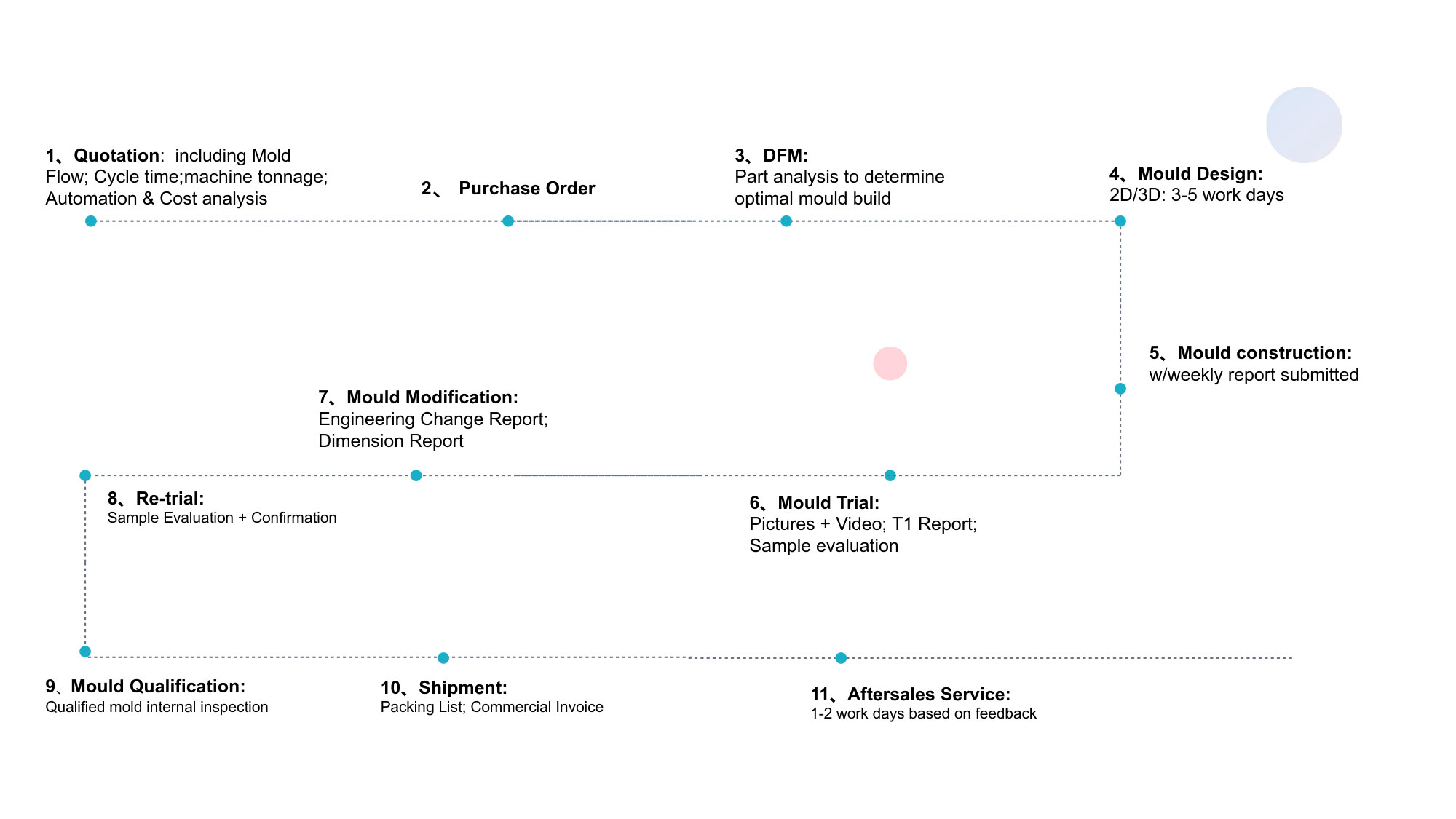
Before a single piece of steel is purchased, Ansix Tech delivers a comprehensive DFM report that includes:
Draft angle recommendations (typically 1° to 3°, depending on wall depth and texture)
Wall thickness optimization to maintain uniform flow and prevent sink marks (thin‑wall cartridges often require walls ≤1.5 mm, with uniform transitions)
Gate location and number to avoid weld lines in critical functional zones
Ejector pin mark placement agreed upon to avoid visible marks on cosmetic surfaces
Degating method recommendation (sub‑gate, edge gate, hot tip gate)
Material shrinkage compensation for each specific polymer grade
This DFM review is provided before a contract is signed. The customer value is avoiding the classic industry trap: designing a part that cannot be molded economically, discovering the problem during molding trials, and paying for expensive mold rework.
T0 to T3 Sample Stages with Improvement Reports
Rather than delivering a “final” mold and hoping it works, Ansix Tech provides a phased sample delivery process:
T0 (first shot) : Molding the first parts, typically for dimensional verification and preliminary function testing
T1 : First corrections implemented, improved parts delivered with dimensional and cosmetic improvements
T2 : Fine adjustments to gate geometry, cooling balance, or venting
T3 : Production‑ready mold, validated through full process verification
Each sample shipment is accompanied by a structured improvement report documenting actions taken, verification results, and remaining action items. There are no hidden agendas—just transparent communication.
Changeable Inserts and Quick‑Turn Modifications
In the medical device development process, design changes happen. Parts that perform correctly in one material may warp in another. Ansix Tech designs molds with replaceable inserts for critical features (such as gate inserts, core pins, cavity inserts). This modular approach means that a design change or material switch does not require an entirely new mold—only a small insert modification, typically completed within 5 to 10 days.
Pre‑Production Pilot Runs
Before committing to full high‑volume production, Ansix Tech offers 100‑ to 500‑shot pilot runs using the validated mold and process. During this phase:
Assembly line yields are measured in customer fixtures
Process capability (Cpk) is recalculated on actual production conditions
Secondary operations such as laser marking, pad printing, or ultrasonic welding are verified for alignment
Scrap rate and cycle time are confirmed
Only when the pilot run passes all metrics—statistically validated—does Ansix Tech transition to volume production. Investment in a pilot run is a fraction of the cost of a production scrap event.
Spare Parts and Preventive Maintenance
The following are included with every medical mold shipment:
Complete set of spare wear parts : ejector pins, core pins, sleeves, and hot runner nozzle tips
Spare heater bands and thermocouples (where applicable)
Digital mold maintenance log with recommended service intervals
Ansix Tech offers scheduled maintenance at 200,000 shot intervals (cleaning, inspection, polishing, lubrication, and wear‑part replacement). For molds out of warranty, repair services are provided at cost plus labor, ensuring that the mold remains productive for its entire design life—often exceeding 2 million shots.
Section Six: Compared to the Industry—Direct Answers to Common Concerns
Medical device OEMs have likely worked with molders before. Some experiences were positive. Others were frustrating. The following table translates scattered concerns into direct responses.
Common Customer Complaint Ansix Tech’s Response (Capability + Value)
The mold requires constant repair, interrupting production schedules. Every medical mold undergoes 2,000‑shot aging and wear testing before shipment, with a detailed wear report provided. Ansix Tech offers a three‑year structural warranty on the mold (excluding normal consumable wear).
Flash is all over the parts, requiring expensive manual trimming. Ansix Tech machines parting lines to 0.005 mm fit accuracy and uses servo‑controlled mold clamping with lock‑force monitoring. Flash is consistently ≤0.03 mm , eliminating deburring for all but the most demanding cosmetic products.
Part dimensions change from batch to batch, causing assembly line stops. Injection machines are equipped with ultrasonic wall‑thickness sensors that provide real‑time wall profile feedback and automatically adjust packing pressure to compensate for viscosity variation. In‑mold pressure and temperature sensors are integrated where required, creating a closed‑loop control system.
Mold repairs take weeks, with no clear timeline. Ansix Tech maintains an in‑house electrode machining center and EDM department. At least 95% of mold repair requirements (such as replacing a damaged ejector pin, repairing a gate, or adding venting) are completed within 24 hours of diagnosis.
Design changes require a new mold and start the timeline over. Ansix Tech’s molds are built with modular insert‑based construction. Design iterations affecting only specific features (gate geometry, core profile, ejector layout) are implemented through replaceable inserts—typically requiring 5 to 10 days of rework time.
Section Seven: Customer Value Summary—What This Means for Your Medical Staple Cartridge Program
Technical capability statements are only valuable when they translate into business outcomes. For a medical thin‑walled staple cartridge program, Ansix Tech’s capabilities deliver the following:
Reduced Total Cost of Ownership
Lower material consumption through optimized wall thickness (thin‑wall molding consumes less resin per part)
Eliminated secondary flash‑trimming labor
Reduced mold repair costs due to robust tool construction and preventive maintenance programs
Shorter qualification timelines, compressing product development schedules
Eliminated Quality Risk
Full material and process traceability for ISO 13485 and FDA compliance
Process‑validated production with CPK ≥ 1.33 on all critical dimensions
In‑process dimensional monitoring that detects drift before scrap is produced
Biocompatible materials with full ISO 10993 certification packages
Increased Production Capacity
Multi‑cavity mold configurations (up to 64 or 128 cavities) that make output scalable to market demand
Short cycle times enabled by conformal cooling and optimized mold design
260 injection molding machines in China and Vietnam, with total installed capacity for millions of parts per month
Guaranteed On‑Time Delivery
Integrated mold design, manufacturing, and injection molding under one roof (no coordination issues between separate vendors)
Local production bases in both China and Vietnam for geographic supply chain diversification
Mold repair capability in‑house eliminates external vendor dependencies for emergency fixes
Conclusion: Precision Engineering Serving Patient Outcomes
Medical thin‑walled staple cartridges are more than plastic parts. They are components of life‑saving and life‑improving devices, and every cartridge must function exactly as intended—every time. Ansix Tech has spent over 28 years building the equipment, processes, and quality systems to deliver that certainty.
From the first DFM consultation to the millionth molded part, Ansix Tech’s approach is grounded in a single principle: technical capability exists to serve customer outcomes. Every piece of mold steel, every process control parameter, and every validation step is chosen not because it is impressive but because it directly addresses a real customer concern.
For medical device OEMs evaluating thin‑walled staple cartridge programs, Ansix Tech offers a comprehensive, validated, and transparent solution. The value is not in the equipment—it is in the confidence that the parts will arrive on time, fit perfectly, perform reliably, and pass regulatory inspection.
For more information: Visit www.ansixtech.com to discuss your medical thin‑walled cartridge program or request a sample DFM report demonstration.
Ansix Tech Co Ltd
If you have any plans related to Manufacturing and Injection Molding of Medical Thin-Walled Stapler Cartridge Molds , you can contact us at any time. We will turn your ideas into reality, let you realize your dreams, and obtain large orders from the market. Our contact information is info@ansixtech.com. Or contact our CTO, mail: stephen@ansixtech.com
#www.ansixtech.com #ansixtech.com #Medical Thin-Walled Staple Cartridge #Syringe mold moulds #Syringe mold molds #Syringe mold injection molding companies #Medical Thin-Walled Staple Cartridge Canopy Mold injection mold companies #Ansix #Ansix moulds #Ansix china #Ansix tech china #Ansix tech company #Ansix facotry #Syringe mold injection molding #Syringe mold injection tools #Syringe mold injection moulds #Syringe mold plastic mould #Syringe mold plastic tools #Ansix Tech #Ansix molds #Ansix injection molding #Ansix mold factory #injection molding Syringe mold #Ansix mold factory #Syringe mold china #Syringe mold molds #injection factory #Syringe mold injection molding #Syringe mold injection molding factory #injection molding company #Syringe mold injection mold companies #Syringe mold#Syringe mold mold limited #Ansix mold china #Ansix companies #Ansix company China #Syringe mold facotry #Ansix Tech #Ansix Tech mould #Syringe mold injection moulding #injection moulding company #Ansix Syringe mold parts injection mold companies #medical injection molding companieschina #Syringe mold china factory #Ansix moulding companies #Ansix molding company #Syringe mold injection moulding facotry #Ansix Tech mold #Syringe mold mould #Syringe mold plastic injection molding #ansix plastic mold #Mold manufacturing #Syringe mold parts manufacturing #Syringe mold plastic parts factory #Syringe mold injection parts mold #Syringe mold PRECISION MANUFACTURING #Syringe mold #China mold #Syringe mold injection moulding china #Syringe mold mould china #china precision mold #mold in china #Syringe mold mold china #Precision molds #High-precision molds #Syringe mold #Injection molds #Syringe mold Factory #Syringe mold Company #Super Large Injection Mold Factory #Large Tonnage Injection Molding Factory #Syringe mold Company #Syringe mold Factory #2800T Injection Molding Factory #3000 Ton Injection Molding #4500 Ton Injection Molding Factory #Large Mold Injection Molding #Large Plastic Mold Injection Molding Factory #Large Injection Mold Manufacturer #Plastic Mold Factory #Injection Mold #Plastic Mold