



36mm thick-walled optical lens
36mm thick-walled optical lens

For Ansix Tech, a mold is not merely a block of steel—it is a revenue-generating asset designed for longevity, precision, and seamless production integration. This comprehensive analysis details how Ansix Tech translates every technical capability into measurable customer value: reducing product costs, accelerating time-to-market, mitigating production risks, and delivering uncompromising quality throughout the entire product lifecycle.
Part Two: Hard Infrastructure – The Foundation of Customer Trust
2.1 Precision Mold Manufacturing Equipment
Customers need to trust the physical assets that make precision manufacturing possible. Ansix Tech has made strategic investments in industry-leading machinery so customers don‘t have to worry about what happens behind the factory walls.
Five-Axis High-Speed Machining Centers – Ansix Tech operates multiple five-axis high-speed machining centers capable of achieving 0.002mm machining accuracy. For a 36mm thick-walled optical lens, this capability delivers seamless parting lines with no witness marks visible under optical inspection, eliminating flash and completely removing the need for secondary deburring or manual post-molding trimming.
Customer Value: One of the most common hidden costs in optical molding is manual flash removal and post-processing. By delivering molds that produce flash-free parts from the first shot, Ansix Tech eliminates these labor expenses entirely, saving customers 15–20% of per-mold finishing costs for optical-grade surfaces.
Wire EDM for Ultra-Fine Features – Ansix Tech’s slow-speed wire EDM capability can produce features as fine as 0.03mm. This directly addresses the deformation risk that plagues conventional machining of delicate optical features. The customer value is certainty: every micro-feature is dimensionally exact from cavity to cavity, and the mold maintains this precision over millions of cycles.
In-House Edm Machining Workshop – With a dedicated EDM workshop, Ansix Tech achieves self-contained mold manufacturing capability where mold rework and repairs can be completed without leaving the factory. Standard repairs such as weld repairs or insert replacements can be completed within 24 hours, dramatically reducing downtime for customers.
2.2 Injection Molding Machine Fleet
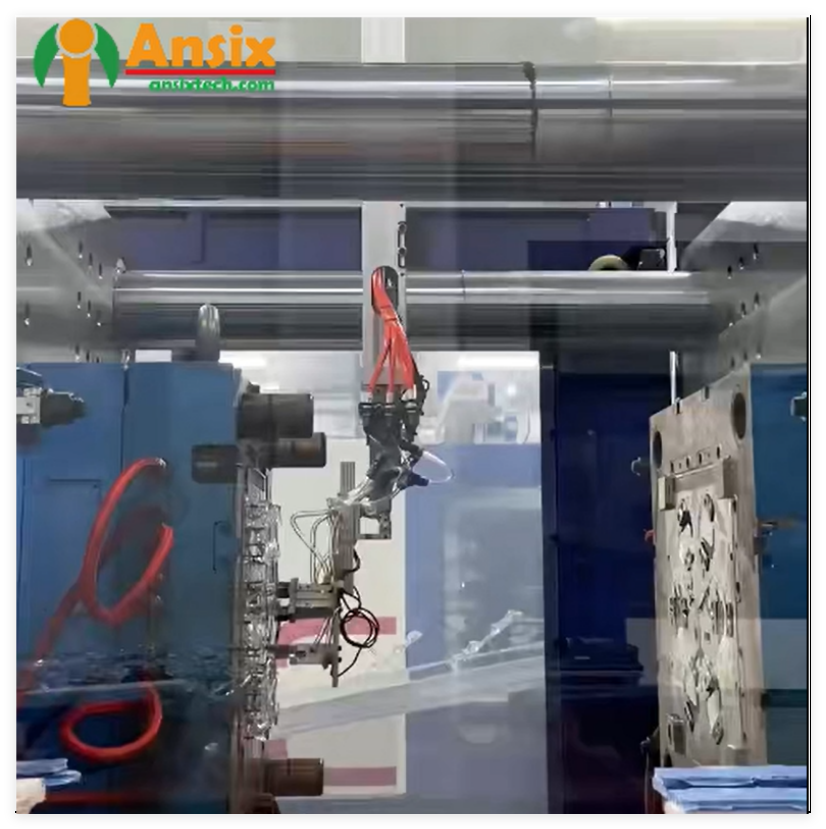
Ansix Tech operates 260 injection molding machines with clamping forces ranging from 30 tons to 2,800 tons. This breadth covers the entire spectrum of thick-walled optical lens production—from small single-cavity prototyping to high-volume multi-cavity production.
Tonnage Range Application Customer Value
30-90 tons Single-cavity prototypes, small optical components Efficient validation with minimal material waste
160-500 tons High-volume production for optical lenses Consistent part-to-part repeatability across multi-cavity configurations
500-2,800 tons Large headlamp lenses exceeding 2kg and 36mm wall thickness Precision molding of demanding geometries
The machine fleet includes Japan‘s Fanuc, Sumitomo, Toshiba, Nissei, and Engel, as well as Germany’s Arburg for liquid silicone applications, plus China‘s Haitian and Victor Taichung Machinery. Every machine is equipped with full servo motor drive systems, delivering repeatable process accuracy of ±0.1%.
Customer Value: When a customer validates a lens design, they need to know that the 10,000th part is identical to the first—in optical performance, dimensions, and appearance. Servo drive technology with closed-loop control systems makes this a production reality, significantly reducing scrap rates and ensuring batch-to-batch consistency.
2.3 In-House Inspection and Metrology
Ansix Tech‘s quality laboratory is equipped with coordinate measuring machines (CMMs) and optical imaging systems capable of sub-micron resolution. For every optical mold, a full dimensional report is generated before shipment, with critical dimensions achieving CPK ≥ 1.33.
Customer Value: Customers receive documented evidence of quality, not just promises. Full dimensional reporting eliminates the uncertainty that leads to incoming inspection bottlenecks and production delays.
Part Three: The 36mm Thick-Walled Optical Lens – Product Overview and Technical Challenges
3.1 What Is a Thick-Walled Optical Lens?
A thick-walled optical lens is a precision injection-molded component used primarily in automotive forward lighting systems (headlamps, high beams, ADB modules). Due to physical requirements in headlamp optics, collimator lenses require high wall thicknesses, typically between 15 and 30 mm—with high-performance designs reaching 36mm or more.
These lenses are manufactured from high-purity optical-grade thermoplastics that have replaced glass in modern automotive lighting, offering weight reduction, design flexibility for complex freeform geometries, and significantly lower manufacturing costs.
3.2 Primary Materials Selection
Material Key Properties Application Customer Value
Polycarbonate (PC) – e.g., Covestro Makrolon® AL2447/AL2647 High impact resistance, heat resistance up to 120°C, excellent optical transparency, UV stabilization Headlamp lenses requiring superior durability and thermal performance Crash-resistant lenses that maintain optical clarity in extreme conditions; UL94 V-0 compliance for safety
PMMA (Acrylic) Superior optical clarity, UV stability, high scratch resistance, lower toughness than PC Light guide lenses where surface integrity is critical Exceptional light transmission (up to 92%) with minimal yellowing over product lifetime
Specialty COC/COP Low birefringence, low moisture absorption, excellent optical purity High-precision optical applications demanding minimal optical distortion Superior image quality for ADB and camera-based lighting systems
PC material offers exceptional impact resistance—200 times that of ordinary glass and 8 times stronger than PMMA—making it the dominant choice for safety-critical automotive lenses.
3.3 The Three Fundamental Challenges of 36mm Thick-Walled Lenses
Challenge 1: Ultra-Long Cooling Time
For a typical headlamp lens with 36mm wall thickness, standard single-layer injection molding requires cycle times of up to 20 minutes. Because plastic is a very poor thermal conductor, cooling time increases by the square of the wall thickness—doubling wall thickness means four times longer cooling time.
Challenge 2: Shrinkage-Induced Dimensional Defects
As thick-walled parts cool, internal shrinkage creates volumetric contraction that can cause sink marks exceeding 20μm on optical surfaces—visually unacceptable for automotive lenses where any surface imperfection scatters light and compromises safety.
Challenge 3: Residual Stress and Optical Distortion
Flow-induced molecular orientation during filling creates residual stresses within the lens. These stresses produce birefringence effects visible as stress patterns under polarized light, which degrade light transmission efficiency and beam pattern accuracy.
Part Four: Mold Manufacturing – The Core Competitive Advantage
4.1 DFM (Design for Manufacturability) – Risk Elimination Before Cutting Steel
Ansix Tech’s engineering process begins with comprehensive DFM analysis using Autodesk Moldflow for melt flow simulation and ANSYS for structural analysis of mold deformation under high injection pressures. This dual-software approach provides “more realistic and reliable” simulation results that identify potential issues before any steel is cut.
What the DFM report delivers to customers:
DFM Analysis Component Customer Value
Weld line prediction All weld lines positioned at least 1.5mm away from CTQ (critical-to-quality) optical areas
Sink mark simulation Critical thickness-to-flow ratio optimized to prevent surface defects
Shear stress analysis Process parameters adjusted to minimize flow-induced birefringence
Cavity pressure mapping Balanced filling ensures uniform density and minimal warpage
Cooling time optimization Multi-layer injection strategy recommended for 36mm parts
Customer Value: By identifying and solving problems virtually, Ansix Tech eliminates expensive mold rework after steel cutting, reducing development time by 20–30% and preventing the 30–50% cost overruns common in complex optical mold projects.
4.2 Mold Steel Selection – Precision Materials for Optical Quality
For 36mm thick-walled optical lenses, Ansix Tech selects mold steels based on optical surface requirements, production volume, and material compatibility:
Mold Component Recommended Steel Properties Customer Value
Optical core/cavity inserts S136/S136H ESR – Swedish premium stainless Excellent corrosion resistance, superior polishability to mirror finish, high purity (ESR refined), hardness HRC 50-55 Mirror-polished optical surfaces (Ra < 0.05μm) enable flawless light transmission; corrosion resistance ensures consistent quality over millions of cycles
Mold base P20 / 718H Good machinability, dimensional stability Cost-effective base with reliable performance
High-wear components SKD11/D2, DC53, M340 Superior wear resistance for glass-fiber reinforced materials Extended mold life even with abrasive PC+GF materials
Heat-treated cores 8407 / H13, 2344 High hot hardness, thermal fatigue resistance Maintains precision under high mold temperatures (80-120°C) for optical PC
For lenses molded with glass-fiber reinforced materials, Ansix Tech guarantees 500,000 shots mold life; for unfilled optical-grade materials, 1,000,000+ shots is standard.
Customer Value: Instead of unpredictable mold replacement costs every few hundred thousand shots, customers get predictable tooling amortization over the full product lifecycle. When a mold delivers 1 million quality parts, per-part tooling cost drops to pennies.
4.3 Mold Manufacturing Process Flow
text
Customer 3D Model → DFM Analysis (Moldflow + ANSYS) → Design Review & Approval
→ Steel Selection & Procurement → Rough Machining (CNC) → Heat Treatment
→ Precision Finishing (5-axis HSC) → EDM (wire/sinker) → Surface Polishing (optical grade)
→ Assembly → Mold Trial (T0 to T3) → Validation & Reporting → Delivery
Critical manufacturing details:
Optical Surface Polishing: Mold cavities for optical lenses are polished to Ra < 0.02μm (mirror finish), requiring diamond-grade polishing compounds and specialized techniques that prevent surface micro-defects from transferring to molded parts.
Parting Line Precision: Ansix Tech‘s 0.005mm mold assembly accuracy ensures flash is controlled to ≤ 0.03mm across the entire parting surface, eliminating manual deburring operations.
Multi-Cavity Consistency: For high-volume production, Ansix Tech designs multi-cavity molds with balanced runner systems ensuring each cavity produces optically identical parts—critical for customers who rely on consistent light distribution across millions of lenses.
4.4 Cooling System and Gate Design
For thick-walled optical lenses, the cooling system is arguably the most critical design element:
Conformal Cooling Channels: Using 3D-printed or five-axis machined conformal cooling channels that follow the lens curvature ensures uniform temperature distribution across the entire optical surface, minimizing differential shrinkage and warpage.
Multi-Layer Cooling Strategy: For 36mm thick lenses, the mold incorporates independent cooling circuits for core and cavity, with zone temperature control maintaining ≤ 2°C variation across the molding surface.
Gate Design for Optical Quality:
Gate Type Application Customer Benefit
Hot runner with valve gate Large-area optical surfaces No gate vestige on cosmetic surface; consistent filling
Edge gate with optimized location Thick-wall applications Balanced flow reduces internal stress and birefringence
Multi-point sequential valve gating Lenses > 150mm length Eliminates flow hesitation and weld lines in optical zone
Customer Value: A properly designed cooling and gating system is what transforms a 20-minute cycle into a 3-minute cycle—directly impacting per-part cost and production capacity.
Part Five: Injection Molding – Process Excellence for 36mm Lenses
5.1 Multi-Layer Injection Molding Technology – The Breakthrough for 36mm Wall Thickness
For 36mm thick-walled optical lenses, conventional single-layer injection molding is commercially impractical. Ansix Tech has mastered multi-layer injection molding (MLIM) technology—the industry‘s solution for producing thick lenses with short cycle times and superior optical quality.
Why multi-layer works: Dividing a 36mm single-layer lens into several thinner layers (typically 3-7 layers) dramatically reduces total cooling time because multiple thin layers cool faster than one thick layer.
For a 30mm lens, standard single-layer molding requires approximately 600-900 seconds (10-15 minutes) per cycle. Multi-layer injection molding reduces cycle time to 180-200 seconds (3-3.3 minutes) —an efficiency improvement of 300-400%.
Customer Value Impact: This cycle time reduction means a single injection molding machine can produce 3-4 times more lenses per day. For a customer needing 1 million lenses annually, this translates to 60-70% lower capital equipment costs and a proportionally lower per-part molding cost.
5.2 Process Parameter Optimization
Through extensive experimental validation and production data, Ansix Tech has established optimized process windows for 36mm optical PC:
Parameter Target Range Quality Impact
Melt temperature 280-320°C Lower melt temp reduces molecular degradation and optical yellowing
Mold temperature 80-120°C Higher mold temp reduces freeze-induced stress and improves surface replication
Injection speed Medium-slow (10-30 mm/s) Controlled filling prevents flow marks and jetting
Packing pressure High, with long hold time Essential for reducing volumetric shrinkage and eliminating sink marks
Back pressure 5-15 bar Ensures melt homogeneity without excessive shear
Academic research confirms that lower melt temperatures combined with higher mold temperatures significantly reduce dimensional defects in thick-walled PC lenses, with effective packing pressure being essential for minimizing sink marks.
Customer Value: Rather than relying on operator experience and manual adjustments, Ansix Tech‘s scientifically optimized process parameters produce first-pass yield > 98% from the first production run, eliminating the costly “learning curve” period where customers typically scrap thousands of parts.
5.3 Process Control and MES Integration
All injection molding machines are connected to MES (Manufacturing Execution System) with process parameters (temperature, pressure, speed, time) locked and accessible only to authorized engineers. Every batch undergoes first-article and last-article inspection comparison.
In-Mold Sensor Technology: For critical quality characteristics, Ansix Tech installs cavity pressure and temperature sensors that provide real-time feedback to the machine controller, enabling closed-loop process adjustment. Product injection repeatability reaches ±0.1%.
Customer Value: Process control is what separates a “molder” from a “precision manufacturer.” When a customer’s production team can verify that every lens was made under identical conditions to the PPAP sample, quality audits become confirmation rather than investigation.
5.4 Addressing Common Defects – Customer Value Translation
Defect Root Cause Ansix Tech Solution Customer Value Eliminated
Sink marks Volumetric shrinkage in thick sections Extended packing pressure + conformal cooling No scrapped lenses; 0% rework
Flow marks Premature freezing at gate Higher mold temp + optimized gate design Consistent appearance across all lenses
Weld lines Split flow recombination Sequential valve gating + venting design No optical disturbance in beam pattern
Warpage Non-uniform cooling/shrinkage Zone temperature control + balanced filling Dimensional stability for assembly
Birefringence (stress) Molecular orientation Injection-compression molding (where applicable) Superior light transmission efficiency
Voids/bubbles trapped gas in thick section Multi-layer injection + vacuum assist Zero internal defects visible under inspection
Part Six: Quality Assurance and Validation
6.1 Full Validation Protocol – From T0 to Mass Production
Ansix Tech provides a structured validation process that eliminates customer uncertainty:
T0 (First Mold Trial): Mold mounted on injection machine for first shots. Dimensional and visual inspection against customer specifications. Full defect log generated.
T1 (First Optimization): Mold modifications implemented based on T0 findings. Repeat inspection and documentation.
T2 (Second Optimization): Fine-tuning of process parameters. CPK analysis for critical dimensions.
T3 (Production Validation): Full-run validation under production conditions. Customer witness sampling and approval.
Small-Batch Pre-Production: 100-500 parts produced under full production parameters. Statistical analysis of yield rate and CPK. Production approval prior to mass production release.
6.2 Quality Certifications – The Compliance Foundation
Certification Scope Customer Value
IATF 16949 Automotive quality management Direct qualification for Tier 1 and OEM suppliers; zero audit friction
ISO 9001:2015 General quality management Documented quality system across all operations
ISO 14001 Environmental management Regulatory compliance for global customers
BSCI Social compliance Ethical supply chain verification
6.3 In-Process Quality Control
Incoming material inspection – Raw material certificates verified, moisture content checked (<0.02% for PC)
In-process monitoring – Real-time SPC with automated alarms for out-of-control conditions
First article inspection – CMM full dimensional report prior to production batch start
Process capability – Critical dimensions maintained at CPK ≥ 1.33
Optical inspection – Each lens visually inspected for cosmetic defects; beam pattern testing on sampling basis
Periodic verification – Dimensional re-check every 1,000 shots to detect tool wear or process drift
6.4 Mold Maintenance and Spare Parts – Extending Asset Life
Spare parts package – Critical wear components (ejector pins, core inserts, hot runner tips) delivered with the mold
Maintenance schedule – Standard service every 200,000 shots, including cleaning, lubrication, and wear inspection
Lifetime repair service – Repairs charged at cost; no markup on emergency maintenance
On-demand service – 24-hour response for critical production stops
Part Seven: Cost Control and Value Engineering
7.1 Systematic Cost Reduction Across Five Dimensions
Dimension 1: Material Cost Optimization
Strategy Implementation Customer Savings
Material grade matching PC Makrolon® AL2447 for standard applications; AL2647 for higher flow 15-25% material cost reduction vs. over-specifying high-end grades
Regrind management Closed-loop regrind system with virgin material blending control 10-15% material cost reduction for non-optical areas (for hybrid applications)
Bulk purchasing Global procurement through Ansix Tech‘s supply chain network Pass-through volume discounts
Dimension 2: Process Efficiency Gains
Multi-layer injection molding reduces 36mm lens cycle time from 15 minutes to under 4 minutes, achieving 300-400% productivity improvement. This means:
One molding machine produces 4× more output
Manufacturing cost per lens reduced by 60-70%
Energy consumption per lens reduced by similar margin
Capital equipment requirement reduced by 75%
Dimension 3: Yield Improvement
Defect Type Industry Average Ansix Tech Achieved Cost Saving per 1M Lenses
Scrap rate (first run) 5-8% < 2% Saves 30,000-60,000 lenses worth of material
Rework/repair rate 10-15% < 3% Eliminates manual finishing labor
Customer rejections 1-3% < 0.5% Prevents shipping, logistics, and reputation costs
Dimension 4: Tooling Cost Per Part
A mold that delivers 1,000,000 shots (standard for Ansix Tech‘s optical tooling) amortizes tooling cost to less than $0.01 per part. By contrast, molds requiring replacement every 200,000 shots carry 5× higher per-part tooling cost.
Dimension 5: Supply Chain Integration
By providing end-to-end service—mold design and manufacturing, injection molding, secondary operations, assembly, and logistics—Ansix Tech eliminates the cost of managing multiple suppliers, multiple POs, multiple quality audits, and multiple logistics providers.
7.2 Customer Value Summary – What Ansix Tech Delivers
Customer Problem Ansix Tech Solution Quantified Benefit
High per-part cost Process optimization + material matching + volume production 30-50% cost reduction vs. conventional manufacturing
Production delays MES monitoring + spare parts inventory On-time delivery > 98%
Quality inconsistency Real-time SPC + multi-layer process control CPK ≥ 1.33 for critical dimensions; < 2% scrap
Mold maintenance costs 1,000,000-shot mold life + spare parts package 80% lower tooling amortization cost
Slow time-to-market DFM analysis + rapid tooling + T0-T3 validation Reduced development time by 20-30%
Multiple supplier management One-stop integrated service 50% fewer suppliers to manage; single point of accountability
Part Eight: Delivery Efficiency and After-Sales Service
8.1 Lead Time Standards
Service Standard Lead Time Expedited Option
DFM analysis report 3-5 business days 2 days
Simple mold (single cavity, ≤ 200mm) 10-15 days N/A
Medium-complexity mold 25-45 days 20 days*
High-complexity optical mold 35-50 days 30 days*
T0 sample delivery Upon mold completion —
Mass production (post-approval) 15-30 days for first batch 10 days
*Expedited mold delivery includes compressed machining and EDM schedules; validation steps (T0-T3) remain fully completed.
8.2 Post-Sales Service Commitment
Warranty: 3 years structural warranty on mold base and core/cavity (excluding normal wear components)
Technical support: Remote support within 4 hours; on-site support within 48 hours (global)
Spare parts: Critical wear components stocked for all active molds
Maintenance service: Scheduled mold maintenance visits available
Process audit: Annual production process review for long-term customers
8.3 Customer Service Philosophy
Ansix Tech‘s service commitment is captured in their core principle: ”For us, the mold is not a piece of steel; it is a money-printing machine.” Every mold is designed with production-line readiness—balanced filling, robust venting, and uniform temperature distribution—ensuring it runs from the first shot without debugging, with minimal flash, and extended production life. On request, Ansix Tech provides a full DFM report walkthrough showing exactly how weld lines, air traps, and sink marks are eliminated before production begins.
Conclusion: Why Ansix Tech is the Trusted Partner for 36mm Thick-Walled Optical Lenses
Over 28 years of specialized manufacturing experience —Founded in 1998, delivering over 30,000 mold sets across automotive, medical, and consumer electronics industries
Complete vertical integration —From DFM analysis and mold design through validation, mass production, assembly, and logistics—customers manage one supplier instead of 5-10
Industry-leading multi-layer injection molding —300-400% cycle time reduction for 36mm thick-walled lenses vs. conventional processes
Proven quality systems —IATF 16949, ISO 9001, ISO 13485, ISO 14001, and BSCI certifications eliminate customer qualification friction
Uncompromising quality control —Sub-micron precision measurement, CPK ≥ 1.33 capability, full dimensional reporting on every shipment
Systematic cost engineering —30-50% lower total cost through material optimization, process efficiency, and yield improvement
Global manufacturing footprint —Four production bases across China and Vietnam with 260 injection molding machines, delivering supply chain resilience and geographic flexibility
Ansix Tech transforms the complex technical challenge of 36mm thick-walled optical lenses into a reliable, cost-effective manufacturing solution. For customers in the automotive lighting industry, this means faster time-to-market, lower production costs, reduced quality risk, and a single point of accountability throughout the entire product lifecycle.
For technical consultation, DFM report requests, or project inquiries, please contact Ansix Tech‘s engineering team for a comprehensive review of your 36mm thick-walled optical lens requirements.



Ansix Tech Co Ltd
If you have any plans related to 36mm thick-walled optical lens , you can contact us at any time. We will turn your ideas into reality, let you realize your dreams, and obtain large orders from the market. Our contact information is info@ansixtech.com. Or contact our CTO, mail: stephen@ansixtech.com
#www.ansixtech.com #ansixtech.com #36mm thick-walled optical lens #36mm thick-walled optical lens #36mm thick-walled optical lens Canopy Mold injection mold companies #Ansix #Ansix moulds #Ansix china #Ansix tech china #Ansix tech company #Ansix facotry #36mm thick-walled optical lens injection molding #36mm thick-walled optical lens injection tools #36mm thick-walled optical lens injection moulds #36mm thick-walled optical lens plastic mould #36mm thick-walled optical lens plastic tools #Ansix Tech #Ansix molds #Ansix injection molding #Ansix mold factory #injection molding 36mm thick-walled optical lens#Ansix mold factory #36mm thick-walled optical lens china #36mm thick-walled optical lens molds #injection factory #36mm thick-walled optical lens injection molding #36mm thick-walled optical lens injection molding factory #injection molding company #36mm thick-walled optical lens injection mold companies #36mm thick-walled optical lens Tooling #36mm thick-walled optical lens mold limited #Ansix mold china #Ansix companies #Ansix company China #36mm thick-walled optical lens facotry #Ansix Tech #Ansix Tech mould #36mm thick-walled optical lens injection moulding #injection moulding company #Ansix 36mm thick-walled optical lens parts injection mold companies #medical injection molding companieschina #36mm thick-walled optical lens china factory #Ansix moulding companies #Ansix molding company #36mm thick-walled optical lens injection moulding facotry #Ansix Tech mold #36mm thick-walled optical lens mould #36mm thick-walled optical lens plastic injection molding #ansix plastic mold #Mold manufacturing #36mm thick-walled optical lens parts manufacturing #36mm thick-walled optical lens plastic parts factory #36mm thick-walled optical lens injection parts mold #36mm thick-walled optical lens PRECISION MANUFACTURING #36mm thick-walled optical lens #China mold #36mm thick-walled optical lens injection moulding china #36mm thick-walled optical lens mould china #china precision mold #mold in china #36mm thick-walled optical lens mold china #Precision molds #High-precision molds #36mm thick-walled optical lens #Injection molds #36mm thick-walled optical lens Factory #36mm thick-walled optical lens Company #Super Large Injection Mold Factory #Large Tonnage Injection Molding Factory #36mm thick-walled optical lens Company #36mm thick-walled optical lens Factory #2800T Injection Molding Factory #3000 Ton Injection Molding #4500 Ton Injection Molding Factory #Large Mold Injection Molding #Large Plastic Mold Injection Molding Factory #Large Injection Mold Manufacturer #Plastic Mold Factory #Injection Mold #Plastic Mold