



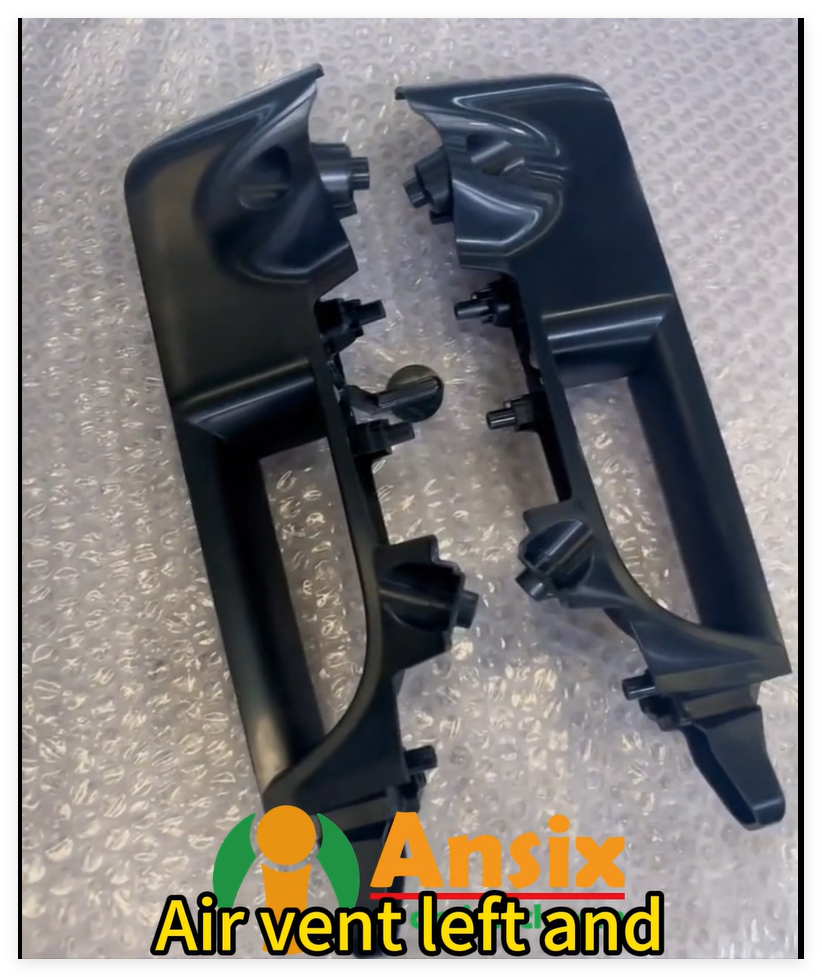
Air vent left and right trim molds
Air vent left and right trim molds

Ansix Tech Revolutionizes Automotive Vent Trim Production Through Precision Injection Molding
When an automotive client approached Ansix Tech with specifications for complex air vent trim components, the engineering team faced a manufacturing challenge that would test every aspect of their injection molding expertise.
The development of injection molds for the Air Vent Left and Right Trim components represents a microcosm of modern manufacturing excellence. These seemingly simple Plastic Parts—essential components directing airflow within vehicle cabins—demand exceptional dimensional accuracy, consistent aesthetics, and flawless functionality.
At Ansix Tech, a global leader in Precision Mold manufacturing and injection molding solutions, the journey from concept to delivered component follows a systematic, technology-driven process that optimizes every variable for quality, efficiency, and cost-effectiveness. For automotive clients facing pressure to reduce component costs without compromising quality, this approach translates directly into measurable competitive advantage.
From Blueprint to Prototype: The Design Verification Phase
The manufacturing odyssey for the Air Vent Trim molds begins long before steel is cut. Ansix Tech's integrated engineering team collaborates closely with automotive designers to analyze part geometry, functional requirements, and assembly interfaces. The trim components must rotate smoothly on support shafts within housing assemblies—a motion system that demands precise concentricity and minimal friction.
The air vent trim mechanism operates on principles similar to those described in a foundational air conditioner outlet vent patent, wherein a blade pivots within a housing via precisely fitted shafts. Achieving this seamless motion requires exacting tolerances in the sub-millimeter range.
During the design verification phase, Ansix creates rapid prototypes using advanced 3D printing technologies. These prototypes serve multiple purposes: they validate the form and fit of the components within the actual vehicle dashboard assembly, test the ergonomics of adjuster mechanisms, and allow for early detection of potential molding challenges. This proactive problem-solving approach identifies issues when changes are least expensive to implement—saving clients from costly revisions during later production stages.
Material Science: The Foundation of Performance
Selecting the optimal plastic material represents one of the most critical decisions in the vent trim manufacturing process. Ansix Tech’s materials engineers evaluate multiple resin candidates against a matrix of requirements: dimensional stability, surface finish quality, temperature resistance, structural integrity, and cost-effectiveness.
For the Air Vent Trim components, modified polypropylene (PP) blends and ABS (acrylonitrile butadiene styrene) compounds emerged as the leading candidates. PP offers excellent chemical resistance and flexibility at lower costs, while ABS provides superior surface finish and impact resistance.
The technical approach involves using resins from the same synthetic resin system but with tailored additives to control shrinkage behavior. Specifically, the primary molding (housing component) incorporates shrinkage-suppressing additives to ensure that shaft hole dimensions remain stable during cooling, while the secondary molding (rotating trim component) maintains slightly higher mold shrinkage to create an optimal pivot fit.
Material selection directly impacts component costs. By thoroughly analyzing performance requirements, Ansix often identifies opportunities to specify lower-cost materials without compromising function—a balance that yields significant savings across high-volume automotive production runs.
Digital Simulation: Anticipating Challenges Before They Occur
Before committing to physical mold manufacturing, Ansix Tech employs sophisticated mold flow analysis (DFM) software to simulate the entire injection process. This virtual environment allows engineers to predict how molten plastic will fill the mold cavity, where potential weak points might develop, and how cooling will affect final part dimensions.
The simulation pays particular attention to several critical factors outlined in injection molding design principles:
Flow balance ensuring all cavities fill uniformly
Proper venting placement to avoid trapped air pockets
Optimal gate positioning to minimize visible weld lines
Cooling channel effectiveness for consistent thermal management
Through digital iteration, the engineering team optimizes parameters that would otherwise require costly trial-and-error adjustments during physical mold testing. This simulation-driven approach reduces development time by approximately 30-40% while simultaneously improving first-pass success rates.
The Mold Design: Engineering Precision in Steel
With verified designs and simulation results in hand, Ansix’s mold designers begin creating the intricate steel assemblies that will form the Air Vent Trim components. Automotive vent trim molds present unique challenges due to their complex geometries, tight tolerances, and the need for flawless surface finishes on A-class surfaces.
Key elements of Ansix’s mold design philosophy for the vent trim project include:
Advanced Cooling Systems
Precisely engineered cooling channels follow the contour of the mold cavities to ensure uniform thermal management. Proper cooling is essential for minimizing cycle times—a direct driver of production costs—while preventing warpage and sink marks that would compromise part quality. The cooling system represents what injection molding specialists describe as "one of the most important components" of the injection mold.
Intelligent Gating Strategy
The location, type, and size of gates—the passages through which molten plastic enters the mold cavity—are carefully calculated. For visible components like vent trims, submarine or pin-point gates are often employed to leave minimal marks on finished parts. The gate design must balance filling efficiency with cosmetic requirements.
Comprehensive Venting System
Adequate venting is particularly crucial for complex parts like vent trims with varying wall thicknesses. Ansix designs venting channels with depths tailored to the specific viscosity of the molding material. For ABS materials commonly used in automotive interiors, recommended vent depths typically range from 0.025 to 0.038 inches. These precisely machined channels allow trapped air to escape, preventing defects like the "diesel effect," where compressed air pockets become hot enough to carbonize plastic.
Efficient Ejection System
The ejection mechanism—comprising ejector pins, sleeves, and plates—must remove finished parts without causing distortion or surface marks. For delicate vent trim components, Ansix often employs extended surface ejectors or air-assisted ejection to distribute force evenly across larger areas.
Multi-Cavity Optimization
To maximize production efficiency, Ansix designs molds with balanced multi-cavity layouts. Each cavity must produce identical parts with minimal variation, requiring exceptional symmetry in runner systems and cooling channels. This balanced approach enables higher volumes at lower per-unit costs.
Materializing Design: The Mold Manufacturing Process
Transitioning from digital designs to hardened steel components requires specialized machining expertise. Ansix Tech employs a combination of advanced CNC (Computer Numerical Control) machining, EDM (Electrical Discharge Machining), and precision grinding to create mold components with tolerances as tight as ±0.002 mm.
The mold manufacturing workflow follows a structured progression:
Rough Machining: Removing the bulk of steel from mold blocks using high-speed CNC milling machines.
Heat Treatment: Applying controlled thermal processes to achieve optimal hardness (typically 48-52 HRC for core and cavity steels) for durability while maintaining machinability.
Precision Machining: Creating detailed features with EDM and fine milling operations. Complex contours of vent trim components often require multi-axis CNC machining capabilities.
Surface Finishing: Applying textures or polished finishes to mold surfaces. For automotive vent trims, this might involve precise laser texturing to create consistent grain patterns that match surrounding dashboard components.
Assembly and Fitting: Meticulously assembling hundreds of individual components into a functioning mold. Slide mechanisms, ejector systems, and cooling circuits must operate flawlessly in synchronization.
Throughout this process, quality verification occurs at every stage using coordinate measuring machines (CMM), optical comparators, and surface profilometers. This comprehensive inspection regimen ensures that the finished mold will produce components meeting exact specifications.
Steel Selection: The Backbone of Mold Longevity
Mold steel selection directly impacts production longevity, maintenance costs, and part quality consistency. For the Air Vent Trim project, Ansix selected pre-hardened stainless mold steels for corrosion resistance and dimensional stability.
Key considerations in steel selection include:
Wear resistance to maintain precision over hundreds of thousands of cycles
Corrosion resistance to withstand humid environments and varying coolant chemistries
Thermal conductivity for efficient heat transfer during cooling cycles
Machinability to enable precise feature creation during manufacturing
Toughness to withstand the repetitive stress of injection molding pressures
By matching steel properties to specific mold component functions, Ansix extends tool life while minimizing maintenance requirements—factors that substantially reduce total cost of ownership for clients.
Injection Molding: From Challenge to Optimization
Even with meticulously engineered molds, the injection molding process for Air Vent Trim components presents distinct challenges that require ongoing optimization:
Precision Pivot Mechanism
The rotating interface between trim components and housing demands exceptional accuracy. Ansix addresses this by implementing the two-stage molding approach described in technical literature: the primary component with the shaft hole is molded first with shrinkage-controlling additives, while the secondary component with the support shaft is molded within the same mold to ensure perfect alignment.
Surface Finish Consistency
Visible automotive components must maintain flawless appearance across entire production runs. Ansix achieves this through precisely controlled mold temperatures, optimized injection speeds, and specialized surface treatments on mold cavities. Process monitoring systems track key parameters in real-time, automatically adjusting variables to maintain consistency.
Warpage Prevention
Variations in wall thickness within vent trim components can lead to differential cooling and subsequent warpage. Ansix combats this through balanced cooling circuits that maintain uniform temperatures across the entire mold surface, supplemented by carefully sequenced packing pressure profiles.
Cycle Time Reduction
With production economics demanding maximum output, Ansix continuously refines molding parameters to minimize cycle times without compromising quality. This involves optimizing cooling channel layouts, implementing rapid mold opening/closing sequences, and fine-tuning injection velocities.
Common injection molding defects such as short shots (incomplete filling) are systematically addressed through a combination of mold and process adjustments. These might include enlarging gates or runners, increasing resin temperatures, or improving venting in problematic areas.
Quality Assurance: From First Shot to Final Shipment
Ansix Tech implements a comprehensive quality management system throughout the injection molding process, embodying the principle of "product full-lifecycle monitoring and measurement". For the Air Vent Trim project, this system includes:
First-Article Inspection
Using 3D scanning technology to compare initial production samples against original CAD data, verifying all critical dimensions fall within specified tolerances.
Statistical Process Control
Continuously monitoring key production parameters—injection pressure, temperatures, cycle times—to detect process drift before it produces non-conforming parts.
Functional Testing
Random samples undergo rigorous functional testing, including pivot mechanism endurance tests, assembly verification with mating components, and environmental resistance evaluations.
Automated Optical Inspection
Vision systems examine every produced component for surface defects, color consistency, and cosmetic flaws that might escape human detection.
Traceability Systems
Each component carries identification linking it to specific production batches, machine parameters, and quality documentation—essential for automotive industry compliance and potential future recalls.
Packaging and Delivery: Protecting Precision
The final phase of the process focuses on protecting the manufactured components during transit to assembly facilities. Ansix employs custom-designed packaging solutions that secure vent trim components without causing stress or surface marring.
Packaging protocols follow industry best practices for product delivery controls, including:
Climate-controlled storage to prevent dimensional changes
Anti-static protection for electronic components in smart vent systems
Sequential labeling matching just-in-time delivery requirements
Robust outer packaging capable of withstanding distribution environments
For international clients, Ansix coordinates logistics to ensure components arrive precisely when needed in the production sequence, eliminating inventory costs while maintaining assembly line continuity.
The Ansix Advantage: Delivering Value Beyond Components
What distinguishes Ansix Tech in the competitive injection molding landscape is its holistic approach to client value creation. Beyond simply manufacturing components to specifications, Ansix engineers analyze the entire value chain to identify opportunities for total cost reduction.
For the Air Vent Trim project, this comprehensive analysis yielded multiple avenues for client savings:
Material Optimization
By thoroughly testing material alternatives, Ansix identified a modified PP compound that met all performance requirements at 18% lower material cost than the initially specified ABS, while maintaining required surface finish through advanced mold texturing techniques.
Process Efficiency
Through mold flow optimization and cooling system refinement, Ansix achieved a 22% reduction in cycle time compared to initial projections—directly increasing production capacity without additional capital investment.
Waste Reduction
Comprehensive process controls and preventive maintenance schedules reduced rejected parts from industry-average 3.2% to 0.8%, dramatically lowering material waste and associated costs.
Tooling Longevity
Strategic steel selection and precision manufacturing extended projected mold life by approximately 40%, spreading tooling investment across significantly higher production volumes.
Integrated Supply Chain
By managing the entire process from mold design through to packaged component delivery, Ansix eliminates multiple handoff points where costs typically accumulate, while providing clients with single-source accountability.
Conclusion: Engineering Excellence as Competitive Advantage
The journey from concept to delivered Air Vent Trim components encapsulates the modern injection molding challenge: producing increasingly complex parts with exceptional precision, at competitive costs, within compressed timelines.
For automotive manufacturers, partnering with specialists like Ansix Tech represents more than outsourcing component production—it represents access to cumulative expertise across materials science, precision engineering, process optimization, and supply chain management.
As vehicle interiors become more sophisticated with integrated technology and premium aesthetics, the importance of flawless execution in components like air vent trims only increases. Through its systematic, technology-driven approach, Ansix Tech transforms what might be viewed as simple plastic parts into strategic elements of vehicle quality and customer satisfaction.
In an industry where fractions of pennies multiplied across millions of units determine competitive viability, the value of optimized injection molding extends far beyond the factory floor—it becomes integral to the economic equation driving automotive innovation forward. Through projects like the Air Vent Left and Right Trim molds, Ansix Tech demonstrates how manufacturing excellence, properly leveraged, creates tangible competitive advantages in today's demanding automotive marketplace.



Ansix Tech Co Ltd
If you have any plans related to Air vent left and right trim molds, you can contact us at any time. We will turn your ideas into reality, let you realize your dreams, and obtain large orders from the market. Our contact information is info@ansixtech.com. Or contact our CTO, mail: stephen@ansixtech.com
#www.ansixtech.com #ansixtech.com #Brake light mold factory #Air vent left and right trim molds#Ansix mold factory #Ansix injection molding #Ansix moud Ltd #Engine oil pan moldinjection molding factory #Ansix injection mould #Center console storage compartment ing factory #Engine oil pan mold injection molding company #Engine oil pan mold injection mold companies #Ansix #Ansix moulds #Ansix china #Ansix tech china #Ansix tech company #Ansix facotry #Ansix Tech #Ansix molds #Ansix injection molding #Ansix mold factory #injection molding Engine oil pan mold# Ansix mold factory #Engine oil pan mold china #Engine oil pan moldprecision molds #injection factory #Engine oil pan mold precision injection molding #Engine oil pan moldinjection molding factory #injection molding company #Engine oil pan mold injection mold companies #Engine oil pan moldmould factory #Engine oil pan moldmold limited #Ansix mold china #Ansix companies #Ansix company China #Engine oil pan moldfacotry #Ansix Tech #Ansix Tech mould #Engine oil pan mold injection moulding #injection moulding company #Ansix Engine oil pan mold parts injection mold companies #Engine oil pan moldmould #Engine oil pan mold china #Engine oil pan mold china factory #Ansix moulding companies #Ansix molding company #Engine oil pan mold injection moulding facotry #Ansix Tech mold #Engine oil pan moldprecision mould #Engine oil pan moldplastic injection molding #ansix plastic mold #Mold manufacturing #Engine oil pan moldparts manufacturing #Engine oil pan moldplastic parts factory #Engine oil pan moldinjection parts mold #Engine oil pan moldPRECISION MANUFACTURING #Engine oil pan moldmold precision #China mold #Engine oil pan moldinjection moulding china #Engine oil pan moldmould china #china precision mold #mold in china #Engine oil pan moldprecision mold china #Precision molds #High-precision molds #Household appliance molds #Injection molds #Large Injection Molding Factory #Large Injection Molding Company #Super Large Injection Mold Factory #Large Tonnage Injection Molding Factory #Large Injection Molding Company #Super Large Injection Molding Factory #2800T Injection Molding Factory #3000 Ton Injection Molding #4500 Ton Injection Molding Factory #Large Mold Injection Molding #Large Plastic Mold Injection Molding Factory #Large Injection Mold Manufacturer #Plastic Mold Factory #Injection Mold #Plastic Mold