



B-pillar lower trim panel mold
B-pillar lower trim panel mold

Ansix Tech Redefines Automotive Trim Manufacturing with Advanced B-Pillar Injection Molding
Innovative Engineering and Cost Optimization Strategies in Automotive Interior Component Production
In the intricate ecosystem of modern automotive manufacturing, the injection molding of interior components remains a cornerstone of efficiency, cost, and design. Among these components, the B-pillar lower trim panel presents a unique set of challenges due to its complex geometry, high surface quality demands, and critical role in the vehicle's aesthetic. Ansix Tech, a leader in Precision Mold manufacturing, has developed a sophisticated, integrated approach to this challenge, transforming the production process into a model of reliability and cost-effectiveness. Their methodology, from initial design to rapid delivery, is engineered not just to meet specifications, but to significantly lower the total cost of ownership for their clients, demonstrating that advanced engineering and value creation are inseparable.
The B-Pillar Challenge: Complexity Meets Precision
The B-pillar lower trim panel is more than a simple plastic cover. It is a complex, large-sized interior part with a 3D curved surface that must meet exacting aesthetic standards. Its structure often includes numerous side snap-fits, internal oblique screw posts, and irregularly shaped holes, which immediately complicate the demolding process. In traditional molding, these undercuts and complex geometries can lead to filling difficulties, sink marks, warpage, and visible defects like weld lines—unacceptable flaws on a part within the occupant's constant line of sight.
Furthermore, the part is typically produced as a left and right pair. While they form a set, their size and shape are not perfectly symmetrical, necessitating a manufacturing approach that ensures both parts have identical quality and performance despite their differences. This is the high-wire act that Ansix Tech’s process is designed to master.
A Blueprint for Success: DFM and Strategic Material Selection
The journey of an Ansix Tech B-pillar mold begins long before steel is cut, rooted in a philosophy of Design for Manufacturing (DFM). "Material selection must be decided at the very beginning of product design," states industry literature, as the performance of the plastic dictates everything from wall thickness and rib design to the assembly process. Changing materials after mold design has commenced is prohibitively expensive and time-consuming.
Ansix Tech’s engineers follow a meticulous four-step material selection process in close collaboration with the client:
Defining the Application Environment: This includes the part's exact location, required lifespan, mechanical loads, chemical exposure, and aesthetic requirements.
Understanding Material Properties: A deep dive into the performance parameters of candidate polymers.
Choosing the Material Family: Narrowing the choice to a specific type of plastic, such as a thermoplastic olefin (TPO) or a polypropylene blend.
Selecting the Specific Grade: Using material databases to select the optimal resin grade from various suppliers.
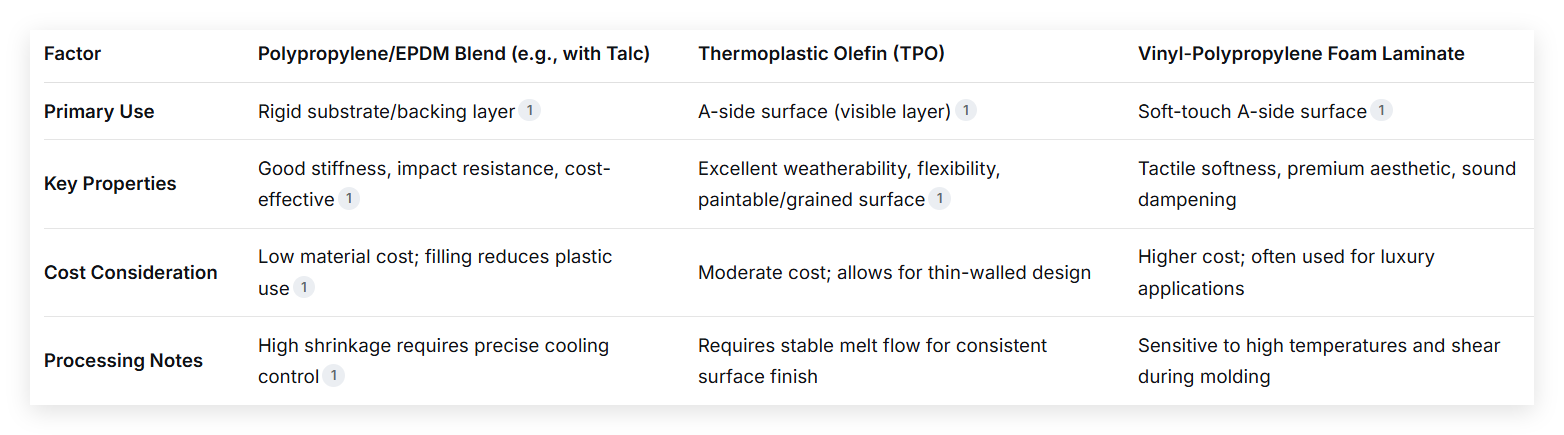
For B-pillar trims, common materials include blends like polypropylene and EPDM (ethylene propylene diene monomer), sometimes filled with talc to improve stiffness and thermal properties. Thermoplastic Olefin (TPO) sheeting is another prevalent choice for its balance of durability, flexibility, and surface finish. Ansix Tech’s expertise lies in balancing these material properties with cost, often recommending optimized blends that meet performance specs while reducing raw material expense.
To make material selection decisions more tangible, the following table compares key factors for common materials used in B-pillar trim panels:
The Digital Crucible: Mold Flow Analysis (DFM Simulation)
With the material defined, the design undergoes rigorous digital validation through Moldflow analysis. This computer simulation is critical for predicting and preventing manufacturing defects. Ansix Tech’s engineers scrutinize key results:
Fill Time: They ensure the flow front is balanced, meaning molten plastic reaches all extremities of the mold cavity simultaneously. Unbalanced flow leads to over-packing in some areas and voids or weak weld lines in others. For a large part like a B-pillar, this is a primary challenge.
Pressure at V/P Switchover: The transition from injection velocity control to packing pressure control is analyzed. A smooth, minimized pressure gradient is essential to avoid excessive stress in the part and machine.
Weld Lines and Air Traps: The software predicts where flow fronts will meet (creating potential weak points) and where air may be trapped (causing burns or voids). The design is then iterated to move these to non-critical or non-visible areas.
This virtual prototyping phase allows Ansix Tech to optimize gate locations, runner systems, and cooling layouts before committing to hard tooling, saving weeks of potential rework and costly mold modifications.
Engineering the Mold: A Symphony of Systems
The physical mold is a masterpiece of integrated systems, each designed for a specific function and collectively engineered for maximum efficiency and longevity.
Mold Steel Selection: Core and cavity inserts are typically machined from high-grade pre-hardened or through-hardened tool steels (e.g., P20, H13, or stainless grades). The choice balances toughness, polishability, corrosion resistance, and cost, with a focus on durability for high-volume automotive production runs.
The Gating and Runner System: To address the challenge of filling a large part, Ansix Tech employs a hot runner system with Sequential Valve Gates (SVG). Instead of filling from multiple points at once—which creates multiple weld lines—the SVG system opens gates in a timed sequence. This creates a single, controlled flow front that sweeps across the part, dramatically reducing visible weld lines and ensuring uniform density. This "progressive fill" technique allows each section of the part to be packed optimally immediately after it fills, which lowers the required packing pressure, reduces part weight, and minimizes warpage.
Advanced Cooling Systems: Cooling time typically constitutes the majority of the injection cycle. Ansix Tech leverages cutting-edge solutions, including 3D-printed conformal cooling channels. Unlike traditional drilled channels, these conformal channels follow the precise contour of the part surface at a uniform distance, enabling faster, more even heat extraction. This can reduce cycle times by 20-30% or more, directly translating to higher output and lower cost per part. Modern temperature control units maintain turbulent flow (with a Reynolds number between 4000-8000) in these channels for peak cooling efficiency.
Complex Demolding Solutions: The B-pillar's geometry demands an ingenious ejection strategy. Ansix Tech designs molds with a combination of mechanisms working in concert:
Angle-Pin or "T-Slot" Sliders: For side undercuts like snap-fits.
Lifter (Angle-Ejector) Systems: For undercuts on the inner walls of the part.
Direct and Indirect Core-Pulls: For complex internal features. This multi-mechanism approach "simplifies and optimizes the mold structure from the overall design" to solve demolding difficulties and long production cycles.
From Validation to Volume: The Production Workflow
The manufacturing workflow at Ansix Tech is a tightly controlled cascade:
Prototype & Design Verification: Using the DFM analysis as a guide, a prototype mold or initial samples are often produced for fit, form, and function testing, ensuring the design meets all specifications.
Mold Manufacturing: High-precision CNC machining, EDM (Electrical Discharge Machining), and deep-hole drilling create the mold components. Critical surfaces are polished to a mirror finish to achieve the required Class A surface on the final part.
Process Optimization: Once the mold is installed in the injection molding machine, a process optimization phase begins. Technicians fine-tune parameters—injection speed, packing pressure and time, melt and mold temperatures—to achieve the perfect balance between cycle time and part quality. This phase is where the digital simulations are validated and adjusted in the physical world.
Quality Assurance & Control: From the first shot, a stringent QC protocol is enforced. This includes dimensional checks using CMMs (Coordinate Measuring Machines), visual inspections for surface defects, and functional tests of snap-fits and mounting points. Statistical Process Control (SPC) monitors production to ensure consistent quality across the entire run.
Packaging & Rapid Delivery: Finished parts are packaged in custom-designed, returnable dunnage or protective recyclable packaging to prevent damage during transit. Ansix Tech’s integrated logistics network is geared for rapid delivery, often operating on Just-In-Time (JIT) schedules to sync with the client’s assembly line.
The Ansix Tech Advantage: Delivering Uncompromised Value
Ansix Tech’s true differentiator is its holistic commitment to reducing the total cost for its customers, which it achieves through a multi-pronged strategy:
Material Cost Optimization: By advising on the most cost-effective material that meets all performance criteria—sometimes by proposing alternative blends or fillers—they directly reduce the bill of materials.
Process Efficiency Gains: The implementation of hot runners, sequential valve gating, and conformal cooling slashes cycle times, boosting the output of each machine and press. A documented case showed a cycle time reduction from 52 seconds to 36 seconds, increasing daily output from 1,300 to 1,670 pieces—a 28% productivity gain.
First-Pass Success: The heavy investment in upfront DFM and Moldflow analysis dramatically reduces the risk of costly mold rework, delays, and production scrap. Getting it right the first time is the ultimate cost-saving measure.
Part Quality and Reliability: By engineering out defects like warpage and sink marks, Ansix Tech ensures a higher yield of good parts and reduces warranty costs for their clients.
The result is a powerful value proposition: superior quality parts, delivered with speed and reliability, at a significantly lower effective cost. In the competitive landscape of automotive manufacturing, where every cent and every second counts, Ansix Tech’s approach to B-pillar lower trim panel molding is not just about making a part—it’s about engineering a sustainable competitive advantage for their customers. Their process stands as a testament to how deep technical expertise, applied with a focus on value, can redefine the economics of modern manufacturing.


Ansix Tech Co Ltd
If you have any plans related to B-pillar lower trim panel mold, you can contact us at any time. We will turn your ideas into reality, let you realize your dreams, and obtain large orders from the market. Our contact information is info@ansixtech.com. Or contact our CTO, mail: stephen@ansixtech.com
#www.ansixtech.com #ansixtech.com #B-pillar lower trim panel mold #Ansix mold factory #Ansix injection molding #Ansix moud Ltd #B-pillar lower trim panel mold injection molding factory #Ansix injection mould #Center console storage compartment ing factory #B-pillar lower trim panel mold injection molding company #B-pillar lower trim panel mold injection mold companies #Ansix #Ansix moulds #Ansix china #Ansix tech china #Ansix tech company #Ansix facotry #Ansix Tech #Ansix molds #Ansix injection molding #Ansix mold factory #injection molding B-pillar lower trim panel mold # Ansix mold factory #B-pillar lower trim panel mold china #B-pillar lower trim panel mold precision molds #injection factory #B-pillar lower trim panel mold precision injection molding #B-pillar lower trim panel mold injection molding factory #injection molding company #B-pillar lower trim panel mold injection mold companies #B-pillar lower trim panel mold mould factory #B-pillar lower trim panel mold mold limited #Ansix mold china #Ansix companies #Ansix company China #B-pillar lower trim panel mold facotry #Ansix Tech #Ansix Tech mould #B-pillar lower trim panel mold injection moulding #injection moulding company #Ansix B-pillar lower trim panel mold parts injection mold companies #B-pillar lower trim panel mold mould #B-pillar lower trim panel mold china #B-pillar lower trim panel mold china factory #Ansix moulding companies #Ansix molding company #B-pillar lower trim panel mold injection moulding facotry #Ansix Tech mold #B-pillar lower trim panel mold precision mould #B-pillar lower trim panel mold plastic injection molding #ansix plastic mold #Mold manufacturing #B-pillar lower trim panel mold parts manufacturing #B-pillar lower trim panel mold plastic parts factory #B-pillar lower trim panel mold injection parts mold #B-pillar lower trim panel mold PRECISION MANUFACTURING #B-pillar lower trim panel mold mold precision #China mold #B-pillar lower trim panel mold injection moulding china #B-pillar lower trim panel mold mould china #china precision mold #mold in china #B-pillar lower trim panel mold precision mold china #Precision molds #High-precision molds #Household appliance molds #Injection molds #Large Injection Molding Factory #Large Injection Molding Company #Super Large Injection Mold Factory #Large Tonnage Injection Molding Factory #Large Injection Molding Company #Super Large Injection Molding Factory #2800T Injection Molding Factory #3000 Ton Injection Molding #4500 Ton Injection Molding Factory #Large Mold Injection Molding #Large Plastic Mold Injection Molding Factory #Large Injection Mold Manufacturer #Plastic Mold Factory #Injection Mold #Plastic Mold