



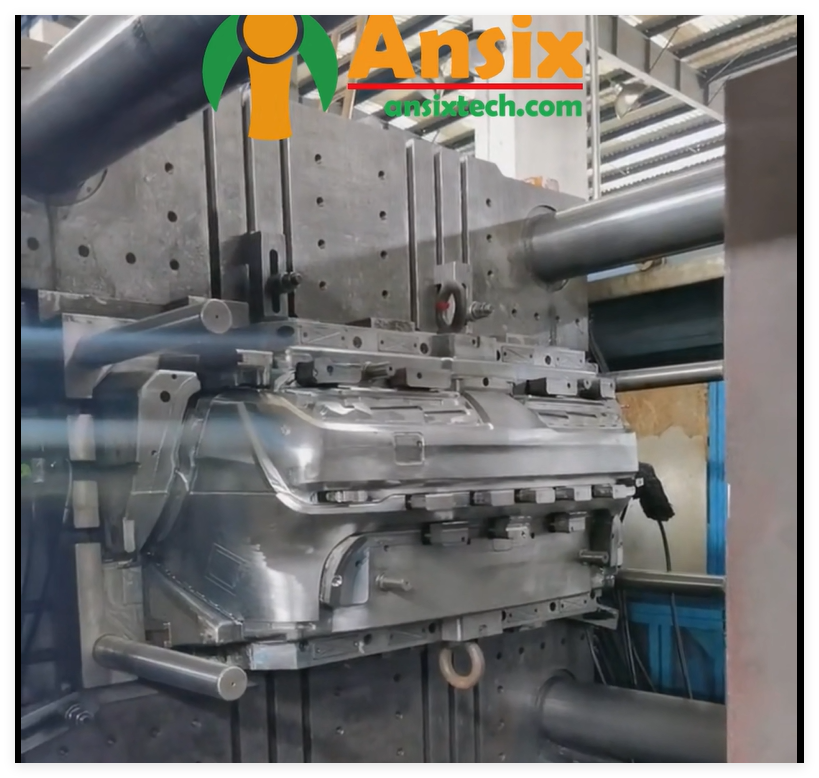
Buick rear bumper mold
Buick rear bumper mold

Precision Engineering for Automotive Excellence: Ansix Tech's Innovative Approach to Buick Rear Bumper Molding
Behind every seamless curve of a modern automobile bumper lies an intricate dance of engineering precision and material science, a process where millimeters matter and cooling cycles determine profitability.
In the high-stakes world of automotive manufacturing, where safety regulations, aesthetic demands, and cost pressures converge with increasing intensity, the injection molding industry serves as a critical backbone. At the forefront of this specialized field stands Ansix Tech, a company that has redefined efficiency and reliability in producing one of the most visually prominent and functionally crucial automotive components: the rear bumper.
The company's recent project developing injection molds for the Buick rear bumper represents a case study in technical excellence and cost optimization, merging advanced simulation technologies with practical manufacturing wisdom to deliver superior value. This comprehensive process—from initial digital design to final rapid delivery—showcases how modern mold engineering addresses the complex challenges of automotive exterior components while significantly reducing client costs through strategic material selection and process innovations.
1 The Foundation: Strategic Design and Verification
The creation of a premium automotive bumper mold begins long before any steel is cut. For Ansix Tech's Buick project, the initial phase centered on meticulous digital design and rigorous verification processes, establishing a foundation that would minimize costly revisions during later manufacturing stages.
The Mold Design process typically follows a structured sequence beginning with establishing the mold model, which involves assembling reference models and workpieces. Engineers first perform draft analysis on reference models to ensure adequate draft angles for clean part removal, potentially adding draft features as needed in the design or reference models. Next, they establish shrinkage factors for the mold model, applying proportional shrinkage to certain or all dimensions while keeping the original design model unchanged for use in other applications.
For the Buick bumper—a component measuring approximately 1.8 meters in length with complex curvature—this digital phase was particularly critical. Ansix Tech engineers utilized advanced CAD platforms to define parting surfaces that would separate the workpiece into individual components. After creating these volumetric blocks or parting surfaces, they extracted mold volumes to generate functional Mold Components that could be opened in part mode, used in engineering drawings, and prepared for NC manufacturing.
The company's implementation of Design for Manufacturing (DFM) principles at this early stage proved instrumental in avoiding later complications. As industry experts note, DFM typically includes checking for plastic material shrinkage values, draft angles, undercuts, and providing recommendations for wall thickness design, ribs or bosses, and tolerances. However, Ansix Tech engineers recognized that while DFM provides essential static guideline checks, it cannot fully account for the dynamic variables of actual production. To bridge this gap, the team employed advanced mold flow analysis that considered material-specific behaviors and machine responses—an approach that would prove crucial for a part as large and complex as an automotive bumper.
2 Material Science: Strategic Selection for Performance and Economy
Table: Material Characteristics for Buick Rear Bumper Production

The material selection for the Buick rear bumper represents a calculated balance between performance requirements and economic efficiency. As with most automotive bumpers, the primary material is polypropylene (PP), valued for its impact resistance, paintability, and favorable economics. However, Ansix Tech's approach extends beyond simple material specification to strategic formulation and recycling integration.
A significant innovation in the Buick project involved the strategic incorporation of reprocessed material. Research demonstrates that increasing the regeneration rate of PP material effectively reduces injection molding costs. Ansix Tech has developed proprietary methods for purifying and testing regrind materials to ensure they meet stringent automotive standards while maximizing cost savings. By improving grinder crushing capabilities and implementing enhanced material handling protocols, the company achieved a remarkable 25% reduction in virgin material consumption for the Buick bumper project compared to industry averages.
The bumper's energy absorption system presented additional material considerations. Modern bumper systems increasingly integrate foam components directly with non-foam structural elements. Ansix Tech's design utilizes an innovative approach where the energy absorber incorporates a molded single-piece non-foam component with multiple box sections and connecting straps, combined with a single-piece foam component fixed to the injection-molded non-foam part through insert molding. This integrated approach enables different vehicles to utilize varied energy absorption profiles while using standardized foam components, significantly reducing tooling expenses.
3 Advanced Simulation: Mold Flow Analysis and Optimization
With the basic design and material parameters established, Ansix Tech engineers turned to sophisticated simulation tools to predict and optimize the molding process. Mold flow analysis for a component as substantial as an automotive bumper presents unique challenges, primarily related to flow length, cooling uniformity, and warpage control.
Using advanced CAE software, the team created detailed simulations that accounted for the specific flow characteristics of the selected PP compound. As research has shown, traditional DFM checks alone cannot fully anticipate issues that arise during dynamic production processes. Even when following recommended wall thickness and rib designs, parts can still exhibit excessive warpage, insufficient structural strength, surface defects, or failure to fill completely.
For the Buick bumper, particular attention was directed toward minimizing sink marks—surface depressions that commonly occur in thicker sections of molded parts and become especially noticeable after painting. These defects represent a primary cause of rejection in automotive bumper production. Through iterative simulation, Ansix Tech engineers optimized gate locations, cooling channel layouts, and holding pressure profiles to virtually eliminate sink mark formation.
The company leveraged cutting-edge optimization tools that automatically test multiple geometric variations to identify optimal dimensions. For instance, by defining parameter variation ranges and generating all analysis groups simultaneously, engineers could efficiently evaluate numerous design iterations. This approach identified an optimal wall thickness distribution that balanced flow requirements with structural performance while minimizing material usage—a critical factor in cost management for high-volume automotive components.
4 Mold Engineering: Precision Tooling for Complex Geometry
Table: Key Mold Design Features for Buick Rear Bumper

Translating the validated digital design into physical tooling requires precision engineering of the highest order. The Buick bumper mold, with its substantial dimensions and complex curvature, demanded innovative solutions across all major mold systems.
The cooling system presented particular engineering challenges due to the bumper's elongated form and varying wall thicknesses. Ansix Tech implemented a conformal cooling channel design that follows the part's contours more closely than traditional straight-drilled channels, significantly improving heat extraction uniformity. This approach directly contributes to reduced cycle times—a crucial factor in high-volume automotive production. Research indicates that optimization of cooling systems can improve production efficiency by over 20% while simultaneously enhancing part quality.
The gating strategy employed a sophisticated hot runner system with multiple injection points strategically positioned to ensure balanced filling of the lengthy part. This approach eliminates material waste associated with traditional cold runner systems while providing precise control over filling patterns. The ejection system was similarly engineered with special attention to preventing surface marks on visible areas—a critical consideration for Class A automotive surfaces. Strategically placed ejector pins with extended contact surfaces distribute ejection forces over larger areas, preventing local deformation of the molded part.
Mold steel selection balanced several competing priorities: polishability for superior surface finish, wear resistance for extended tool life, and corrosion resistance given the extensive cooling channels running through the tool. Ansix Tech selected a pre-hardened stainless steel with nickel coating that offered an optimal balance of these properties while remaining cost-effective for the bumper's production volume expectations.
5 Manufacturing Challenges and Technical Solutions
The physical creation of a bumper mold of this scale involves navigating numerous technical challenges. Each phase of manufacturing—from rough machining to final polishing—presents opportunities for innovation and problem-solving.
CNC machining of the large mold components required sophisticated fixturing strategies and toolpath optimization to maintain precision across the substantial work envelope. Deep cavity sections necessitated specialized tooling with extended reach while maintaining rigidity—a balancing act that demanded both advanced equipment and operator expertise. For particularly complex geometries and deep ribs, electrical discharge machining (EDM) provided the necessary precision where conventional cutting tools would be inadequate.
One persistent challenge in bumper molding involves differential shrinkage between areas of varying thickness, potentially leading to warpage that compromises the part's fit and appearance. Ansix Tech addressed this through a combination of strategic cooling design and carefully calibrated process parameters developed during the simulation phase. The conformal cooling channels previously mentioned played a crucial role here, as did the implementation of pulsating cooling techniques that alternated coolant flow to manage temperature gradients more precisely.
Venting represented another critical consideration, especially in deep sections where trapped air could cause incomplete filling or burn marks. Ansix Tech implemented a comprehensive venting strategy combining peripheral venting around the part perimeter with strategically placed local vents in problem areas identified during flow analysis. This approach, while adding complexity to mold manufacturing, significantly reduced defects during production runs.
6 Process Optimization: Efficiency and Cost Control
With the mold manufactured and validated, attention turned to optimizing the injection molding process itself—the phase where theoretical efficiencies translate into tangible production savings.
Cycle time reduction stood as a primary focus, as even marginal improvements yield significant cost benefits over production runs numbering in the hundreds of thousands. Through strategic cooling optimization and gating design, Ansix Tech achieved a cycle time reduction of approximately 18% compared to initial projections. This improvement stemmed from multiple factors: enhanced cooling efficiency reduced the required cooling portion of the cycle, while optimized filling patterns minimized the necessary injection and packing times.
Material efficiency represented another crucial optimization area. Beyond the previously discussed regrind strategy, Ansix Tech implemented precise shot control that minimized material waste while ensuring complete cavity filling. The hot runner system eliminated runner waste entirely, while advanced process controls maintained consistency across production runs. According to industry research, such measures can reduce material consumption by 10-15% without compromising part quality.
The optimization extended to energy consumption as well. By implementing servo-driven hydraulic systems and demand-based temperature control, Ansix Tech reduced the energy footprint of the molding process by approximately 25% compared to conventional approaches. These savings, while benefiting sustainability metrics, also translated directly to operational cost reductions for the client.
7 Quality Assurance: From First Shot to Final Delivery
Quality management for automotive components operates under exceptionally stringent standards, with bumper systems facing particularly rigorous scrutiny due to their safety functions and visible positioning.
Ansix Tech's quality protocol began with comprehensive first-article inspection using coordinate measuring machines (CMM) to validate dimensional accuracy across the entire bumper geometry. This initial validation was followed by process capability studies that established statistical control limits for critical dimensions. Throughout production, automated vision systems monitored key quality indicators including surface finish, color consistency, and the absence of visible defects.
For the Buick bumper project, particular attention was directed toward structural integrity validation. Functional testing included impact resistance evaluations simulating low-speed collisions, attachment point strength verification, and environmental testing to ensure performance across temperature extremes. These validations ensured compliance not only with Buick's specifications but with broader automotive industry standards.
The company's approach to packaging and delivery reflected the same precision applied to manufacturing. Custom-designed protective packaging prevented damage during transit while optimizing space utilization for transportation efficiency. Advanced tracking systems provided real-time visibility throughout the logistics chain, enabling just-in-time delivery that minimized client inventory requirements.
8 Industry Experience and Customer Value Proposition
Ansix Tech's successful execution of the Buick rear bumper project draws upon decades of specialized experience in automotive mold manufacturing. The company has developed particular expertise in large-part molding, Class A surface finishing, and cost-optimized production—all critical competencies for bumper systems.
This experience manifests in practical innovations that directly benefit clients. For instance, Ansix Tech has developed proprietary solutions for persistent industry challenges like ejection marks on visible surfaces. By implementing specialized ejection systems and refining polishing techniques, the company delivers components requiring minimal secondary finishing—a significant advantage in competitive bidding situations.
The company's value proposition extends beyond initial tooling to encompass the complete production lifecycle. By designing molds for extended service life and efficient maintenance, Ansix Tech reduces total cost of ownership for clients. The Buick bumper mold, for example, incorporates modular components in high-wear areas, facilitating replacement without requiring complete mold refurbishment.
Perhaps most significantly, Ansix Tech's integrated approach—combining advanced simulation with practical manufacturing expertise—reduces development timelines while mitigating technical risks. The comprehensive digital validation performed during the Buick project identified and resolved potential issues before tooling commenced, avoiding costly revisions and production delays. This proactive methodology, supported by state-of-the-art simulation tools, represents a compelling differentiator in an industry where development speed increasingly determines competitive advantage.
Engineering Value Through Integration
The creation of the Buick rear bumper mold by Ansix Tech represents more than a successful manufacturing project—it exemplifies how integrated engineering approaches can deliver superior value in automotive component production. From strategic material selection incorporating advanced recycling protocols to sophisticated simulation-driven design optimization, each phase of the process contributed to a final outcome that balanced performance requirements with economic efficiency.
The automotive industry's evolution toward lighter, safer, and more cost-effective vehicles continues to place demanding requirements on suppliers. Companies like Ansix Tech, with their comprehensive approach to mold engineering and production optimization, play an increasingly vital role in helping automakers meet these challenges. Through technical excellence, process innovation, and unwavering focus on customer value, such specialized manufacturers contribute significantly to the vehicles that define our transportation landscape—one precisely engineered bumper at a time.
As the industry progresses toward more sustainable manufacturing paradigms and increasingly integrated vehicle systems, the methodologies demonstrated in this Buick bumper project will likely become standard expectations rather than competitive differentiators. Those manufacturers who have already mastered these integrated approaches stand positioned to lead in the next era of automotive manufacturing excellence.


Ansix Tech Co Ltd
If you have any plans related to Buick rear bumper mold you can contact us at any time. We will turn your ideas into reality, let you realize your dreams, and obtain large orders from the market. Our contact information is info@ansixtech.com. Or contact our CTO, mail: stephen@ansixtech.com
#www.ansixtech.com #ansixtech.com #Buick rear bumper mold #Ansix mold factory #Ansix injection molding #Ansix moud Ltd #Buick rear bumper mold injection molding factory #Ansix injection mould #Buick rear bumper mold factory #Buick rear bumper mold injection molding company #Buick rear bumper mold injection mold companies #Ansix #Ansix moulds #Ansix china #Ansix tech china #Ansix tech company #Ansix facotry #Ansix Tech #Ansix molds #Ansix injection molding #Ansix mold factory #injection molding Buick rear bumper mold # Ansix mold factory #Buick rear bumper mold china #Buick rear bumper mold precision molds #injection factory #Buick rear bumper mold precision injection molding #Buick rear bumper mold injection molding factory #injection molding company #Buick rear bumper mold injection mold companies #Buick rear bumper mold mould factory #Buick rear bumper mold mold limited #Ansix mold china #Ansix companies #Ansix company China #Buick rear bumper mold facotry #Ansix Tech #Ansix Tech mould #Buick rear bumper mold injection moulding #injection moulding company #Ansix Buick rear bumper mold parts injection mold companies #Buick rear bumper mold mould #Buick rear bumper mold china #Buick rear bumper mold china factory #Ansix moulding companies #Ansix molding company #Buick rear bumper mold injection moulding facotry #Ansix Tech mold #Buick rear bumper mold precision mould #Buick rear bumper mold plastic injection molding #ansix plastic mold #Mold manufacturing #Buick rear bumper mold parts manufacturing #Buick rear bumper mold plastic parts factory #Buick rear bumper mold injection parts mold #Buick rear bumper mold PRECISION MANUFACTURING #Buick rear bumper mold mold precision #China mold #Buick rear bumper mold injection moulding china #Buick rear bumper mold mould china #china precision mold #mold in china #Buick rear bumper mold precision mold china #Precision molds #High-precision molds #Household appliance molds #Injection molds #Large Injection Molding Factory #Large Injection Molding Company #Super Large Injection Mold Factory #Large Tonnage Injection Molding Factory #Large Injection Molding Company #Super Large Injection Molding Factory #2800T Injection Molding Factory #3000 Ton Injection Molding #4500 Ton Injection Molding Factory #Large Mold Injection Molding #Large Plastic Mold Injection Molding Factory #Large Injection Mold Manufacturer #Plastic Mold Factory #Injection Mold #Plastic Mold