



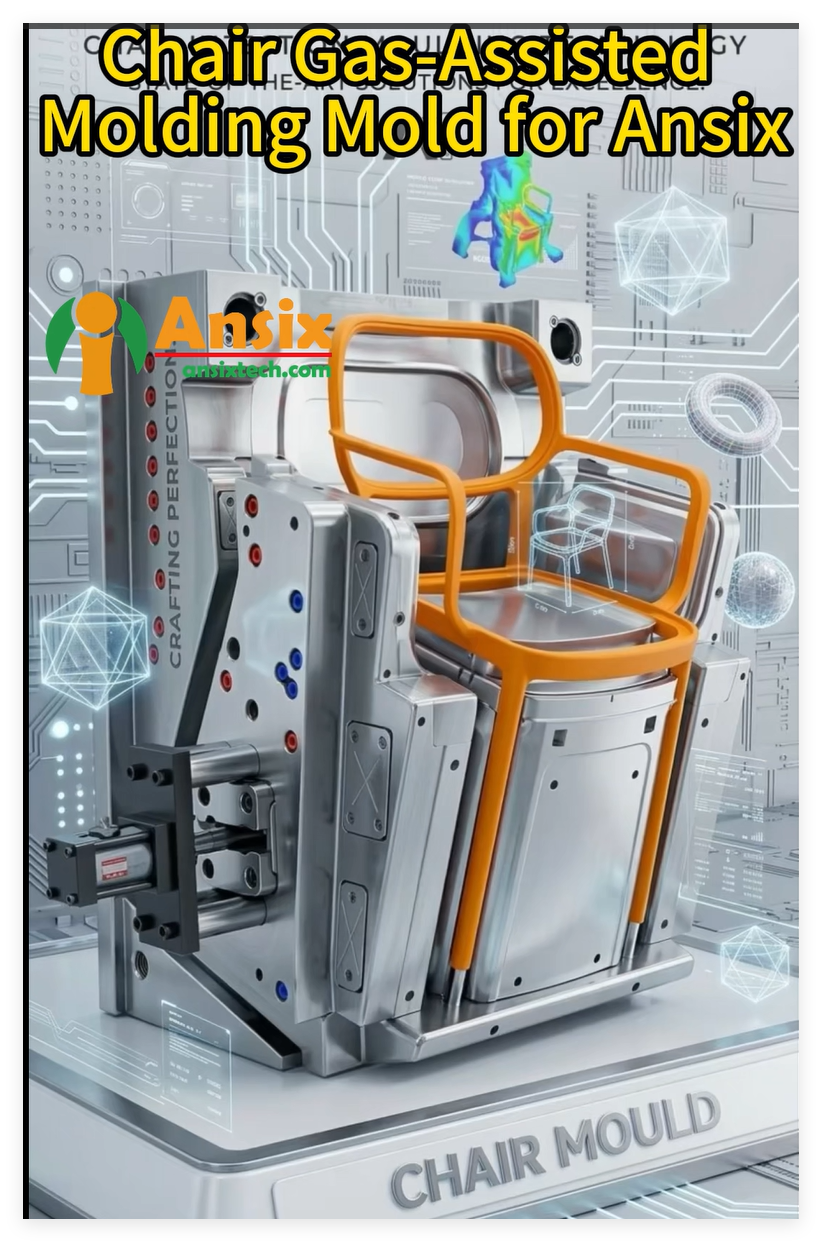
Chair Gas-Assisted Molding Mold
Chair Gas-Assisted Molding Mold

The Air of Excellence: How Ansix Tech is Redefining High-Volume Chair Production Through Gas-Assisted Molding Mastery
In the competitive landscape of industrial manufacturing, where the difference between market leadership and obsolescence is often measured in grams of material and seconds of cycle time, the art of molding has evolved into a science of precision engineering. For over twenty-eight years, one name has stood at the forefront of this specialized niche—particularly in the demanding sector of seating solutions. Ansix Tech has carved out an unparalleled reputation not merely as a supplier, but as a strategic partner in the design and manufacturing of Chair Gas-Assisted Molding Molds.
As the global furniture industry pivots toward lightweight durability, ergonomic complexity, and sustainable cost-efficiency, the injection molding process must adapt. Traditional injection molding struggles with the thick cross-sections, sink marks, and warpage inherent in robust chair components like armrests, seat shells, and backrest frames. This is where gas-assisted molding (GAM) transcends conventional limitations, and where Ansix Tech has established its dominion. By leveraging over two and a half decades of specialized experience, Ansix Tech provides a comprehensive lifecycle service—from prototype design and manufacturing validation to mass production and assembly verification—ensuring that clients receive not just a mold, but a complete manufacturing solution engineered for profitability.
The Strategic Initiation: Engineering Value Before Steel is Cut
The journey of a chair gas-assisted mold at Ansix Tech begins long before the first chip of steel is removed. It starts with a philosophy rooted in Project Initiation that prioritizes client-specific product standards above all else. In an industry where the final product must withstand rigorous dynamic loading (often exceeding ANSI/BIFMA standards) while maintaining a premium aesthetic, Ansix Tech’s approach is holistic.
The value delivered to clients is quantifiable from day one. Ansix Tech engages in deep-dive consultations to understand the end-market application—whether it is a high-end executive office chair requiring a flawless Class A surface finish or a heavy-duty stacking chair for commercial use requiring structural integrity under extreme loads. By aligning mold design with client brand expectations and market demands, Ansix Tech eliminates the costly disconnect between product design and manufacturability.
A significant problem Ansix Tech solves is the inherent risk of "design for manufacturing" (DFM) mismatches. In standard mold-making scenarios, a client might present a 3D model that looks perfect on screen but is impossible to produce efficiently in high volumes due to flow imbalances or gas penetration issues. Ansix Tech mitigates this through rigorous Mold Flow Analysis (MFA) . Utilizing advanced simulation software, the engineering team analyzes the polymer melt behavior, identifying weld lines, air traps, and, most critically, the behavior of the pressurized nitrogen gas used in the process.
During this DFM phase, Ansix Tech addresses the specific challenges of gas-assisted technology: gas fingering, blow-through, and uneven hollowing. By simulating the gas injection parameters—delay time, pressure profiles, and gas volume—the team optimizes the design to ensure that the gas follows the path of least resistance through the thickest sections, creating a hollow channel that reduces weight without compromising strength. This preemptive engineering saves clients hundreds of thousands of dollars in potential tool modifications and production delays later in the project lifecycle.
The Alchemy of Materials: Selecting the Right Raw Components
The performance of a gas-assisted mold is intrinsically linked to the metallurgical quality of the mold itself. Ansix Tech’s manufacturing capabilities are underpinned by a stringent selection process for raw materials used in mold components. Recognizing that chair molds often endure millions of cycles with abrasive glass-filled polymers (such as Nylon PA6 or PA66 reinforced with 30-50% glass fiber), the choice of steel is critical.
For core and cavity components subjected to high wear and corrosion from polymer off-gassing, Ansix Tech predominantly utilizes Stavax ESR (Electro-Slag Remelted) or S136 grades of stainless steel. These materials offer exceptional corrosion resistance, which is vital for maintaining polished surfaces over long production runs. The specific grade, DIN 1.2083 (equivalent to AISI 420) , is frequently employed for its hardness (typically heat-treated to 48-52 HRC) and its ability to take a high polish—a non-negotiable requirement for chair surfaces that will be visible in an office environment.
For structural components of the mold base and support plates, where rigidity is paramount to withstand high clamping tonnage and gas injection pressures, Ansix Tech employs P20 + Ni (DIN 1.2738) . This pre-hardened steel (approx. 34-38 HRC) offers superior toughness and uniform hardness through thick sections, ensuring the mold base does not deflect under pressure. The nickel content enhances through-hardening capabilities, which is essential for maintaining parallelism and flatness—critical factors for preventing flash on large-format chair molds.
For sliding components, such as core pulls used to form complex undercuts in chair armrests or mechanical fixing points, Ansix Tech selects H13 (DIN 1.2344) . This hot-work tool steel retains its hardness at elevated temperatures, resisting the wear and galling that occur during the high-speed linear movements required for automated production cycles.
Design and Development: Engineering for Air, Flow, and Ejection
The design and development phase for a Chair Gas-Assisted Molding Mold is where Ansix Tech’s expertise manifests in technical specificity. Unlike conventional molds, gas-assisted molds require a symbiotic relationship between the melt flow and the gas flow.
Critical Design Considerations
The primary challenge in chair molding is managing varying wall thicknesses. A chair back, for example, may be 3mm thick for flexibility but requires 8mm to 10mm thick ribs for structural rigidity at the junction with the seat. Without gas assist, these thick ribs would result in sink marks on the aesthetic surface.
Ansix Tech’s designers strategically place gas channels within these thick rib structures. The geometry of these channels is critical; they are designed with a specific "teardrop" or circular cross-section that guides the nitrogen gas to core out the thick section. The design philosophy focuses on achieving a ratio of hollowed cross-section to solid wall that maintains flexural modulus while reducing weight by 15% to 30% compared to solid molding.
Runner and Gating Systems
The gating system for gas-assisted molds differs fundamentally from standard injection. Ansix Tech employs a combination of hot runner systems and valve gates to precisely control the filling process. For large chair components, a sequential valve gate system is often utilized. This allows the mold to fill the farthest extremities of the part first before back-filling the thick sections, creating a pre-filled cavity that guides the subsequent gas injection.
The gas is typically injected through the same nozzle (gas-assisted injection molding, or GAIM) or through specialized gas pins located within the mold. Ansix Tech engineers the runners to ensure that the gas does not blow back into the runner system. This is achieved by precisely timing the gas injection—initiating the gas only when the melt front has reached the end of the cavity and the screw has retracted to prevent backflow.
Cooling Systems and Water Channels
Efficiency in high-volume production is dictated by cooling time. For gas-assisted molded chairs, cooling is a complex challenge because the gas creates an internal void that acts as an insulator, trapping heat inside the thick sections.
Ansix Tech solves this through conformal cooling . Using advanced 5-axis machining and, in some cases, additive manufacturing inserts, the cooling channels follow the complex curvature of the chair geometry. Rather than relying on straight-line drilled channels, Ansix Tech implements conformal channels that maintain a consistent distance (typically 10-15mm) from the cavity surface. For gas-assisted components, specialized "baffles" and "heat pipes" are integrated into the gas channel areas to extract heat from the thickest sections. This sophisticated cooling design reduces cycle times by up to 40% compared to traditional cooling layouts, directly boosting production capacity and reducing per-unit energy costs.
Ejection Systems
Ejection of gas-assisted chair molds presents unique challenges. Because the part is often larger and thinner than a conventional solid part, it is prone to deformation during ejection. Ansix Tech utilizes a combination of hydraulic ejectors, pneumatic air poppets, and telescoping sleeves on core pins. The ejection system is meticulously timed; air poppets release vacuum pressure before the ejector pins contact the part, ensuring the delicate gas-assisted channels are not crushed or marked. For complex chair frames, robotic extraction systems are integrated, with the mold designed to accommodate gripper pads, ensuring the part is removed cleanly and consistently without human intervention.
Manufacturing Capabilities: Precision Meets Scale
Ansix Tech’s manufacturing facility is a testament to its 28 years of experience. The production of these high-precision molds requires a workflow that marries traditional craftsmanship with digital precision. The process begins with high-speed machining centers capable of achieving tolerances of ±0.005mm. For the gas-assisted channels, which require a mirror finish to prevent gas adhesion and turbulence, CNC milling is followed by EDM (Electrical Discharge Machining) with fine-grain graphite electrodes to achieve the necessary surface finish without compromising the intricate geometry of the gas entry points.
Manufacturing Challenges
One of the most significant challenges in manufacturing chair gas-assisted molds is the creation of the gas pin seals. These are the points where nitrogen enters the cavity. Any imperfection here leads to gas leakage, resulting in incomplete hollowing or "short shots." Ansix Tech employs specialized heat-treating processes for these pins, utilizing vacuum hardening to maintain dimensional stability.
Additionally, the manufacturing team focuses heavily on venting. In gas-assisted molding, air entrapment is a primary cause of burns and aesthetic defects. Ansix Tech integrates laser-cut venting slots (depths of 0.02mm to 0.05mm) along the parting line and at the extremities of the gas flow path. This ensures that as the gas expands, the displaced air is evacuated efficiently, preventing compression burns that would scrap expensive parts.
Quality Validation: The Rigor of Process Optimization
For Ansix Tech, the mold is not complete until it has passed a grueling validation process that mirrors, and often exceeds, the client’s mass production environment. The validation process is multi-phased:
T1 (First Shot) Testing: This initial trial focuses on dimensional integrity and the successful initiation of the gas circuit. Engineers check for "gas breakthrough" (where the gas escapes the intended channel) and confirm that the gas core-out ratio meets the structural FEA (Finite Element Analysis) predictions.
Process Window Study: Ansix Tech conducts a systematic variation of parameters—melt temperature, gas pressure, gas hold time, and cooling time—to define the widest possible processing window. This ensures that even with slight variations in raw material batches (common in the plastics industry), the client’s production team can produce consistent parts without stopping the line.
CMM and Optical Scanning: Every critical dimension, particularly the mounting points for chair mechanisms (which require precise tolerances for safety), is verified using Coordinate Measuring Machines (CMM) and blue-light 3D scanners. The scanner compares the molded part to the original CAD model, generating a heat map that identifies any warpage or shrinkage variation.
Cycle Time Optimization: Through iterative testing, the validation team fine-tunes the cooling system to achieve the lowest possible cycle time while maintaining dimensional stability. This directly translates to the client’s bottom line.
Addressing Injection Molding Challenges
The inherent challenges of injection molding for chair components are numerous: warpage due to anisotropic shrinkage, sink marks over ribs, and the high cost of materials. Ansix Tech addresses these through strategic optimization of the injection molding process.
By utilizing gas assist, Ansix Tech solves the warpage issue by eliminating packing pressure. In conventional molding, high packing pressure is required to sink material into thick sections, which introduces internal stress. With gas assist, the gas pressure holds the material against the cavity wall without the need for excessive packing, resulting in lower residual stress and flatter parts.
From a cost control perspective, the reduction in material usage is substantial. For a standard office chair armrest, gas-assisted molding can reduce the weight by 20% compared to a solid part. Over a production run of 500,000 units, this represents a significant reduction in tangible product costs.
Boosting Production Capacity and Ensuring On-Time Delivery
Ansix Tech’s operational model is built on the principle that a mold is only valuable if it produces parts reliably at scale. To boost client production capacity, Ansix Tech designs molds with high cavitation where possible, but more importantly, with rapid changeover features. Standardized clamping plates, water manifolds, and electrical connections allow molds to be swapped out in under 15 minutes, minimizing downtime.
The workflow for rapid delivery is meticulously managed. Upon order confirmation, a project manager is assigned to monitor the critical path—from steel ordering (which often involves long lead times for specialized grades) to heat treatment and final assembly. Ansix Tech maintains a strategic inventory of standard mold bases and raw materials, shaving weeks off lead times.
Packaging is also a critical component of delivery. Ansix Tech provides comprehensive packaging solutions for the molds themselves, utilizing corrosion inhibitors and vacuum-sealed wrapping to ensure the mold arrives at the client’s facility in the same pristine condition it left the assembly floor.
Experience and Reliability: The Ansix Tech Advantage
With over 28 years of manufacturing experience, Ansix Tech has accumulated an institutional knowledge base that is invaluable to clients entering the furniture market. This experience allows the company to act as a consultant, not just a vendor. When a client brings a new chair design to Ansix Tech, the engineering team can predict failure modes related to gas assist based on decades of historical data.
This reliability translates into a consistent value proposition: the reduction of tangible product costs. Through strategic optimization of materials (using specific steel grades to prolong mold life), manufacturing processes (implementing conformal cooling to reduce cycle times), and operational efficiency (designing for automation and minimal maintenance), Ansix Tech ensures that the total cost of ownership for a mold is significantly lower than industry averages.
Furthermore, by controlling the entire lifecycle—from prototype design to assembly verification—Ansix Tech eliminates the finger-pointing that often occurs when a mold maker blames the molder, or vice versa. The company takes full responsibility for the manufacturability of the chair. If a component requires verification of assembly tolerance, Ansix Tech performs in-house assembly trials, ensuring that the armrest fits the back frame, and the back frame fits the mechanism, before the mold ever ships.
Conclusion
In the specialized field of Chair Gas-Assisted Molding Molds, Ansix Tech stands as a paragon of engineering excellence and operational reliability. By mastering the intricate interplay of high-pressure nitrogen, polymer rheology, and precision tooling, the company delivers solutions that solve the most persistent challenges of the furniture industry: weight reduction, structural integrity, aesthetic perfection, and cost efficiency.
From the careful selection of S136 and P20+Ni steels to the sophisticated implementation of conformal cooling and sequential valve gates, every aspect of Ansix Tech’s process is optimized for high-volume success. The company’s rigorous validation protocols and strategic focus on client-specific product standards ensure that once a mold enters mass production, it remains there—running efficiently, delivering consistent quality, and generating value.
For clients looking to launch or scale their seating product lines, Ansix Tech offers more than a mold; it offers a partnership backed by 28 years of specialized experience. In an industry where the margin of success is defined by speed, quality, and cost, Ansix Tech provides the air of excellence that lifts its clients above the competition.


Ansix Tech Co Ltd
If you have any plans related to Chair Gas-Assisted Molding Mold , you can contact us at any time. We will turn your ideas into reality, let you realize your dreams, and obtain large orders from the market. Our contact information is info@ansixtech.com. Or contact our CTO, mail: stephen@ansixtech.com
#www.ansixtech.com #ansixtech.com #Chair Gas-Assisted Molding Mold #Chair Gas-Assisted Molding Mold#Chair Gas-Assisted Molding Mold injection molding company #Chair Gas-Assisted Molding Mold injection mold companies #Ansix #Ansix moulds #Ansix china #Ansix tech china #Ansix tech company #Ansix facotry #Ansix Tech #Ansix molds #Ansix injection molding #Ansix mold factory #injection molding Chair Gas-Assisted Molding Mold #Ansix mold factory #Chair Gas-Assisted Molding Mold china #Chair Gas-Assisted Molding Mold molds #injection factory #Chair Gas-Assisted Molding Mold injection molding #Chair Gas-Assisted Molding Mold injection molding factory #injection molding company #Chair Gas-Assisted Molding Mold injection mold companies #Chair Gas-Assisted Molding Mold#Chair Gas-Assisted Molding Mold mold limited #Ansix mold china #Ansix companies #Ansix company China #Chair Gas-Assisted Molding Mold facotry #Ansix Tech #Ansix Tech mould #Chair Gas-Assisted Molding Mold injection moulding #injection moulding company #Ansix Chair Gas-Assisted Molding Mold parts injection mold companies #Chair Gas-Assisted Molding Mold #Chair Gas-Assisted Molding Mold china #Chair Gas-Assisted Molding Mold china factory #Ansix moulding companies #Ansix molding company #Chair Gas-Assisted Molding Mold injection moulding facotry #Ansix Tech mold #Chair Gas-Assisted Molding Mold mould #Chair Gas-Assisted Molding Mold plastic injection molding #ansix plastic mold #Mold manufacturing #Chair Gas-Assisted Molding Mold parts manufacturing #Chair Gas-Assisted Molding Mold plastic parts factory #Chair Gas-Assisted Molding Mold injection parts mold #Chair Gas-Assisted Molding Mold PRECISION MANUFACTURING #Chair Gas-Assisted Molding Mold #China mold #Chair Gas-Assisted Molding Mold injection moulding china #Chair Gas-Assisted Molding Mold mould china #china precision mold #mold in china #Chair Gas-Assisted Molding Mold mold china #Precision molds #High-precision molds #Chair Gas-Assisted Molding Mold #Injection molds #Chair Gas-Assisted Molding Mold Factory #Chair Gas-Assisted Molding Mold Company #Super Large Injection Mold Factory #Large Tonnage Injection Molding Factory #Chair Gas-Assisted Molding Mold Company #Chair Gas-Assisted Molding Mold Factory #2800T Injection Molding Factory #3000 Ton Injection Molding #4500 Ton Injection Molding Factory #Large Mold Injection Molding #Large Plastic Mold Injection Molding Factory #Large Injection Mold Manufacturer #Plastic Mold Factory #Injection Mold #Plastic Mold