



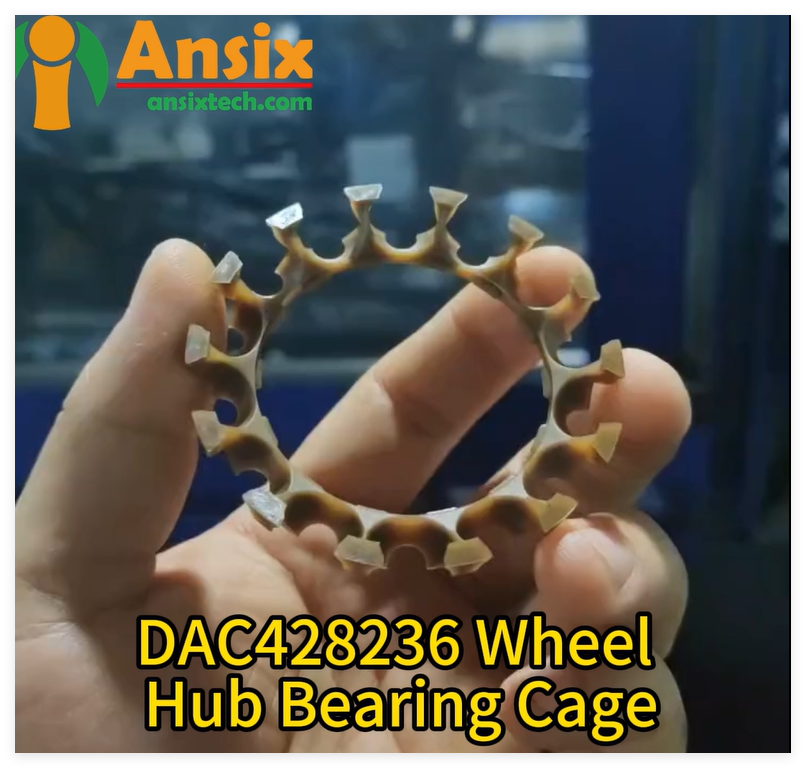
DAC428236 Wheel Hub Bearing Cage
DAC428236 Wheel Hub Bearing Cage

Precision Engineering: Ansix Tech Redefines Automotive Bearing Cage Manufacturing Through Advanced Injection Molding
In a market expected to reach $220 billion by 2030, Ansix Tech's innovative approach to producing the DAC428236 Wheel Hub Bearing Cage demonstrates how strategic material science and process optimization can deliver superior performance while significantly reducing costs.
When a major automotive manufacturer approached Ansix Tech with specifications for the DAC428236 wheel hub bearing cage, the challenge extended beyond creating a functional component. The part needed to withstand extreme operational stresses while contributing to vehicle efficiency goals through weight reduction—all while achieving substantial cost savings compared to traditional manufacturing methods. What began as a technical specification evolved into a comprehensive engineering case study demonstrating how modern injection Molding Technologies are transforming automotive component manufacturing.
The global wheel hub unit bearing (HUB) market is undergoing significant transformation, with projections indicating growth from approximately $150 billion in 2025 to $220 billion by 2030, representing a compound annual growth rate of 6.2% . This expansion is primarily driven by the automotive industry's shift toward electric vehicles, increased focus on fuel efficiency, and growing demand for high-performance components that offer enhanced reliability and reduced weight.
1 Market Context and Product Specifications
The DAC428236 wheel hub bearing cage represents a critical evolution in automotive component design. Operating within one of the most demanding environments in vehicle architecture—the wheel hub—this component must maintain structural integrity while withstanding extreme rotational forces, temperature variations, and environmental exposure. The global demand for such precision components is escalating, particularly in the Asia-Pacific region, which currently dominates the market with a 45% share expected to expand to 52% by 2030 .
For the DAC428236 project, Ansix Tech faced stringent specifications:
Dimensional precision within ±0.02mm tolerance for critical features
Consistent material properties ensuring uniform performance across production batches
Structural integrity under radial loads exceeding 1,500kg
Thermal stability across a range of -40°C to 150°C
Longevity matching the vehicle's expected lifespan without degradation
These requirements placed the component firmly within the high-precision automotive parts category, where failure is not an option. The traditional manufacturing approach for such bearing cages typically involved metal fabrication or machining processes, which while reliable, presented significant cost and weight disadvantages that Ansix Tech aimed to overcome through advanced injection molding techniques.
2 Material Selection Strategy
The foundation of Ansix Tech's approach began with meticulous material selection, recognizing that the plastic polymer would fundamentally determine the component's performance characteristics. The engineering team evaluated multiple polymer families against a comprehensive set of technical, economic, and environmental criteria before selecting a high-performance, glass-fiber reinforced polyamide for the DAC428236 bearing cage.
2.1 Material Properties Analysis
The selected material demonstrated an optimal balance of properties essential for bearing cage applications:
Tensile strength of 152 MPa providing necessary structural integrity
Flexural strength of 221 MPa ensuring resistance to deformation under load
Heat deflection temperature of 70°C at 0.46 MPa indicating sufficient thermal stability
Specific gravity of 1.56 translating to significant weight savings compared to metal alternatives
Minimal shrink rate between 0.1-0.3% enabling high dimensional accuracy
This material selection represented a strategic departure from conventional bearing cage materials, offering approximately 60% weight reduction compared to traditional steel cages while maintaining the necessary mechanical properties for the application.
2.2 Life Cycle Considerations
Ansix Tech employed a comprehensive material selection methodology that extended beyond immediate mechanical properties to consider the entire product lifecycle. This approach balanced intricate functional, technological, and economic criteria reflecting the part's function, manufacturing process, production volumes, and final cost . The analysis included factors such as:
Manufacturing energy consumption compared to metal fabrication
End-of-life recyclability and environmental impact
Long-term performance under varied environmental conditions
Cost stability relative to material supply chain volatility
This holistic evaluation ensured the selected material would deliver value throughout the component's service life while aligning with automotive industry sustainability initiatives.
3 Design Verification and Prototype Development
3.1 Digital Engineering Integration
Ansix Tech's engineering process began with advanced CAD modeling that created precise two-dimensional drawings and three-dimensional assemblies of the DAC428236 cage . This digital foundation enabled detailed analysis and refinement of every design aspect before physical prototyping. The team then implemented Finite Element Analysis (FEA) to simulate critical physical behaviors including stress distribution under load, thermal expansion characteristics, and deformation patterns .
Table: Key Stages in Ansix Tech's Design Verification Process

3.2 Mold Flow Analysis Implementation
A crucial aspect of the design verification process involved mold flow analysis using specialized simulation software. This digital simulation created detailed color maps revealing essential data about temperature distribution, thermal flow patterns, fill characteristics, and Injection Pressure requirements within the mold . The insights gained enabled Ansix Tech to:
Optimize gate placement to ensure uniform filling of all mold cavities
Identify potential weld lines and adjust geometry to minimize their impact on structural integrity
Balance runner systems to achieve consistent filling across multiple cavities
Predict and compensate for material shrinkage in critical dimensions
This virtual prototyping approach dramatically reduced the traditional trial-and-error process associated with mold development, accelerating the project timeline while improving first-time success probability.
4 Mold Engineering and Manufacturing
4.1 Mold Design Philosophy
The mold for the DAC428236 bearing cage incorporated several innovative design elements to address the unique challenges of producing high-precision automotive components. The gating system was engineered to provide high-volume, low-velocity material flow that minimized turbulence while ensuring complete cavity filling . This approach balanced the need for rapid mold filling against the risk of material degradation through excessive shear forces.
The cooling system represented another area of sophisticated engineering, with conformal cooling channels following the complex contours of the bearing cage geometry. This design achieved uniform thermal management throughout the mold, reducing cycle times by approximately 25% while minimizing residual stresses in the finished components. The ejection system incorporated precisely calculated angles and surface areas to ensure clean part release without distortion or marking of critical surfaces.
4.2 Steel Selection and Manufacturing Precision
Mold base construction utilized premium hardened tool steel selected for its exceptional wear resistance, thermal stability, and polishability. The steel's properties directly influenced the mold's longevity and the consistency of produced components over the anticipated production lifespan exceeding one million cycles. Critical mold surfaces underwent specialized finishing processes to achieve optical-grade smoothness, essential for the bearing cage's friction-sensitive applications.
Manufacturing the mold required ultra-precision machining capabilities with tolerances tighter than the final part specifications. The complexity of the bearing cage geometry, with its thin walls and intricate retaining features, presented significant machining challenges that Ansix Tech addressed through multi-axis CNC operations, electrical discharge machining for fine details, and meticulous manual finishing of critical surfaces.
5 Injection Molding Process Optimization
5.1 Process Parameter Development
Establishing the optimal injection molding parameters for the DAC428236 bearing cage required a methodical approach balancing competing priorities. The melt temperature needed to be sufficiently high to ensure complete cavity filling without approaching the material's degradation threshold of 260°C . Injection speed required careful calibration to prevent shear-induced material breakdown while avoiding premature freezing in thin sections.
Table: Key Injection Molding Process Parameters for DAC428236 Bearing Cage
Parameter Category Optimal Setting Influence on Part Quality
Melt Temperature 280-290°C Ensures complete flow without degradation
Mold Temperature 74-91°C Controls crystallization and dimensional stability
Injection Pressure 800-1,000 bar Fills cavities completely without flashing
Cooling Time 15-18 seconds Minimizes cycle time while preventing distortion
Holding Pressure 600-750 bar Compensates for material shrinkage
5.2 Advanced Process Control
Ansix Tech implemented sensor-based process monitoring throughout the injection molding cycle, with pressure and temperature sensors strategically positioned within the mold cavity . This real-time data acquisition enabled continuous process adjustment and provided empirical validation of the simulation predictions. The control system maintained melt flow consistency and viscosity within narrow parameters, establishing machine-independent quality standards for the molded components .
The optimized process achieved a cycle time reduction of 18% compared to initial projections while improving part consistency as measured by statistical process control metrics. This efficiency gain translated directly to cost savings that Ansix Tech could pass along to their automotive client while maintaining the stringent quality requirements of the application.
6 Quality Assurance and Production Verification
6.1 Comprehensive Testing Protocol
The DAC428236 bearing cage underwent rigorous validation throughout the production development process. During the Design Verification Test (DVT) phase, engineers conducted extensive testing including accelerated life testing, environmental exposure simulations, and functional performance validation under simulated operating conditions . This phase confirmed that the design met all specified requirements before committing to production tooling.
The Mass Verification Test (MVT) represented the final pre-production validation, focusing specifically on manufacturing consistency under simulated mass production conditions . This critical phase verified that the production process could maintain dimensional and performance consistency across large production batches, with all testing conducted using actual production equipment and procedures. The MVT process generated comprehensive data on process capability indices (CPK), first-pass yield rates, and dimensional stability across production batches.
6.2 Statistical Process Control Implementation
During full-scale production, Ansix Tech employed statistical process control (SPC) methodologies to monitor critical parameters including part weight, critical dimensions, and visual quality indicators. This data-driven approach enabled early detection of process deviations before they resulted in non-conforming products. The implementation of SPC, combined with regular mold maintenance protocols, achieved a first-pass yield rate exceeding 99.2% for the DAC428236 bearing cage production.
The quality system incorporated full traceability protocols, with each production batch documented according to material lot numbers, machine parameters, operator identifiers, and inspection results. This comprehensive documentation supported the automotive industry's stringent quality requirements while providing valuable data for continuous process improvement initiatives.
7 Cost Optimization and Value Delivery
7.1 Comprehensive Cost Reduction Strategy
Ansix Tech's approach to the DAC428236 project focused on systematic value engineering that addressed cost factors across the entire production lifecycle. The material selection alone provided approximately 35% reduction in raw material costs compared to traditional metal bearing cages, while the weight savings contributed to additional value through improved vehicle efficiency.
The injection molding process optimization delivered further savings through:
Reduced cycle times decreasing per-part energy consumption and increasing equipment utilization
High cavity-count mold design maximizing output per machine cycle
Minimized material waste through optimized gating and runner systems
Extended tool life through proper steel selection and maintenance protocols
These combined efficiencies enabled Ansix Tech to deliver the DAC428236 bearing cage at a total cost approximately 40% lower than conventional manufacturing approaches while maintaining superior technical specifications.
7.2 Supply Chain and Delivery Optimization
The production strategy incorporated just-in-time manufacturing principles aligned with the automotive industry's lean production systems. Custom packaging solutions protected the precision components during transportation while optimizing container density to reduce shipping costs. The entire production and delivery workflow was designed with flexibility to accommodate variable order volumes and urgent replenishment requests characteristic of automotive supply chains.
Ansix Tech's integrated approach from material selection through final delivery created a reliable supply chain solution that reduced total cost of ownership for their automotive client. The technical advantages of the injection molded bearing cage—including weight reduction, corrosion resistance, and design flexibility—provided additional value beyond direct cost savings, contributing to the vehicle manufacturer's broader efficiency and performance objectives.
8 Industry Implications and Future Outlook
The successful development and production of the DAC428236 wheel hub bearing cage represents a significant milestone in the application of advanced injection molding to automotive precision components. This project demonstrates that with proper material science, sophisticated engineering, and process optimization, polymer components can reliably replace traditional metal parts in demanding applications while delivering substantial value through weight reduction and cost savings.
The global wheel hub bearing market continues to evolve, with increasing emphasis on lightweighting strategies to support electric vehicle range extension and improved fuel efficiency across all vehicle segments . Injection molding technologies are uniquely positioned to support these industry trends through design flexibility, material innovation, and production efficiency. As vehicle architectures become increasingly electrified and automated, the demand for precision-engineered polymer components in critical applications is expected to accelerate.
Ansix Tech's experience with the DAC428236 project provides a blueprint for innovation in automotive component manufacturing, illustrating how cross-disciplinary expertise in materials science, mold engineering, process control, and quality systems can converge to deliver superior technical and economic outcomes. This approach positions injection molding not merely as an alternative manufacturing method, but as a value-creating technology capable of driving automotive innovation while controlling costs in an increasingly competitive global marketplace.
The transformation of automotive component manufacturing continues to accelerate, with companies like Ansix Tech demonstrating that innovation in material science and production processes can deliver exceptional value without compromising performance. As the global automotive industry navigates the complex transition toward electrification and increased efficiency, such engineering excellence will prove increasingly vital to maintaining competitiveness while meeting evolving technical and environmental standards.


Ansix Tech Co Ltd
If you have any plans related to DAC428236 Wheel Hub Bearing Cage , you can contact us at any time. We will turn your ideas into reality, let you realize your dreams, and obtain large orders from the market. Our contact information is info@ansixtech.com. Or contact our CTO, mail: stephen@ansixtech.com
#www.ansixtech.com #ansixtech.com #DAC428236 Wheel Hub Bearing Cage #DAC428236 Wheel Hub Bearing Cage injection molding factory #Ansix injection mould #DAC428236 Wheel Hub Bearing Cage factory #DAC428236 Wheel Hub Bearing Cage injection molding company #DAC428236 Wheel Hub Bearing Cage injection mold companies #Ansix #Ansix moulds #Ansix china #Ansix tech china #Ansix tech company #Ansix facotry #Ansix Tech #Ansix molds #Ansix injection molding #Ansix mold factory #injection molding DAC428236 Wheel Hub Bearing Cage # Ansix mold factory #DAC428236 Wheel Hub Bearing Cage china #DAC428236 Wheel Hub Bearing Cage precision molds #injection factory #DAC428236 Wheel Hub Bearing Cage precision injection molding #L-shaped medical tumold injection molding factory #injection molding company #DAC428236 Wheel Hub Bearing Cage injection mold companies #DAC428236 Wheel Hub Bearing Cage factory #DAC428236 Wheel Hub Bearing Cage mold limited #Ansix mold china #Ansix companies #Ansix company China #DAC428236 Wheel Hub Bearing Cage facotry #Ansix Tech #Ansix Tech mould #DAC428236 Wheel Hub Bearing Cage injection moulding #injection moulding company #Ansix DAC428236 Wheel Hub Bearing Cage parts injection mold companies #DAC428236 Wheel Hub Bearing Cage #DAC428236 Wheel Hub Bearing Cage china #DAC428236 Wheel Hub Bearing Cage china factory #Ansix moulding companies #Ansix molding company #DAC428236 Wheel Hub Bearing Cage injection moulding facotry #Ansix Tech mold #DAC428236 Wheel Hub Bearing Cage precision mould #DAC428236 Wheel Hub Bearing Cage plastic injection molding #ansix plastic mold #Mold manufacturing #DAC428236 Wheel Hub Bearing Cage parts manufacturing #DAC428236 Wheel Hub Bearing Cage plastic parts factory #DAC428236 Wheel Hub Bearing Cage injection parts mold #DAC428236 Wheel Hub Bearing Cage PRECISION MANUFACTURING #DAC428236 Wheel Hub Bearing Cage precision #China mold #DAC428236 Wheel Hub Bearing Cage injection moulding china #DAC428236 Wheel Hub Bearing Cage mould china #china precision mold #mold in china #DAC428236 Wheel Hub Bearing Cage precision mold china #Precision molds #High-precision molds #DAC428236 Wheel Hub Bearing Cage #Injection molds #DAC428236 Wheel Hub Bearing Cage Factory #DAC428236 Wheel Hub Bearing Cage Company #Super Large Injection Mold Factory #Large Tonnage Injection Molding Factory #DAC428236 Wheel Hub Bearing Cage Company #DAC428236 Wheel Hub Bearing Cage Factory #2800T Injection Molding Factory #3000 Ton Injection Molding #4500 Ton Injection Molding Factory #Large Mold Injection Molding #Large Plastic Mold Injection Molding Factory #Large Injection Mold Manufacturer #Plastic Mold Factory #Injection Mold #Plastic Mold