



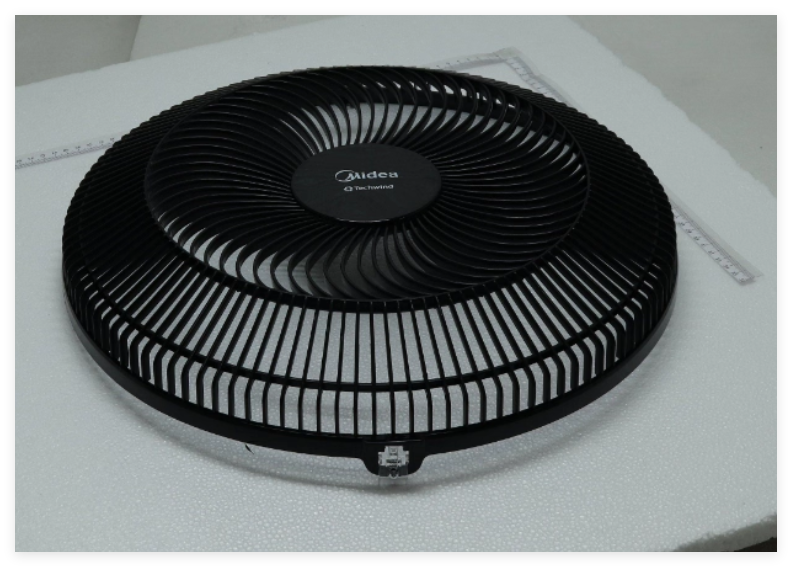
Electric fan rear grille
Electric fan rear grille

Precision in Motion: Ansix Tech Masters the Art of Fan Grille Manufacturing
In the high-stakes world of consumer appliance manufacturing, the unassuming rear grille of an electric fan represents a complex symphony of design, material science, and precision engineering, where fractions of a millimeter can separate market success from costly failure.
The Critical Component in Air Circulation
In the competitive landscape of home appliance manufacturing, the electric fan rear grille stands as a critical intersection of safety, performance, and aesthetics. While consumers may see only a simple plastic guard, industry engineers recognize it as a component where material science, Precision Molding, and regulatory compliance converge. This protective yet functional part must balance structural integrity with airflow efficiency, all while meeting stringent international safety standards for household electrical appliances .
The global fan market, driven by rising temperatures and increasing electrification, demands components that are not only reliable but also cost-effective. Injection molding has emerged as the dominant manufacturing process for these components, offering the repeatability, complexity, and efficiency needed for mass production. At the forefront of this specialized manufacturing sector is Ansix Tech, a company that has transformed the production of fan grilles through integrated engineering solutions and value-driven manufacturing.
Design and Standards: The Foundation of Safety
The development of any fan component begins not with a sketch, but with a thorough understanding of regulatory frameworks. The rear grille, as part of a fan assembly, must comply with multiple international standards that govern electrical safety, mechanical strength, and acoustic performance.
The primary safety standard, CAN/CSA C22.2 No. 60335-2-80-2017, adopts IEC requirements specifying that electric fans for household use must prevent access to hazardous moving parts while maintaining structural integrity under normal use . This standard effectively dictates critical design parameters for rear grilles, including barrier spacing (to prevent finger access), impact resistance, and flammability ratings. Simultaneously, IEC 60704-2-7:2020 establishes test codes for determining airborne acoustical noise, meaning the grille's design must minimize airflow turbulence that contributes to operational noise .
Beyond regulatory compliance, market expectations drive additional design considerations. Consumers increasingly demand sleek aesthetics, easy cleaning features, and material consistency. These requirements translate to specific engineering challenges: achieving thin yet rigid ribs, maintaining consistent surface finishes, and ensuring dimensional stability across thousands of production cycles.
The Prototype Pathway: From Concept to Verification
Ansix Tech's development process begins with comprehensive design analysis before any metal is cut. Using advanced CAE (Computer-Aided Engineering) systems, engineers perform mold flow simulations to predict how plastic will fill the mold cavity. This virtual prototyping phase, as highlighted in studies of fan shell manufacturing, helps identify potential defects like weld lines, air traps, and uneven cooling before committing to tooling .
During one recent rear grille project, simulation revealed that traditional gating would create weld lines across critical structural ribs. By relocating injection points based on flow analysis data, engineers eliminated these weaknesses in the virtual stage, saving an estimated three weeks of trial-and-error modifications. This approach aligns with industry research showing that CAE systems "can reduce costly trial-and-error loops and shorten development cycle, and correctly solve production problems on material property, product design, and mould design" .
Physical prototyping follows virtual validation. Ansix Tech often employs high-performance thermoplastics for prototype verification, including glass-filled materials that offer higher heat deflection temperatures and strength similar to production materials . These prototypes undergo rigorous testing for finger probe compliance, impact resistance, and long-term durability before the design is finalized for production tooling.
Material Selection: Engineering the Molecular Foundation
The choice of material fundamentally determines the performance, cost, and manufacturability of the rear grille. While numerous thermoplastics could technically meet basic requirements, Ansix Tech specializes in selecting the optimal balance of mechanical properties, thermal stability, and cost efficiency.
A commonly specified material for fan components is SAN (Styrene Acrylonitrile), particularly grades like SAN300 which offer excellent dimensional stability, high gloss finish, and good chemical resistance. The technical specifications of SAN300 reveal why it's so suitable: with a melt flow index of 35g/10min (200°C, 21.6kg), it exhibits high fluidity ideal for filling complex geometries, while maintaining a heat deflection temperature of 92°C (at 6.4mm, 18.6kg/cm²) sufficient for fan applications .
Table 1: Key Properties of SAN300 Material for Fan Grilles

For applications requiring enhanced mechanical properties, Ansix Tech may recommend glass-fiber reinforced composites that offer superior strength and stiffness. However, such materials present their own molding challenges, including increased wear on tooling and potential for fiber alignment issues that can create anisotropic shrinkage . The decision between standard and reinforced materials exemplifies Ansix Tech's value engineering approach, balancing performance requirements against total manufacturing cost.
Mold Engineering Excellence: The Heart of Precision
The injection mold represents the most critical capital investment in the production process, and its design determines not only part quality but also manufacturing efficiency. Ansix Tech approaches mold design as an integrated system where cooling, gating, ejection, and structural elements must work in harmony.
Mold Flow Analysis (DFM) serves as the cornerstone of this process. By simulating the filling pattern, pressure distribution, and cooling behavior, engineers optimize the complete molding system before manufacturing begins. This analysis helps determine the optimal injection location, which studies have shown significantly affects fill time, weld line formation, and required clamp force . For a rear grille with its intricate pattern of protective ribs, proper gate placement ensures complete filling without excessive injection pressure that could cause material degradation or flash.
The cooling system presents particular challenges for grille molds due to their typically thin but extensive rib structures. Traditional straight-drilled cooling channels often prove inadequate for uniform heat extraction from these complex geometries. Ansix Tech has increasingly adopted conformal cooling solutions made possible by additive manufacturing. As described in DfAM (Design for Additive Manufacturing) approaches, "3D printing as a data-driven additive manufacturing technology enables conformal cooling channels of any shape and cross-section" . These conformal channels follow the contour of the mold cavity, providing uniform cooling that reduces cycle times by up to 30% while minimizing warpage.
The runner and gating system must be precisely calibrated to the material's flow characteristics. For SAN300 with its high fluidity, Ansix Tech typically employs hot runner systems with thermally controlled nozzles to maintain material at optimal temperature, reducing waste and improving cycle time. The ejection system, often overlooked, receives careful attention as the delicate rib structure of fan grilles makes them susceptible to damage during part removal. Strategically placed ejector pins with optimized surface area prevent distortion or marking on visible surfaces.
Table 2: Critical Mold Design Considerations for Fan Grilles

Manufacturing Challenges and Workflow Optimization
The intricate geometry of fan grilles presents distinct manufacturing challenges. The thin-walled ribs that provide both safety protection and structural support are particularly difficult to fill completely without creating excessive injection pressure. Additionally, the intersection points of multiple ribs create areas where plastic flows converge, often resulting in weld lines that can weaken the structure .
A patented method addresses this exact challenge by incorporating overflow points at these convergence areas. According to the technique, "in the seam region of the cavity where plastic material converges from two directions during the injection molding process, plastic material is at least partially diverted from the cavity via at least two overflow points, thereby locally agitating or mixing the plastic material between the overflow points" . This innovation effectively eliminates weak weld lines at critical structural intersections.
Ansix Tech's mold manufacturing workflow integrates advanced technologies at every stage:
Design Validation: Comprehensive DFM analysis including mold flow, cooling, and structural simulations
Precision Machining: CNC programming using systems like UG NX for core and cavity creation
Surface Enhancement: Application of specialized coatings or textures to improve release and surface finish
System Integration: Assembly of cooling, ejection, and gating systems with meticulous alignment
Process Validation: Initial sampling with full parameter documentation and optimization
This systematic approach reduces time-to-market while ensuring production readiness from the first mold trial.
Process Optimization: The Efficiency Multiplier
Once the mold is perfected, attention turns to optimizing the injection molding process itself. Every second of cycle time reduction translates to substantial cost savings over a production run of hundreds of thousands of parts. Ansix Tech employs scientific molding principles to establish stable, repeatable processes rather than relying on operator adjustments.
Cooling optimization represents the most significant opportunity for cycle time reduction, as approximately 80% of the molding cycle is devoted to cooling . By implementing turbulent flow in cooling channels (with Reynolds numbers maintained between 4,000-8,000), heat transfer efficiency increases dramatically . In one documented case, implementing conformal cooling with precise temperature control reduced a panel component's cycle from 52 to 36 seconds—a 28% improvement that increased daily output from 1,300 to 1,670 pieces .
Material selection also influences process efficiency. While "wide-specification resins" (those with greater property variation) may be cheaper initially, they often lead to process variability and higher rejection rates . Ansix Tech's material expertise helps clients select resins with consistent flow characteristics that maintain dimensional stability while allowing for optimized processing conditions.
Quality Assurance: From Production to Packaging
Quality control in fan grille manufacturing extends beyond dimensional checks to encompass functional testing, cosmetic standards, and long-term reliability. Ansix Tech implements a multi-layered quality approach:
In-process monitoring: Cavity pressure sensors detect variations in fill patterns, allowing real-time adjustments and automatic rejection of non-conforming parts
Statistical process control: Tracking of critical dimensions over production runs to identify trends before they exceed tolerances
Functional testing: Sample testing for finger probe compliance, impact resistance, and assembly fit
Cosmetic inspection: Consistent surface evaluation under controlled lighting conditions
Packaging receives equal attention, as damaged components during shipping represent wasted production value. Custom-designed stackable trays protect the delicate rib structures during transit while optimizing container density. For high-volume orders, Ansix Tech can implement complete automated packaging systems that further reduce handling costs and damage risk .
Ansix Tech's Value Proposition: Engineering Cost Out of the Equation
What distinguishes Ansix Tech in the competitive injection molding landscape is its systematic approach to value engineering—not merely manufacturing components to specification, but re-engineering both product and process to deliver superior value. This philosophy manifests in three primary areas:
Material Optimization: By thoroughly understanding material properties and processing characteristics, Ansix Tech engineers can often recommend alternative materials that meet all functional requirements at lower cost. This might involve downgauging (using thinner sections made possible by material strength), suggesting recycled-content grades where appropriate, or identifying locally sourced alternatives that reduce logistics expenses.
Process Innovation: The implementation of conformal cooling channels, scientific molding techniques, and automated systems collectively drives down per-part costs. As noted in industry analyses, "when we begin to automate processes, we begin to remove variation, increase efficiency, improve quality, and increase available floor space" . These efficiencies compound throughout the production lifecycle.
Design for Manufacturability: Early engagement in the design process allows Ansix Tech to suggest modifications that simplify manufacturing without compromising function. This might involve adding slight draft angles to ease ejection, uniform wall thickness to improve filling, or consolidation of multiple components into a single molded piece.
A case study from a recent pedestal fan project illustrates this comprehensive approach. By suggesting a material change from a specialty resin to a modified SAN grade, implementing conformal cooling in the mold, and redesigning the attachment points for easier assembly, Ansix Tech reduced the total manufactured cost by 23% while improving part consistency and reducing assembly time at the customer's plant.
The Future of Fan Component Manufacturing
As appliance manufacturers face increasing pressure to reduce costs while improving quality and sustainability, partners like Ansix Tech become increasingly valuable. The next frontier in injection molding includes greater integration of IoT sensors for predictive maintenance, advanced machine learning algorithms for process optimization, and continued material innovation including higher bio-based content resins.
The electric fan rear grille, once considered a simple commodity component, has evolved into a showcase of precision manufacturing where engineering excellence directly translates to consumer value. Through its integrated approach encompassing material science, mold engineering, process optimization, and quality systems, Ansix Tech demonstrates how specialized manufacturers can drive innovation even in mature product categories.
In an industry where cost pressures constantly threaten to compromise quality, Ansix Tech's methodology proves that the most sustainable cost reduction comes not from cutting corners, but from engineering smarter solutions—a philosophy that benefits manufacturers, retailers, and ultimately consumers who enjoy reliable, affordable cooling products.


Ansix Tech Co Ltd
If you have any plans related to Electric fan rear grille , you can contact us at any time. We will turn your ideas into reality, let you realize your dreams, and obtain large orders from the market. Our contact information is info@ansixtech.com. Or contact our CTO, mail: stephen@ansixtech.com
#www.ansixtech.com #ansixtech.com #Electric fan rear grille #Electric fan rear grille injection molding factory #Ansix injection mould #Electric fan rear grille factory #Electric fan rear grille injection molding company #Electric fan rear grille injection mold companies #Ansix #Ansix moulds #Ansix china #Ansix tech china #Ansix tech company #Ansix facotry #Ansix Tech #Ansix molds #Ansix injection molding #Ansix mold factory #injection molding Electric fan rear grille # Ansix mold factory #Electric fan rear grille china #Electric fan rear grille precision molds #injection factory #Electric fan rear grille precision injection molding #L-shaped medical tumold injection molding factory #injection molding company #Electric fan rear grille injection mold companies #Electric fan rear grille factory #Electric fan rear grille mold limited #Ansix mold china #Ansix companies #Ansix company China #Electric fan rear grille facotry #Ansix Tech #Ansix Tech mould #Electric fan rear grille injection moulding #injection moulding company #Ansix Electric fan rear grille parts injection mold companies #Electric fan rear grille #Electric fan rear grille china #Electric fan rear grille china factory #Ansix moulding companies #Ansix molding company #Electric fan rear grille injection moulding facotry #Ansix Tech mold #Electric fan rear grille precision mould #Electric fan rear grille plastic injection molding #ansix plastic mold #Mold manufacturing #Electric fan rear grille parts manufacturing #Electric fan rear grille plastic parts factory #Electric fan rear grille injection parts mold #Electric fan rear grille PRECISION MANUFACTURING #Electric fan rear grille precision #China mold #Electric fan rear grille injection moulding china #Electric fan rear grille mould china #china precision mold #mold in china #Electric fan rear grille precision mold china #Precision molds #High-precision molds #Electric fan rear grille #Injection molds #Electric fan rear grille Factory #Electric fan rear grille Company #Super Large Injection Mold Factory #Large Tonnage Injection Molding Factory #Electric fan rear grille Company #Electric fan rear grille Factory #2800T Injection Molding Factory #3000 Ton Injection Molding #4500 Ton Injection Molding Factory #Large Mold Injection Molding #Large Plastic Mold Injection Molding Factory #Large Injection Mold Manufacturer #Plastic Mold Factory #Injection Mold #Plastic Mold