



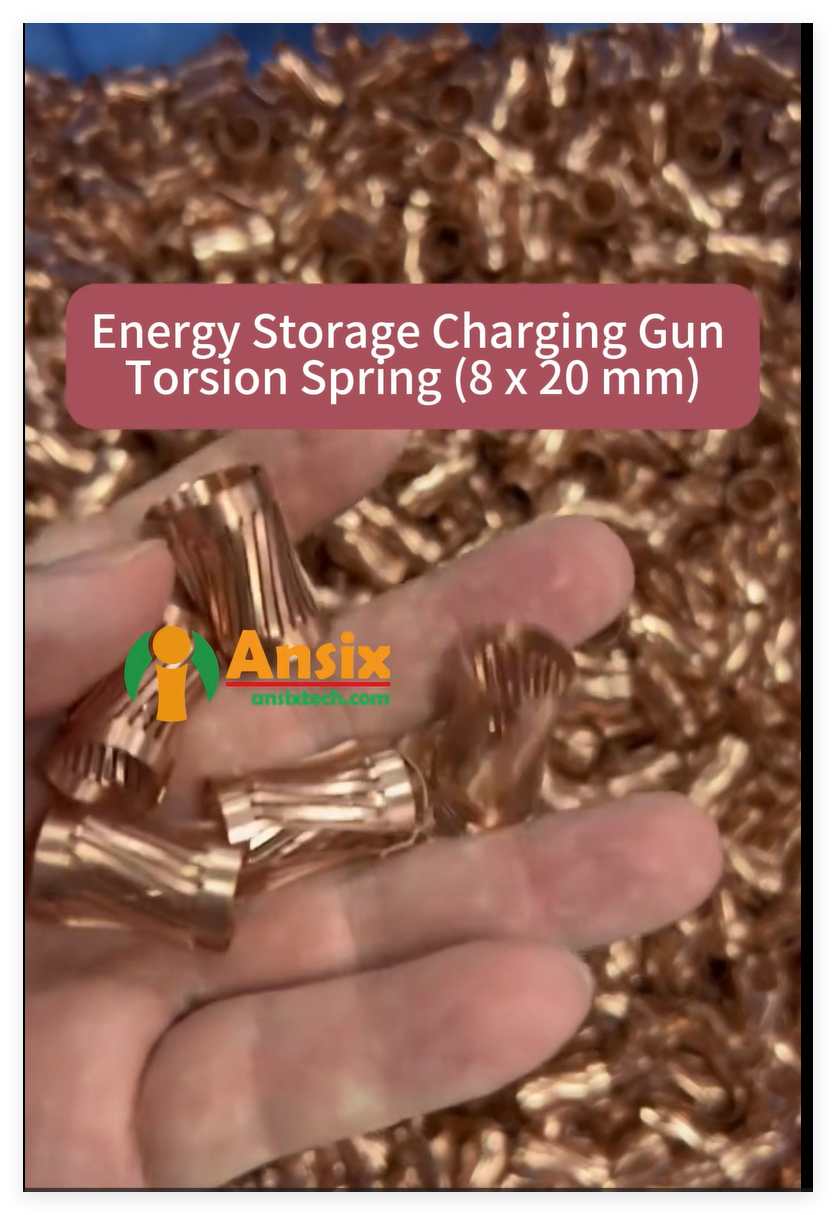
Energy Storage Charging Gun Torsion Spring (8 x 20 mm)
Energy Storage Charging Gun Torsion Spring (8 x 20 mm)

Precision Under Pressure: How Ansix Tech is Redefining Reliability in the Energy Storage Charging Gun Torsion Spring (8 x 20 mm) Sector
In the rapidly evolving landscape of energy storage and electric vehicle (EV) infrastructure, the smallest components often bear the greatest responsibility for safety and user experience. As the global market pivots toward high-voltage direct current (HVDC) fast-charging stations and modular energy storage systems (ESS), the mechanical interface between the user and the machine—the charging gun—has come under intense scrutiny. At the heart of this interface lies a component that is often overlooked yet critically vital: the torsion spring.
Specifically, the Energy Storage Charging Gun Torsion Spring (8 x 20 mm) has emerged as a benchmark standard for ensuring the mechanical resilience, ergonomic safety, and operational longevity of next-generation charging connectors. In this specialized sector, Ansix Tech has not merely positioned itself as a supplier but as a full-spectrum engineering partner. With over 28 years of manufacturing expertise, the company has initiated a comprehensive project lifecycle for this specific component—moving beyond off-the-shelf solutions to deliver precision-engineered reliability.
This article delves into Ansix Tech’s approach to the Energy Storage Charging Gun Torsion Spring (8 x 20 mm), exploring how the company addresses the critical tension between durability and cost, the technical nuances of Mold Design and material science, and the rigorous validation protocols that ensure these springs perform flawlessly across millions of mating cycles.
Project Initiation: Solving the Fatigue Failure Epidemic
The initiation of Ansix Tech’s dedicated project for the Energy Storage Charging Gun Torsion Spring (8 x 20 mm) was born from a common pain point reported by major EV charging infrastructure providers: premature fatigue failure. In standard market offerings, charging gun torsion springs often suffer from stress relaxation and plastic deformation after as few as 10,000 insertion/removal cycles. For commercial energy storage stations expected to operate for a decade or more, this represents a critical failure point, leading to poor contact, overheating risks, and costly warranty claims.
Ansix Tech recognized that the issue was not merely a flaw in the spring itself, but a systemic failure in the integration of design, material selection, and manufacturing consistency. The company initiated a project to create a torsion spring that could withstand the rigorous demands of the 8 x 20 mm form factor—a size specifically calibrated to balance torque output with the spatial constraints of modern, ergonomically designed charging guns.
The project scope was defined from the outset to cover the entire lifecycle: from prototype design and manufacturing validation through to mass production and assembly verification. By adopting a holistic approach, Ansix Tech aimed to eliminate the disconnect that often exists between Mold Makers, material suppliers, and assembly lines.
Value Delivery: Engineering Reliability from the Ground Up
For clients in the energy storage sector, downtime is not merely an inconvenience; it is a financial liability. Ansix Tech’s value proposition for the Energy Storage Charging Gun Torsion Spring (8 x 20 mm) centers on delivering "operational certainty." This is achieved through a triad of design, development, and manufacturing alignment.
Design for Manufacturability (DFM) and Simulation
Before any metal is cut or mold base is ordered, Ansix Tech employs advanced Mold Flow Analysis (DFM) specifically tailored for the spring’s housing and mounting points. While the spring itself is metal, its interaction with the plastic housing is where failures originate. Using simulation software, Ansix Tech analyzes how the Energy Storage Charging Gun Torsion Spring (8 x 20 mm) will seat within the injection-molded components during the final assembly.
This analysis predicts stress concentrations at the mounting bosses and living hinges. By simulating the flow of the plastic around the spring’s anchor points, Ansix Tech ensures that the “hard” metal component integrates seamlessly with the “soft” plastic housing, eliminating stress risers that could lead to cracking under repeated torque.
Addressing Specific Problems: The Battle Against Stress Relaxation
The primary technical challenge in the Energy Storage Charging Gun Torsion Spring (8 x 20 mm) sector is managing stress relaxation. When a torsion spring is held in a deflected state (as it is when the charging gun handle is at rest), internal stresses gradually diminish over time, reducing the clamping force. If this force drops below a threshold, the charging gun’s latch mechanism fails to secure the connector to the vehicle inlet, resulting in arcing or disconnection.
Ansix Tech addressed this through a dual-pronged strategy: superior raw material selection and precision heat treatment protocols.
Raw Material Selection: The Chemistry of Resilience
For the Energy Storage Charging Gun Torsion Spring (8 x 20 mm), Ansix Tech exclusively utilizes high-grade Oil-Tempered Chrome Silicon Alloy Steel (SAE 9254 or equivalent) . Unlike standard carbon steel, Chrome Silicon (Cr-Si) alloys offer exceptional high-temperature resistance to tempering and superior relaxation resistance.
Chemical Composition: The specific grade selected features a carbon content (0.51–0.59%) balanced with silicon (1.20–1.60%) and chromium (0.50–0.80%). This combination provides the hardenability required for deep-section springs while maintaining the ductility necessary to withstand the cyclic torsional loads of a charging gun.
Wire Diameter Precision: For the 8 x 20 mm specification (referring to leg length and body diameter constraints), Ansix Tech sources wire with a tolerance of ±0.01 mm. This precision is non-negotiable, as variances in wire diameter directly alter the spring constant (k), affecting the torque output required by the end-user.
The Mold Manufacturing Ecosystem
While the torsion spring is the hero component, its performance is dictated by the precision of the injection-molded components that house it. Ansix Tech leverages its 28 years of expertise not just in spring winding, but in the complex injection molding of the surrounding infrastructure. The company’s approach to mold design for the housings that accept the Energy Storage Charging Gun Torsion Spring (8 x 20 mm) is a masterclass in precision engineering.
Mold Flow Analysis (DFM)
Utilizing software such as Moldex3D, Ansix Tech conducts a comprehensive DFM for the plastic components interacting with the spring. The analysis focuses on:
Weld Line Positioning: Ensuring that the convergence points of molten plastic do not align with the structural anchors of the torsion spring.
Air Traps: Eliminating voids that could create weak points under the cyclic loading exerted by the spring.
Critical Aspects of Mold Design
The mold design for these components is dictated by the mechanical demands of the spring. Key features include:
Durable Steel Selection: For mold construction, Ansix Tech selects S136 (Stavax ESR) or H13 tool steels, depending on the production volume and the abrasiveness of the reinforced plastics (such as PC/ABS or PA66+GF) used in charging guns. S136 is favored for its corrosion resistance and high polishability, ensuring that the spring’s mounting posts remain glass-smooth to prevent wear.
Cooling System Optimization: Cycle time is critical in mass production. Ansix Tech designs conformal cooling channels within the mold cores—a technique that uses 3D-printed mold inserts or complex machining to follow the geometry of the part. For the Energy Storage Charging Gun Torsion Spring (8 x 20 mm) mounting bracket, this ensures uniform cooling, preventing warpage that could alter the spring’s preload alignment.
Runner and Gate System Design: To ensure consistent packing pressure around the metal spring inserts (in cases where the spring is overmolded), Ansix Tech employs hot runner systems with valve gates. This allows for precise control over the fill pattern, eliminating shear stress that could shift the spring’s position during injection. The gate location is meticulously placed to ensure that the flow front converges away from the spring’s torsion arms, maintaining the integrity of the anchor points.
Ejection System Engineering: Ejecting a part that houses a high-tension spring requires sophistication. Ansix Tech utilizes a combination of ejector pins and, in complex cases, stripper plates to ensure that the finished component is released without deforming the spring or stressing the plastic geometry. The ejection system is timed and sequenced to relieve tension gradually, preventing the spring from “shooting” out of the mold.
Validation Processes and Technical Difficulties in Injection Molding
Integrating a metal torsion spring into a plastic assembly—either via over-molding or post-molding assembly—presents unique manufacturing difficulties. Ansix Tech has developed proprietary validation processes to mitigate these risks.
Technical Difficulty: Insert Deformation
During the injection molding process for components that utilize the Energy Storage Charging Gun Torsion Spring (8 x 20 mm) as an insert, the high pressure (often exceeding 1,500 bar) of the plastic melt can deform or shift the spring.
Solution: Ansix Tech employs magnetic or mechanical pre-fixturing within the mold cavity. Before the mold closes, the spring is precisely positioned using robotic arms equipped with vision systems. The mold is designed with hardened steel "shut-offs" that shield the spring’s critical torsional body from direct flow pressure, allowing the plastic to flow only around the anchor legs.
Technical Difficulty: Stress Cracking
Certain engineering plastics used in charging guns (such as PC/ABS) are susceptible to environmental stress cracking when exposed to chemicals (like hand creams or cleaning solvents) and sustained mechanical load from the torsion spring.
Solution: Through Mold Flow Analysis and validation testing, Ansix Tech optimizes the residual stress in the plastic. By adjusting the holding pressure and melt temperature, the company ensures that the molecular orientation of the plastic aligns with the direction of the stress applied by the spring, rather than perpendicular to it, drastically reducing the risk of field failures.
Cost Reduction Strategies: Hard Cost Engineering
One of the most compelling aspects of Ansix Tech’s approach is its ability to reduce the "hard costs"—the tangible bill of materials (BOM) and manufacturing expenses—for clients. The company achieves this through comprehensive optimization across three pillars: materials, manufacturing processes, and operational efficiency.
- Material Consolidation
By utilizing advanced Mold Flow Analysis, Ansix Tech often identifies opportunities to reduce the wall thickness of the plastic housing surrounding the Energy Storage Charging Gun Torsion Spring (8 x 20 mm) . For every 0.1 mm reduction in wall thickness across high-volume production (millions of units), material cost savings can reach six figures annually. Crucially, Ansix Tech uses simulation to verify that these reductions do not compromise the structural integrity required to withstand the spring’s torque.
- Cycle Time Reduction
In injection molding, time is money. Ansix Tech’s expertise in conformal cooling allows for a reduction in cycle times by 15–25% compared to traditional cooling methods. For the components interacting with the torsion spring, faster cooling translates directly to lower unit costs without sacrificing dimensional stability.
- Automated Assembly Verification
Labor costs associated with assembling the Energy Storage Charging Gun Torsion Spring (8 x 20 mm) into the final housing are a significant factor. Ansix Tech has invested in automated assembly lines where vision-guided robots place the spring into the housing, perform a torque validation test (ensuring the spring meets the specified N/mm rate), and then assemble the latch mechanism. This automation reduces human error, eliminates rework costs, and ensures that every unit shipped meets the same high standard.
Quality Control and Assurance Protocols
For Ansix Tech, quality validation is not an endpoint; it is a continuous loop. The company implements a comprehensive Quality Management System (ISO 9001 and IATF 16949 standards) specifically adapted for the Energy Storage Charging Gun Torsion Spring (8 x 20 mm) lifecycle.
Incoming Material QC: Every batch of Chrome Silicon alloy wire is tested for tensile strength and chemical composition using Optical Emission Spectrometry (OES). The plastic resins (such as PA66 or PBT) are tested for moisture content and Melt Flow Index (MFI) to ensure consistency.
In-Process Monitoring: During injection molding, cavity pressure sensors provide real-time data to the molding machine’s closed-loop control system. If the packing pressure deviates by even 1%, the system auto-corrects or rejects the part. For the spring winding process, CNC coiling machines are equipped with laser micrometers that verify the outer diameter and leg length of the 8 x 20 mm spring at a rate of 600 parts per minute.
End-of-Line Validation: Finished assemblies undergo load-life testing. Ansix Tech utilizes custom test rigs that actuate the charging gun latch mechanism for 20,000 to 50,000 cycles. During these tests, the torque output of the Energy Storage Charging Gun Torsion Spring (8 x 20 mm) is measured continuously. The acceptable threshold for relaxation is less than 5% loss of initial torque—a standard that exceeds typical industry requirements.
Enhancing Production Capacity and Ensuring On-Time Delivery
In the energy storage sector, market windows are tight, and delays in component supply can derail entire infrastructure projects. Ansix Tech has structured its manufacturing workflows to ensure rapid delivery without sacrificing quality.
Modular Tooling Strategy: Instead of building single-cavity molds for new projects, Ansix Tech invests in multi-cavity, modular tooling. For the Energy Storage Charging Gun Torsion Spring (8 x 20 mm) , the company utilizes 4+4 cavity molds (four cavities for the spring housing, four for the latch mechanism) that run on all-electric injection molding machines. This modularity allows Ansix Tech to scale production from 50,000 units per month to 500,000 units by simply adding additional modules to the production cell.
Strategic Raw Material Buffers: Recognizing the volatility of the global supply chain, Ansix Tech maintains a strategic inventory of SAE 9254 wire and high-performance engineering plastics. This buffer ensures that if market disruptions occur, the production of the Energy Storage Charging Gun Torsion Spring (8 x 20 mm) continues uninterrupted, safeguarding client timelines.
Packaging for Protection: The final step in the manufacturing workflow is packaging. Ansix Tech utilizes anti-static, compartmentalized trays specifically designed to protect the delicate torsion arms of the spring during transit. Each tray is bar-coded with traceability data linking the components to the specific batch of raw material and the machine settings used during production, ensuring full recall capability if ever required.
Industry Experience: The Ansix Tech Advantage
The ability to execute on the Energy Storage Charging Gun Torsion Spring (8 x 20 mm) project with such precision is not an overnight achievement; it is the culmination of 28 years of accumulated knowledge. Ansix Tech’s extensive experience in injection molding projects—encompassing both mold development and actual molding operations—provides a unique competitive advantage.
Unlike suppliers who specialize solely in spring manufacturing or solely in molding, Ansix Tech understands the interface between the two. This dual-expertise allows the company to predict failures that would otherwise only emerge after a client had assembled thousands of units.
Case in Point: Addressing Assembly Line Friction
In one recent project for a European energy storage manufacturer, clients reported that the Energy Storage Charging Gun Torsion Spring (8 x 20 mm) was scoring the plastic housing during assembly, causing cosmetic damage and weak particulate contamination. While the spring met dimensional specs, Ansix Tech’s mold engineers identified that the ejection pins in the housing mold were leaving micro-burrs. By modifying the mold’s ejection system and adding a slight radius to the spring’s leg tips, Ansix Tech eliminated the issue, saving the client from a costly assembly line stoppage.
Conclusion: Delivering Tangible Reliability
The Energy Storage Charging Gun Torsion Spring (8 x 20 mm) is a small component that carries an outsized responsibility. It is the guardian of the electrical connection, ensuring that high-voltage energy transfers occur safely and consistently. Ansix Tech has demonstrated that by treating this component not as a commodity, but as a critical engineering system, it is possible to deliver superior reliability while simultaneously reducing costs.
Through meticulous raw material selection (SAE 9254 Chrome Silicon), advanced mold flow analysis, precision tool steel mold construction, optimized cooling systems, and rigorous in-process validation, Ansix Tech has set a new benchmark in the sector. The company’s ability to manage the entire lifecycle—from prototype to mass production—combined with its 28-year legacy in manufacturing, provides clients with the confidence that their charging infrastructure will withstand the test of time.
In an industry where "hard costs" often dictate design compromises, Ansix Tech proves that true value lies in comprehensive optimization. By engineering out failure modes, reducing cycle times, and ensuring on-time delivery, Ansix Tech is not just manufacturing a spring; it is fortifying the reliability of the global energy storage network, one 8 x 20 mm component at a time.



Ansix Tech Co Ltd
If you have any plans related to Energy Storage Charging Gun Torsion Spring (8 x 20 mm) , you can contact us at any time. We will turn your ideas into reality, let you realize your dreams, and obtain large orders from the market. Our contact information is info@ansixtech.com. Or contact our CTO, mail: stephen@ansixtech.com
#www.ansixtech.com #ansixtech.com #Energy Storage Charging Gun Torsion Spring (8 x 20 mm) #Energy Storage Charging Gun Torsion Spring (8 x 20 mm) #Energy Storage Charging Gun Torsion Spring (8 x 20 mm) injection molding company #Energy Storage Charging Gun Torsion Spring (8 x 20 mm) injection mold companies #Ansix #Ansix moulds #Ansix china #Ansix tech china #Ansix tech company #Ansix facotry #Ansix Tech #Ansix molds #Ansix injection molding #Ansix mold factory #injection molding Energy Storage Charging Gun Torsion Spring (8 x 20 mm) #Ansix mold factory #Energy Storage Charging Gun Torsion Spring (8 x 20 mm) china #Energy Storage Charging Gun Torsion Spring (8 x 20 mm) molds #injection factory #Energy Storage Charging Gun Torsion Spring (8 x 20 mm) injection molding #Energy Storage Charging Gun Torsion Spring (8 x 20 mm) injection molding factory #injection molding company #Energy Storage Charging Gun Torsion Spring (8 x 20 mm) injection mold companies #Energy Storage Charging Gun Torsion Spring (8 x 20 mm)#Energy Storage Charging Gun Torsion Spring (8 x 20 mm) mold limited #Ansix mold china #Ansix companies #Ansix company China #Energy Storage Charging Gun Torsion Spring (8 x 20 mm) facotry #Ansix Tech #Ansix Tech mould #Energy Storage Charging Gun Torsion Spring (8 x 20 mm) injection moulding #injection moulding company #Ansix Energy Storage Charging Gun Torsion Spring (8 x 20 mm) parts injection mold companies #Energy Storage Charging Gun Torsion Spring (8 x 20 mm) #Energy Storage Charging Gun Torsion Spring (8 x 20 mm) china #Energy Storage Charging Gun Torsion Spring (8 x 20 mm) china factory #Ansix moulding companies #Ansix molding company #Energy Storage Charging Gun Torsion Spring (8 x 20 mm) injection moulding facotry #Ansix Tech mold #Energy Storage Charging Gun Torsion Spring (8 x 20 mm) mould #Energy Storage Charging Gun Torsion Spring (8 x 20 mm) plastic injection molding #ansix plastic mold #Mold manufacturing #Energy Storage Charging Gun Torsion Spring (8 x 20 mm) parts manufacturing #Energy Storage Charging Gun Torsion Spring (8 x 20 mm) plastic parts factory #Energy Storage Charging Gun Torsion Spring (8 x 20 mm) injection parts mold #Energy Storage Charging Gun Torsion Spring (8 x 20 mm) PRECISION MANUFACTURING #Energy Storage Charging Gun Torsion Spring (8 x 20 mm) #China mold #Energy Storage Charging Gun Torsion Spring (8 x 20 mm) injection moulding china #Energy Storage Charging Gun Torsion Spring (8 x 20 mm) mould china #china precision mold #mold in china #Energy Storage Charging Gun Torsion Spring (8 x 20 mm) mold china #Precision molds #High-precision molds #Energy Storage Charging Gun Torsion Spring (8 x 20 mm) #Injection molds #Energy Storage Charging Gun Torsion Spring (8 x 20 mm) Factory #Energy Storage Charging Gun Torsion Spring (8 x 20 mm) Company #Super Large Injection Mold Factory #Large Tonnage Injection Molding Factory #Energy Storage Charging Gun Torsion Spring (8 x 20 mm) Company #Energy Storage Charging Gun Torsion Spring (8 x 20 mm) Factory #2800T Injection Molding Factory #3000 Ton Injection Molding #4500 Ton Injection Molding Factory #Large Mold Injection Molding #Large Plastic Mold Injection Molding Factory #Large Injection Mold Manufacturer #Plastic Mold Factory #Injection Mold #Plastic Mold