



European Standard High-Current Charging Connector Pin and Socket Manufacturer
European Standard High-Current Charging Connector Pin and Socket Manufacturer
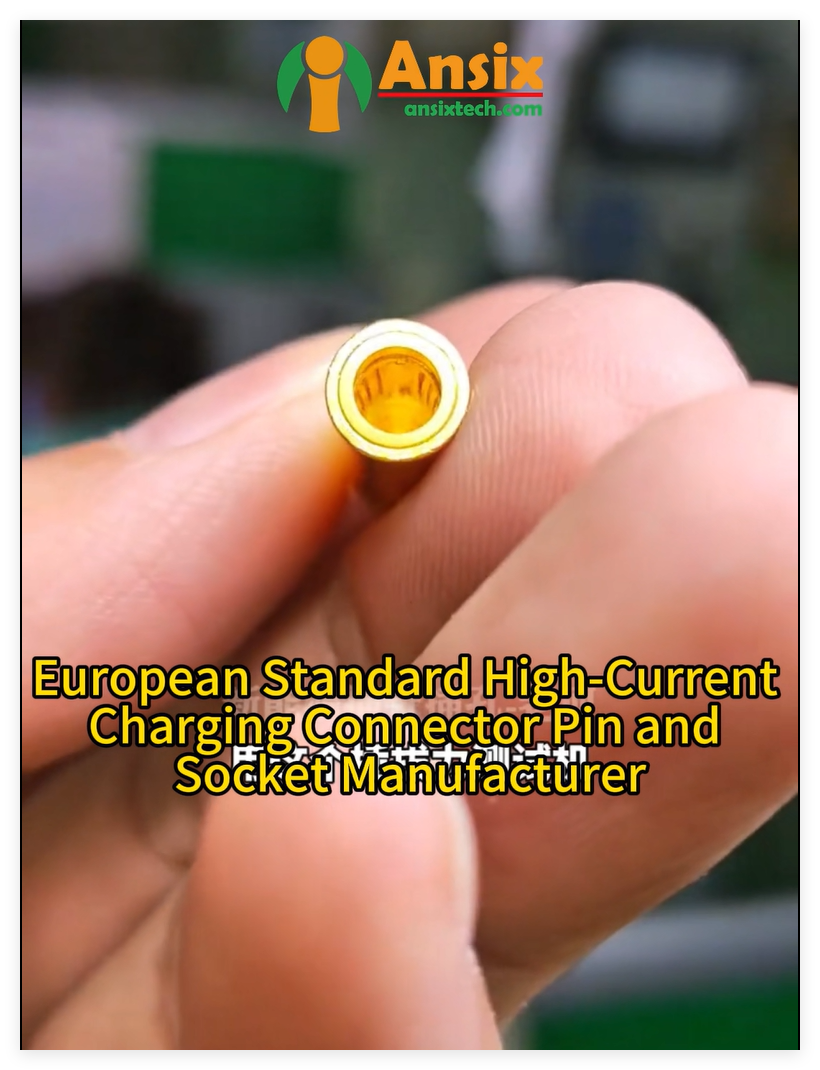
Beyond the Contact: How Ansix Tech is Redefining Reliability and Cost Efficiency in European Standard High-Current Charging Connectors
As the backbone of the electric vehicle (EV) revolution and industrial automation, the European Standard high-current charging connector has become a critical component where failure is not an option. In an industry driven by the relentless pursuit of faster charging times and higher energy densities, the humble pin and socket—the physical interface where power transfers—represent the most demanding engineering challenge.
For original equipment manufacturers (OEMs), the difference between a market-leading charging system and a recall-prone liability often comes down to the expertise of their supply chain partners. In this high-stakes arena, Ansix Tech has carved out a formidable niche. With over 28 years of manufacturing experience, the company has moved beyond being a simple component supplier to become a strategic partner specializing in the design and manufacturing of European Standard High-Current Charging Connector Pins and Sockets.
This article explores Ansix Tech’s comprehensive approach—from project initiation and material science to mold flow analysis, high-precision injection molding, and aggressive cost-reduction strategies—illustrating how the company delivers tangible value by solving the sector’s most persistent engineering problems.
Project Initiation: Bridging the Gap Between Blueprint and Reality
The journey of a high-current connector at Ansix Tech begins long before the first mold is cut. In the European standard sector, specifications such as IEC 62196 (for Type 2 connectors) impose rigorous demands regarding thermal stability, mechanical endurance, and ingress protection (IP). However, market standards often exceed these baseline requirements.
Ansix Tech’s project initiation phase is characterized by a collaborative design-for-manufacturability (DFM) approach. Unlike manufacturers who simply bid on existing blueprints, Ansix Tech engages in the "prototype design" phase. The company’s engineering team analyzes client specifications to identify potential failure points before they occur.
One of the primary problems Ansix Tech solves at this stage is the mismatch between theoretical design and practical manufacturability. A connector pin that looks perfect in CAD software may warp during injection molding or fail to achieve the required press-fit retention due to shrinkage inconsistencies. By integrating its 28 years of tooling experience at the outset, Ansix Tech ensures that the design is not only compliant with European standards but is also optimized for high-volume, defect-free production.
The Alchemy of Raw Materials: Selecting for Conductivity and Durability
The performance of a high-current connector is fundamentally dictated by its materials. For the conductive pins and sockets, copper alloys are the primary candidates. However, the selection process is nuanced. Ansix Tech utilizes specific grades tailored to the mechanical and electrical demands of the application.
For high-current applications (typically ranging from 32A to 250A+ in European AC and DC fast-charging standards), Ansix Tech predominantly employs CuCrZr (Copper-Chromium-Zirconium) alloys, such as C18150 or C18400. These materials are selected for their superior combination of high electrical conductivity (approximately 80% IACS) and exceptional mechanical strength. In a charging connector, the pins act as both electrical conductors and structural retention elements. CuCrZr withstands the high insertion/withdrawal cycles (often exceeding 10,000 cycles) without losing its spring properties, a critical requirement for sockets that must maintain consistent contact force.
For applications where conductivity is the paramount factor, Ansix Tech utilizes C11000 (Electrolytic Tough Pitch Copper) . While softer than CuCrZr, its conductivity (100% IACS) minimizes resistive losses—a critical factor in reducing heat generation during ultra-fast charging sessions.
To combat the environmental adversaries of humidity, salt spray, and thermal cycling, the pins undergo surface plating. Ansix Tech employs a multi-layer plating strategy: a nickel underlayer (for corrosion resistance and diffusion barrier) followed by a silver or tin top layer. Silver plating is favored for high-power DC charging due to its superior conductivity and low contact resistance, while tin plating is often specified for AC applications requiring cost optimization and environmental compliance (RoHS).
On the insulating side—the plastic housing that holds the pins in precise alignment—Ansix Tech leverages high-performance thermoplastics. The material of choice for European Standard connectors is often PPS (Polyphenylene Sulfide) or LCP (Liquid Crystal Polymer) , specifically grades like PPS GF40 (40% glass-filled). These materials offer a unique blend of high continuous operating temperatures (up to 220°C), UL94 V-0 flammability ratings, and chemical resistance to oils and battery coolants. The selection of these specific grades is crucial to preventing deformation during high-current temperature spikes, ensuring the insulation barrier remains intact.
Precision Tooling: The Heart of Manufacturing
If materials are the body, the injection mold is the brain of Ansix Tech’s operation. The company’s core competency lies in its ability to design and manufacture high-cavitation molds that produce complex geometries with micron-level precision.
Mold Flow Analysis (DFM)
Before steel is cut, Ansix Tech performs comprehensive Mold Flow Analysis. This simulation software predicts how the molten PPS or LCP will fill the cavity. For high-current connectors, where wall thicknesses vary dramatically (thick bosses for pin retention versus thin walls for creepage distances), weld lines are a significant risk. A weld line in a high-voltage insulator can become a path for arc tracking.
Using DFM, Ansix Tech’s engineers optimize gate locations to position weld lines in mechanically neutral or non-critical areas. They also simulate venting strategies to eliminate air traps that could cause voids or burn marks, which would compromise the dielectric strength of the finished part.
Critical Considerations in Mold Design and Machining
The machining of molds for European Standard connectors presents unique technical challenges. The geometry of the socket contacts often involves cantilever beams or “tulip” shapes that require complex core pulls and slides. Ansix Tech’s tool room specializes in high-speed machining (HSM) of hardened steel, achieving tolerances of ±0.005mm on critical dimensions such as pin pitch and contact retention pockets.
The mold processing workflow is rigorous:
Steel Selection: For molds destined for mass production (exceeding 1 million cycles), Ansix Tech utilizes S136 (Stavax ESR) —a stainless tool steel with excellent corrosion resistance and polishability—or H13 for high-wear cores. These materials prevent oxidation in the cooling channels and maintain surface finish over millions of cycles.
CNC Machining & EDM: Complex geometries that cannot be milled directly are achieved through sinker Electrical Discharge Machining (EDM), allowing for the creation of sharp internal corners and fine texturing required for high-voltage creepage distances.
Cooling System Design: One of the most critical aspects of mold design is the cooling system. High-current connectors have thick sections that retain heat, leading to extended cycle times and warpage. Ansix Tech employs conformal cooling strategies where possible, using 3D-printed or CNC-machined cooling channels that follow the contour of the part. By placing water lines strategically around the pin insertion areas, they reduce cooling time by up to 30%, directly boosting production capacity.
The Gating and Ejection Systems
The gating system dictates how material flows and where the vestige remains. For aesthetic and functional surfaces, Ansix Tech frequently utilizes hot runner systems with valve gates. This allows for precise control of the fill rate, eliminating pressure drops and ensuring consistent packing of the thick-walled sections around the copper inserts.
Ejection systems in these molds must be flawless. The delicate plastic ribs that separate high-voltage pins from ground pins can be easily damaged by standard ejector pins. Ansix Tech employs wide, precision-ground stripper plates to ensure the molded parts are ejected uniformly, without residual stress or cosmetic defects.
Mastering the Injection Molding Process
With the tool built, the focus shifts to the injection molding process itself. Ansix Tech operates a fleet of advanced injection molding machines equipped with real-time process monitoring. The technical complexities here are substantial. Insert molding—where the machined copper pins and sockets are placed into the mold before plastic injection—is a standard requirement for European Standard connectors.
The optimization of this process focuses on two pillars: efficiency improvements and cost control.
Efficiency: By utilizing high-cavitation molds (8, 16, or 32 cavities), Ansix Tech drastically reduces the per-part cycle time. However, high cavitation introduces flow imbalance risks. To solve this, the company employs geometric balancing in the runner systems and uses temperature-controlled manifolds to ensure each cavity fills identically.
Process Validation: Before a project moves to mass production, Ansix Tech executes a rigorous validation protocol. This includes First Article Inspection (FAI) per AS9102 standards, where every dimension is measured against the blueprint using Coordinate Measuring Machines (CMM). Beyond dimensions, they perform Overmolding Integrity Tests, such as pull-out tests to verify the bond strength between the copper insert and the plastic housing. Given the thermal cycling environment of EV charging (from -40°C to 85°C), they also conduct Thermal Shock testing to ensure the interface does not delaminate or lose sealing integrity.
The Manufacturing Workflow: Quality, Packaging, and Delivery
Ansix Tech’s value proposition extends from the molding machine to the client’s assembly line. The company’s manufacturing workflow is designed to maintain traceability and quality at every step.
Incoming Material QC: Raw materials—both the CuCrZr pins sourced from certified mills and the PPS/LCP resins—are quarantined upon arrival. Spectrometer analysis confirms alloy composition, while moisture analyzers ensure the hygroscopic engineering plastics are dried to manufacturer specifications before processing.
In-Process Inspection: Automated Optical Inspection (AOI) stations are integrated into the assembly lines. For high-current sockets, contact crimp height and insertion depth are monitored in real-time. If a pin is skewed by even 0.1mm, it could prevent the connector from mating with the vehicle inlet. Ansix Tech utilizes laser measurement systems to guarantee positional tolerances.
Assembly Verification: Many European Standard connectors require assembly of multiple sub-components (signal pins, safety shutters, seals). Ansix Tech’s assembly verification includes electrical testing (Hi-Pot and contact resistance) to validate that the assembled unit meets the stringent Class B or Class C voltage requirements of automotive standards.
Packaging: Packaging is treated as a critical extension of quality control. To prevent “tinning” or fretting corrosion during shipping, pins and sockets are packaged in anti-static, moisture-barrier bags with desiccant. For high-volume orders, Ansix Tech employs tray packing with specific pocket geometries that protect the delicate spring contacts from deformation during transit.
Rapid Delivery: To boost production capacity and ensure on-time delivery, Ansix Tech maintains a strategic inventory of raw materials and utilizes a modular mold base strategy. By standardizing mold bases, they can rapidly swap cavity inserts for different connector variants, reducing changeover times from hours to minutes. This flexibility allows them to respond to surge demands—a common occurrence in the volatile EV supply chain—without compromising lead times.
Reducing Hard Costs: The Ansix Tech Advantage
A key focus for any client in the competitive EV infrastructure market is the reduction of "hard costs"—the direct material and production costs associated with the connector. Ansix Tech has systematically engineered its operations to reduce these costs without sacrificing reliability.
This cost reduction is achieved through three strategic levers:
- Material Optimization
While premium materials like CuCrZr are non-negotiable for the contact area, Ansix Tech analyzes the entire current path. By utilizing bi-metal technology (selective plating and selective material application), they ensure that expensive alloying elements are placed only where they are needed. For instance, the crimp barrel of a pin, which does not require the same spring properties as the contact beam, can be manufactured from a less expensive, high-conductivity copper, while the tip utilizes CuCrZr. This selective material strategy can reduce raw material costs by 15-20% for high-volume projects.
- Manufacturing Process Efficiency
Ansix Tech’s deep expertise in mold design directly attacks the per-part variable cost. By designing hot runner systems with optimized gate sizes, they reduce sprue waste—the plastic that is typically discarded in cold runner systems—by up to 100% on the runner itself. Additionally, their advanced cooling system designs reduce cycle times. A reduction in cycle time from 60 seconds to 45 seconds represents a 25% increase in machine capacity, which directly lowers the amortized labor and overhead cost per unit.
- Operational Efficiency and Yield
The most significant hidden cost in manufacturing is scrap. A connector that fails final assembly due to a short shot, flash, or insert misalignment represents a total loss of raw material and labor. Ansix Tech’s rigorous validation processes—including real-time Statistical Process Control (SPC) during molding—targets Six Sigma quality levels (less than 3.4 defects per million). By maintaining yields above 99.5% even on complex overmolded parts, Ansix Tech eliminates the hidden costs of rework and scrap that plague less experienced manufacturers.
Reliability Through Experience
The underlying theme of Ansix Tech’s value proposition is reliability. In the context of European Standard High-Current Charging Connectors, reliability is not merely a performance metric; it is a safety imperative. A single point of failure—a cracked insulator leading to arc flash, or a fatigued socket leading to thermal runaway—can have catastrophic consequences.
With over 28 years of experience in injection molding tooling and manufacturing, Ansix Tech brings a depth of tribal knowledge that is difficult to replicate. This experience manifests in seemingly minor but critical details: the specific surface finish required on the mold cavity to allow the high-flow LCP to release without sticking; the precise dwell pressure required to pack out the thick section around a power pin to prevent sink marks that could compromise IP rating; the design of the water channels to maintain consistent mold temperature across a 32-cavity tool to ensure dimensional uniformity.
This expertise translates directly into client value. By de-risking the manufacturing process, Ansix Tech allows its clients—the EV charger manufacturers and automotive Tier 1 suppliers—to focus on their core competencies of system integration and market expansion, confident that the fundamental electrical interface is robust.
Conclusion
The European Standard high-current charging connector is a component that demands perfection. As the EV market matures, the pressure is on to reduce costs while simultaneously increasing power density and reliability. Ansix Tech stands at the intersection of these opposing forces.
By leveraging 28 years of manufacturing expertise—from raw material selection (CuCrZr, C11000, PPS, LCP) and precision mold machining (S136, H13) to advanced injection molding optimization and rigorous quality validation—Ansix Tech has positioned itself as a critical enabler for the industry.
Its ability to solve complex engineering problems through collaborative DFM, boost production capacity via high-cavitation and conformal cooling molds, and ensure on-time delivery through agile manufacturing workflows offers clients a singular advantage. Most importantly, by strategically optimizing materials and processes to reduce hard costs, Ansix Tech proves that superior quality and cost efficiency are not mutually exclusive.
For clients seeking to build the next generation of charging infrastructure, the journey begins not with a purchase order, but with a conversation about how Ansix Tech’s holistic approach to the connector lifecycle—from prototype to mass production—can provide the reliability, scalability, and cost structure needed to lead the market.


Ansix Tech Co Ltd
If you have any plans related to European Standard High-Current Charging Connector Pin and Socket Manufacturer , you can contact us at any time. We will turn your ideas into reality, let you realize your dreams, and obtain large orders from the market. Our contact information is info@ansixtech.com. Or contact our CTO, mail: stephen@ansixtech.com
#www.ansixtech.com #ansixtech.com #European Standard High-Current Charging Connector Pin and Socket Manufacturer #European Standard High-Current Charging Connector Pin and Socket Manufacturer #European Standard High-Current Charging Connector Pin and Socket Manufacturer injection molding company #European Standard High-Current Charging Connector Pin and Socket Manufacturer injection mold companies #Ansix #Ansix moulds #Ansix china #Ansix tech china #Ansix tech company #Ansix facotry #Ansix Tech #Ansix molds #Ansix injection molding #Ansix mold factory #injection molding European Standard High-Current Charging Connector Pin and Socket Manufacturer #Ansix mold factory #European Standard High-Current Charging Connector Pin and Socket Manufacturer china #European Standard High-Current Charging Connector Pin and Socket Manufacturer molds #injection factory #European Standard High-Current Charging Connector Pin and Socket Manufacturer injection molding #European Standard High-Current Charging Connector Pin and Socket Manufacturer injection molding factory #injection molding company #European Standard High-Current Charging Connector Pin and Socket Manufacturer injection mold companies #European Standard High-Current Charging Connector Pin and Socket Manufacturer#European Standard High-Current Charging Connector Pin and Socket Manufacturer mold limited #Ansix mold china #Ansix companies #Ansix company China #European Standard High-Current Charging Connector Pin and Socket Manufacturer facotry #Ansix Tech #Ansix Tech mould #European Standard High-Current Charging Connector Pin and Socket Manufacturer injection moulding #injection moulding company #Ansix European Standard High-Current Charging Connector Pin and Socket Manufacturer parts injection mold companies #European Standard High-Current Charging Connector Pin and Socket Manufacturer #European Standard High-Current Charging Connector Pin and Socket Manufacturer china #European Standard High-Current Charging Connector Pin and Socket Manufacturer china factory #Ansix moulding companies #Ansix molding company #European Standard High-Current Charging Connector Pin and Socket Manufacturer injection moulding facotry #Ansix Tech mold #European Standard High-Current Charging Connector Pin and Socket Manufacturer mould #European Standard High-Current Charging Connector Pin and Socket Manufacturer plastic injection molding #ansix plastic mold #Mold manufacturing #European Standard High-Current Charging Connector Pin and Socket Manufacturer parts manufacturing #European Standard High-Current Charging Connector Pin and Socket Manufacturer plastic parts factory #European Standard High-Current Charging Connector Pin and Socket Manufacturer injection parts mold #European Standard High-Current Charging Connector Pin and Socket Manufacturer PRECISION MANUFACTURING #European Standard High-Current Charging Connector Pin and Socket Manufacturer #China mold #European Standard High-Current Charging Connector Pin and Socket Manufacturer injection moulding china #European Standard High-Current Charging Connector Pin and Socket Manufacturer mould china #china precision mold #mold in china #European Standard High-Current Charging Connector Pin and Socket Manufacturer mold china #Precision molds #High-precision molds #European Standard High-Current Charging Connector Pin and Socket Manufacturer #Injection molds #European Standard High-Current Charging Connector Pin and Socket Manufacturer Factory #European Standard High-Current Charging Connector Pin and Socket Manufacturer Company #Super Large Injection Mold Factory #Large Tonnage Injection Molding Factory #European Standard High-Current Charging Connector Pin and Socket Manufacturer Company #European Standard High-Current Charging Connector Pin and Socket Manufacturer Factory #2800T Injection Molding Factory #3000 Ton Injection Molding #4500 Ton Injection Molding Factory #Large Mold Injection Molding #Large Plastic Mold Injection Molding Factory #Large Injection Mold Manufacturer #Plastic Mold Factory #Injection Mold #Plastic Mold