



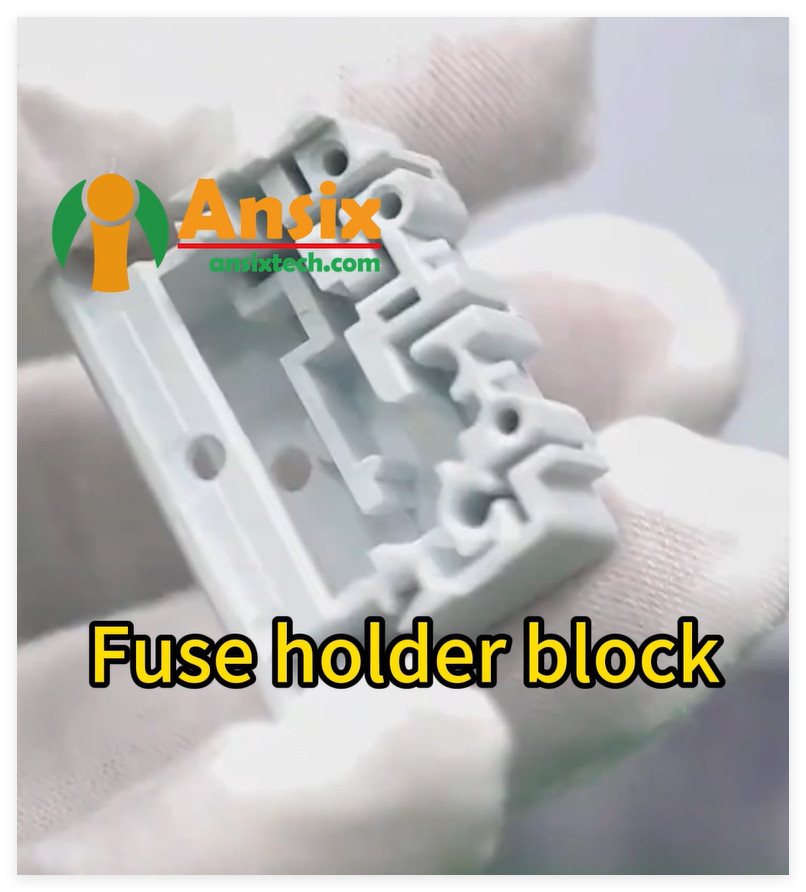
Fuse holder block
Fuse holder block

Revolutionizing Electrical Safety: How Ansix Tech Masters Injection Molding for Precision Fuse Holder Blocks
In the intricate world of electrical components, a fuse holder block is a humble guardian, quietly standing between everyday operation and catastrophic failure—a responsibility requiring absolute manufacturing precision.
Electrical safety relies on components that function flawlessly under stress, with fuse holder blocks playing a critical role in protecting circuits from overcurrent damage. The injection molding process that produces these essential components combines material science, precision engineering, and rigorous testing to meet exacting international standards. Ansix Tech has positioned itself at the forefront of this specialized manufacturing niche, developing sophisticated production methodologies that ensure reliability, regulatory compliance, and cost efficiency for global customers. The journey from raw polymer to certified safety component is a testament to modern manufacturing's capabilities.
The Critical Role and Specifications of Fuse Holder Blocks
Fuse holder blocks serve as secure housings for fuses in electrical circuits, ensuring reliable connections while providing insulation and user protection. These components must adhere to strict international standards like the North American CSA C22.2 No. 4248.1:22 and China's GB/T 9364.6-2023, which govern their construction, performance, and safety characteristics. These standards establish requirements for electrical insulation, thermal resistance, mechanical durability, and fire safety that directly inform manufacturing decisions.
Industry specifications reveal the demanding performance envelope these components must navigate. Typical fuse holder blocks operate within a temperature range of -40°C to +85°C, handling voltages up to 300V AC/DC and currents from 10A to 20A. They accommodate standard fuse sizes like 5mm × 20mm cartridges or 6.35mm × 31.8mm tubes, with configurations varying from single-pole, through-hole PCB mounts to chassis-mounted blocks with quick-connect terminals. This technical diversity necessitates a manufacturing approach that is both precise and adaptable.
Product Development and Design Verification Framework
Ansix Tech's development process follows a structured phase-gate approach that systematically transforms design concepts into production-ready components. This methodology ensures that each fuse holder block design is optimized for manufacturability, reliability, and cost-effectiveness before committing to mass production tooling.
Phase-Based Development Process
Prototype Phase: Initial design validation using 3D-printed or soft-tooled components to verify form, fit, and basic function.
Engineering Verification Test (EVT): Comprehensive testing of engineering samples against performance specifications and regulatory requirements.
Design Verification Test (DVT): Production feasibility validation using tools approaching production quality to assess manufacturability.
Production Validation: Final verification that the manufacturing process consistently delivers components meeting all quality standards and customer requirements.
Implementing Design for Manufacturing (DFM)
Central to Ansix Tech's development philosophy is early and rigorous DFM analysis. This proactive approach examines how design decisions impact moldability, assembly, testing, and cost long before tooling begins. The company's DFM checklist addresses critical factors including uniform wall thickness (typically 1.5-3.0mm for optimal flow and strength), appropriate draft angles (1-3° depending on texture depth), boss and rib design to prevent sink marks, and proper gate locations to minimize weld lines in critical areas.
"DFM isn't just about making parts easier to produce," explains a senior Ansix Tech engineer. "It's about optimizing the entire value chain—reducing cycle times, improving yield rates, and eliminating failure points that could compromise performance in the field."
Strategic Material Selection for Performance and Economy
The polymer selection for fuse holder blocks represents a critical balance between electrical properties, thermal stability, mechanical strength, and cost considerations. Ansix Tech evaluates materials not just for their initial properties but for their behavior throughout the injection molding process and the component's operational lifetime.
Table: Common Materials for Fuse Holder Blocks

Recent projects at Ansix Tech have focused on material optimization strategies that deliver required performance at reduced cost. This includes evaluating glass-filled compounds for enhanced strength without wall thickness increases, flame-retardant additives that meet UL94 V-0 requirements without compromising flow characteristics, and regrind ratios that maintain properties while reducing material costs. The company's material database cross-references technical specifications with processing parameters and supplier economics to identify optimal solutions for each application.
For one recent automotive fuse block project, Ansix Tech engineers recommended a 15% glass-filled PBT compound over a more expensive high-temperature nylon, achieving the required dimensional stability at 125°C while reducing material costs by 22%. This decision was validated through extensive thermal cycling tests and creep resistance evaluations that confirmed the material would maintain clamping force on fuse contacts throughout the vehicle's service life.
Advanced Mold Engineering and Precision Manufacturing
The injection mold represents the single largest investment in fuse holder block production, with its design and construction directly determining part quality, manufacturing efficiency, and per-unit economics. Ansix Tech approaches mold engineering as a holistic discipline that balances mechanical precision, thermal management, and production robustness.
Mold Design Innovations
Modern fuse holder molds incorporate sophisticated systems to address the unique challenges of these components:
Multi-gate hot runner systems that ensure complete cavity filling while minimizing material waste
Conformal cooling channels that follow the contour of complex parts for uniform heat extraction
Modular insert designs allowing rapid changeover between similar fuse block configurations
High-precision ejection systems that prevent deformation of delicate features during part removal
"The electrical components industry presents unique mold design challenges," notes an Ansix Tech tooling engineer. "We're not just creating shapes—we're creating dimensional stability for tight tolerance electrical contacts, surface finishes that prevent tracking currents, and mechanical features that must maintain spring tension over thousands of insertion cycles."
Mold Flow Analysis and Process Simulation
Before steel is ever cut, Ansix Tech utilizes advanced simulation software to predict and optimize the injection molding process. This virtual prototyping identifies potential issues including:
Air traps that could cause burning or incomplete filling
Weld line formations in structurally or electrically critical areas
Sink marks over ribs or bosses that might affect contact alignment
Differential shrinkage leading to warpage or dimensional inaccuracy
By resolving these issues digitally, the company reduces tooling modifications by approximately 60% and shortens the development timeline by 4-6 weeks compared to traditional trial-and-error methods.
Optimized Injection Molding Process and Quality Assurance
The transition from mold validation to mass production requires precise control of processing parameters and implementation of rigorous quality systems. Ansix Tech has developed specialized approaches for fuse holder blocks that address their unique combination of electrical, mechanical, and thermal requirements.
Process Optimization Strategies
Table: Critical Injection Molding Parameters for Fuse Holder Blocks

For a recent series of miniature fuse holders, Ansix Tech implemented a scientific molding approach that established process windows based on viscosity curves and pressure loss calculations rather than operator experience. This methodology reduced cycle times by 18% while improving dimensional consistency by 35% as measured by CpK values on critical features.
Intelligent Quality Systems
Quality assurance for electrical components extends beyond dimensional checks to functional validation. Ansix Tech employs a multi-layered testing protocol:
In-process monitoring of critical parameters (shot size, injection pressure, cooling time) with statistical process control limits
First-article inspections using coordinate measuring machines to validate all critical dimensions
Sampling-based dielectric testing to verify insulation integrity at voltages exceeding rated values
Mechanical cycling tests simulating fuse insertion/extraction to validate contact retention
Thermal aging studies ensuring materials maintain properties throughout service life
The company's recent adoption of automated optical inspection systems represents a significant advancement in quality assurance. These systems compare every produced part against digital masters, flagging deviations in flash formation, surface defects, or feature presence with sub-pixel accuracy. When integrated with the molding machine controls, these systems enable closed-loop correction of process parameters—an implementation of the intelligent systems described in emerging injection molding technologies.
Cost Optimization Through Integrated Engineering
Perhaps Ansix Tech's most significant value proposition lies in its systematic approach to cost reduction without compromising quality. This philosophy permeates every stage from initial design to final packaging.
Material Efficiency Innovations
Runner optimization reducing material waste by 30-40% through hot runner systems and optimal gate design
Regrind management programs establishing maximum percentages that maintain properties while utilizing production scrap
Alternative material qualifications identifying equivalent-performing resins from multiple suppliers to ensure competitive pricing
Part consolidation designing multiple functions into single molded pieces where feasible
Process Efficiency Enhancements
Cycle time reduction through advanced cooling channel designs and optimized process parameters
Automated degating and deflashing reducing labor content and improving consistency
High-cavitation molds where production volumes justify the additional tooling investment
Energy monitoring systems identifying and eliminating wasteful consumption patterns
For a recent high-volume fuse block program, Ansix Tech's integrated approach delivered a 24% total cost reduction compared to the customer's previous supplier. This was achieved through material substitution (14% savings), cycle time optimization (7% savings), and tooling modifications that increased acceptable yield by 3 percentage points.
Industry Applications and Future Developments
The precision injection molding expertise developed for fuse holder blocks has applications across the electrical components industry. Ansix Tech has successfully adapted these methodologies to connector housings, terminal blocks, circuit breaker components, and electrical enclosures—all sharing requirements for dimensional precision, electrical insulation, and thermal stability.
Looking forward, several trends are shaping the future of fuse holder manufacturing:
Miniaturization requiring even tighter tolerances on smaller components
Higher temperature materials for automotive and industrial applications
Smart manufacturing integration with IoT-enabled machines providing real-time process analytics
Sustainable materials including bio-based polymers and easier-to-recycle compounds
Additive manufacturing integration for rapid prototyping and custom low-volume solutions
The industry is moving toward more integrated electronic protection devices that combine fusing with monitoring and communication capabilities. Ansix Tech is already developing overmolding processes that encapsulate sensing elements within traditional fuse block form factors, creating next-generation components with enhanced functionality.
Conclusion: Engineering Excellence in Safety-Critical Manufacturing
The production of fuse holder blocks exemplifies the intersection of materials science, precision engineering, and quality management required for modern electrical safety components. Through systematic application of DFM principles, strategic material selection, advanced mold engineering, and optimized processing, Ansix Tech has established a methodology that delivers reliability, compliance, and value across diverse applications.
In an industry where component failure can have serious consequences, this commitment to manufacturing excellence represents more than competitive advantage—it's a fundamental responsibility to the engineers, technicians, and end-users who depend on these unassuming components to protect people and equipment every day. As electrical systems grow more complex and demanding, the injection molding expertise refined through fuse block production will continue to evolve, ensuring that safety remains molded into every component from the very first stage of design.



Ansix Tech Co Ltd
If you have any plans related to Fuse holder block , you can contact us at any time. We will turn your ideas into reality, let you realize your dreams, and obtain large orders from the market. Our contact information is info@ansixtech.com. Or contact our CTO, mail: stephen@ansixtech.com
#www.ansixtech.com #ansixtech.com #Fuse holder block #Fuse holder block injection molding factory #Ansix injection mould #Fuse holder block factory #Fuse holder block injection molding company #Fuse holder block injection mold companies #Ansix #Ansix moulds #Ansix china #Ansix tech china #Ansix tech company #Ansix facotry #Ansix Tech #Ansix molds #Ansix injection molding #Ansix mold factory #injection molding Fuse holder block # Ansix mold factory #Fuse holder block china #Fuse holder block precision molds #injection factory #Fuse holder block precision injection molding #L-shaped medical tumold injection molding factory #injection molding company #Fuse holder block injection mold companies #Fuse holder block factory #Fuse holder block mold limited #Ansix mold china #Ansix companies #Ansix company China #Fuse holder block facotry #Ansix Tech #Ansix Tech mould #Fuse holder block injection moulding #injection moulding company #Ansix Fuse holder block parts injection mold companies #Fuse holder block #Fuse holder block china #Fuse holder block china factory #Ansix moulding companies #Ansix molding company #Fuse holder block injection moulding facotry #Ansix Tech mold #Fuse holder block precision mould #Fuse holder block plastic injection molding #ansix plastic mold #Mold manufacturing #Fuse holder block parts manufacturing #Fuse holder block plastic parts factory #Fuse holder block injection parts mold #Fuse holder block PRECISION MANUFACTURING #Fuse holder block precision #China mold #Fuse holder block injection moulding china #Fuse holder block mould china #china precision mold #mold in china #Fuse holder block precision mold china #Precision molds #High-precision molds #Fuse holder block #Injection molds #Fuse holder block Factory #Fuse holder block Company #Super Large Injection Mold Factory #Large Tonnage Injection Molding Factory #Fuse holder block Company #Fuse holder block Factory #2800T Injection Molding Factory #3000 Ton Injection Molding #4500 Ton Injection Molding Factory #Large Mold Injection Molding #Large Plastic Mold Injection Molding Factory #Large Injection Mold Manufacturer #Plastic Mold Factory #Injection Mold #Plastic Mold