



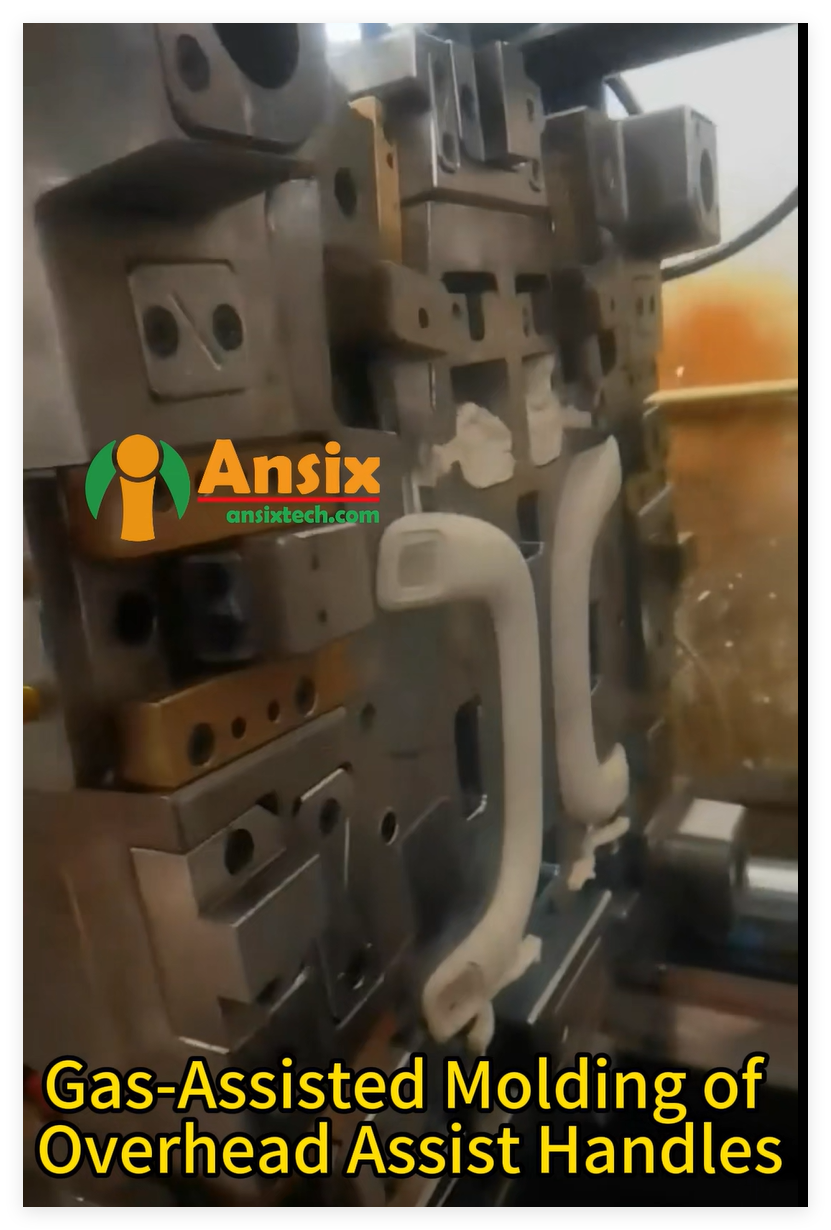
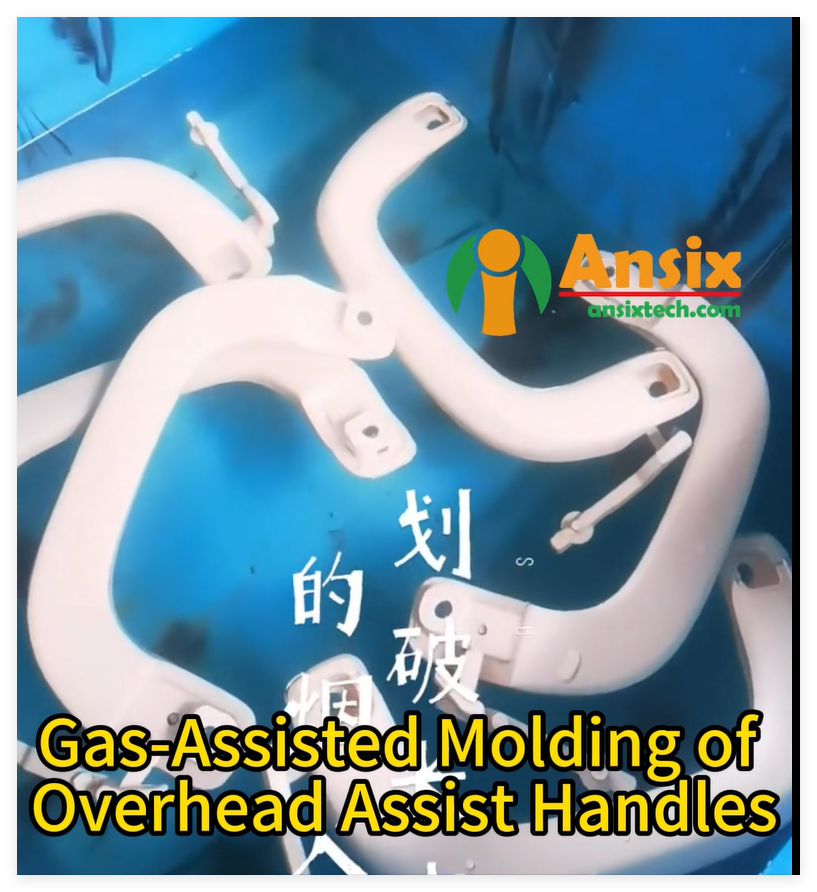
Gas-Assisted Molding of Overhead Assist Handles
Gas-Assisted Molding of Overhead Assist Handles

Headline: Beyond the Grab Handle: How Ansix Tech is Redefining Gas-Assisted Molding Economics for Automotive Interiors
In the complex ecosystem of automotive manufacturing, few components are as deceptively simple—and yet as technically challenging—as the overhead assist handle. It is a part that passengers interact with daily, demanding a solid, tactile feel, a flawless surface finish that matches the vehicle‘s premium interior, and the structural integrity to support significant weight during dynamic driving conditions. For decades, manufacturers have grappled with a fundamental trade-off: how to create a part that is both strong and lightweight, aesthetically perfect, and economical to produce at high volumes.
Gas-assisted injection molding (GAIM) emerged as the theoretical answer, offering a way to hollow out thick sections, reduce weight, and eliminate sink marks. However, the path from theory to a reliably manufactured, cost-effective part is fraught with complexity. This is the arena where Ansix Tech has staked its 28-year legacy. With the official initiation of its dedicated project for the Gas-Assisted Molding of Overhead Assist Handles, Ansix Tech is not merely offering a manufacturing service; it is delivering a comprehensive engineering solution that systematically dismantles the traditional cost and quality barriers of automotive interior production.
The Project Initiation: A Strategic Response to Market Demands
The launch of Ansix Tech‘s specialized overhead assist handle program is a direct response to the automotive industry’s pivot toward "lightweighting" and premium interior aesthetics without cost penalties. Traditional solid molding of handles results in longer cycle times, higher material consumption, and persistent quality issues like sink marks where thick ribs meet the class-A surface . Ansix Tech‘s project is built on the premise that the handle is not just a grab bar, but a system—one that must integrate seamlessly with airbag systems, coat hooks, and microphone assemblies.
By focusing exclusively on this niche, Ansix Tech moves beyond the role of a generic molder. The company positions itself as a strategic partner from the concept phase, understanding that the value delivered to a client is inversely proportional to the problems encountered during production. The initiation of this project signifies a commitment to mastering the specific rheology, gas dynamics, and mechanical requirements unique to overhead handles in vehicles ranging from compact cars to luxury SUVs.
Delivering Value Through Integrated Capabilities
Ansix Tech’s value proposition rests on a tripod of Design, Development, and Manufacturing. It is one thing to run a gas-assist press; it is another to engineer the part and the tool so that the process runs without interruption.
- Solving the Aesthetic-Structural Paradox
The primary problem with overhead handles is their geometry. They require a robust, ergonomic grip (often with a thick cross-section) and robust mounting points (bosses), but they must also present a pristine surface to the vehicle's interior. In conventional molding, the shrinking plastic at these thick junctures creates visible sink marks on the visible surface.
Ansix Tech solves this through precise gas channel integration. By injecting nitrogen into the molten plastic core, the gas creates internal voids that pack the plastic against the mold wall from the inside out . This eliminates sink marks without the need for excessive packing pressure or prolonged cooling. The result is a handle that feels solid and weighty to the user but is actually hollow and lightweight, offering the perfect tactile experience.
- Rigorous Quality Validation
In the automotive sector, validation is non-negotiable. Ansix Tech’s process begins long before the mold is mounted on the press. The company employs a multi-stage validation protocol:
Digital Validation: Before steel is cut, every design undergoes rigorous Mold Flow Analysis.
Process Window Validation: During trials, Ansix Tech maps the entire processing window to ensure that the part remains within specification despite normal variations in material viscosity or ambient humidity.
Dimensional and Mechanical Validation: Using CMM and functional testing, every batch of handles is validated against 3D CAD data to ensure fit, form, and function within the vehicle cabin.
The Science of Cost Reduction: Attacking "Hard Costs"
A key focal point of Ansix Tech‘s market strategy is the aggressive reduction of "hard costs"—the tangible expenses of resin, energy, and time that directly impact a client’s bottom line.
Material Optimization: By coring out the handle with gas, Ansix Tech typically reduces material usage by 20% to 30% compared to a solid part . In high-volume production, this saving in polypropylene (PP), polycarbonate (PC), or ABS compounds translates directly to millions of dollars saved annually.
Cycle Time Reduction: Plastic thickness dictates cooling time. By creating a hollow part with uniform wall thickness, the cooling phase of the molding cycle is drastically shortened. Gas-assist technology can reduce cycle times by 15-25%, effectively boosting production capacity without adding new machinery .
Scrap Reduction: Warpage and sink marks are primary drivers of scrap in handle molding. Through optimized gas packing, Ansix Tech produces parts with minimal internal stress, ensuring dimensional stability and a near-zero scrap rate once the process is dialed in .
Boosting Capacity and Guaranteeing Delivery
In the just-in-time world of automotive assembly, a missed delivery is a crisis. Ansix Tech‘s methods for boosting capacity and guaranteeing deadlines are rooted in process robustness.
The company utilizes advanced machine monitoring and real-time process parameter adjustment. By standardizing the Mold Design and processing guidelines across different handle platforms, Ansix Tech reduces changeover times and increases machine uptime. Furthermore, the predictable cooling inherent in their gas-assist mold designs allows for accurate cycle time forecasting, enabling precise scheduling of production runs that align with client assembly plant needs.
Material Science: The Foundation of Performance
The selection of raw materials for gas-assisted components is a critical engineering decision that impacts everything from gas penetration to final part strength. For overhead assist handles, Ansix Tech engineers typically work with a range of thermoplastic polymers, each selected for specific property sets .
Polypropylene (PP) with Talc Fillers: For cost-sensitive, high-volume applications, PP offers excellent chemical resistance and low density. However, its semi-crystalline nature requires careful control of Mold Temperature to achieve desired surface finishes. Ansix Tech often specifies impact-modified copolymers to ensure the handle does not fracture under cold-weather impact tests.
ABS (Acrylonitrile Butadiene Styrene): ABS is a workhorse for interior automotive applications, prized for its excellent surface finish, impact resistance, and dimensional stability. For gas assist, the material‘s melt strength is crucial; it must resist tearing as the gas bubble expands.
PC/ABS Blends: For premium vehicles where higher heat resistance and impact strength are required, polycarbonate blends are specified. These materials offer a superior Class-A surface but are more viscous, requiring higher injection pressures and more robust tooling .
Chemical Additives and Nucleation: The patent literature highlights the importance of specific filler compositions. Ansix Tech selects grades with optimized filler packages (like talc or glass fibers) that act as nucleation sites, promoting a uniform and controlled gas bubble formation .
The Digital Twin: Mold Flow Analysis and DFM
Before any metal is machined, Ansix Tech creates a digital twin of the entire molding process. Mold Flow Analysis (MFA) is not merely a box-checking exercise; it is the central tool for Design for Manufacturability (DFM) .
For overhead assist handles, the simulation answers critical questions:
Gas Channel Layout: Where should the gas channels be routed to maximize core-out without breaking through to the surface? The analysis predicts the "fingering" effect of the gas, ensuring it follows the designed pathways.
Gate Location: The gate must be positioned so that the melt flow is balanced and the gas can enter without disrupting the aesthetic surface . Ansix Tech’s analysis determines if a valve gate or a sub-gate is optimal for the specific handle geometry.
Weld Line Prediction: Handles often have complex shapes or holes for coat hooks. MFA predicts where melt fronts meet, allowing engineers to move these weld lines to low-stress areas or vent them to improve strength.
Cooling Efficiency: By simulating the cooling phase, Ansix Tech identifies hot spots that could lead to warpage, allowing for iterative adjustments to the cooling circuit design before the tool is built .
Mold Design: Engineering for Mass Production
The mold is the heart of the production system, and for gas-assist handles, it is a masterpiece of precision engineering. Ansix Tech’s mold designs address several critical challenges to ensure they meet the rigorous demands of mass production—often defined as cycles in the hundreds of thousands or millions.
- Gas Injection System Design
The design of the gas pins or nozzles is paramount. These components must seal against high melt pressure, open precisely to allow nitrogen injection, and then retract or seal without leaving a mark. Ansix Tech typically employs controlled pressure profiles, using systems capable of delivering nitrogen at pressures up to 350 bar or more, with multi-stage pressure control to optimize gas penetration and packing .
- Runner and Gating System
The runner system must deliver melt to the cavity with minimal pressure drop and shear. For multi-cavity tools, the runners must be geometrically balanced to ensure each cavity fills simultaneously. Ansix Tech utilizes either cold runners with optimized trapezoidal cross-sections or hot runner systems with thermal shut-off nozzles to precisely control the melt temperature entering the cavity .
- Cooling System Design
Efficient cooling is the key to short cycle times. Ansix Tech designs cooling circuits to maintain turbulent flow (Reynolds number above 4,000), maximizing heat transfer. For complex geometries like the grip area of a handle, conventional straight-line drilling may not suffice. In such cases, Ansix Tech employs conformal cooling, using additive manufacturing to create cooling channels that follow the exact contour of the part . This results in uniform cooling, reduced cycle times, and minimized thermal stress.
- Ejection System
Thin-walled, hollow parts can be delicate. The ejection system must be designed to push the part off the core without denting or distorting it. Ansix Tech utilizes a combination of ejector pins, sleeves, and sometimes air-assist ejection to ensure the part is released cleanly and consistently.
Mold Manufacturing: The Challenge of Precision
Building a gas-assist mold requires a manufacturing workflow that marries traditional machining with advanced techniques. Ansix Tech‘s 28 years of experience are evident in the selection of mold materials and machining strategies .
Mold Material Selection:
H13 and P20 Tool Steels: For high-volume production, these are the standards. H13 offers superior toughness and resistance to thermal fatigue, making it ideal for cores and cavities that see millions of cycles. P20 is often used for mold bases and support plates due to its good machinability and wear resistance .
Copper Alloys: For areas requiring rapid heat extraction—such as near the gas channel or the gate—Ansix Tech may integrate beryllium-free copper alloy inserts. These materials have thermal conductivity significantly higher than steel, acting as "heat sinks" to speed solidification .
Machining Workflow:
Rough Machining: The mold block is roughed out using high-speed CNC milling to remove bulk material.
Heat Treatment: The mold components are heat-treated to achieve the required core hardness (typically 48-52 HRC).
Finish Machining and EDM: Final contours are cut using precision CNC, while intricate details—such as the shut-offs for gas pins or textured surfaces—are often created using Electrical Discharge Machining (EDM) with custom-machined electrodes.
Bench Work and Polishing: The mold is fitted, and critical surfaces are polished to the specified SPI finish to ensure the plastic flows correctly and the part releases easily.
Optimizing the Injection Molding Process
With a world-class tool in the press, Ansix Tech turns to process optimization to drive efficiency and cost control. This is where the science of molding meets the art of problem-solving.
Gas Delay Time: The timing between the end of plastic injection and the start of gas injection is critical. Too short, and the gas may blow through the melt front; too long, and the skin is too thick, preventing effective coring.
Gas Pressure Profile: Ansix Tech utilizes multi-stage gas pressure profiles. A high initial pressure punches the gas into the channel, followed by a holding pressure to compensate for material shrinkage as the part cools .
Melt Temperature and Mold Temperature: These are fine-tuned to balance surface finish requirements with the rheological needs of the gas-assist process.
Quality Assurance and Packaging
Quality assurance at Ansix Tech is a closed-loop system. In-process sensors monitor cavity pressure and temperature, flagging any deviations in real-time. Post-production, sampling protocols ensure that the gas channel is fully formed and that the handle meets all pull-test requirements.
Packaging is also engineered to protect the part and facilitate assembly. Handles are often packaged in nested trays that prevent scuffing of the Class-A surface and allow for easy picking by robotic assembly systems at the client‘s facility.
Conclusion: The Ansix Tech Difference
With over 28 years of manufacturing experience, Ansix Tech brings a level of reliability and technical depth to gas-assisted molding that few can match. The overhead assist handle project is a testament to the company‘s philosophy: that the greatest value delivered to a client is a part that works perfectly, every time, at the lowest possible total cost.
By integrating material science, advanced simulation, precision tooling, and optimized processing, Ansix Tech doesn't just make handles; it engineers solutions. For automotive OEMs and tier-one suppliers looking to reduce hard costs while elevating interior quality, Ansix Tech stands as a partner capable of navigating the complex intersection of design, physics, and economics. In the world of gas-assisted molding, experience isn‘t just an asset—it’s the key to getting a grip on profitability.


Ansix Tech Co Ltd
If you have any plans related to Gas-Assisted Molding of Overhead Assist Handles , you can contact us at any time. We will turn your ideas into reality, let you realize your dreams, and obtain large orders from the market. Our contact information is info@ansixtech.com. Or contact our CTO, mail: stephen@ansixtech.com
#www.ansixtech.com #ansixtech.com #Gas-Assisted Molding of Overhead Assist Handles #Gas-Assisted Molding of Overhead Assist Handles#Gas-Assisted Molding of Overhead Assist Handles injection molding company #Gas-Assisted Molding of Overhead Assist Handles injection mold companies #Ansix #Ansix moulds #Ansix china #Ansix tech china #Ansix tech company #Ansix facotry #Ansix Tech #Ansix molds #Ansix injection molding #Ansix mold factory #injection molding Gas-Assisted Molding of Overhead Assist Handles #Ansix mold factory #Gas-Assisted Molding of Overhead Assist Handles china #Gas-Assisted Molding of Overhead Assist Handles molds #injection factory #Gas-Assisted Molding of Overhead Assist Handles injection molding #Gas-Assisted Molding of Overhead Assist Handles injection molding factory #injection molding company #Gas-Assisted Molding of Overhead Assist Handles injection mold companies #Gas-Assisted Molding of Overhead Assist Handles#Gas-Assisted Molding of Overhead Assist Handles mold limited #Ansix mold china #Ansix companies #Ansix company China #Gas-Assisted Molding of Overhead Assist Handles facotry #Ansix Tech #Ansix Tech mould #Gas-Assisted Molding of Overhead Assist Handles injection moulding #injection moulding company #Ansix Gas-Assisted Molding of Overhead Assist Handles parts injection mold companies #Gas-Assisted Molding of Overhead Assist Handles #Gas-Assisted Molding of Overhead Assist Handles china #Gas-Assisted Molding of Overhead Assist Handles china factory #Ansix moulding companies #Ansix molding company #Gas-Assisted Molding of Overhead Assist Handles injection moulding facotry #Ansix Tech mold #Gas-Assisted Molding of Overhead Assist Handles mould #Gas-Assisted Molding of Overhead Assist Handles plastic injection molding #ansix plastic mold #Mold manufacturing #Gas-Assisted Molding of Overhead Assist Handles parts manufacturing #Gas-Assisted Molding of Overhead Assist Handles plastic parts factory #Gas-Assisted Molding of Overhead Assist Handles injection parts mold #Gas-Assisted Molding of Overhead Assist Handles PRECISION MANUFACTURING #Gas-Assisted Molding of Overhead Assist Handles #China mold #Gas-Assisted Molding of Overhead Assist Handles injection moulding china #Gas-Assisted Molding of Overhead Assist Handles mould china #china precision mold #mold in china #Gas-Assisted Molding of Overhead Assist Handles mold china #Precision molds #High-precision molds #Gas-Assisted Molding of Overhead Assist Handles #Injection molds #Gas-Assisted Molding of Overhead Assist Handles Factory #Gas-Assisted Molding of Overhead Assist Handles Company #Super Large Injection Mold Factory #Large Tonnage Injection Molding Factory #Gas-Assisted Molding of Overhead Assist Handles Company #Gas-Assisted Molding of Overhead Assist Handles Factory #2800T Injection Molding Factory #3000 Ton Injection Molding #4500 Ton Injection Molding Factory #Large Mold Injection Molding #Large Plastic Mold Injection Molding Factory #Large Injection Mold Manufacturer #Plastic Mold Factory #Injection Mold #Plastic Mold