



High-Toughness Plastic Snakebone for Endoscopes
High-Toughness Plastic Snakebone for Endoscopes

Mastering the Maze: How Ansix Tech's High-Toughness Plastic "Snakebone" Components are Redefining Endoscope Manufacturing Economics
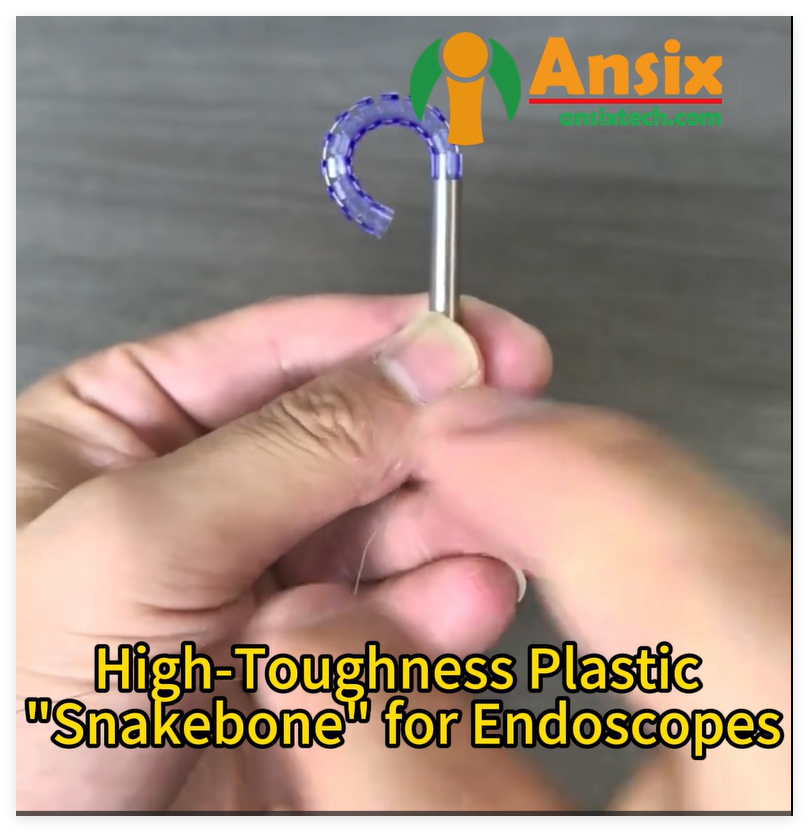
The modern medical endoscope is a marvel of miniaturization, a device that must be at once flexible enough to navigate the tortuous pathways of the human colon or upper gastrointestinal tract, yet rigid enough to transmit torque and maintain positional stability. At the heart of this mechanical duality lies a component so critical and so complex that it has become a benchmark for precision injection molding: the "snake bone."
This articulated structure, typically a series of interlinked vertebrae-like segments, provides the endoscope's distal tip with its angulation capabilities. For decades, these components were often the domain of precision machining or complex metal assemblies. However, the seismic shift toward high-performance, single-use disposable endoscopes has fundamentally altered the manufacturing landscape. To meet the dual demands of clinical efficacy and economic viability, OEMs are turning to advanced polymers and the specialized manufacturers who have mastered their processing.
At the forefront of this revolution is Ansix Tech, a company with over 28 years of injection molding heritage that has systematically de-risked and optimized the production of high-toughness plastic snake bone components. This article delves into the initiation of Ansix Tech’s dedicated snake bone project, exploring the comprehensive ecosystem—from material science and mold engineering to process optimization and quality assurance—that the company leverages to deliver unparalleled reliability and significant hard-cost savings to its clients.
The Genesis of a Specialized Project: Answering the Single-Use Mandate
The initiation of Ansix Tech’s focused project on high-toughness plastic snake bones was not a random expansion but a strategic response to a clear market inflection point. The global medical community, spurred by concerns over cross-contamination and the high costs of reprocessing reusable endoscopes, has increasingly embraced the disposable model. Industry projections indicate the single-use endoscope market is on a trajectory to more than double, presenting both a massive opportunity and a formidable challenge for manufacturers .
The challenge is stark: how do you produce a component that must meet the same, if not more stringent, mechanical and biocompatibility standards as its metal counterpart, but at a cost point that makes a single-use device commercially viable?
Ansix Tech recognized that the answer lay not in incremental improvement, but in a wholesale re-engineering of the production workflow. The company initiated its snake bone project with a clear mandate: to create a vertically integrated, co-engineering solution that would systematically eliminate waste, reduce cycle times, and guarantee quality from the first shot to the millionth. This initiative built upon the company's existing foundation of over 28 years of experience and a portfolio of more than 30,000 successful mold builds, positioning it not as a mere supplier, but as a strategic partner capable of navigating the complexities of Class II and Class III medical device manufacturing .
The Architectural Blueprint: Value Through Co-Engineering and DFM
Ansix Tech’s value proposition to its clients is rooted in a philosophy of "co-engineering." The process begins long before any steel is cut, with a deep collaborative dive into the client's design intent, functional requirements, and end-user needs. This upfront investment in engineering is where the company believes the majority of cost savings are realized.
Design for Manufacturability (DFM) is the cornerstone of this phase. For a snake bone component—which may feature living hinges, micro-features, and complex internal channels for Steering wires or optical fibers—DFM is not a luxury; it is a necessity. Ansix Tech’s engineers scrutinize every aspect of the 3D model, analyzing wall thickness uniformity to prevent sink marks, ensuring adequate draft angles for clean ejection, and simplifying or eliminating undercuts that would necessitate complex and costly side-action mechanisms in the mold . By consolidating multiple parts into a single, moldable geometry and designing in snap-fits to replace screws or secondary assembly steps, the company has consistently helped clients reduce assembly time by up to 40% and material costs by 5–18% .
Mold Flow Analysis (MFA) serves as the digital crystal ball, allowing the engineering team to peer into the future of the molding process. Using advanced simulation software like Moldflow or Moldex3D, Ansix Tech creates a virtual "computer-aided tryout" . This simulation predicts how the molten polymer will fill the complex snake bone cavity. It identifies potential defect zones with remarkable accuracy:
Weld Line Management: Predicting where flow fronts meet and repositioning gates to ensure these potential weak points are located in non-critical areas.
Air Trap Elimination: Pinpointing locations where trapped air could cause burn marks or short shots, allowing for optimized venting placement.
Warpage and Shrinkage Prediction: Modeling differential cooling and material shrinkage to ensure the final part maintains its critical geometry and precise articulation tolerances .
This digital validation process is a powerful risk mitigation tool. Ansix Tech reports that this simulation-driven approach allows them to identify and rectify design flaws before tooling begins, slashing development time by an average of 30% and virtually eliminating the need for costly and time-consuming mold rework . The result is a "first-time-right" mold design, with the company averaging only two mold trials before final approval—a testament to the accuracy of its upfront engineering .
The Foundation of Performance: Strategic Material Selection
The journey of a high-toughness snake bone is defined by its molecular makeup. The choice of polymer is a critical strategic decision that dictates the component's performance, its compatibility with sterilization methods, and, crucially, its contribution to the final unit cost. Ansix Tech’s material science team guides clients through this complex landscape, balancing technical requirements with economic realities.
For the snake bone itself, the material must exhibit exceptional fatigue resistance to endure repeated flexing, high tensile strength to transmit forces, and dimensional stability to maintain precise control. Several classes of engineering thermoplastics are commonly employed:
Thermoplastic Polyurethane (TPU) has emerged as a preferred choice for many disposable snake bone applications. Its appeal lies in its tunable hardness, allowing engineers to tailor the flexibility and kink resistance of the endoscope's bending section. Furthermore, TPU exhibits excellent chemical resistance to common sterilants like Ethylene Oxide (EtO) and can bond effectively with other materials used in overmolding processes, facilitating complex multi-material assemblies .
Polyether Ether Ketone (PEEK) represents the pinnacle of high-performance thermoplastics for medical devices. Its adoption in snake bone components is driven by its extraordinary properties: it maintains structural integrity across a vast temperature range (-100°C to 250°C), offers superb chemical resistance to bodily fluids and aggressive cleaning agents, and demonstrates remarkable fatigue life, capable of withstanding millions of articulation cycles . For applications requiring enhanced stiffness or radiopacity, Ansix Tech utilizes glass or carbon fiber-reinforced PEEK compounds, precisely tailoring the material properties to the device's specific needs .
Other engineering thermoplastics like Polyetherimide (PEI/Ultem) and Polyphenylsulfone (PPSU) are also employed for their high strength, rigidity, and resistance to repeated sterilization cycles, making them suitable for both reusable and high-performance disposable components .
The Ansix Tech Cost Advantage in Materials:
Ansix Tech’s value engineering extends to optimizing material costs without compromising performance. This involves:
Avoiding Over-Engineering: Critically assessing whether a premium material like PEEK is truly necessary or if a more cost-effective alternative with slightly different characteristics could perform equally well in the intended environment .
Strategic Use of "Wide-Spec" Resins: For certain applications, the company leverages its advanced process control systems to handle materials with slightly broader performance tolerances, which are often available at a lower cost. By using cavity pressure sensors and decoupled molding techniques, the process is actively controlled to compensate for material viscosity fluctuations, allowing clients to benefit from lower material costs while maintaining consistent part quality .
Exploring Hybrid Formulations: In some cases, blending virgin polymers with approved recycled content or mineral fillers can reduce material costs by 5–15% without negatively impacting the required performance characteristics .
The Heart of Precision: Advanced Mold Design and Manufacturing
If the material is the soul of the snake bone, the injection mold is its heart—the precision-engineered tool that gives it form and function. Ansix Tech’s mold design philosophy treats the tool not just as a cavity, but as a high-performance "pressure vessel and heat exchanger" that must be optimized for longevity, speed, and consistent output .
Mold Steel Selection and Heat Treatment
The choice of steel is a critical cost-versus-performance decision. For high-volume medical molds producing abrasive materials, Ansix Tech specifies premium, corrosion-resistant steels. 420 stainless steel and S136 ESR (Electro-Slag Remelted) stainless steel are frequently chosen for their ability to maintain a flawless, mirror-like polish (often to SPI A1 standards) over hundreds of thousands of cycles, and for their resistance to corrosive elements that may be present in the manufacturing environment . For applications requiring extreme toughness, such as molds with thin blades or intricate details, materials like H13 hot-work steel are standard . The company also employs advanced water-air alternate quenching heat treatments to enhance the toughness and structural integrity of the mold steel, significantly reducing the risk of cracking during production .
The Cooling Revolution: Conformal Cooling
In injection molding, time is money, and cooling typically accounts for a staggering 70-80% of the total cycle time . Any reduction in cooling time translates directly into increased production capacity and lower per-part cost. Ansix Tech has embraced conformal cooling as a key differentiator.
Unlike traditional straight-line cooling channels that are drilled through the mold, conformal channels are designed to follow the exact 3D contour of the snake bone cavity. These complex, curvilinear channels are often manufactured using metal 3D printing (additive manufacturing) . By wrapping the cooling circuit precisely around the part geometry, heat is extracted uniformly and rapidly. This not only slashes cooling times by an impressive 20-30% but also ensures uniform part cooling, which is critical for preventing warpage in long, slender snake bone components .
Optimized Runner, Gating, and Ejection Systems
The journey of the molten polymer into the mold cavity is meticulously controlled.
Hot Runner Systems: For multi-cavity snake bone molds, Ansix Tech frequently employs hot runner systems. These systems keep the plastic in a molten state within the manifold, eliminating the solid runner waste associated with cold runner molds. This is a significant cost saver, especially when using expensive medical-grade resins .
Gate Design: The gate—the entry point into the cavity—is optimized via Mold Flow Analysis to ensure balanced filling and to minimize vestige. For snake bones, tiny gate types like pin-point or submarine gates are often used to allow for automatic degating and to leave an imperceptible mark on the final component .
Ejection System: Ejecting a delicate, flexible snake bone without causing distortion or damage is a complex engineering challenge. Ansix Tech designs precision ejection systems with accurately positioned ejector pins, sleeves, or blades. Generous draft angles (typically 1-2 degrees) are incorporated to ensure low-force, reliable ejection in every cycle .
Masterful Mold Machining
Manufacturing these intricate molds requires machining capabilities at the edge of what is possible. Ansix Tech's toolroom is equipped to handle this challenge, utilizing 5-axis CNC machining for complex core and cavity geometries, Electrical Discharge Machining (EDM) for burning super-fine details and internal features, and slow wire EDM to achieve breathtaking tolerances of ±0.002mm on critical features like articulation joints and lens mounts .
Mastering the Process: Injection Molding and Systemic Optimization
With a world-class mold in hand, the focus shifts to the injection molding process itself. This is where Ansix Tech's commitment to Scientific Molding and data-driven optimization delivers tangible results in efficiency and cost control.
Overcoming Technical Challenges
Molding a snake bone presents a unique set of processing difficulties:
Thin-Wall Molding: The ultra-thin sections of the snake bone require high injection speeds and precise pressure control to fill completely without causing hesitation or short shots.
Maintaining Dimensional Stability: The high aspect ratio (length vs. thickness) of the component makes it inherently prone to warpage. This is counteracted by the uniform cooling of the conformal cooling system and precisely controlled packing pressures.
Biocompatibility Preservation: For medical-grade materials, strict control over processing temperatures and the use of dedicated, clean screw-and-barrel assemblies are essential to prevent material degradation and cross-contamination .
The Efficiency Engine: Process Optimization
Ansix Tech’s relentless focus on reducing "hard costs" for clients is realized through a multi-pronged process optimization strategy.
Cycle Time Reduction: Every second shaved off the production cycle is a direct saving. Using Design of Experiments (DOE), engineers identify the ideal combination of injection speed, packing pressure, and cooling time. A reduction in cooling time from, for example, 30 seconds to 25 seconds can boost overall output by 20%, dramatically lowering the unit cost .
Energy Efficiency: The company's production floors are increasingly populated with all-electric injection molding machines. These machines offer several advantages: they provide the precise control required for medical molding while consuming up to 60% less energy than traditional hydraulic machines, reducing both operational costs and the device's carbon footprint .
Scrap Elimination: In high-volume production, even a small percentage of scrap represents a significant financial loss. Ansix Tech’s use of in-mold cavity pressure sensors provides a "digital fingerprint" for every single shot . This real-time monitoring, combined with Statistical Process Control (SPC), allows the process to be locked into a stable, repeatable window. Any deviation is detected instantly, and corrective action can be taken before a single non-conforming part is produced. This rigorous approach has enabled the company to reduce defect rates from industry averages of 3% to as low as 0.5% , representing a massive reduction in waste and rework costs .
Uncompromising Quality and Accelerated Delivery
In the medical device industry, quality is not an attribute; it is a regulatory requirement. Ansix Tech’s quality management system is built on a foundation of international certifications, including ISO 13485 (Medical Devices) , IATF 16949, and ISO 14001 .
Quality assurance is not a final inspection gate but a pervasive culture woven into every step of the workflow:
First Article Inspection (FAI): Using Coordinate Measuring Machines (CMM), the first samples from a new mold are subjected to a comprehensive inspection to verify every dimension against the CAD model .
In-Process SPC: Critical dimensions are continuously monitored during production runs, with data plotted on control charts to detect any process drift before it results in out-of-spec parts .
Automated Optical Inspection: For high-volume runs, automated vision systems provide 100% inspection, instantly flagging any surface defects or gross dimensional errors .
Full Traceability: Every batch of medical-grade resin is tracked from receipt through to the finished, shipped product, ensuring a complete and auditable device history, a requirement for compliance with FDA regulations .
This quality-first approach is seamlessly integrated with the final steps of packaging and delivery. Parts are often handled and bagged in ISO Class 8 cleanroom environments to maintain purity . Furthermore, Ansix Tech employs lean manufacturing principles and Single-Minute Exchange of Die (SMED) techniques to minimize mold changeover times by up to 60%, boosting overall equipment effectiveness and ensuring the agility to meet clients' often-aggressive market launch windows .
Conclusion: A Partnership for the Future of Medical Innovation
The manufacturing of high-toughness plastic snake bone components for endoscopes stands as a testament to the power of integrated engineering. It is a process where material science, precision tooling, and data-driven process control must converge with absolute precision.
Ansix Tech has successfully positioned itself at the center of this convergence. By initiating a dedicated project focused on this critical component, the company has built a comprehensive ecosystem that delivers far more than molded plastic. It provides a strategic partnership that systematically reduces the total cost of ownership for medical device OEMs.
Through intelligent upfront engineering (DFM/MFA), strategic and cost-conscious material selection, revolutionary mold design (conformal cooling), and a fanatical commitment to process optimization and quality assurance, Ansix Tech delivers on its corporate mission: "Make Our Customers Successful." In doing so, they are not just manufacturing snake bones; they are enabling the next generation of minimally invasive surgical tools to reach the market faster, more reliably, and at a price point that makes advanced healthcare accessible to all. For innovators looking to navigate the complex maze of medical device manufacturing, Ansix Tech offers a proven guide and a reliable partner.


Ansix Tech Co Ltd
If you have any plans related to High-Toughness Plastic Snakebone for Endoscopes , you can contact us at any time. We will turn your ideas into reality, let you realize your dreams, and obtain large orders from the market. Our contact information is info@ansixtech.com. Or contact our CTO, mail: stephen@ansixtech.com
#www.ansixtech.com #ansixtech.com #High-Toughness Plastic Snakebone for Endoscopes #Plastic POM Snakebone for Bladder, Biliary, and Intestinal Endoscopes #High-Toughness Plastic Snakebone for Endoscopes injection molding company #High-Toughness Plastic Snakebone for Endoscopes injection mold companies #Ansix #Ansix moulds #Ansix china #Ansix tech china #Ansix tech company #Ansix facotry #Ansix Tech #Ansix molds #Ansix injection molding #Ansix mold factory #injection molding High-Toughness Plastic Snakebone for Endoscopes #Ansix mold factory #High-Toughness Plastic Snakebone for Endoscopes china #High-Toughness Plastic Snakebone for Endoscopes molds #injection factory #High-Toughness Plastic Snakebone for Endoscopes injection molding #High-Toughness Plastic Snakebone for Endoscopes injection molding factory #injection molding company #High-Toughness Plastic Snakebone for Endoscopes injection mold companies #Plastic POM Snakebone for Bladder, Biliary, and Intestinal Endoscopes #High-Toughness Plastic Snakebone for Endoscopes mold limited #Ansix mold china #Ansix companies #Ansix company China #High-Toughness Plastic Snakebone for Endoscopes facotry #Ansix Tech #Ansix Tech mould #High-Toughness Plastic Snakebone for Endoscopes injection moulding #injection moulding company #Ansix High-Toughness Plastic Snakebone for Endoscopes parts injection mold companies #High-Toughness Plastic Snakebone for Endoscopes #High-Toughness Plastic Snakebone for Endoscopes china #High-Toughness Plastic Snakebone for Endoscopes china factory #Ansix moulding companies #Ansix molding company #High-Toughness Plastic Snakebone for Endoscopes injection moulding facotry #Ansix Tech mold #High-Toughness Plastic Snakebone for Endoscopes mould #High-Toughness Plastic Snakebone for Endoscopes plastic injection molding #ansix plastic mold #Mold manufacturing #High-Toughness Plastic Snakebone for Endoscopes parts manufacturing #High-Toughness Plastic Snakebone for Endoscopes plastic parts factory #High-Toughness Plastic Snakebone for Endoscopes injection parts mold #High-Toughness Plastic Snakebone for Endoscopes PRECISION MANUFACTURING #High-Toughness Plastic Snakebone for Endoscopes #China mold #High-Toughness Plastic Snakebone for Endoscopes injection moulding china #High-Toughness Plastic Snakebone for Endoscopes mould china #china precision mold #mold in china #High-Toughness Plastic Snakebone for Endoscopes mold china #Precision molds #High-precision molds #High-Toughness Plastic Snakebone for Endoscopes #Injection molds #High-Toughness Plastic Snakebone for Endoscopes Factory #High-Toughness Plastic Snakebone for Endoscopes Company #Super Large Injection Mold Factory #Large Tonnage Injection Molding Factory #High-Toughness Plastic Snakebone for Endoscopes Company #High-Toughness Plastic Snakebone for Endoscopes Factory #2800T Injection Molding Factory #3000 Ton Injection Molding #4500 Ton Injection Molding Factory #Large Mold Injection Molding #Large Plastic Mold Injection Molding Factory #Large Injection Mold Manufacturer #Plastic Mold Factory #Injection Mold #Plastic Mold